

Prefabricated Construction Market Summary:
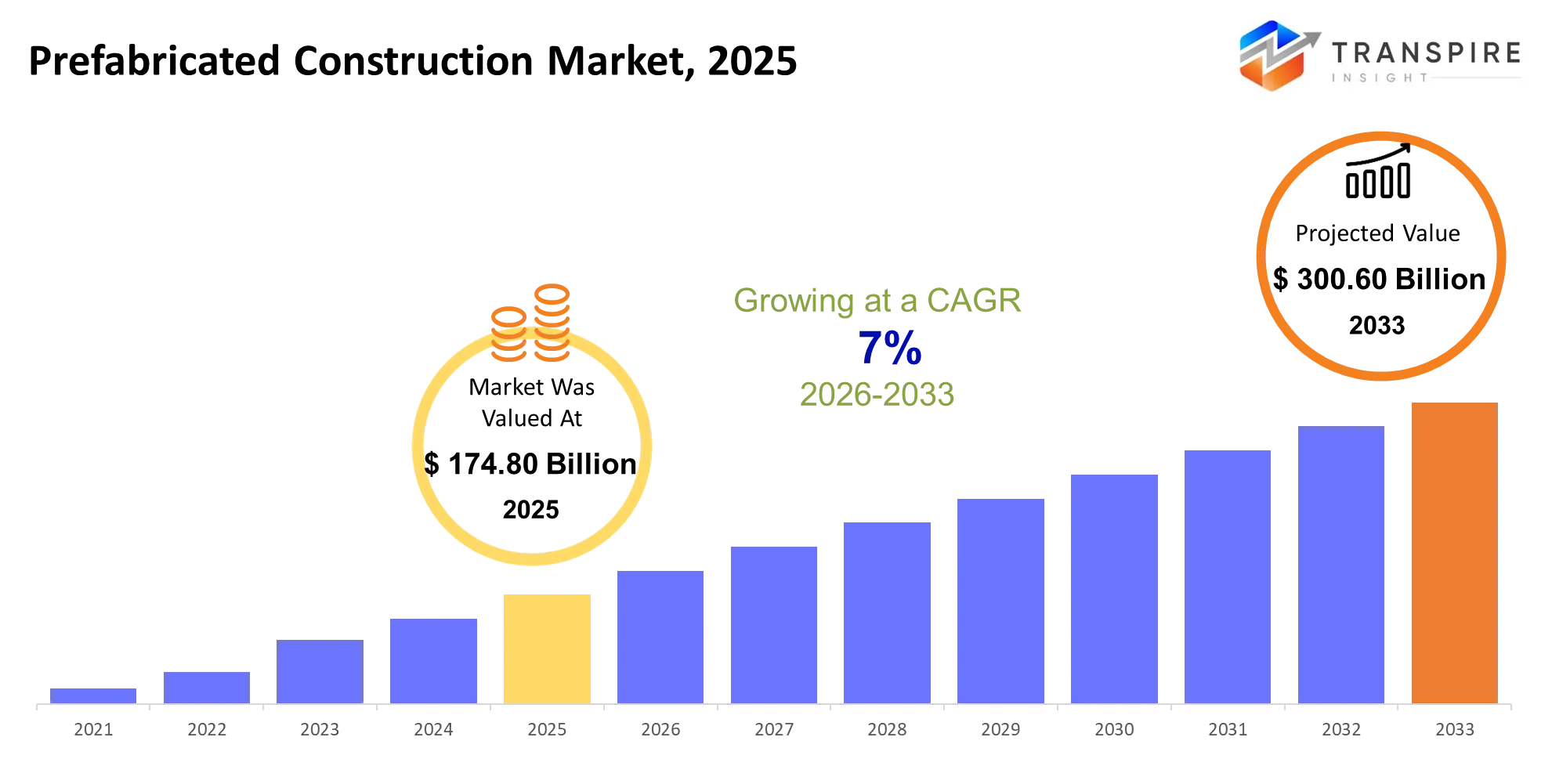
As per the Transpire Insight, The Prefabricated Construction Market size is estimated at USD 174.80 billion in 2025 and is anticipated to reach USD 300.60 billion by 2033, growing at a CAGR of 7% from 2026 to 2033.
Prefab construction shifts site activity to a controlled factory setting where modules, panels, and precast assemblies are fabricated, inspected, and then reassembled. Over the last three to five years, this practice has transitioned from a cost-driven gimmick to an accepted, cost-effective project delivery model that tackles constraints in housing, health care capacity, and infrastructure asset renewal. The trend represents a fundamental shift in value drivers enabled by the fusion of BIM, robotics, machine vision, and digital twins, which provides a "digital thread" directly to the factory floor and the construction site. One key driver: an ever-growing skilled labour shortage, along with unpredictable site schedules, has forced public agencies and developers to turn to off-site techniques to condense project timelines and slash rework. This movement has been following a sequence of events: reproducible digital designs that support factory volume; tighter factory controls that improve material quality and waste; on-site installation speeds that save in financing costs; and governments moving toward standard modular support through updated funding models and permitting.
Prefabricated Construction Market Size & Forecast:
- Market Size 2025: USD 174.80 Billion
- Expected Market Value (2033): USD 300.60 Billion
- Forecast CAGR (2026–2033): 7%
- Leading Region in 2025: North America
- Fastest Growing Region: Asia Pacific
- Key Company Profiles: Skanska, Bouygues Construction, Laing O'Rourke, Lendlease, Sekisui House, Daiwa House, Clayton Homes, Modular Space, Champion Homes, Katerra, Algeco, Fleetwood Australia, ATCO Structures, WillScot, McGrath RentCorp.
Key Prefabricated Construction Market Insights:
Prefabrication is transforming from the traditional project-centric approach to building into an industrial platform that combines design, factory capacity, logistics, and financing. Repeatable product platforms, digital integration, and reliable delivery networks are more important than ever to achieve competitive advantage, rather than individual module production.
- Modular construction makes up 47.4% of the market, and this is being developed based on standardised product platforms, instead of one-off bespoke projects.
- Multifamily housing, healthcare, data centres, and logistics demand are driving market growth in North America, which accounts for 33.2% of the market.
- Asia-Pacific accounts for 30.8% and will grow at an 8.65% CAGR due to industrialised housing policy and sizeable urban project pipelines.
- There is 21.4% in Europe, with Germany, the Nordics and the UK leading the way in timber systems, circular-construction rules and off-site public procurement.
- Latin America makes up 7.8%, and adoption is focused in the fields of industrial, logistics, and quickly deployed social infrastructure.
- In the Middle East & Africa region, there are 6.8% of projects and hospitality pipelines that need fast and scalable delivery, with Saudi Arabia's Vision 2030 projects of interest.
- Modern methods of construction in 2026 are expected to be dominated by prefabricated and modular methods, accounting for 90.84% of the market.
- Sekisui House and Daiwa House are competing by producing a range of housing platforms that are integrated into their factories, by their energy performance and by the repeatability of their residential product design.
- The multi-trade prefabrication, BIM-driven engineering, and integrated project delivery are how Laing O'Rourke, Bouygues, Skanska, and Lendlease stand out.
- WillScot, Algeco, ATCO and McGrath RentCorp are harnessing the demand for temporary space to generate recurring rental and fleet management income.
What are the Key Drivers, Restraints, and Opportunities in the Prefabricated Construction Market?
Driver:
Construction labour shortages, project delays, and rising site-management costs are encouraging developers to shift repetitive building activities into factories. The underlying trigger is the growing difficulty of coordinating skilled workers, materials and subcontractors across complex projects. Factory-based manufacturing enables parallel production and site preparation, improving schedule reliability and allowing contractors to handle more projects with existing resources. This supports adoption across housing, commercial buildings and infrastructure, while creating revenue opportunities for manufacturers supplying repeatable components and integrated building systems.
Restraint:
High initial investment in manufacturing facilities, specialised equipment, moulds and logistics remains a major barrier. These costs persist because prefabrication requires consistent production volumes, standardised designs and long-term capacity utilisation. Irregular project pipelines, transport constraints and local building-code differences can undermine factory economics, particularly for smaller contractors and geographically dispersed projects.
Opportunity:
Digital design integration, robotic production and policy-supported industrialisation could unlock wider adoption. The European Commission’s construction strategy highlights modular building, digital tools and standardisation as priorities, while identifying fragmented regulations as a scaling challenge. Investment in regional factories, reusable components and BIM-linked manufacturing could improve cost competitiveness. India’s precast investments also demonstrate how local production capacity can support large residential and infrastructure programmes.
Driver Impact Analysis – Prefabricated Construction Market
|
Driver |
Relative Impact on Growth (%) |
Geographic Relevance |
Impact Timeline |
Demand Strength |
Growth Mechanism |
Key Beneficiaries |
Major Constraint |
|
1. Accelerating Urbanization and Affordable Housing Demand |
25% |
Asia-Pacific, Middle East, Africa |
Medium-term (2–4 years) |
High |
Urban housing shortages accelerate factory-built residential deployment |
Modular housing manufacturers, developers, governments, homebuyers |
Land availability and housing affordability constraints |
|
2. Construction Labor Shortages and Productivity Optimization |
23% |
North America, Europe, Australia |
Short-term (≤2 years) |
High |
Factory automation reduces labor dependence and construction schedules |
Prefabrication contractors, automation vendors, project developers |
High factory investment and skilled workforce requirements |
|
3. Government Infrastructure Investment and Public Housing Programs |
20% |
Asia-Pacific, North America, Europe |
Medium-term (2–4 years) |
High |
Public procurement and infrastructure spending stimulate modular project pipelines |
Building manufacturers, EPC contractors, infrastructure developers |
Procurement delays and inconsistent policy implementation |
|
4. Sustainability Regulations and Low-Carbon Construction Adoption |
17% |
Europe, North America, Asia-Pacific |
Long-term (≥4 years) |
High |
Waste-efficient fabrication and low-carbon materials support environmental compliance |
Green building manufacturers, timber suppliers, sustainability consultants |
Green material premiums and certification complexity |
|
5. BIM Integration, AI, Robotics, and Digital Manufacturing |
15% |
Europe, North America, Asia-Pacific |
Long-term (≥4 years) |
Medium |
BIM-linked automation improves design accuracy and manufacturing efficiency |
BIM software providers, robotics vendors, modular manufacturers |
Digital integration costs and interoperability challenges |
|
Total |
100% |
— |
— |
— |
— |
— |
— |
What Has the Impact of Artificial Intelligence Been on the Prefabricated Construction Market?
The increasing use of AI is helping make the leap from digital design-to-production to digital-to-digital design-to-production more intelligent and flexible. When paired with BIM, generative design based on AI can weigh in on design alternatives, sizes, and materials before going into production, reducing clashes and waste. On the manufacturing side, computer vision increases accuracy in dimensional inspection, defect detection and quality tracking; predictive analytics can help predict equipment maintenance and production bottlenecks; and AI-assisted scheduling can improve coordination of manufacturing, logistics and installation by flagging sequencing conflicts, and adjusting resources accordingly. Digital twins can help derive operational benefits by tying together design and production data with real-time information coming from equipment and project data, by helping test scenarios, forecast production cycles, and intervene when plans or quality parameters go off-kilter, before final construction. A recent paper in the journal Automation in Construction identified BIM-integrated AI, optimisation for design and production, and digital twins as three of the most promising directions for prefabrication. But these systems might not always work seamlessly, with legacy equipment, disjointed BIM formats, lack of high-quality production data, and integration costs all presenting challenges to providing AI systems with dependable outputs; human validation of safety-critical engineering decisions and conformity with final construction plans will continue to be essential.
In October 2026, Procore Technologies expanded its collaboration with NVIDIA to introduce advanced, AI-driven digital twin capabilities utilizing NVIDIA Omniverse technology.
https://www.sciencedirect.com/science/article/abs/pii/S0926580525003905
Key Prefabricated Construction Market Trends:
Prefabrication is becoming less of an alternative approach to construction, and more of an industrial delivery route. The focus of competition will now be on manufacturing scale, digital coordination, sustainability, and repeatable project execution.
- Modular is moving from pilot projects to institutionalized housing systems, including disaster recovery, schools, healthcare, and apartments.
- BIM is gradually moving from design to the production instructions that control tolerancing, manufacturing, logistics, and assembly.
- Quality control can now be achieved during the manufacturing process, and robotics and machine vision technology are taking it beyond final-site inspection.
- Digital twins are now seamlessly integrating factory production, transport, and site readiness within a single operational perspective.
- The trend of delivering through a combination of volumetric modules, panels and precast elements is overtaking a single-method approach for complex projects.
- Configurable interiors on standardised platforms are becoming the preferred development approach, in a trade-off between factory repeatability and market-specific design.
- A paradigm has shifted from making material claims to controlling for waste, embodied carbon, and process emissions.
- Slowing Modular Housing: Code, permitting, and financing issues are starting to be addressed by public policy.
- Localised factories in the vicinity of demand corridors are minimising transport risks and enhancing delivery responsiveness.
Prefabricated Construction Market Segmentation
Construction Type:
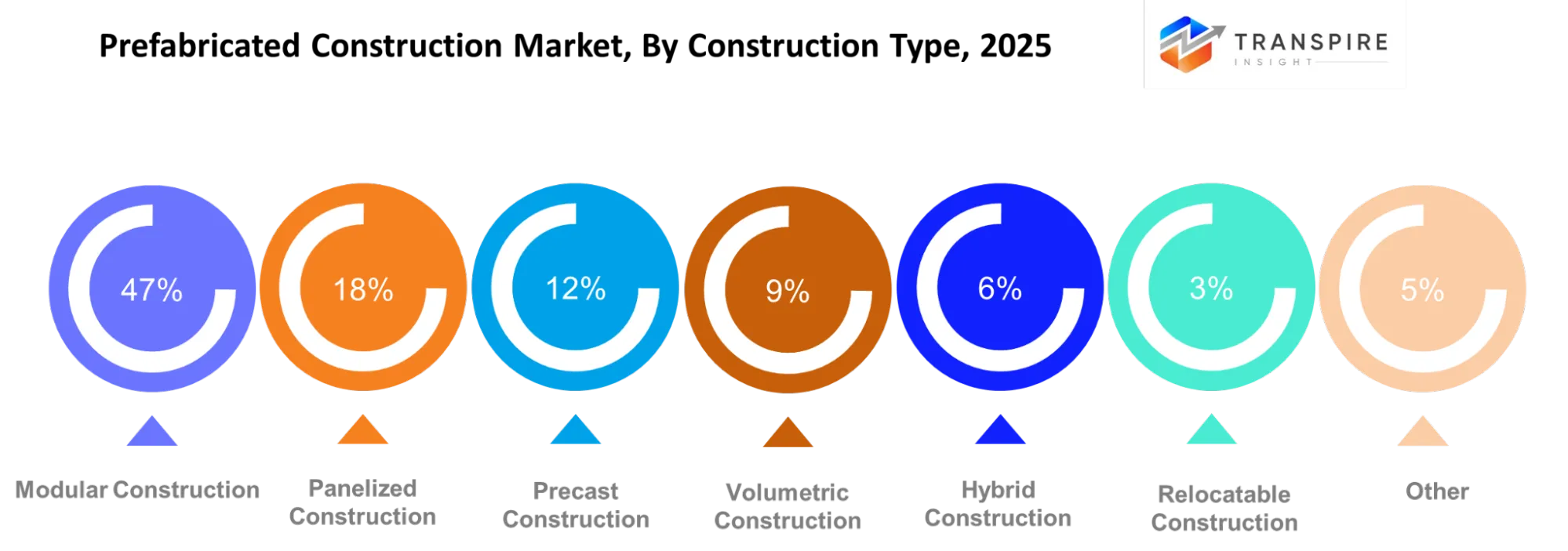
The growing preference for mass customization at reduced costs towards modular construction, which has a market share of 47.4% in the construction sector and a CAGR of 8.31%, suggests its use for repetitive projects in residential, healthcare, hospitality, and educational applications. Panelized construction has a market share of 18.0%. Precast construction has a market share of 12.5%. The market share for volumetric construction is 9.5%. Hybrid construction has a market share of 6.5%. Relocatable construction has a market share of 3.6%. Other formats have a market share of 2.5%. Modular and volumetric systems find advantages due to full factory finish & quick on-site installation; panelized & precast offer benefits in the presence of transport limitations, design variety, and a large amount of structural work.
Material:
Concrete remains essential for structural strength, fire resistance, and precast applications, particularly in residential buildings and infrastructure. Steel supports lightweight framing, long spans and industrial construction, enabling faster assembly and flexible architectural designs. Timber and wood panels attract developers seeking lower embodied carbon and sustainable building materials. Aluminum, composite materials and glass support lightweight façades, specialised architectural features and energy-efficient envelopes. Material selection increasingly reflects structural performance, transportation costs, durability, sustainability targets and compatibility with automated factory production.
Application:
Residential construction benefits from housing shortages, urbanisation and repeatable apartment designs, making modular systems attractive for affordable housing and multi-family developments. Commercial applications, including offices, retail outlets and hotels, prioritise faster fit-outs and reduced construction disruption. Industrial projects use prefabricated warehouses, manufacturing facilities and production buildings to accommodate operational requirements. Institutional applications across healthcare, education and infrastructure emphasise standardisation, safety, predictable delivery and rapid deployment, particularly where construction delays can affect essential services and project budgets.
Mobility:
Permanent prefabricated structures dominate long-term residential, commercial and institutional development because they provide durability and conventional building functionality. Relocatable and temporary structures address construction camps, emergency accommodation, workforce housing and short-term operational requirements. Transportable and demountable buildings offer flexibility where projects require movement between sites or changing layouts. Semi-permanent and expandable systems bridge temporary and permanent requirements, enabling phased capacity additions. Mobility considerations increasingly influence engineering design, connection systems, transportation planning, installation methods and lifecycle costs, particularly for remote industrial projects.
Building Type:
Single-family and multi-family housing support modular adoption through repeatable layouts, standardised components and predictable residential requirements. Multi-family developments particularly benefit from coordinated bathroom pods, prefabricated façades and structural modules. Offices, retail spaces and hotels favour factory-produced components that accelerate fit-outs and reduce disruption to commercial operations. Warehouses benefit from steel framing and scalable structural systems, while schools require rapid construction, repeatable designs and functional layouts. Building-specific engineering, occupancy requirements and installation complexity ultimately determine the suitability of prefabricated solutions across different property categories.
What are the Key Use Cases Driving the Prefabricated Construction Market?
The core use case is permanent volumetric modular housing, aligned with the segment’s 47.4% share and 8.31% CAGR. Developers use factory-built apartment modules to compress schedules, stabilise labour requirements, and deliver multi-family projects with more predictable quality and cost.
Expansion is occurring in healthcare, education, hotels, warehouses, and commercial fit-outs, where standardized room modules, bathroom pods, and precast structural elements reduce on-site trade coordination. These applications benefit from repeatable layouts and the ability to manufacture critical interiors while site foundations and infrastructure are completed.
Emerging use cases include disaster-resilient and rapid-deployment buildings, retrofit modules for façade and service upgrades, and AI-monitored modular factories supporting mass-customised housing. Digital-twin-enabled production and transportable modular systems are also extending prefab into infrastructure, remote worksites, and adaptive-reuse projects.
|
Report Metrics |
Details |
|
Market size value in 2025 |
USD 174.80 Billion |
|
Market size value in 2026 |
USD 186.90 Billion |
|
Revenue forecast in 2033 |
USD 300.60 Billion |
|
Growth rate |
CAGR of 7% from 2026 to 2033 |
|
Base year |
2025 |
|
Historical data |
2021 - 2024 |
|
Forecast period |
2026 - 2033 |
|
Report coverage |
Revenue forecast, competitive landscape, growth factors, and trends |
|
Regional scope |
United States; Canada; Mexico; United Kingdom; Germany; France; Italy; Spain; Denmark; Sweden; Norway; China; Japan; India; Australia; South Korea; Thailand; Brazil; Argentina; South Africa; Saudi Arabia; United Arab Emirates |
|
Key companies profiled |
Skanska, Bouygues Construction, Laing O'Rourke, Lendlease, Sekisui House, Daiwa House, Clayton Homes, Modular Space, Champion Homes, Katerra, Algeco, Fleetwood Australia, ATCO Structures, WillScot, McGrath RentCorp. |
|
Customization scope |
Free report customization (country, regional & segment scope). Available customized purchase options to meet your exact research needs. |
|
Report Segmentation |
Construction Type (Modular Construction, Panelized Construction, Volumetric Construction, Precast Construction, Hybrid Construction, Permanent Structures, Relocatable Structures); Material (Concrete, Steel, Timber, Aluminium, Wood Panels, Composite Materials, Glass); Application (Residential, Commercial, Industrial, Institutional, Healthcare, Education, Infrastructure); Mobility (Permanent, Relocatable, Temporary, Semi-Permanent, Expandable, Transportable, Demountable); Building Type (Single-Family, Multi-Family, Offices, Retail, Hotels, Warehouses, Schools) |
Which Regions are Driving the Prefabricated Construction Market Growth?
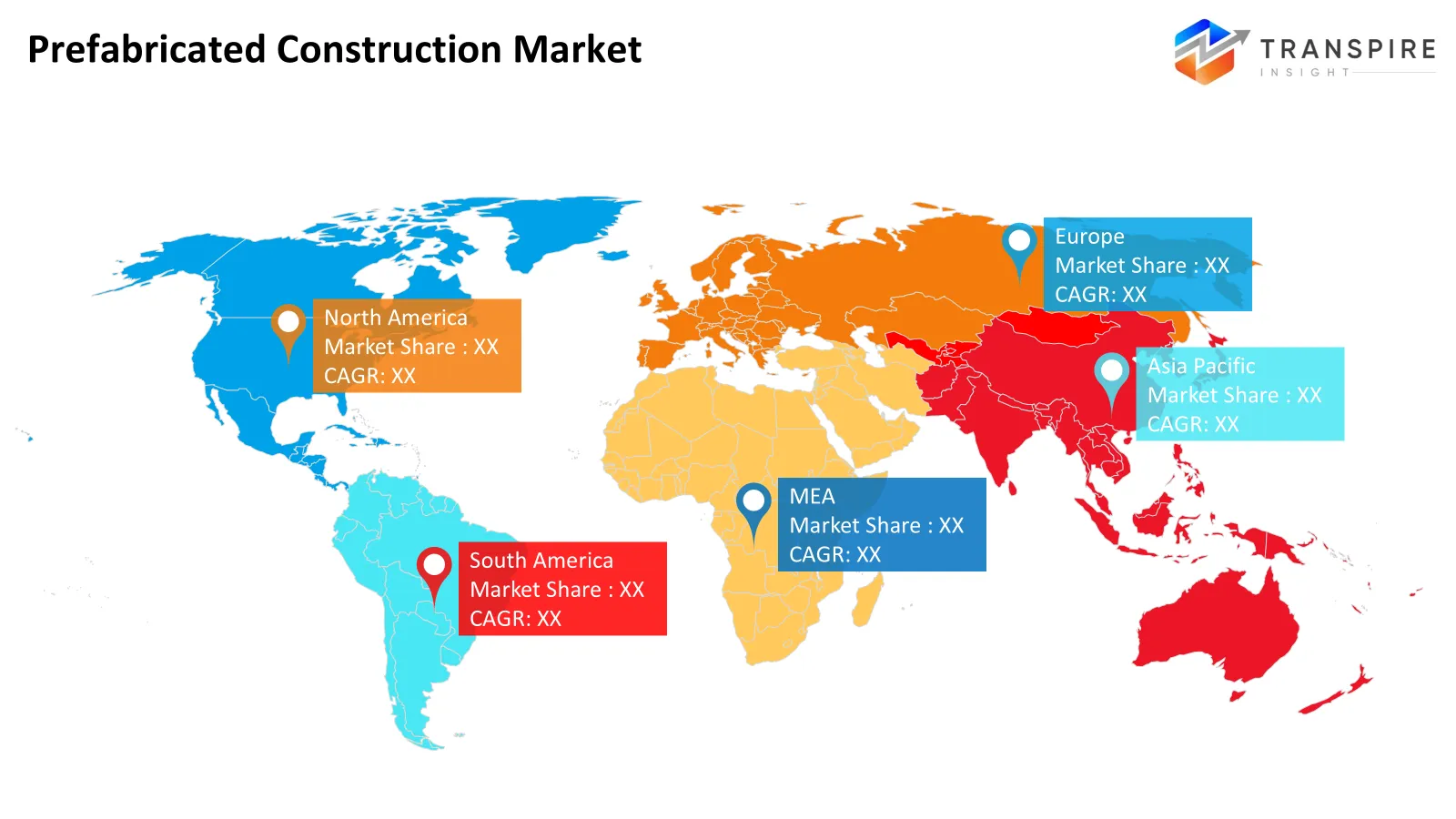
North America dominates the market at 33.2%. This leadership is supported by a mature factory-built housing infrastructure, high demand from multifamily residential, healthcare, data centres, and logistics facilities, and the growing adoption of modular units as permanent real property. North America's advantage lies in its mature component manufacturers, engineered-wood and precast supply chains, and the productivity constraints from skilled trades shortages. Furthermore, zoning reform in the United States and the Regional Homebuilding Innovation Initiative in Canada are driving the commercial viability of modular delivery.
In July 2026, ZS2 Technologies secured a repayable funding investment of over $2.7 million through the Canadian government's Regional Homebuilding Innovation Initiative (RHII). This funding allows the company to scale up its advanced, disaster-resilient Structural Insulated Panel (SIP) manufacturing to accelerate the production and commercial viability of off-site modular housing.
Europe, at 21.4%, is more regulation- and sustainability-focused than North America. Germany, the Nordic countries, the Netherlands, and the United Kingdom are developing energy-performance standards, whole-life carbon disclosure, and public procurement standards that favour low-carbon factory-formed systems. Europe's strength stems from mature codes and standards, long experience in engineered timber, full logistics corridors, and its continuing public housing upgrade programs.
In January 2026, the Built4People Partnership launched the STAR*track initiative. This three-year project, funded under Europe's Horizon Europe framework, directly supports the growth of dedicated sustainable construction and renovation innovation clusters across European member states.
With a compound annual growth rate of 8.65% representing a 30.8% share, the Asia-Pacific region is the fastest-growing region. Increased momentum in this region follows several events: China's aggressive factory-built construction mandates, Japan's mature prefab home market, Singapore's commitment to skyscraper pre-fab technology, and massive urban home and infrastructure pipelines in India. The next value proposition here is to match decentralized factory footprints with standardized modular housing systems to minimize shipping while feeding dense high-volume housing hubs.
In October 2026, ChinaMarket launched an integrated sourcing and delivery digital infrastructure network at the Fourth Linyi Mall International Buyers Conference. This action connects real estate developers with modular and prefabricated building manufacturers to engineer cross-border procurement pipelines for hospitality, tourism, and dense residential projects.
Who are the Key Players in the Prefabricated Construction Market, and how do they compete?
Competition in construction is increasingly divided between integrated construction groups delivering engineering-based project execution and product companies delivering repeatable, factory-built assets. Scale is relevant, but the relevant capability is the ability to combine design standardization, factory throughput, transport and site assembly without cost or risk transfer to the customer.
Skanska, Bouygues Construction, Laing O'Rourke, and Lendlease implement innovation-led strategies by embedding Building Information Modelling, multi-trade prefabrication, and design-for-manufacture into large infrastructure, healthcare, and commercial program wins. Their competitive positioning is through engineering control and early design involvement, while growth occurs through regional factories, joint ventures, and public-private partnerships. Sekisui House, Daiwa House, Clayton Homes, and Champion Homes compete through product-platform and cost strategies. They maintain an advantage through repeatable housing designs, energy-efficient building envelopes, and vertical integration, while scaling through factory capacity, dealer distribution, and financing partnerships. Will Scot, Algeco, ATCO Structures, Modular Space, Fleetwood Australia, and McGrath Rent Corp execute a niche rental strategy. They leverage fleet availability, fast deployment, and lifecycle service while growing through fleet expansion, acquisitions, and recurring-revenue contracts.
Key Players are:
- Skanska
- Bouygues Construction
- Laing O'Rourke
- Lendlease
- Sekisui House
- Daiwa House
- Clayton Homes
- Modular Space
- Champion Homes
- Katerra
- Algeco
- Fleetwood Australia
- ATCO Structures
- WillScot
- McGrath RentCorp
Prefabricated Construction Market — Enhanced Competitive Benchmarking
|
Company |
Est. Revenue Share Range |
Key Offerings |
Strategic Positioning |
Geographic Strength |
Technology Focus |
|
Skanska AB |
Estimated 3.5–5.0% |
Modular buildings, off-site construction, commercial and residential projects |
Integrated construction delivery with sustainability-led differentiation |
Europe, North America |
BIM-enabled construction, modular design, low-carbon materials |
|
Bouygues Construction |
Estimated 2.5–4.0% |
Modular housing, commercial buildings, industrialised construction, turnkey infrastructure |
Large-scale project integration with industrialised construction capabilities |
Europe, Middle East |
BIM, digital construction, prefabrication, sustainable building systems |
|
Lendlease Group |
Estimated 2.0–3.5% |
Modular buildings, residential construction, commercial developments, off-site solutions |
Integrated development and construction with project-led modular adoption |
Australia, Asia Pacific |
DfMA, digital engineering, modular project delivery |
|
Daiwa House Industry Co., Ltd. |
Estimated 2.0–3.5% |
Prefabricated steel-frame housing, modular commercial buildings, industrialised residential systems |
Industrialised construction leadership through vertically integrated manufacturing |
Japan, Asia Pacific, North America |
Factory automation, BIM, AI-assisted housing design, energy-efficient construction |
|
Sekisui House, Ltd. |
Estimated 1.5–3.0% |
Prefabricated residential homes, industrialised housing systems, modular building components |
Premium residential positioning through factory-controlled quality |
Japan, North America, Australia |
Automated manufacturing, precision component production, energy-efficient housing |
|
Laing O’Rourke |
Estimated 1.0–2.5% |
Modular buildings, structural systems, off-site construction, commercial project solutions |
DfMA-driven engineering specialisation and complex project execution |
Europe, Middle East, Australia |
DfMA, digital engineering, advanced off-site manufacturing |
|
Clayton Homes |
Estimated 1.0–2.5% |
Manufactured homes, modular homes, CrossMod homes, residential building solutions |
Affordable housing leadership through high-volume manufacturing |
North America |
Factory-built housing, standardised production, residential design customisation |
|
Skyline Champion Corporation |
Estimated 0.5–1.5% |
Manufactured homes, modular homes, residential building systems, factory-built housing |
Residential scale and affordability through manufacturing specialisation |
North America |
Automated manufacturing, modular home design, production standardisation |
|
Algeco / Modulaire Group |
Estimated 0.5–1.5% |
Modular buildings, temporary accommodation, education and healthcare facilities, workspace solutions |
Flexible modular infrastructure through rental and service-based delivery |
Europe, North America |
Reusable modular systems, relocatable buildings, lifecycle asset management |
|
Red Sea International Company |
Estimated 0.3–1.0% |
Modular buildings, workforce accommodation, hospitality facilities, turnkey building solutions |
Regional turnkey specialisation in remote and infrastructure-intensive projects |
Middle East, Africa |
Integrated modular manufacturing, rapid deployment, prefabricated steel systems |
Recent Development News
- In November 2026, Elematic Group and Vakio Jindal Build announced a strategic partnership to accelerate industrialized construction in India through advanced precast concrete technology, prefabrication, and automated production processes. The collaboration is expected to strengthen manufacturing efficiency, construction scalability, and the adoption of standardized building solutions across residential and infrastructure projects. https://www.constructionworld.in/latest-construction-technology/elematic--vakio-jindal-build-partner-to-boost-precast-construction/99819
- In January 2026, Modulex Modular Buildings Plc completed the acquisition of a majority stake in Merit Industrial Construction Limited, integrating advanced modular engineering, digital design, and manufacturing capabilities to strengthen its international modular construction operations and improve scalable building delivery. https://www.londonstockexchange.com/en/news/article/modulex-acquires-majority-stake-in-merit/17429273
- In June 2026, Holcim completed the acquisition of Xella, adding Ytong and Hebel autoclaved aerated concrete (AAC) modular systems, Silka calcium-silicate elements, and Multipor insulation to its permanent building portfolio. This integration scales up their eco-efficient, lightweight material offerings to address stringent carbon reduction regulations in high-volume institutional and residential sectors. https://finance.yahoo.com/
What Strategic Insights Define the Future of the Prefabricated Construction Market?
The industry is moving toward platform-enabled industrialisation, including common modules, configurable interiors and digital factories to enable repeatable residential, healthcare and industrial projects. The greatest danger of this shift is excess capital and capacity expansion – firms that expand factory capacity ahead of securing project pipelines will face underutilization, negative cash flow and balance sheet stress. An emerging opportunity is the mass customisation of AI-enabled digital fabrication, using generative design and machine vision to enable builders to deliver varied building configurations at the economies of standardised manufacturing. For strategic players, the new criteria to win will focus on demand-backed capacity expansion; interoperable BIM-to-factory digital streams; and partnerships with public housing and infrastructure buyers. Instead of simply growing capacity, companies should serve demand, minimise constraints, improve operating flexibility, and balance capital costs. Tomorrow's winners will balance innovation with measured capital deployment, build scalable factories, and deliver on their client commitments.
Key segmentations are:
Construction Type
- Modular Construction
- Panelized Construction
- Volumetric Construction
- Precast Construction
- Hybrid Construction
- Permanent Structures
- Relocatable Structures
Material
- Concrete
- Steel
- Timber
- Aluminum
- Wood Panels
- Composite Materials
- Glass
Application
- Residential
- Commercial
- Industrial
- Institutional
- Healthcare
- Education
- Infrastructure
Mobility
- Permanent
- Relocatable
- Temporary
- Semi-Permanent
- Expandable
- Transportable
- Demountable
Building Type
- Single-Family
- Multi-Family
- Offices
- Retail
- Hotels
- Warehouses
- Schools
By Regional Analysis
North America
- US
- Canada
- Mexico
Europe
- Germany
- UK
- France
- Italy
- Spain
- Russia
- Rest of Europe
Asia Pacific
- China
- Japan
- India
- South Korea
- Australia
- Rest of Asia Pacific
South America
- Brazil
- Argentina
- Rest of South America
Middle East & Africa
- UAE
- Saudi Arabia
- Qatar
- South Africa
- Rest of the Middle East & Africa
Frequently Asked Questions
Find quick answers to common questions.
The prefabricated construction market size was valued at USD 174.80 billion in 2025 and is poised to reach USD 300.60 billion by 2033, expanding at a 7% CAGR.
Key segments for the prefabricated construction market are Construction Type (Modular Construction, Panelized Construction, Volumetric Construction, Precast Construction, Hybrid Construction, Permanent Structures, Relocatable Structures); Material (Concrete, Steel, Timber, Aluminum, Wood Panels, Composite Materials, Glass); Application (Residential, Commercial, Industrial, Institutional, Healthcare, Education, Infrastructure); Mobility (Permanent, Relocatable, Temporary, Semi-Permanent, Expandable, Transportable, Demountable); Building Type (Single-Family, Multi-Family, Offices, Retail, Hotels, Warehouses, Schools).
Growth is primarily driven by labour shortages, housing affordability pressures, shorter construction timelines, rising demand for modular housing, factory automation, sustainability initiatives, reduced material waste, and increasing investment in industrialised construction methods.
The prefabricated construction market is led by major manufacturers including Skanska, Bouygues Construction, Laing O'Rourke, Lendlease, Sekisui House, Daiwa House, Clayton Homes, Modular Space, Champion Homes, Katerra, Algeco, Fleetwood Australia, ATCO Structures, WillScot, McGrath RentCorp.
North America holds 33.2% of the market, supported by established manufactured-housing networks, skilled manufacturing capabilities, labour shortages, housing affordability pressures, supportive building-code developments, and demand for faster residential and commercial construction.
Opportunities include AI-enabled factory automation, modular affordable housing, prefabricated healthcare and data-centre facilities, sustainable timber systems, regional manufacturing investments and BIM-integrated construction solutions.
- Skanska
- Bouygues Construction
- Laing O'Rourke
- Lendlease
- Sekisui House
- Daiwa House
- Clayton Homes
- Modular Space
- Champion Homes
- Katerra
- Algeco
- Fleetwood Australia
- ATCO Structures
- WillScot
- McGrath RentCorp
About the Authors

Kartik bhong
I am Kartik Bhong, a Senior Research Analyst at Transpire Insight, specializing in the Packaging, Manufacturing, and Construction industry. My work focuses on analyzing market trends, emerging technologies, industry regulations, and competitive landscapes to deliver accurate, data-driven insights. I am passionate about transforming complex industry information into clear, practical content that helps businesses, professionals, and decision-makers stay informed and make confident strategic decisions. Through continuous research and a strong commitment to accuracy, I strive to create reliable, well-researched content that reflects the latest developments across these dynamic industries and supports the vision of Transpire Insight in delivering valuable market intelligence.

Chakradhar Khansole
Chakradhar serves as the Research Director at Transpire Insight, bringing over 8 years of experience in technology, innovation, and strategic market intelligence. He specializes in transforming complex market data into actionable business insights that enable organizations to make informed, growth-oriented decisions. Recognized for his strategic vision and analytical expertise, Chakradhar leads high-impact research initiatives, delivering comprehensive market assessments, competitive intelligence, and forward-looking industry analysis.
Recently Published Reports
-
Apr 2026
Handling and Lifting Equipment Market
Handling and Lifting Equipment Market Size, Share & Analysis Report By Product (Cranes and Hoists, Forklifts, Conveyor Systems, Aerial Work Platforms, Others), By Application (E-Commerce, Automotive and Railway, Food and Beverages, Aviation, Others), and Geography (North America, Europe, Asia-Pacific, Middle East and Africa, South and Central America), 2021 - 2031
-
Nov 2026
HVAC Equipment Market
HVAC Equipment Market Size, Share & Analysis Report By Heating Equipment Type (Boilers and Furnaces, Heat Pumps, and Unitary Heaters), By Ventilation Equipment (Air Handling Units, Humidifiers and Dehumidifiers, Air Filters, and Fan Coiling Units), By Air Conditioning Equipment (Unitary Air Conditioners, Room Air Conditioners, Packaged Terminal Air Conditioners, and Chillers), By End User (Commercial, Residential, Industrial, and others), and Geography (North America, Europe, Asia-Pacific, Middle East and Africa, South and Central America), 2021 – 2031
-
Apr 2026
Refrigeration Valves Market
Refrigeration Valves Market Size, Share & Analysis Report By Type (Solenoid Valves, Expansion Valves, Check Valves, Service Valves, Others), By Application (Commercial Refrigeration, Industrial Refrigeration, Transport Refrigeration, Residential Refrigeration, Air Conditioning Systems), By End User (Food and Beverage Industry, Pharmaceutical Industry, HVAC Industry, Chemical Industry, Others), and Geography (North America, Europe, Asia-Pacific, Middle East and Africa, South and Central America), 2021 – 2031
-
Apr 2026
E-Commerce Packaging Materials Market
E-Commerce Packaging Materials Market By Material Type (Corrugated Boxes, Paper & Paperboard, Foam & Cushioning Materials, Plastic Packaging, Flexible Packaging, Protective Packaging, Others), By Product(Primary Packaging, Secondary Packaging, Tertiary Packaging), By Packaging Function (Protective Packaging, Branding & Presentation Packaging, Transit & Logistic Packaging, Sustainable Packaging, Tamper Evidence Packaging), By End-User (Retail & Consumer Goods, Electronic Appliances, Food & Beverages, Healthcare & Pharmaceutical, Fashion & Apparel, Home & Furnishing, Others); By Industry Analysis, Size, Share, Growth, Trends, and Forecasts 2021-2033