

Potting Compound Market Summary:
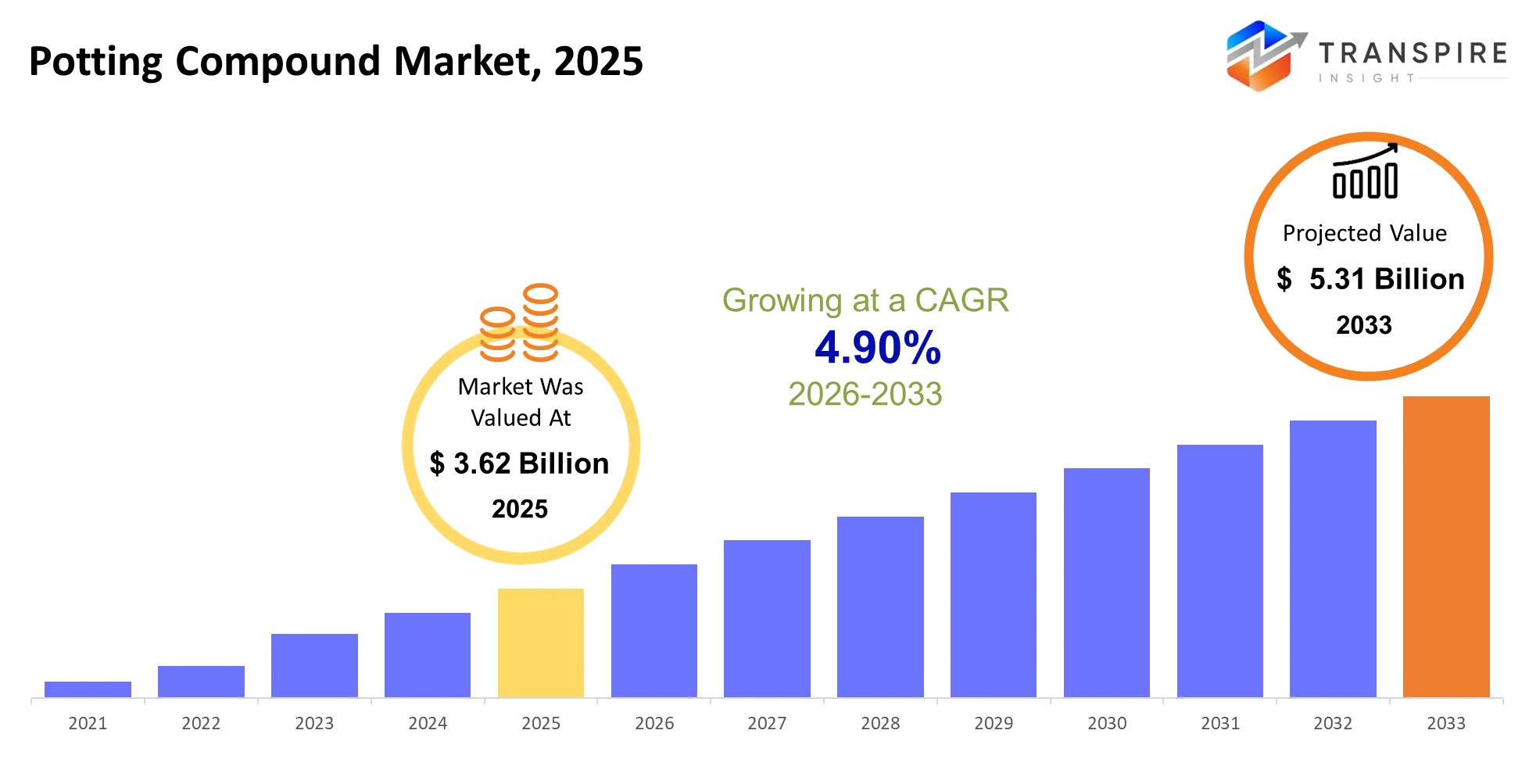
As per the Transpire Insight Analysis, The Potting Compound Market size is estimated at USD 3.62 billion in 2025 and is anticipated to reach USD 5.31 billion by 2033, growing at a CAGR of 4.90% from 2026 to 2033.
The market for potting compounds offers resin systems that encapsulate and protect electronics, sensors, power modules, connectors, and electrical assemblies against moisture, vibration, dust, thermal cycling, and electrical failure. In the past three to five years, the industry has experienced an evolution from meeting basic insulation needs of standard epoxies to a more robust set of requirements for thermally conductive, low-stress, fast-curing materials that offer structural support for small power-electronic assemblies. This structural shift can be linked in large measure to the ongoing emergence of higher-voltage devices in vehicles, energy, and industrial applications that generate more heat, along with the need for durable dielectric protection in extremely tight spaces. But a major real-world push has come from the rapid rollout of electric vehicle battery-management systems, onboard chargers, traction inverters, and DC fast chargers for charging electric vehicles, which generate more heat and vibrate in real-world use and for which compact, high-volume parts require thermal heat-sinking with rugged, roadworthy electrical isolation.
Potting Compound Market Size & Forecast:
- Market Size 2025: USD 3.62 Billion
- Expected Market Value (2033): USD 5.31 Billion
- Forecast CAGR (2026-2033): 4.90%
- Leading Region in 2025: Asia-Pacific
- Fastest Growing Region: Middle East & Africa
- Key Company Profiles: Henkel, Dow, 3M, Huntsman, H.B. Fuller, Momentive, Shin-Etsu Chemical, Wacker Chemie, Electrolube, Master Bond, MG Chemicals, LORD Corporation, ELANTAS, Dymax, ITW.
Key Potting Compound Market Insights:
The market is shifting from the basic "standard" encapsulation to "performance" based protection, with thermal conductivity, low stress, and automation being the criteria for material selection. The importance of specialised formulations is growing, especially when it comes to EV electronics, compact devices, and chemical rules that are becoming tougher.
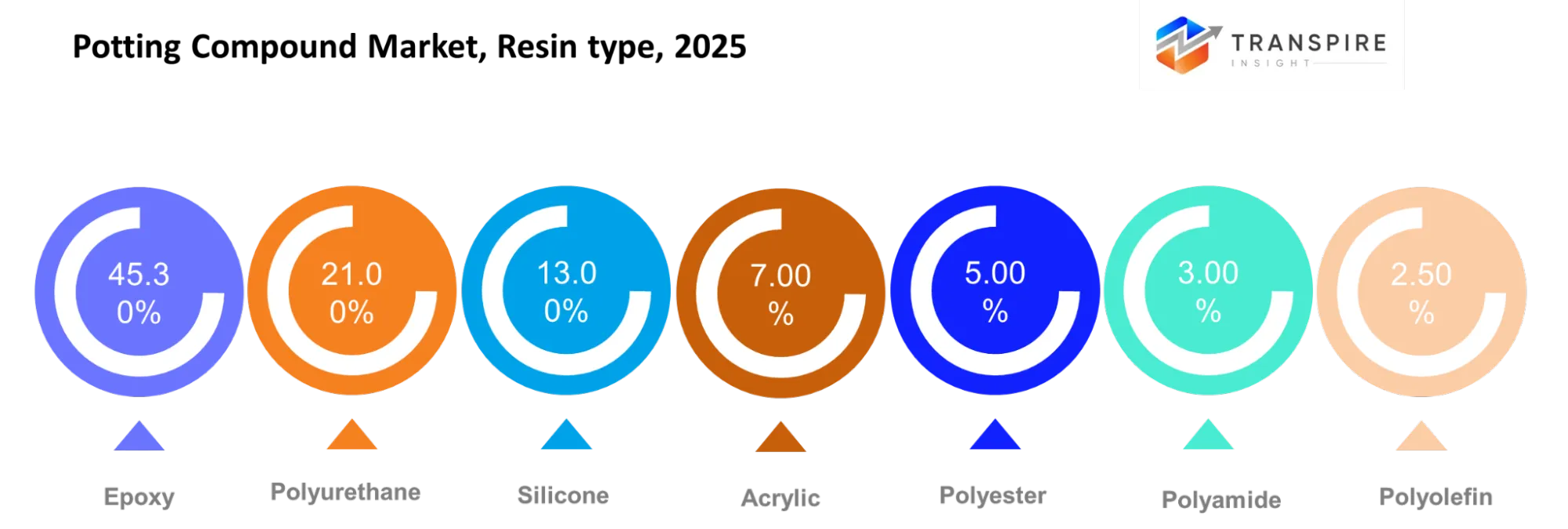
- Epoxy, 45.30%, remains the volume anchor; Henkel’s automotive-grade launches reflect a shift toward moisture-resistant protection for control-unit connectors.
- Polyurethane, 21.00%, is vibration-tolerant, and Huntsman and H.B. Fuller compete on systems that are flexible and impact-resistant for transport and industrial assemblies.
- Silicone, 13.00%, is the fastest technology pivot, and Wacker's high-temperature EV battery materials tackle thermal cycling instead of just insulation.
- Acrylic, 7.00%, becomes relevant in the case of rapid processing; Dymax differentiates with light-curable materials, which reduce the handling time of electronics assembly.
- Polyester, 5.00%, retains cost-sensitive transformer and appliance roles as manufacturers prioritise dependable dielectric protection at scale.
- Other resins, 3.20%, meet special requirements; Master Bond's speciality formulations are designed for low outgassing and high reliability in aerospace applications.
- Chemically demanding applications that require toughness and thermal resistance over low material cost are the applications of Polyamide, 3.00%.
- Whereas low density, chemical resistance, and lightweight designs are important factors in choosing components, niche but relevant, Polyolefin is 2.50%.
- Silicone's 8.10% CAGR is indicative of a technology shift to thermally conductive, two-component systems in EV Inverters and Onboard Chargers.
What are the Key Drivers, Restraints, and Opportunities in the Potting Compound Market?
Driver:
Electrified mobility and high-density power electronics are driving adoption because EV inverters, battery packs, chargers, renewable-energy converters, and ADAS modules operate under high voltage, vibration, humidity, and thermal cycling. The trigger is the replacement of mechanical and combustion-engine systems with electronics-intensive architectures. Each additional protected module increases material consumption and supports higher-value sales of thermally conductive, flame-retardant, and low-ionic formulations. EV chargers and power converters, for example, require potting for dielectric insulation, heat transfer, and moisture protection, moving suppliers toward specialised two-component silicone and polyurethane products.
Restraint:
Formulation cost and compliance complexity limit wider adoption. Silicone systems, advanced ceramic fillers, and low-VOC or halogen-free chemistries are more expensive than conventional epoxy systems. This issue persists because performance requirements conflict: improving thermal conductivity can raise viscosity, while reducing hazardous additives can narrow curing and flame-retardancy options. VOC restrictions and tightening scrutiny of selected photoinitiators further require reformulation, qualification testing, and production-line validation.
Opportunity:
Faster curing and repair-conscious encapsulation can create new demand by reducing production bottlenecks in electronics assembly. UV/visible-light materials cure within seconds, while dual-cure systems use moisture or heat to complete curing beneath components and in shadowed areas. TPO-free formulations also help manufacturers respond to evolving European chemical-compliance expectations. This combination is particularly valuable for automotive sensors, wearable devices, dense printed circuit boards, and compact power electronics, where reliable coverage, lower solvent use, rapid inspection, and shorter handling times can improve line throughput without compromising component protection.
What Has the Impact of Artificial Intelligence Been on the Potting Compound Market?
Artificial intelligence has the potential to improve potting compound manufacturing process automation in the areas of automated dispensing control, visual inspection, formulation optimization, and predictive maintenance. Machine-vision systems can spot underfilled parts, trapped bubbles, overflow, poor bead placement, and poor or patchy encapsulation before final testing of the electronics subassembly begins and reduce waste for high-value applications like power modules in electric vehicles, battery management systems, and industrial controllers.
AI-enabled dispensing equipment can apply data on viscosity, temperature, pressure, flow, and curing to optimise the dispense process in real time. Filled epoxy and silicone systems can have their flow properties change as a result of storage conditions or temperature, so using this data can optimise coverage and minimise excess material. Identifying pump wear, clogged nozzles, micro-mixer imbalance, and curing variation from the beginning can also enable manufacturing plants to predict and prevent component breakdowns and unplanned manufacturing line downtime. There are hurdles, however. Building a dependable AI model requires labelled defect data, sensor integration, and a predictable process, which can be lacking on older lines. Smaller compounders and contract manufacturers may find the cost of vision equipment, data infrastructure, and validation prohibitive until a sufficiently high production volume exists.
In July 2026, Coherix showcased its advanced AI-based quality control systems designed for the automated dispensing of adhesives and potting materials at the AUTOMATE 2026 exhibition.https://interplasinsights.com/plastics-industry-news/Plastic-industry-events-conferences-news/coherix-ai-quality-control-systems-automate-2026/
Key Potting Compound Market Trends:
Potting is evolving from mere passive encapsulation to multifunctional materials with insulation, thermal transfer, vibration control, and process efficiency. The most significant trend is the closer coupling of potting and electronics design as batteries, inverters, and PCBs get smaller, hotter, and more automated.
- Low-viscosity systems have emerged as a result of the need for increased flow rates, fewer voids, and consistent automated dispensing in complex geometries.
- In response to the trend of batch processing to high-throughput electronics assembly, the two-part formulation is becoming more and more towards shorter cure windows.
- Silicone is moving beyond sealing into thermally conductive varieties for EV inverters, chargers, battery electronics and robotics.
- Polyurethane is moving towards applications, such as flexible grades for vibration damping and corrosion protection in battery-management and control boards.
- Where rigidity is required, dielectric strength and mechanical strength are important, and the ability to repair or flex is not, epoxy is still relevant.
- Thermal management has become a design requirement, and the materials used, such as fillers and formulations, need to be able to conduct heat and still isolate the electrical properties.
- Potting-friendly designs are being introduced earlier by battery manufacturers, which helps to decrease rework and enhance resin flow around dense components.
- Automated dam and fill and precision dispensing are becoming significant as manufacturers are looking for repeatable coverage, reduced waste, and reduced manual quality checks.
- Materials development is getting digital, with AI-driven simulation and formulation screening minimising physical trial-and-error or qualification.
Potting Compound Market Segmentation
Resin Type:
Epoxy will hold the largest share of 45.30% due to excellent adhesion, electrical insulation, mechanical strength, and affordability in electronic equipment and industrial assemblies. Polyurethane, with 21.00%, will have the 2nd largest market share due to flexibility and vibration resistance in automotive parts, connectors, and outdoor equipment. Silicone, with a 13.00% share, is anticipated to register a CAGR of 8.10%, driven by electric vehicle power electronics, aerospace, and high-temperature fields demanding thermal stability & low-stress cycling applications. Acrylic with 7.00%, Polyester with 5.00%, Polyamide with 3.00%, polyolefin with 2.50%, and other types of resins with 3.20% share meet the fast curing rate, chemical resistance, flexibility, and cost-effective protection demands.
Application:
Electronics and automotive form the strongest adoption bases because power electronics, sensors, battery systems, and control modules require reliable encapsulation. Aerospace and defence prioritise low outgassing, thermal stability and vibration resistance, while energy equipment requires protection against heat, moisture and electrical stress. Industrial machinery uses potting to improve component durability in harsh environments. Telecommunications equipment requires protection for dense electronic assemblies, while consumer appliances and medical devices favour insulation, compact packaging and controlled processing for reliability and regulatory compliance.
Curing Method:
Heat cure remains relevant for high-volume manufacturing where controlled thermal processing delivers predictable crosslinking. UV cure supports rapid production when light reaches the formulation, reducing cycle times. Moisture and room-temperature curing benefit heat-sensitive assemblies, while two-part curing provides adaptable processing across complex geometries. Anaerobic and radiation curing address specialised applications requiring controlled reactions. Future adoption will favour curing systems that shorten production cycles, reduce energy consumption, minimise defects, and integrate with automated dispensing and inline quality-control equipment.
Form:
Liquid compounds remain important because their flow characteristics enable penetration around densely packed electronic components and support automated dispensing. Paste formulations provide positional control for vertical or localised application, while gels offer flexible protection against vibration and thermal expansion. Solid and granular materials support handling and processing requirements. Pre-mixed products simplify preparation and reduce operator variability, whereas two-component systems provide formulation flexibility. Future growth will favour low-viscosity, low-void formulations compatible with precision equipment and high-throughput production.
End User:
Electronics manufacturers and automotive OEMs anchor adoption because compact assemblies require protection from moisture, vibration, contamination, and thermal stress. Aerospace companies prioritise reliability under demanding temperature and mechanical conditions, while energy companies require durable encapsulation for power-conversion and storage equipment. Industrial manufacturers use compounds to protect sensors, controllers and automation hardware. Telecom companies require protection for dense communication electronics, while medical-device companies emphasise material consistency, controlled processing and long service life. Future adoption will depend increasingly on co-development between material suppliers and equipment manufacturers.
Function:
Insulation, protection and sealing remain fundamental because potting prevents electrical leakage, moisture ingress, contamination and mechanical damage. Thermal management is gaining importance as power density rises in batteries, inverters, and compact electronics, requiring compounds that transfer heat without compromising dielectric performance. Vibration dampening protects assemblies exposed to vehicle and industrial movement, while corrosion protection extends service life in humid environments. Mechanical strength supports stability during handling and operation. Future formulations will increasingly combine functions within one material for efficient assembly and reliability.
What are the Key Use Cases Driving the Potting Compound Market?
The core use case is electronics protection, aligned with epoxy’s 45.30% share. Epoxy potting secures power supplies, sensors, controllers, and PCB assemblies against moisture, contamination, electrical leakage, and mechanical shock, supporting durability.
Expanding applications are concentrated in automotive and energy systems. EV inverters, onboard chargers, battery-management units and power-conversion modules use thermally conductive silicone or flexible polyurethane to manage heat, vibration and thermal cycling without overstressing components.
Emerging use cases include robotics, industrial automation, telecom hardware and advanced battery packs. These applications favour low-viscosity, fast-curing and automated systems because tighter component spacing increases void, heat and process risks, creating demand for materials designed alongside dispensing equipment and digital quality controls.
|
Report Metrics |
Details |
|
Market size value in 2025 |
USD 3.62 Billion |
|
Market size value in 2026 |
USD 3.80 Billion |
|
Revenue forecast in 2033 |
USD 5.31 Billion |
|
Growth rate |
CAGR of 4.90% from 2026 to 2033 |
|
Base year |
2025 |
|
Historical data |
2021 - 2024 |
|
Forecast period |
2026 - 2033 |
|
Report coverage |
Revenue forecast, competitive landscape, growth factors, and trends |
|
Regional scope |
United States; Canada; Mexico; United Kingdom; Germany; France; Italy; Spain; Denmark; Sweden; Norway; China; Japan; India; Australia; South Korea; Thailand; Brazil; Argentina; South Africa; Saudi Arabia; United Arab Emirates |
|
Key companies profiled |
Henkel, Dow, 3M, Huntsman, H.B. Fuller, Momentive, Shin-Etsu Chemical, Wacker Chemie, Electrolube, Master Bond, MG Chemicals, LORD Corporation, ELANTAS, Dymax, ITW. |
|
Customization scope |
Free report customisation (country, regional & segment scope). Available customised purchase options to meet your exact research needs. |
|
Report Segmentation |
Resin Type (Epoxy, Polyurethane, Silicone, Acrylic, Polyester, Polyamide, Polyolefin, Other Resins); Application (Electronics, Automotive, Aerospace & Defense, Energy, Industrial, Telecommunications, Consumer Appliances, Medical Devices); Curing Method (Heat Cure, UV Cure, Moisture Cure, Room Temperature Cure, Two-Part Cure, Anaerobic Cure, Radiation Cure); Form (Liquid, Paste, Gel, Solid, Granules, Pre-Mixed, Two-Component); End User (Electronics Manufacturers, Automotive OEMs, Aerospace Companies, Energy Companies, Industrial Manufacturers, Telecom Companies, Medical Device Companies); Function (Insulation, Protection, Sealing, Thermal Management, Vibration Dampening, Corrosion Protection, Mechanical Strength). |
Which Regions are Driving the Potting Compound Market Growth?
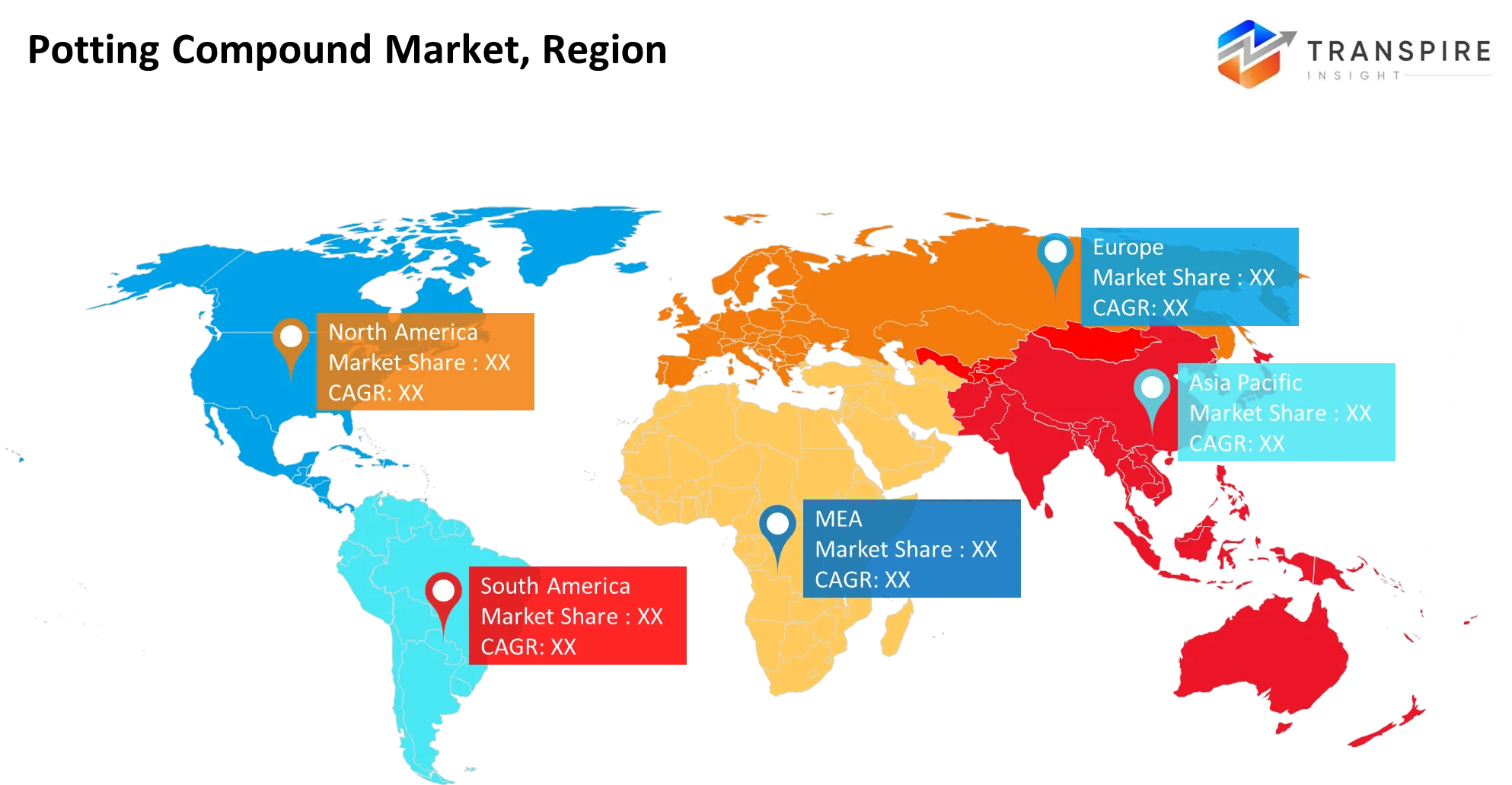
Asia Pacific has a 42.20% share, dominating regional demand as the largest regional demand hub, due to the presence of major electronics, semiconductors, smartphones, and electric vehicle manufacturing industries in China, Taiwan, South Korea, Vietnam, Japan, and India. Through local supply chains, compound suppliers can quickly deliver part qualification cycles for high-volume device assembly, battery production, and power electronics manufacturing. The demand for thermally conductive and moisture-resistant compounds is also driven by government support for the deployment of electric vehicles, investment in charging stations, and growth in regional capacity.
In May 2026, Henkel launched the Bergquist TGF 2030APS thermal gap filler and Loctite TLB 9270APS thermally conductive adhesive to optimise EV battery thermal management.https://www.globenewswire.com/news-release/2026/09/24/3368005/0/en/semiconductor-packaging-materials-market-set-for-strong-growth-through-2033-fueled-by-ai-chips-advanced-packaging-and-heterogeneous-integration.html
Europe accounts for 25.00% of the market and is characterised by a greater focus on premium automotive, industrial automation, aerospace and renewable-energy sectors. Tough environmental and product-performance requirements demand formulations that are low in volatile organic compounds, conscious of the halogen content, long-lasting, and traceable, and are therefore of higher commercial value. Market demand is stabilised by the mature state of automotive engineering and electrification projects, as well as the very high reliability standards required for industrial machinery. Qualified materials for thermal cycling, vibration and long lifetime are a key factor, rather than just being volume-driven.
In September 2026, Isar Aerospace successfully reached orbit and deployed its commercial satellite payloads during its second test flight. This launch was executed from the Andøya Spaceport in continental Europe as part of the European Space Agency's (ESA) Boost! Program.https://isaraerospace.com/press/history-for-european-spaceflight-isar-aerospace-reaches-orbit-and-deploys-payloads-on-second-flight
Middle East & Africa comprises 4.30% of the regional market and grows fastest across four regions with a 6.80% CAGR. Growth has been driven by grid modernisation, solar deployment, telecom expansion, automation and local manufacturing of equipment. Unlike the demand in Asia Pacific (assembly) or Europe (mandated compliance), the opportunity in the Middle East and Africa is infrastructure-based, as the need for rugged electronic components is greater due to extreme heat, humidity, dust, and remote operations. Electric vehicle charging networks, solar inverters, data centres, and power-control systems are major areas for future growth in the region. Latin America contributes 5.50% and North America 23.00%, with most growth from vehicle electrification and localisation efforts.
In September 2026, ADNEC Group extended its clean electricity agreement with Emirates Water and Electricity Company (EWEC) and advanced a 5 MWp rooftop solar project at ADNEC Centre Abu Dhabi.https://www.utilities-me.com/news/adnec-advances-solar-project
Who are the Key Players in the Potting Compound Market, and how do they compete?
The competitive landscape varies significantly for each product type by competition material, qualification capability, breadth of formulary, and proximity to electronics/automotive customers, not price. Competition is evolving for premium-silicone, epoxy, polyurethane, UV-curable, and high-reliability, high-performance niche systems among Henkel, Dow, 3M, Huntsman, H.B. Fuller, Momentive, Shin-Etsu Chemical, Wacker Chemie, Electrolube, Master Bond, MG Chemicals, LORD Corporation, ELANTAS, Dymax, and ITW.
Henkel leverages application-led innovation and automotive-channel access (through its silicone product lines for fluid and moisture barrier on critical vehicle components). Dow, Momentive, Shin-Etsu, and Wacker are differentiated by high-performance silicone chemistry, flexibility, adhesion, high-temperature operation, thermal conductivity, and low-stress mechanical to electronics and e-vehicle power-electronic assemblies. Recent Wacker development delivers an illustrative material innovation for electric vehicles that relies on thermal-management capabilities. 3M, Huntsman, H.B. Fuller, LORD, ELANTAS, and ITW combine broad industrial portfolios with bespoke bonding, insulating, and vibration-management grades; Master Bond and Electrolube for very specific, high-reliability, electronics-market-focused formulations; and MG Chemicals for relatively low-cost, easily accessible maintenance, repair, and small-volume application demands. Dymax applies its strength in UV-curing processing advantages for process throughput, speed, and automation compatibility.
Key Players are:
- Henkel
- Dow
- 3M
- Huntsman
- H.B. Fuller
- Momentive
- Shin-Etsu Chemical
- Wacker Chemie
- Electrolube
- Master Bond
- MG Chemicals
- LORD Corporation
- ELANTAS
- Dymax
- ITW
Recent Development News
- In January 2026, Henkel launched LOCTITE STYCAST US 8000 A/B, a next-generation two-component polyurethane potting compound designed for industrial and power electronics protection. This development addresses the growing risk of corrosion, insulation breakdown, and premature component failure in harsh environmental conditions.https://www.henkel.com/press-and-media/press-releases-and-kits/2026-01-20-henkel-launches-next-generation-polyurethane-potting-solution-for-industrial-and-power-electronics-reliability-2116814
- In June 2026, WEVO-CHEMIE introduced WEVOPUR 512 FLE, an electronic potting resin designed to protect lithium-ion battery packs used in power tools. The material supports reliable battery protection while enabling efficient series production, strengthening the use of polyurethane potting materials in compact energy-storage electronics.https://www.wevo-chemie.de/en/news-press/detailpage/electronic-potting-resin-power-tools-battery-packs
- In June 2026, Dow announced an approximate USD 100 million speciality-silicones investment initiative extending through 2027 to build new electronics manufacturing facilities and specialised cooling laboratories. This allocation targets the expanding demand for high-reliability thermal management infrastructure and advanced encapsulation materials.https://www.stocktitan.net/news/DOW/
What Strategic Insights Define the Future of the Potting Compound Market?
The industry is heading toward multi-functional, process-optimised protection, where one formulation offers excellent insulation and thermal management, high environmental resistivity, as well as high mechanical compliance. The largest opportunity for this is in EV powertrains, battery-management systems, AI/data-center hardware, and industrial automation, where denser component packaging requires all of the thermal and reliability performance to be combined in the selection of materials. Henkel's 2026 product launches exemplify this trend by including low-viscosity polyurethane and electronics-processing technologies. One risk is process-material incompatibility, as resin with higher cure speed or conductivity can lead to problems with viscosity, stress, adhesion, or dispensing, which can reduce reliability if formulations are not qualified properly with equipment. Another risk is substitution by other encapsulation solutions, such as low-pressure moulding. The emerging opportunity is localised application engineering, especially in Asia Pacific and other developing electronics ecosystems. To address this, suppliers need to invest in formulation R&D, digital validation, and application centres, instead of focusing solely on resin performance and price.
Key Segmentations are:
Resin Type
- Epoxy
- Polyurethane
- Silicone
- Acrylic
- Polyester
- Polyamide
- Polyolefin
- Other Resins
Application
- Electronics
- Automotive
- Aerospace & Defence
- Energy
- Industrial
- Telecommunications
- Consumer Appliances
- Medical Devices
Curing Method
- Heat Cure
- UV Cure
- Moisture Cure
- Room Temperature Cure
- Two-Part Cure
- Anaerobic Cure
- Radiation Cure
Form
- Liquid
- Paste
- Gel
- Solid
- Granules
- Pre-Mixed
- Two-Component
End User
- Electronics Manufacturers
- Automotive OEMs
- Aerospace Companies
- Energy Companies
- Industrial Manufacturers
- Telecom Companies
- Medical Device Companies
Function
- Insulation
- Protection
- Sealing
- Thermal Management
- Vibration Dampening
- Corrosion Protection
- Mechanical Strength
By Regional Analysis
North America
- US
- Canada
- Mexico
Europe
- Germany
- UK
- France
- Italy
- Spain
- Russia
- Rest of Europe
Asia Pacific
- China
- Japan
- India
- South Korea
- Australia
- Rest of Asia Pacific
South America
- Brazil
- Argentina
- Rest of South America
Middle East & Africa
- UAE
- Saudi Arabia
- Qatar
- South Africa
- Rest of the Middle East & Africa
Frequently Asked Questions
Find quick answers to common questions.
The potting compound market size was valued at USD 3.62 billion in 2025 and is poised to reach USD 5.31 billion by 2033, expanding at a 4.90% CAGR.
Key segments for the potting compound market are Resin Type (Epoxy, Polyurethane, Silicone, Acrylic, Polyester, Polyamide, Polyolefin, Other Resins); Application (Electronics, Automotive, Aerospace & Defense, Energy, Industrial, Telecommunications, Consumer Appliances, Medical Devices); Curing Method (Heat Cure, UV Cure, Moisture Cure, Room Temperature Cure, Two-Part Cure, Anaerobic Cure, Radiation Cure); Form (Liquid, Paste, Gel, Solid, Granules, Pre-Mixed, Two-Component); End User (Electronics Manufacturers, Automotive OEMs, Aerospace Companies, Energy Companies, Industrial Manufacturers, Telecom Companies, Medical Device Companies); Function (Insulation, Protection, Sealing, Thermal Management, Vibration Dampening, Corrosion Protection, Mechanical Strength).
Growth is primarily driven by EV electrification, rising electronics density, thermal-management requirements, battery-pack protection, miniaturized components, and adoption of automated dispensing and encapsulation technologies.
The potting compound market is led by major manufacturers, including Henkel, Dow, 3M, Huntsman, H.B. Fuller, Momentive, Shin-Etsu Chemical, Wacker Chemie, Electrolube, Master Bond, MG Chemicals, LORD Corporation, ELANTAS, Dymax, and ITW
Asia Pacific, holding a 42.20% share, influences market dynamics through its concentrated electronics and automotive manufacturing base, battery production, semiconductor ecosystem, and expanding EV and industrial automation investments.
Key opportunities include thermally conductive EV potting, battery-management protection, AI/data-center electronics, low-void automated dispensing, multifunctional resins, and localised application-engineering services.
- Henkel
- Dow
- 3M
- Huntsman
- H.B. Fuller
- Momentive
- Shin-Etsu Chemical
- Wacker Chemie
- Electrolube
- Master Bond
- MG Chemicals
- LORD Corporation
- ELANTAS
- Dymax
- ITW
About the Authors

Pankaj Ghogare Patil
I am Pankaj Ghogare Patil, a Senior Research Analyst at Transpire Insight, specializing in the Pharmaceutical, Chemicals & Materials, Healthcare IT, and Biotechnology industry. My expertise lies in conducting comprehensive market research, analyzing industry trends, evaluating competitive landscapes, and translating complex data into actionable insights. At Transpire Insight, I closely follow emerging technologies, regulatory developments, and market innovations to create accurate, well-researched, and informative content that helps businesses and professionals make informed decisions. I am committed to producing credible, evidence-based articles that reflect industry best practices while making technical topics accessible and valuable for a broad audience.

Chakradhar Khansole
Chakradhar serves as the Research Director at Transpire Insight, bringing over 8 years of experience in technology, innovation, and strategic market intelligence. He specializes in transforming complex market data into actionable business insights that enable organizations to make informed, growth-oriented decisions. Recognized for his strategic vision and analytical expertise, Chakradhar leads high-impact research initiatives, delivering comprehensive market assessments, competitive intelligence, and forward-looking industry analysis.
Recently Published Reports
-
May 2026
Healthcare Polymer Packaging Market
Healthcare Polymer Packaging Market Size, Share & Analysis Report By Packaging Type (Syringes, IV Bottles and Pouches, Clamshells, Blisters, Bottles & Jars, Containers, Tubes, IV Parental Packaging, Others), By Type (Regulated, Non-regulated), By Polymer Type (LDPE (Low-Density Polyethylene), HDPE (High-Density Polyethylene), Homo-polymer (Homo), Random Copolymer (Random), Block Copolymer (Block), PET, Polystyrene, Polyvinyl Chloride, Polyamide/EVOH, Others), and Geography (North America, Europe, Asia-Pacific, Middle East and Africa, South and Central America), 2021 - 2031
-
Apr 2026
Hydrophilic Tape (Waterstop) Market
Hydrophilic Tape (Waterstop) Market Size, Share & Analysis Report By Type (Bentonite-Based Hydrophilic Tape, Rubber-Based Hydrophilic Tape), By Application (Residential Buildings, Commercial Buildings, Infrastructure Projects), and Geography (North America, Europe, Asia-Pacific, Middle East and Africa, South and Central America), 2021 - 2031
-
Apr 2026
Metalens Market
Metalens Market Size, Share & Analysis Report By Type (Visible Light Metalens, and Infrared Metalens), By Application (Consumer Electronics, Automotive Electronics, Industrial, Medical, and Others), and Geography (North America, Europe, Asia-Pacific, Middle East and Africa, South and Central America), 2021 - 2031
-
Apr 2026
PBT Resin Market
PBT Resin Market Size, Share & Analysis Report By Type (Reinforced PBT Resin, Unreinforced PBT Resin), By Processing Method (Injection Molding, Extrusion, Blow Molding, Others), By End-User (Automotive, Electrical & Electronics, Consumer Appliances, Industrial Machinery, Medical Devices, Packaging, Others), and Geography (North America, Europe, Asia-Pacific, Middle East and Africa, South and Central America), 2021 - 2031