
Thermal Management Technologies Market Summary:
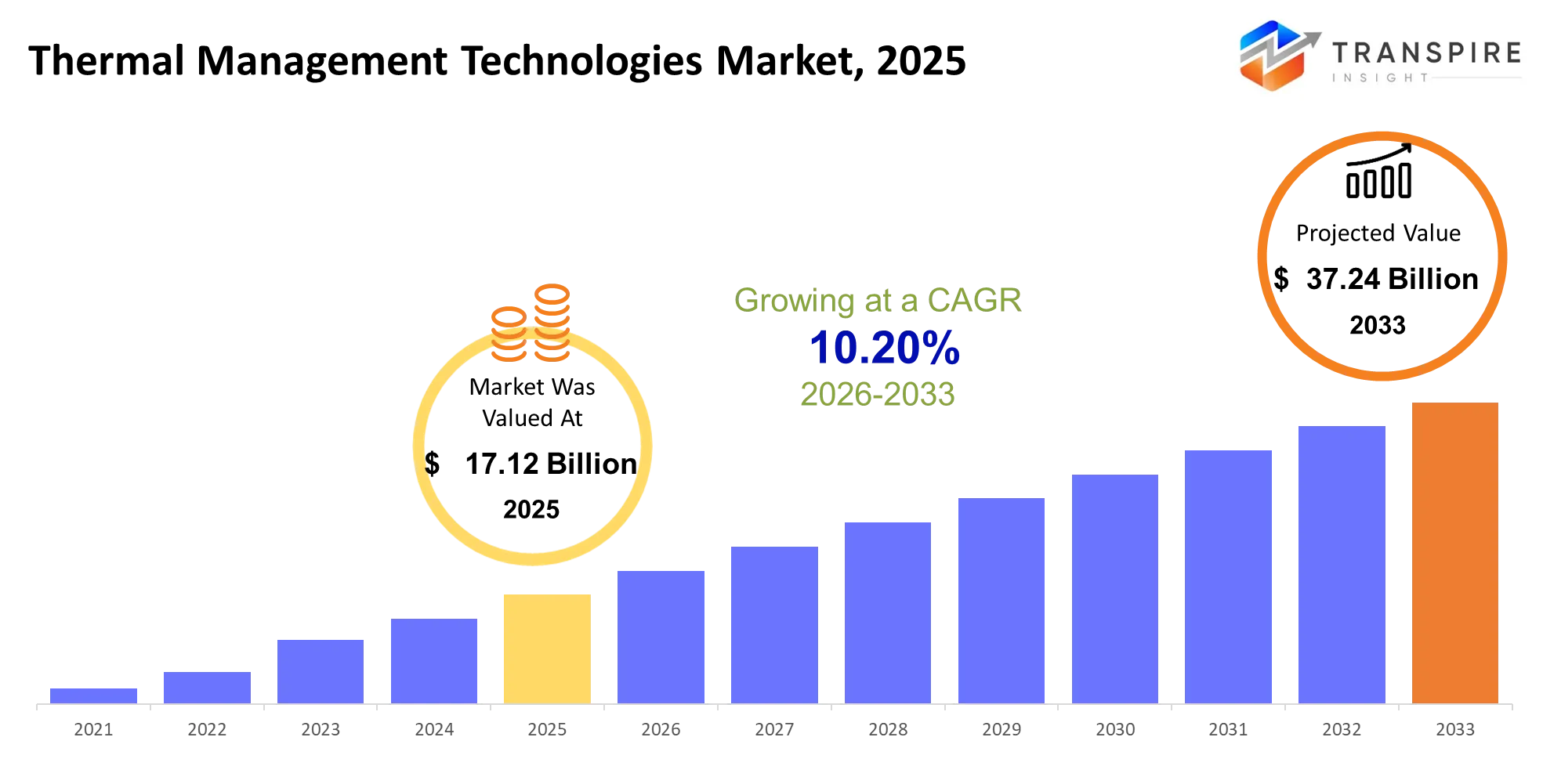
As per the Transpire Insight Analysis, The Thermal Management Technologies Market size is estimated at USD 17.12 billion in 2025 and is anticipated to reach USD 37.24 billion by 2033, growing at a CAGR of 10.20% from 2026 to 2033.
The thermal management technologies market provides the basic systems for cooling, heat dissipation, insulation, and control to keep batteries, chips, servers, motors, and medical equipment operating at safe temperatures. Over the last 3-5 years, the market has been transitioning from component-led air cooling towards system-level thermal architectures that combine liquid loops, advanced interface materials, sensors and software controls. This is predominantly driven by the practicalities of having to deal with a quantum leap in heat density delivered by AI GPU clusters, fast-charging EV batteries, tiny power electronics and high-performance telecom infrastructure. As heat loads exceed the reach of standard fans and heat sinks, users are resorting to direct-to-chip liquid cooling, vapour chambers, heat pipes and phase change materials to avoid throttling, failure and energy waste. This evolution is underpinned by data centre efficiency reporting regulations and rising battery safety demands. Thermal management is increasingly seen as an investment in performance and reliability, not a mechanical line item.
Thermal Management Technologies Market Size & Forecast:
- Market Size 2025: USD 17.32 Billion
- Expected Market Value (2033): USD 37.24 Billion
- Forecast CAGR (2026–2033): 10.20%
- Leading Region in 2025: North America
- Fastest Growing Region: Asia-Pacific
- Key Company Profiles: Honeywell, 3M, Parker Hannifin, Boyd Corporation, Vertiv, Delta Electronics, Advanced Energy, Aavid Thermalloy, Modine Manufacturing, Laird Thermal Systems, Henkel, Panasonic, Schneider Electric, TDK, Emerson.
Key Thermal Management Technologies Market Insights:
Thermal management is moving beyond the traditional hardware approach to integrated, software-aware cooling solutions for dense compute, electrified mobility and compact electronics. Heat transfer efficiency, modular deployment, material reliability, and service capability for the lifecycle are increasingly becoming the key to competitive advantage.
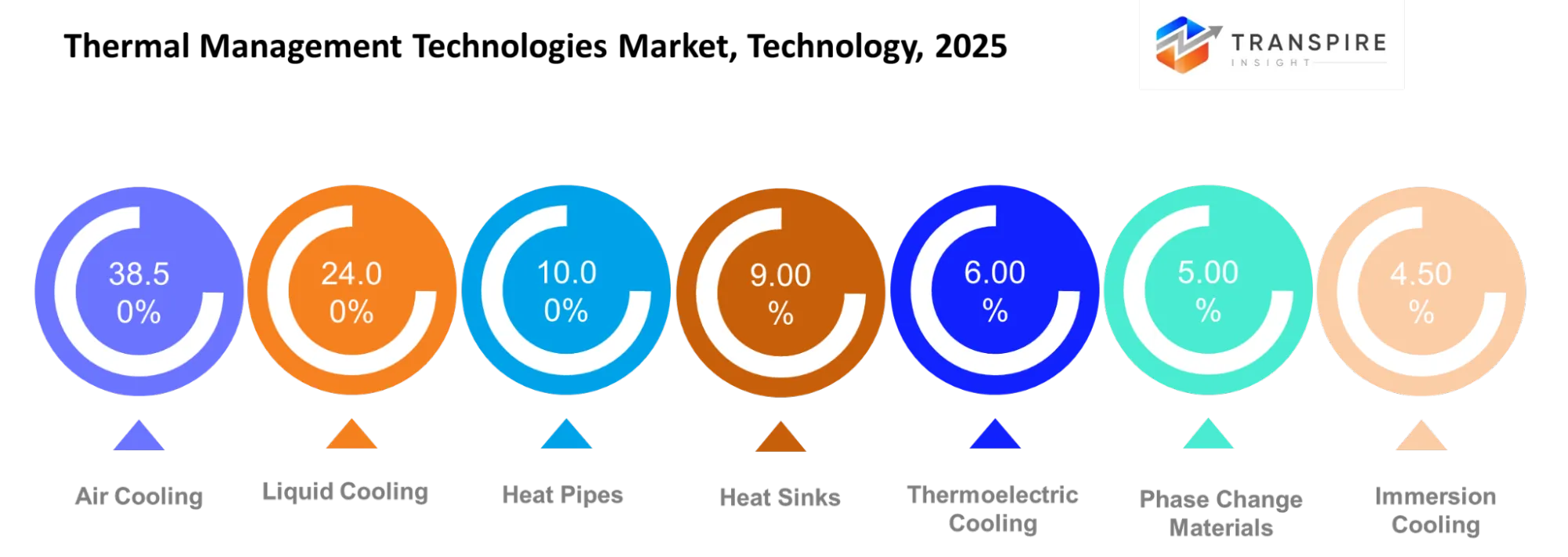
- Air cooling is still the installed base at 38.50%, but Vertiv is offering a combination of air cooling and direct-to-chip liquid loops for AI-ready hybrid infrastructure.
- Parker is promoting the liquid cooling market with the introduction of quick disconnects, thermal hoses, and cold-plate fluid connectivity, which is expected to grow at 17.80% CAGR.
- The electronics industry is beginning to shift away from mechanical cooling and towards sealed passive heat-transfer assemblies, with heat pipes accounting for 10.00% of the market.
- Heat sinks make up 9.00%; as operators seek to reduce cooling-energy overheads, 3M enhances airflow and interface solutions.
- Thermoelectric cooling makes up 6.00%, allowing for the development of precision temperature control in sensors, medical equipment and compact optical systems.
- Phase-change materials (PCM) make up 5.00%, going from speciality thermal buffering to battery and semiconductor-package protection applications.
- Immersion cooling is 4.50% of the market, while hyperscale operators test dielectric-fluid systems when AI racks exceed fan-based capacity.
- Vapour chambers make up 3.00% and are being used in dense chip packages where heat needs to be dissipated laterally to a cold plate.
- The hybrid platforms are now integrating liquid and air cooling together with Vertiv's prefabricated MegaMod HDX that can be scaled to support AI deployments up to 10 MW.
What are the Key Drivers, Restraints, and Opportunities in the Thermal Management Technologies Market?
Driver:
AI computing, vehicle electrification, and compact high-power electronics are raising heat loads faster than conventional cooling capacity. The immediate trigger is dense GPU deployment for generative AI and accelerated computing, where a server rack can concentrate far more heat than traditional enterprise hardware. This shifts purchasing toward cold plates, liquid distribution units, high-conductivity thermal interface materials, and rear-door heat exchangers. For suppliers, revenue rises not only from cooling hardware but also from recurring fluid management, monitoring, maintenance, and engineering services. Electric vehicles reinforce this demand because battery packs, inverters, and fast-charging systems require temperature control to protect range, safety, and charging performance.
Restraint:
Adoption remains constrained by retrofitting complexity, high upfront expenditure, and uneven standards across hardware and facilities. Liquid and immersion systems require compatible racks, plumbing, fluids, leak-detection practices, service skills, and equipment warranties. These structural barriers persist because many installed data centres were designed around air cooling, while automotive and electronics OEMs face long validation cycles before qualifying new materials or fluid systems.
Opportunity:
Hybrid cooling architectures are emerging as a practical growth pathway because they let operators add direct liquid cooling to high-density AI racks while retaining air cooling for conventional equipment. This phased approach reduces retrofit costs, avoids full facility reconstruction, and supports faster capacity upgrades. Meanwhile, immersion cooling fluids are gaining traction for AI servers, EV battery packs, and energy-storage systems, where concentrated heat threatens performance and safety. Recent data-centre demonstrations and supplier activity in South Korea indicate growing commercial confidence in these specialised cooling systems.
What Has the Impact of Artificial Intelligence Been on the Thermal Management Technologies Market?
AI has turned thermal management from a primarily reactive engineering function into a forward-looking operational discipline. Data centres use artificial intelligence models that incorporate temperature, flow, power, humidity, workload, and fan speed data to optimise the efficiency of cooling systems in real time. Instead of running chillers, pumps, and fans at conservative, steady-state levels, the controls can dynamically modulate equipment based on the true thermal load of each rack or zone; this reduces excess energy use while maintaining processor performance.
Artificial intelligence also enables predictive maintenance; models can flag abnormal pump vibration, fan degradation, coolant-flow bottlenecks, rising thermal resistance, or non-uniform temperature distributions before a server, battery module, or power electronic assembly fails, thus increasing uptime and extending component life. In manufacturing, AI-supported simulation and design tools let engineers identify the optimal cooling plates, microchannels, heat sinks, vapour chambers, and thermal interface materials earlier during product development. Models require dependable sensor coverage, clean and consistent operational data, interoperable building-management systems, and knowledgeable thermal engineers. For existing facilities, the operational costs of deploying artificial intelligence controls and the potential of creating false alerts or risking unsafe control moves can make implementation expensive and challenging.
In July 2026, Daikin Industries launched a joint proof of concept with NTT DATA Japan focused on AI-driven data centre cooling optimisation. This system uses machine learning to predict internal server thermal conditions from indirect operational data, seamlessly integrating facility-side HVAC, chiller, and liquid cooling controls.https://www.daikin.com/press/2026/20260706
Key Thermal Management Technologies Market Trends:
Thermal management is transitioning from individual components to integrated architectures and software determining where cooling is placed. The most pronounced trend is convergence: the design of chips, cooling plates, pumps, heat exchangers, controls, and facilities is becoming a single thermal stack that is handling high heat fluxes.
- Air cooling is still relevant, and fan walls, free cooling, and airflow engineering can be used to expand the envelope of air cooling before liquid cooling can be considered.
- The technology of direct-to-chip liquid cooling is moving from niche deployments to infrastructure, with larger CDUs and reference designs for AI factories.
- Immersion cooling is moving towards specific high-density workloads where the benefits of heat removal, water savings and rack considerations outweigh the cost of fluid-based architecture.
- With increased package density, thermal interface materials are increasingly important, as they lower the microscopic resistance between processors, memory, heat spreaders and cooling plates.
- Inside packages, embedded cooling is growing, as SK hynix's 2026 iHBM embeds cooling elements into HBM and claims to reduce thermal resistance by 30%.
- Rejected heat recovery is becoming relevant as operators try to use the rejected heat for district heating instead of discarding it.
- EU refrigerant restrictions and data-centre efficiency initiatives are driving lower-GWP, lower-water, and measurable-efficiency architectures, as well as earlier impacts on product design.
Thermal Management Technologies Market Segmentation
Technology:
Air cooling is the current market dominator with a 38.50% share due to the affordability and familiarity of fans, heat sinks, ducts, and radiators in consumer electronics, industrial equipment, and less-dense computing environments. When it transitions to the future, it will take a hybrid form to work alongside liquid-cooled hotspots rather than stand-alone. Liquid cooling, a large contributor with a CAGR of 17.80%, is the most promising growth path due to the need for artificial intelligence processors, fast-charging batteries, and power electronics to transfer heat more efficiently. Market by technology: heat pipes 10.00%, heat sinks 9.00%, thermoelectric cooling 6.00%, phase-change materials 5.00%, immersion cooling 4.50%, vapour chambers 3.00%.
Component:
Heat Exchangers, Fans, Pumps, Cooling Plates, Heat Spreaders, Thermal Interface Materials, Radiators, and Insulation are evolving into engineered subsystems rather than isolated parts. Integration improves heat-transfer efficiency, simplifies installation, and enables coordinated controls across thermal loops. Cooling plates and pumps gain importance in high-density computing, while heat exchangers and radiators support larger loads. Thermal interface materials increasingly determine performance at component junctions. This shift raises the value of design integration, customization, and lifecycle support for manufacturers and integrators.
Application:
Automotive, Consumer Electronics, Data Centres, Aerospace & Defence, Healthcare, Industrial, Telecommunications, and Energy require different architectures based on heat density, reliability, and conditions. Data centres increasingly adopt liquid systems as AI accelerators raise rack temperatures and power density. Automotive platforms prioritise battery and power-electronics temperature control, while aerospace emphasises weight and reliability. Consumer devices favour compact passive solutions, whereas industrial and energy installations require scalable control. Application-specific engineering is becoming central to product development, deployment, and maintenance decisions.
Material:
Aluminium and Copper remain used because they combine thermal conductivity, manufacturability, and established supply chains. Graphite is gaining attention where lightweight heat spreading and anisotropic conductivity improve compact electronics. Ceramics support electrical insulation with thermal performance in power modules, while Polymers enable flexible, lightweight interface and insulation designs. Phase Change Materials provide temporary heat buffering during thermal spikes, and Composites combine multiple performance characteristics. Material selection is increasingly application-driven, balancing conductivity, weight, insulation, durability, manufacturability, and lifecycle requirements.
End User:
Data Centre Operators, Electronics Manufacturers, Automotive Manufacturers, Aerospace Companies, Industrial Companies, and Healthcare Providers are incorporating thermal performance during product design. Data centre operators specify cooling compatibility before deploying high-density accelerator clusters, while automotive manufacturers evaluate battery and power-electronics thermal paths during platform design. Aerospace and healthcare users prioritise reliability and controlled operating temperatures, whereas electronics OEMs emphasise compactness and efficiency. This earlier specification process increases demand for simulation, validation, customized components, and integrated thermal services.
Cooling Type:
Passive Cooling remains important where simplicity, low maintenance, and low energy consumption are priorities. Active Cooling gains relevance when equipment produces sustained heat requiring controlled airflow or circulation, while Air Cooling continues serving electronic installations. Liquid Cooling is expanding in dense computing, with Hybrid Cooling combining methods for flexibility. Immersion Cooling targets high heat loads, whereas Refrigeration supports precise control. The market is moving toward modular architectures selected according to density, climate, efficiency, footprint, and reliability requirements.
What are the Key Use Cases Driving the Thermal Management Technologies Market?
The first use case corresponds to heat removal of high-density electronic systems, which accounts for 38.50% of the market share for air-cooled servers, and power electronics still rely on proven airflow design.
However, there is a noticeable adoption trend of liquid- and hybrid-cooling methods for AI data centres, battery systems, telecom infrastructure, and high-end electronics. For these applications, direct-to-chip cooling allows heat to be transferred with no or minimal impact on the facility airflow system capacity.
Other use cases emerging include integrated package and chipset cooling, HBM/AiM accelerator module cooling, high-density racks immersion cooling, and heat recovery.
In 2026, SK hynix launched iHBM with cooling components integrated, while Singapore published a Tropical Liquid Cooling Standard, transitioning from components innovation to heat and cooling infrastructure.
|
Report Metrics |
Details |
|
Market size value in 2025 |
USD 17.12 Billion |
|
Market size value in 2026 |
USD 18.87 Billion |
|
Revenue forecast in 2033 |
USD 37.24 Billion |
|
Growth rate |
CAGR of 10.20% from 2026 to 2033 |
|
Base year |
2025 |
|
Historical data |
2021 - 2024 |
|
Forecast period |
2026 - 2033 |
|
Report coverage |
Revenue forecast, competitive landscape, growth factors, and trends |
|
Regional scope |
United States; Canada; Mexico; United Kingdom; Germany; France; Italy; Spain; Denmark; Sweden; Norway; China; Japan; India; Australia; South Korea; Thailand; Brazil; Argentina; South Africa; Saudi Arabia; United Arab Emirates |
|
Key companies profiled |
Honeywell, 3M, Parker Hannifin, Boyd Corporation, Vertiv, Delta Electronics, Advanced Energy, Aavid Thermalloy, Modine Manufacturing, Laird Thermal Systems, Henkel, Panasonic, Schneider Electric, TDK, Emerson. |
|
Customization scope |
Free report customisation (country, regional & segment scope). Available customised purchase options to meet your exact research needs. |
|
Report Segmentation |
Technology (Air Cooling, Liquid Cooling, Heat Pipes, Thermoelectric Cooling, Phase Change Materials, Immersion Cooling, Vapor Chambers, Heat Sinks); Component (Heat Exchangers, Fans, Pumps, Cooling Plates, Heat Spreaders, Thermal Interface Materials, Radiators, Insulation); Application (Automotive, Consumer Electronics, Data Centers, Aerospace & Defense, Healthcare, Industrial, Telecommunications, Energy); Material (Aluminum, Copper, Graphite, Ceramics, Polymers, Phase Change Materials, Composites); End User (OEMs, Data Center Operators, Electronics Manufacturers, Automotive Manufacturers, Aerospace Companies, Industrial Companies, Healthcare Providers); Cooling Type (Passive Cooling, Active Cooling, Air Cooling, Liquid Cooling, Hybrid Cooling, Immersion Cooling, Refrigeration). |
Which Regions are Driving the Thermal Management Technologies Market Growth?
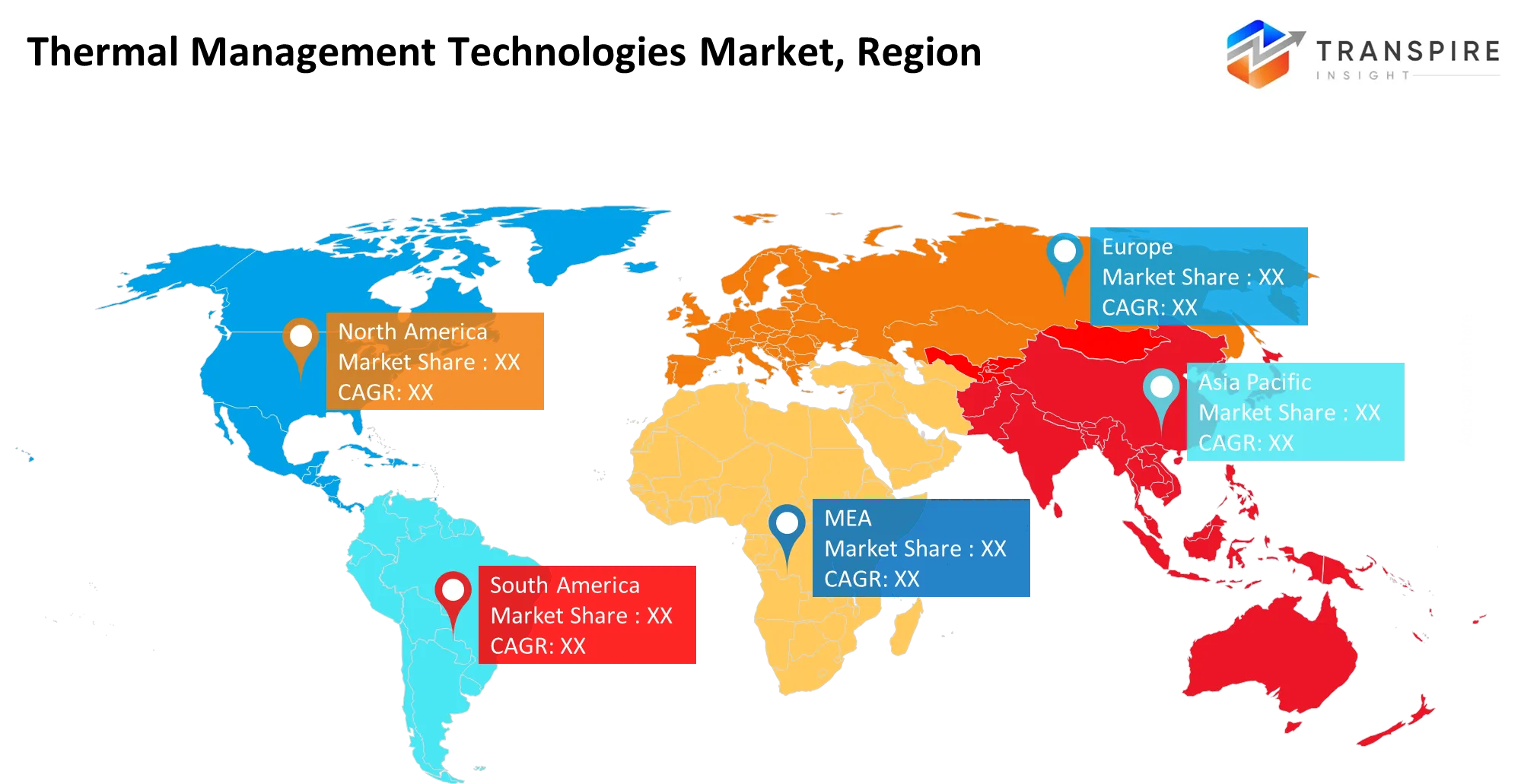
North America has the largest 36.50% market share, due to hyperscale cloud infrastructure investments, leading semiconductor activities, electric vehicle manufacturing, and an extensive supplier ecosystem for cooling systems. North American artificial intelligence infrastructure is also on the rise, with rising rack power density and accelerating adoption of direct-to-chip liquid cooling, cold plates, cooling distribution units, and thermal monitoring systems. The leading technology operators have the financial muscle to build dedicated data centres, and not to capitalise on time-bound retrofit projects, making it more economically feasible to deploy an advanced cooling system. Government investments in domestic semiconductor manufacturing, battery manufacturing, energy efficiency, and grid modernization are further increasing demands for dedicated thermal systems.
In May 2026, Johnson Controls completed its acquisition of Alloy Enterprises, a Boston-based developer of advanced direct-liquid-cooling technology for high-performance data centres. The acquisition expands Johnson Controls’ thermal-management capabilities and strengthens deployment of higher-efficiency cooling architectures across North American AI infrastructure.https://www.johnsoncontrols.com/media-center/news/press-releases/2026/05/13/johnson-controls-completes-acquisition-of-alloy-enterprises
Europe 27.00% represents the share of the market that is centred around priority concerns for energy efficiency, carbon minimisation, and heat reuse. The European Union's standards for data centre efficiency highlight direct liquid cooling as a positive technology for high-power-density facilities, which can generate higher coolant temperatures, free cooling, and waste-heat reuse opportunities. Europe's developed automotive industry also generates a fairly predictable demand for battery thermal management and power-electronics cooling, as well as markets for new lightweight materials development. Development is more mature in this region, and growth is mostly driven by regulation, industrial automation, and existing engineering supply chains.
In September 2026, Taiwan-based LITEON Technology announced a strategic investment of approximately $176 million to acquire a 25% equity stake in Warsaw, Poland-based DCX Liquid Cooling Systems. This partnership integrates DCX's specialised European expertise in direct liquid cooling technologies.https://www.sttinfo.fi/tiedote/72291596/liteon-announces-strategic-investment-in-liquid-cooling-technology-company-dcx?publisherId=58763726&lang=en
Asia Pacific accounts for 25.00% today and is the fastest-growing region, projected to expand at a 12.90% CAGR. The recent change is rapid investment in AI-ready capacity across China, Japan, South Korea, Singapore, and India, where conventional air-cooled halls cannot efficiently manage high-density GPU workloads. In Japan, 40% of new capacity commissioned during 2024 reportedly integrated liquid cooling, illustrating the technology’s transition from pilot activity to infrastructure planning. Future opportunity lies in locally manufactured cooling equipment, liquid-cooling fluids, modular systems, and thermal-control software supporting regional cloud, telecom, EV, and electronics production. Latin America and the Middle East & Africa, at 6.00% and 5.50%, respectively, remain smaller but offer selective opportunities around new digital infrastructure and hot-climate cooling resilience.
In August 2026, the Infocomm Media Development Authority and Enterprise Singapore launched the Singapore Standard for liquid cooling in tropical data centres. This standard helps data centres adopt liquid cooling technologies in the tropics to handle the growing energy demands of artificial intelligence workloads.https://www.imda.gov.sg/resources/press-releases-factsheets-and-speeches/singapore-launches-worlds-first-liquid-cooling-standard-for-data-centres-in-tropical-climates
Who are the Key Players in the Thermal Management Technologies Market, and how do they compete?
The industry is shifting away from a handful of integrated infrastructure providers to specialist materials and component-oriented thermal engineering companies. Competition will depend on how well they can assemble cooling hardware, power, monitoring software, service, and application-centric design - not simply the best fan or heat sink.
Honeywell, 3M, Henkel, TDK, Panasonic, and Laird Thermal Systems have expertise in advanced materials, thermal-interface compounds, battery solutions, and niche cooling. 3M is linking innovative thermal management with improved performance of lower-carbon vehicle batteries and data-centre efficiencies. Henkel distinguishes itself with its adhesive and interface-material chemistry that is designed for automation-friendly electronics assembly. Vertiv, Schneider Electric, Emerson, Modine Manufacturing, Delta Electronics, and Advanced Energy focus on scalable infrastructure, smart controls, and integrated, energy-efficient cooling. These solutions from such firms as Vertiv Mega Mod HDX-combining the benefits of prefabrication, direct-to-chip liquid and air cooling for high-density AI needs-reduce implementation risk for data-centre owners. Fluid pathway makers like Parker Hannifin, Boyd Corporation, and Aavid Thermalloy compete using custom thermal assemblies, quick-connect fittings, cold plates, and heat exchangers; Parker high-performance couplings and hose products will accommodate serviceable liquid-cooling treatments.
Key Players are:
- Honeywell
- 3M
- Parker Hannifin
- Boyd Corporation
- Vertiv
- Delta Electronics
- Advanced Energy
- Aavid Thermalloy
- Modine Manufacturing
- Laird Thermal Systems
- Henkel
- Panasonic
- Schneider Electric
- TDK
- Emerson
Recent Development News
- In September 2026, LG Electronics partnered with SK Enmove to jointly develop next-generation thermal management technologies, including eco-friendly refrigerants, refrigerant oils and immersion cooling solutions. The collaboration is expected to expand thermal-management applications across AI data centres, energy storage systems and electric-vehicle components.https://www.upi.com/Top_News/World-News/2026/09/23/sk-enmove-lg-electronics-next-gen-refrigerants-ai-data-centers-immersion-cooling/4131790206921/
- In September 2026, Castrol launched Castrol CORE, an integrated end-to-end thermal management service portfolio for data centres. This product launch represents a strategic evolution from hardware product supply to an integrated service approach that coordinates a network of design, infrastructure, and operations partners through a single point of contact.https://www.prnewswire.com/news-releases/castrol-launches-castrol-core-an-integrated-thermal-management-offer-for-data-centres-302889539.html
- In August 2026, Molex made a strategic investment in CAEPlus to accelerate development and commercialization of active liquid-cooling technology for AI data centres and high-performance computing. The investment supports the development of CAEPlus’ BoundaryCool platform for managing higher heat loads from next-generation GPU and ASIC systems.https://www.molex.com/en-us/news/molex-invests-in-caeplus-to-advance-thermal-management
What Strategic Insights Define the Future of the Thermal Management Technologies Market?
The market is heading toward application-specific thermal solutions that incorporate liquid cooling, next-generation materials, power management, and AI-enabled monitoring. A looming threat is that GPU and battery thermal loads could grow faster than infrastructure upgrades to water, power, plumbing, and maintenance support, so even the most capable cooling product could flounder commercially if installation and maintenance are not upgraded in parallel.
A nascent opportunity lies in retrofit-ready hybrid cooling modules. Rather than ejecting an air-cooled data centre, an operator could install cooling distribution units, rear-door heat exchangers, and direct-to-chip loops in selected high-density racks with nominal capital disruption while advancing AI deployment. From a strategic perspective, suppliers should focus on interoperable fluid connectors, leak detection, lifecycle service arrangements, and certified compatibility with servers, batteries, and thermal interface materials. Competitors that tie thermal performance to reduced downtime, higher power density, and adherence to energy-efficiency standards will be most competitive.
Key Segmentations are:
Technology
- Air Cooling
- Liquid Cooling
- Heat Pipes
- Thermoelectric Cooling
- Phase Change Materials
- Immersion Cooling
- Vapour Chambers
- Heat Sinks
Component
- Heat Exchangers
- Fans
- Pumps
- Cooling Plates
- Heat Spreaders
- Thermal Interface Materials
- Radiators
- Insulation
Application
- Automotive
- Consumer Electronics
- Data Centres
- Aerospace & Defence
- Healthcare
- Industrial
- Telecommunications
- Energy
Material
- Aluminium
- Copper
- Graphite
- Ceramics
- Polymers
- Phase Change Materials
- Composites
End User
- OEMs
- Data Centre Operators
- Electronics Manufacturers
- Automotive Manufacturers
- Aerospace Companies
- Industrial Companies
- Healthcare Providers
Cooling Type
- Passive Cooling
- Active Cooling
- Air Cooling
- Liquid Cooling
- Hybrid Cooling
- Immersion Cooling
- Refrigeration
By Regional Analysis
North America
- US
- Canada
- Mexico
Europe
- Germany
- UK
- France
- Italy
- Spain
- Russia
- Rest of Europe
Asia Pacific
- China
- Japan
- India
- South Korea
- Australia
- Rest of Asia Pacific
South America
- Brazil
- Argentina
- Rest of South America
Middle East & Africa
- UAE
- Saudi Arabia
- Qatar
- South Africa
- Rest of the Middle East & Africa
Frequently Asked Questions
Find quick answers to common questions.
The thermal management technologies market size was valued at USD 17.12 billion in 2025 and is poised to reach USD 37.24 billion by 2033, expanding at a 10.20% CAGR.
Key segments for the thermal management technologies market are Technology (Air Cooling, Liquid Cooling, Heat Pipes, Thermoelectric Cooling, Phase Change Materials, Immersion Cooling, Vapor Chambers, Heat Sinks); Component (Heat Exchangers, Fans, Pumps, Cooling Plates, Heat Spreaders, Thermal Interface Materials, Radiators, Insulation); Application (Automotive, Consumer Electronics, Data Centers, Aerospace & Defense, Healthcare, Industrial, Telecommunications, Energy); Material (Aluminum, Copper, Graphite, Ceramics, Polymers, Phase Change Materials, Composites); End User (OEMs, Data Center Operators, Electronics Manufacturers, Automotive Manufacturers, Aerospace Companies, Industrial Companies, Healthcare Providers); Cooling Type (Passive Cooling, Active Cooling, Air Cooling, Liquid Cooling, Hybrid Cooling, Immersion Cooling, Refrigeration).
Who are the leading manufacturers in the thermal management technologies market? Ans: The thermal management technologies market is led by major manufacturers, including Honeywell, 3M, Parker Hannifin, Boyd Corporation, Vertiv, Delta Electronics, Advanced Energy, Aavid Thermalloy, Modine Manufacturing, Laird Thermal Systems, Henkel, Panasonic, Schneider Electric, TDK, and Emerson.
North America holds 36.50% of the market, supported by hyperscale data-center investment, semiconductor manufacturing, EV production, advanced cooling infrastructure, and strong adoption of high-density liquid-cooling technologies.
Opportunities include AI data-center liquid cooling, retrofit-ready hybrid systems, advanced thermal interface materials, embedded semiconductor cooling, heat recovery, and climate-specific cooling solutions in Asia Pacific and other high-growth markets.
- Honeywell
- 3M
- Parker Hannifin
- Boyd Corporation
- Vertiv
- Delta Electronics
- Advanced Energy
- Aavid Thermalloy
- Modine Manufacturing
- Laird Thermal Systems
- Henkel
- Panasonic
- Schneider Electric
- TDK
- Emerson
About the Authors

Mayur Shinde
I am Mayur Shinde, a Senior Research Analyst at Transpire Insight, specializing in the Automotive & Transportation and Information & Communication Technology (ICT) Industry. My work focuses on analyzing emerging market trends, technological advancements, competitive landscapes, and industry developments to deliver accurate, data-driven insights. I am passionate about transforming complex market information into clear, actionable content that helps businesses, professionals, and decision-makers stay informed and make confident strategic decisions.

Chakradhar Khansole
Chakradhar serves as the Research Director at Transpire Insight, bringing over 8 years of experience in technology, innovation, and strategic market intelligence. He specializes in transforming complex market data into actionable business insights that enable organizations to make informed, growth-oriented decisions. Recognized for his strategic vision and analytical expertise, Chakradhar leads high-impact research initiatives, delivering comprehensive market assessments, competitive intelligence, and forward-looking industry analysis.
Recently Published Reports
-
Apr 2026
3D Optical Profiler Market
3D Optical Profiler Market Size, Share & Analysis Report By Type (Desktop 3D Optical Profiler, and Portable 3D Optical Profiler), By Technology (Confocal Technology, and White Light Interference), By End-Use Industry (Manufacturing, Research Institutions, Automotive, Aerospace and Defense, Medical Devices, and Other), and Geography (North America, Europe, Asia-Pacific, Middle East and Africa, South and Central America), 2021 - 2031
-
Apr 2026
Depth Sensor Market
Depth Sensor Market Size, Share & Analysis Report By Type (Infrared Depth Sensors, Time-of-Flight (ToF) Sensors, Stereo Vision Sensors, Structured Light Sensors, Ultrasonic Depth Sensors), By Application (Automotive, Robotics, Gaming, Consumer Electronics, Industrial Automation, Healthcare, Security & Surveillance, Others), By End Users (Automotive Manufacturers, Consumer Electronics Companies, Healthcare Providers, Industrial Companies, Security Agencies, Gaming Companies, Robotics Companies, Others), and Geography (North America, Europe, Asia-Pacific, Middle East and Africa, South and Central America), 2021 – 2031
-
Apr 2026
Digital Manufacturing Market
Digital Manufacturing Market Size, Share & Analysis Report By Component (Hardware, Software, and Services), By Technology (Robotics, 3D Printing, Internet of Things (IoT), and Others), By Application (Automotive and Transportation, Aerospace and Defense, Consumer Electronics, Industrial Machinery, and Others), By Process Type (Computer-Based Designing, Computer-Based Simulation, Computer 3D Visualization, Analytics, and Others), and Geography (North America, Europe, Asia-Pacific, Middle East and Africa, South and Central America), 2021 – 2031
-
Apr 2026
Digital Visa Services Market
Digital Visa Services Market Size, Share & Analysis Report By Type (Individual Travelers, Group Travelers), By Application (Tourism, Business Travel, Others), and Geography (North America, Europe, Asia-Pacific, Middle East and Africa, South and Central America), 2021 – 2031