

Pickled Cucumber Market Summery:
According to Transpire Insights, a detailed research report on the market reflects that the retail and household consumption application segment dominates the Global Pickled Cucumber Market, accounting for approximately 64% of the total share worldwide. Mt. Olive Pickle Company leads the market with approximately (around USD 1.14 billion) in annual revenue and an estimated 6–9% global market influence/share, making it a leading contributor to market development, innovation, manufacturing expansion, and industry growth.
Market Snapshot Pickled Cucumber Market
- Market Value (2025): USD 11.42 Billion.
- Expected Market Value (2026): USD 19.6 Billion.
- Estimated Market Value (2033): USD 17.29 Billion.
- Forecast CAGR (2026–2033): 5.41%
- Leading Region in 2025: Asia Pacific
- Second-largest Region: Europe
- Fastest Growing Region: North America
Introduction
The market for Pickled Cucumber comprises modern food processing solutions and advanced preservation technologies that support extended shelf life, consistent product quality, convenient consumption, and evolving consumer preferences across retail, foodservice, and processed food applications. Pickled cucumber products, fermented pickles, vinegar-based pickles, brined cucumbers, flavored pickled cucumbers, organic pickled cucumbers, and other value-added cucumber products are examples of pickled cucumber offerings that address the growing requirements of consumers, food manufacturers, retailers, restaurants, and foodservice providers.
• Advanced food preservation technologies, controlled fermentation processes, optimized brining systems, vinegar-based pickling methods, automated processing equipment, temperature-controlled storage, sustainable packaging solutions, and quality monitoring technologies are examples of industry innovations that improve product consistency, shelf life, food safety, and production efficiency. Pickled cucumber innovation improves flavor consistency, texture preservation, microbial safety, nutritional quality, packaging performance, product stability, and overall consumer satisfaction through the use of advanced processing technologies, automated production systems, controlled fermentation, improved preservation techniques, and modern packaging solutions. Improved processing efficiency, reduced product losses, enhanced quality control, extended shelf life, greater production scalability, sustainable resource utilization, and consistent product quality across diverse product categories are all made possible by technological innovation. Food safety standards, quality control requirements, preservation regulations, packaging standards, hygiene practices, labeling regulations, and industry-specific compliance criteria are all adhered to.
• The demand for advanced Pickled Cucumber products is being driven by a number of factors, including increasing consumer demand for convenient and ready-to-eat foods, growing preference for preserved and fermented food products, rising popularity of pickled vegetables and ethnic cuisines, increasing awareness of diverse flavor profiles, expanding retail and foodservice distribution networks, growing demand for natural and clean-label preservation methods, increasing focus on food quality and safety, rising adoption of sustainable packaging solutions, and ongoing developments in food processing, controlled fermentation, automated pickling systems, advanced packaging technologies, cold-chain logistics, product innovation, and next-generation pickle preservation solutions.
Market Highlights: -
- Asia Pacific is expected to grow at a rapid CAGR in the Pickled Cucumber Market by holding nearly 42% of the share during the forecast period.
- North America is the fastest-growing region in the Pickled Cucumber Market during the period, holding around 31% share.
- Europe is anticipated to hold approximately 24% share of the Pickled Cucumber Market over the predicted timeframe.
- By Product Type, the Fermented Pickled Cucumbers segment dominated the market and holds nearly 47.3% share in 2025 and is projected to grow at a substantial CAGR during the forecast period.
- By Packaging Type, the Glass Jars segment dominated the market and holds almost 48.6% share in 2025 and is projected to grow at a substantial CAGR during the forecast period.
- By Distribution Channel, the Supermarkets & Hypermarkets segment dominated the market and holds approximately 36.8% share in 2025 and is projected to grow at a substantial CAGR during the forecast period.
- By End User, the Household Consumers segment dominated the market and holds roughly 41.4% share in 2025 and is projected to grow at a substantial CAGR during the forecast period.
- By Application, the Food Consumption segment dominated the market and holds around 44.1% share in 2025 and is projected to grow at a substantial CAGR during the forecast period.
- Growing Adoption of Pickled Cucumber Products, Advanced Food Preservation Technologies, and Convenient Packaged Food Solutions: Food manufacturers, pickle producers, restaurants, foodservice companies, supermarkets, hypermarkets, convenience stores, specialty food retailers, e-commerce platforms, and other industry stakeholders across Asia Pacific, North America, and Europe are increasing investments in fermented pickled cucumbers, vinegar-based pickling solutions, innovative flavors, sustainable packaging, ready-to-eat food products, and advanced food processing technologies, while adopting controlled fermentation, automated pickling systems, quality monitoring technologies, improved brining processes, cold-chain logistics, extended shelf-life solutions, and modern packaging technologies to improve product quality, food safety, processing efficiency, shelf life, distribution capabilities, and consumer convenience.
How is the Pickled Cucumber Market Growing Due to Technology?
The Pickled Cucumber Market is growing as a result of ongoing developments in food processing, controlled fermentation, automated pickling systems, advanced preservation technologies, packaging innovations, cold-chain logistics, quality monitoring, and food safety technologies. Improved product consistency, extended shelf life, enhanced food safety, efficient production processes, better texture and flavor retention, and improved distribution capabilities are provided by contemporary solutions such as automated brining systems, controlled fermentation technologies, precision processing equipment, advanced packaging solutions, and quality control systems. Innovations in food processing automation, fermentation monitoring, intelligent temperature control, modified atmosphere packaging, sustainable packaging, automated filling and sealing, digital quality management, cold-chain monitoring, and advanced food safety testing allow manufacturers, retailers, foodservice providers, and pickle producers to develop pickled cucumber production workflows that are more accurate, efficient, scalable, reliable, cost-effective, and quality-driven while still meeting strict food safety standards, preservation requirements, packaging regulations, hygiene standards, product quality requirements, labeling regulations, and industry-specific compliance criteria. In addition to improving product quality, preservation efficiency, food safety, shelf life, packaging performance, production scalability, supply chain management, and consumer convenience across the Pickled Cucumber Market, these technological advancements are promoting broader adoption among food and beverage manufacturers, pickle producers, restaurants, foodservice companies, supermarkets, hypermarkets, convenience stores, specialty food retailers, e-commerce platforms, and other emerging processed food applications.
|
Report Metrics |
Details |
|
Market size value in 2025 |
USD 11.42 Billion |
|
Market size value in 2026 |
USD 19.6 Billion |
|
Revenue forecast in 2033 |
USD 17.29 Billion |
|
Growth rate |
CAGR of 5.41% from 2026 to 2033 |
|
Base year |
2025 |
|
Historical data |
2021 - 2024 |
|
Forecast period |
2026 - 2033 |
|
Report coverage |
Revenue forecast, competitive landscape, growth factors, and trends |
|
Regional scope |
United States; Canada; Mexico; United Kingdom; Germany; France; Italy; Spain; Denmark; Sweden; Norway; China; Japan; India; Australia; South Korea; Thailand; Brazil; Argentina; South Africa; Saudi Arabia; United Arab Emirates |
|
Key company profiled |
Mt. Olive Pickle Company, Conagra Brands, Kraft Heinz, Del Monte Foods, Kühne, Hengstenberg, Reitzel Group, B&G Foods, Gedney Foods, Vlasic, Orkla Foods, Kühne + Nagel Food, ADF Foods, Mrs. Elswood, McClure's Pickles |
|
Customization scope |
Free report customization (country, regional & segment scope). Avail customized purchase options to meet your exact research needs. |
|
Report Segmentation |
By Product Type (Whole Pickles, Sliced Pickles, Gherkins, Dill Pickles, Sweet Pickles, Kosher Pickles, Organic Pickles, Others); By Packaging (Glass Jars, Plastic Containers, Pouches, Cans, Bulk Packaging, PET Jars, Others); By Distribution Channel (Supermarkets & Hypermarkets, Convenience Stores, Online Retail, Specialty Stores, Wholesale, Foodservice, Others); By End User (Households, Restaurants, Hotels, Food Processors, Catering Services, Retail Chains, Others); By Flavor (Classic Dill, Sweet, Spicy, Garlic, Bread & Butter, Mixed Herbs, Others) |
Market Drivers
The Pickled Cucumber Market is being driven by the growing adoption of advanced food preservation technologies, controlled fermentation processes, automated pickling systems, innovative packaging solutions, quality monitoring technologies, and efficient cold-chain logistics, along with the increasing consumption of pickled cucumber products by households, restaurants, foodservice providers, supermarkets, hypermarkets, convenience stores, specialty food retailers, and food manufacturers. The increasing demand for fermented pickled cucumbers, vinegar-based pickles, brined cucumbers, flavored pickled cucumbers, organic pickled cucumbers, and other convenient preserved food products, along with the growing adoption of automated processing, controlled fermentation, advanced brining systems, sustainable packaging, digital quality management, food safety testing, and temperature-controlled distribution technologies, is driving demand for solutions that improve product quality, extend shelf life, enhance food safety, maintain flavor and texture consistency, increase production efficiency, and deliver convenient food products across diverse retail, foodservice, and processed food applications. These advancements are encouraging manufacturers, pickle producers, retailers, foodservice companies, and technology providers to invest in next-generation food processing technologies, automated production systems, advanced preservation methods, sustainable packaging, quality control solutions, and expanded distribution capabilities. Companies in the worldwide Pickled Cucumber Market are expanding their production capabilities, improving processing and preservation efficiency, increasing investments in food processing and packaging innovation, strengthening consumer-focused product development, and creating new growth opportunities.
For example, leading pickled cucumber producers and food processing companies continue to advance food manufacturing and preservation technology innovation by developing controlled fermentation processes, automated pickling systems, precision brining technologies, advanced packaging solutions, quality monitoring systems, and efficient cold-chain technologies that improve product consistency, enhance food safety, extend shelf life, increase production efficiency, support sustainable packaging, and expand applications across retail, foodservice, restaurants, supermarkets, hypermarkets, convenience stores, specialty food retailers, e-commerce platforms, and other emerging processed food applications in the Pickled Cucumber Market.
Restrain
The primary challenges facing the Pickled Cucumber Market are fluctuating raw material prices, seasonal availability of cucumbers, high processing and preservation costs, stringent food safety requirements, limited availability of suitable agricultural inputs, energy-intensive processing operations, packaging costs, supply chain disruptions, and operational requirements related to product quality, shelf life, food safety, flavor consistency, and storage conditions. The use of advanced fermentation systems, automated pickling equipment, temperature-controlled processing, sophisticated packaging technologies, cold-chain logistics, and quality monitoring systems can significantly increase production and operational costs.
Analysis of Prices and Consumer Behaviour
The Pickled Cucumber Market is experiencing increasing demand for affordable, high-quality, convenient, flavorful, safe, and longer-shelf-life pickled cucumber products as households, restaurants, foodservice providers, retailers, and food manufacturers increasingly prioritize product quality, convenience, food safety, flavor variety, nutritional value, packaging sustainability, and overall product value. Pricing is influenced by factors such as cucumber availability, raw material costs, vinegar and brine prices, processing technology, fermentation methods, packaging type, product formulation, flavor profile, production scale, transportation costs, storage requirements, distribution channels, brand positioning, geographic location, and application-specific market requirements. Manufacturers, retailers, and foodservice providers are increasingly evaluating pickled cucumber products based on overall product value, taste, texture, quality, shelf life, ingredient composition, packaging convenience, brand reputation, sustainability, and food safety rather than price alone. Consumer purchasing behaviour is also shifting toward products offering convenient consumption, authentic flavors, clean-label ingredients, fermented food characteristics, organic options, reduced additives, sustainable packaging, and diverse flavor profiles, while manufacturers are increasingly adopting controlled fermentation, automated pickling systems, advanced packaging, digital quality monitoring, efficient cold-chain logistics, and innovative product formulations to strengthen consumer satisfaction and expand market reach. As food, beverage, retail, restaurant, foodservice, and e-commerce organizations increasingly demand affordable, consistent, safe, convenient, and innovative pickled cucumber products, companies are focusing on competitive pricing strategies, product diversification, efficient processing technologies, sustainable packaging solutions, premium product formulations, improved distribution networks, and innovative pickled cucumber offerings to address evolving consumer preferences and strengthen their position in the Pickled Cucumber Market.
Top Companies in the Pickled Cucumber Market
- Mt. Olive Pickle Company,
- Conagra Brands,
- Kraft Heinz,
- Del Monte Foods,
- Kühne,
- Hengstenberg,
- Reitzel Group,
- B&G Foods,
- Gedney Foods,
- Vlasic,
- Orkla Foods,
- Kühne + Nagel Food,
- ADF Foods,
- Mrs. Elswood,
- McClure's Pickles
Market Segmentation
The Pickled Cucumber Market share is divided into five categories: Product Type, Packaging, Distribution Channel, End User, Flavor.
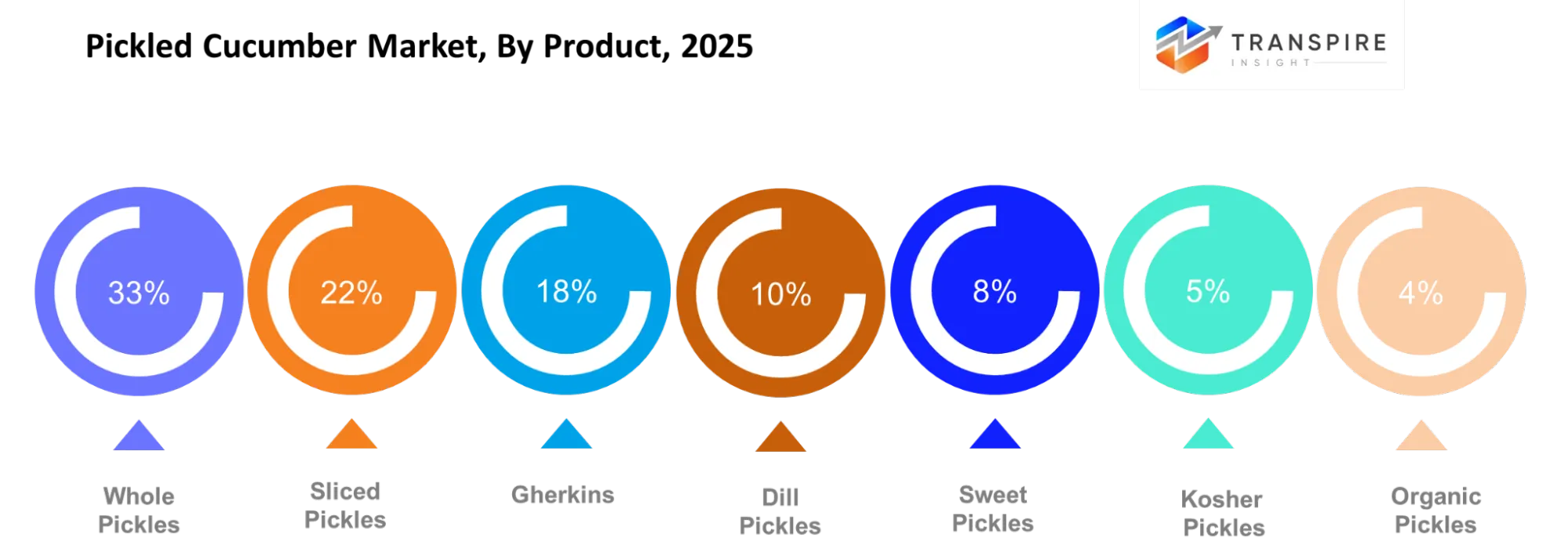
The Fermented Pickled Cucumbers dominated the market, accounting for nearly 47.3% in 2025, and is expected to rise at a significant CAGR during the forecast period.
The Pickled Cucumber Marketis segmented. By Product Type Whole Pickles, Sliced Pickles, Gherkins, Dill Pickles, Sweet Pickles, Kosher Pickles, Organic Pickles, Others Among these, the Fermented Pickled Cucumbers dominated the market, accounting for nearly 47.3% in 2025 and expected to increase at a significant CAGR during the forecast period.due to growing consumer preference for fermented foods, distinctive flavors, longer shelf life, natural preservation, digestive benefits, and increasing demand for minimally processed food products.
The Glass Jars segmentheld the greatest share of approximately 49.1% in 2025 and is expected to increase at a substantial CAGR over the forecast period.
The Pickled Cucumber Market is By Packaging Glass Jars, Plastic Containers, Pouches, Cans, Bulk Packaging, PET Jars, Others Among these, the Glass Jars segment held the greatest share of approximately 49.1% in 2025 and is expected to increase at a substantial CAGR over the forecast period.due to their excellent product visibility, chemical stability, recyclability, premium appearance, strong barrier properties, and ability to preserve the flavor, texture, and quality of pickled cucumbers.
The Supermarkets & Hypermarketssegmentheld the greatest share of approximately 45.4%in 2025 and is expected to increase at a high CAGR over the forecast period.
The Pickled Cucumber Market is segmented.By Distribution Channel Supermarkets & Hypermarkets, Convenience Stores, Online Retail, Specialty Stores, Wholesale, Foodservice, OthersAmong these the Supermarkets & Hypermarkets segment held the greatest share of approximately 44.9% in 2025 and is expected to increase at a considerable CAGR over the projected period. due to their extensive product variety, strong consumer reach, convenient shopping experience, competitive pricing, promotional activities, and widespread availability of pickled cucumber products across multiple regions.
Regional Segment Analysis of the Pickled Cucumber Market
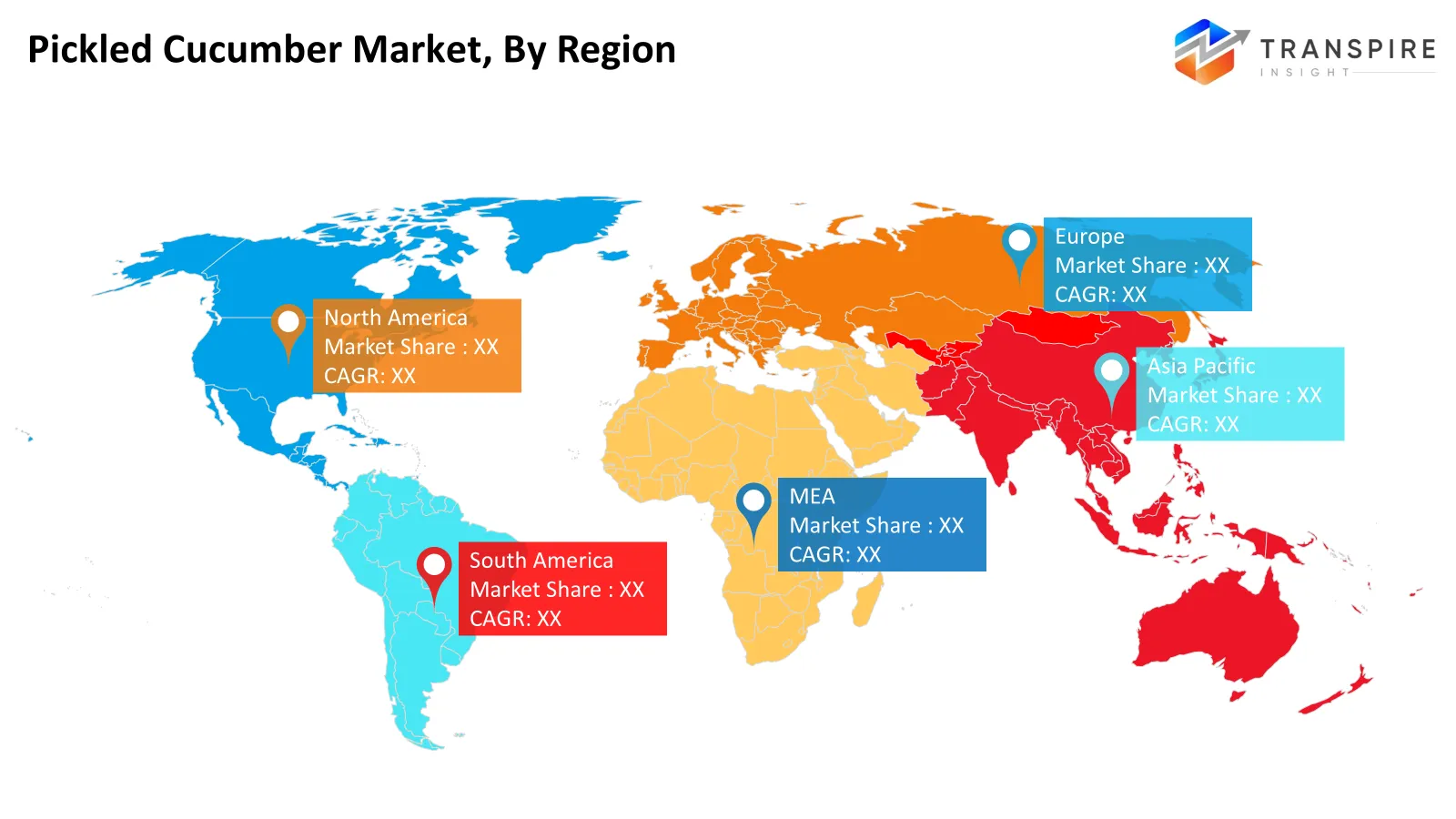
- North America (U.S., Canada, Mexico)
- Europe (Germany, France, U.K., Italy, Spain, Rest of Europe)
- Asia-Pacific (China, Japan, India, Rest of APAC)
- South America (Brazil and the Rest of South America)
- The Middle East and Africa (UAE, South Africa, Rest of MEA)
Asia Pacific is expected to grow at a rapid CAGR in the Pickled Cucumber Market by holding nearly 42% of the share during the forecast period.
Over the forecast period, the market for pickled cucumbers is anticipated to expand rapidly in Asia Pacific. The region accounts for nearly 42% of the market and is expected to maintain its leading position due to increasing consumer demand for convenient and ready-to-eat foods, rising consumption of pickled and fermented vegetables, growing preference for traditional and preserved food products, expanding food processing industries, increasing retail penetration, and rapid development of modern food distribution infrastructure in countries such as China, India, Japan, South Korea, Singapore, and Australia. Market demand is driven by increasing consumption of fermented and preserved foods, growing interest in natural food preservation, expanding availability of pickled cucumber products, rising demand for convenient side dishes and snacks, and increasing utilization of glass jars, plastic containers, flexible packaging, and other preservation-oriented packaging formats. The expansion of supermarkets, hypermarkets, convenience stores, online grocery platforms, specialty food retailers, and foodservice channels, combined with increasing investments in food processing, cold-chain infrastructure, packaging technologies, and sustainable food production, is further strengthening regional market growth. The rising adoption of pickled cucumber products, expanding food and beverage industries, increasing consumer interest in fermented foods, improved retail accessibility, and growing public and private investments in food processing and distribution infrastructure further support the growth of the Pickled Cucumber Market in Asia Pacific.
Europe is anticipated to hold approximately 24% share of the Pickled Cucumber Market over the predicted timeframe.
Over the course of the projected period, Europe is expected to hold approximately 24% market share of the Pickled Cucumber Market. The region's growth is primarily driven by increasing consumer demand for preserved and fermented vegetables, established consumption patterns for pickled foods, growing preference for convenient food products, stringent food safety and quality standards, expanding premium food categories, and rising demand for natural and traditionally processed food products across households, restaurants, foodservice operators, retailers, and food manufacturers. Germany, France, the UK, Italy, and Spain are among the countries demonstrating strong demand for pickled vegetables, fermented foods, convenient side dishes, and premium preserved food products. Manufacturers and retailers are increasingly focusing on product quality, ingredient transparency, sustainable packaging, extended shelf life, food safety, and innovative product formulations. Partnerships involving food processors, pickle manufacturers, packaging suppliers, supermarkets, hypermarkets, specialty retailers, foodservice companies, and online grocery platforms are accelerating the production, distribution, and adoption of diverse pickled cucumber products to improve product availability, enhance consumer choice, strengthen food quality, support sustainable packaging practices, and promote long-term market growth throughout Europe.
North America is anticipated to hold approximately 31% share of the Pickled Cucumber Market over the predicted timeframe.
North America is anticipated to hold around 31% of the worldwide market for Pickled Cucumbers throughout the forecast period. A well-established food and beverage ecosystem, strong retail infrastructure, advanced food processing capabilities, and increasing consumer demand for convenient, preserved, fermented, and ready-to-eat foods are expected to contribute to the region's sustained growth. Growing investments by food and beverage manufacturers, pickle producers, retailers, supermarkets, hypermarkets, restaurants, foodservice operators, specialty food companies, and online grocery platforms, increased demand for glass jars, convenient packaging, premium pickled products, fermented foods, and value-added vegetable products, and continuous advancements in food processing, preservation, packaging, distribution, and product innovation are contributing to market expansion. Additionally, efforts to develop new pickled cucumber varieties, improve shelf life, enhance packaging efficiency, expand retail availability, meet food safety requirements, increase consumer engagement, and introduce premium, organic, low-sodium, and naturally fermented products are driving innovation, product diversification, technology adoption, and commercialization in the North American Pickled Cucumber Market.
Strategies for Market Growth in Non-Leading Regions
By developing scalable, cost-effective, and efficient food processing and distribution infrastructure utilizing advanced pickling technologies, food preservation systems, sustainable packaging solutions, quality control technologies, cold-chain infrastructure, and digital retail platforms, non-leading regions can promote growth in the Pickled Cucumber Market. Through the development of local food and beverage manufacturing networks, optimized supply chain workflows, and value-added pickled cucumber processing, packaging, preservation, and distribution capabilities, regions can strengthen local food ecosystems and reduce dependency on limited established producers and fragmented distribution infrastructure. Commercialization and market penetration will be accelerated through strategic partnerships with food processors, pickle manufacturers, packaging suppliers, supermarkets, hypermarkets, retailers, restaurants, foodservice operators, online grocery platforms, and specialty food companies. To increase operational efficiency, product quality, shelf life, food safety, supply chain visibility, and consumer trust, investments in modern fermentation and pickling processes, automated processing equipment, sustainable packaging, quality assurance systems, cold-chain logistics, digital inventory management, and compliance with international food safety and quality standards are required. Government support for food processing initiatives, agricultural value-chain development programs, food safety frameworks, rural manufacturing, industry modernization, workforce development, and sustainable packaging investments can increase technology adoption, attract private investment, strengthen local production capabilities, and accelerate the long-term growth of the Pickled Cucumber Market in emerging economies.
Recent Development
In March, 2026, leading pickled cucumber manufacturers, food processing companies, and packaging solution providers announced advancements in pickling, fermentation, preservation, and packaging technologies with improved processing systems, enhanced food safety technologies, sustainable packaging solutions, and optimized shelf-life management capabilities. The innovation supports next-generation pickled cucumber production, improves product quality and consistency, promotes efficient preservation, and enhances food safety, packaging efficiency, supply chain management, product availability, consumer convenience, and sustainability across the food and beverage industry.
In June, 2026: Leading pickled cucumber companies expanded their product development and distribution capabilities with improved fermentation and pickling technologies, advanced food processing systems, automated packaging equipment, sustainable glass jar and container solutions, enhanced quality control technologies, cold-chain logistics, digital inventory management, and expanded retail and online distribution channels for supermarkets, hypermarkets, convenience stores, restaurants, foodservice operators, specialty food retailers, and online grocery platforms. The development supports advanced pickled cucumber production, improves processing and preservation efficiency, enhances product quality and shelf life, optimizes supply chain and distribution workflows, and strengthens reliable, scalable, and technology-driven pickled cucumber manufacturing and market distribution capabilities.
Future Market Trends for the Pickled Cucumber Market:
- Growing Adoption of Advanced Pickling, Fermentation, and Food Preservation Technologies: As food and beverage manufacturers, pickle producers, retailers, supermarkets, hypermarkets, restaurants, foodservice operators, specialty food companies, and online grocery platforms place greater priority on product quality, food safety, shelf life, consumer convenience, product consistency, sustainability, and cost optimization, producers are expanding their pickled cucumber capabilities, including advanced pickling processes, controlled fermentation systems, automated food processing, quality control technologies, sustainable packaging solutions, and efficient preservation technologies.
- Growing Need for Premium, Convenient, and Value-Added Pickled Cucumber Products: To meet increasing consumer demand for convenient, ready-to-eat, fermented, preserved, natural, organic, low-sodium, and premium vegetable products, food manufacturers are progressively developing diverse pickled cucumber formulations, innovative flavors, smaller convenient packaging formats, glass jar products, resealable containers, and value-added pickled cucumber solutions. Rising consumer interest in traditional foods, fermented products, clean-label ingredients, and convenient meal accompaniments is expected to support continued product innovation across the Pickled Cucumber Market.
- Increasing Investment in Sustainable Packaging, Digital Supply Chains, and Product Innovation: In order to improve production efficiency, product quality, shelf life, supply chain visibility, packaging sustainability, distribution efficiency, consumer engagement, cost optimization, scalability, and support next-generation food preservation ecosystems, organizations are investing in advanced pickling technologies, automated processing systems, sustainable glass and recyclable packaging, cold-chain logistics, digital inventory management, quality assurance technologies, traceability systems, online distribution platforms, and innovative Pickled Cucumber products.
Market Segment
This study forecasts revenue at , regional, and country levels from 2020 to 2033. Transpire Insights has segmented the Pickled Cucumber Market based on the below-mentioned segments
Pickled Cucumber Market, By Product Type
- Dill Pickled Cucumbers
- Bread and Butter Pickles
- Sweet Pickled Cucumbers
- Sour Pickled Cucumbers
- Kosher Pickles
- Gherkins
- Spicy Pickled Cucumbers
- Others
Pickled Cucumber Market, By Packaging Type
- Glass Jars
- Plastic Containers
- Pouches
- Cans
- Bottles
- Vacuum Packs
- Others
Pickled Cucumber Market, By Distribution Channel
- Supermarkets & Hypermarkets
- Convenience Stores
- Specialty Food Stores
- Online Retail
- Foodservice Distributors
- Direct Sales
- Others
Pickled Cucumber Market, By End User
- Household Consumers
- Restaurants
- Foodservice Operators
- Food Manufacturers
- Retailers
- Catering Companies
- Others
Pickled Cucumber Market, By Application
- Household Consumption
- Foodservice
- Sandwiches & Burgers
- Salads & Side Dishes
- Snacks
- Food Processing
- Others
Ingredient Transparency Market, By Regional Analysis
North America
- US
- Canada
- Mexico
Europe
- Germany
- UK
- France
- Italy
- Spain
- Rest of Europe
Asia Pacific
- China
- Japan
- India
- South Korea
- Australia
- Rest of Asia Pacific
South America
- Brazil
- Argentina
- Rest of South America
Middle East & Africa
- UAE
- Saudi Arabia
- Qatar
- South Africa
- Rest of the Middle East & Africa
Frequently Asked Questions
Find quick answers to common questions.
The market is driven by rising demand for convenient and ready-to-eat foods, growing preference for fermented and preserved products, expanding retail and foodservice networks, innovative flavors, sustainable packaging, and advancements in food processing technologies.
Asia Pacific is the leading region, accounting for nearly 42% of the market share during the forecast period, supported by increasing consumption of pickled and fermented vegetables, expanding food processing industries, and growing retail penetration.
The Glass Jars segment dominates the market, holding approximately 49.1% share in 2025, due to product visibility, chemical stability, recyclability, premium appearance, and strong barrier properties that help preserve product quality.
Technology is improving the market through controlled fermentation, automated pickling systems, advanced brining, precision processing, sustainable packaging, cold-chain monitoring, automated filling and sealing, and digital quality management, resulting in better consistency, food safety, shelf life, and production efficiency.
The The Pickled Cucumber Market is projected to grow from USD 11.42 billion in 2025 to USD 17.29 billion by 2033, registering a 5.41% CAGR from 2026 to 2033.
- Mt. Olive Pickle Company,
- Conagra Brands,
- Kraft Heinz,
- Del Monte Foods,
- Kühne,
- Hengstenberg,
- Reitzel Group,
- B&G Foods,
- Gedney Foods,
- Vlasic,
- Orkla Foods,
- Kühne + Nagel Food,
- ADF Foods,
- Mrs. Elswood,
- McClure's Pickles
About the Authors

Chetan Dhatrak
I’m Chetan Dhatrak, a Senior Research Analyst at Transpire Insight, specializing in the Consumer Goods, Foods and Beverages industry. I focus on analyzing market trends, consumer behavior, competitive landscapes, and industry developments to deliver accurate, data-driven insights. My research at Transpire Insight is built on credible sources and in-depth analysis, helping businesses and readers better understand market dynamics, emerging opportunities, and evolving consumer preferences. I’m committed to creating reliable, well-researched content that supports informed decision-making and reflects the latest developments in the consumer goods and food & beverage sectors.

Chakradhar Khansole
Chakradhar serves as the Research Director at Transpire Insight, bringing over 8 years of experience in technology, innovation, and strategic market intelligence. He specializes in transforming complex market data into actionable business insights that enable organizations to make informed, growth-oriented decisions. Recognized for his strategic vision and analytical expertise, Chakradhar leads high-impact research initiatives, delivering comprehensive market assessments, competitive intelligence, and forward-looking industry analysis.
Recently Published Reports
-
Apr 2026
Baby Infant Formula Market
Baby Infant Formula Market Size, Share & Analysis Report By ype (Infant Milk, Follow On Milk, Specialty Baby Milk, Growing-Up Milk), By Ingredient (Carbohydrate, Fat, Protein, Minerals, Vitamins, and Others), By Product Form (Powder, Liquid, and Ready-to-feed), By Distribution Channels (Supermarket/Hypermarket, Specialty Store, Pharmacies, Online Retail, and Others), and Geography (North America, Europe, Asia-Pacific, Middle East and Africa, South and Central America), 2021 - 2031
-
Apr 2026
Edible Insects for Animal Feed Market
Edible Insects for Animal Feed Market Size, Share & Analysis Report By Type (Insect Powder, Insect Meal, Insect Bar, Insect Paste, Insect Oil, and Others), By Insect Type (Beetles, Cricket, Caterpillar, Hymenoptera, Orthoptera, Tree Bugs, and Others), By Application (Livestock, Pet Food, and Aquaculture), By Livestock Type (Poultry, Swine, and Others), and Geography (North America, Europe, Asia-Pacific, Middle East and Africa, South and Central America), 2021 - 2031
-
Apr 2026
Food Industry Disinfection and Bacterial Control Market
Food Industry Disinfection and Bacterial Control Market Size, Share & Analysis Report By Type (Chemical Disinfectants, Physical Disinfectants, and Biocides and Antimicrobials), By Application (Food Processing Equipment Surface Disinfection, Food Preparation Areas Surface Disinfection, Storage Areas Surface Disinfection, Anti-microbial Coatings Food Preservation, and Preservative Solutions Food Preservation), By End User (Meat and Poultry Processing, Dairy Processing, Seafood Processing, Bakery and Confectionery, Restaurants and Commercial Kitchens, and Food Service Providers), By Sales Channel (Online, Offline), and Geography (North America, Europe, Asia-Pacific, Middle East and Africa, South and Central America), 2021 - 2031
-
May 2026
Freeze Dried Food Market
Freeze Dried Food Market Size, Share & Analysis Report By Product Type (Fruits, Vegetables, Freeze-Dried Dairy Products, Freeze-Dried Meat and Seafood, Freeze-Dried Pet Food, and Prepared Meal), By Nature (Organic, and Conventional), By Form (Powdered, Granules, and Diced), By End Use (Breakfast Cereals, Dairy Products, Bakery & Confectionery, Nutritional Bars & Supplements, Powdered Beverages, Snacks, and Retail (Household)), and Geography (North America, Europe, Asia-Pacific, Middle East and Africa, South and Central America), 2021 - 2031