

Pharmaceutical Management Software Market Summary:
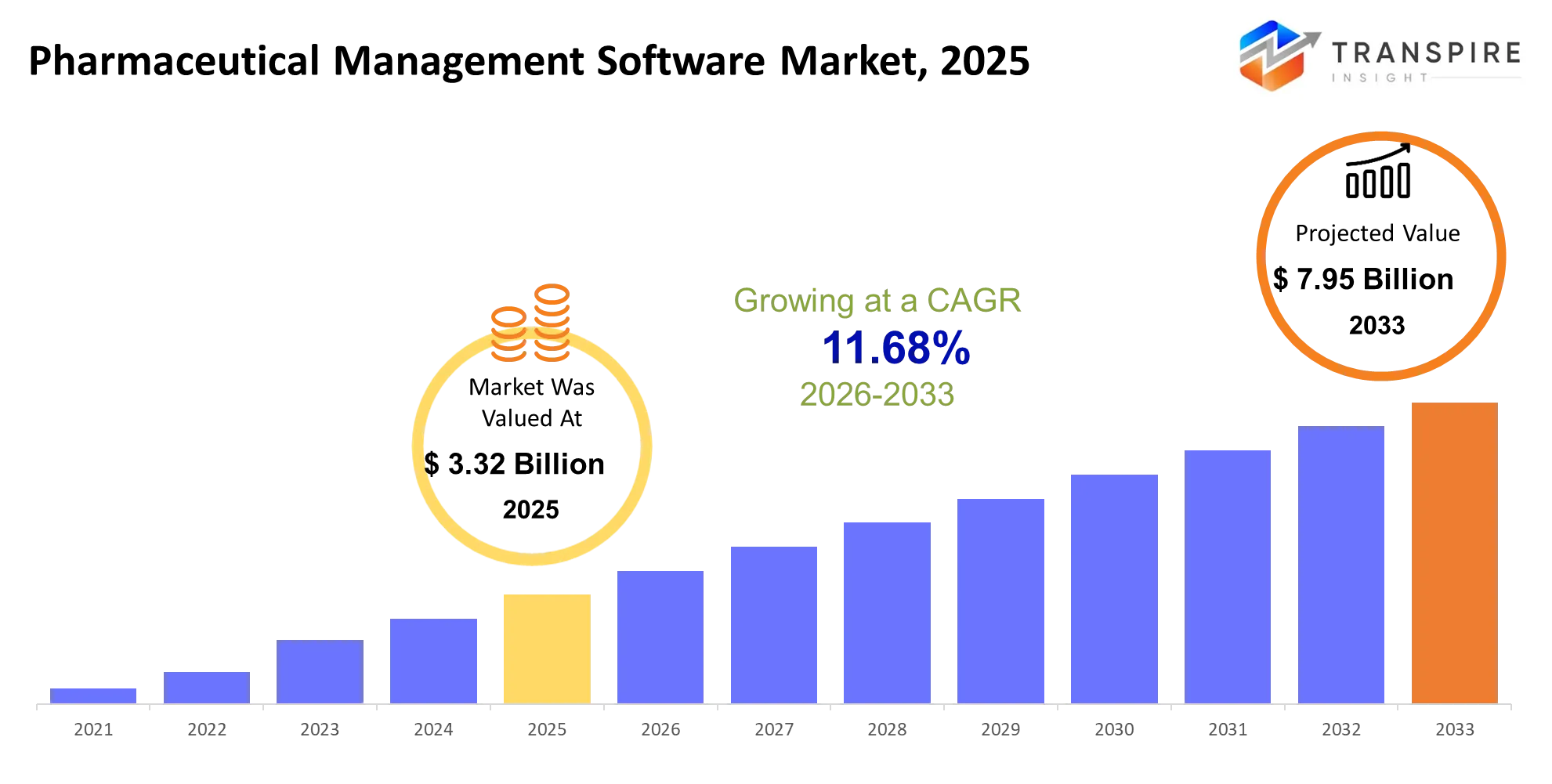
As per Transpire Insight, the Pharmaceutical Management Software Market size is estimated at USD 3.32 billion in 2025 and is anticipated to reach USD 7.95 billion by 2033, growing at a CAGR of 11.68% from 2026 to 2033.
The Pharmaceutical management software is changing from tools used by different departments to connected platforms that bring together manufacturing, quality, regulatory work, supply chains, commercial activity and enterprise data. In the past three to five years cloud deployment, paperless workflows, real-time data exchange and AI-assisted functions have changed the way pharmaceutical companies handle daily tasks. A big change has been the move to customizable systems that link MES, ERP, quality and regulatory processes instead of having information in separate applications. This has increased the need for access, digital records and quicker coordination. Growth is happening because there is a need to cut down on manual documentation, make tracking easier, respond faster to compliance rules and use production and business data to make better choices. As pharmaceutical operations get more complicated, software use is going beyond record keeping, into automation, analysis and connected decision support.
Pharmaceutical Management Software Market Size & Forecast:
- Market Size 2025: USD 3.32 Billion
- Expected Market Value (2033): USD 7.95 Billion
- Forecast CAGR (2026-2033): 11.68%
- Leading Region in 2025: North America
- Fastest Growing Region: Asia-Pacific
- Key Company Profiles: Oracle, SAP, Veeva Systems, MasterControl, Dassault Systèmes, Siemens, Körber Pharma, Aspen Technology, PTC, Honeywell, Rockwell Automation, Sparta Systems, TraceLink, IQVIA, L7 Informatics
Key Market Insights:
The market is moving towards integrated, compliant platforms, with manufacturing execution still being the biggest solution category, with artificial intelligence, cloud-connected devices, and data-driven quality management becoming more critical factors.
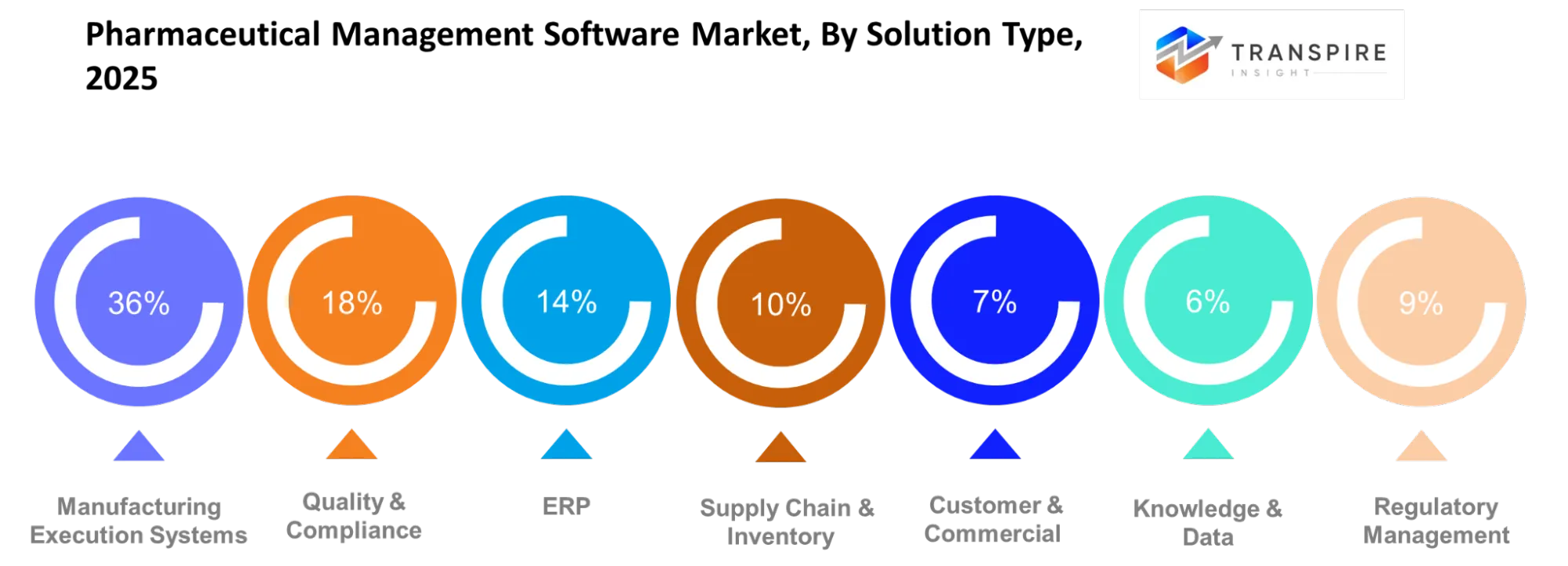
- Manufacturing Execution Systems constitute 36.12%, making it the most extensive solution category.
- Siemens Opcenter Execution Pharma solution has been constantly improved with features such as web-enabled execution and electronic batch records owing to the shift in the industry towards paperless manufacturing.
- Quality & Compliance Management constitutes 18.00% of the market share and has become increasingly technology-oriented as companies use technology solutions for quality management and compliance processes.
- ERP takes up 14.00%, as pharmaceutical companies integrate financial, production, and procurement processes.
- Supply Chain & Inventory takes up 10.00%, backed by real-time inventory and supply chain visibility.
- Customer & Commercial stands for 7.00%, as vendors add artificial intelligence-based CRM capabilities.
- Knowledge & Data takes up 6.00%, as pharmaceutical data become more centralized.
What are the Key Drivers, Restraints, and Opportunities in the Pharmaceutical Management Software Market?
Drivers:
The shift from paper-based systems to connected digital processes is driving software adoption. Growing demand for electronic recordkeeping, batch tracking, documentation, and audit capabilities has compelled firms to adopt MES, ERP, and quality management software. The move helps organisations eliminate manual data entry, enhance visibility of production, and integrate manufacturing data with quality and supply chain systems.
Restraints:
Implementation challenges of high complexity are still a critical obstacle. Validation, integration with the existing enterprise and production software, and integration of compliance requirements increase implementation time, training needs, maintenance expenses, and integration effort. The problem exists because pharmaceutical companies cannot change their validated processes without considering the integrity of data, system performance, security, and regulatory aspects.
Opportunities:
AI-powered and modular cloud platforms provide enormous growth potential. Providers may integrate predictive analytics, automated documentation, intelligent workflow support, and API integration with pharmaceutical software. For instance, the use of AI-assisted manufacturing and quality workflows may allow identifying problems with operations in advance and eliminating routine paperwork. Cloud and hybrid implementation can also assist regional manufacturers, biotech firms, and CDMOs in deploying modern systems without building the necessary infrastructure.
What Has the Impact of Artificial Intelligence Been on the Pharmaceutical Management Software Market?
The use of Artificial Intelligence is transforming pharmaceutical management software by incorporating prediction, automation, and decision-making into existing workflows. On the manufacturing side, AI can help with instructions for production, detect abnormal process behaviours, and accelerate the review of information about operations. The Opcenter Execution Pharma release by Siemens brought in the new features of AI-driven design and AI-based support, as well as enhancements to web-based work instructions and system integration. With respect to commercial activities, Veeva has created AI Agents designed specifically for the pharmaceutical industry that work within applications based on context, documents, and workflows and automate certain tasks. the implementation process is not without obstacles. Pharmaceutical companies still have to validate processes, ensure the safe handling of data, have good governance practices, and integrate successfully with legacy systems. Certain AI outcomes still have to be reviewed manually if they impact quality, compliance, and record-keeping.
Instance:
In April 2025, Veeva Systems unveiled Veeva AI, an AI that integrates AI agents and AI shortcuts into its Vault platform and apps. This technology automates industry-specific activities in clinical, regulatory, safety, quality, medical, and commercial areas.
https://www.veeva.com/medtech/news/announcing-veeva-ai/
Key Market Trends:
The market is shifting from simply keeping digital records to becoming more interconnected and automation-friendly in pharmaceutical practices. There is an increasing trend among companies in adopting cloud computing solutions, artificial intelligence, and analytics.
- Drug manufacturing companies have been switching to electronic documentation instead of the paper documentation process.
- Software solutions used in drug manufacturing are being made more integrated and networked.
- Drug manufacturers have been shifting towards cloud computing solutions for ease of access and updates.
- Software solutions are now being integrated with AI for improved functionality in document management and workflows.
- Pharmaceutical firms have been adopting data analytics solutions to help solve problems of quality and production.
- Drug manufacturing companies have started shifting towards the use of electronic batch records.
Pharmaceutical Management Software Market Segmentation
By Solution Type:
The Manufacturing Execution Systems have the highest share in the market with 36.12%, providing the segment a key position within the digital pharma space. The segment enjoys high value addition because of the requirement for integration of manufacturing records, process monitoring, quality management, and manufacturing processes. Quality & Compliance Management holds 18.00%, ERP has 14.00%, Supply Chain & Inventory Management has 10.00%, Customer & Commercial Management has 7.00%, Knowledge & Data Management has 6.00%, Regulatory Management has 5.00%, and Others have 3.88%. Quality & Compliance Management is considered to be the fastest-growing solution segment at 13.06% CAGR.
By Deployment:
The trends in terms of deployment involve moving from on-premises to cloud-based/hybrid architectures by pharmaceutical organisations due to the need for scalable solutions without giving up control over the regulated data. The use of on-premises solutions is still relevant in cases when there are legacy systems, validations at sites, or internal controls that cannot be implemented elsewhere. Different options for scalability, integration, security, and control such as Cloud-Based, Hybrid, Private Cloud, Public Cloud, Multi-Cloud, and Edge solutions are available for different situations.
By End User:
Pharmaceutical Companies represent the main end-users who need the software due to the needs of various departments. Manufacturing, quality, regulatory, supply-chain management, clinical trials, and commercial activities. Biotechnology Firms and CDMOs/CMOs also represent potential end-users due to the increasing complexity of development pipelines and outsourcing manufacturing operations. Additional end-users like CROs, Hospitals & Clinics, Research Institutes, Distributors, and others are important due to the need for clinical data, coordination, regulatory documents, and supply chain visibility.
By Function:
Manufacturing is well-integrated with the leading Manufacturing Execution Systems function, whereas Quality Control and Regulatory Affairs add value through increased need for process-controlled systems. The Supply Chain, Clinical Operations, Sales & Marketing and Finance areas have increasing connection within the pharmaceutical industry as the companies look for consistent information flow throughout the business. This implies that there will be a growing need for systems that link operational and administrative processes.
By Enterprise Size:
Large Enterprises and Pharma Groups are important users since they cover multiple products, locations, countries and different regulations. Medium Enterprises, Small Enterprises, Startups, Regional Pharma Companies, and Virtual Pharma are also important user segments as cloud-based systems reduce infrastructure costs related to enterprise software. Different enterprise sizes imply different configurations, integration, implementation needs and cost structures. Vendors with scalable architecture and modular capabilities will thus be able to target established pharmaceutical groups as well as emerging life-science companies.
What are the Key Use Cases Driving the Pharmaceutical Management Software Market?
Manufacturing execution represents the primary use case, since it involves linking manufacturing activities with digital documentation, quality assurance, scheduling, and traceability. In this regard, it corresponds to Manufacturing Execution Systems among the components of the solution. Some other use cases involve quality and compliance management, ERP, supply chain and inventory management, regulatory work, and commerce, where connectivity helps to eliminate duplication of efforts and streamline collaboration. Potential future use cases are evolving towards document processing with AI assistance, predictive exceptions identification, smart forecasting, and workflow automation in areas like clinical, regulatory, safety, and customer services. These types of applications will be especially useful for pharmaceutical companies, biotech companies, CDMOs/CMOs, and CROs.
|
Report Metrics |
Details |
|
Market size value in 2025 |
USD 3.32 Billion |
|
Market size value in 2026 |
USD 3.67 Billion |
|
Revenue forecast in 2033 |
USD 7.95 Billion |
|
Growth rate |
CAGR of 11.68% from 2026 to 2033 |
|
Base year |
2025 |
|
Historical data |
2021 - 2024 |
|
Forecast period |
2026 - 2033 |
|
Report coverage |
Revenue forecast, competitive landscape, growth factors, and trends |
|
Regional scope |
United States; Canada; Mexico; United Kingdom; Germany; France; Italy; Spain; Denmark; Sweden; Norway; China; Japan; India; Australia; South Korea; Thailand; Brazil; Argentina; South Africa; Saudi Arabia; United Arab Emirates |
|
Key company profiled |
Oracle, SAP, Veeva Systems, MasterControl, Dassault Systèmes, Siemens, Körber Pharma, Aspen Technology, PTC, Honeywell, Rockwell Automation, Sparta Systems, TraceLink, IQVIA, L7 Informatics |
|
Customization scope |
Free report customization (country, regional & segment scope). Avail customized purchase options to meet your exact research needs. |
|
Report Segmentation |
Solution Type (Manufacturing Execution Systems, Quality & Compliance Management, ERP, Supply-Chain & Inventory Management, Customer & Commercial Management, Knowledge & Data Management, Regulatory Management, Others); Deployment (On-Premise, Cloud-Based, Hybrid, Private Cloud, Public Cloud, Multi-Cloud, Edge, Others); End User (Pharmaceutical Companies, Biotechnology Firms, CDMOs/CMOs, CROs, Hospitals & Clinics, Research Institutes, Distributors, Others); Function (Manufacturing, Quality Control, Regulatory Affairs, Supply Chain, Clinical Operations, Sales & Marketing, Finance, Others); Enterprise Size (Large Enterprises, Medium Enterprises, Small Enterprises, Startups, Pharma Groups, Regional Pharma Companies, Virtual Pharma, Others) |
Which Regions are Driving the Pharmaceutical Management Software Market Growth?
North America:
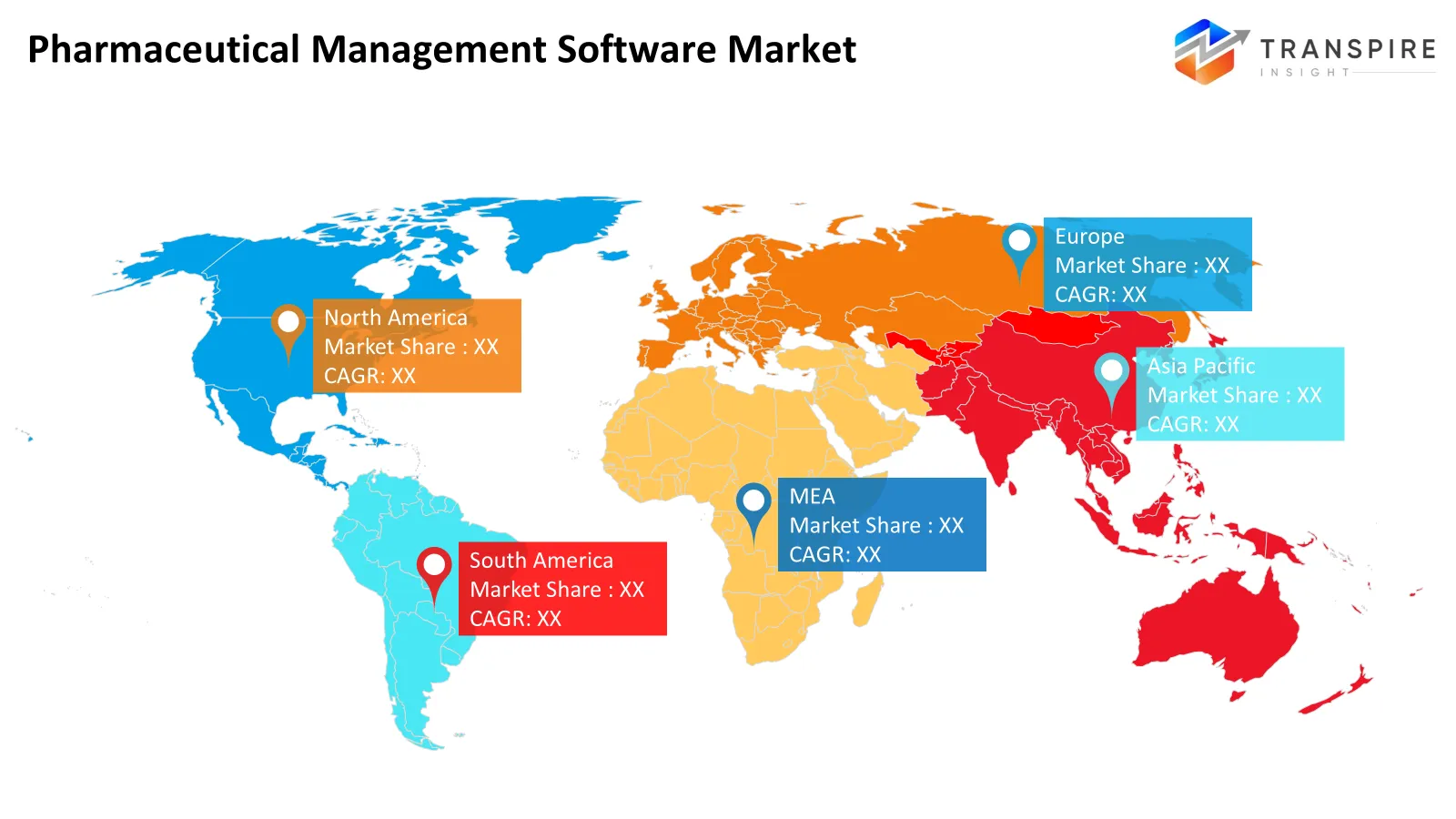
North America accounts for 41.18% of the market in pharmaceutical management software. This is the largest regional market as per the segmentation provided. The region's advantage includes the presence of well-established pharmaceutical companies, developed digital infrastructure, adoption of enterprise software and stringent data management compliance requirements. There is also a robust software vendor ecosystem and clinical, technology and healthcare establishments that will assist in the implementation of software. Continued investments in the connected platform and AI-based workflows will continue to drive adoption of software within manufacturing, quality, regulatory and commercial roles.
In January 2025, Veeva Systems and Zifo collaborated to transform pharmaceutical quality control through integration of Veeva LIMS with Zifo’s data management platform.
Europe:
Europe constitutes 27.00% of the market for pharmaceutical management software. This continues to be an important market along with North America. The demand is driven by stringent regulations, pharmaceutical business activities that span borders, data governance needs, and the requirement for consistent quality processes within multiple countries. This means that pharmaceutical companies and research organisations need to standardise their documentation, compliance workflows and process-related data. The presence of the established life sciences sector ensures that there will be a stable adoption of software despite the movement towards cloud platforms.
In February 2025, Servier chose Veeva RIM for streamlining their regulatory operations by managing their regulatory data, documentation, and processes through one platform.
Asia-Pacific:
The Asia-Pacific region holds 23.00% of the world market share of pharmaceutical management software, which is recognised as the fastest-growing region with a CAGR of 14.71%. The expansion of this market is facilitated by the expansion of pharmaceutical manufacturing, biotech activities, digital transformation, and increased use of cloud-based enterprise solutions. There is also a rise in the significance of this region for manufacturing, clinical trials, contract development, and manufacturing. This presents an opportunity for vendors that can provide a platform that fits well into different regulatory environments and growing pharmaceutical companies.
In August 2025, Tata Consultancy Services formed a partnership with Unilab, a renowned pharmaceutical company in the Philippines, to update its enterprise applications via cloud migration. TCS is assisting Unilab in migrating from its current ERP application to SAP S/4HANA on RISE, thus forming a cloud-based digital core for operations, decision making, logistics, and compliance.
Who are the Key Players in the Pharmaceutical Management Software Market and how do they Compete?
The competition in pharmaceutical management software is being driven by platform capability, verticalized workflows, data integration, AI functionality, and the ability to operate in a regulated environment. Competitors are defining themselves by extending beyond discrete applications to interconnected environments covering development, quality, regulation, manufacturing, supply chain, and commercial functions. Veeva operates a platform and innovation strategy, leveraging its Vault for core life sciences workflows and agentic functions such as Falcon and AI-driven CRM. The company’s acquisition of Copli provided agentic medical, legal, and regulatory content review via Falcon MLR.IQVIA provides software integrated with data and analytics, clinical trials, and commercial knowledge. SAP competes via enterprise resource planning, supply chain management, finance management, and process integration, making it relevant when pharmaceutical companies seek enterprise-level control. MasterControl defines itself based on quality and manufacturing workflows, making it suitable for companies requiring controlled digital processes.
Pharmaceutical Management Software Market companies
- Oracle
- SAP
- Veeva Systems
- MasterControl
- Dassault Systèmes
- Siemens
- Körber Pharma
- Aspen Technology
- PTC
- Honeywell
- Rockwell Automation
- Sparta Systems
- TraceLink
- IQVIA
- L7 Informatics
Recent Development News
- In June 2026, Veeva Systems acquired Copli and Veeva Falcon MLR was introduced. This acquisition provided agentic review of medical, legal, and regulatory issues within the product offerings of Veeva Systems, where the solution aimed at automating compliance reviews. https://www.veeva.com/resources/veeva-acquires-copli-launches-veeva-falcon-mlr-to-accelerate-content-review/
- In August 2025, IQVIA and Flagship Pioneering entered into a strategic partnership. This is a combination of IQVIA's data, analytics, artificial intelligence, clinical research, and life sciences with that of Flagship's biopharma ecosystem. https://www.iqvia.com/newsroom/2025/08/iqvia-and-flagship-pioneering-announce-strategic-collaboration
What Strategic Insights Define the Future of the Pharmaceutical Management Software Market?
The market is evolving towards connected pharmaceutical ecosystems where software, data, and AI solutions become cross-functional rather than being kept in separate applications belonging to each department. The vendor will have a strong emphasis on agentic automation capabilities, data modeling, cloud platforms, and intelligent workflows to reduce the amount of repetition and leave the decision-making to humans. It is important to note that the legacy architectures may cause fragmentation that will influence the quality and integration of data and, hence, will lead to a poor return on investment from advanced analytics and AI. Another risk is the problem of validation when switching to new technologies in controlled environments.the opportunity of combining domain-specific controls with AI in order to automate the process will remain. Veeva, IQVIA, and Medidata have already taken this step. Strategically, pharmaceutical companies should focus on interoperability, data governance, staged deployment, and workflow benefits instead of considering AI as an independent solution.
Key Segmentations are:
By Solution Type
- Manufacturing Execution Systems
- Quality & Compliance Management
- Enterprise Resource Planning (ERP)
- Supply Chain & Inventory Management
- Customer & Commercial Management
- Knowledge & Data Management
- Regulatory Management
- Others
By Deployment
- On-Premise
- Cloud-Based
- Hybrid
- Private Cloud
- Public Cloud
- Multi-Cloud
- Edge
- Others
By End User
- Pharmaceutical Companies
- Biotechnology Firms
- CDMOs/CMOs
- CROs
- Hospitals & Clinics
- Research Institutes
- Distributors
- Others
By Function
- Manufacturing
- Quality Control
- Regulatory Affairs
- Supply Chain
- Clinical Operations
- Sales & Marketing
- Finance
- Others
By Enterprise Size
- Large Enterprises
- Medium Enterprises
- Small Enterprises
- Startups
- Pharma Groups
- Regional Pharma Companies
- Virtual Pharma
- Others
By Regional Analysis
North America
- US
- Canada
- Mexico
Europe
- Germany
- UK
- France
- Italy
- Spain
- Russia
- Rest of Europe
Asia Pacific
- China
- Japan
- India
- South Korea
- Australia
- Rest of Asia Pacific
South America
- Brazil
- Argentina
- Rest of South America
Middle East & Africa
- UAE
- Saudi Arabia
- Qatar
- South Africa
- Rest of the Middle East & Africa
Frequently Asked Questions
Find quick answers to common questions.
The pharmaceutical management software market size was valued at USD 3.32 billion in 2025 and is poised to reach USD 7.95 billion by 2033, expanding at a 11.68% CAGR.
Key segments for the pharmaceutical management software market are Solution Type (Manufacturing Execution Systems, Quality & Compliance Management, ERP, Supply-Chain & Inventory Management, Customer & Commercial Management, Knowledge & Data Management, Regulatory Management, Others); Deployment (On-Premise, Cloud-Based, Hybrid, Private Cloud, Public Cloud, Multi-Cloud, Edge, Others); End User (Pharmaceutical Companies, Biotechnology Firms, CDMOs/CMOs, CROs, Hospitals & Clinics, Research Institutes, Distributors, Others); Function (Manufacturing, Quality Control, Regulatory Affairs, Supply Chain, Clinical Operations, Sales & Marketing, Finance, Others); Enterprise Size (Large Enterprises, Medium Enterprises, Small Enterprises, Startups, Pharma Groups, Regional Pharma Companies, Virtual Pharma, Others).
Growth is primarily driven by Increasing manufacturing of drugs, rising needs of automation and digitalization, increasing need for regulatory compliance, rising cloud software adoption, and the need for increased efficiency in operations and supply chain management.
The market is led by major manufacturers including Oracle, SAP, Veeva Systems, MasterControl, Dassault Systèmes, Siemens, Körber Pharma, Aspen Technology, PTC, Honeywell, Rockwell Automation, Sparta Systems, TraceLink, IQVIA, L7 Informatics.
North America represents 41.18% of the pharmaceutical management software market across the globe. This is because of the presence of several pharmaceutical and biotech firms, high penetration of cloud-based software systems, developed health IT infrastructure, and increasing regulatory requirements.
Commercial opportunities in the pharmaceutical management software market are the rise in popularity of cloud-based applications, increase in need for artificial intelligence-based analytics and automation, growth in software offerings from small and medium-sized pharmaceutical organizations, supply chain and regulatory management system integration, and increasing demand for software to optimize manufacturing operations.
- Oracle
- SAP
- Veeva Systems
- MasterControl
- Dassault Systèmes
- Siemens
- Körber Pharma
- Aspen Technology
- PTC
- Honeywell
- Rockwell Automation
- Sparta Systems
- TraceLink
- IQVIA
- L7 Informatics
About the Authors

Pankaj Ghogare Patil
I am Pankaj Ghogare Patil, a Senior Research Analyst at Transpire Insight, specializing in the Pharmaceutical, Chemicals & Materials, Healthcare IT, and Biotechnology industry. My expertise lies in conducting comprehensive market research, analyzing industry trends, evaluating competitive landscapes, and translating complex data into actionable insights. At Transpire Insight, I closely follow emerging technologies, regulatory developments, and market innovations to create accurate, well-researched, and informative content that helps businesses and professionals make informed decisions. I am committed to producing credible, evidence-based articles that reflect industry best practices while making technical topics accessible and valuable for a broad audience.

Chakradhar Khansole
Chakradhar serves as the Research Director at Transpire Insight, bringing over 8 years of experience in technology, innovation, and strategic market intelligence. He specializes in transforming complex market data into actionable business insights that enable organizations to make informed, growth-oriented decisions. Recognized for his strategic vision and analytical expertise, Chakradhar leads high-impact research initiatives, delivering comprehensive market assessments, competitive intelligence, and forward-looking industry analysis.
Recently Published Reports
-
Apr 2026
AI in Diabetic Retinopathy Market
AI in Diabetic Retinopathy Market Size, Share & Analysis Report By Type (Screening AI Systems, Diagnostic AI Systems, and Predictive AI Models), By Application Segment (Hospitals, Ophthalmology Clinics, Diagnostic Centers, and Research and Development), and Geography (North America, Europe, Asia-Pacific, Middle East and Africa, South and Central America), 2021 - 2031
-
Apr 2026
Psychometric Tests Market
Psychometric Tests Market Size, Share & Analysis Report By Type (Personality Tests, Ability/Aptitude Tests, Skill/Knowledge Tests, and Others), By Application (Talent Acquisition and Talent Management), and Geography (North America, Europe, Asia-Pacific, Middle East and Africa, South and Central America), 2021 – 2031
-
Apr 2026
Rare Biological Sample Collection Market
Rare Biological Sample Collection Market Size, Share & Analysis Report By Type (Isolation Kits & Reagent, Blood Collection Tubes, and Others), By Application (Oncology, Transcriptomics, Pharmacogenomics, and Others), and Geography (North America, Europe, Asia-Pacific, Middle East and Africa, South and Central America), 2021 – 2031
-
Jul 2026
Diabetic Retinopathy Market
Diabetic Retinopathy Market Size, Share & Analysis Report By Type (Proliferative Diabetic Retinopathy, and Diabetic Macular Edema (DME)), By Treatment Type (Anti VEGF Drug, Steroid Implants, Laser Surgeries, and Vitrectomy), and Geography (North America, Europe, Asia-Pacific, Middle East and Africa, South and Central America), 2021 – 2031
Our Clients







