

Pension Fund Market Summary:
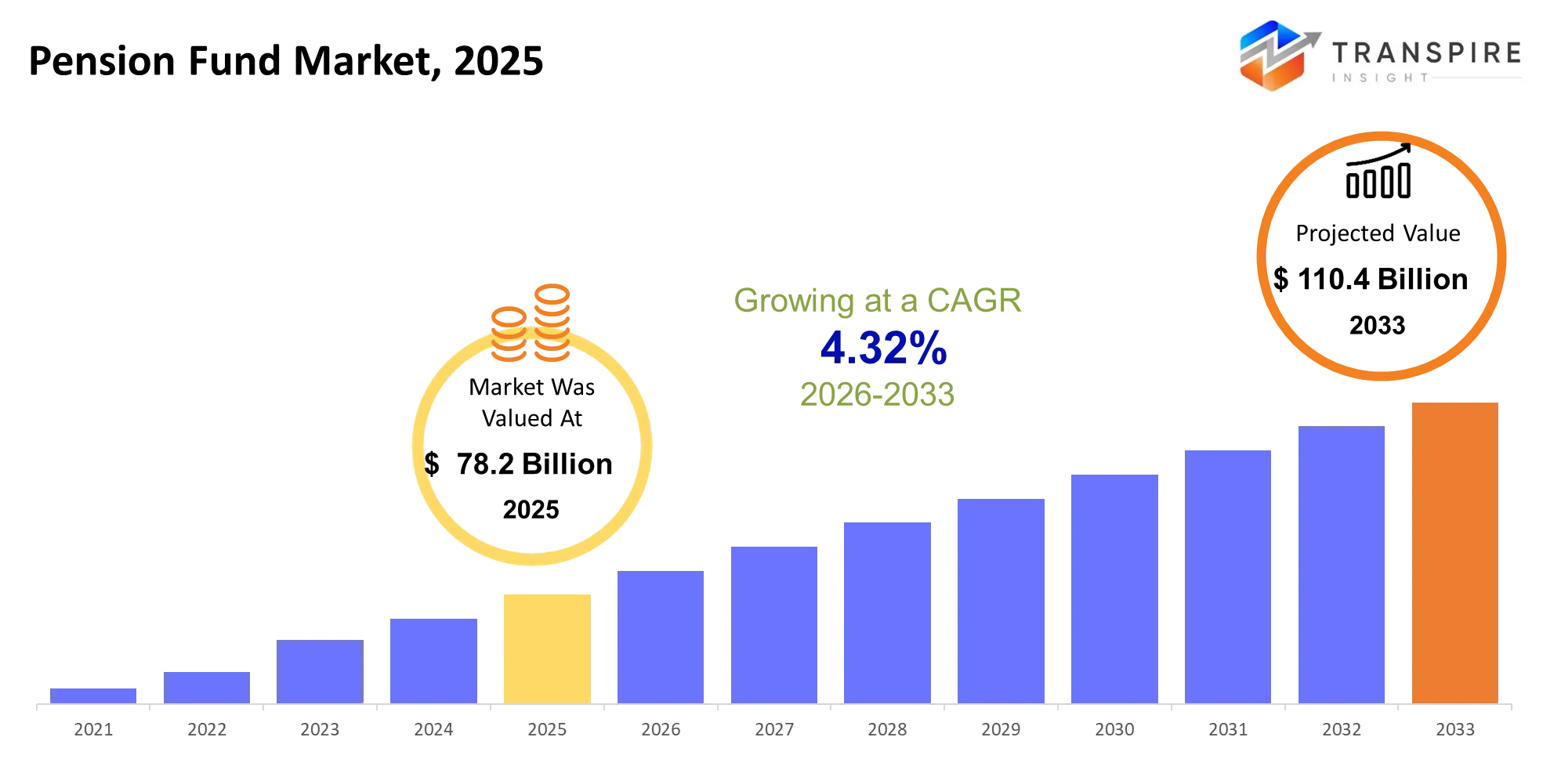
As per the Transpire Insight Analysis, The Pension Fund Market size is estimated at USD 78.2 Billion in 2025 and is anticipated to reach USD 110.4 Billion by 2033, growing at a CAGR of 4.32% from 2026 to 2033.
The world is moving towards a digitally created, goal-oriented retirement system from traditional long-term asset ownership. Well-funded defined-contribution plans, digital administration, customised solutions, and private-market access have attained importance over the past three to five years as sponsors re- align to evolved workforces and governance trends. Two significant structural changes are finance management through technology, as automated contribution processing, member portals, analytics, and digital advice improve service frictions and insight; and policy-making that is altering product design as retirement age and pension regulations adapt to accommodate ageing populations. This is important as extended retirement periods require more sustainable wealth accumulation and risk management expertise; pension assets currently equal 95% of aggregated OECD economic output, an increase from 87% two years earlier; and increased pension pools serve as additional capital, portfolio, and infrastructure opportunities for investment managers, administrators, and entities around the world.
Pension Fund Market Size & Forecast:
- Market Size 2025: USD 78.2 Billion
- Expected Market Value (2033): USD 110.4 Billion
- Forecast CAGR (2026-2033): 4.32%
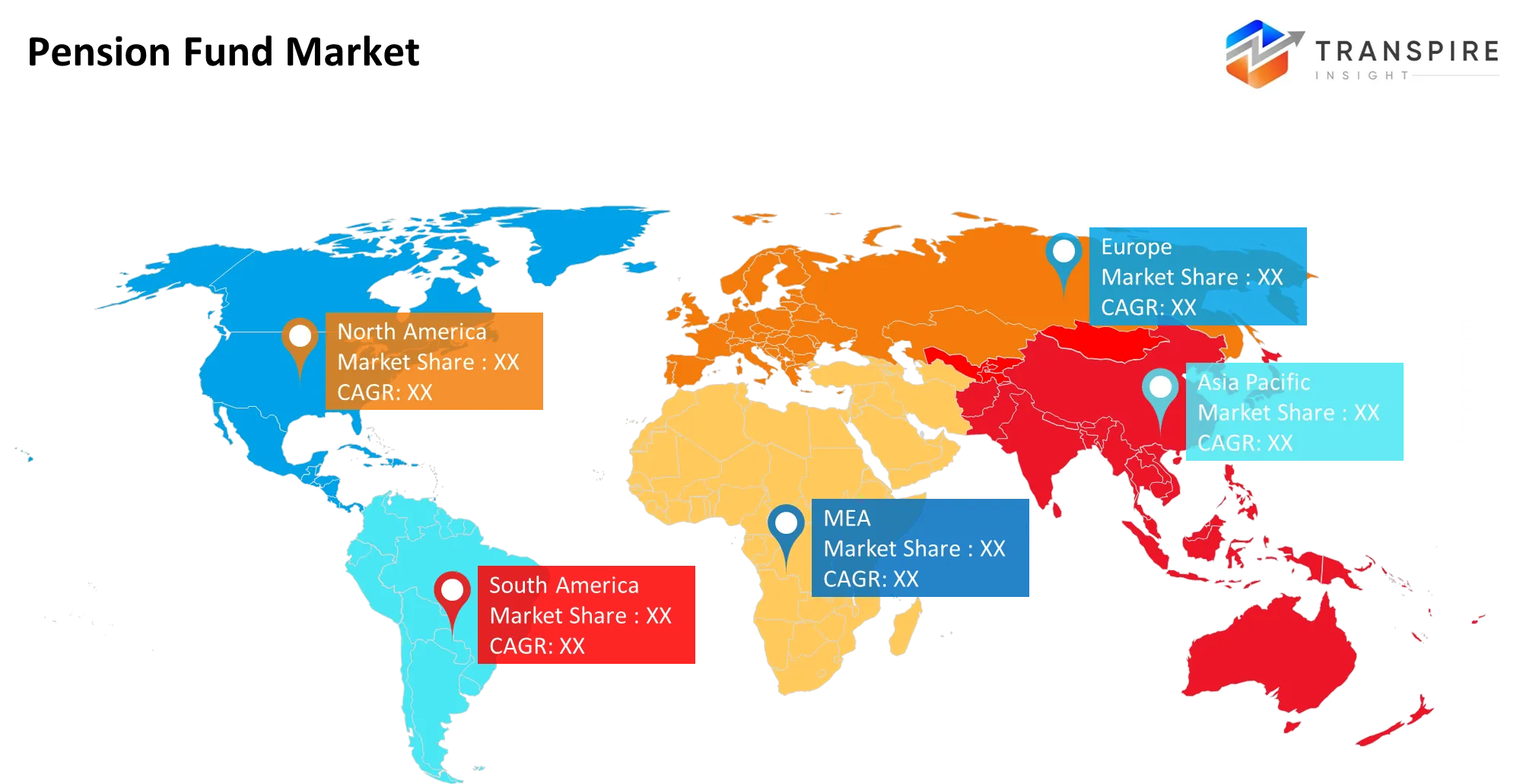
- Leading Region in 2025: North America
- Fastest-Growing Region: Asia Pacific
- Key Company Profiles: BlackRock, Vanguard, Fidelity, State Street Advisors, T. Rowe Price, Capital Group, JPMorgan Asset Management, Goldman Sachs Asset Management, PIMCO, Northern Trust, Legal & General, Amundi, Allianz Investors, Mercer, Aon.
Key Pension Fund Market Insights:
Pension funds are shifting from asset building to tangible outcomes for retirement, and plan design, private assets, guaranteed income, and digital administration are increasingly intertwined. This change is increasingly reflected in company strategies, which include investment innovation, automated participant engagement, and outsourcing retirement services.
- 70.65% of North America is supported by 401(k)/403(b) ecosystems, auto-enrollment and advanced asset-management platforms.
- Pillar II/III reforms, IORP II governance, and increasing fixed income allocations to ESG are the key drivers of Europe's 16% base.
- The 9% in Asia Pacific is growing at a 6.65% CAGR through compulsory schemes, digital onboarding, and the increasing awareness of the middle class about retirement.
- The 2.5% is scaling in Latin America through AFP-style DC frameworks and cross-border investment liberalisation.
- Middle East & Africa's 1.85% is coming out with the sovereign wealth connections and expatriate retirement demands.
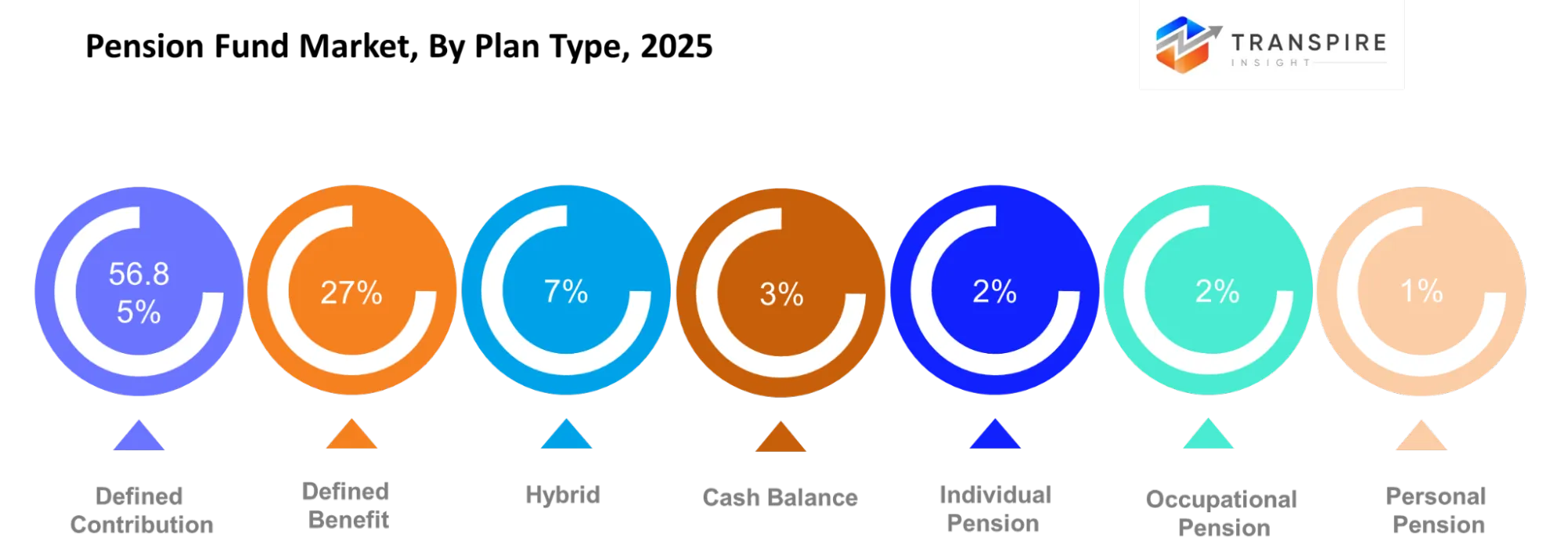
- Defined Contribution plans are fueling record-keeping, target date fund uptake and personalised advice platforms at 56.85%.
- Private-sector plans with growth rates of 6.91% CAGR are driving the conversion of DC plans and outsourcing of third-party administration.
- Operational leakage is being minimised, and engagement is increased via AI for fraud detection, forecasting, and member servicing.
- DB funding ratios are stabilising, and capital is freed up for private investments through liability-driven investment and inflation hedging.
What are the Key Drivers, Restraints, and Opportunities in the Pension Fund Market?
Driver:
Mandatory pension schemes and auto-enrollment reforms are driving growth by legally expanding the contributor base. Triggered by fiscal pressure from ageing demographics, these policies convert informal savers into formal plan members, directly increasing contribution inflows and assets under management. As DC plans dominate, participants’ individual accounts accumulate and require ongoing investment administration, boosting record-keeping, account servicing, portfolio management, and transaction-related revenues. This regulatory shift also strengthens long-term pension participation across previously underserved worker groups and households.
Restraint:
Complex regulation, legacy infrastructure, and fragmented administration constrain modernisation. Pension schemes must reconcile member records, contribution rules, investment reporting, cybersecurity, and fiduciary requirements across older systems. The structural issue is that replacing core platforms can be costly and operationally risky, slowing migration to automated services and limiting technology adoption.
Opportunity:
Greater use of private markets, infrastructure, and digital administration can widen investment choices and improve operational efficiency. The UK Pension Schemes Act 2026 introduces new requirements for defined-contribution schemes, including value-for-money measures, while regulators are examining barriers to private-market and infrastructure investment. This creates opportunities for platforms that combine governance, liquidity management, portfolio analytics, and transparent member reporting, particularly in pension markets. As these systems mature, providers that connect operations with analytics can capture recurring administration fees while helping sponsors demonstrate compliance and retirement outcomes.
What Has the Impact of Artificial Intelligence Been on the Pension Fund Market?
Artificial intelligence shifts pensions from rules-based processing to continuous evaluation and decision support. Funds and administrators can employ AI to automate document categorisation, member service queries, contribution reconciliation, compliance monitoring and routine reporting, easing manual workloads and driving down processing times. Machine-learning algorithms can evaluate contribution histories and demographic trends, withdrawals, market conditions and asset allocations to detect the emerging risks of retirement income shocks, supporting scenario analysis.
Predictive analytics may also identify potential contribution shortfalls, member attrition, outlier transactions and operational anomalies before they escalate into costly incidents. In investment operations, AI can assist portfolio research, stock and fund monitoring, cash-flow projection and risk radar, helping teams analyse vast data volumes more efficiently while preserving human governance on fiduciary outcomes. The technology can further enable hyper-personalised digital engagement by individualising reminders, education and projection scenarios. According to the OECD, AI is emerging in four primary areas - data analysis, communication, knowledge management, and administration - with organisational and workforce change being key caveats. Adoption challenges include integration hurdles such as disconnected legacy systems, poor data quality, model validation, cyber risks, transparency and implementation costs.
In July 2026, Procentia partnered with Wipro to launch a specialised pension administration platform embedded with generative-AI assistants. This deployment automates complex pension risk transfer workflows and provides automated, AI-assisted member services to public pension plans.
Key Pension Fund Market Trends:
Technology and regulation are influencing investment, communication, and governance in pension markets, which are shifting from product administration to retirement outcomes. The biggest changes are in the area of DC design, digital servicing, private market access, and data-driven oversight.
- Defined contribution is getting heavier as sponsors move more retirement assets to the member and look for accumulation solutions.
- Digital administration is taking the place of workflows, and portals, automated contributions and real-time reporting are becoming commonplace.
- Private equity, infrastructure and private credit are starting to attract attention for long-duration capital deployment, which is widening pension funds' focus beyond public markets.
- Passive investing has grown, and active investing is becoming more common in specific instances where teams are looking for risk or return exposures.
- The transition from generic to personalised is going beyond statements of retirement projections and contribution prompts to member communications.
- Rather than just product availability, regulatory focus is turning to value for money, transparency, and member outcomes.
- Alternative assets are getting more organised, with funds getting more liquid and disciplined in their valuation, governance, and access vehicles.
- AI-powered analytics are being adopted by pension firms for investment research, fraud detection, and operational exception handling, in addition to experimentation.
- As managers navigate diversification and currency, geopolitical, liquidity, and regulatory risks, cross-border investment is increasing in data volume.
Pension Fund Market Segmentation
By Plan Type:
Defined Contribution holds 56.85%, reflecting employer preference for predictable contribution obligations and member-directed accumulation, while Defined Benefit at 27% remains supported by legacy guarantees. Hybrid at 7%, Cash Balance at 3%, Individual Pension at 2%, Occupational Pension at 2%, Personal Pension at 1%, and Others at 1.15% provide alternative risk-sharing structures. Providers increasingly combine accumulation, guarantees, portability, and flexible retirement-income options within integrated plans, giving members greater choice while helping sponsors manage long-term liabilities, administrative complexity, and changing workforce expectations.
By Sponsor:
Public Sector, Private Sector, Corporate, Government, Employer-sponsored, Individual, Multi-employer, and Others represent varied funding structures and governance models. Private Sector plans show a 6.91% CAGR, supported by workplace enrollment, benefits outsourcing, and digital administration. Employer-sponsored and corporate arrangements increasingly emphasise portability, simplified onboarding, and personalised member services, while multi-employer structures can spread administrative costs. These models support broader participation and more efficient retirement-plan delivery across workplaces and employees.
By Investment Strategy:
Active Management, Passive Management, Alternative Investments, Equity-focused, Fixed Income, Real Estate, Infrastructure, and Others address differing return, liquidity, and risk requirements. Passive Management supports cost control and transparent market exposure, while Active Management targets selective opportunities. Alternative Investments, Real Estate, and Infrastructure provide diversification and long-duration exposure. Funds increasingly combine these approaches through multi-asset portfolios, balancing return objectives with liquidity requirements, governance capacity, and changing market conditions.
By Asset Class:
Equities, Bonds, Real Estate, Private Equity, Infrastructure, Cash & Equivalents, Commodities, and Others support different portfolio objectives across growth, income, liquidity, and inflation protection. Equities provide long-term return potential, while Bonds support income and liability management. Private Equity and Infrastructure are gaining strategic attention for diversification and long-duration exposure. Cash & Equivalents preserve liquidity, while Real Estate and Commodities can provide additional diversification across changing economic conditions.
By Coverage:
Public Sector Workers, Private Sector Workers, Self-employed, Government Employees, Corporate Employees, Individuals, Retirees, and Others represent distinct participation and retirement-income needs. Public and government employees often participate through structured workplace systems, while private-sector workers increasingly access employer-sponsored plans. Self-employed and individual participants require flexible contribution models. Digital enrollment, automated payroll connections, and mobile access can reduce participation barriers, improve engagement, and extend coverage to previously underserved worker groups.
By Administration:
Trust-based, Contract-based, Insurance-based, Employer-managed, Government-managed, Third-party Administration, Digital Administration, and Others determine how plans are governed, serviced, and reported. Trust-based and insurance-based models provide established oversight structures, while Third-party Administration can reduce employer workload. Digital Administration is gaining importance through automated records, online servicing, and real-time reporting. Providers increasingly integrate administration with analytics and member platforms to reduce manual processing, improve accuracy, and strengthen operational transparency and consistency.
By Investment Geography:
Domestic, International, Developed Markets, Emerging Markets, Regional, Global, Offshore, and Others provide different diversification and risk exposures. Domestic allocations support local economic participation and regulatory alignment, while International and strategies broaden access to investment opportunities. Developed Markets offer established financial infrastructure, whereas Emerging Markets provide exposure to faster-changing economies. Offshore and Regional allocations can further diversify portfolios, but require stronger currency, liquidity, tax, and regulatory controls.
What are the Key Use Cases Driving the Pension Fund Market?
Core use cases center on retirement accumulation, contribution management, and long-term portfolio construction, directly supporting Defined Contribution plans, which account for 56.85%. These functions help employers manage recurring contributions while giving members clearer visibility over balances and projected retirement income.
Expanding applications include automated administration, digital enrollment, member communications, portfolio rebalancing, risk monitoring, and value-for-money reporting. Private-sector sponsorship, growing at a 6.91% CAGR, supports wider deployment of outsourced administration and workplace platforms.
Emerging use cases include AI-assisted retirement forecasting, personalised contribution nudges, private-market access, infrastructure allocation, fraud detection, and liquidity forecasting. These applications connect member-level data with investment and operational decisions, allowing funds to respond faster to changing contribution patterns, market conditions, and regulatory requirements. OECD research similarly highlights AI's potential for personalised communication, data analysis, and administrative automation.
|
Report Metrics |
Details |
|
Market size value in 2025 |
USD 78.2 Billion |
|
Market size value in 2026 |
USD 82.1 Billion |
|
Revenue forecast in 2033 |
USD 110.4 Billion |
|
Growth rate |
CAGR of 4.32% from 2026 to 2033 |
|
Base year |
2025 |
|
Historical data |
2021 - 2024 |
|
Forecast period |
2026 - 2033 |
|
Report coverage |
Revenue forecast, competitive landscape, growth factors, and trends |
|
Regional scope |
United States; Canada; Mexico; United Kingdom; Germany; France; Italy; Spain; Denmark; Sweden; Norway; China; Japan; India; Australia; South Korea; Thailand; Brazil; Argentina; South Africa; Saudi Arabia; United Arab Emirates |
|
Key companies profiled |
BlackRock, Vanguard, Fidelity, State Street Advisors, T. Rowe Price, Capital Group, JPMorgan Asset Management, Goldman Sachs Asset Management, PIMCO, Northern Trust, Legal & General, Amundi, Allianz Investors, Mercer, Aon |
|
Customization scope |
Free report customization (country, regional & segment scope). Available customized purchase options to meet your exact research needs. |
|
Report Segmentation |
By Plan Type (Defined Contribution, Defined Benefit, Hybrid, Cash Balance, Individual Pension, Occupational Pension, Personal Pension, Others); By Sponsor (Public Sector, Private Sector, Corporate, Government, Employer-sponsored, Individual, Multi-employer, Others); By Investment Strategy (Active Management, Passive Management, Alternative Investments, Equity-focused, Fixed Income, Real Estate, Infrastructure, Others); By Asset Class (Equities, Bonds, Real Estate, Private Equity, Infrastructure, Cash & Equivalents, Commodities, Others); By Coverage (Public Sector Workers, Private Sector Workers, Self-employed, Government Employees, Corporate Employees, Individuals, Retirees, Others); By Administration (Trust-based, Contract-based, Insurance-based, Employer-managed, Government-managed, Third-party Administration, Digital Administration, Others); By Investment Geography (Domestic, International, Developed Markets, Emerging Markets, Regional, Global, Offshore, Others) |
Which Regions are Driving the Pension Fund Market Growth?
North America dominates at 70.65% with advanced DC structures, developed public-equity and private-asset markets, and robust fiduciary principles. Policy initiatives include auto-enrollment increases, tax-advantaged contribution caps, and well-defined de-risking pathways that facilitate liability transfer. An institutional infrastructure of record-keepers, target-date providers, and RIAs seamlessly connects contribution to decumulation. This comprehensive system supports large flows of high-value assets for asset managers.
In September 2026, BlackRock introduced its LifePath Solutions framework to integrate private markets and lifetime income features directly into U.S. retirement target-date strategies.
Europe has a 16% share, and only because of multi-pillar and IORP II governance and an expanding sustainable-finance mandate. Besides North America's sole reliance on DC, Europe has significant DB and hybrids, buy-ins, buy-outs, and liability-matching bonds from de-risking. Brought about by high coherence, long-term investors in jurisdictions, and stable asset growth, dominated by mandatory, steady-fire, regulation-driven product sales instead of violent expansion. Europe is a robust, regulation-driven, and slowly DDC-converging market.
In June 2026, the European Council agreed on a negotiating mandate to review and update the IORP II directive. This partnership-driven legislative action aims to enhance cost transparency and remove cross-border investment barriers.
Asia Pacific, though smaller at 9%, is the fastest-growing region with a 6.65% CAGR, driven by mandatory pension laws, digital enrollment, and rising formal employment. Recent changes include expanded coverage for self-employed workers, portability reforms, and deeper local capital markets enabling broader asset menus. Future opportunity lies in integrating DC accounts with wealth platforms, offering target-date solutions, and unlocking cross-border investment options for growing middle-class savers.
In July 2026, Sun Life launched an integrated private-wealth platform to support high-net-worth families and advisers managing complex cross-border wealth in Singapore, Hong Kong, and Bermuda. This development harmonises operating models across jurisdictions to address intergenerational succession needs.
https://www.hubbis.com/news/sun-life-launches-integrated-private-wealth-platform-for-hnw-families
Who are the Key Players in the Pension Fund Market, and how do they compete?
The race in the market for pension funds is among asset managers, record-keepers, and fiduciary advisors that can scale, offer investment ingenuity, and develop decumulation solutions. Fee compression and ESG imperatives are motivating firms to focus on passive cores, private-asset differentiation and tech-enabled advice.
The competitive analysis of BlackRock and Vanguard. They are focused on cost leadership and passive core allocations and differentiate themselves through ETF ecosystems, target-date series, and stewardship functions, broadening through product scope and institutional mandates. Fidelity and T. Rowe Price. They are concentrating on DC record-keeping and active equity segments, using participant engagement solutions and their in-house research to maintain relationships with plan sponsors. State Street Advisors, JPMorgan Asset Management and Goldman Sachs Asset Management. Big name providers Capital Group, PIMCO and Northern Trust deliver active fixed income, liability-matching and fiduciary capabilities, relying on their expertise and, in the case of Northern Trust, trust and custody capabilities to differentiate and using their deep consultant relationships to grow. Meanwhile, insurance-focused providers Legal & General, Amundi and Allianz Investors bring insurance-linked annuities, European distribution, and sustainable fixed income to the market, aiming to grow through buy-ins and Pillar II/III product expertise.
Key Players are:
- BlackRock
- Vanguard
- Fidelity
- State Street Advisors
- T. Rowe Price
- Capital Group
- JPMorgan Asset Management
- Goldman Sachs Asset Management
- PIMCO
- Northern Trust
- Legal & General
- Amundi
- Allianz Investors
- Mercer
- Aon
Recent Development News
- In September 2026, PFRDA announced plans to introduce inflation-linked bonds for pension subscribers. The proposed instruments are designed to help pension fund managers provide returns that better protect retirement savings against inflation, supporting product diversification within the pension market. https://m.economictimes.com/industry/banking/finance/pfrda-unveils-plans-for-inflation-linked-bonds-at-global-fintech-fest-2026-aiming-to-transform-pension-returns/articleshow/134005369.cms
- In July 2026, Borders to Coast, NEST, and several other prominent UK pension schemes partnered to launch a £1 billion initiative tailored to finance scaling British companies. By pooling capital, the participating funds intend to significantly drive long-term retirement capital into high-growth, domestic private markets, fulfilling broad structural commitments to diversify domestic infrastructure and enterprise asset allocation. https://www.ipe.com/news/pension-savers-seek-clearer-picture-of-infrastructure-investments/10138512.article
What Strategic Insights Define the Future of the Pension Fund Market?
The market is headed toward outcome-based retirement platforms that integrate accumulation, guaranteed income, advice, private assets, and automate the administration rather than treating all of these as individual products. Strategic focus will move away from accumulation toward demonstrating retirement value through costs, liquidity management, and member outcomes. A lesser-known risk is technology fragmentation: toolkits enabled by artificial intelligence can improve efficiency while the legacy data, model errors, cybersecurity vulnerabilities, and decision logic introduce new governance risk. The opportunity is to use the pension record and investment analytics data to serve as a decision layer on which personal contributions and income pathways are built. Providers should focus on building flexible, interoperable data architectures prior to embedding AI, while allowing intelligent human advisors to make fiduciary decisions. More solutions should be developed via partnerships with recordkeepers, insurers, asset managers, and fintechs as a way to scale without requiring plan sponsors to replace the existing systems.
Key Segmentations are:
By Plan Type
- Defined Contribution
- Defined Benefit
- Hybrid
- Cash Balance
- Individual Pension
- Occupational Pension
- Personal Pension
- Others
By Sponsor
- Public Sector
- Private Sector
- Corporate
- Government
- Employer-sponsored
- Individual
- Multi-employer
- Others
By Investment Strategy
- Active Management
- Passive Management
- Alternative Investments
- Equity-focused
- Fixed Income
- Real Estate
- Infrastructure
- Others
By Asset Class
- Equities
- Bonds
- Real Estate
- Private Equity
- Infrastructure
- Cash & Equivalents
- Commodities
- Others
By Coverage
- Public Sector Workers
- Private Sector Workers
- Self-employed
- Government Employees
- Corporate Employees
- Individuals
- Retirees
- Others
By Administration
- Trust-based
- Contract-based
- Insurance-based
- Employer-managed
- Government-managed
- Third-party Administration
- Digital Administration
- Others
By Investment Geography
- Domestic
- International
- Developed Markets
- Emerging Markets
- Regional
- Global
- Offshore
- Others
By Regional Analysis
North America
- United States
- Canada
- Mexico
Europe
- Germany
- United Kingdom
- France
- Spain
- Italy
- Rest of Europe
Asia Pacific
- Japan
- China
- Australia & New Zealand
- South Korea
- India
- Rest of Asia Pacific
South America
- Brazil
- Argentina
- Rest of South America
Middle East & Africa
- Saudi Arabia
- United Arab Emirates
- South Africa
- Rest of the Middle East & Africa
Frequently Asked Questions
Find quick answers to common questions.
The pension fund market size was valued at USD 72.77 trillion in 2025 and is poised to reach USD 109.28 trillion by 2033, expanding at a 5.37% CAGR
Key segments for the pension fund market are By Plan Type (Defined Contribution, Defined Benefit, Hybrid, Cash Balance, Individual Pension, Occupational Pension, Personal Pension, Others); By Sponsor (Public Sector, Private Sector, Corporate, Government, Employer-sponsored, Individual, Multi-employer, Others); By Investment Strategy (Active Management, Passive Management, Alternative Investments, Equity-focused, Fixed Income, Real Estate, Infrastructure, Others); By Asset Class (Equities, Bonds, Real Estate, Private Equity, Infrastructure, Cash & Equivalents, Commodities, Others); By Coverage (Public Sector Workers, Private Sector Workers, Self-employed, Government Employees, Corporate Employees, Individuals, Retirees, Others); By Administration (Trust-based, Contract-based, Insurance-based, Employer-managed, Government-managed, Third-party Administration, Digital Administration, Others); By Investment Geography (Domestic, International, Developed Markets, Emerging Markets, Regional, Global, Offshore, Others)
Growth is primarily driven by mandatory pension schemes, auto-enrollment reforms, population ageing, workplace retirement participation, digital administration, and expansion of diversified investment strategies
The pension fund market is led by major manufacturers, including BlackRock, Vanguard, Fidelity, State Street Advisors, T. Rowe Price, Capital Group, JPMorgan Asset Management, Goldman Sachs Asset Management, PIMCO, Northern Trust, Legal & General, Amundi, Allianz Investors, Mercer, and Aon
North America holds 70.65% and influences market dynamics through large DC assets, mature capital markets, established pension infrastructure, workplace participation, and advanced digital retirement platforms
Commercial opportunities include AI-enabled administration, personalised retirement solutions, private-market access, digital pension platforms, infrastructure investment, outsourced plan management, and retirement-income products
- BlackRock
- Vanguard
- Fidelity
- State Street Advisors
- T. Rowe Price
- Capital Group
- JPMorgan Asset Management
- Goldman Sachs Asset Management
- PIMCO
- Northern Trust
- Legal & General
- Amundi
- Allianz Investors
- Mercer
- Aon
About the Authors

Mayur Shinde
I am Mayur Shinde, a Senior Research Analyst at Transpire Insight, specializing in the Automotive & Transportation and Information & Communication Technology (ICT) Industry. My work focuses on analyzing emerging market trends, technological advancements, competitive landscapes, and industry developments to deliver accurate, data-driven insights. I am passionate about transforming complex market information into clear, actionable content that helps businesses, professionals, and decision-makers stay informed and make confident strategic decisions.

Chakradhar Khansole
Chakradhar serves as the Research Director at Transpire Insight, bringing over 8 years of experience in technology, innovation, and strategic market intelligence. He specializes in transforming complex market data into actionable business insights that enable organizations to make informed, growth-oriented decisions. Recognized for his strategic vision and analytical expertise, Chakradhar leads high-impact research initiatives, delivering comprehensive market assessments, competitive intelligence, and forward-looking industry analysis.
Recently Published Reports
-
Apr 2026
3D Optical Profiler Market
3D Optical Profiler Market Size, Share & Analysis Report By Type (Desktop 3D Optical Profiler, and Portable 3D Optical Profiler), By Technology (Confocal Technology, and White Light Interference), By End-Use Industry (Manufacturing, Research Institutions, Automotive, Aerospace and Defense, Medical Devices, and Other), and Geography (North America, Europe, Asia-Pacific, Middle East and Africa, South and Central America), 2021 - 2031
-
Apr 2026
Depth Sensor Market
Depth Sensor Market Size, Share & Analysis Report By Type (Infrared Depth Sensors, Time-of-Flight (ToF) Sensors, Stereo Vision Sensors, Structured Light Sensors, Ultrasonic Depth Sensors), By Application (Automotive, Robotics, Gaming, Consumer Electronics, Industrial Automation, Healthcare, Security & Surveillance, Others), By End Users (Automotive Manufacturers, Consumer Electronics Companies, Healthcare Providers, Industrial Companies, Security Agencies, Gaming Companies, Robotics Companies, Others), and Geography (North America, Europe, Asia-Pacific, Middle East and Africa, South and Central America), 2021 – 2031
-
Apr 2026
Digital Manufacturing Market
Digital Manufacturing Market Size, Share & Analysis Report By Component (Hardware, Software, and Services), By Technology (Robotics, 3D Printing, Internet of Things (IoT), and Others), By Application (Automotive and Transportation, Aerospace and Defense, Consumer Electronics, Industrial Machinery, and Others), By Process Type (Computer-Based Designing, Computer-Based Simulation, Computer 3D Visualization, Analytics, and Others), and Geography (North America, Europe, Asia-Pacific, Middle East and Africa, South and Central America), 2021 – 2031
-
Apr 2026
Digital Visa Services Market
Digital Visa Services Market Size, Share & Analysis Report By Type (Individual Travelers, Group Travelers), By Application (Tourism, Business Travel, Others), and Geography (North America, Europe, Asia-Pacific, Middle East and Africa, South and Central America), 2021 – 2031