Market Snapshot
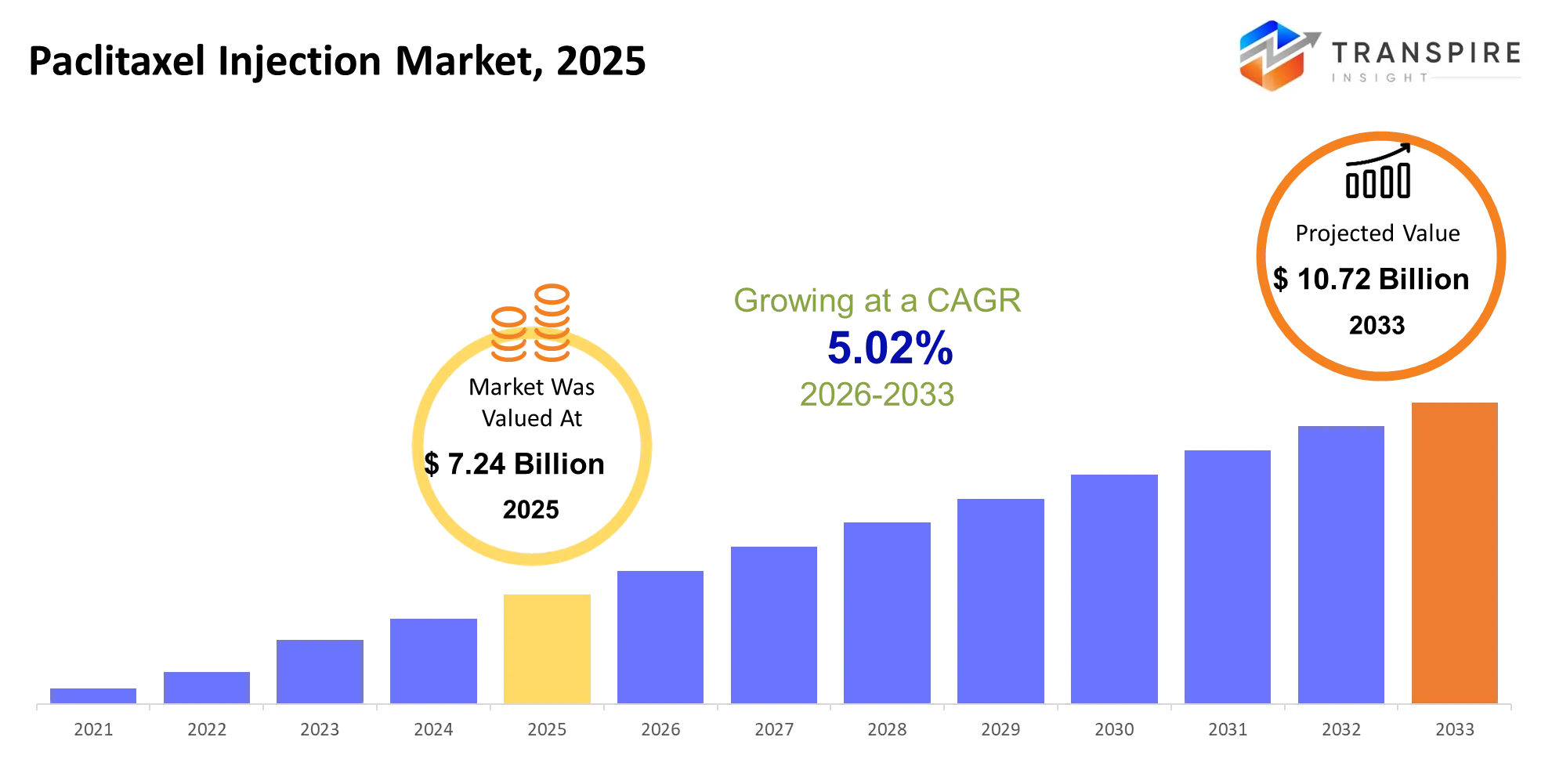
- Market Value (2025): USD 7.24 Billion.
- Expected Market Value (2026): USD 7.61 Billion.
- Estimated Market Value (2033): USD 10.72 Billion.
- Forecast CAGR (2026–2033): 5.02 %
- Leading Region in 2025: Asia Pacific
- Second-largest Region: Europe
- Fastest Growing Region: North America
Introduction
The Paclitaxel Injection Market comprises pharmaceutical injectable products used in oncology treatment to address the growing demand for effective and reliable chemotherapy solutions across hospitals, cancer centers, specialty clinics, ambulatory surgical centers, research institutes, and other healthcare facilities. Conventional Paclitaxel Injection, Albumin-bound Paclitaxel, Generic Paclitaxel, Liposomal Paclitaxel, Ready-to-use Formulations, Premixed Injectables, and other specialized paclitaxel injection products are examples of Paclitaxel Injection offerings that address the evolving requirements of oncology treatment, pharmaceutical providers, healthcare institutions, and cancer care facilities.
Advanced pharmaceutical technologies, albumin-bound drug delivery systems, liposomal formulation technologies, ready-to-use injectable solutions, premixed injectable formulations, sterile manufacturing processes, pharmaceutical automation, formulation engineering, quality-control systems, specialized pharmaceutical packaging, and advanced drug-delivery technologies are examples of industry innovations that improve formulation consistency, manufacturing efficiency, product stability, pharmaceutical quality, supply reliability, and overall product performance. Paclitaxel Injection innovation improves pharmaceutical manufacturing through the integration of advanced formulation technologies, sterile production systems, quality-control processes, automated manufacturing, specialized packaging, and innovative drug-delivery approaches. Improved product consistency, enhanced manufacturing efficiency, reliable pharmaceutical quality, optimized formulation performance, improved supply-chain reliability, and expanded access to injectable oncology therapies are all supported by pharmaceutical and technological innovation. Pharmaceutical manufacturing standards, sterile product requirements, quality-control regulations, drug safety requirements, regulatory approval standards, pharmaceutical packaging requirements, and industry-specific compliance requirements are all adhered to.
The demand for advanced Paclitaxel Injection solutions is being driven by a number of factors, including increasing cancer treatment requirements, growing oncology healthcare infrastructure, rising demand for injectable chemotherapy products, expanding hospitals and cancer centers, increasing pharmaceutical manufacturing capabilities, growing availability of generic oncology medicines, rising healthcare expenditure, increasing adoption of advanced drug-delivery technologies, growing demand for reliable pharmaceutical supply, expanding specialty clinics, increasing investments in pharmaceutical research and development, and ongoing developments in albumin-bound formulations, liposomal technologies, ready-to-use injectables, premixed formulations, sterile manufacturing, pharmaceutical automation, formulation engineering, quality-control systems, and next-generation Paclitaxel Injection products.
Market Highlights:
- Asia Pacific is expected to grow at a rapid CAGR in the Paclitaxel Injection Market, holding nearly 42% of the market share during the forecast period, supported by increasing oncology treatment requirements, expanding healthcare infrastructure, growing pharmaceutical manufacturing capabilities, rising availability of generic oncology medicines, and increasing adoption of advanced injectable pharmaceutical formulations across countries such as China, India, Japan, South Korea, Singapore, and Australia.
- North America is anticipated to be one of the fastest-growing regions in the Paclitaxel Injection Market during the forecast period, holding around 31% share, driven by increasing demand for cancer treatment, advanced oncology infrastructure, growing pharmaceutical research and development, increasing adoption of innovative drug-delivery technologies, expanding specialty cancer centers, rising healthcare expenditure, and growing availability of conventional, generic, albumin-bound, and other advanced paclitaxel injection formulations.
- Europe is anticipated to hold approximately 24% share of the Paclitaxel Injection Market over the predicted timeframe, supported by established oncology healthcare infrastructure, increasing cancer treatment requirements, growing pharmaceutical manufacturing capabilities, rising adoption of generic pharmaceutical products, expanding specialty clinics and cancer centers, increasing investments in advanced drug-delivery technologies, and growing demand for reliable and cost-effective injectable oncology therapies.
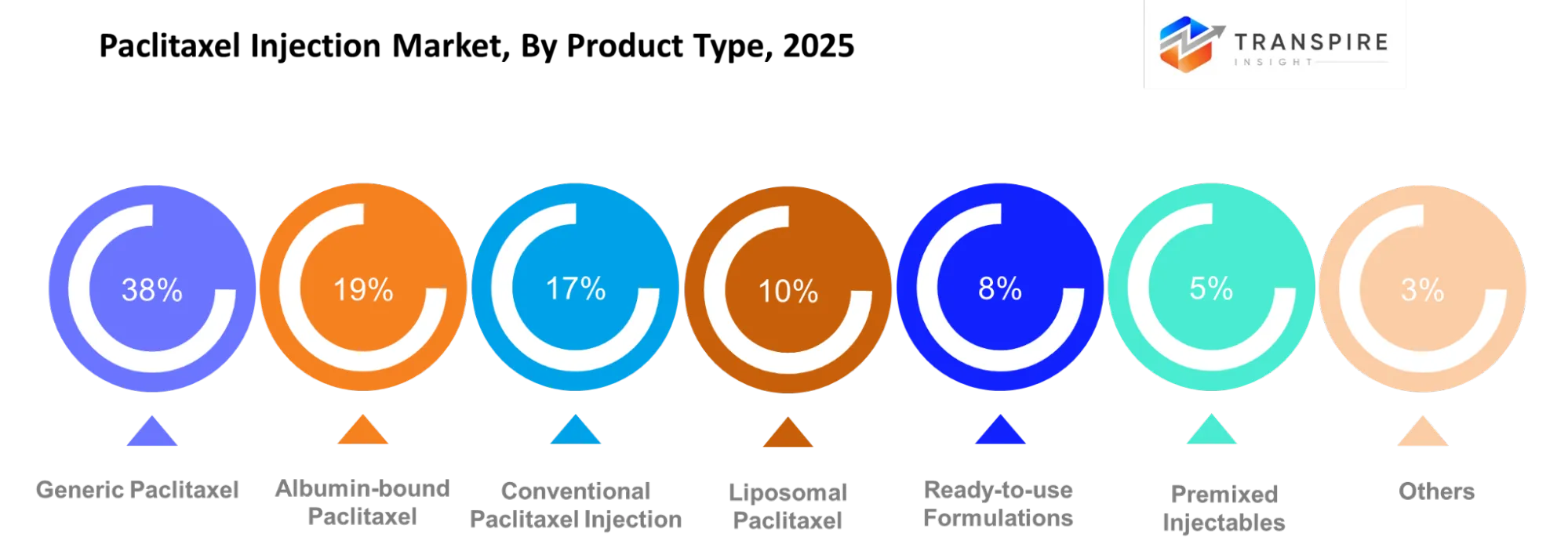
- By Product Type, the Conventional Paclitaxel Injection segment dominated the market and holds nearly 47.3% share in 2025 and is projected to grow at a substantial CAGR during the forecast period, owing to its established use in oncology treatment, broad availability, extensive pharmaceutical manufacturing capabilities, established clinical utilization, and continued demand across hospitals, cancer centers, and specialty healthcare facilities.
- By Indication Type, the Albumin-bound Paclitaxel segment is projected to grow at a substantial CAGR during the forecast period, supported by increasing pharmaceutical innovation, growing adoption of advanced drug-delivery technologies, continued development of specialized oncology formulations, rising investments in formulation research, and increasing demand for differentiated paclitaxel-based injectable products.
- By End User, the Hospitals segment dominated the market and holds approximately 36.8% share in 2025 and is projected to grow at a substantial CAGR during the forecast period, driven by expanding oncology treatment infrastructure, increasing cancer care requirements, availability of specialized medical professionals, growing hospital-based chemotherapy services, and rising demand for injectable oncology products across healthcare facilities.
- By Distribution Channel, the Hospital Pharmacies segment dominated the market and holds roughly 41.4% share in 2025 and is projected to grow at a substantial CAGR during the forecast period, supported by increasing hospital-based cancer treatment, centralized pharmaceutical procurement, growing demand for injectable oncology medicines, reliable product availability, specialized pharmaceutical storage capabilities, and increasing adoption of hospital-based chemotherapy services.
- By Route of Administration, the Intravenous Infusion segment dominated the market and holds around 44.1% share in 2025 and is projected to grow at a substantial CAGR during the forecast period, driven by the established administration of paclitaxel injection through intravenous infusion, increasing demand for hospital-based oncology treatment, expanding cancer care infrastructure, and growing utilization of injectable chemotherapy products across specialized healthcare settings.
- Growing Adoption of Advanced Paclitaxel Injection Formulations Across Oncology Healthcare and Pharmaceutical Manufacturing: Pharmaceutical manufacturers, hospitals, cancer centers, specialty clinics, ambulatory surgical centers, research institutes, pharmaceutical distributors, and other healthcare stakeholders across Asia Pacific, North America, and Europe are increasing investments in Conventional Paclitaxel Injection, Albumin-bound Paclitaxel, Generic Paclitaxel, Liposomal Paclitaxel, Ready-to-use Formulations, Premixed Injectables, and other advanced injectable oncology solutions to support pharmaceutical quality, reliable product availability, manufacturing efficiency, formulation innovation, and healthcare accessibility. The growing adoption of advanced drug-delivery technologies, sterile manufacturing, pharmaceutical automation, formulation engineering, quality-control systems, ready-to-use technologies, premixed injectable solutions, specialized pharmaceutical packaging, and advanced manufacturing processes is further supporting product consistency, supply-chain reliability, formulation development, operational efficiency, and long-term growth in the Paclitaxel Injection Market.
How is the Paclitaxel Injection Market Growing Due to Technology?
The Paclitaxel Injection Market is growing as a result of ongoing developments in pharmaceutical formulation technologies, advanced drug-delivery systems, albumin-bound formulations, liposomal technologies, ready-to-use injectable products, premixed formulations, sterile manufacturing, pharmaceutical quality-control systems, and advanced packaging technologies. Improved formulation stability, manufacturing efficiency, product consistency, supply-chain reliability, and pharmaceutical quality are supported by contemporary technologies such as Albumin-bound Paclitaxel, Liposomal Paclitaxel, Ready-to-use Formulations, Premixed Injectables, and advanced generic paclitaxel manufacturing processes. Innovations in drug-delivery technologies, pharmaceutical manufacturing automation, sterile production environments, formulation engineering, quality-control systems, process optimization, and specialized packaging allow pharmaceutical manufacturers, hospitals, cancer centers, specialty clinics, ambulatory surgical centers, research institutes, and other healthcare organizations to adopt injectable oncology products that are more consistent, reliable, scalable, and manufacturing-efficient while meeting stringent pharmaceutical quality and regulatory requirements. In addition to supporting pharmaceutical manufacturing efficiency, formulation development, product quality, supply-chain reliability, and healthcare accessibility across the Paclitaxel Injection Market, these technological advancements are promoting continued investment in advanced injectable formulations, generic pharmaceutical production, drug-delivery innovation, and next-generation oncology pharmaceutical manufacturing.
|
Report Metrics |
Details |
|
Market size value in 2025 |
USD 7.24 Billion |
|
Market size value in 2026 |
USD 7.61 Billion |
|
Revenue forecast in 2033 |
USD 10.72 Billion |
|
Growth rate |
CAGR of 5.02% from 2026 to 2033 |
|
Base year |
2025 |
|
Historical data |
2021 - 2024 |
|
Forecast period |
2026 - 2033 |
|
Report coverage |
Revenue forecast, competitive landscape, growth factors, and trends |
|
Regional scope |
United States; Canada; Mexico; United Kingdom; Germany; France; Italy; Spain; Denmark; Sweden; Norway; China; Japan; India; Australia; South Korea; Thailand; Brazil; Argentina; South Africa; Saudi Arabia; United Arab Emirates |
|
Key company profiled |
Bristol Myers Squibb, Fresenius Kabi, Teva Pharmaceutical Industries, Hikma Pharmaceuticals, Viatris, Sun Pharmaceutical, Cipla, Dr. Reddy's Laboratories, Sandoz, Aurobindo Pharma, Accord Healthcare, Pfizer, Hospira, Intas Pharmaceuticals, Qilu Pharmaceutical |
|
Report Segmentation |
By Product Type (Conventional Paclitaxel Injection, Albumin-bound Paclitaxel, Generic Paclitaxel, Liposomal Paclitaxel, Ready-to-use Formulations, Premixed Injectables, Others); By Indication (Breast Cancer, Ovarian Cancer, Lung Cancer, Pancreatic Cancer, Gastric Cancer, Cervical Cancer, Others); By End User (Hospitals, Cancer Centers, Specialty Clinics, Ambulatory Surgical Centers, Research Institutes, Others); By Distribution Channel (Hospital Pharmacies, Retail Pharmacies, Specialty Pharmacies, Government Procurement, Direct Sales, Others); By Route of Administration (Intravenous Infusion, Combination Therapy, Monotherapy, Adjuvant Therapy, Neoadjuvant Therapy, Others) |
|
Customization scope |
Free report customization (country, regional & segment scope). Avail customized purchase options to meet your exact research needs. |
Market Drivers
The Paclitaxel Injection Market is being driven by increasing demand for oncology treatment products, expansion of cancer care infrastructure, growing pharmaceutical manufacturing capabilities, rising availability of generic oncology medicines, increasing healthcare expenditure, expansion of hospitals and specialized cancer centers, and continued development of advanced injectable formulations. The increasing demand for Conventional Paclitaxel Injection, Albumin-bound Paclitaxel, Generic Paclitaxel, Liposomal Paclitaxel, Ready-to-use Formulations, Premixed Injectables, and other pharmaceutical products, along with growing investments in formulation technologies, sterile manufacturing, quality-control systems, pharmaceutical automation, and advanced drug-delivery technologies, is supporting demand for reliable, high-quality, and scalable injectable oncology products. These advancements are encouraging pharmaceutical manufacturers, healthcare providers, hospitals, specialty clinics, cancer centers, research institutes, and pharmaceutical distributors to invest in next-generation formulation technologies, manufacturing capabilities, quality systems, and expanded product portfolios. Companies in the worldwide Paclitaxel Injection Market are expanding their pharmaceutical manufacturing capabilities, strengthening product development, improving manufacturing efficiency, increasing investments in formulation innovation, and creating new opportunities for market growth.
For example, leading pharmaceutical manufacturers and oncology product companies continue to develop and commercialize conventional, generic, albumin-bound, liposomal, ready-to-use, and premixed paclitaxel formulations while improving sterile manufacturing, pharmaceutical quality control, formulation stability, packaging, and supply-chain capabilities to support reliable product availability across hospitals, cancer centers, specialty clinics, pharmaceutical distributors, and other healthcare applications in the Paclitaxel Injection Market.
Restrain
The primary challenges facing the Paclitaxel Injection Market are stringent pharmaceutical regulations, manufacturing complexity, quality-control requirements, supply-chain disruptions, raw material availability, competition from alternative oncology therapies, pricing pressure from generic products, and the high cost associated with advanced formulation technologies. The development and manufacturing of sterile injectable products, albumin-bound formulations, liposomal formulations, ready-to-use products, and premixed injectables can require specialized manufacturing infrastructure, sophisticated quality-control systems, stringent regulatory compliance, and significant investment. Widespread market expansion is challenged by concerns regarding manufacturing costs, regulatory approvals, pharmaceutical quality requirements, supply continuity, product competition, pricing pressures, manufacturing capacity, and technological complexity. These factors could restrain the expansion of the Paclitaxel Injection Market and broader adoption of advanced, innovative, and technology-driven injectable pharmaceutical solutions.
Analysis of Prices and Consumer Behaviour
The Paclitaxel Injection Market is experiencing demand for reliable, high-quality, cost-effective, and consistently available injectable oncology products as hospitals, cancer centers, specialty clinics, ambulatory surgical centers, research institutes, pharmaceutical procurement organizations, and healthcare providers increasingly prioritize pharmaceutical quality, supply reliability, cost efficiency, manufacturing consistency, and product availability. Pricing is influenced by factors such as product type, formulation technology, manufacturing process, pharmaceutical quality requirements, production scale, packaging, regulatory requirements, distribution channel, procurement model, geographic location, brand positioning, generic competition, and supply-chain conditions. Healthcare organizations and pharmaceutical procurement teams are increasingly evaluating Paclitaxel Injection products based on product quality, supply reliability, manufacturing standards, procurement costs, formulation characteristics, regulatory compliance, and long-term availability rather than initial product price alone. Purchasing behaviour is also influenced by the availability of generic formulations, established pharmaceutical suppliers, specialized oncology distribution networks, hospital procurement systems, government purchasing programs, and direct pharmaceutical sales channels. As hospitals, cancer centers, specialty clinics, pharmaceutical distributors, and healthcare organizations increasingly demand reliable, cost-efficient, quality-focused, and scalable injectable pharmaceutical products, companies are focusing on competitive pricing strategies, product diversification, manufacturing optimization, formulation innovation, supply-chain improvements, and expanded distribution capabilities to address evolving market requirements and strengthen their position in the Paclitaxel Injection Market.
Who are the Key Players in the Paclitaxel Injection Market and how do they compete?
In the market for Paclitaxel Injection solutions, the competitiveness of companies depends on firms that provide pharmaceutical formulations, generic oncology products, injectable medicines, advanced drug-delivery technologies, and reliable pharmaceutical manufacturing capabilities. They compete, not just on prices, but on product quality, formulation capabilities, manufacturing efficiency, regulatory compliance, supply reliability, pharmaceutical technology, distribution networks, product portfolio, production capacity, and innovation capabilities. Thus, competition encourages continuous pharmaceutical innovation and helps healthcare organizations, hospitals, cancer centers, specialty clinics, pharmaceutical distributors, and other healthcare stakeholders access reliable and quality-focused Paclitaxel Injection products.
Leading pharmaceutical companies are strengthening their presence in the market through the development, manufacturing, commercialization, and distribution of conventional paclitaxel, generic paclitaxel, albumin-bound formulations, liposomal formulations, ready-to-use products, and premixed injectable solutions. Companies are able to distinguish themselves through advanced pharmaceutical manufacturing facilities, formulation capabilities, quality-control systems, regulatory expertise, distribution networks, supply-chain management, and product diversification. Other market participants are strengthening their position through investments in advanced drug-delivery technologies, sterile manufacturing, pharmaceutical automation, manufacturing efficiency, formulation development, and expanded oncology product portfolios.
Top Companies in the Paclitaxel Injection Market
- Bristol Myers Squibb
- Fresenius Kabi
- Teva Pharmaceutical Industries
- Hikma Pharmaceuticals
- Viatris
- Sun Pharmaceutical
- Cipla
- Dr. Reddy's Laboratories
- Sandoz
- Aurobindo Pharma
- Accord Healthcare
- Pfizer
- Hospira
- Intas Pharmaceuticals
- Qilu Pharmaceutical
Market Segmentation
The Paclitaxel Injection Market share is divided into five categories: Product Type,Indicatio,End User,Distribution Channel,Route of Administration.
The Conventional Paclitaxel Injection dominated the market, accounting for nearly 47.3% in 2025, and is expected to rise at a significant CAGR during the forecast period.
The Paclitaxel Injection Market is segmented. By Product Type Conventional Paclitaxel Injection, Albumin-bound Paclitaxel, Generic Paclitaxel, Liposomal Paclitaxel, Ready-to-use Formulations, Premixed Injectables, Others. Among these,the Conventional Paclitaxel Injection dominated the market, accounting for nearly 47.3% in 2025 and expected to increase at a significant CAGR during the forecast period.due to established clinical utilization, broad availability, extensive manufacturing capabilities, proven formulation familiarity, established oncology applications, and continued demand across hospitals and cancer treatment facilities.
The Hospitals segment segment held the greatest share of approximately 49.1% in 2025 and is expected to increase at a substantial CAGR over the forecast period.
The Paclitaxel Injection Market is segmented By Indication Breast Cancer, Ovarian Cancer, Lung Cancer, Pancreatic Cancer, Gastric Cancer, Cervical Cancer, Others. Among these,the Hospitals segment segment held the greatest share of approximately 49.1% in 2025 and is expected to increase at a substantial CAGR over the forecast period.due to extensive oncology infrastructure, high patient volumes, specialized cancer treatment services, centralized pharmaceutical procurement, availability of trained healthcare professionals, and continued demand for injectable chemotherapy products.
The Albumin-bound Paclitaxel segment held the greatest share of approximately 45.4%in 2025 and is expected to increase at a high CAGR over the forecast period.
The Paclitaxel Injection Marketis segmented.By End User Hospitals, Cancer Centers, Specialty Clinics, Ambulatory Surgical Centers, Research Institutes, Others.Among these the Albumin-bound Paclitaxel segment held the greatest share of approximately 44.9% in 2025 and is expected to increase at a considerable CAGR over the projected period. due to enhanced drug delivery, improved tumor targeting, reduced solvent-related toxicity, convenient administration, better tolerability, and increasing adoption in cancer treatment protocols.
Regional Segment Analysis of the Paclitaxel Injection Market
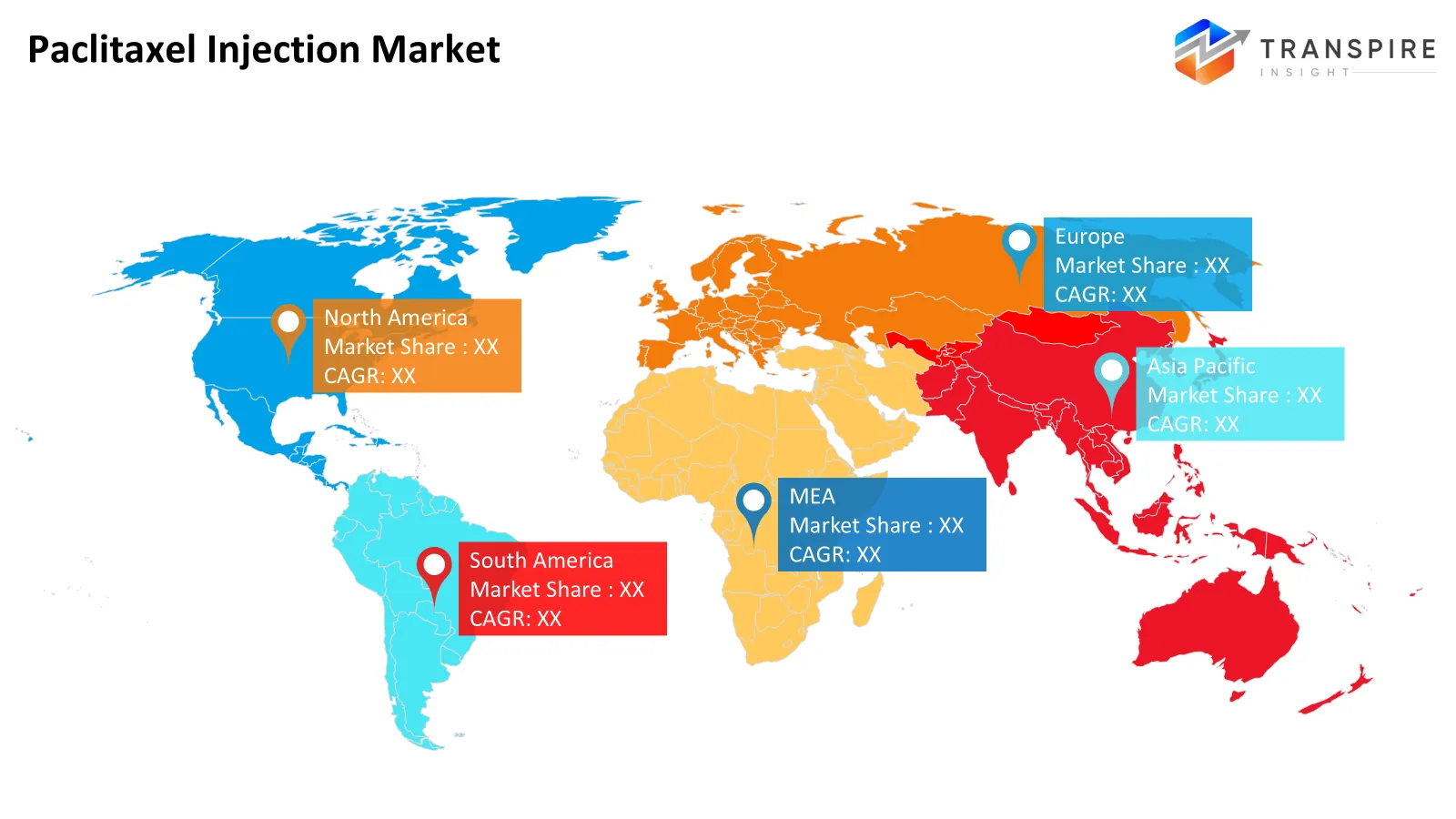
- North America (U.S., Canada, Mexico)
- Europe (Germany, France, U.K., Italy, Spain, Rest of Europe)
- Asia-Pacific (China, Japan, India, Rest of APAC)
- South America (Brazil and the Rest of South America)
- The Middle East and Africa (UAE, South Africa, Rest of MEA)
Asia Pacific is expected to grow at a rapid CAGR in the Paclitaxel Injection Market by holding nearly 42% of the share during the forecast period.
Over the forecast period, the Paclitaxel Injection Market is anticipated to expand rapidly in Asia Pacific. The region accounts for nearly 42% of the market and is expected to maintain its leading position due to rising cancer incidence, increasing demand for effective chemotherapy treatments, expanding oncology infrastructure, growing healthcare expenditure, improving access to cancer care, and increasing adoption of advanced anticancer therapies across countries such as China, India, Japan, South Korea, Singapore, and Australia. Market demand is driven by increasing cancer prevalence, growing geriatric populations, expanding hospitals and oncology centers, rising diagnostic capabilities, increasing government initiatives for cancer treatment, and growing demand for affordable and accessible chemotherapy medications. The expansion of hospitals, specialty oncology centers, cancer treatment facilities, ambulatory care centers, academic medical institutions, and pharmaceutical distribution networks, combined with increasing investments in oncology research, drug manufacturing, biosimilar development, generic drug production, and advanced drug delivery technologies, is further strengthening regional market growth. The rising adoption of Conventional Paclitaxel Injection, Albumin-bound Paclitaxel, combination chemotherapy, and other paclitaxel-based treatment options, expanding cancer treatment infrastructure, improved access to healthcare services, and growing demand for effective therapies for breast cancer, ovarian cancer, non-small cell lung cancer, and other cancers further support the growth of the Paclitaxel Injection Market in Asia Pacific.
Europe is anticipated to hold approximately 24% share of the Paclitaxel Injection Market over the predicted timeframe.
Over the course of the projected period, Europe is expected to hold approximately 24% market share of the Paclitaxel Injection Market. The region's growth is primarily driven by increasing cancer prevalence, advanced oncology infrastructure, strong healthcare expenditure, rising adoption of chemotherapy, expanding access to innovative cancer treatments, and increasing demand for cost-effective and clinically established anticancer medications across hospitals, oncology centers, specialty clinics, research institutions, and healthcare organizations. Germany, France, the UK, Italy, and Spain are among the countries demonstrating strong demand for Conventional Paclitaxel Injection, Albumin-bound Paclitaxel, generic paclitaxel formulations, and combination chemotherapy treatments. Pharmaceutical manufacturers, healthcare providers, oncology specialists, and research organizations are increasingly focusing on improving treatment accessibility, drug quality, manufacturing efficiency, patient safety, clinical outcomes, and personalized cancer care. Partnerships involving pharmaceutical companies, hospitals, oncology centers, research institutions, healthcare organizations, government agencies, and academic institutions are accelerating the development, manufacturing, distribution, and adoption of advanced Paclitaxel Injection therapies to improve cancer treatment outcomes, expand patient access, strengthen oncology care infrastructure, and promote long-term market growth throughout Europe.
North America is anticipated to hold approximately 31% share of the Paclitaxel Injection Market over the predicted timeframe.
North America is anticipated to hold around 31% of the worldwide market for Paclitaxel Injection solutions throughout the forecast period. A well-established oncology healthcare ecosystem, advanced cancer treatment infrastructure, strong pharmaceutical industry, extensive hospital networks, high healthcare expenditure, and increasing demand for effective chemotherapy treatments are expected to contribute to the region's sustained growth. Growing investments by pharmaceutical manufacturers, oncology centers, hospitals, academic medical institutions, healthcare organizations, and research companies, increased demand for Conventional Paclitaxel Injection, Albumin-bound Paclitaxel, generic paclitaxel formulations, and combination chemotherapy, and continuous advancements in oncology research, drug delivery technologies, clinical development, and cancer diagnostics are contributing to market expansion. Additionally, efforts to improve cancer diagnosis, expand access to chemotherapy, enhance treatment outcomes, reduce healthcare disparities, strengthen oncology infrastructure, increase availability of cost-effective anticancer therapies, and introduce improved pharmaceutical formulations are driving innovation, product diversification, technology adoption, and commercialization in the North American Paclitaxel Injection Market.
Strategies for Market Growth in Non-Leading Regions
By developing scalable, cost-effective, safe, reliable, and accessible oncology treatment infrastructure utilizing Conventional Paclitaxel Injection, Albumin-bound Paclitaxel, generic paclitaxel formulations, combination chemotherapy, and other advanced anticancer treatment options, non-leading regions can promote growth in the Paclitaxel Injection Market. Through the development of local pharmaceutical manufacturing capabilities, optimized oncology infrastructure, and integrated cancer treatment services, regions can strengthen hospital, specialty oncology, and public healthcare environments and improve access to established chemotherapy therapies. Commercialization and market penetration will be accelerated through strategic partnerships with pharmaceutical manufacturers, hospitals, oncology centers, healthcare providers, government agencies, research institutions, academic medical centers, distributors, and healthcare technology companies. To improve cancer treatment accessibility, therapeutic outcomes, pharmaceutical supply reliability, and patient care, investments in oncology research, drug manufacturing, quality-control systems, advanced drug delivery technologies, cancer diagnostics, healthcare infrastructure, and clinical development are required. Government support for cancer treatment programs, healthcare infrastructure development, pharmaceutical manufacturing, workforce training, research and development, affordable medicine initiatives, regulatory frameworks, and oncology care expansion can increase treatment adoption, attract private investment, strengthen local healthcare capabilities, improve access to paclitaxel-based therapies, and accelerate the long-term growth of the Paclitaxel Injection Market in emerging economies.
Recent Development
- In February, 2026, leading pharmaceutical manufacturers, oncology treatment providers, research organizations, and healthcare companies announced advancements in paclitaxel-based cancer treatment formulations, albumin-bound drug delivery technologies, conventional paclitaxel injection manufacturing, combination chemotherapy approaches, and supportive oncology treatment solutions with improved treatment accessibility, enhanced drug delivery, optimized pharmaceutical performance, and improved patient care. The innovation supports next-generation cancer treatment applications, strengthens the availability of paclitaxel-based therapies, promotes efficient oncology treatment, and enhances treatment accessibility, manufacturing efficiency, clinical development, and scalability across breast cancer, ovarian cancer, non-small cell lung cancer, and other oncology applications.
- In May, 2026: Leading Paclitaxel Injection companies expanded their product development and commercialization capabilities with advanced Conventional Paclitaxel Injection, Albumin-bound Paclitaxel, generic formulations, combination chemotherapy solutions, improved drug delivery technologies, and oncology treatment products for hospitals, oncology centers, specialty clinics, academic medical institutions, research organizations, and healthcare providers. The development supports improved anticancer treatment availability, enhances chemotherapy delivery, expands patient access, strengthens pharmaceutical manufacturing capabilities, improves treatment efficiency, supports regulatory requirements, and strengthens reliable, scalable, accessible, and technology-driven Paclitaxel Injection Market capabilities.
Future Market Trends for the Paclitaxel Injection Market:
- Growing Adoption of Advanced Paclitaxel-Based Chemotherapy and Targeted Drug Delivery Technologies: As hospitals, oncology centers, specialty clinics, academic medical institutions, pharmaceutical companies, and healthcare providers place greater priority on effective cancer treatment, improved therapeutic outcomes, treatment accessibility, and patient safety, organizations are expanding their adoption of advanced Paclitaxel Injection therapies, including Conventional Paclitaxel Injection, Albumin-bound Paclitaxel, generic paclitaxel formulations, combination chemotherapy, and advanced drug delivery approaches.
- Growing Need for Effective, Scalable, and Patient-Centric Paclitaxel Injection Therapies: To meet increasing demand for accessible cancer treatment, improved chemotherapy outcomes, optimized drug delivery, reduced treatment-related complications, and cost-effective oncology solutions, pharmaceutical manufacturers and healthcare providers are progressively developing advanced Paclitaxel Injection formulations, albumin-bound drug delivery technologies, improved pharmaceutical formulations, combination treatment approaches, and value-added oncology therapies. Rising healthcare expenditure, increasing cancer prevalence, expanding oncology infrastructure, and growing demand for affordable and effective chemotherapy treatments are expected to support continued innovation across the Paclitaxel Injection Market.
- Increasing Investment in Paclitaxel Injection Manufacturing, Oncology Research, and Advanced Drug Delivery: In order to improve cancer treatment outcomes, expand patient access, optimize chemotherapy delivery, strengthen pharmaceutical manufacturing capabilities, and support next-generation oncology treatment ecosystems, pharmaceutical companies, research institutions, hospitals, and healthcare organizations are investing in Conventional Paclitaxel Injection, Albumin-bound Paclitaxel, generic drug development, advanced drug delivery technologies, combination chemotherapy, oncology research, clinical development, manufacturing automation, quality-control systems, and innovative Paclitaxel Injection solutions.
Market Segment
This study forecasts revenue at global, regional, and country levels from 2020 to 2033. Transpire Insight has segmented the Paclitaxel Injection Market based on the below-mentioned segments.
Paclitaxel Injection Market, By Product Type
- Conventional Paclitaxel Injection
- Albumin-bound Paclitaxel
- Generic Paclitaxel Injection
- Others
Paclitaxel Injection Market, By Dosage Form
- Intravenous Injection
- Concentrated Injection
- Ready-to-use Injection
- Others
Paclitaxel Injection Market, By Cancer Type
- Breast Cancer
- Ovarian Cancer
- Non-small Cell Lung Cancer
- Pancreatic Cancer
- Kaposi Sarcoma
- Others
Paclitaxel Injection Market, By End User
- Hospitals
- Oncology Centers
- Specialty Clinics
- Ambulatory Surgical Centers
- Academic & Research Institutes
- Others
Paclitaxel Injection Market, By Distribution Channel
- Hospital Pharmacies
- Retail Pharmacies
- Specialty Pharmacies
- Online Pharmacies
- Others
By Regional Analysis
North America
- US
- Canada
- Mexico
Europe
- Germany
- UK
- France
- Italy
- Spain
- Russia
- Rest of Europe
Asia Pacific
- China
- Japan
- India
- South Korea
- Australia
- Rest of Asia Pacific
South America
- Brazil
- Argentina
- Rest of South America
Middle East & Africa
- UAE
- Saudi Arabia
- Qatar
- South Africa
- Rest of the Middle East & Africa
Frequently Asked Questions
Find quick answers to common questions.
The market is driven by increasing oncology treatment requirements, expanding healthcare infrastructure, pharmaceutical manufacturing growth, generic product availability, and continued development of advanced injectable formulations.
Based on the supplied market data, the Paclitaxel Injection Market is projected to reach USD 10.72 Billion by 2033, growing at a 5.02% CAGR from 2026 to 2033.
The market includes Conventional Paclitaxel Injection, Albumin-bound Paclitaxel, Generic Paclitaxel, Liposomal Paclitaxel, Ready-to-use Formulations, Premixed Injectables, and Others.
Key end users include Hospitals, Cancer Centers, Specialty Clinics, Ambulatory Surgical Centers, Research Institutes, and other healthcare facilities.
Key companies include Bristol Myers Squibb, Fresenius Kabi, Teva Pharmaceutical Industries, Hikma Pharmaceuticals, Viatris, Sun Pharmaceutical, Cipla, Dr. Reddy's Laboratories, Sandoz, Aurobindo Pharma, Accord Healthcare, Pfizer, Hospira, Intas Pharmaceuticals, and Qilu Pharmaceutical.
- Bristol Myers Squibb
- Fresenius Kabi
- Teva Pharmaceutical Industries
- Hikma Pharmaceuticals
- Viatris
- Sun Pharmaceutical
- Cipla
- Dr. Reddy's Laboratories
- Sandoz
- Aurobindo Pharma
- Accord Healthcare
- Pfizer
- Hospira
- Intas Pharmaceuticals
- Qilu Pharmaceutical
About the Authors

Pankaj Ghogare Patil
I am Pankaj Ghogare Patil, a Senior Research Analyst at Transpire Insight, specializing in the Pharmaceutical, Chemicals & Materials, Healthcare IT, and Biotechnology industry. My expertise lies in conducting comprehensive market research, analyzing industry trends, evaluating competitive landscapes, and translating complex data into actionable insights. At Transpire Insight, I closely follow emerging technologies, regulatory developments, and market innovations to create accurate, well-researched, and informative content that helps businesses and professionals make informed decisions. I am committed to producing credible, evidence-based articles that reflect industry best practices while making technical topics accessible and valuable for a broad audience.

Chakradhar Khansole
Chakradhar serves as the Research Director at Transpire Insight, bringing over 8 years of experience in technology, innovation, and strategic market intelligence. He specializes in transforming complex market data into actionable business insights that enable organizations to make informed, growth-oriented decisions. Recognized for his strategic vision and analytical expertise, Chakradhar leads high-impact research initiatives, delivering comprehensive market assessments, competitive intelligence, and forward-looking industry analysis.
Recently Published Reports
-
Apr 2026
AI in Diabetic Retinopathy Market
AI in Diabetic Retinopathy Market Size, Share & Analysis Report By Type (Screening AI Systems, Diagnostic AI Systems, and Predictive AI Models), By Application Segment (Hospitals, Ophthalmology Clinics, Diagnostic Centers, and Research and Development), and Geography (North America, Europe, Asia-Pacific, Middle East and Africa, South and Central America), 2021 - 2031
-
Apr 2026
Psychometric Tests Market
Psychometric Tests Market Size, Share & Analysis Report By Type (Personality Tests, Ability/Aptitude Tests, Skill/Knowledge Tests, and Others), By Application (Talent Acquisition and Talent Management), and Geography (North America, Europe, Asia-Pacific, Middle East and Africa, South and Central America), 2021 – 2031
-
Apr 2026
Rare Biological Sample Collection Market
Rare Biological Sample Collection Market Size, Share & Analysis Report By Type (Isolation Kits & Reagent, Blood Collection Tubes, and Others), By Application (Oncology, Transcriptomics, Pharmacogenomics, and Others), and Geography (North America, Europe, Asia-Pacific, Middle East and Africa, South and Central America), 2021 – 2031
-
Jul 2026
Diabetic Retinopathy Market
Diabetic Retinopathy Market Size, Share & Analysis Report By Type (Proliferative Diabetic Retinopathy, and Diabetic Macular Edema (DME)), By Treatment Type (Anti VEGF Drug, Steroid Implants, Laser Surgeries, and Vitrectomy), and Geography (North America, Europe, Asia-Pacific, Middle East and Africa, South and Central America), 2021 – 2031
Our Clients