

Oral Care Products Market Summary:
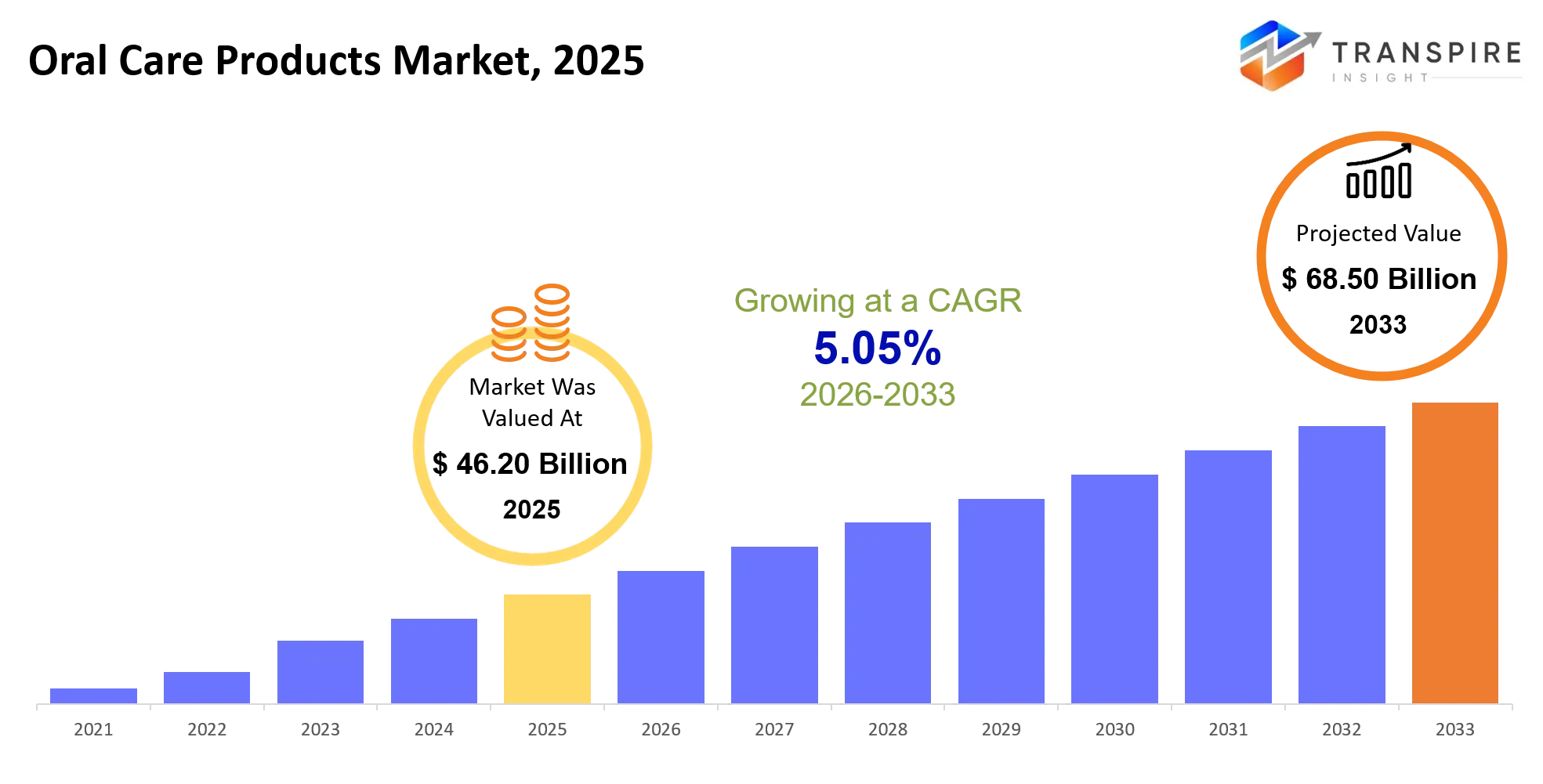
As per the Transpire Insight Analysis, The Oral Care Products Market size is estimated at USD 46.20 billion in 2025 and is anticipated to reach USD 68.50 billion by 2033, growing at a CAGR of 5.05% from 2026 to 2033.
The oral care market has gone from a single focus on basic hygiene to targeted, multifunctional, and increasingly connected routines. Toothpaste remains the prime product, complemented by whitening, sensitivity, gum protection, and digitally instructed brushing to enhance its value proposition. Driven by premium formulations, online purchasing, and a beauty positioning, the last three to five years have seen the space transition to wellness through electric devices and digital tools. A structural shift is taking place through the convergence of sensors, imaging, and machine learning in home-care devices, providing consumers with feedback on their brushing habits rather than just a routine. The real-world drivers are increased awareness of the links between oral health and overall health, as well as ongoing deficiencies in brushing behaviours, motivating consumers to move to more complete and targeted routines and to brands that have new sources of revenue from premium formulations, digitised tools, refillable packaging, and digital engagement.
Oral Care Products Market Size & Forecast:
- Market Size 2025: USD 46.20 Billion
- Expected Market Value (2033): USD 68.50 Billion
- Forecast CAGR (2026–2033): 5.05%
- Leading Region in 2025: Asia Pacific
- Fastest Growing Region: Middle East & Africa
- Key Company Profiles: Colgate-Palmolive, Procter & Gamble, Haleon, Unilever, Church & Dwight, Lion Corporation, Sunstar, GC Corporation, Dentsply Sirona, Philips, Kao Corporation, Dabur, Himalaya Wellness, GlaxoSmithKline Consumer Healthcare, 3M.
Key Oral Care Products Market Insights:
The market is moving away from basic hygiene and moving towards measurable prevention, premium formulations, and digitally connected care. Toothpaste leads the segments, and smart devices, clinical claims, and sustainable packaging are changing the competition.
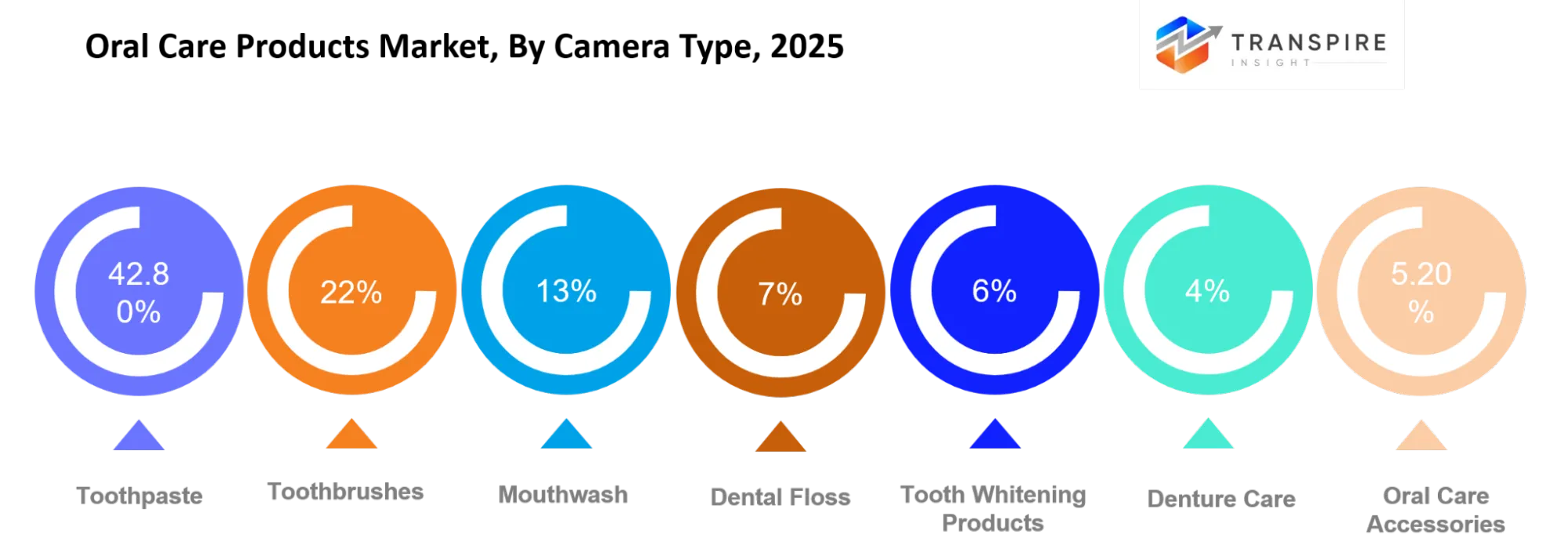
- Toothpaste accounts for 42.80%, while Colgate's 2025 Total Active Prevention system is making strides toward integrated toothpaste, brush, and mouthwash routines.
- Toothbrushes account for 22.00%, with P&G's Oral-B iO enabling AI feedback and app connectivity to make brushing a monitored activity.
- Mouthwash contributes 13.00%, and Haleon is enhancing clinically positioned products as consumers look for specific gum and sensitivity solutions.
- Dental floss accounts for 7.00%, and Sunstar is moving to a specialist interdental-care positioning and not just a mass-market price war.
- The home whitening segment is moving towards convenient, non-clinical routines, with Tooth-whitening products reporting a CAGR of 6.00% and Church & Dwight benefiting.
- Denture care is 4.00%, and GC Corporation and Dentsply Sirona are bringing together the expertise of the dental profession and the needs of ageing.
- Oral-care accessories make up 3.00%, and Philips is taking advantage of Sonicare connectivity and sonic technology to enhance the replacement cycles of the devices.
- Breath fresheners account for 2.20%, and Unilever and regional brands are adapting to a portable, discreet form of products for mobile users.
- Asia-Pacific accounts for 35.60%, and Dabur, Himalaya, and Lion are working on herbal positioning, local trust, and digital distribution to increase adoption.
- Innovation is becoming premium, and Colgate is progressing with recyclable tubes and less impactful packaging.
What are the Key Drivers, Restraints, and Opportunities in the Oral Care Products Market?
Driver:
Growth is being driven by premiumisation around whitening, sensitivity, enamel, and gum care. The trigger is a shift from basic cleaning toward visible and condition-specific outcomes, reinforced by social-media beauty routines and greater preventive-health awareness. This allows manufacturers to move consumers from standard toothpaste into higher-value multifunctional formulas and complementary products. Mintel identifies whitening and gum-care enhancement as important innovation spaces, while Euromonitor reports that India’s value growth was supported mainly by premiumisation and product innovation.
Restraint:
Unequal affordability limits adoption. Smart devices, premium whitening systems and specialised formulations carry higher upfront prices than manual brushes and conventional toothpaste. This persists because hardware, software development, clinical validation, and replacement components add structural costs. In lower-income markets, consumers therefore prioritise essential toothpaste and manual brushes, slowing premium-category penetration.
Opportunity:
Personalised and sustainable oral care can unlock the next growth phase. AI can match brushing routines or product recommendations to individual behaviour, while refillable packaging and lower-plastic formats address environmental concerns. Asia-Pacific offers a strong expansion opportunity because digital commerce and organic toothpaste launches are accelerating, with some research indicating organic product launches rising by approximately 25% annually in the region. Partnerships among dental clinics, insurers, consumer brands and telehealth platforms could convert occasional purchases into preventive-care programmes.
What Has the Impact of Artificial Intelligence Been on the Oral Care Products Market?
It can enhance oral health by translating usage data into behaviour that can be acted upon. Sensors in connected toothbrushes monitor time, pressure, coverage, and failure to reach all areas of the mouth; algorithms send user-specific advice in a mobile app in real time. Such remote tracking automates less-effective routines and helps consumers correct poor habits without a trip to the dentist.
Artificial intelligence can also be predictive: analysing brushing behaviour can predict when an individual's ability to adhere to the regimen might decline, suggest replacing the toothbrush head or identify problem areas the user may not be aware of, and therefore recommend a doctor's check-up. Manufacturers have deployed similar tools in product design and testing, custom formulation, demand forecasting, and in planning inventories; factories and distributors can reduce errors and improve scheduling through automation; and diagnostic platforms can use photos to provide remote oral screening (and should complement doctor visits rather than replace them). Connected devices breed loyalty as they are associated with repeat consumption and teledentistry; but accuracy, data integration, privacy requirements, and high development costs remain the key barriers to ubiquitous use.
In September 2026, Dyson launched the an advanced smart electric toothbrush equipped with a miniature internal camera and machine learning capabilities. This product launch enables the device to analyse gaps between teeth in real time and automatically trigger a precision water jet spray.
Key Oral Care Products Market Trends:
The market is transitioning from single-use hygiene products to personalised, connected and recurring oral-health habits. Measurable outcomes are becoming a key element of competitive advantage, not just product availability, but digital engagement and sustainable product design.
- With the introduction of pressure sensors and app feedback, manual brushing is increasingly being complemented by electric and smart devices to measure technique.
- As consumers pay closer attention to ingredients, traditional toothpaste is growing in herbal/natural, charcoal, sensitivity, and enamel care varieties.
- Retail-led purchasing is moving to e-commerce, D2C subscriptions, and automatic replenishment, enabling better repeat sales and consumer data collection.
- Whitening has shifted from occasional use in clinics to strips, gel, LED, and cosmetically placed daily whitening.
- Packaging is moving from traditional plastic tubes to more eco-friendly options like refillable, low-material, and recyclable packaging.
- Oral care companies are developing products that include digital education, tele-dentistry, and personalised recommendations to reinforce preventive behaviour.
- Manufacturers are increasingly using consumer feedback, search trends, and AI-driven forecasting to make product development more data-driven and boost launches.
- Emerging market growth is no longer just about affordability, but about premium, imported and natural products, and those promoted through digital channels are being embraced by urban consumers.
- Compliance requirements are growing as ingredient safety, whitening claims, environmental claims, and transparent labelling come under increasing regulatory and consumer scrutiny.
Oral Care Products Market Segmentation
Product Type:
Toothpaste leads at 42.80%, supported by daily use and broad multifunctional claims. Toothbrushes hold 22.00%, benefiting from electric and connected formats. Mouthwash accounts for 13.00%, increasingly used as a complementary preventive product, while dental floss represents 7.00% through interdental cleaning. Tooth-whitening products contribute 6.00% and offer strong premiumisation potential, with a 7.40% CAGR driven by beauty-focused routines and visible results. Denture care at 4.00%, oral care accessories at 3.00%, and breath fresheners at 2.20% serve targeted needs while expanding overall consumer spending.
Toothpaste Type:
Conventional formulations retain the largest consumer base because they address everyday cavity protection and routine hygiene at accessible prices. However, whitening, sensitivity, gum-care, enamel-protection, herbal, fluoride-free, and multifunctional formulations are gaining commercial importance by addressing specific consumer concerns. Premium variants allow manufacturers to increase value per purchase through specialised active ingredients and clinically positioned benefits. Future competition will increasingly depend on demonstrating measurable efficacy, improving formulation transparency and balancing specialised benefits with affordability across developed and emerging markets.
Distribution Channel:
Supermarkets, hypermarkets, pharmacies and convenience stores remain essential for frequent toothpaste, toothbrush and mouthwash replenishment because of their accessibility and established purchasing habits. However, e-commerce and direct-to-consumer platforms are gaining strategic importance by enabling consumers to compare formulations, access specialist products and receive personalised recommendations. Subscription models can also improve replenishment consistency while generating recurring revenue. Manufacturers are therefore combining physical retail visibility with digital channels to reach consumers across routine, premium and specialised oral-care purchasing occasions.
Age Group:
Adults represent the broadest commercial base because sensitivity, staining, gum concerns, enamel deterioration and cosmetic priorities become more relevant across working-age lifestyles. Children create demand for age-specific formulations, appealing flavours and cavity-focused products, while seniors require solutions addressing dentures, dry mouth, gum health and sensitivity. This creates opportunities for manufacturers to segment products according to changing oral-health needs rather than relying on universal formulations. Future innovation will increasingly focus on life-stage-specific claims, packaging, dosage formats, and easier-to-use products.
End User:
Households remain the primary consumption base because oral-care products are purchased frequently for individual and family routines. Dental professionals and clinics influence adoption by recommending clinically positioned toothpaste, toothbrushes, interdental products and specialised treatments for specific conditions. Schools and institutional programmes can support early preventive habits by introducing children to structured brushing and oral-health education. This creates a two-way opportunity: consumer brands can build household penetration, while professional and institutional channels can strengthen product credibility, encourage trial and influence long-term preventive behaviour.
Price Category:
Mass-market products defend penetration through affordability and broad retail availability, particularly where oral care remains a routine low-involvement purchase. Mid-priced multifunctional products support trade-up by combining several benefits, such as whitening, sensitivity protection and enamel care, within one formulation. Premium products increasingly use advanced ingredients, clinical evidence, connected technology and personalised guidance to justify higher prices. Future growth will depend on creating clear value differences between tiers while maintaining accessibility, enabling consumers across income groups to progress from basic hygiene toward specialised and technology-enabled oral-care routines.
What are the Key Use Cases Driving the Oral Care Products Market?
While toothpaste 42.80% continues to be the dominant usage for this system, it remains a critical component of cavity protection, freshness, and specialised benefits. Toothbrushes support this function by providing manual plaque removal, and mouthwash and dental floss extend the cleaning process beyond the brush.
A growing emphasis on adding new applications to cosmetic and therapeutic uses. Tooth-whitening applications are critical to visible results, while denture cleansers and breath fresheners solve more functional needs.
The new use cases are also increasingly based on new technologies: 'smart' toothbrushes can inform you of coverage and guide you, while camera-based approaches address gap management. These will take oral care towards prevention at home.
|
Report Metrics |
Details |
|
Market size value in 2025 |
USD 46.20 Billion |
|
Market size value in 2026 |
USD 48.53 Billion |
|
Revenue forecast in 2033 |
USD 68.50 Billion |
|
Growth rate |
CAGR of 4.32% from 2026 to 2033 |
|
Base year |
2025 |
|
Historical data |
2021 - 2024 |
|
Forecast period |
2026 - 2033 |
|
Report coverage |
Revenue forecast, competitive landscape, growth factors, and trends |
|
Regional scope |
United States; Canada; Mexico; United Kingdom; Germany; France; Italy; Spain; Denmark; Sweden; Norway; China; Japan; India; Australia; South Korea; Thailand; Brazil; Argentina; South Africa; Saudi Arabia; United Arab Emirates |
|
Key companies profiled |
Colgate-Palmolive, Procter & Gamble, Haleon, Unilever, Church & Dwight, Lion Corporation, Sunstar, GC Corporation, Dentsply Sirona, Philips, Kao Corporation, Dabur, Himalaya Wellness, GlaxoSmithKline Consumer Healthcare, 3M |
|
Customization scope |
Free report customization (country, regional & segment scope). Avail customized purchase options to meet your exact research needs. |
|
Report Segmentation |
Product Type (Toothpaste, Toothbrushes, Mouthwash, Dental Floss, Tooth Whitening Products, Denture Care, Oral Care Accessories, Breath Fresheners); Toothpaste Type (Fluoride, Herbal, Whitening, Sensitive Teeth, Tartar Control, Children’s, Natural, Charcoal); Distribution Channel (Supermarkets & Hypermarkets, Pharmacies, Convenience Stores, Specialty Stores, Online Retail, Dental Clinics, Wholesale); Age Group (Adults, Children, Infants, Seniors, Teenagers, Families, Geriatric Users); End User (Households, Dental Clinics, Hospitals, Hotels, Schools, Institutions, Professional Dental Practices); Price Category (Economy, Mid-Range, Premium, Super-Premium, Professional, Organic, Specialty) |
Which Regions are Driving the Oral Care Products Market Growth?
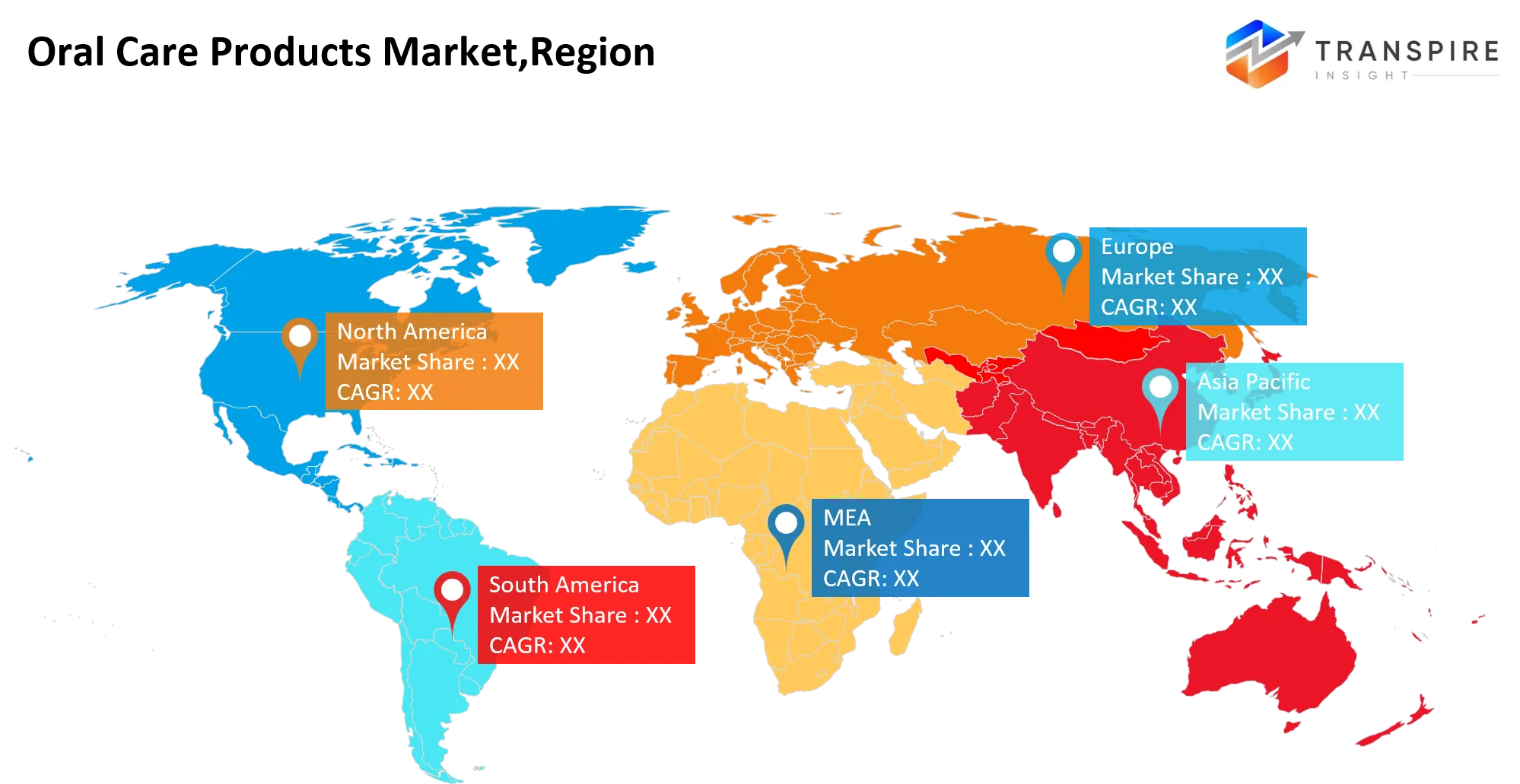
Asia Pacific is the largest regional market, accounting for 35.60% of the world's oral-care market. The majority of Asia Pacific's market share can be attributed to the large population, rising urban incomes, increasing pharmacy and online presence, and rising awareness about preventive dental care. Regional companies such as Dabur, Himalaya Wellness and Lion Corporation offer formulas designed for this market, focusing on herbal, medicated and sensitive offerings. With government partnerships for health awareness, increasing access to mobile internet and improved retail infrastructure, the region is moving from sporadic new product adoption to domestic household consumption.
In October 2026, Lion Corporation signed a partnership with the FDI World Dental Federation for the three-year "Generation Smile" World Oral Health Day campaign.
https://www.lion.co.jp/en/newsroom/news/2026/5206
North America is 28.00%, and Europe is 25.00%; both are more mature regions. North American growth is supported by the premium electric toothbrush category, whitening systems, replenishment subscriptions, and brand marketing. Europe is supported by pharmacy reach, sustainability mandates, and established preventive-care behavioural patterns. Mature regions are highly stable, with high household penetration, established clinical and consumer research, lower price sensitivity, preventive-care behaviours, strong provider influence, and resilient replacement demand. Innovations such as Colgate's recyclable tube and P&G's AI-enabled Oral-B ecosystem help ensure value in developed markets.
In January 2026, Colgate-Palmolive announced a partnership with the WHO Foundation. This multi-year funding commitment scales oral health education and policy guidance within public infrastructures to reach 3.7 billion people globally.
Latin America makes up 7.00% of the market, supported by urbanisation, the rise of branded products, and the rise of social commerce. Middle East & Africa accounts for 4.40% of the current market while being the fastest-growing at 6.90% CAGR. The latest developments include penetration of modern trade, mobile commerce, premium imported products, and a higher penetration of Halal, herbal, and whitening formulations. Opportunities lie in cheap pack sizes, local manufacturing, partnerships with pharmacies, and mobile-driven awareness to deal with uneven dental infrastructure and income disparity.
In February 2026, Sensodyne (an oral care brand under Haleon) expanded its specialized oral care portfolio by launching the new Clinical Repair dual-action toothpaste line. This product launch delivers a rapid restorative formulation that targets the root cause of tooth sensitivity within 60 seconds.
Who are the Key Players in the Oral Care Products Market, and how do they compete?
There is competition in the mass market among multinational FSGs, specialist dental players, and local herbal brands. Colgate and P&G are fighting on scale, clinical innovation, and shopping channel coverage: Total prevention in the case of Colgate, recyclable tubes, and fully connected toothbrushes in the case of P&G. Haleon is betting on clinical trust, built in through the brand equity of Sensodyne and Parodontax; Unilever has introduced mass-market pricing, digital formulation optimization, and local brands; Church & Dwight is focusing on the Arm & Hammer baking soda brand platform and whitening.
Meanwhile, in specialist FSGs, Lion, Sunstar, GC Corporation, and Dentsply Sirona all target a narrower, more premium-positioned segment: medicated, interdental, professional channels, or professional materials. Philips targets high-end sonic devices and connected Sonicare ecosystems. Kao leverages formulation expertise and their Asian distribution network; Dabur and Himalaya leverage their herbal capital to enable expansion into emerging markets. GlaxoSmithKline Consumer Healthcare relies on therapeutic brand equity, while 3M plays in professional materials and clinical use. Importantly, growth increasingly relies on partnerships, acquisitions, local manufacturing, online sales, and a roll-out of services enabled by technology, rather than simply on geographic extension.
Key Players are:
- Colgate-Palmolive
- Procter & Gamble
- Haleon
- Unilever
- Church & Dwight
- Lion Corporation
- Sunstar
- GC Corporation
- Dentsply Sirona
- Philips
- Kao Corporation
- Dabur
- Himalaya Wellness
- GlaxoSmithKline Consumer Healthcare
- 3M
Recent Development News
In January 2026, Procter & Gamble (P&G) expanded its corporate sponsorship with America's ToothFairy through its core oral hygiene brands, Crest and Oral-B. The corporate funding secures preventive dental care kits and specialised oral-care diagnostic tools for nonprofit safety-net dental clinics serving economically vulnerable children across the United States.
In January 2026, Colgate-Palmolive formed a multi-year partnership with the WHO Foundation to fund public oral health work. This collaboration scales dental education infrastructure across ministries of health. It integrates diagnostic prevention models directly into national public health policies to address the chronic burden of non-communicable oral diseases.
In September 2026, usmile launched its D Series visual oral-care system, comprising the D50 OralCam Toothbrush and D-lite OralCam, which combine oral imaging, AI-assisted brushing guidance, plaque visualization, and hygiene tracking. The launch strengthens the role of visual feedback and AI in home oral care, enabling consumers to identify areas requiring greater attention and adopt more targeted daily cleaning routines.
https://finance.yahoo.com/healthcare/articles/beyond-smart-toothbrush-usmile-unveils-140000286.html
What Strategic Insights Define the Future of the Oral Care Products Market?
The industry is shifting toward fully integrated oral-health ecosystems, where toothpaste, devices, data, subscriptions and professional support all work in harmony. The biggest incremental growth will likely come from innovation that delivers outcomes such as better coverage, less sensitivity, healthier gums and reduced environmental impact, rather than new flavours and pack formats. A risk is that AI-enabled devices may end up providing inaccurate advice if sensors don't capture data adequately, and regulation around privacy, medical claims, and sustainability drives up compliance costs. We see a growing opportunity for affordable personalization in APAC, Latin America and the Middle East via app-light devices, refillables and pharmacy-led programs. Companies can prioritise interoperability, clinical validation and onshore manufacturing sensibly while keeping their product mix low-cost to sustain high volumes. And brands should establish quantifiable sustainability claims to prevent unsubstantiated claims from damaging consumer trust and triggering regulatory interventions.
Key Segmentations are:
Product Type
- Toothpaste
- Toothbrushes
- Mouthwash
- Dental Floss
- Tooth Whitening Products
- Denture Care
- Oral Care Accessories
- Breath Fresheners
Toothpaste Type
- Fluoride
- Herbal
- Whitening
- Sensitive Teeth
- Tartar Control
- Children’s
- Natural Charcoal
Distribution Channel
- Supermarkets & Hypermarkets
- Pharmacies
- Convenience Stores
- Speciality Stores
- Online Retail
- Dental Clinics
- Wholesale
Age Group
- Adults
- Children
- Infants
- Seniors
- Teenagers
- Families
- Geriatric Users
End User
- Households
- Dental Clinics
- Hospitals
- Hotels
- Schools
- Institutions
- Professional Dental Practices
Price Category
- Economy
- Mid-Range
- Premium
- Super-Premium
- Professional
- Organic
- Speciality
Frequently Asked Questions
Find quick answers to common questions.
The oral care products market size was valued at USD xx.xx billion in 2025 and is poised to reach USD xx.xx billion by 2033, expanding at a xx.xx% CAGR.
Key segments for the oral care products market are Product Type (Toothpaste, Toothbrushes, Mouthwash, Dental Floss, Tooth Whitening Products, Denture Care, Oral Care Accessories, Breath Fresheners); Toothpaste Type (Fluoride, Herbal, Whitening, Sensitive Teeth, Tartar Control, Children’s, Natural, Charcoal); Distribution Channel (Supermarkets & Hypermarkets, Pharmacies, Convenience Stores, Specialty Stores, Online Retail, Dental Clinics, Wholesale); Age Group (Adults, Children, Infants, Seniors, Teenagers, Families, Geriatric Users); End User (Households, Dental Clinics, Hospitals, Hotels, Schools, Institutions, Professional Dental Practices); Price Category (Economy, Mid-Range, Premium, Super-Premium, Professional, Organic, Specialty).
Growth is primarily driven by premiumisation of specialised oral-care products, rising adoption of electric and AI-enabled toothbrushes, demand for whitening and sensitivity solutions, expanding e-commerce penetration, and greater emphasis on preventive and personalised oral health.
The oral care products market is led by major manufacturers, including Colgate-Palmolive, Procter & Gamble, Haleon, Unilever, Church & Dwight, Lion Corporation, Sunstar, GC Corporation, Dentsply Sirona, Philips, Kao Corporation, Dabur, Himalaya Wellness, GlaxoSmithKline Consumer Healthcare, and 3M.
Asia Pacific holds 35.60% of the market, supported by its large consumer base, expanding modern retail and e-commerce networks, rising preventive-care awareness, and increasing adoption of specialised and premium oral-care products.
Key opportunities include AI-enabled personalised oral care, affordable premium formulations, specialist whitening and sensitivity products, e-commerce subscriptions, and expansion into underserved emerging markets.
- Colgate-Palmolive
- Procter & Gamble
- Haleon
- Unilever
- Church & Dwight
- Lion Corporation
- Sunstar
- GC Corporation
- Dentsply Sirona
- Philips
- Kao Corporation
- Dabur
- Himalaya Wellness
- GlaxoSmithKline Consumer Healthcare
- 3M
About the Authors

Chetan Dhatrak
I’m Chetan Dhatrak, a Senior Research Analyst at Transpire Insight, specializing in the Consumer Goods, Foods and Beverages industry. I focus on analyzing market trends, consumer behavior, competitive landscapes, and industry developments to deliver accurate, data-driven insights. My research at Transpire Insight is built on credible sources and in-depth analysis, helping businesses and readers better understand market dynamics, emerging opportunities, and evolving consumer preferences. I’m committed to creating reliable, well-researched content that supports informed decision-making and reflects the latest developments in the consumer goods and food & beverage sectors.

Chakradhar Khansole
Chakradhar serves as the Research Director at Transpire Insight, bringing over 8 years of experience in technology, innovation, and strategic market intelligence. He specializes in transforming complex market data into actionable business insights that enable organizations to make informed, growth-oriented decisions. Recognized for his strategic vision and analytical expertise, Chakradhar leads high-impact research initiatives, delivering comprehensive market assessments, competitive intelligence, and forward-looking industry analysis.
Recently Published Reports
-
Apr 2026
Bottled Water Market
Bottled Water Market Size, Share & Analysis Report By Product Type (Still Bottled Water, Carbonated Bottled Water, Functional Bottled Water, and Others), By Packaging (PET, Cans, and Others), By Sales Channel (Supermarkets/Hypermarkets, Convenience Stores/Drug Stores, Grocery Stores/Club Stores, Foodservice, and Others) and Geography (North America, Europe, Asia-Pacific, Middle East and Africa, South and Central America), 2021 - 2032
-
Apr 2026
Color Cosmetic Packaging Market
Color Cosmetic Packaging Market Size, Share & Analysis Report By Application (Mascara Packaging, Liquid Packaging, and Liquid Face), By Type (Tubes & Bottles, Pens & Markers, Compacts & Containers, and Droppers & Pumps), and Geography (North America, Europe, Asia-Pacific, Middle East and Africa, South and Central America), 2021 - 2031
-
Apr 2026
External Microphone For Camera Market
External Microphone For Camera Market Size, Share & Analysis Report By Type (Shotgun Microphone, Lavalier Microphone, and Others), By Application (Digital Camera, Professional Video Camera, and Others), and Geography (North America, Europe, Asia-Pacific, Middle East and Africa, South and Central America), 2021 - 2031
-
Apr 2026
Foot Orthotic Insoles Market
Foot Orthotic Insoles Market Size, Share & Analysis Report By Type (Pre-fabricated, and Custom-made), By Material (Thermoplastic, Composite Carbon Fiber, and Others), By Distribution Channel (Drug Stores, Hospitals & Clinics, and Others), and Geography (North America, Europe, Asia-Pacific, Middle East and Africa, South and Central America), 2021 - 2031