
Onshore Drilling Fluid Market Summary:
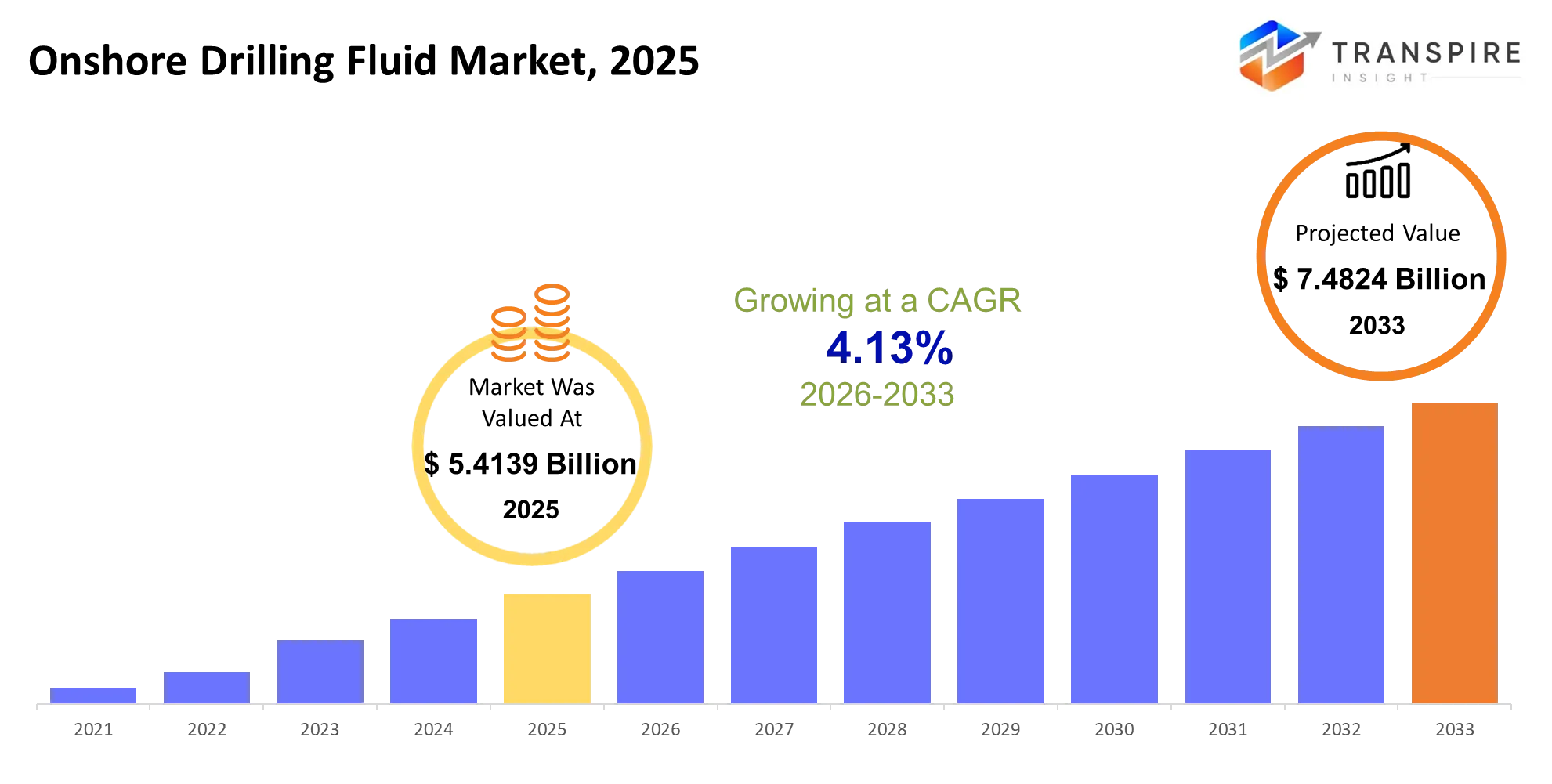
As per Transpire Insight, the Onshore Drilling Fluid Market size is estimated at USD 5.4139 billion in 2025 and is anticipated to reach USD 7.4824 billion by 2033, growing at a CAGR of 4.13% from 2026 to 2033.
The Onshore Drilling Fluid Market supports oil and gas well construction by providing fluids that keep downhole pressure under control, keep wellbores stable, move rock cuttings to the surface and keep drilling equipment safe. Over the past three to five years, operators have put more focus on drilling efficiency, fluid recycling, environmental compliance and real-time monitoring. The shift toward directional drilling has made the need for fluid formulations that stay stable under high pressure and temperature higher. The growth of oil and gas development in North America has pushed service providers to make mud performance better and to cut down nonproductive time. Water-based fluids are still part of the market because they give a good mix of performance, cost and environmental friendliness. At the same time, better automation and fluid management are making operators want to use more custom solutions that can boost drilling consistency and lower operating costs. I see how the Onshore Drilling Fluid Market keeps evolving. I think it shows a clear trend.
Onshore Drilling Fluid Market Size & Forecast:
- Market Size 2025: USD 5.4139 Billion
- Expected Market Value (2033): USD 7.4824 Billion
- Forecast CAGR (2026–2033): 4.13%
- Leading Region in 2025: North America
- Fastest Growing Region: Middle East & Africa
- Key Company Profiles: SLB, Halliburton, Baker Hughes, NOV, Weatherford, TETRA Technologies, Newpark Resources, CES Energy Solutions, ChampionX, Scomi Group, GEO Drilling Fluids, Flotek Industries, QMax, CNPC, Sinopec
Key Market Insights:
The trend is shifting towards fluid systems that are cost-effective and specialised formulations suited to difficult drilling operations. Suppliers who integrate innovation in chemicals, reliable field services and real-time monitoring stand in a better position to serve their needs.
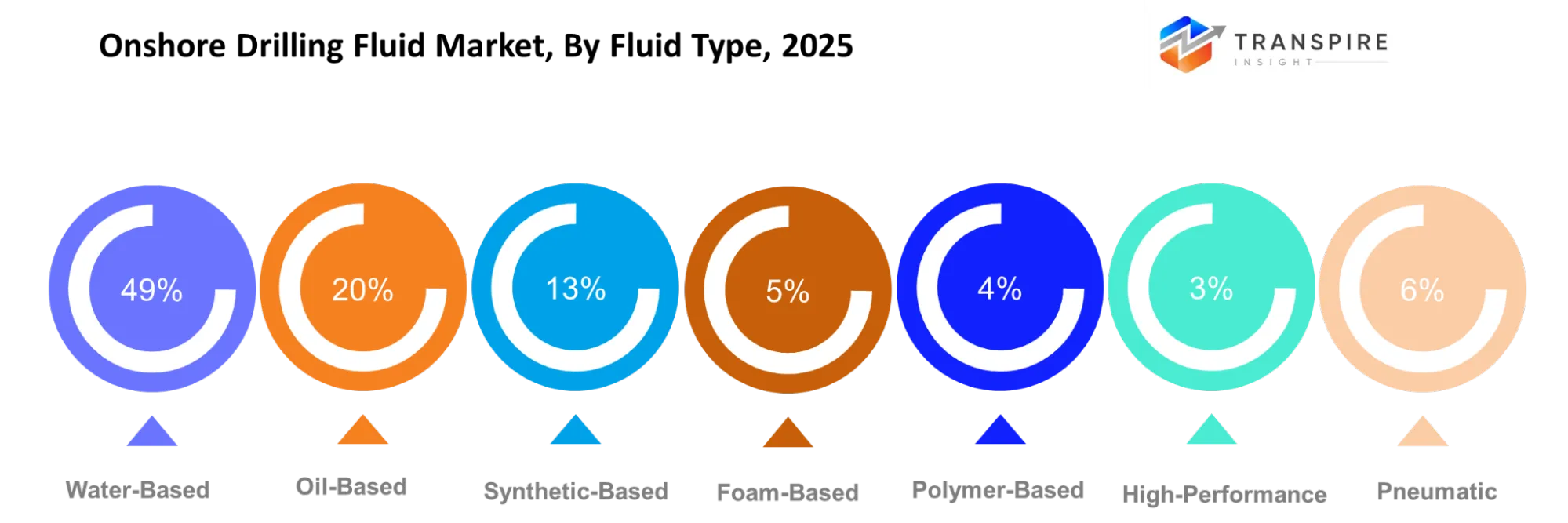
- Oil-based fluids constitute 20.5% of the total market. The need for oil-based fluids to work under difficult well conditions promotes the need for enhanced lubrication, shale stability, and drilling fluid performance.
- Synthetic-based fluids make up 13.5% of the total market size and will grow at a CAGR of 6.9%.
- Foam-based fluids are 5.0% of the market size. The possibility of applying foam-based fluids in certain low-pressure and underbalanced drilling operations encourages the use of such fluids where conventional systems cannot be used.
- Polymer-based fluids are 4.5%. The development of additives and technologies of fluid viscosity control helps to develop special formulations that can suit formation and cuttings transportation.
- High-performance fluids are 3.5%. Their significance increases when dealing with complex wells because the maintenance of stable fluid properties will help to avoid drilling stops.
- Pneumatic fluids are 2.0% of the total market size. Pneumatic fluids are still being applied in certain operations only where there is a need to decrease fluid density.
What are the Key Drivers, Restraints, and Opportunities in the Onshore Drilling Fluid Market?
Drivers:
The increased complexity of horizontal, directional and unconventional wells has made the demand for drilling fluids that provide wellbore stability, solid removal and pressure control greater than ever before. Extended lateral lengths and varying formation conditions can cause an increase in friction, fluid loss and delays in the drilling process. This means that operators will rely on solutions like custom-formulated fluids, fluids monitoring in real-time and field services.
Restraints:
Variations in the prices of chemicals, transport costs, waste disposal needs and the requirement to monitor fluids continuously can impact on operating margins. Smaller drilling contractors might not be able to stomach the added expense of these new formulations and digital monitoring. Local regulations related to the handling and disposal of fluids mean products and operations have to be adjusted.
Opportunities:
The most promising opportunities are high-performance water-based systems, synthetic systems, fluid recycling and automated data monitoring. In the North American shale basins, systems that sustain rheological properties while minimising fluid losses and waste streams are expected to appeal to operators. In the Middle East, redevelopment of mature fields and more challenging wells could generate opportunities for highly tailored fluid programs. Suppliers that use chemical know-how coupled with analytics and reliable supply chains will be better positioned to retain customers.
|
Driver |
Relative Impact on Growth (%) |
Geographic Relevance |
Impact Timeline |
Demand Strength |
Growth Mechanism (5–10 words) |
Key Beneficiaries (5–10 words) |
Major Constraint (5–10 words) |
|
Rising onshore oil and gas exploration and production |
28% |
North America, Asia-Pacific, Middle East |
Short-term (≤2 years) |
High |
More drilling wells increase drilling fluid consumption and replenishment. |
Drilling fluid manufacturers, mud service providers, exploration companies. |
Oil price volatility can delay drilling investment decisions. |
|
Expansion of shale gas and unconventional resource development |
24% |
North America, China, Argentina |
Medium-term (2–4 years) |
High |
Horizontal drilling requires specialized fluids for wellbore stability. |
Specialty chemical suppliers, drilling contractors, fluid engineering providers. |
Complex formations increase fluid costs and operational risks. |
|
Adoption of advanced drilling fluid technologies and digital monitoring |
19% |
North America, Middle East, Asia-Pacific |
Medium-term (2–4 years) |
High |
Real-time monitoring improves fluid performance and reduces drilling downtime. |
Technology vendors, fluid formulators, integrated drilling service providers. |
High implementation costs limit adoption among smaller operators. |
|
Environmental regulations and demand for sustainable fluid formulations |
16% |
North America, Europe, Asia-Pacific |
Long-term (≥4 years) |
High |
Low-toxicity formulations reduce environmental risks and disposal burdens. |
Green chemical manufacturers, fluid suppliers, waste management service providers. |
Environmentally compliant formulations may increase procurement and treatment costs. |
|
Government exploration initiatives and investment in domestic energy production |
13% |
India, China, Middle East, North America |
Medium-term (2–4 years) |
Medium |
Exploration incentives encourage new wells and drilling fluid procurement. |
National oil companies, drilling contractors, regional fluid manufacturers. |
Regulatory uncertainty and funding delays can postpone exploration projects. |
|
Total |
100% |
— |
— |
— |
— |
— |
— |
What Has the Impact of Artificial Intelligence Been on the Onshore Drilling Fluid Market?
Artificial intelligence is transforming the drilling fluid management process from a reactive one to a more data-driven process. The drilling fluid's density, viscosity, temperature, pressure, and flow properties affect the wellbore stability and cuttings removal during onshore drilling. An AI system can analyse all these parameters and drilling parameters together to detect anomalies and make faster decisions.AI predictive models can also be used to predict how different changes in the formation or drilling parameters would affect the drilling fluid performance. When used in conjunction with drilling control systems, these tools can help drilling engineers change the fluid formulation and operations before small issues turn into expensive interruptions. Drilling service providers are increasingly using a combination of software, real-time monitoring, and drilling experience. Baker Hughes provides digital well construction solutions that use AI, physics models, and operational data to plan and drill wells.The implementation of these technologies is not easy. Old equipment, poor data quality, high costs of integration, and the need for specialists' supervision can hinder the process. Recommendations provided by AI also have to be confirmed by engineers because wrong inputs or unique geological conditions can decrease the prediction accuracy.
Instance:
In September 2025, Halliburton emphasised the application of artificial intelligence and machine learning in analysing drilling data, predicting issues in operations, and optimising drilling parameters. This can lead to higher efficiencies in drilling, less downtime, and effective drilling fluid management in onshore drilling operations.
Key Market Trends:
The market trend for fluid management systems is heading towards speciality data-based systems rather than relying purely on traditional mud systems.
- Formulation standards are progressively accompanied by application-specific systems for use in various formations, temperatures, and pressures.
- Although manual testing is still used, the digital version is aiding identification and response to fluid changes for better efficiency.
- Operators are paying more attention to fluid recovery and disposal to help minimise the costs and environmental effects involved.
- Horizontal wells and those requiring an extended reach pose challenges in controlling fluid lubricity and rheology transport.
- Digital platforms are helping in the analysis of drilling data and decision-making in drilling operations but at varying levels between companies.
- Additive technologies continue to be enhanced to expand conditions where water-based systems can perform efficiently.
Onshore Drilling Fluid Market Segmentation
By fluid type:
Water-based fluids hold the largest share at 48.5%, while oil-based fluids account for 20.5% and synthetic-based fluids account for 13.5%. Foam-based fluids have a 5.0% share, polymer-based fluids have a 4.5% share, high-performance fluids have a 3.5% share, pneumatic fluids have a 2.0% share, and others account for 2.5%. Water-based systems still hold the edge in conventional drilling operations, while synthetic fluids provide opportunities in technologically difficult operations. The provided forecast indicates that synthetic-based fluids have the highest growth rate, with a CAGR of 6.9%.
By system:
Market comprises inhibitive, non-inhibitive, saltwater, polymer, KCl, silicate, silica and other systems. The inhibitive system is used for inhibiting the reactive shale formation, while the non-inhibitive formulation may be very useful for formations which do not require such a degree of chemical inhibition. The saltwater and polymer systems suit the chemistry and flow properties of the fluid, while the KCl and silicate systems are compatible with the formation.
By function:
The drilling fluids market consists of enhancing wellbore stability, lubricating and cooling the bits, transporting cuttings, reducing formation damage, managing the wellbore pressure, resisting corrosion and other functions. The characteristics of drilling fluids are not only required for transporting cuttings to the surface but also play an important role in determining the rate of penetration, equipment wear and operational delay. The current well design requirements have become stringent.
By well type:
Typical fluid design challenges for the market include conventional, horizontal, directional, extended reach, multilateral, shale, tight oil and other wells. Conventional wells may follow existing fluid programs, while laterals and extended reach requires attention to friction control, suspension capacity and hole cleaning. The development of shale and tight oil formations adds requirements to control reactive formations and performance in longer laterals, supporting ongoing investments in fluid engineering.
By application:
Exploration, development, production, workover, completion, enhanced recovery, well intervention, and various other operations. Well conditions and operational requirements drive fluid selection in workover, completion, and intervention operations. The needs for exploration operations are fluid as subsurface geology and other data become clearer; exploration operations use flexible fluids, while development operations prefer homogeneous solutions. As market focus shifts to mature field recovery, opportunities for dedicated fluids in all phases are likely.
By operator type:
The customer base consists of integrated oil and gas companies; national oil companies; independent operators; oilfield services companies. Drilling contractors, exploration companies, midstream companies, and others. The large integrated oil companies and national oil companies have more emphasis on technical and environmental standards and equipment procurement agreements between various assets. Independent operators and drilling contractors require cost management and flexibility, and technical support is key. Service companies influence the purchasing decision process since fluid chemistry, equipment, monitoring, and engineering are integrated into drilling programs.
What are the Key Use Cases Driving the Onshore Drilling Fluid Market?
The use case is ensuring safety and efficiency by means of circulating fluids, pressure control, wellbore stability, and transportation of rock cuttings from the drilling site. The water based fluids, of the market share, are appropriate for the regular drilling projects that require considering price, fluid properties, and environmental issues. Growing use cases involve using drilling fluids during horizontal and directional drilling, exploration of shales, and drilling of extended reach wells. These procedures require drilling fluids that control friction, formation instability, and ensure proper transport of cuttings along complex and lengthy well sections. Future use cases will include automated monitoring of fluid properties, improved recirculation, and designing specific fluids for extreme temperatures and pressures. Such applications may help companies avoid unnecessary interruption of drilling process.
|
Report Metrics |
Details |
|
Market size value in 2025 |
USD 5.4139 Billion |
|
Market size value in 2026 |
USD 5.6359 Billion |
|
Revenue forecast in 2033 |
USD 7.4824 Billion |
|
Growth rate |
CAGR of 4.13% from 2026 to 2033 |
|
Base year |
2025 |
|
Historical data |
2021 - 2024 |
|
Forecast period |
2026 - 2033 |
|
Report coverage |
Revenue forecast, competitive landscape, growth factors, and trends |
|
Regional scope |
United States; Canada; Mexico; United Kingdom; Germany; France; Italy; Spain; Denmark; Sweden; Norway; China; Japan; India; Australia; South Korea; Thailand; Brazil; Argentina; South Africa; Saudi Arabia; United Arab Emirates |
|
Key company profiled |
SLB, Halliburton, Baker Hughes, NOV, Weatherford, TETRA Technologies, Newpark Resources, CES Energy Solutions, ChampionX, Scomi Group, GEO Drilling Fluids, Flotek Industries, QMax, CNPC, Sinopec |
|
Customization scope |
Free report customization (country, regional & segment scope). Avail customized purchase options to meet your exact research needs. |
|
Report Segmentation |
Fluid Type (Water-Based, Oil-Based, Synthetic-Based, Foam-Based, Pneumatic, Polymer-Based, High-Performance, Others)System (Inhibitive, Non-Inhibitive, Saltwater, Polymer, KCl, Silicate, Silica, Others)Function (Wellbore Stabilization, Lubrication, Cooling, Cuttings Transport, Formation Protection, Pressure Control, Corrosion Control, Others)Well Type (Conventional, Horizontal, Directional, Extended-Reach, Multilateral, Shale, Tight Oil, Others)Application (Exploration, Development, Production, Workover, Completion, Enhanced Recovery, Well Intervention, Others)Operator Type (Integrated Oil Companies, National Oil Companies, Independent Operators, Oilfield Service Companies, Drilling Contractors, Exploration Firms, Midstream Companies, Others) |
Which Regions are Driving the Onshore Drilling Fluid Market Growth?
North America:
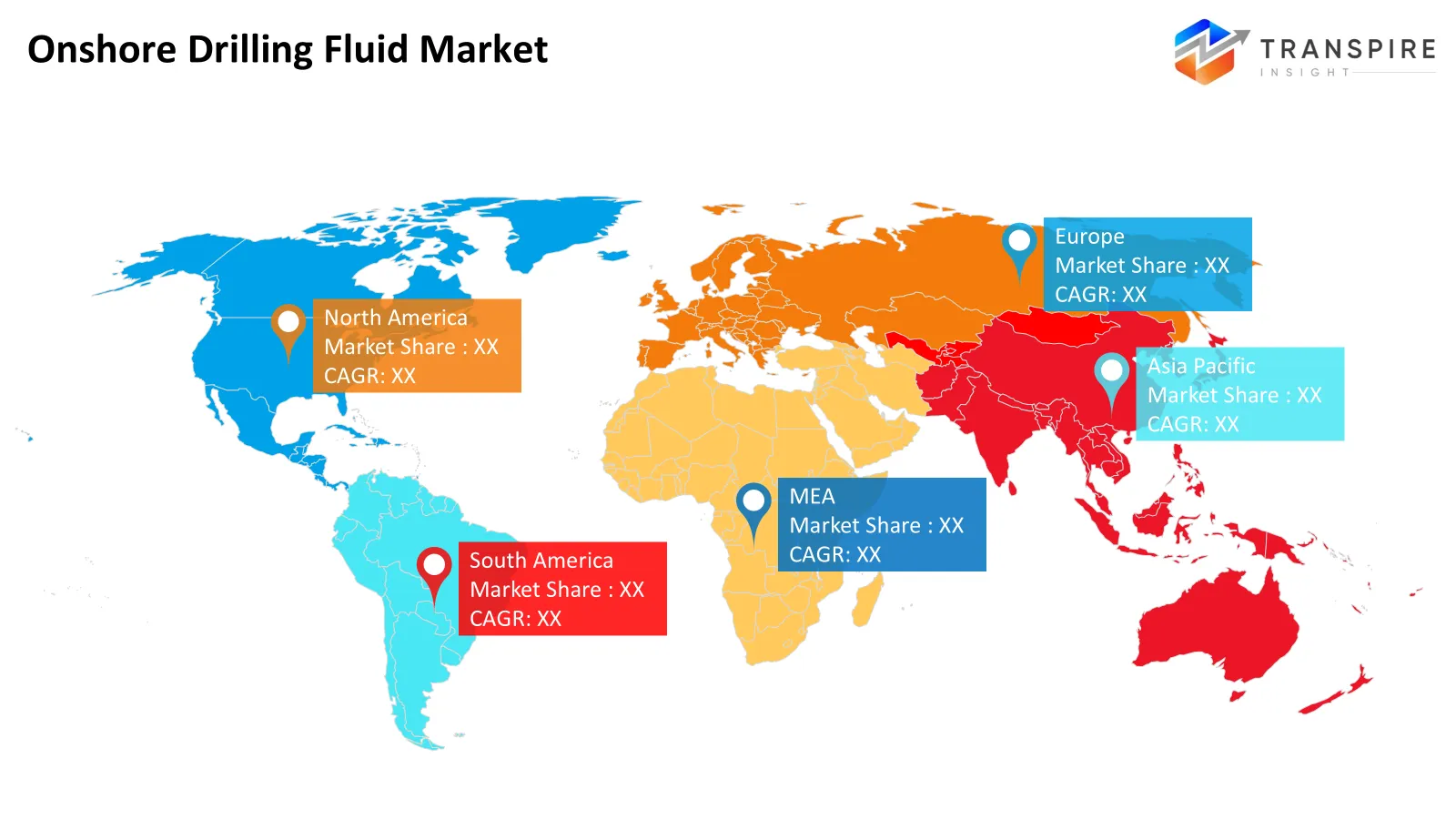
North America holds the largest share in the Onshore Drilling Fluids Market, holding 45.8% of the supplied regional estimates. The dominance of this region is driven by oilfield services infrastructure, drilling infrastructure, and unconventional drilling of oil and gas. For shale projects, reliable fluid systems need to be used to minimise friction, ensure wellbore stability, and help in removing cuttings from the well. The investments in the drilling technology and services will drive demand for both standard and speciality drilling fluids.
In July 2025,Halliburton indicated changes in U.S. land operations and fluid services in the second-quarter report. There was an indication of the need for drilling services in North America.
Europe:
Europe accounts for a 10.2% share in the market. Here, the demand drivers include the availability of energy infrastructure, technology, and environmental considerations. While compared to North America, Europe holds less share in the supplied estimates, still the operators in the region have much focus on the well integrity, operational dependability, and compliance. The mature fields, along with drilling projects involving technical challenges, create opportunities for the use of speciality fluids and better waste management processes.
In May 2026, Equinor indicated contract renewals for drilling and well services, which include Halliburton, Schlumberger and Baker Hughes. These contracts provide for drilling activities in Europe, but the project is an offshore one.
https://www.equinor.com/news/20260504-nok-17-billion-continued-drilling-ncs
Asia Pacific:
Asia Pacific constitutes 24.7% of the market share owing to their energy security concerns and domestic exploration and development of oil & gas field projects. Demand patterns in the region are different since geological formations, infrastructure development and the needs of the operators varies from one country to another. Further development of their resources and better drilling technology can create scope for tailor-made water-based, polymer-based and synthetic-based fluids.
In February 2026, SLB received drilling service contracts for the Tangkulo gas development in Indonesia by Mubadala Energy. Services provided were drilling fluids, cementing, and directional drilling. The project shows demand for drilling services in the Asia-Pacific region, but the project is offshore.
https://www.slb.com/newsroom/press-release/2026/pr-2026-0212-mubadala
Who are the Key Players in the Onshore Drilling Fluid Market and how do they compete?
Onshore Drilling Fluids Market Competitors rely on formulation, technical support, availability, environmental factors, and total cost of drilling as major competitive factors. Leading firms include SLB, Halliburton, Baker Hughes, Newpark Fluids Systems, Weatherford, NOV, TETRA Technologies, and CES Energy Solutions. These companies compete due to their capability to formulate the appropriate chemistry based on geological settings and assist operators in reducing nonproductive time and managing wellsite operations.SLB relies on integrated well construction capabilities, digital capabilities, and technical expertise throughout the drilling process lifecycle. Collaboration of the company with drilling contractors, together with investments in digital workflows, enables SLB to improve operational consistency and relationships with its customers. Halliburton combines drilling and evaluation services with fluid technology, which makes it possible to associate the product selection with well construction needs. Its portfolio includes water-based systems for high-temperature wells and synthetic-based products for challenging drilling operations. Newpark Fluids Systems is concerned with the provision of drilling fluids and field and regional services, with investments in infrastructure contributing to supply chain reliability. Weatherford and NOV compete through their broad drilling technology and well construction offerings. TETRA Technologies and CES Energy Solutions provide selected fluid, chemical, and energy services.
Onshore Drilling Fluid Market Companies
- SLB
- Halliburton
- Baker Hughes
- NOV
- Weatherford
- TETRA Technologies
- Newpark Resources
- CES Energy Solutions
- ChampionX
- Scomi Group
- GEO Drilling Fluids
- Flotek Industries
- QMax
- CNPC
- Sinopec
|
Company |
Est. Revenue Share Range |
Key Offerings |
Strategic Positioning |
Geographic Strength |
Technology Focus |
|
SLB |
Estimated: 12–20% |
M-I SWACO fluid systems, WARP fluids, MEGADRIL, LateralMax |
scale and integrated drilling-fluid engineering |
North America, Middle East & Africa, Asia Pacific |
Advanced rheology, digital fluid modelling and automated testing |
|
Halliburton |
Estimated: 10–18% |
Baroid drilling fluids, BaraHib, BaraSeal, BaraLogix |
Performance-led fluid engineering and solids management |
North America, Middle East & Africa, Latin America |
Fluid monitoring, advanced additives and automated optimization |
|
Baker Hughes |
Estimated: 7–13% |
Water-based fluids, invert emulsions, specialty additives, reservoir drill-in fluids |
Technology-led formulations and integrated wellsite services |
North America, Middle East & Africa, Latin America |
Intelligent fluids, digital monitoring and fluid optimization |
|
Newpark Fluids Systems |
Estimated: 4–9% |
Kronos, Teros, Volos, OptiDrill fluid systems |
Specialist formulations and customized drilling-fluid solutions |
North America, Middle East, Europe |
Advanced fluid chemistry, friction reduction and digital optimization |
|
CES Energy Solutions |
Estimated: 3–7% |
CES Invert, EnerDrill, EnerReach, EnerSeal |
Basin-focused chemical solutions and tailored fluid systems |
North America, particularly Canada and the United States |
Polymer chemistry, lost-circulation control and fluid stability |
|
Weatherford International |
Estimated: 2–5% |
Drilling-fluid chemicals, wellbore stability solutions, drilling optimization services |
Integrated well construction and operational efficiency |
Middle East, North America, Latin America |
Wellbore engineering, drilling optimization and fluid monitoring |
|
NOV Inc. |
Estimated: 2–5% |
Solids-control equipment, shale shakers, centrifuges, mud-processing systems |
Equipment-led differentiation in fluid circulation and solids control |
North America, Middle East, Asia Pacific |
Automated solids separation, fluid recovery and waste reduction |
|
TETRA Technologies |
Estimated: 1–4% |
Clear brines, completion and workover fluids, specialty fluid services |
Specialty-fluid expertise and well lifecycle applications |
North America, Latin America, Middle East |
Brine formulation, fluid purification and recycling |
|
Flotek Industries |
Estimated: 1–3% |
Specialty oilfield chemicals, drilling and completion chemical solutions |
Application-specific chemical formulations and performance differentiation |
North America, selected international markets |
Chemical formulation, analytical chemistry and fluid optimization |
|
China Oilfield Services Limited (COSL) |
Estimated: 2–6% |
Drilling-fluid services, mud engineering, drilling-waste management |
Integrated oilfield services and strong domestic market access |
Asia Pacific, particularly China, selected Middle Eastern markets |
Mud engineering, solids control and drilling-waste treatment |
Recent Development News
- In January 2026, Baker Hughes introduced Kantori, an autonomous well construction solution that brings together artificial intelligence, physics-based modelling, and real-time data analytics. The solution is aimed at enhancing planning, drilling, monitoring, and optimisation processes. While it covers a wider scope of well construction activities beyond drilling fluids, it is relevant to our discussion about the growing connectivity and data orientation of the drilling process. Original company announcement. https://www.bakerhughes.com/company/news/baker-hughes-launches-kantoritm-unified-digital-autonomous-well-construction-solution
- In June 2025, SLB signed a collaboration agreement with Cactus Drilling for expansion of its automated and autonomous drilling solutions. The solution provides improved drilling control, efficiency, and consistency. Its relevance to the fluid market stems from the growing role of drilling data and automation in making wellsite decisions. https://www.slb.com/newsroom/press-release/2025/slb-announces-digital-collaboration-with-cactus-drilling
What Strategic Insights Define the Future of the Onshore Drilling Fluid Market ?
The future of the Onshore Drilling Fluid Market will be shaped by the ability of the suppliers to offer efficient fluid performance along with cost control, environmental consideration and data driven approach. Water based fluids are expected to maintain their importance due to the existing applications of these systems, while synthetic based fluids can get more applications in the technically complex wells. Digital monitoring and predictive analytics can help suppliers differentiate through identifying the issues with fluids and decreasing unnecessary downtime.Another risk is the difference between advanced fluid technology and the ability of the operators to utilize this technology efficiently. Poor data quality, inconsistent field practices and lack of technical knowledge can limit the benefits that the customers can receive from advanced solutions. Chemical prices and disposal requirements can affect the profitability of the solution even more.One of the opportunities is to integrate fluid recycling, automation and custom formulations for shale development and mature fields. Suppliers should focus on field validated innovations, regional services and customer results rather than competing through price.
Key Segmentations are:
Fluid Type
- Water-Based
- Oil-Based
- Synthetic-Based
- Foam-Based
- Pneumatic
- Polymer-Based
- High-Performance
- Others
System
- Inhibitive
- Non-Inhibitive
- Saltwater
- Polymer
- KCl
- Silicate
- Silica
- Others
Function
- Wellbore Stabilization
- Lubrication
- Cooling
- Cuttings Transport
- Formation Protection
- Pressure Control
- Corrosion Control
- Others
Well Type
- Conventional
- Horizontal
- Directional
- Extended-Reach
- Multilateral
- Shale
- Tight Oil
- Others
Application
- Exploration
- Development
- Production
- Workover
- Completion
- Enhanced Recovery
- Well Intervention
- Others
Operator Type
- Integrated Oil Companies
- National Oil Companies
- Independent Operators
- Oilfield Service Companies
- Drilling Contractors
- Exploration Firms
- Midstream Companies
- Others
By Regional Analysis
North America
- US
- Canada
- Mexico
Europe
- Germany
- UK
- France
- Italy
- Spain
- Russia
- Rest of Europe
Asia Pacific
- China
- Japan
- India
- South Korea
- Australia
- Rest of Asia Pacific
South America
- Brazil
- Argentina
- Rest of South America
Middle East & Africa
- UAE
- Saudi Arabia
- Qatar
- South Africa
- Rest of the Middle East & Africa
Frequently Asked Questions
Find quick answers to common questions.
The keyword size was valued at USD 5.4139 billion in 2025 and is poised to reach USD 7.4824 Billion by 2033, expanding at a 4.13% CAGR.
Key segments for the onshore drilling fluid market are Fluid Type (Water-Based, Oil-Based, Synthetic-Based, Foam-Based, Pneumatic, Polymer-Based, High-Performance, Others)System (Inhibitive, Non-Inhibitive, Saltwater, Polymer, KCl, Silicate, Silica, Others)Function (Wellbore Stabilization, Lubrication, Cooling, Cuttings Transport, Formation Protection, Pressure Control, Corrosion Control, Others)Well Type (Conventional, Horizontal, Directional, Extended-Reach, Multilateral, Shale, Tight Oil, Others)Application (Exploration, Development, Production, Workover, Completion, Enhanced Recovery, Well Intervention, Others)Operator Type (Integrated Oil Companies, National Oil Companies, Independent Operators, Oilfield Service Companies, Drilling Contractors, Exploration Firms, Midstream Companies, Others).
Growth is primarily driven by increasing onshore oil and gas exploration, rising shale drilling activities, growing energy demand, advancements in drilling technologies, and the need for efficient drilling fluids to improve wellbore stability and operational performance.
The market is led by major manufacturers including SLB, Halliburton, Baker Hughes, NOV, Weatherford, TETRA Technologies, Newpark Resources, CES Energy Solutions, ChampionX, Scomi Group, GEO Drilling Fluids, Flotek Industries, QMax, CNPC, Sinopec.
North America holds a 45.8% market share for onshore drilling fluids due to its vast shale exploration operations, drilling techniques, high production of oil and gas, and well-developed drilling fluid companies.
Commercial prospects of the onshore drilling fluid industry are shale gas exploration, increased demand for high-performance and eco-friendly drilling fluids, greater investments in oil and gas projects, and advanced waste recycling and disposal methods.
- SLB
- Halliburton
- Baker Hughes
- NOV
- Weatherford
- TETRA Technologies
- Newpark Resources
- CES Energy Solutions
- ChampionX
- Scomi Group
- GEO Drilling Fluids
- Flotek Industries
- QMax
- CNPC
- Sinopec
About the Authors

Pankaj Ghogare Patil
I am Pankaj Ghogare Patil, a Senior Research Analyst at Transpire Insight, specializing in the Pharmaceutical, Chemicals & Materials, Healthcare IT, and Biotechnology industry. My expertise lies in conducting comprehensive market research, analyzing industry trends, evaluating competitive landscapes, and translating complex data into actionable insights. At Transpire Insight, I closely follow emerging technologies, regulatory developments, and market innovations to create accurate, well-researched, and informative content that helps businesses and professionals make informed decisions. I am committed to producing credible, evidence-based articles that reflect industry best practices while making technical topics accessible and valuable for a broad audience.

Chakradhar Khansole
Chakradhar serves as the Research Director at Transpire Insight, bringing over 8 years of experience in technology, innovation, and strategic market intelligence. He specializes in transforming complex market data into actionable business insights that enable organizations to make informed, growth-oriented decisions. Recognized for his strategic vision and analytical expertise, Chakradhar leads high-impact research initiatives, delivering comprehensive market assessments, competitive intelligence, and forward-looking industry analysis.
Recently Published Reports
-
May 2026
Healthcare Polymer Packaging Market
Healthcare Polymer Packaging Market Size, Share & Analysis Report By Packaging Type (Syringes, IV Bottles and Pouches, Clamshells, Blisters, Bottles & Jars, Containers, Tubes, IV Parental Packaging, Others), By Type (Regulated, Non-regulated), By Polymer Type (LDPE (Low-Density Polyethylene), HDPE (High-Density Polyethylene), Homo-polymer (Homo), Random Copolymer (Random), Block Copolymer (Block), PET, Polystyrene, Polyvinyl Chloride, Polyamide/EVOH, Others), and Geography (North America, Europe, Asia-Pacific, Middle East and Africa, South and Central America), 2021 - 2031
-
Apr 2026
Hydrophilic Tape (Waterstop) Market
Hydrophilic Tape (Waterstop) Market Size, Share & Analysis Report By Type (Bentonite-Based Hydrophilic Tape, Rubber-Based Hydrophilic Tape), By Application (Residential Buildings, Commercial Buildings, Infrastructure Projects), and Geography (North America, Europe, Asia-Pacific, Middle East and Africa, South and Central America), 2021 - 2031
-
Apr 2026
Metalens Market
Metalens Market Size, Share & Analysis Report By Type (Visible Light Metalens, and Infrared Metalens), By Application (Consumer Electronics, Automotive Electronics, Industrial, Medical, and Others), and Geography (North America, Europe, Asia-Pacific, Middle East and Africa, South and Central America), 2021 - 2031
-
Apr 2026
PBT Resin Market
PBT Resin Market Size, Share & Analysis Report By Type (Reinforced PBT Resin, Unreinforced PBT Resin), By Processing Method (Injection Molding, Extrusion, Blow Molding, Others), By End-User (Automotive, Electrical & Electronics, Consumer Appliances, Industrial Machinery, Medical Devices, Packaging, Others), and Geography (North America, Europe, Asia-Pacific, Middle East and Africa, South and Central America), 2021 - 2031