
Offshore Support Vessels Market Summary:
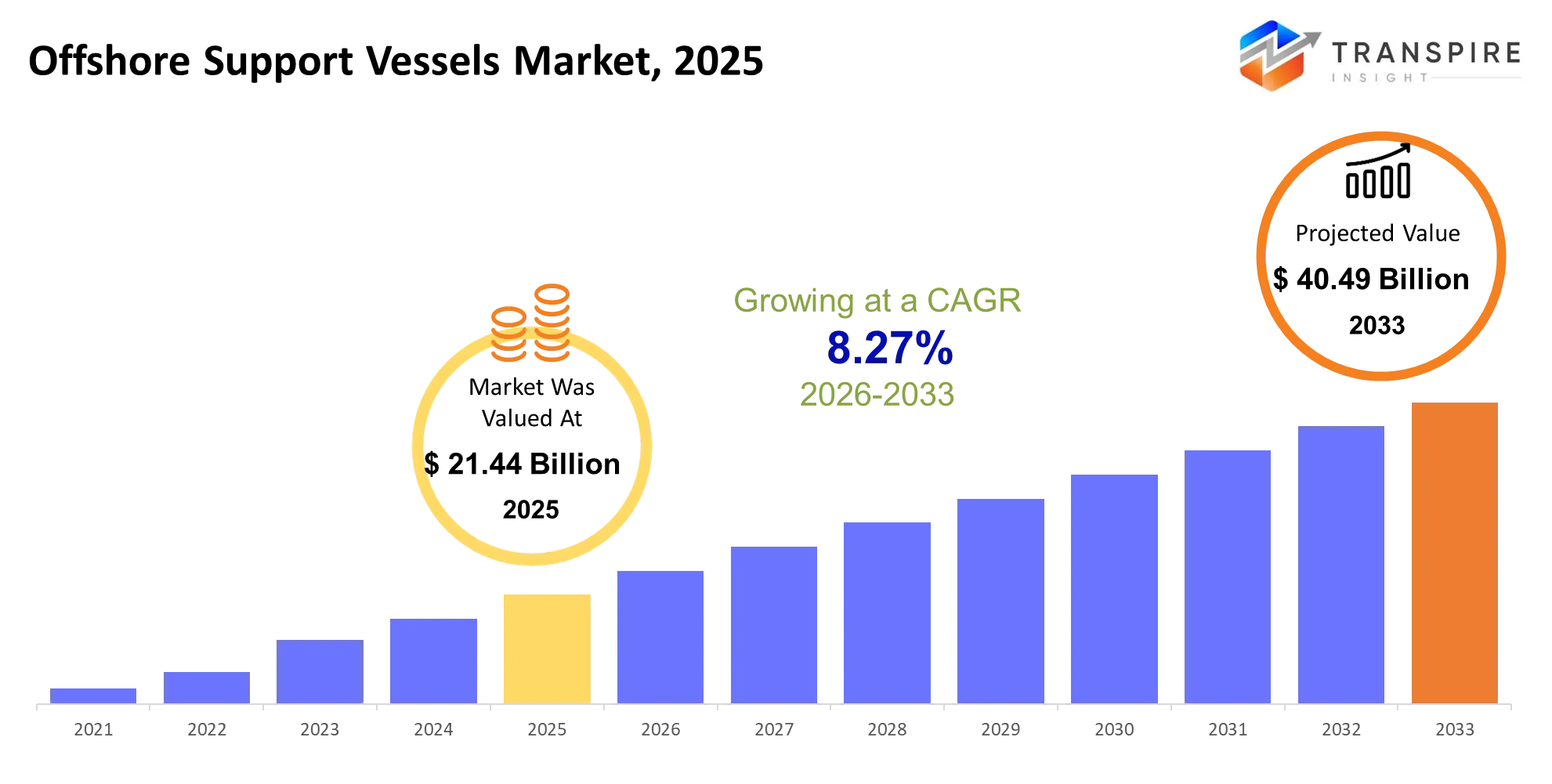
As per the Transpire Insight, The Offshore Support Vessels Market size is estimated at USD 21.44 billion in 2025 and is anticipated to reach USD 40.49 billion by 2033, growing at a CAGR of 8.27% from 2026 to 2033.
Offshore support vessels (OSVs) are used for the transportation of cargo, personnel, equipment, and specialised staff to offshore installations, as well as anchor handling, construction support, subsea work, and salvage. In the real world, OSVs keep oil and gas platforms, floating production units and wind farms in safe, working condition 24/7. In the past three to five years, the market has transitioned from the conventional diesel-powered vessels to hybrid, LNG-dual-fuel and digitally monitored vessels, as charterers tighten emissions and efficiency requirements. There has been a significant structural shift with the arrival of the offshore wind sector, which has created demand for crew-transfer, cable-support, construction and service-operation vessels. Driven by the burgeoning large-scale wind farms in Europe and Asia and renewed deepwater activity in Brazil, West Africa and the Middle East, this expands the customer base beyond oil and gas, improving vessel utilisation and encouraging owners to build higher-specification, lower-emission vessels.
Offshore Support Vessels Market Size & Forecast:
- Market Size 2025: USD 21.44 Billion
- Expected Market Value (2033): USD 40.49 Billion
- Forecast CAGR (2026–2033): 8.27%
- Leading Region in 2025: Asia Pacific
- Fastest Growing Region: Europe
- Key Company Profiles: Tidewater, Bourbon Corporation, Solstad Maritime, DOF Group, Seacor Marine, Swire Pacific Offshore, Edison Chouest Offshore, Hornbeck Offshore Services, Maersk Supply Service, Siem Offshore, Harvey Gulf, Solstad Offshore, PACC Offshore Services, GulfMark Offshore, Vroon.
Key Offshore Support Vessels Market Insights:
Supplied segment shares indicate a wide logistics base, and company investments are focused on specialised equipment and flexible deployment. The advances below show competitive movements, not company shares, and percentages indicate market segments.
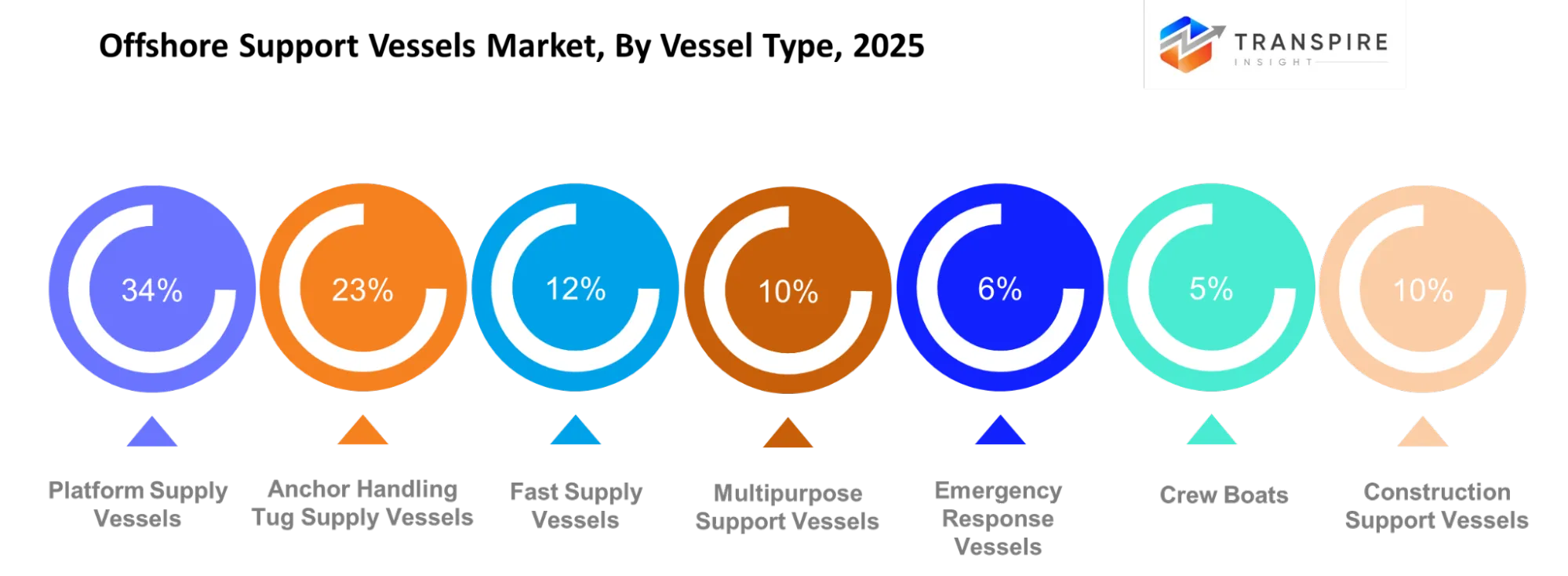
- Platform supply vessels make up 34.0% of the market, and Tidewater has acquired many high-spec PSVs to boost its logistics coverage.
- Anchor handling tug supply vessels account for 23.0%, and Maersk Supply Service announced the launch of the first hybrid-powered AHTS in 2025, marking the beginning of low-carbon heavy operations.
- Fast supply vessels have 12.0%, and operators are increasingly using fuel-efficient designs for crew boats as the frequency of offshore personnel transfers increases.
- Multipurpose support vessels make up 10.5%, and owners are reconfiguring their vessels for combined logistics, inspection and light-construction operations.
- Emergency response vessels account for 6.0%, and operators are working to incorporate remote monitoring to reduce incident-response time.
- Crew boats represent 5.5%, and hybrid/battery-assisted designs are becoming more common for short-route, high-frequency transfers.
- Construction support vessels make up 5.0%, and Solstad won long-term construction support contracts in the North Sea in 2025.
- Other vessel types account for 4.0%, and offshore wind support vessels are growing at a 12.5% CAGR, as developers call for specific installation and maintenance capacity.
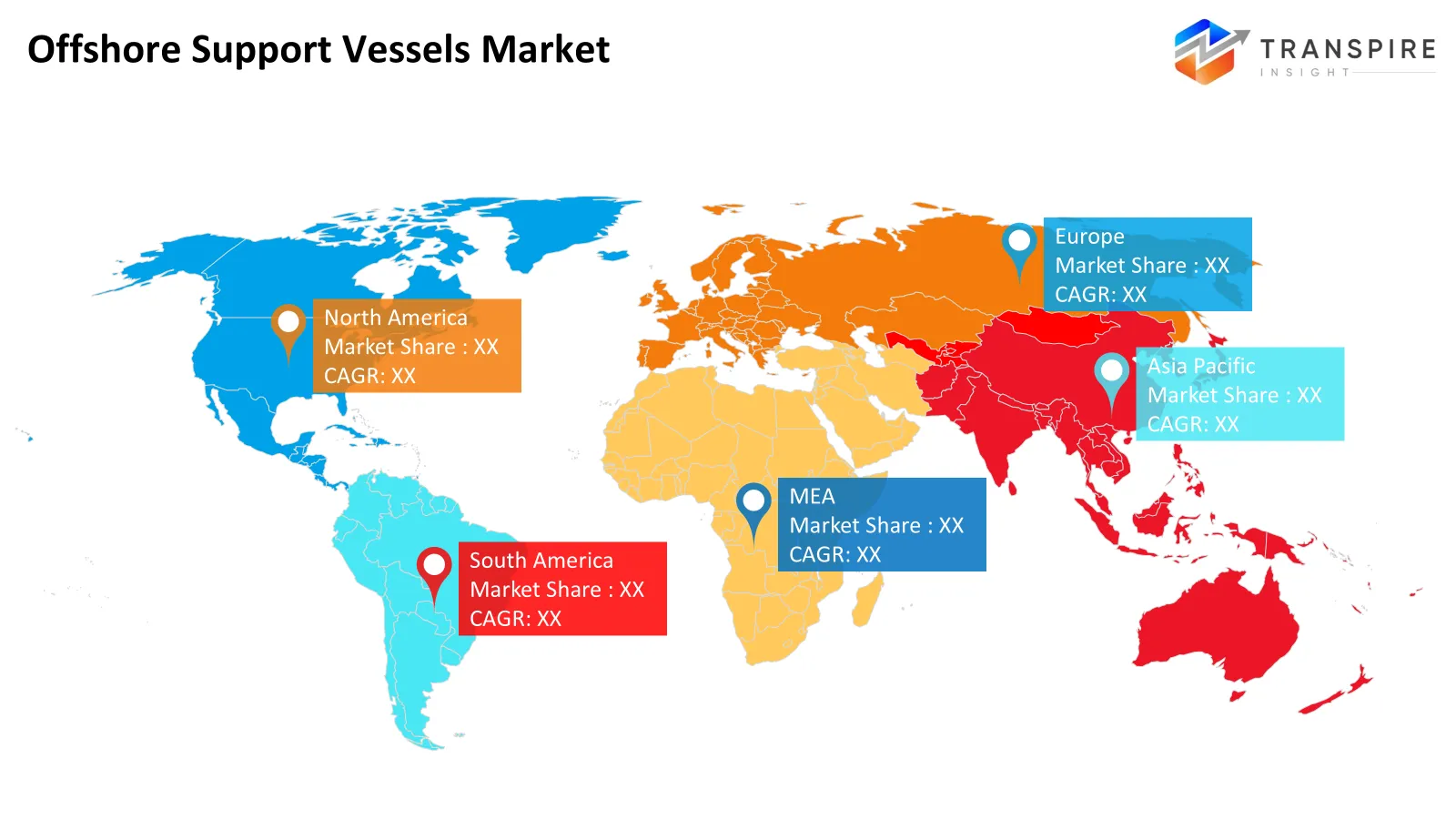
- Asia Pacific accounts for 34.8%, Europe 10.9% (wind-led fleet renewal), North America 20.5%, Middle East & Africa 8.8%, and Latin America 6.9%.
What are the Key Drivers, Restraints, and Opportunities in the Offshore Support Vessels Market?
Driver:
Deepwater oil and gas development, alongside offshore wind construction, is strengthening demand for specialised offshore support vessels. Investment approvals for long-cycle production projects and large wind farms are creating requirements for platform supply, anchor handling, construction support, and crew transfer services. These projects need vessels with reliable positioning, greater endurance, and advanced onboard equipment. As suitable capacity tightens, modern vessels can secure stronger charter rates, improving owner revenues and encouraging selective fleet renewal, equipment upgrades, and investment in efficient propulsion.
Restraint:
Fleet renewal remains constrained by the mismatch between substantial upfront investment and uncertain future charter coverage. Owners must commit capital before knowing whether project schedules, oil prices, or wind economics will sustain employment. Specialised equipment, shipyard availability, and experienced crews further complicate expansion. These structural barriers persist because vessels operate for decades, whereas customers can defer projects much faster. Higher charter rates therefore do not automatically produce immediate capacity additions.
Opportunity:
The next growth unlock is the conversion of OSVs into low-emission, data-enabled multipurpose assets. Hybrid battery systems, shore-power compatibility, LNG dual-fuel propulsion, and AI-supported operations can reduce fuel use during dynamic positioning and standby periods. Europe and Asia offer strong examples: offshore wind developers increasingly require service-operation vessels, cable-support craft, and emergency-response vessels capable of operating in deeper, more remote sites. This creates premium contracts for owners that can combine environmental compliance, digital capability, and operational flexibility.
|
Driver |
Relative Impact on Growth (%) |
Geographic Relevance |
Impact Timeline |
Demand Strength |
Growth Mechanism |
Key Beneficiaries |
Major Constraint |
|
Expansion of offshore oil and gas development projects |
35% |
Brazil, Guyana, Middle East, West Africa |
Short-term (≤2 years) |
High |
Drilling campaigns increase PSV logistics and AHTS deployment |
PSV operators, AHTS owners, shipyards, offshore logistics providers |
Oil price volatility can delay sanctioned project execution |
|
Growing subsea infrastructure inspection, maintenance, and repair requirements |
23% |
Brazil, North Sea, West Africa, Southeast Asia |
Short-term (≤2 years) |
High |
Expanding subsea assets sustain recurring ROV vessel charters |
Subsea vessel owners, ROV suppliers, offshore maintenance contractors |
Specialist crew shortages and equipment costs restrict deployment |
|
Offshore wind expansion and emerging floating wind projects |
19% |
North Sea, Baltic Sea, China, Taiwan, South Korea |
Medium-term (2–4 years) |
High |
Turbine servicing and mooring installation expand specialized charters |
CSOV operators, AHTS owners, gangway suppliers, subsea contractors |
Financing pressures and permitting delays postpone wind projects |
|
Fleet renewal and investment in higher specification vessels |
13% |
Brazil, Southeast Asia, Middle East, North Sea |
Medium-term (2–4 years) |
High |
Modern vessels capture contracts requiring greater operational capability |
Shipbuilders, propulsion suppliers, dynamic positioning vendors, vessel owners |
High newbuilding costs and financing constraints delay orders |
|
Emissions regulation and charterer adoption of efficient vessels |
10% |
Europe, particularly EU/EEA offshore operations |
Short-term (≤2 years) |
Medium |
Carbon costs strengthen demand for efficient hybrid vessels |
Battery suppliers, hybrid integrators, retrofit yards, efficient operators |
Retrofit expenditure and charging availability constrain commercial adoption |
|
Total |
100% |
— |
— |
— |
— |
— |
— |
What Has the Impact of Artificial Intelligence Been on the Offshore Support Vessels Market?
Artificial Intelligence can shift OSV activity from scheduled, experience-driven management to condition-based, route-optimised activity. Machine-learning algorithms track engine telemetry, fuel efficiency, weather, and historical equipment data to predict failures and eliminate unplanned downtime. This will lead to predictive maintenance; avoid spares wastage and help operators to plan for planned downtime during downtime.
Artificial Intelligence will also enable voyage and dynamic-positioning optimisation. Combining metocean forecasts with vessel performance and install schedules will detect safer weather windows, avoid unnecessary standby days and optimise fuel burn. Computer vision and remote diagnostics are also being used for inspections of hulls, subsea equipment, turbines and structures to reduce the requirement for surveys in high-risk environments. The key challenge is integration. Many mixed-fleet operators have an inconsistent fleet in terms of sensor coverage, legacy fleet systems and data formats; innovations are also subject to validation in safety-critical offshore environments. Operators will, therefore, be required to invest in cybersecurity, crew training and resilient communications to unlock the benefits of these innovations.
In February 2026, Jifmar Group signed a strategic partnership with Seavium. The deployment integrates more than 80 offshore vessels into a unified digital ecosystem featuring AI-assisted project-vessel matching and operational chartering analysis.
https://www.oedigital.com/news/535767-jifmar-seavium-partner-to-roll-out-ai-across-offshore-fleet
Key Offshore Support Vessels Market Trends:
Commercial benefit is moving towards the ability to safeguard uptime while performing a range of offshore functions. Digital oversight and emissions accountability are transforming the justification process of owners for upgrades and the selection of contracts by customers.
- Operators are increasingly favouring hybrid and battery-ready ships to reduce fuel usage when operating in DP and standby modes.
- Increasingly, charterers are requesting low-emission tonnage, which is now a commercial qualification rather than a voluntary upgrade.
- Crew transfer and cable-support vessels, construction vessels, and service-operation vessels are all driving offshore wind's changing demand.
- The owners are upgrading older PSVs and AHTS to incorporate battery storage, emissions monitoring, and digital systems to prolong economic life.
- Unplanned downtime and fuel waste are being minimised through AI-powered predictive maintenance and route optimisation.
- The use of digital twins and real-time fleet monitoring is becoming commonplace in asset-performance management.
- High-specification AHTS and PSV tonnage is complementing the demand from deepwater activity in Brazil, West Africa and the Middle East.
- Conventional diesel vessels are being rushed into replacement by regulatory pressure, such as IMO emissions standards.
- LEO satellite communication is enhancing the ability to diagnose remotely, provide crew welfare, and coordinate with vessels and onshore teams in real-time.
Offshore Support Vessels Market Segmentation
Vessel Type:
Platform Supply Vessels remain dominant and have a 34.0% share of the market, which reflects the need for routine flights on a recurring basis to offshore facilities. Anchor Handling Tug Supply Vessels have a 23.0% share, Fast Supply Vessels 12.0%, Multipurpose Support Vessels 10.5%, Emergency Response Vessels 6.0%, Crew Boats 5.5%, Construction Support Vessels 5.0%, and Others have a 4.0% share. These figures reflect the very real need for reliable logistics, operational support, multipurpose capabilities, anchor handling, personnel transport and emergency preparedness to underpin subsea infrastructure and meet the demands of future projects which must be competitive based on reliability, flexible equipment, propulsion and the ability to meet evolving client requirements so the operator maintains their utilisation as well as controlling costs.
Propulsion:
Diesel benefits from established fueling infrastructure and maintenance networks, while Diesel-Electric accommodates changing power requirements across offshore assignments. Hybrid systems improve efficiency during standby and positioning, helping operators manage fuel expenditure. LNG and Dual-Fuel provide operational flexibility where suitable bunkering facilities exist. Battery-Electric vessels are better suited to shorter routes with dependable charging access. Hydrogen and Others remain dependent on infrastructure development, safety approvals, and commercial viability, making deployment decisions increasingly sensitive to vessel operating profiles and costs.
Service:
Supply & Logistics generates recurring employment through regular deliveries to offshore facilities, supporting predictable vessel utilization. Anchor Handling depends on rig movements and mooring requirements, while Offshore Construction and Well Intervention capture investment in installation and production enhancement. Crew Transfer emphasizes safe, reliable personnel access. Subsea Support requires advanced inspection and intervention equipment, while Emergency Response prioritizes readiness. Others address specialized assignments, encouraging operators to differentiate through equipment, execution quality, and integrated service packages that strengthen contract competitiveness.
Water Depth:
Shallow Water, Continental Shelf, Coastal, and Nearshore assignments favour vessels that combine efficient local deployment with access to nearby support infrastructure. Deep Water and Ultra-Deep Water operations require greater endurance, advanced positioning, and reliable cargo handling because longer distances increase disruption costs. Harsh Environment assignments prioritize vessel stability, weather resilience, and safe working windows. Others cover additional operating profiles, reinforcing the need to match vessel specifications with site conditions rather than assuming interchangeability across offshore project locations.
Ownership:
Vessel Owners and Marine Logistics Companies generate revenue through chartering, balancing fleet availability against maintenance expenditure and contract coverage. Oil Companies and Offshore Contractors may retain vessels to secure project control and reduce scheduling uncertainty. Government ownership supports strategic readiness, while Wind Farm Operators assess dedicated fleets against outsourced services. Mining Companies and Others make similar decisions around specialized requirements. Future ownership choices will depend on utilization visibility, financing access, and whether direct control justifies substantial capital commitments.
End User:
Oil & Gas sustains established logistics and maintenance work, while Offshore Wind diversifies vessel employment, with wind support vessels projected to register the supplied 12.5% CAGR. Marine Construction requires installation capabilities, and Subsea Operations reward advanced inspection and intervention systems. Defence and Research prioritise mission suitability, while Mining and Others introduce specialised transport and support requirements. These differences encourage modular equipment and broader customer portfolios, helping operators manage exposure to changing investment cycles without sacrificing operational capability.
What are the Key Use Cases Driving the Offshore Support Vessels Market?
The core use case is offshore logistics for oil and gas production, where PSVs holding a 34.0% market share deliver fuel, water, drilling materials, spare parts, and provisions to platforms and floating production units. This recurring activity sustains baseline vessel demand even when new project activity slows.
Applications are expanding into offshore wind construction and operations, including turbine-component transport, cable-lay support, technician transfer, and maintenance coordination. The 12.5% CAGR for offshore wind support vessels reflects this shift toward renewable-energy service contracts.
Emerging use cases include AI-supported subsea inspection, hybrid-powered emergency response, deepwater floating-production support, and potential marine-mining or ocean-research missions. These applications favour multipurpose, low-emission vessels with advanced monitoring and remote-operation capability.
|
Report Metrics |
Details |
|
Market size value in 2025 |
USD 21.44 Billion |
|
Market size value in 2026 |
USD 23.21 Billion |
|
Revenue forecast in 2033 |
USD 40.49 Billion |
|
Growth rate |
CAGR of 8.27% from 2026 to 2033 |
|
Base year |
2025 |
|
Historical data |
2021 - 2024 |
|
Forecast period |
2026 - 2033 |
|
Report coverage |
Revenue forecast, competitive landscape, growth factors, and trends |
|
Regional scope |
United States; Canada; Mexico; United Kingdom; Germany; France; Italy; Spain; Denmark; Sweden; Norway; China; Japan; India; Australia; South Korea; Thailand; Brazil; Argentina; South Africa; Saudi Arabia; United Arab Emirates |
|
Key companies profiled |
Tidewater, Bourbon Corporation, Solstad Maritime, DOF Group, Seacor Marine, Swire Pacific Offshore, Edison Chouest Offshore, Hornbeck Offshore Services, Maersk Supply Service, Siem Offshore, Harvey Gulf, Solstad Offshore, PACC Offshore Services, GulfMark Offshore, Vroon. |
|
Customization scope |
Free report customization (country, regional & segment scope). Available customized purchase options to meet your exact research needs. |
|
Report Segmentation |
Vessel Type (Platform Supply Vessels, Anchor Handling Tug Supply Vessels, Fast Supply Vessels, Multipurpose Support Vessels, Emergency Response Vessels, Crew Boats, Construction Support Vessels, Others)Propulsion (Diesel, Diesel-Electric, Hybrid, LNG, Battery-Electric, Dual-Fuel, Hydrogen, Others)Service (Supply & Logistics, Anchor Handling, Offshore Construction, Well Intervention, Crew Transfer, Subsea Support, Emergency Response, Others)Water Depth (Shallow Water, Deep Water, Ultra-Deep Water, Continental Shelf, Coastal, Nearshore, Harsh Environment, Others)Ownership (Oil Companies, Vessel Owners, Offshore Contractors, Marine Logistics Companies, Government, Wind Farm Operators, Mining Companies, Others)End User (Oil & Gas, Offshore Wind, Marine Construction, Subsea Operations, Defense, Research, Mining, Others) |
Which Regions are Driving the Offshore Support Vessels Market Growth?
Asia Pacific dominates with a supplied share of 34.8%, providing offshore production logistics to back Asian wind projects and offshore developments. Local shipyards and Singapore's marine services cluster facilitate vessel construction, repair, and deployment. Taiwan drives diversification, with Dong Fang Offshore's vessels being one example of wind servicing joined with subsea proficiency, providing a local capability to reduce the need for far-flung mobilisation.
In September 2026, Dong Fang Offshore (DFO) finalised a state-of-the-art shipbuilding contract with VARD. VARD will design and construct a new-generation battery-hybrid Commissioning Service Operation Vessel (CSOV) valued between €66 million and €75 million to execute subsea operations, cable installations, and wind farm maintenance.
North America represents 20.5% of the supplied share and is third in this reference, but is cited second in this mention. Unlike the more diverse manufacturing-interconnected network of the Asia Pacific system, North America's competition is based on the Gulf-focused business and Jones Act provisions. More mature ports, offshore manufacturing centres, and local operators drive constant logistics-related transactions. The Middle East and Africa groups supply 8.8% of the demand, with Latin America contributing 6.9% for a total of 100% by region.
In June 2026, Subsea7 secured an engineering, procurement, construction, and offshore installation (EPCI) contract from an affiliate of Murphy Oil Corporation for the String Music development in the U.S. Gulf. This development expands offshore logistics infrastructure by initiating immediate project management and engineering work in Houston, Texas, with marine deployment scheduled to scale up regional capacity.
https://www.workboat.com/subsea7-bags-epci-contract-from-murphy-oil-in-us-gulf
Europe makes up 29.0% of the market, and this region is also the most dynamic for growth (compound annual growth rate of 10.9%). Key to the positive outlook is wind in the North Sea and Baltic Sea, increasingly attractive for wind projects, which is driving robust demand for construction support, cable support, and service-operation vessels. The ageing diesel-powered fleet is also being replaced faster due to European Union emissions requirements to make hybrid, LNG, and battery-ready fleets.
In October 2026, Bibby Marine launched the Staffordshire, a first-of-its-kind "battery-first" electric commissioning service operation vessel (CSOV). The vessel will serve as a high-capacity, low-emission offshore hub designed to directly support the rapid expansion of construction, maintenance, and operation activities for next-generation offshore wind infrastructure.
Who are the Key Players in the Offshore Support Vessels Market, and how do they compete?
This competition is centred on fleet availability, technical ability, and execution of contracts. Tidewater Inc. Will increase its size through acquisitions, e.g., Swire Pacific Offshore, Gulf Mark Offshore. Similarly, DOF Group adds engineering expertise as well as subsea vessels and another Maersk Supply Service to broaden project scope. BOURBON will extend contracted tonnage and IMR capability for geographical growth. Solstad Maritime expects to win specialised international contracts. Solstad Offshore is differentiated through installation collaborations, e.g., with SBM Offshore. SEACOR Marine is focused on efficient operations through hybrid upgrades and fleet regeneration. Edison Chouest Offshore is low-cost through domestic vessel construction and integrated logistics. Hornbeck Offshore Services is specialised in vessel conversion to wind-service and accommodation. Harvey Gulf has LNG and battery to speed regional deployment. PACC Offshore Services has a vessel fleet for construction. Vroon has emergency-response operations and preparedness for wind. The company formerly known as Siem Offshore has been renamed Sea1 Offshore for renewal, and the former Siem assets form part of the operational fleet of subsidiary Aurora Offshore so as not to appear as a separate competitor.
Key Players are:
- Tidewater
- Bourbon Corporation
- Solstad Maritime
- DOF Group
- Seacor Marine
- Swire Pacific Offshore
- Edison Chouest Offshore
- Hornbeck Offshore Service
- Maersk Supply Service
- Siem Offshore
- Harvey Gulf
- Solstad Offshore
- PACC Offshore Services
- GulfMark Offshore
- Vroon
Offshore Support Vessels Market — Enhanced Competitive Benchmarking
|
Company |
Est. Revenue Share Range |
Key Offerings |
Strategic Positioning |
Geographic Strength |
Technology Focus |
|
Tidewater Inc. |
Estimated 6–8% |
Platform supply vessels; anchor handling tug supply vessels; offshore towing |
scale leadership through fleet breadth and redeployment |
Middle East & Africa; Europe; Latin America |
Dynamic positioning, deepwater supply, high bollard pull |
|
Edison Chouest Offshore |
Estimated 5–8% |
Platform supply vessels; anchor handling vessels; subsea support vessels; well stimulation vessels |
Vertical integration across vessels, shipyards, ports, and subsea services |
North America; Latin America |
Integrated ROV operations, specialized vessels, deepwater logistics |
|
BOURBON |
Estimated 4–6% |
Platform supply vessels; anchor handling vessels; subsea support vessels; personnel transport |
Diversified marine support combining standardized fleets and local execution |
Middle East & Africa; Latin America; Asia Pacific |
Diesel-electric propulsion, dynamic positioning, subsea intervention systems |
|
DOF Group ASA |
Estimated 4–6% |
Subsea support vessels; anchor handling vessels; platform supply vessels; integrated subsea services |
Engineering-led differentiation through integrated vessels and subsea execution |
Latin America; Europe; Asia Pacific |
Work class ROVs, subsea engineering, advanced anchor handling |
|
Hornbeck Offshore Services, Inc. |
Estimated 3–5% |
Deepwater supply vessels; multipurpose support vessels; subsea support; well intervention support |
Integrated deepwater platform combining marine transportation and subsea capabilities |
North America; Latin America; Europe |
High capacity DP vessels, robotics, subsea intervention integration |
|
China Oilfield Services Limited — COSL |
Estimated 3–4% |
Supply vessels; anchor handling vessels; standby vessels; offshore towing services |
Domestic scale advantage through integrated Chinese offshore customer relationships |
Asia Pacific |
Precision towing, LNG propulsion, integrated vessel resource scheduling |
|
Solstad Maritime ASA |
Estimated 2–4% |
Construction support vessels; anchor handling vessels; ROV services; offshore surveys |
Premium positioning in complex construction and anchor handling assignments |
Europe; Latin America; Asia Pacific |
Dynamic positioning, ROV integration, offshore construction support systems |
|
ADNOC Logistics & Services plc |
Estimated 2–4% |
Platform supply vessels; anchor handling vessels; diving support vessels; offshore personnel transport |
Integrated logistics contracting anchored by recurring ADNOC offshore requirements |
Middle East & Africa |
Digital logistics planning, vessel routing, offshore resource optimization |
|
Zamil Offshore Services |
Estimated 1–3% |
Anchor handling vessels; diving support vessels; supply vessels; crew and utility boats |
Regional specialization through Saudi offshore contracts and local execution |
Middle East & Africa |
DP2 station keeping, diesel-electric propulsion, diving integration |
|
SEACOR Marine Holdings Inc. |
Estimated 0.8–1.5% |
Platform supply vessels; fast support vessels; liftboats; walk-to-work support |
Efficiency-focused differentiation through hybrid supply and fast transport |
Latin America; Middle East & Africa; North America |
Battery hybrid propulsion, energy management, heave-compensated gangways |
Recent Development News
- In September 2026, Alewijnse signed a contract with Damen Shipyards Group to integrate electrical and automation systems aboard Windcat’s first Innovation Series offshore support vessel. Designed to accommodate 190 personnel and operate offshore for up to 28 days without resupply, the vessel combines hybrid-electric propulsion with subsea support capabilities to improve campaign efficiency. https://www.alewijnse.com/news/alewijnse-damen-and-windcat-strengthen-long-standing-partnership-new-offshore-support-vessel
- In January 2026, MPC OSE Offshore secured long-term financing for offshore survey and support vessels scheduled for delivery during 2026–2027. Combining construction financing with ship mortgage loans and a Danish EIFO credit guarantee, the 12-year facility supports fleet deployment for offshore wind lifecycle services and other offshore assignments. https://www.mpc-oceanic.com/de/news/detail/913
- In August 2026,Tidewatercompleted its all-cash acquisition of Wilson Sons Ultratug Offshore. This transaction integrates 22 specialised Platform Supply Vessels into the company's regional operations to scale up deepwater fleet capabilities across the South American market. https://investor.tdw.com/news/default.aspx
What Strategic Insights Define the Future of the Offshore Support Vessels Market?
The industry is moving toward a smaller number of more capable vessels competing across multiple energy sources, rather than fleets of vessels competing within a single commodity cycle. Charterers are increasingly incentivising operators to operate low-emission propulsion, with digital transparency and enhanced capabilities including both wind and oil & gas sectors.
There is also an insidious risk of stranded conventional tonnage, as vessels which are not retrofitable could see slow attrition in their chartering power even before end of life, particularly in Europe. This could serve to widen the gap between owners of integrated modern fleets and small operators that are unable to operate the capital-intensive retrofitting process. Opportunities are emerging in long-term offshore wind service contracts, particularly in Europe, with a 10.9% CAGR driven by wind construction/maintenance. Retrofit conversion or newbuild to hybrids-enabled platform supply vessels, crew boats, and construction-support vessels could provide reliable revenues through the oil cycle's bust periods.
Key Segmentations are:
Vessel Type
- Platform Supply Vessels
- Anchor Handling Tug Supply Vessels
- Fast Supply Vessels
- Multipurpose Support Vessels
- Emergency Response Vessels
- Crew Boats
- Construction Support Vessels
- Others
Propulsion
- Diesel
- Diesel-Electric
- Hybrid
- LNG
- Battery-Electric
- Dual-Fuel
- Hydrogen
- Others
Service
- Supply & Logistics
- Anchor Handling
- Offshore Construction
- Well Intervention
- Crew Transfer
- Subsea Support
- Emergency Response
- Others
Water Depth
- Shallow Water
- Deep Water
- Ultra-Deep Water
- Continental Shelf
- Coastal
- Nearshore
- Harsh Environment
- Others
Ownership
- Oil Companies
- Vessel Owners
- Offshore Contractors
- Marine Logistics Companies
- Government
- Wind Farm Operators
- Mining Companies
- Others
End User
- Oil & Gas
- Offshore Wind
- Marine Construction
- Subsea Operations
- Defense
- Research
- Mining
- Others
By Regional Analysis
North America
- US
- Canada
- Mexico
Europe
- Germany
- UK
- France
- Italy
- Spain
- Russia
- Rest of Europe
Asia Pacific
- China
- Japan
- India
- South Korea
- Australia
- Rest of Asia Pacific
South America
- Brazil
- Argentina
- Rest of South America
Middle East & Africa
- UAE
- Saudi Arabia
- Qatar
- South Africa
- Rest of the Middle East & Africa
Frequently Asked Questions
Find quick answers to common questions.
The offshore support vessels market size was valued at USD 21.44 billion in 2025 and is poised to reach USD 40.49 billion by 2033, expanding at an 8.27% CAGR.
Key segments for the offshore support vessels market are Vessel Type (Platform Supply Vessels, Anchor Handling Tug Supply Vessels, Fast Supply Vessels, Multipurpose Support Vessels, Emergency Response Vessels, Crew Boats, Construction Support Vessels, Others)Propulsion (Diesel, Diesel-Electric, Hybrid, LNG, Battery-Electric, Dual-Fuel, Hydrogen, Others)Service (Supply & Logistics, Anchor Handling, Offshore Construction, Well Intervention, Crew Transfer, Subsea Support, Emergency Response, Others)Water Depth (Shallow Water, Deep Water, Ultra-Deep Water, Continental Shelf, Coastal, Nearshore, Harsh Environment, Others)Ownership (Oil Companies, Vessel Owners, Offshore Contractors, Marine Logistics Companies, Government, Wind Farm Operators, Mining Companies, Others)End User (Oil & Gas, Offshore Wind, Marine Construction, Subsea Operations, Defense, Research, Mining, Others).
Growth is primarily driven by offshore oil and gas development, wind farm servicing, subsea maintenance, and fleet upgrades that improve reliability and fuel efficiency.
The offshore support vessels market is led by major manufacturers, including Tidewater, Bourbon Corporation, Solstad Maritime, DOF Group, Seacor Marine, Swire Pacific Offshore, Edison Chouest Offshore, Hornbeck Offshore Services, Maersk Supply Service, Siem Offshore, Harvey Gulf, Solstad Offshore, PACC Offshore Services, GulfMark Offshore, and Vroon.
Asia Pacific holds a 34.8% market share, supported by offshore energy projects, established shipbuilding capacity, marine logistics infrastructure, and expanding offshore wind activity.
Opportunities include hybrid vessel retrofits, offshore wind maintenance, subsea inspection, cable repair, and emissions monitoring services.
- Tidewater
- Bourbon Corporation
- Solstad Maritime
- DOF Group
- Seacor Marine
- Swire Pacific Offshore
- Edison Chouest Offshore
- Hornbeck Offshore Service
- Maersk Supply Service
- Siem Offshore
- Harvey Gulf
- Solstad Offshore
- PACC Offshore Services
- GulfMark Offshore
- Vroon
About the Authors

Mayur Shinde
I am Mayur Shinde, a Senior Research Analyst at Transpire Insight, specializing in the Automotive & Transportation and Information & Communication Technology (ICT) Industry. My work focuses on analyzing emerging market trends, technological advancements, competitive landscapes, and industry developments to deliver accurate, data-driven insights. I am passionate about transforming complex market information into clear, actionable content that helps businesses, professionals, and decision-makers stay informed and make confident strategic decisions.

Chakradhar Khansole
Chakradhar serves as the Research Director at Transpire Insight, bringing over 8 years of experience in technology, innovation, and strategic market intelligence. He specializes in transforming complex market data into actionable business insights that enable organizations to make informed, growth-oriented decisions. Recognized for his strategic vision and analytical expertise, Chakradhar leads high-impact research initiatives, delivering comprehensive market assessments, competitive intelligence, and forward-looking industry analysis.
Recently Published Reports
-
Apr 2026
ATV & UTV Market
ATV & UTV Market Size, Share & Analysis Report By Type (ATV, and UTV), By Variants (Less Than 400 CC, 400 CC To 800 CC, and More Than 800 CC), and Geography (North America, Europe, Asia-Pacific, Middle East and Africa, South and Central America), 2021 - 2031
-
Apr 2026
Automotive Central Gateway Module Market
Automotive Central Gateway Module Market Size, Share & Analysis Report By Type (Ethernet Central Gateway Module, CAN Central Gateway Module, LIN Central Gateway Module, and FlexRay), By Application (Powertrain Control, Body Control, Infotainment System, Advanced Driver Assistance Systems (ADAS), and Others), By End User (Passenger Vehicles, and Commercial Vehicles), and Geography (North America, Europe, Asia-Pacific, Middle East and Africa, South and Central America), 2021 - 2031
-
Apr 2026
Automotive Engine Oil Filter Market
Automotive Engine Oil Filter Market Size, Share & Analysis Report By Filter Type (Fuel Filter, Engine Oil Filter, Hydraulic Oil Filter, and Others), By Filter Media (Cellulose, Synthetic, and Micro), By Sales Channel (OEMs, and Aftermarket), By Vehicle Type (Passenger Cars, Light Commercial Vehicles, Heavy Duty Trucks, Buses and Coaches, and Off-road Vehicles), and Geography (North America, Europe, Asia-Pacific, Middle East and Africa, South and Central America), 2021 - 2031
-
Apr 2026
Automotive Parts Aluminium Die Casting Market
Automotive Parts Aluminium Die Casting Market Size, Share & Analysis Report By Production Process (Pressure Die Casting, Vacuum Die Casting, Squeeze Die Casting, Gravity Die Casting), By Application (Body Parts, Engine Parts, Transmission Parts, Battery And Related Components, Other Application Types), and Geography (North America, Europe, Asia-Pacific, Middle East and Africa, South and Central America), 2021 - 2031
Our Clients