

North America Wound Irrigation Systems Market Size & Forecast:
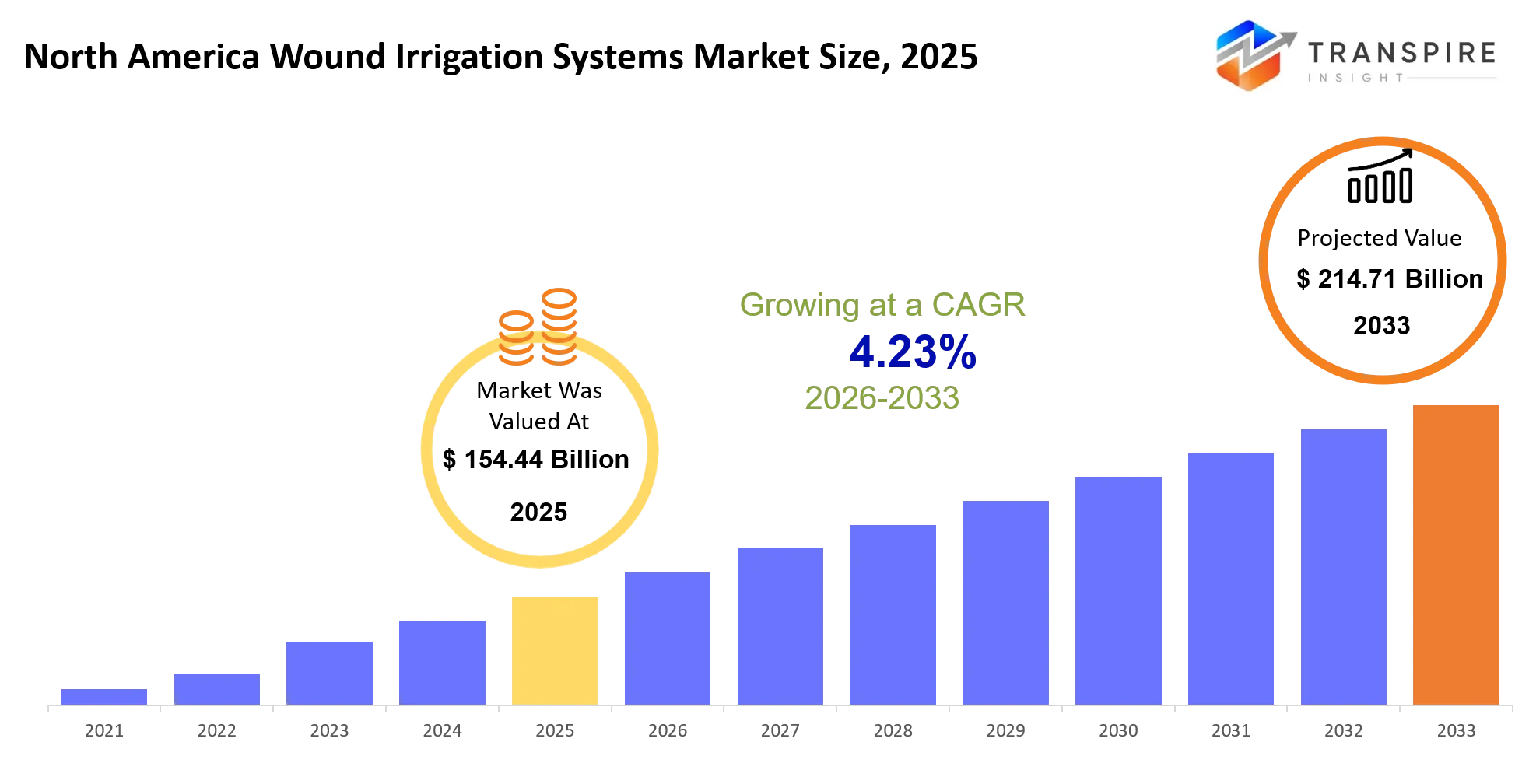
- North America Wound Irrigation Systems Market Size 2025: USD 154.44 Million
- North America Wound Irrigation Systems Market Size 2033: USD 214.71 Million
- North America Wound Irrigation Systems Market CAGR: 4.23%
- North America Wound Irrigation Systems Market Segments: By Product Type (Pulsatile Irrigation Systems, Battery-operated Irrigation Systems, Manual Irrigation Systems, Others), By Application (Chronic Wounds, Surgical Wounds, Burn Care, Trauma Wounds, Others), By End User (Hospitals, Ambulatory Surgical Centers, Home Healthcare, Others), By Technology (Disposable Systems, Reusable Systems, Smart Irrigation Systems, Others).
To learn more about this report,  Download Free Sample Report
North America Wound Irrigation Systems Market Summary:
The North America Wound Irrigation Systems Market size is estimated at USD 154.44 Million in 2025 and is anticipated to reach USD 214.71 Million by 2033, growing at a CAGR of 4.23% from 2026 to 2033.The North America wound irrigation systems market really supports one of the most critical pieces of wound management, namely clearing out debris, bacteria, and other contaminants from acute as well as chronic wounds, before any further treatment even begins. In everyday use, these systems show up a lot in hospitals, emergency rooms, surgical centers, and, honestly, even outpatient wound care clinics, mostly because they can help bring down infection risk and make the healing course feel more predictable.
Over the past five years the market, kind of quietly, shifted its backbone away from manual cleansing methods and toward controlled-pressure irrigation systems. These newer systems are designed to deliver more consistent clinical results, and they also align better with standardized wound care protocols.A specific real world factor that a lot of people keep bringing up was the COVID-19 pandemic, it kinda pushed infection control higher on the priority ladder across almost all healthcare settings, and honestly it also seems to have sped up investment in technologies designed to reduce complications. Plus, it indirectly raised attention on hospital readmissions, as well, even if that part is less obvious at first.
Right now, there’s still momentum but it’s being tugged forward by the rising clinical and financial strain that comes with chronic wounds, especially those linked to diabetes, vascular disorders, and the aging population overall. Providers are under constant pressure to improve outcomes, while not letting treatment costs get out of hand, so increasingly they’re moving toward advanced irrigation systems. That sustains demand, not just for the systems themselves, but for the disposable components and the add-on supplies, which are used each time, so it’s a repeated cycle rather than a one off purchase.
Key Market Insights
- In North America, the United States pretty much takes the lead in the Wound Irrigation Systems Market, and in 2025 it accounts for roughly 80% of the regional revenue, it’s pretty dominant, overall.
- That big share is tied to a strong healthcare backbone, very high surgical numbers ,and broader adoption of advanced wound care practices, so yeah, the demand stays steady.
- Canada is the quickest mover through 2032, backed by the continued rollout of outpatient wound care programs and older demographics that just keep expanding.
- Also, higher healthcare spending and chronic disease care initiatives just keep adding fuel to regional growth, not really slowing down anytime soon.
- Battery-powered wound irrigation systems are leading the pack, and they hold around 45% of the North America Wound Irrigation Systems market share in 2025, give or take a bit.
- Manual wound irrigation devices are still the second-largest segment, mainly because they’re relatively affordable and they are widely used in emergency environments.
- Disposable irrigation systems are forecast to grow the fastest through 2032, driven by infection control expectations and a preference for single-use apparatus.
- Meanwhile, controlled-pressure irrigation technologies are seeing more momentum, especially across hospitals, as well as ambulatory care facilities.
- For the wound types , acute wound management comes out on top, contributing about 55% of total revenue in 2025.
- Trauma cases, surgical wounds, and emergency procedures keep supporting that dominant role, so it stays at the front.
- Chronic wound treatment is the fastest-growing application area, with diabetic foot ulcers and pressure injury occurrences increasing over time.
- Healthcare providers are also pushing for more advanced wound cleansing technologies , hoping to boost healing efficiency and lower the risk of complications.
- And on the end-user side, hospitals capture more than 60% market share, meaning they remain the foremost end-user segment across the North America wound care industry.
What are the Key Drivers, Restraints, and Opportunities in the North America Wound Irrigation Systems Market?
The most powerful growth driver in the North America Wound Irrigation Systems Market is really the climbing clinical and financial burden tied to chronic wounds, especially those linked to diabetes, obesity, and vascular conditions. In practice healthcare providers feel this as more pressure, because value based reimbursement schemes now punish avoidable issues, as well as extra readmissions. Because of that, hospitals and wound care centers have started to lean into controlled-pressure irrigation devices, they help with wound bed preparation and also lower infection risks. And since clinicians are pushing for outcomes that look measurable, these newer irrigation technologies have been moving from “maybe later” tools to baseline parts of wound management protocols, which in turn supports equipment sales while also sustaining recurring disposable revenue streams.
The biggest restraint, on the other hand, comes from a pretty fragmented reimbursement landscape around advanced wound care technology. Coverage rules are different depending on the payer, the care environment, and the specific clinical indication. This creates a kind of procurement uncertainty that’s hard to ignore. The real issue is structural too, because reimbursement structures tend to change slowly, and they usually demand a large amount of clinical proof before broader endorsement is granted. So, many smaller hospitals and outpatient centers end up postponing upgrades to advanced irrigation systems, which can choke off market penetration and put a brake on the revenue growth that would otherwise be possible.
There’s a major chance sitting right there in growing outpatient wound care networks and also these home based treatment models. Lately, portable single use irrigation systems for non acute settings are getting more notice, kind of because healthcare systems want lower-cost care routes, not always the hospital way. If you invest in ambulatory wound centers across the United States and Canada, it really makes the whole environment friendlier for technologies that can support good wound cleansing outside the traditional hospital setting, which is sort of the key.
What Has the Impact of Artificial Intelligence Been on the North America Wound Irrigation Systems Market?
Artificial intelligence and advanced digital technologies are starting to slowly reshape the North America Wound Irrigation Systems Market, mostly by nudging clinical decision-making, device utilization, and daily workflow efficiency. In practice, newer wound care platforms now often bundle AI powered image analysis tools, these tools look at wound dimensions, tissue composition, and healing movement using digital photographs. They also handle a lot of the “paperwork” side of documentation, so clinicians can standardize treatment calls and, in turn, reduce those common differences across care settings.
Meanwhile machine learning models are being used to forecast wound deterioration, infection likelihood, and healing timeframes. They do it by looking at patient histories, comorbidities, and how treatments have actually worked before. Then, if these tools get connected to advanced irrigation devices and digital wound management platforms, the predictions can support clinicians in picking the best intervention timing, and modify the protocol earlier, before complications show up. Because of this, healthcare providers often report better healing results, fewer avoidable hospital readmissions, and generally lower overall treatment costs.
On the operations side, digital monitoring setups can clean up inventory management for disposable irrigation components, and also help with resource allocation across hospitals plus outpatient wound centers. Some networks even mention improved documentation accuracy, quicker clinical checkups, and stronger compliance with wound care protocols overall.
That said, a real constraint still sits in data quality and interoperability. A lot of providers operate with fragmented electronic health record systems and this makes it hard to gather consistent wound care data for AI training. So model performance can suffer and large scale deployment gets delayed, especially across different clinical environments where systems don’t quite “speak” to each other the same way.
Key Market Trends
- Since 2020, hospitals have been adopting single-use irrigation bits faster, like infection-control protocols got stricter everywhere, in surgical care and wound care too. This isn’t just a small shift, it kind of snowballed, and clinicians ended up using more disposables in practice.
- From around 2021 through 2025, battery-powered wound irrigation systems gained more share, mainly because people wanted portability, and they also cared about keeping pressure steady during the procedure. In other words it was less about “plug it in” and more about reliable delivery.
- At the same time, outpatient wound centers kept spreading across the United States and Canada, which quietly changed purchasing from acute-care departments toward ambulatory care providers. That’s where a lot of the ordering momentum ended up.
- Manufacturers also started bundling irrigation devices with disposable consumables more often. So instead of selling one capital item and moving on, they lean into recurring revenue models, kinda like consumable companionship, rather than only equipment sales.
- Chronic wound cases tied to diabetes and vascular disease rose over the last five years, so providers started folding broader advanced wound cleansing routines into regular care. It’s sort of a wider protocol swap, not just one isolated change.
- Healthcare providers, meanwhile, drifted away from buying based only on the procedure. They moved toward outcome-based procurement, and they seemed to favor technologies that help lower infections and reduce readmissions, even if the upfront decision looked different.
- Companies such as Becton Dickinson, Stryker, and Medline intensified their innovation, bringing in more ergonomic designs plus precision-controlled irrigation platforms. Basically, easier handling and tighter control.
- After 2022, digital wound assessment tools showed up more frequently, and that encouraged integration between irrigation systems and electronic wound documentation workflows. So the system doesn’t only clean, it also logs, and that matters.
- Supply chain disruptions during 2020 and 2021 made facilities diversify suppliers and keep larger inventories of key wound care products. Even when stock was uneven, they tried not to pause wound services.
- And then reimbursement pressure, it pushed providers to adopt solutions that can shorten healing timelines. That strengthened the appetite for evidence-backed wound irrigation solutions, because payers and budgets both want results.
North America Wound Irrigation Systems Market Segmentation
By Product Type
On product type, pulsatile irrigation systems kinda take the front, largely because they deliver consistent pressure, they help with wound cleansing, and they’re broadly accepted in surgical and hospital environments. Healthcare providers are leaning toward these setups more and more, since a controlled flush can help cut down contamination, while also backing standardized treatment protocols.
Battery-operated irrigation systems are still a pretty strong secondary segment, especially for emergency care, ambulatory care, and any situation where mobility is a must. Manual irrigation systems keep showing up in cost sensitive facilities and smaller clinics too, though the adoption growth is still slower, mainly because of worries around pressure steadiness and workflow efficiency. Other product categories, meanwhile, grab a smaller portion and usually go after specialized clinical needs.
Looking ahead, the market direction seems headed toward portable, ergonomically designed, and precision-controlled systems, aimed at making day to day use easier while still supporting infection prevention targets. Manufacturers that blend strong device performance with recurring consumable sales should be able to improve their competitive standing and also bring in revenue that’s more predictable over time.
By Application
On application, surgical wounds take the largest slice of the market, mostly because hospitals do such high volumes of procedures that call for dependable wound rinsing before closure, or even just before the dressing step. There is also this pretty strong clinical focus on stopping infection early, plus supporting post surgical recovery, and that really helps the demand stay steady. Chronic wounds are still the quickest growing group, largely linked to more diabetes cases, vascular problems, and age related health issues throughout North America.
When people talk about chronic wound care, treatment of diabetic foot ulcers, pressure injuries and venous leg ulcers usually means repeat irrigation, so utilization keeps coming back in a pretty consistent way. Trauma wounds hold a meaningful place too, since emergency departments often count on irrigation systems to wash out debris, and to lower risks of complications. Burn care is more specialized, yet it stays important, because controlled wound handling can make healing results better. Looking ahead, growth should start leaning even more toward chronic wound management programs, so suppliers will likely push for more tailored solutions for long term care settings and outpatient care routes.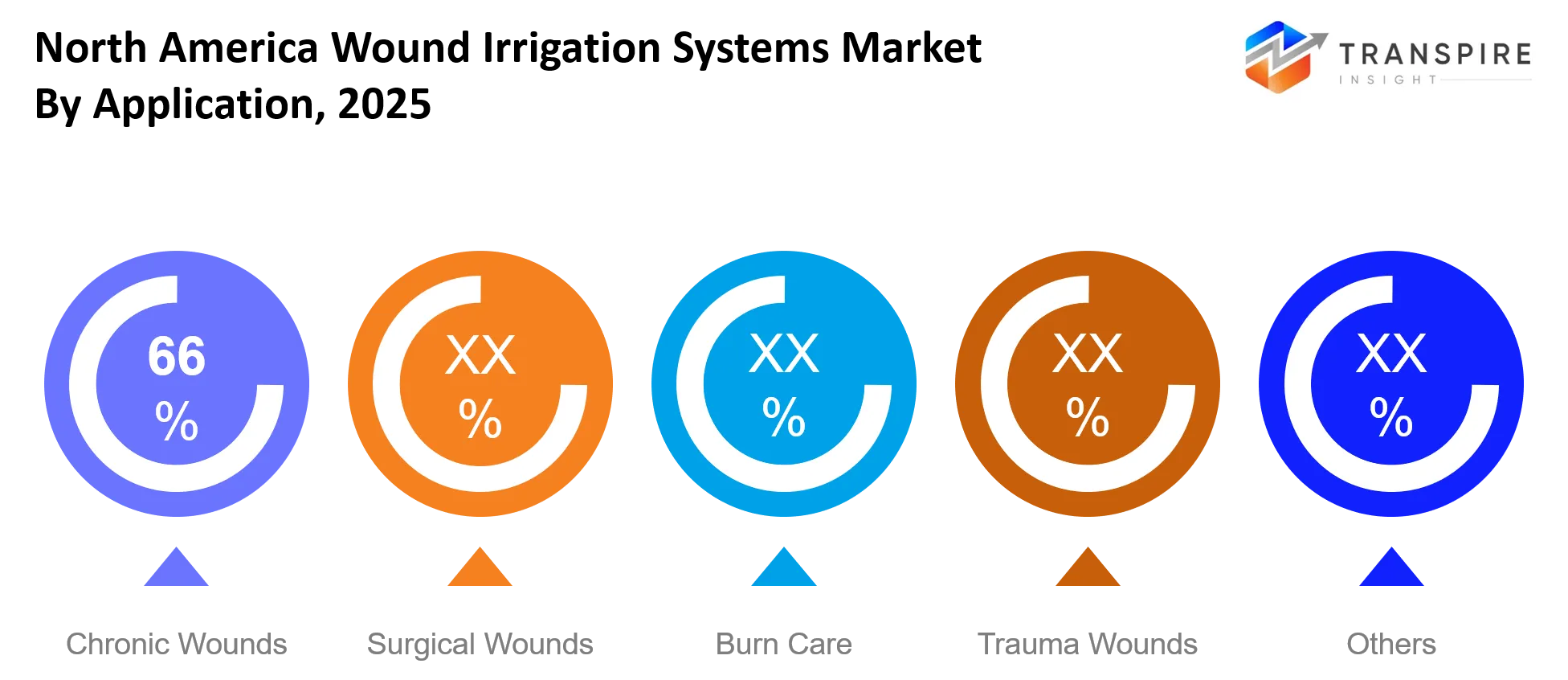
To learn more about this report, Download Free Sample Report
By End-User
For end user, hospitals kind of dominate market demand , mainly because they see huge patient volumes and they do a lot of surgical activity, plus procurement budgets are already in place so wound irrigation equipment and related consumables get bought on a steady basis. Also, integrated healthcare systems tend to lean toward standardized wound care protocols, and that basically helps advanced irrigation technologies.
Then there’s ambulatory surgical centers , which are becoming more and more influential, since more care is moving into outpatient workflows that cut costs but still keep the clinical standard intact. Home healthcare looks like it may be a real growth angle too, largely because chronic wounds are increasingly being managed outside the classic hospital setting. But in homes, adoption depends on how easy it is to use, how portable it is, and whether caregivers actually get enough training.
Other end users like specialty wound clinics, and rehabilitation facilities, also add meaningful demand , though it’s more concentrated in specific types of care environments. Going forward, future investment is expected to focus on products built for decentralized care delivery, and that should open up room for manufacturers who can balance clinical performance with everyday user convenience.
By Technology
Through, technology reusable setups still hold a fairly big slice, since hospitals usually want longer-term equipment use and better cost efficiency across lots of patient traffic. But disposable systems have gotten a lot of pull lately, because infection-control rules keep getting stricter, and healthcare teams try to cut down cross-contamination risks. In some places single-use designs also make daily workflow management easier, and they reduce the whole sterilization load, so it feels more attractive in hectic clinical settings, where time matters .
Smart irrigation systems seem to be the fastest moving tech category, mostly tied to digital integration, pressure monitoring features, and what you could call data guided wound care routines. Meanwhile connected technologies are climbing in interest, as healthcare organizations look for tighter documentation, steadier treatment practices and clearer outcome tracking. Other technologies do exist for more specific needs , yet they only add a small portion overall volume. Going forward competitive strength will likely hinge on merging smart functionality with infection prevention advantages, which should spur new ideas that match shifting clinical and operational priorities, even if the exact blend varies by site.
What are the Key Use Cases Driving the North America Wound Irrigation Systems Market?
The main use case for wound irrigation systems is still kinda surgical wound management in hospitals. Surgical teams count on controlled pressure irrigation to lift debris and lower bacterial contamination before they close the wound, so healthcare facilities can meet infection-control standards and also support better recovery outcomes.
More adoption is showing up in chronic wound treatment and trauma care. Specialized wound clinics , and ambulatory surgical centers too, are using more advanced irrigation systems to handle diabetic foot ulcers , pressure injuries, and injury related wounds that just need repeated rinsing through out the whole treatment cycle.
There are also emerging use cases in home healthcare and digitally enabled wound management programs. Portable and disposable irrigation systems let caregivers back long-term wound treatment outside the hospital setting, while tying these tools into digital wound assessment platforms opens up chances for remote monitoring and more individualized care routes over the forecast period.
|
Report Metrics |
Details |
|
Market size value in 2025 |
USD 154.44 Million |
|
Market size value in 2026 |
USD 160.61 Million |
|
Revenue forecast in 2033 |
USD 214.71 Million |
|
Growth rate |
CAGR of 4.23% from 2026 to 2033 |
|
Base year |
2025 |
|
Historical data |
2021 - 2024 |
|
Forecast period |
2026 - 2033 |
|
Report coverage |
Revenue forecast, competitive landscape, growth factors, and trends |
|
Country scope |
North America (Canada, The United States, and Mexico) |
|
Key company profiled |
Stryker, Zimmer Biomet, Smith & Nephew, Mölnlycke Health Care, Medline Industries, Cardinal Health, CooperSurgical, Becton Dickinson, Pulsecare Medical, Irrimax, 3M, B. Braun, Baxter International, Teleflex, Convatec |
|
Customization scope |
Free report customization (country, regional & segment scope). Avail customized purchase options to meet your exact research needs. |
|
Report Segmentation |
By Product Type (Pulsatile Irrigation Systems, Battery-operated Irrigation Systems, Manual Irrigation Systems, Others), By Application (Chronic Wounds, Surgical Wounds, Burn Care, Trauma Wounds, Others), By End User (Hospitals, Ambulatory Surgical Centers, Home Healthcare, Others), By Technology (Disposable Systems, Reusable Systems, Smart Irrigation Systems, Others) |
Which Regions are Driving the North America Wound Irrigation Systems Market Growth?
The United States counts as the leading region within the North America Wound Irrigation Systems Market, mostly because of its large healthcare network , a very high number of surgical procedures, and a reimbursement setup that is pretty advanced for wound care . When clinicians lean into evidence based care pathways, hospitals and wound specialty centers tend to buy controlled-pressure irrigation devices. Big integrated health systems , plus dedicated wound clinics, and also major academic hospitals, all together form a fairly mature environment that keeps products in active use without much disruption. And there are ongoing budgets for infection control and chronic illness follow-up, which in practice keeps reinforcing market strength across the whole country.
Canada comes in as the second-largest regional contributor, though the momentum there depends more on overall healthcare stability than on sheer procedure volume. Since the country runs publicly funded healthcare programs, provinces usually sustain fairly consistent uptake of clinically proven wound management solutions. Compared with the United States, buying choices often tilt toward longer-term clinical benefit, but also toward cost effectiveness. That kind of organized purchasing routine ends up building steady demand, and it gives manufacturers an dependable stream of repeating income .
Mexico is looking like the fastest-growing market in the region, as healthcare modernization programs keep expanding access to advanced wound care solutions. In the last stretch, investments in hospital infrastructure and private healthcare facilities, have made it easier to find specialized wound treatment services, for patients. At the same time, the rising prevalence of diabetes related complications has pushed providers toward more effective wound cleansing technologies, because well, the demand is there.
What’s happening across Mexico is creating real momentum, and for manufacturers plus investors it means attractive expansion potential between 2026 and 2033. This is especially true in urban healthcare networks and in private care settings where decision makers tend to move sooner, and they’re often more open to new options.
Who are the Key Players in the North America Wound Irrigation Systems Market and How Do They Compete?
Competition in the North America Wound Irrigation Systems Market looks moderately consolidated, in a way where a small set of medical technology companies ends up steering a large portion of hospital procurement paths while more specialized manufacturers keep pushing forward inside narrower clinical areas. Honestly, the edge is mostly coming from how well the technology performs , its infection-control strengths , and how smoothly it connects with the bigger wound care routine, not just from pricing alone. Incumbent suppliers still try to hold onto market share through product upgrades and solid distribution reach . Meanwhile smaller entrants often lean into portable, disposable, and more outpatient oriented offerings. In practice, winning is getting more about proving real clinical value, cutting down treatment complications , and helping healthcare providers with dependable supply chains.
Becton, Dickinson and Company leans hard on technology-led differentiation, with newer surgical and wound management portfolios that are meant to sit alongside broader infection prevention approaches . They also gain from long standing relationships with major hospital groups, and they use cross category purchasing arrangements to keep customers in place. Stryker meanwhile highlights precision irrigation technologies in surgical environments, where procedural throughput and steady fluid delivery translate into clinical benefits you can point to. Ongoing investment in surgical product innovation plus healthcare partnerships is what supports wider adoption across busy care centers.
Medline Industries shows up and competes mostly because they have real service capability, plus that wide distribution reach, so they can ship wound care products with supply chain support for hospitals and outpatient facilities like it’s all one system. That mix makes things easier for healthcare organizations who want procurement efficiency, and also steadier product availability, at least on paper. Baxter International takes a different route, more leaning on their know-how in wound care and fluid management technologies, and so their solutions tend to match the bigger treatment pathways that clinicians are already using. Zimmer Biomet, on the other hand, leans on long standing relationships with orthopedic and surgical specialists, and they place irrigation technologies right where procedure focused care happens every day. And then there is the ongoing stuff too, like strategic portfolio expansion, clinical education programs that are meant to build familiarity, and targeted investments in ambulatory care channels that keep pushing their competitive position forward.
Company List
- Stryker
- Zimmer Biomet
- Smith & Nephew
- Mölnlycke Health Care
- Medline Industries
- Cardinal Health
- CooperSurgical
- Becton Dickinson
- Pulsecare Medical
- Irrimax
- 3M
- B. Braun
- Baxter International
- Teleflex
- Convatec
Recent Development News
In March 2026, BD Pioneers New Standard in Surgical Safety with FDA-Cleared Surgiphor™ 1000mL for Wound Irrigation: BD announced that the U.S. FDA granted 510(k) clearance for its Surgiphor™ 1000mL antimicrobial irrigation system. The product is designed specifically for powered lavage procedures and provides a standardized, ready-to-use irrigation solution intended to improve operating-room efficiency and wound cleansing outcomes. This regulatory milestone strengthens BD’s position in the North American surgical wound management market.
Source: https://news.bd.com
In March 2026, BD Gains FDA Clearance for Surgiphor 1000mL Surgical Irrigation System: Industry coverage highlighted that BD’s newly cleared Surgiphor 1000mL system expands the company’s surgical irrigation portfolio. The sterile, ready-to-use antimicrobial irrigation system is intended for wound cleansing during surgical procedures and reduces the need for manual solution preparation by hospital staff, supporting workflow efficiency in North American operating rooms.
Source: https://finance.yahoo.com
What Strategic Insights Define the Future of the North America Wound Irrigation Systems Market?
The North America Wound Irrigation Systems Market is kind of moving in a structural way toward integrated wound management platforms instead of just standalone irrigation devices. Over the next five to seven years, the most important growth driver will likely be the coming together of infection prevention, value-based healthcare reimbursement, and digital wound assessment tools. Healthcare providers are starting to favor solutions that actually show measurable improvements in healing results and total cost of care, more than things that mainly compete on device performance, you know, the hardware side.
There is also a risk that is a bit less visible, it comes from how concentrated the market can be among large healthcare procurement networks. Since group purchasing organizations keep gaining more influence over which suppliers get picked, smaller manufacturers might struggle with limited access to big hospital accounts. That could reduce innovation diversity, and then it can push pricing pressure across the whole industry, even if nobody says it directly.
On the opportunity side, one emerging angle is connected irrigation systems that tie into remote wound monitoring platforms used in home healthcare and outpatient settings. This particular segment is still underpenetrated but it fits the wider movement toward decentralized care delivery. Market participants should focus investments on digital interoperability, strong clinical evidence building, and outpatient-oriented product designs, so they can secure longer term competitive advantage as treatment keeps moving beyond the usual traditional hospital environment.
North America Wound Irrigation Systems Market Report Segmentation
By Product Type
- Pulsatile Irrigation Systems
- Battery-operated Irrigation Systems
- Manual Irrigation Systems
- Others
By Application
- Chronic Wounds
- Surgical Wounds
- Burn Care
- Trauma Wounds
- Others
By End User
- Hospitals
- Ambulatory Surgical Centers
- Home Healthcare
- Others
By Technology
- Disposable Systems
- Reusable Systems
- Smart Irrigation Systems
- Others
Frequently Asked Questions
Find quick answers to common questions.
The Expected North America Wound Irrigation Systems Market size for the Market will be USD 214.71 Million in 2033.
The key Segments of the North America Wound Irrigation Systems Market are By Product Type (Pulsatile Irrigation Systems, Battery-operated Irrigation Systems, Manual Irrigation Systems, Others), By Application (Chronic Wounds, Surgical Wounds, Burn Care, Trauma Wounds, Others), By End User (Hospitals, Ambulatory Surgical Centers, Home Healthcare, Others), By Technology (Disposable Systems, Reusable Systems, Smart Irrigation Systems, Others).
Major Players in the North America Wound Irrigation Systems Market are Stryker, Zimmer Biomet, Smith & Nephew, Mölnlycke Health Care, Medline Industries, Cardinal Health, CooperSurgical, Becton Dickinson, Pulsecare Medical, Irrimax, 3M, B. Braun, Baxter International, Teleflex, Convatec.
The Current Market size of the North America Wound Irrigation Systems Market is USD 154.44 Million in 2025.
The North America Wound Irrigation Systems Market CAGR is 4.23%.
- Stryker
- Zimmer Biomet
- Smith & Nephew
- Mölnlycke Health Care
- Medline Industries
- Cardinal Health
- CooperSurgical
- Becton Dickinson
- Pulsecare Medical
- Irrimax
- 3M
- B. Braun
- Baxter International
- Teleflex
- Convatec
About the Authors

Pankaj Ghogare Patil
I am Pankaj Ghogare Patil, a Senior Research Analyst at Transpire Insight, specializing in the Pharmaceutical, Chemicals & Materials, Healthcare IT, and Biotechnology industry. My expertise lies in conducting comprehensive market research, analyzing industry trends, evaluating competitive landscapes, and translating complex data into actionable insights. At Transpire Insight, I closely follow emerging technologies, regulatory developments, and market innovations to create accurate, well-researched, and informative content that helps businesses and professionals make informed decisions. I am committed to producing credible, evidence-based articles that reflect industry best practices while making technical topics accessible and valuable for a broad audience.

Chakradhar Khansole
Chakradhar serves as the Research Director at Transpire Insight, bringing over 8 years of experience in technology, innovation, and strategic market intelligence. He specializes in transforming complex market data into actionable business insights that enable organizations to make informed, growth-oriented decisions. Recognized for his strategic vision and analytical expertise, Chakradhar leads high-impact research initiatives, delivering comprehensive market assessments, competitive intelligence, and forward-looking industry analysis.
Recently Published Reports
-
Jul 2026
Alopecia Treatment Market
Alopecia Treatment Market Size, Share & Analysis Report By Disease Type (Alopecia Areata, Cicatricial Alopecia, Traction Alopecia, Alopecia Totalis, Androgenetic Alopecia, Alopecia Universalis, and Other Disease Types), By Treatment Type (Topical Treatments, Oral Medications, Injectable Therapies, and Hair Transplantation), By Gender (Male, and Female), By Distribution Channel (Hospitals and Clinics, Retail Pharmacies, and Online Retailers), and Geography (North America, Europe, Asia-Pacific, Middle East and Africa, South and Central America), 2021 - 2031
-
Jul 2026
Medical Ultrasound Probe Market
Medical Ultrasound Probe Market Size, Share & Analysis Report By Type (Linear Type, Convex Type, Endocavitary Probe, Phased Array/Cardiac Probe, Transesophageal (TEE) Probe, and Others), By Application (Ophthalmology, Cardiology, Musculoskeletal, Oncology, Obstetrics & Gynecology, General Imaging, and Others), By End User (Hospitals & Clinics, Diagnostic Centers, Ambulatory Surgical Centers, and Others), and Geography (North America, Europe, Asia-Pacific, Middle East and Africa, South and Central America), 2021 – 2031
-
May 2026
Biosimilars Market
Biosimilars Market By Product Type (Monoclonal Antibodies, Recombinant Hormones, Erythropoietin, G-CSF, Others), By Indication (Oncology, Autoimmune Diseases, Blood Disorders, Diabetes, Others), By Manufacturing Type (In-House Manufacturing, Contract Manufacturing), By Distribution Channel (Hospital Pharmacies, Retail Pharmacies, Online Pharmacies), By Industry Analysis, Size, Share, Growth, Trends, and Forecasts 2021-2033
-
Apr 2026
Gastrointestinal Endoscopy Market
Gastrointestinal Endoscopy Market By Type (Rigid Gastrointestinal Endoscope, Flexible Gastrointestinal Endoscopes, Disposable Gastrointestinal Endoscope), By Procedure Type (Colonoscopy, Gastroscopy, Duodenoscopy, Enteroscopy, Flexible Sigmoidoscopy, Others), By Application (Diagnosis, Treatment), By End-Users (Hospitals, Ambulatory Surgical Centers, Specialty Clinics, Laboratories, Others), By Industry Analysis, Size, Share, Growth, Trends, and Forecasts 2021-2033