

North America Ultrasound Probe Covers Market Size & Forecast:
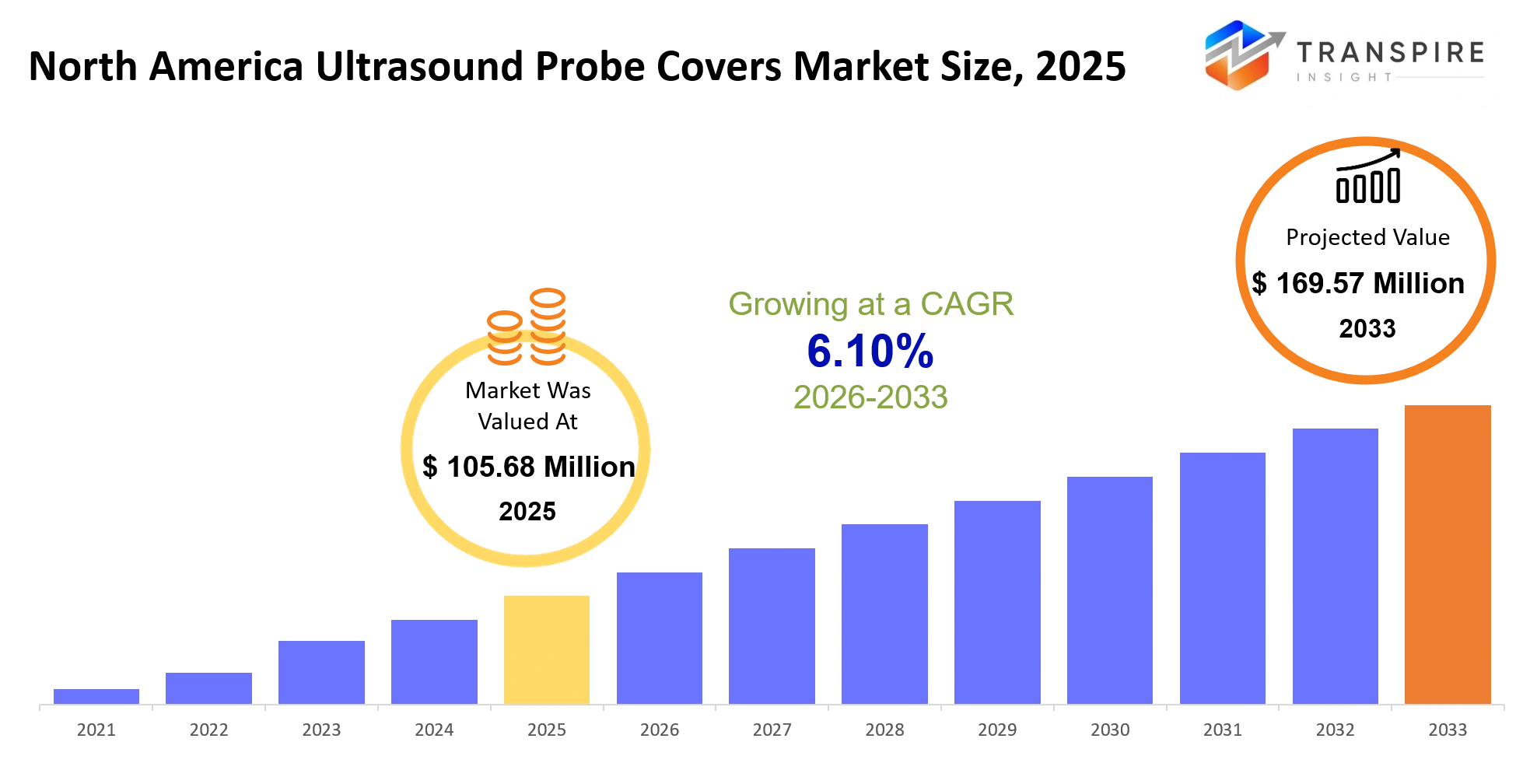
- North America Ultrasound Probe Covers Market Size 2025: USD 105.68 Million
- North America Ultrasound Probe Covers Market Size 2033: USD 169.57 Million
- North America Ultrasound Probe Covers Market CAGR: 6.10%
- North America Ultrasound Probe Covers Market Segments: By Product Type (Disposable Probe Covers, Reusable Probe Covers, Sterile Covers, Non-sterile Covers, Others), By Application (Diagnostic Imaging, Interventional Procedures, Gynecology, Urology, Others), By Material (Latex Covers, Polyurethane Covers, Polyethylene Covers, Others), By End User (Hospitals, Diagnostic Centers, Clinics, Others).
To learn more about this report,  Download Free Sample Report
North America Ultrasound Probe Covers Market Summary:
The North America Ultrasound Probe Covers Market size is estimated at USD 105.68 Million in 2025 and is anticipated to reach USD 169.57 Million by 2033, growing at a CAGR of 6.10% from 2026 to 2033. In North America, the Ultrasound Probe Covers market acts a key part in stopping cross contamination during both diagnostic and interventional ultrasound sessions. These so-called single-use protective barriers help clinicians keep sterility, even when a probe touches a patient , especially in areas like biopsy guidance, vascular access, obstetrics gynecology and surgical settings. Basically the whole role has become more and more important while healthcare orgs push to lower infection risks linked to procedures yet still keep things moving smoothly day to day.
Over the last three to five years, the market structure shifted pretty noticeably toward tighter infection prevention rules and wider use of point-of-care ultrasound inside hospitals , ambulatory centers and emergency departments. The COVID-19 pandemic sort of lit a fire under procurement decisions, revealing weak spots in infection control and pushing faster buying of disposable protective products. Since ultrasound is now used beyond radiology rooms and into bedside care and outpatient workflows, probe cover demand tends to climb in step. All of this creates a repeat buy rhythm for suppliers, while providers typically lean toward products that make compliance easier, protect patients better, and support operational continuity in busy, high volume clinical environments.
Key Market Insights
- The United States kind of dominates the North America Ultrasound Probe Covers Market, taking more than 80% of the market share in 2025, mainly because it has advanced healthcare infrastructure, and you can see that reflected in procurement.
- Canada shows up as the second-largest regional market, backed by higher spending on hospital infection control and diagnostic imaging services, basically.
- Mexico is the fastest-growing regional market through 2030, because of healthcare modernization, plus the rising access to ultrasound-guided procedures, over time.
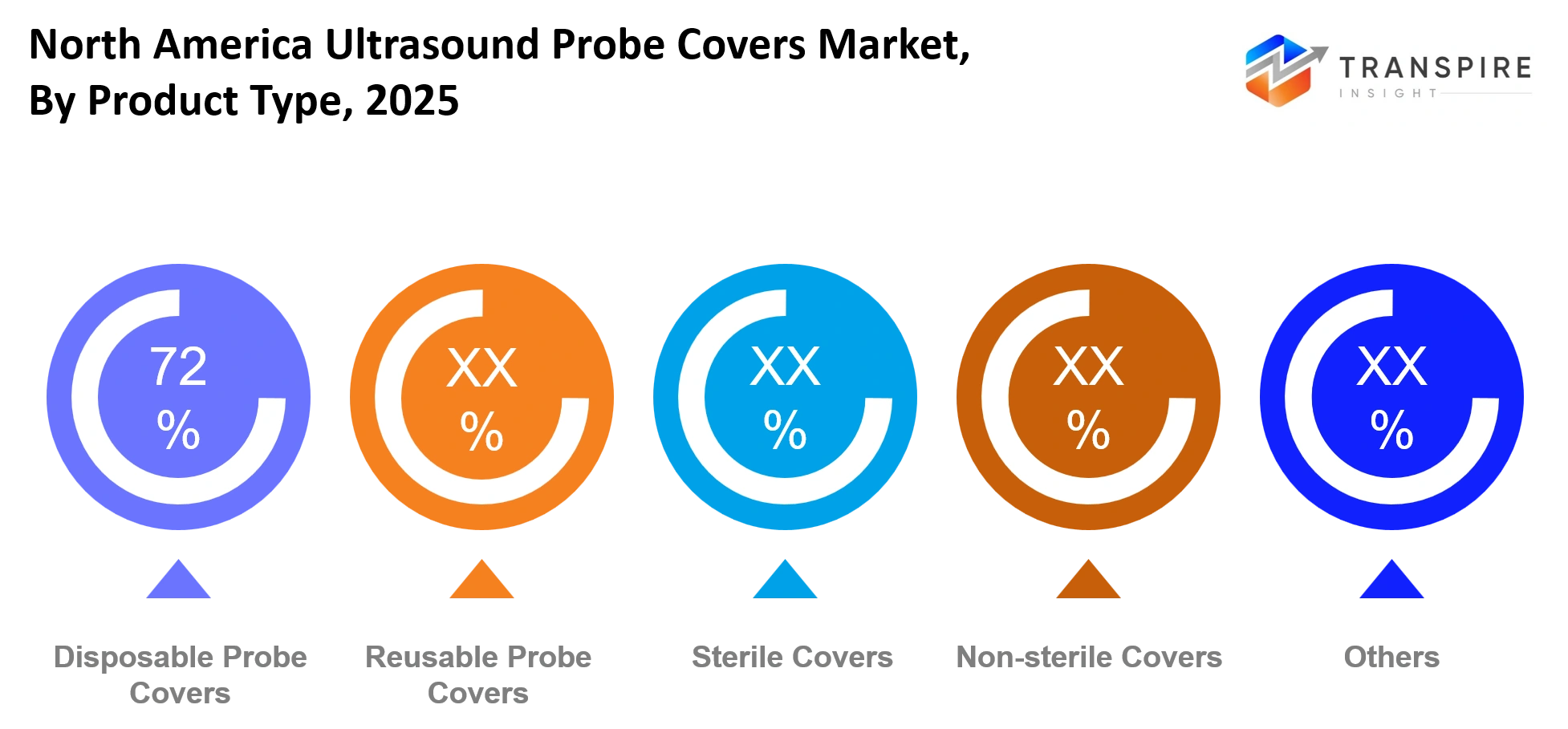
- Disposable ultrasound probe covers lead the whole space with roughly 70% share in 2025, driven by infection prevention requirements that hospitals really do not want to skip.
- Latex-free probe covers come in second by market share, supported by the growing emphasis on patient safety and allergy prevention measures.
- Sterile probe covers are the fastest-growing segment across the forecast period, pushed by more frequent use in interventional procedures and similar settings.
- For applications, diagnostic imaging accounts for almost 45% of the North America Ultrasound Probe Covers Market share in 2025.
- Ultrasound-guided biopsy, along with vascular access procedures, is the fastest-growing application segment through 2030.
- Also, the growing adoption of bedside ultrasound is creating emerging demand across emergency and critical care departments, pretty consistently.
- On end users, hospitals hold more than 60% share, largely due to high procedural volumes and strict infection control standards, all the time.
- Diagnostic imaging centers are the second-largest end-user segment, because outpatient ultrasound examinations keep increasing.
- Ambulatory surgical centers are the fastest-growing end-user category, as minimally invasive procedures get broader acceptance, gradually and in more locations.
What are the Key Drivers, Restraints, and Opportunities in the North America Ultrasound Probe Covers Market?
The biggest push behind the North America Ultrasound Probe Covers Market is basically the institutionalization of infection prevention protocols across hospitals, outpatient centers, and those point of care environments. It kind of picked up speed after the COVID-19 pandemic made it pretty clear where the weak spots were, especially around equipment hygiene and cross-contamination control. Meanwhile ultrasound systems have moved beyond radiology departments into emergency rooms , intensive care units , and even physician offices. And every time an ultrasound-guided procedure gets added, it ends up generating recurring need for disposable probe covers, so procedure volume and product consumption stay tightly tied together. That loop then improves revenue visibility for manufacturers and helps long-term adoption across whole healthcare networks.
The main obstacle is still persistent pricing pressure inside healthcare procurement systems. Probe covers are frequently treated as consumable supplies, not as some high value clinical product, so they become easy targets for cost-cutting programs. This is kind of structural, because hospital purchasing organizations typically negotiate big contracts where the focus is always minimizing per-unit costs. Manufacturers then have limited room to adjust pricing, while smaller suppliers find it harder to stand out or offer clear differentiation. The outcome is margin compression , slower uptake of premium options, and restrained revenue growth even when procedure volumes are going up.
One big opportunity is the growth of minimally invasive and ultrasound-guided interventions happening outside the classic hospital model. Ambulatory surgical centers and specialty clinics are putting money into portable ultrasound platforms for things like vascular access, pain management , and biopsy workflows.
What Has the Impact of Artificial Intelligence Been on the North America Ultrasound Probe Covers Market?
Artificial intelligence and advanced digital technologies are starting to reshape the North America Ultrasound Probe Covers Market, more or less by tweaking inventory management, procurement planning and infection control compliance. In day to day care, healthcare providers are using AI-enabled supply chain platforms to automate consumption tracking of disposable medical products, and yes probe covers are part of that. These platforms take a look at procedure volumes, usage patterns and inventory levels to trigger replenishment orders, which should cut down on stock shortages , and at the same time minimize waste.
Machine learning models are also getting used to predict demand for sterile consumables. They do it by leaning on historical imaging data, seasonal patient volumes, and procedure scheduling tendencies. Hospitals can then forecast product needs more accurately, so procurement teams can fine tune purchasing decisions while keeping operating costs more controlled. For bigger healthcare networks, predictive analytics helps with centralized inventory management, which boosts product availability while also trimming excess stock at several facilities, instead of just one.
There’s also more digital integration between ultrasound systems, electronic health records, and inventory platforms. This kind of connection strengthens operational efficiency pretty quickly. Automated documentation, compliance tracing and related workflows help healthcare facilities keep infection prevention standards on track, and reduce the administrative workload that tends to pile up. Altogether these upgrades support better resource utilization lower supply chain costs, and more steady access to protective products that are critical.
Still, a major sticking point remains the fragmented nature of healthcare data systems. A lot of facilities keep legacy software platforms, which can make AI integration difficult. On top of that inconsistent data quality can reduce forecasting accuracy, and it can also delay wider adoption of more advanced analytics solutions.
Key Market Trends
- Since 2020, hospitals have… kind of tightened up infection control protocols a bit more, and that’s pushed more adoption of sterile, disposable probe covers across ultrasound guided procedures. You know, like not just the usual setting.
- Point-of-care ultrasound usage grew a lot between 2021 and 2025, and the probe cover demand didn’t stay put only in radiology departments; it moved into emergency and critical care units too, sort of a sideways shift that is pretty noticeable.
- Healthcare systems increasingly prefer single-use covers over reusable alternatives, because it cuts contamination risks, but also it makes compliance and workflow management simpler overall, less fuss.
- Procurement teams also changed how they look at what to buy. It went from price-obsessed purchasing to value based evaluations, with more focus on product reliability , sterility assurance and regulatory compliance. Not as much “lowest bid wins.”
- Manufacturers started offering latex-free, allergy conscious product lines, reflecting stricter patient safety requirements and these changing clinical procurement standards.
- Then during 2020–2022, supply chain disruptions happened, and providers responded by spreading risk—diversifying suppliers and keeping larger inventories of essential consumables, even if it meant tying up more stock.
- Some companies, like Cardinal Health , Medline Industries , and CIVCO Medical Solutions, expanded procedure specific portfolios, sort of to make themselves stand out more clearly in the market.
- Ambulatory surgical centers increased ultrasound guided interventions, which created a visible swing in purchasing volumes away from the classic hospital only demand channels.
- After 2022, digital inventory management platforms started gaining real traction, helping healthcare networks automate replenishment and reduce the chances of consumable stockouts.
- And competition, it shifted too—more toward long-term supply agreements and integrated infection prevention solutions, rather than just standalone probe cover offerings.
North America Ultrasound Probe Covers Market Segmentation
By Product Type
Disposable probe covers keep the top spot in the product type segment, mostly because healthcare facilities are leaning harder and harder into single use options that help with infection prevention and also make clinical workflows feel less complicated. Sterile covers take a major share, not surprising really, since they are used so often in biopsies, vascular access procedures , and other ultrasound guided interventions where contamination control has to stay tight. Non-sterile covers still matter though for routine diagnostic examinations, where the procedural risk is usually lower.
Reusable probe covers take up a smaller slice of the market, since the whole cleaning validation requirement and liability worries push most teams away from broad adoption. Overall demand still leans toward products that cut down on preparation time and also back regulatory compliance. Manufacturers are answering with procedure-specific designs and packaging formats that are a bit more refined , and easier to handle. Looking ahead, growth is expected to stay mostly in the disposable and sterile categories, so there will be room for premium product development, while also nudging healthcare providers to standardize purchasing across several clinical departments.
To learn more about this report, Download Free Sample Report
By Application
Diagnostic imaging is still the leading application segment, mostly because ultrasound examinations get done routinely across radiology, cardiology, obstetrics, and also emergency medicine departments. The high number of procedures then keeps pushing a steady consumption of probe covers, which is why market penetration stays strong in practice. Interventional procedures are the fastest growing part, not only because clinicians are using ultrasound guidance more often for biopsies, catheter placements, and some minimally invasive treatments too. Meanwhile, gynecology and urology still bring real demand, driven by frequent imaging needs and procedural requirements , that kind of thing.
On top of that, other specialty applications keep showing up as portable ultrasound systems become more accessible in outpatient setups. The growth dynamics are not identical though, because diagnostic imaging tends to move with procedure volume, while interventional use follows stricter sterility requirements. Going forward, market development will probably lean toward more specialized cover solutions made for procedural complexity, so suppliers may expand their product portfolios and build stronger relationships with specialty care providers.
By Material
Polyurethane covers hold a pretty strong spot in the material segment because flexibility, durability, and the way they transmit image line up well with what clinical work actually needs. Polyethylene covers still keep a notable market presence too, mostly from cost efficiency, and also because they work broadly with routine ultrasound procedures. Latex covers have slowly been losing share as healthcare organizations try to lower allergy related risks and follow new patient safety policies. Other materials are getting more attention, simply because manufacturers are pushing for better barrier protection, and also for stronger environmental performance.
Material selection is becoming more of a deciding factor for procurement, because facilities weigh both clinical effectiveness and day to day operational value. What makes companies stand out is shifting toward more comfort, less tearing risk, and imaging quality that’s been tuned to perform better. In the future, opportunities will likely focus on more advanced materials that try to balance sterility, usability, and cost management. That balance creates incentives for innovation while supporting providers in achieving steadier procedural consistency, across a wider range of healthcare settings.
By End-User
Hospitals are probably the biggest end-user chunk, mainly because there are huge patient volumes, a lot of procedures happening day after day, and strict infection control rules all together create a steady need for ultrasound probe covers. After that, diagnostic centers sit in the next largest spot, since outpatient imaging services keep expanding, and health systems are basically chasing more cost-efficient care delivery models, you know. Clinics also keep pushing the market forward in a fairly consistent way, through routine examinations and the growing take-up of portable ultrasound technologies. Then you have other end users, like ambulatory surgical centers and specialty practices, they’re getting more relevant too, because ultrasound-guided procedures are moving beyond the old, traditional hospital bubble.
Buying habits vary by who the end user is. Hospitals tend to care more about supply reliability and regulatory compliance. Smaller facilities, on the other hand, often lean toward operational efficiency and product affordability, maybe more so than paperwork. Looking ahead, market expansion will depend more and more on outpatient and ambulatory care environments, so manufacturers may need to build flexible distribution approaches and create tailored product offerings that match the changing needs of decentralized healthcare delivery, in practice.
What are the Key Use Cases Driving the North America Ultrasound Probe Covers Market?
The main use case for ultrasound probe covers is basically diagnostic imaging in hospitals, where high exam numbers mean you need reliable infection control. Everyday obstetric, abdominal, cardiac, and emergency ultrasound work create a lot of pull, because every patient visit needs some sort of protective barrier, that helps stop cross contamination.
More applications are showing up too, especially in ultrasound assisted interventions like vascular access, biopsies, and pain management procedures. Ambulatory surgical centers , and different specialty clinics are relying more on sterile probe covers, since ultrasound guidance is turning into a regular thing for minimally invasive care and outpatient delivery .
There are also newer use cases around point-of-care ultrasound, in community health settings and even home-based clinical services. Adoption keeps rising for portable ultrasound machines used by urgent care teams and mobile health groups, which is driving demand for compact, procedure specific covers. These fit decentralized care settings, and the whole rapid patient assessment workflow, tends to go faster that way.
|
Report Metrics |
Details |
|
Market size value in 2025 |
USD 105.68 Million |
|
Market size value in 2026 |
USD 112.02 Million |
|
Revenue forecast in 2033 |
USD 169.57 Million |
|
Growth rate |
CAGR of 6.10% from 2026 to 2033 |
|
Base year |
2025 |
|
Historical data |
2021 - 2024 |
|
Forecast period |
2026 - 2033 |
|
Report coverage |
Revenue forecast, competitive landscape, growth factors, and trends |
|
Country scope |
North America (Canada, The United States, and Mexico) |
|
Key company profiled |
CIVCO Medical Solutions, Parker Laboratories, Ecolab, Cardinal Health, Medline Industries, B. Braun, VWR International, Sheathing Technologies, GE HealthCare, Siemens Healthineers, Philips Healthcare, Nanosonics, Aspen Surgical, AliMed, Protek Medical. |
|
Customization scope |
Free report customization (country, regional & segment scope). Avail customized purchase options to meet your exact research needs. |
|
Report Segmentation |
By Product Type (Disposable Probe Covers, Reusable Probe Covers, Sterile Covers, Non-sterile Covers, Others), By Application (Diagnostic Imaging, Interventional Procedures, Gynecology, Urology, Others), By Material (Latex Covers, Polyurethane Covers, Polyethylene Covers, Others), By End User (Hospitals, Diagnostic Centers, Clinics, Others). |
Which Regions are Driving the North America Ultrasound Probe Covers Market Growth?
In the North America Ultrasound Probe Covers Market, the United States basically shows up as the most dominant region, partly because it has a huge healthcare setup, plus a high level of day to day procedures, and also very strict infection prevention needs. On top of that, federal and state healthcare rules push for more or less consistent usage of protective consumables during both diagnostic and interventional ultrasound work. There’s also this dense web of hospitals, ambulatory surgical centers, imaging facilities, and specialty clinics which keeps product consumption happening without long gaps. With strong buying power, and supplier relationships that are already well established, it kinda supports the regional leadership and keeps innovation moving forward.
Canada comes next, and it’s the second-largest market area, but the growth story is not exactly the same as in the United States. For Canada, market stability seems tied to publicly funded healthcare programs that stress standardized procurement habits, along with long-term infection control approaches. Healthcare providers still channel steady investment into diagnostic imaging services, so demand stays pretty predictable for sterile consumables across the biggest provinces. Because the purchasing environment is so structured, Canada ends up being a dependable part of regional revenue, even if the patient base is smaller overall.
Mexico looks like the fastest-growing market, but it’s really about healthcare modernization efforts that are, expanding access to diagnostic imaging and these minimally invasive kind of procedures. Lately investments in private healthcare facilities, outpatient care networks and advanced medical equipment have lifted ultrasound utilization rates. Even more, the adoption of portable ultrasound systems, is pushing imaging services into underserved areas where it was harder to get them before. So for manufacturers and investors, this kind of momentum opens up chances to grow distribution networks, launch cost-effective product lines and build an early presence across 2026–2033.
Who are the Key Players in the North America Ultrasound Probe Covers Market and How Do They Compete?
Competition in the North America Ultrasound Probe Covers Market is still pretty fragmented in a moderate way, so you get global medical supply companies in the mix , plus also specialized infection prevention teams, and even ultrasound accessory manufacturers that focus on narrower things. Most market players end up going head to head using product quality, sterility assurance, clinical compatibility, and how far they can distribute , rather than price by itself. At the same time, bigger health systems in North America are being more careful , they want dependable suppliers who can keep products on hand without interruptions. That shift makes supply chain performance and service capabilities feel more important than before. New entrants keep showing up in small or niche categories , but the more established vendors still tend to win more often because they have regulatory know-how, long term procurement contracts, and broad networks of healthcare customers.
CIVCO Medical Solutions seems to run on a technology-first approach, mainly centered around procedure specific ultrasound accessories and infection control products. They differentiate by offering customized probe cover layouts for interventional work, biopsies, and vascular access use cases. Parker Laboratories leans into specialization as well, particularly in ultrasound consumables and imaging support products, which helps them form close relationships with diagnostic imaging providers. Both firms continue moving forward through updates to their product catalogs , and those updates match the increased adoption of ultrasound guided procedures in outpatient care and specialty clinics.
Cardinal Health and Medline Industries kind of compete by using scale, distribution efficiency, and also integrated healthcare supply solutions, you know the whole package. They both lean heavily on extensive logistics networks so large hospital systems get consistent product availability and procurement stays streamlined , more or less. Meanwhile Ecolab differentiates itself with know-how in infection prevention and healthcare compliance, so it basically places probe cover products inside broader contamination control programs rather than treating them as a standalone thing. On top of that, all three are pushing ahead via strategic healthcare partnerships, digital procurement integration and expanded infection prevention offerings that let providers simplify buying, but still meet clinical standards that keep getting stricter .
Company List
- CIVCO Medical Solutions
- Parker Laboratories
- Ecolab
- Cardinal Health
- Medline Industries
- B. Braun
- VWR International
- Sheathing Technologies
- GE HealthCare
- Siemens Healthineers
- Philips Healthcare
- Nanosonics
- Aspen Surgical
- AliMed
- Protek Medical
Recent Development News
In January 2026, Aspen Surgical Acquires Ruhof Healthcare: Aspen Surgical, a supplier of ultrasound-related infection prevention and procedural products, announced the acquisition of Ruhof Healthcare. The deal expands Aspen’s manufacturing and innovation capabilities and strengthens its North American healthcare presence. The acquisition is expected to enhance Aspen’s infection-control portfolio, which is relevant to ultrasound probe cover and probe protection markets.
Source: https://www.aspensurgical.com
What Strategic Insights Define the Future of the North America Ultrasound Probe Covers Market?
The North America Ultrasound Probe Covers Market is kind of moving, structurally, toward more integration with decentralized and procedure based healthcare delivery over the next five to seven years. The real driver is not just more ultrasound use, it’s the gradual movement of imaging and ultrasound guided interventions into ambulatory surgical centers , specialty clinics urgent care facilities, and even mobile care environments. Because of that, things will favor suppliers who can offer specialized, workflow oriented products rather than plain standardized consumables.
There is also a risk that is a bit less obvious. It shows up in how concentrated the market is among large healthcare purchasing organizations. When procurement keeps getting centralized, suppliers may end up dealing with tougher pricing pressure and weaker negotiating power, so profitability could shrink even if procedure volumes are rising. On top of that, there’s a dependence on a limited set of medical grade polymer materials , which might make manufacturers more exposed to supply disruptions, plus cost volatility too.
At the same time, there’s an opportunity that is starting to appear. Smart inventory and consumption tracking systems, linked to ultrasound workflows, could become a differentiator. If suppliers mix procedure specific probe covers with digital inventory management capabilities, they can build stronger retention. Market players should therefore push outpatient focused product lineups and data enabled supply solutions, so they can lock in long term competitive positioning.
North America Ultrasound Probe Covers Market Report Segmentation
By Product Type
- Disposable Probe Covers
- Reusable Probe Covers
- Sterile Covers
- Non-sterile Covers
- Others
By Application
- Diagnostic Imaging
- Interventional Procedures
- Gynecology
- Urology
- Others
By Material
- Latex Covers
- Polyurethane Covers
- Polyethylene Covers
- Others
By End User
- Hospitals
- Diagnostic Centers
- Clinics
- Others
Frequently Asked Questions
Find quick answers to common questions.
The expected North America Ultrasound Probe Covers Market size for the market will be USD 169.57 Million in 2033.
The key segments of the North America Ultrasound Probe Covers Market are By Product Type (Disposable Probe Covers, Reusable Probe Covers, Sterile Covers, Non-sterile Covers, Others), By Application (Diagnostic Imaging, Interventional Procedures, Gynecology, Urology, Others), By Material (Latex Covers, Polyurethane Covers, Polyethylene Covers, Others), By End User (Hospitals, Diagnostic Centers, Clinics, Others).
Major players in the North America Ultrasound Probe Covers Market are CIVCO Medical Solutions, Parker Laboratories, Ecolab, Cardinal Health, Medline Industries, B. Braun, VWR International, Sheathing Technologies, GE HealthCare, Siemens Healthineers, Philips Healthcare, Nanosonics, Aspen Surgical, AliMed, Protek Medical.
The current market size of the North America Ultrasound Probe Covers Market is USD 105.68 Million in 2025.
The North America Ultrasound Probe Covers Market CAGR is 6.10%.
- CIVCO Medical Solutions
- Parker Laboratories
- Ecolab
- Cardinal Health
- Medline Industries
- B. Braun
- VWR International
- Sheathing Technologies
- GE HealthCare
- Siemens Healthineers
- Philips Healthcare
- Nanosonics
- Aspen Surgical
- AliMed
- Protek Medical
About the Authors

Pankaj Ghogare Patil
I am Pankaj Ghogare Patil, a Senior Research Analyst at Transpire Insight, specializing in the Pharmaceutical, Chemicals & Materials, Healthcare IT, and Biotechnology industry. My expertise lies in conducting comprehensive market research, analyzing industry trends, evaluating competitive landscapes, and translating complex data into actionable insights. At Transpire Insight, I closely follow emerging technologies, regulatory developments, and market innovations to create accurate, well-researched, and informative content that helps businesses and professionals make informed decisions. I am committed to producing credible, evidence-based articles that reflect industry best practices while making technical topics accessible and valuable for a broad audience.

Chakradhar Khansole
Chakradhar serves as the Research Director at Transpire Insight, bringing over 8 years of experience in technology, innovation, and strategic market intelligence. He specializes in transforming complex market data into actionable business insights that enable organizations to make informed, growth-oriented decisions. Recognized for his strategic vision and analytical expertise, Chakradhar leads high-impact research initiatives, delivering comprehensive market assessments, competitive intelligence, and forward-looking industry analysis.
Recently Published Reports
-
Apr 2026
AI in Diabetic Retinopathy Market
AI in Diabetic Retinopathy Market Size, Share & Analysis Report By Type (Screening AI Systems, Diagnostic AI Systems, and Predictive AI Models), By Application Segment (Hospitals, Ophthalmology Clinics, Diagnostic Centers, and Research and Development), and Geography (North America, Europe, Asia-Pacific, Middle East and Africa, South and Central America), 2021 - 2031
-
Apr 2026
Psychometric Tests Market
Psychometric Tests Market Size, Share & Analysis Report By Type (Personality Tests, Ability/Aptitude Tests, Skill/Knowledge Tests, and Others), By Application (Talent Acquisition and Talent Management), and Geography (North America, Europe, Asia-Pacific, Middle East and Africa, South and Central America), 2021 – 2031
-
Apr 2026
Rare Biological Sample Collection Market
Rare Biological Sample Collection Market Size, Share & Analysis Report By Type (Isolation Kits & Reagent, Blood Collection Tubes, and Others), By Application (Oncology, Transcriptomics, Pharmacogenomics, and Others), and Geography (North America, Europe, Asia-Pacific, Middle East and Africa, South and Central America), 2021 – 2031
-
Jul 2026
Diabetic Retinopathy Market
Diabetic Retinopathy Market Size, Share & Analysis Report By Type (Proliferative Diabetic Retinopathy, and Diabetic Macular Edema (DME)), By Treatment Type (Anti VEGF Drug, Steroid Implants, Laser Surgeries, and Vitrectomy), and Geography (North America, Europe, Asia-Pacific, Middle East and Africa, South and Central America), 2021 – 2031
Our Clients







