
North America SGLT-2 Inhibitors Market Summary
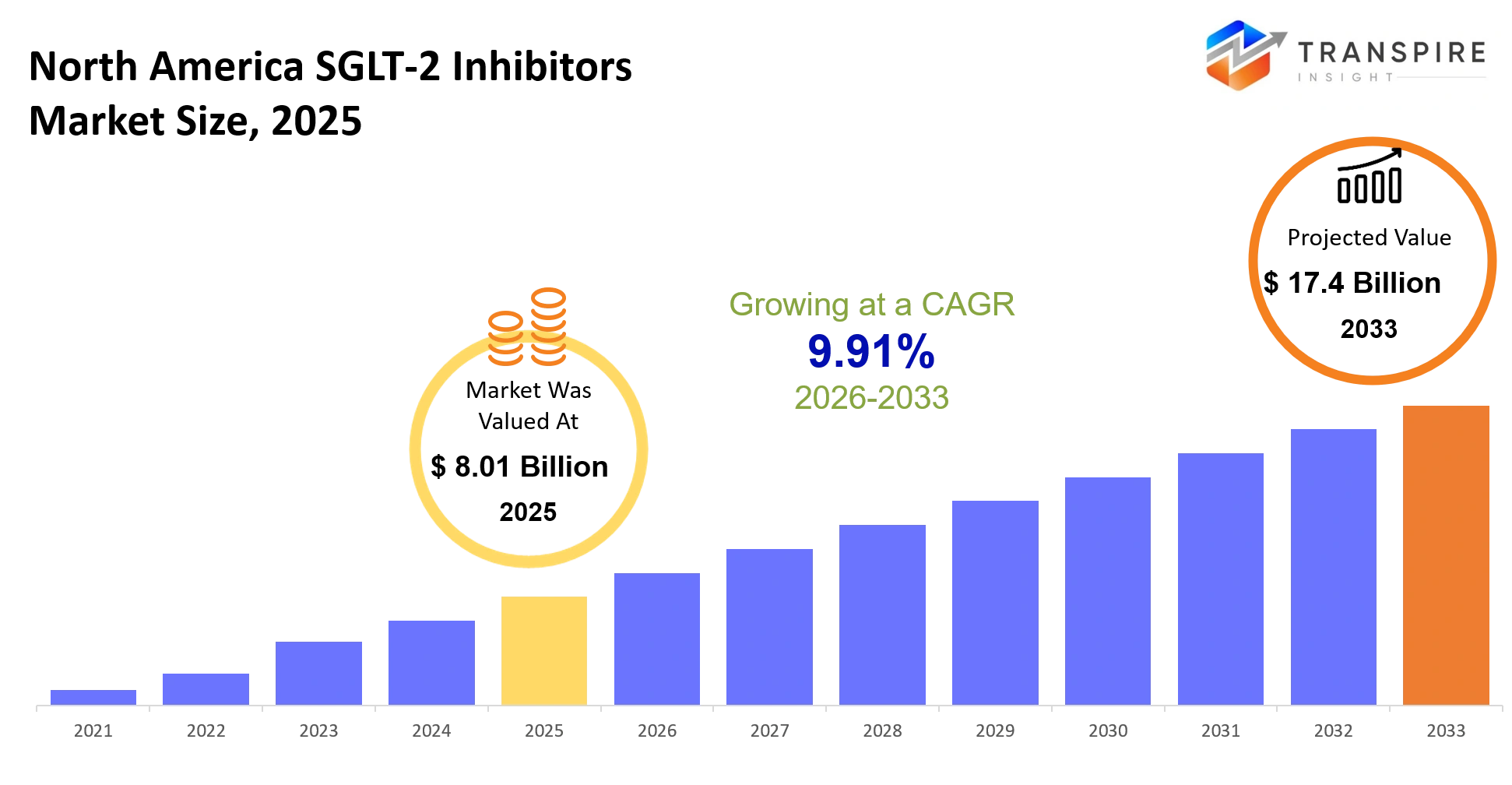
As per Transpire Insight Analysis the North America SGLT-2 Inhibitors Market size is estimated at USD 8.01 Billion in 2025 and is anticipated to reach USD 17.4 Billion by 2033, growing at a CAGR of 9.91% from 2026 to 2033.
In North America, the market for SGLT-2 inhibitors supports the long term management of type 2 diabetes while also helping lower the risk of cardiovascular and kidney related complications. so, healthcare providers can often improve patient outcomes using one streamlined therapeutic approach instead of mixing many options. Over the last five years the market seems to have moved from a mainly glucose focused idea toward broader cardio-renal protection, and that shift changed prescribing habits across several medical specialties. It really picked up speed after big clinical outcome studies, and then updated treatment guidelines pushed clinicians to start SGLT-2 inhibitors sooner, not only as diabetes management in the usual sense.
At the same time the lingering effects of the COVID 19 pandemic nudged more adoption of remote chronic care, which makes a strong case for treatments that keep working over time and still keep care plans simpler. As physicians bring these medicines earlier into care pathways and payer support expands for high-risk patient groups, prescription volumes keep climbing. That growth, in turn, creates better revenue potential across the regional pharmaceutical landscape, even with all the day to day pressures clinics face.
North America SGLT-2 Inhibitors Market Size & Forecast:
- North America SGLT-2 Inhibitors Market Size 2025: USD 8.01 Billion
- Expected Market Value 2033: USD 17.4 Billion
- Forecast CAGR: 9.91%
- Leading region in 2025: United States
- Fastest Growing region: Canada
- Key Profile: Boehringer Ingelheim, Eli Lilly, AstraZeneca, Johnson & Johnson, Merck & Co., Lexicon Pharmaceuticals, Sanofi, Novo Nordisk, Pfizer, Bayer, Novartis, Bristol Myers Squibb, Amgen, Roche, Viatris
Key Market Insights
- North America, led by the United States, really dominated with roughly 88% market share in 2025, backed by decent reimbursement, specialist uptake, and a wide branded product shelf, basically everywhere.
- Canada is expected to be the fastest-growing regional market over the forecast window, since guideline driven prescribing keeps widening and public reimbursement keeps increasing , so patients can access therapy sooner.
- For type 2 diabetes, sodium glucose co transporter-2 inhibitors stayed the top segment, taking in about 68% market share in 2025 because of strong established clinical use.
- Combination therapies were the second biggest segment, since physicians more and more choose multi mechanism regimens, aiming to support longer term metabolic plus cardiovascular results.
- Heart failure indications are likely to turn into the fastest-growing segment by 2032 , as more clinical evidence keeps pushing treatment beyond the older diabetes only mindset.
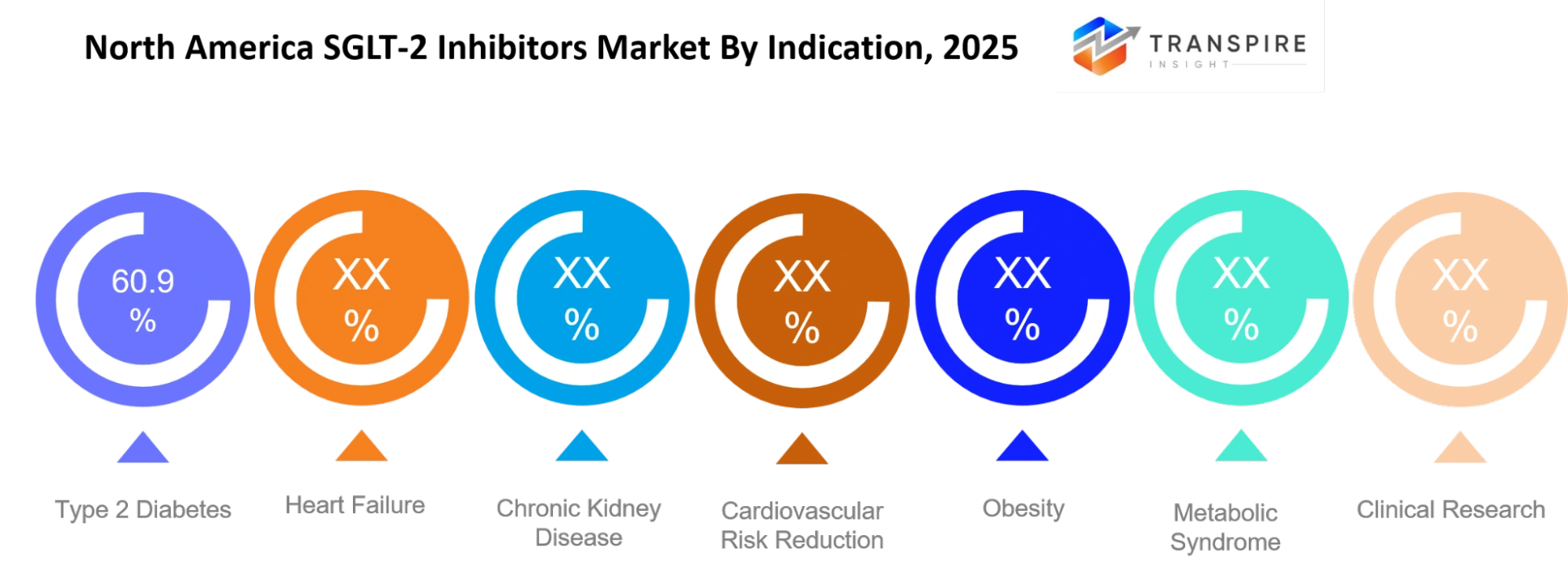
- Type 2 diabetes management led the applications side too, with nearly 61% market share in 2025 due to the large eligible population and earlier prescribing patterns that became routine.
- Cardiorenal disease prevention is forecasted to be the fastest-growing application, as revised care pathways push earlier action for people who are considered high risk, kind of sooner than before.
- Hospitals and specialty clinics, together held around 56% market share in 2025 supported by specialist-led prescribing and organized chronic illness management programs.
- Ambulatory care centers are projected to become the fastest-growing end user group, since long running outpatient care for chronic disease keeps shifting away from hospital walls.
What are the Key Drivers, Restraints, and Opportunities in the North America SGLT-2 Inhibitors Market?
The strongest growth driver is the shift toward integrated cardio-renal-metabolic care . With updated clinical guidelines and big cardiovascular outcome trials , prescribing started earlier across endocrinology, cardiology ,and nephrology. This change effectively broadened the eligible patient group way past glucose management only. More doctors now use these therapies before the disease turns worse . Earlier intervention helps long-term outcomes, while it also extends the prescription duration . So you see stronger recurring pharmaceutical revenue, and a higher level of treatment uptake across North America.
The biggest restraint still is premium drug pricing combined with patchy reimbursement across public and private health plans . Coverage differs by indication and by payer, which means administrative delays crop up before therapy begins . To expand reimbursement, companies still need long health technology assessments , plus budget negotiations. Unfortunately those processes cannot be rushed . As a result , many eligible patients defer treatment , which lowers prescription volumes and delays revenue realization. Based on a Transpire Insight review of regional procurement updates , and launch timing, supply chain concentration stays the main execution risk .
The next growth opportunity lies in precision medicine backed by digital health platforms and real world evidence . Artificial intelligence assisted patient matching, remote surveillance, and biomarker-guided selection can improve how therapies are chosen . Pharmaceutical organizations are also increasing spending on evidence that ties to outcomes, and on digital partnerships. Together these moves can raise payer trust, strengthen adherence, and expand adoption among patients with chronic kidney disease and heart failure, setting up the next stage of sustainable market expansion.
What Has the Impact of Artificial Intelligence Been on the North America SGLT-2 Inhibitors Market?
Artificial intelligence plus digital technologies are kind of reshaping the regional SGLT-2 inhibitor landscape, spanning research, day to day commercial operations, and patient handling in practice. More and more pharmaceutical makers are leaning on AI so they can automate pharmacovigilance, keep watch on adverse event submissions, streamline clinical trial enrollment, and basically strengthen the regulatory compliance “paper trails”. Machine learning models then look at prescribing patterns, epidemiology, and even healthcare utilization, to support demand prediction and manufacturing scheduling. With these forward-looking tools, companies can lower the risk of inventory mismatches, while still keeping product availability steadier across hospitals and retail pharmacy routes.
At the same time digital health platforms, when paired with AI, can help spot earlier which patients might benefit from cardio renal therapies, by scanning electronic health records and clinical risk profiles, kind of more quickly. That way providers can set priorities for intervention, reinforce treatment adherence, and keep track on long term results using connected care setups, all together.On the commercial side, advanced analytics are also used to fine tune market access tactics and physician outreach, which can reduce operational expenses while improving how resources are allocated overall. Still, broad AI deployment hits real hurdles. The integration costs can be high, healthcare data stays fragmented, interoperability standards are inconsistent sometimes, and privacy obligations constrain scale across many health systems. So even with the clear promise of better operational efficiency and improved patient outcomes across the whole pharmaceutical value chain, these constraints still slow implementation.
Key Market Trends
- Since 2022, clinical guidelines keep pushing SGLT-2 inhibitors more and more for heart failure and chronic kidney disease, like they are casting a wider net than only diabetes care and the routine stuff that goes with it.
- Between 2021 and 2025, pharmaceutical companies sped up cardiovascular outcome studies ,and that made physicians feel a bit more secure about using them, and it also looks like it nudged prescribing habits toward a broader use pattern.
- Real world evidence efforts started growing fast in 2023, letting payers weigh long-term healthcare savings together with actual clinical performance, not only short term results.
- At the same time, digital patient monitoring platforms are helping with medication compliance, which supports chronic disease care and also seems to lower the chances of dropping treatment in outpatient clinics.
- Manufacturers appear to be putting more money into label expansion strategies rather than going all-in on totally new molecules, so they can stretch lifecycle value, and lock in competitive positioning.
- After 2022, the whole combination treatment thing picked up some momentum, since clinicians were trying to find complementary therapeutic mechanisms for high-risk cardiometabolic patients, rather than leaning on just one pathway alone.
- Since 2023, retail plus specialty pharmacy coordination has also grown, which helps patient access through more coordinated dispensing , and reimbursement kind of guidance.
- In the meantime, clinical research is increasingly targeting chronic kidney disease cohorts, you know, basically pointing to a strategic shift toward wider therapeutic use across the forecast window.
- Also, AI-enabled commercial analytics are getting sharper, especially around demand forecasting, inventory calls, and physician outreach, all of that tends to support smoother pharmaceutical operations across North America.
North America SGLT-2 Inhibitors Market Segmentation
By Drug Type :
Empagliflozin keeps a top spot , mostly because there is solid clinical evidence showing cardiovascular and kidney protection , plus it still helps with blood glucose control. Dapagliflozin keeps pushing further into heart failure and chronic kidney disease care lanes , and that tends to create more commercial leverage overall. Canagliflozin stays fairly steady thanks to well known use in diabetes management , even if newer products bring tougher competition. Ertugliflozin fits into more selected patient segments , where prescribing choices line up with the clinical needs and the actual formulary access.
Sotagliflozin draws notice due to the dual inhibition edge , for people that are chosen carefully. Combination SGLT-2 approaches help make the treatment path feel simpler and they can support better medication adherence. In the pipeline, SGLT-2 inhibitors are being shaped around stronger efficacy, safety, and wider therapeutic indications, while the rest of the group still includes smaller niche products , these cover specific clinical requirements and help support future portfolio diversification.
By Indication :
Type 2 diabetes stays the largest indication because, for a long time, glucose management still needs reliable oral therapies with solid clinical outcomes. Heart failure became a major growth area following guideline updates and that’s helping wider use across eligible patient groups, in a sort of “now we can do more” way. Chronic kidney disease treatment is also moving forward since more clinical evidence showed real protection against progression, not just theoretical benefit. Cardiovascular risk reduction now counts as a key prescribing goal rather than only a secondary extra benefit.
Obesity and metabolic syndrome are getting more research focus too, as broader metabolic care approaches keep evolving. Clinical research programs are looking at additional therapeutic uses and longer-term patient outcomes, across several condition groups, often with different trial designs. Other indications still add incremental chances through more specialized treatment pathways. Strong clinical evidence should keep backing expansion in multiple disease categories.
By Route of Administration :
Oral tablets still look like the preferred way to take medicines, mostly because a simple once-a-day routine helps patient comfort and keeps the treatment going. Fixed-dose combination tablets cut down the number of pills, while also helping adherence in people who actually need two or more therapies at the same time. Extended-release tablets keep getting attention too, where longer, steady drug delivery lines up with the clinical targets. With combination therapy, clinicians can handle several metabolic issues by using coordinated treatment plans, in a more unified way.
Personalized therapy keeps rising in value, since patient specifics steer which medicine to choose and how to manage the disease over time. Precision-oriented treatment methods can support better clinical results, and at the same time reduce unnecessary switches. There are also other administration routes that fit more specific patient needs, or newer therapeutic strategies that keep emerging. In product development, the focus will likely stay on convenience , and on improving treatment persistence without too much friction.
By End User :
Hospitals make up a big chunk , mostly because multidisciplinary care helps patients start treatment sooner even when they have hard cardiovascular and metabolic issues. Diabetes clinics stay important too, for routine disease follow-up and then the long term medication management, not just the initial visit. Cardiology clinics now more often end up prescribing these therapies , after heart failure indications kept expanding and when cardiovascular outcome evidence got stronger. Nephrology clinics also keep pushing uptake, through wider chronic kidney disease treatment guidance.
At the same time , home healthcare services help with long term adherence to medication and with remote patient monitoring, so chronic disease management keeps moving without so many in person steps. Academic medical centers add value by running clinical studies, supporting physician training, and helping build treatment guideline resources. Research institutes continue to look into fresh indications and what they call next generation therapies, which should shape where the market goes in the next phase. Other types of healthcare facilities round things out by providing extra treatment access across community based care locations.
By Distribution Channel :
Hospital pharmacies kind of act as this hub, helping supply medicines for people who are newly diagnosed, and also for those more complicated treatment situations . Meanwhile retail pharmacies keep a wide assortment on hand, and they also help with continuous prescription refills throughout the local communities, kind of day to day. Online pharmacies still keep growing, mainly via digital ordering, home drop-off , and general “patient convenience” upgrades that make things easier. Specialty pharmacies offer more targeted guidance too, especially around reimbursement coordination, patient teaching and adherence programs that help people stay on track.
Government programs, in turn, boost access to care for eligible patient groups through structured reimbursement measures. Direct supply channels also help solidify product availability for healthcare facilities and big medical networks. There are additional distribution routes as well, which can accommodate regional needs and specific procurement patterns when that makes sense. If investment continues to go into distribution efficiency, it should help maintain dependable product access across North America without too many interruptions.
What are the Key Use Cases Driving the North America SGLT-2 Inhibitors Market?
For Type 2 diabetes management, it remains the primary use case driving market revenue. Hospitals, diabetes clinics and retail healthcare networks prescribe SGLT-2 inhibitors since sustained glucose control, paired with heart plus kidney protection, tends to help clinical outcomes and at the same time lowers hospitalization risk. On top of that broad reimbursement backing kinda reinforces regular prescribing for the patient populations that fit eligibility.
Then there is heart failure and chronic kidney disease treatment, which keeps widening across both cardiology and nephrology settings. Newer clinical guidance pushes for starting therapy earlier, while academic medical centers fold these medicines into evidence-driven care pathways. Specialty pharmacies also matter a lot here, not just for access but for keeping treatment continuity steady.
Looking ahead, new use cases are emerging, such as metabolic syndrome care and certain obesity treatment programs supported by ongoing clinical research. Research institutes and academic healthcare organizations are still evaluating wider cardio metabolic uses. And if future regulatory approvals land during the forecast period, prescribing opportunities could broaden across more high risk patient groups.
|
Report Metrics |
Details |
|
Market size value in 2025 |
USD 8.01 Billion |
|
Market size value in 2026 |
USD 8.98 Billion |
|
Revenue forecast in 2033 |
USD 17.4 Billion |
|
Growth rate |
CAGR of 9.91% from 2026 to 2033 |
|
Base year |
2025 |
|
Historical data |
2021 - 2024 |
|
Forecast period |
2026 - 2033 |
|
Report coverage |
Revenue forecast, competitive landscape, growth factors, and trends |
|
Regional scope |
North America (Canada, The United States, and Mexico) |
|
Key company profiled |
Boehringer Ingelheim, Eli Lilly, AstraZeneca, Johnson & Johnson, Merck & Co., Lexicon Pharmaceuticals, Sanofi, Novo Nordisk, Pfizer, Bayer, Novartis, Bristol Myers Squibb, Amgen, Roche, Viatris . |
|
Customization scope |
Free report customization (country, regional & segment scope). Avail customized purchase options to meet your exact research needs. |
|
Report Segmentation |
By Drug Type (Empagliflozin, Dapagliflozin, Canagliflozin, Ertugliflozin, Sotagliflozin, Combination SGLT-2 Therapies, Pipeline SGLT-2 Inhibitors, Others); By Indication (Type 2 Diabetes, Heart Failure, Chronic Kidney Disease, Cardiovascular Risk Reduction, Obesity, Metabolic Syndrome, Clinical Research, Others); By Route of Administration (Oral Tablets, Fixed-Dose Combination Tablets, Extended-Release Tablets, Combination Therapy, Personalized Therapy, Others); By End User (Hospitals, Diabetes Clinics, Cardiology Clinics, Nephrology Clinics, Home Healthcare, Academic Medical Centers, Research Institutes, Others); By Distribution Channel (Hospital Pharmacies, Retail Pharmacies, Online Pharmacies, Specialty Pharmacies, Government Programs, Direct Supply, Others) |
Which Regions are Driving the North America SGLT-2 Inhibitors Market Growth?
Canada looks like the clear regional winner, accounting for around 88% of North American revenue. The main reasons are that reimbursement systems remain strong, clinical guideline updates are frequent, and established regulatory pathways allow SGLT-2 inhibitors to reach a broad set of eligible patients. Also, the big pharmaceutical players keep running large commercial operations, active clinical research projects, and distribution partnerships that help keep products available throughout the healthcare system. If the cardio-renal treatment recommendations continue to expand and chronic disease management remains steadily funded, Canada should maintain its leadership position throughout the forecast window.
Mexico adds a more steady piece of the market, mostly because healthcare is slowly modernizing and access to chronic disease treatment is widening. The reimbursement rules at the national level seem to develop at a measured pace, so adoption feels predictable rather than leading to a fast, sudden shift in prescriptions. Meanwhile public healthcare spending keeps moving, and pharmaceutical distribution networks keep improving, which supports branded therapies across urban medical centers in a fairly consistent way. Overall, this kind of balanced setup brings dependable revenue chances but it also helps reduce unexpected market swings.
Mexico is also expected to show the quickest expansion between 2026 and 2033, as healthcare infrastructure spending and broader access to innovative medicines keep on improving. There has been recent growth in chronic condition management programs, and also more access to specialty care, which has sped up prescribing at many bigger healthcare centers. On top of that, regulatory upgrades plus tighter pharmaceutical collaborations continue to help wider commercialization of advanced treatments. All of this momentum should bring compelling chances for manufacturers, distributors, and investors who are looking for long term scaling across a healthcare market that still feels underpenetrated.
Who are the Key Players in the North America SGLT-2 Inhibitors Market and How Do They Compete?
Competition is still fairly consolidated, mostly because a limited set of multinational pharmaceutical companies kind of control most commercial sales and product development . So, when it comes to how companies really compete, it’s rarely just price. Instead clinical evidence matters, plus expanded therapeutic indications, regulatory approvals,and market access agreements really do the heavy lifting.
Established manufacturers continue to protect market share through lifecycle management, while smaller biotechnology firms tend to shift toward differentiated pipeline products and a more targeted approach to innovation.
AstraZeneca seems to strengthen its competitive posture by expanding clinical evidence for dapagliflozin across cardiovascular and kidney disease areas, which opens up wider prescribing windows that are not just diabetes management. **Boehringer Ingelheim** differentiates empagliflozin with deep cardiovascular outcome research and strategic collaborations, these efforts help reinforce physician confidence.
Eli Lilly backs commercial growth by adding more clinical programs, and by improving access through healthcare partnerships.
Johnson & Johnson builds an edge through long-term real world evidence and ongoing research, keeping canagliflozin supported across different therapeutic settings. **Lexicon Pharmaceuticals** is more focused on differentiated dual inhibition technology with sotagliflozin, trying to reach patient groups that may need broader metabolic advantages.
Ongoing investment in new indications, research partnerships,and expanded commercialization moves should keep competitive positioning strong as treatment pathways continue evolving across North America.
Company List
- Boehringer Ingelheim
- Eli Lilly
- AstraZeneca
- Johnson & Johnson
- Merck & Co.
- Lexicon Pharmaceuticals
- Sanofi
- Novo Nordisk
- Pfizer
- Bayer
- Novartis
- Bristol Myers Squibb
- Amgen
- Roche
- Viatris
Recent Development News
In February 2026, Lexicon Pharmaceuticals received more than US$100 million through a capital raise and a milestone payment from Novo Nordisk linked to the licensed obesity candidate LX9851. The investment strengthened funding for cardiometabolic pipeline development, including programs related to SGLT therapies, and extended execution capacity for future commercialization. Sourcehttps://lexiconpharma.gcs-web.com/
In April 2025, Lexicon Pharmaceuticals and Novo Nordisk advanced their strategic licensing collaboration after Novo Nordisk made a US$45 million upfront payment for the exclusive global rights to develop and commercialize LX9851 for obesity and related cardiometabolic diseases. The agreement expanded long-term investment in metabolic disease innovation and reinforced collaboration across adjacent therapeutic areas.
Sourcehttps://lexiconpharma.gcs-web.com/
What Strategic Insights Define the Future of the North America SGLT-2 Inhibitors Market?
The North America SGLT-2 inhibitors market will keep shifting toward an integrated cardio renal metabolic care approach, instead of staying stuck on glucose management alone. As clinical evidence keeps expanding, along with broader treatment guidelines and value based reimbursement schemes, clinicians will likely prescribe earlier across several medical specialties, which should open up durable long term revenue. A quieter headwind will be market concentration, because relying on only a handful of branded products plus manufacturing networks can make supply continuity and pricing tactics more vulnerable to sudden disruptions. An opportunity that is still kind of under the radar will grow through AI enabled patient identification and real world evidence platforms, these can help providers screen for eligible people and align them with the right therapy, while also boosting payer confidence. Market players should put money into digital health partnerships, decentralized evidence creation, and enlarged clinical programs targeting new therapeutic indications. Taken together these moves will sharpen competitive positioning, improve reimbursement reach, and support steady growth as treatment pathways continue evolving across North America.
North America SGLT-2 Inhibitors Market Report Segmentation
By Drug Type
- Empagliflozin
- Dapagliflozin
- Canagliflozin
- Ertugliflozin
- Sotagliflozin
- Combination SGLT-2 Therapies
- Pipeline SGLT-2 Inhibitors
By Indication
- Type 2 Diabetes
- Heart Failure
- Chronic Kidney Disease
- Cardiovascular Risk Reduction
- Obesity
- Metabolic Syndrome
- Clinical Research
By Route of Administration
- Oral Tablets
- Fixed-Dose Combination Tablets
- Extended-Release Tablets
- Combination Therapy
- Personalized Therapy
By End User
- Hospitals
- Diabetes Clinics
- Cardiology Clinics
- Nephrology Clinics
- Home Healthcare
- Academic Medical Centers
- Research Institutes
By Distribution Channel
- Hospital Pharmacies
- Retail Pharmacies
- Online Pharmacies
- Specialty Pharmacies
- Government Programs
- Direct Supply
Frequently Asked Questions
Find quick answers to common questions.
The expected North America SGLT-2 Inhibitors Market size for the market will be USD 17.4 Billion in 2033.
Key segments for the North America SGLT-2 Inhibitors Market are By Drug Type (Empagliflozin, Dapagliflozin, Canagliflozin, Ertugliflozin, Sotagliflozin, Combination SGLT-2 Therapies, Pipeline SGLT-2 Inhibitors, Others); By Indication (Type 2 Diabetes, Heart Failure, Chronic Kidney Disease, Cardiovascular Risk Reduction, Obesity, Metabolic Syndrome, Clinical Research, Others); By Route of Administration (Oral Tablets, Fixed-Dose Combination Tablets, Extended-Release Tablets, Combination Therapy, Personalized Therapy, Others); By End User (Hospitals, Diabetes Clinics, Cardiology Clinics, Nephrology Clinics, Home Healthcare, Academic Medical Centers, Research Institutes, Others); By Distribution Channel (Hospital Pharmacies, Retail Pharmacies, Online Pharmacies, Specialty Pharmacies, Government Programs, Direct Supply, Others).
Major North America SGLT-2 Inhibitors Market players are Boehringer Ingelheim, Eli Lilly, AstraZeneca, Johnson & Johnson, Merck & Co., Lexicon Pharmaceuticals, Sanofi, Novo Nordisk, Pfizer, Bayer, Novartis, Bristol Myers Squibb, Amgen, Roche, Viatris.
The North America SGLT-2 Inhibitors Market size is USD 8.01 Billion in 2025.
The North America SGLT-2 Inhibitors Market CAGR is 9.91% from 2026 to 2033.
- Boehringer Ingelheim
- Eli Lilly
- AstraZeneca
- Johnson & Johnson
- Merck & Co.
- Lexicon Pharmaceuticals
- Sanofi
- Novo Nordisk
- Pfizer
- Bayer
- Novartis
- Bristol Myers Squibb
- Amgen
- Roche
- Viatris
About the Authors

Pankaj Ghogare Patil
I am Pankaj Ghogare Patil, a Senior Research Analyst at Transpire Insight, specializing in the Pharmaceutical, Chemicals & Materials, Healthcare IT, and Biotechnology industry. My expertise lies in conducting comprehensive market research, analyzing industry trends, evaluating competitive landscapes, and translating complex data into actionable insights. At Transpire Insight, I closely follow emerging technologies, regulatory developments, and market innovations to create accurate, well-researched, and informative content that helps businesses and professionals make informed decisions. I am committed to producing credible, evidence-based articles that reflect industry best practices while making technical topics accessible and valuable for a broad audience.

Chakradhar Khansole
Chakradhar serves as the Research Director at Transpire Insight, bringing over 8 years of experience in technology, innovation, and strategic market intelligence. He specializes in transforming complex market data into actionable business insights that enable organizations to make informed, growth-oriented decisions. Recognized for his strategic vision and analytical expertise, Chakradhar leads high-impact research initiatives, delivering comprehensive market assessments, competitive intelligence, and forward-looking industry analysis.
Recently Published Reports
-
Apr 2026
AI in Diabetic Retinopathy Market
AI in Diabetic Retinopathy Market Size, Share & Analysis Report By Type (Screening AI Systems, Diagnostic AI Systems, and Predictive AI Models), By Application Segment (Hospitals, Ophthalmology Clinics, Diagnostic Centers, and Research and Development), and Geography (North America, Europe, Asia-Pacific, Middle East and Africa, South and Central America), 2021 - 2031
-
Apr 2026
Psychometric Tests Market
Psychometric Tests Market Size, Share & Analysis Report By Type (Personality Tests, Ability/Aptitude Tests, Skill/Knowledge Tests, and Others), By Application (Talent Acquisition and Talent Management), and Geography (North America, Europe, Asia-Pacific, Middle East and Africa, South and Central America), 2021 – 2031
-
Apr 2026
Rare Biological Sample Collection Market
Rare Biological Sample Collection Market Size, Share & Analysis Report By Type (Isolation Kits & Reagent, Blood Collection Tubes, and Others), By Application (Oncology, Transcriptomics, Pharmacogenomics, and Others), and Geography (North America, Europe, Asia-Pacific, Middle East and Africa, South and Central America), 2021 – 2031
-
Jul 2026
Diabetic Retinopathy Market
Diabetic Retinopathy Market Size, Share & Analysis Report By Type (Proliferative Diabetic Retinopathy, and Diabetic Macular Edema (DME)), By Treatment Type (Anti VEGF Drug, Steroid Implants, Laser Surgeries, and Vitrectomy), and Geography (North America, Europe, Asia-Pacific, Middle East and Africa, South and Central America), 2021 – 2031
Our Clients







