
North America Service Delivery Automation Market Size & Forecast:
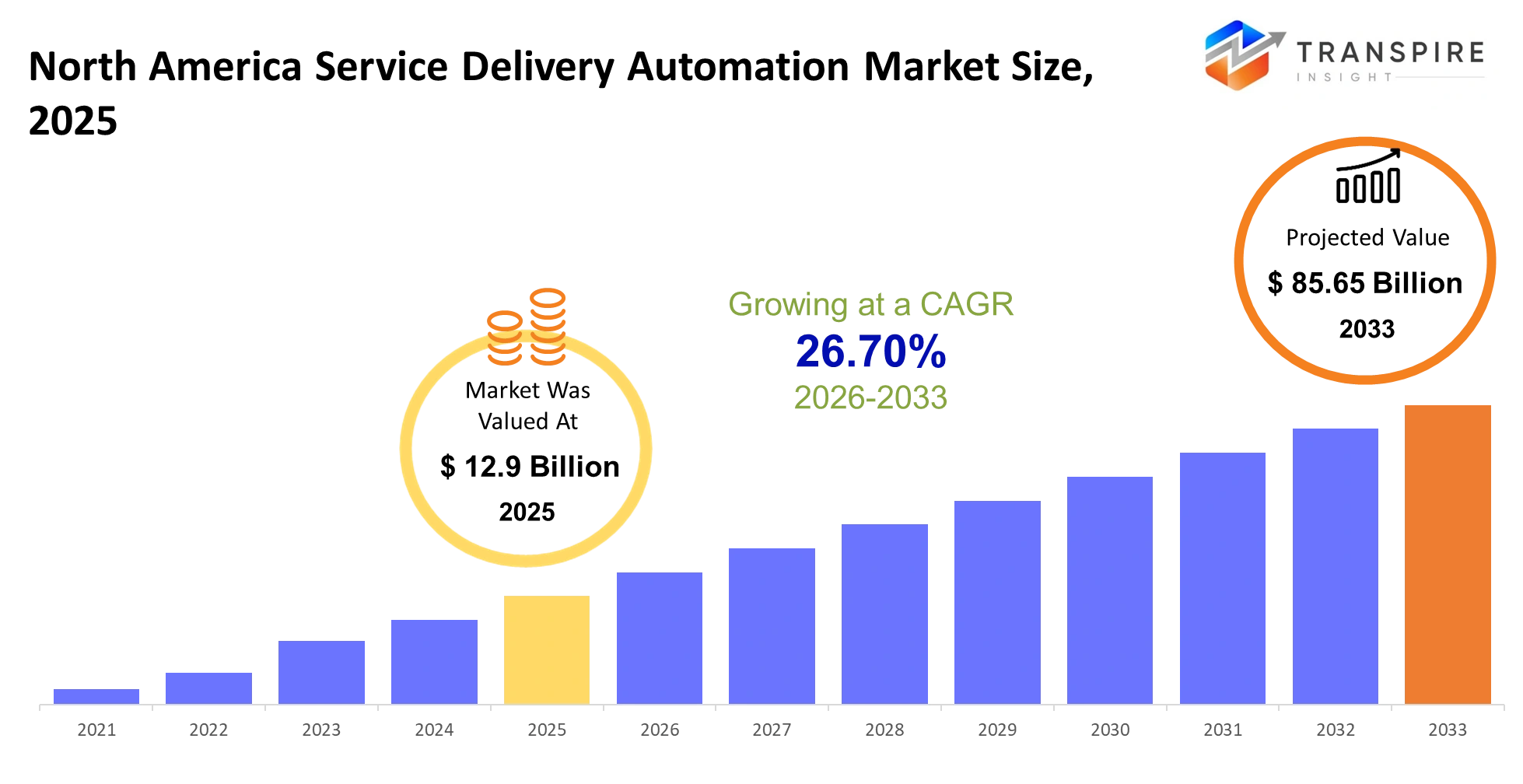
- North America Service Delivery Automation Market Size 2025: USD 12.9 Billion
- North America Service Delivery Automation Market Size 2033: USD 85.65 Billion
- North America Service Delivery Automation Market CAGR: 26.70%
- North America Service Delivery Automation Market Segments: By Component (Software, Services, Platforms, AI Tools, Others, Analytics); By Deployment (Cloud, On-Premises, Hybrid, SaaS, Others, AIaaS); By Application (IT Operations, Customer Support, HR, Finance, Others, Automation); By End-User (IT, BFSI, Healthcare, Retail, Others, Telecom).
To learn more about this report,  Download Free Sample Report
North America Service Delivery Automation Market Summary:
The North America Service Delivery Automation Market size is estimated at USD 12.9 Billion in 2025 and is anticipated to reach USD 85.65 Billion by 2033, growing at a CAGR of 26.70% from 2026 to 2033.
The North American Service Delivery Automation Market will define organizational operational methods because businesses implement digital solutions for their everyday activities, which require less staff. The system will operate through intelligent workflows that manage service processes by predicting and automatically solving problems without human assistance. Organizations from all business sectors will demand faster service delivery and uniform service standards which will drive service providers to enhance their automated systems that combine analytical capabilities with operational control and instantaneous system assessment into a single service delivery mechanism.
Customers will develop higher service requirements which they will fulfill through permanent online services together with tailored customer assistance approaches. The development of adaptive automation systems will become essential for service providers because these systems will learn from user interactions to improve operational processes. The combination of artificial intelligence improvements together with low-code development environments and cloud-native software frameworks will transform solution development and implementation processes while North America implements stricter data governance regulations for automated decision systems. The current market situation and its future development during the next years will emerge from these two simultaneous changes.
What Has the Impact of Artificial Intelligence Been on the North America Service Delivery Automation Market?
The north america service delivery automation market experiences a major transformation through artificial intelligence which creates operational systems that rely on data and achieve maximum performance. The North American service delivery automation market platforms apply AI to market research and data analysis because they can handle multiple operational and customer data streams in real time. Organizations use machine learning models to identify patterns and optimize workflows while the models create actionable insights that enable organizations to respond quickly to changing market conditions.The system enables better demand forecasting and trend prediction which results in more accurate resource allocation and service requirement anticipation by enterprises.
North American service delivery automation markets use artificial intelligence to improve operational efficiency through automated smart systems and intelligent process management. AI-powered systems streamline repetitive tasks, reduce human error, and accelerate service delivery timelines across industries such as IT services, healthcare, and finance. Predictive analytics enables supply chain optimization through its ability to forecast disruptions while it also enhances vendor management and decreases operational expenses. The system achieves better efficiency results which allow it to scale up operations without sacrificing service quality.
The North American service delivery automation market shows operational benefits through AI solutions which deliver both innovative and personalized services to customers at large scale. Intelligent automation platforms develop custom service delivery systems which match user needs and preferences to establish a competitive edge for service providers. The North American service delivery automation market evolves into a more flexible and customer-focused system as organizations adopt advanced AI technologies.
Key Market Trends & Insights:
- The United States markets service delivery automation in North America through an 78% market share which will continue to grow until 2025 because of strong enterprise IT adoption.
- The fastest-growing region in Canada will experience more than 11% CAGR growth until 2030 because of increasing digital infrastructure investments.
- The IT service automation market leads with about 45% market share which results from organizations seeking to improve their workflows through cloud-based service delivery platforms.
- Business process automation maintains its position as the second-largest market segment because companies implement digital transformation projects and strive to improve their operational efficiency.
- The AI-driven automation solutions market represents the fastest expanding segment which will continue to grow until 2030 because more organizations adopt machine learning and predictive analytics.
- More than 50 percent of application usage in the IT and telecom sector which will reach this threshold in 2025 operates through automated systems that improve incident management and service desk processes.
- Healthcare automation has emerged as the most rapidly expanding application because healthcare facilities require better patient data management tools and organizations need more efficient workflow systems.
- The north america service delivery automation market remains primarily controlled by large enterprises, which hold substantial market share because they can invest heavily and require solutions that can grow with their needs.
- The end-user segment that experiences the highest growth rate includes small and medium enterprises which benefit from cloud-based automation to decrease their operational expenses while enhancing their business flexibility. The main industry players in the market include IBM, Microsoft, ServiceNow, Automation Anywhere, and UiPath.
North America Service Delivery Automation Market Segmentation
By Component :
The software serves as the fundamental layer which permits users to automate their repetitive tasks while decreasing their need to perform manual work and maintaining operational process stability throughout their work activities. The services enable organizations to implement their systems while integrating new components and providing ongoing support needed to maintain system performance. Organizations can operate their workflows more effectively through platforms which combine multiple tools into one system.
AI tools bring intelligence to systems through their ability to study patterns, forecast results and support decision-making processes which require little human involvement. Analytics enables organizations to monitor their performance, discover weaknesses, and enhance service delivery standards through insights derived from data analysis. The other elements of the system enable organizations to meet their specialized operational needs which exist in various industrial sectors. The system consists of various components which work together to boost system performance through enhanced processing speed and precise results.
By Deployment :
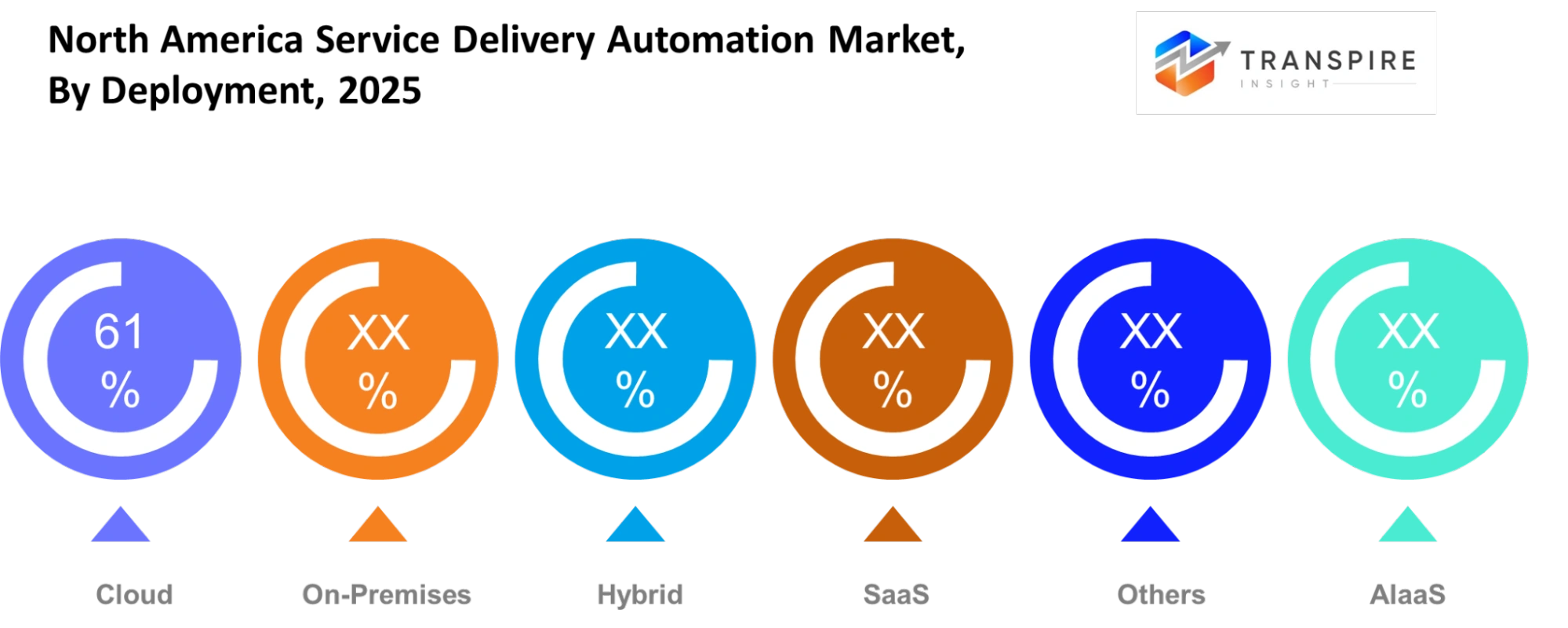
Organizations can achieve rapid automation solution expansion through cloud deployment because it requires minimal initial costs. The system enables users to access information remotely while providing current updates,which makes it ideal for businesses that experience constant changes. Organizations with strict compliance requirements prefer on-premises deployment because it enables them to maintain full control over their data and systems.
Hybrid models that combine cloud and on-premises systems allow organizations to retain control over their operations while achieving flexible output capabilities. SaaS provides users with automation tools through subscription-based delivery which eliminates the need for complex installation processes. AIaaS delivers advanced automation through external providers which enables businesses to access AI capabilities without developing them in-house.
Organizations use different deployment methods to meet their particular operational requirements and system limitations.
To learn more about this report, Download Free Sample Report
By Application :
The IT operations team employs automation to handle infrastructure management, system monitoring, and problem-solving activities which results in decreased service interruptions. The implementation of automated response systems together with chat support tools enables customer support teams to resolve customer inquiries more efficiently which enhances user experience. Automated systems create more efficient HR operations which include recruitment, onboarding, and employee management processes.
Finance applications process invoices, generate reports, and track compliance, which helps to decrease errors while increasing efficiency. The other applications use automation to extend its reach into various business operations which involve repetitive work. The category of automation links all these domains together which leads to improved operational efficiency and enhanced interdepartmental collaboration and increased work output.
By End-User :
The IT sector leads adoption because businesses need efficient systems which maintain high operational performance. The BFSI sector uses automation technology to handle transaction processing and risk management and compliance operations which require high precision and quick performance. Healthcare uses automation to handle patient data and schedule appointments and manage administrative tasks, which leads to better service delivery.
The retail sector employs automation technologies to manage inventory and engage customers and process orders, which enables businesses to adapt to changing customer demand. Telecom companies use automation to manage their networks and provide customer service which maintains uninterrupted system operation. Other industries adopt these solutions based on operational needs, driving broader adoption across sectors in North America.
What are the Main Challenges for the North America Service Delivery Automation Market Growth?
The North America service delivery automation market encounters multiple technical and operational difficulties which prevent organizations from achieving full system performance and scalability. Businesses experience reduced operational efficiency because AI automation solutions fail to work with their existing enterprise systems.
The North America service delivery automation market development path faces constraints from manufacturing and commercialization obstacles. To create new automation platforms organizations must spend substantial resources on research work and building facilities and following strict data security regulations. Small vendors experience financial challenges that prevent them from developing new products and bringing them to market. The North America service delivery automation market faces essential market challenges because testing processes take too long and businesses must demonstrate enterprise-level product dependability before they can launch their products.
The North American service delivery automation market faces its most significant barrier to adoption in the challenges small and medium enterprises must overcome. The organization cannot implement its operations because it lacks access to essential skilled workers who include AI engineers and automation specialists. The presence of insufficient IT systems together with budget limitations prevents organizations from adopting technology in industries that have not yet implemented digital transformation.
The North American service delivery automation market experiences its second complexity because competitive strength and technological risk development create new operational challenges. Established companies in the market increase the pricing pressure for their services, while businesses must develop new products to keep up with fast-moving alternative technologies. The North American service delivery automation market faces two major challenges that result from changing regulations and cybersecurity threats which create uncertainty about future market growth and technology adoption.
Regional Insights
The North American Service Delivery Automation Market will continue to expand as companies aim to enhance operational processes and reduce manual work. The IT industry and customer service and back-office operations use automation tools to create faster and more reliable service delivery systems while decreasing operational expenses and reducing the chances of human mistakes.
The North America Service Delivery Automation Market will benefit from automation platforms that integrate artificial intelligence and machine learning. The technologies will help organizations make better decisions through predictive service management and real-time issue resolution which enables them to develop advanced service delivery systems that go beyond basic automation.
North America will keep its dominant position because it has a history of adopting advanced technologies and maintains a strong digital infrastructure. Companies in the area will continue to invest in automation because it helps them work more efficiently while staying competitive. The major technology providers in the area will help organizations build new automation solutions which will lead to faster deployment of these solutions.
The region will experience growth because organizations need more cloud-based solutions and remote working tools. Businesses will depend on automation to effectively control their distributed operations which will help them maintain service quality across different locations. Smaller businesses will start using these solutions after they become budget-friendly and more people understand their advantages.
Recent Development News
In March 2026, FedEx Corporation accelerated deployment of AI-driven automation across its enterprise workflows. The company announced plans to integrate AI agents into more than half of its operational processes which will deliver major improvements to service delivery automation in logistics and back-office functions.
Source: https://www.wsj.com/
In April 2026, UiPath reported continued expansion of its AI-powered automation platform because more enterprises in North America started using the system. The company showed increasing use of agentic automation together with orchestration tools which help businesses to handle their complex processes more efficiently than standard RPA systems.
Source: https://www.uipath.com/newsro
|
Report Metrics |
Details |
|
Market size value in 2025 |
USD 12.9 Billion |
|
Market size value in 2026 |
USD 16.34 Billion |
|
Revenue forecast in 2033 |
USD 85.65 Billion |
|
Growth rate |
CAGR of 26.70% from 2026 to 2033 |
|
Base year |
2025 |
|
Historical data |
2021 - 2024 |
|
Forecast period |
2026 - 2033 |
|
Report coverage |
Revenue forecast, competitive landscape, growth factors, and trends |
|
Regional scope |
North America (Canada, The United States, and Mexico) |
|
Key company profiled |
IBM, Microsoft, Automation Anywhere, UiPath, Blue Prism, ServiceNow, Oracle, SAP, NICE, Pegasystems, Cognizant, Infosys, Wipro, TCS, HCL. |
|
Customization scope |
Free report customization (country, regional & segment scope). Avail customized purchase options to meet your exact research needs. |
|
Report Segmentation |
By Component (Software, Services, Platforms, AI Tools, Others, Analytics); By Deployment (Cloud, On-Premises, Hybrid, SaaS, Others, AIaaS); By Application (IT Operations, Customer Support, HR, Finance, Others, Automation); By End-User (IT, BFSI, Healthcare, Retail, Others, Telecom). |
How Can New Companies Establish a Strong Foothold in the North America Service Delivery Automation Market?
New entrants can establish a strong foothold in the north america service delivery automation market by focusing on niche targeting and industry-specific solutions. Companies should focus on their most important sectors which include healthcare and BFSI and manufacturing because these sectors need automation to solve their main operational problems. New players in the north america service delivery automation market can establish themselves as specialized solution providers by showing their products which match current market growth drivers and industry trends.
The north american service delivery automation market needs businesses to create innovation strategies together with technology differentiation strategies which will help them build their market presence. Startups that use AI platforms together with machine learning and predictive analytics will create advanced capabilities which include intelligent process orchestration and real-time decision-making. WorkFusion develops AI-powered automation systems for financial services while Moveworks builds conversational AI systems to improve IT support.
The North American service delivery automation market gets enhanced market entry through strategic partnerships and scalable business models. The company achieves quick market expansion through partnerships with cloud providers and system integrators and enterprise customers.
Key North America Service Delivery Automation Market Company Insights
The North American Service Delivery Automation Market will grow as businesses seek better workflow solutions and lower costs. The use of automation tools will enable organizations to deliver services more quickly and to achieve better service quality and compliance with standards. The demand for service delivery automation solutions will increase because organizations across industries are implementing digital transformation initiatives.
Organizations in banking and healthcare and telecom industries will increase their spending on automation platforms which will help them manage their repetitive service operations. The demand for cloud-based deployments will increase as customers seek flexible, scalable solutions. The integration of artificial intelligence with analytics tools will enable businesses to make better decisions by leveraging predictive service management across their operations.
Competitive insights: The major industry players will develop new products and create partnerships and complete acquisitions to boost their market presence while adding new services. The market will become more competitive as global technology companies and new solution providers enter. The companies will achieve greater automation capabilities and improved customer retention through their ongoing commitment to research and development.
Company List
- IBM
- Microsoft
- Automation Anywhere
- UiPath
- Blue Prism
- ServiceNow
- Oracle
- SAP
- NICE
- Pegasystems
- Cognizant
- Infosys
- Wipro
- TCS
- HCL
What are the Key Use-Cases Driving the Growth of North America Service Delivery Automation Market?
The North America service delivery automation market is experiencing rapid growth because both IT service management and enterprise operations have started using the technology. Organizations are using automation platforms to improve their incident resolution processes and service desk operations and infrastructure monitoring activities. The north america service delivery automation market experiences high demand because these use cases shorten response times and improve service delivery effectiveness and reduce operational expenses.
The healthcare sector drives growth in the north america service delivery automation market through its use of automated systems for patient data processing and appointment scheduling and claims management. Automation improves accuracy while it decreases administrative work and it helps organizations follow regulatory requirements. The BFSI sector uses automation for fraud detection and transaction processing and customer onboarding which allows organizations to manage large transaction volumes while ensuring security and regulatory compliance.
The north america service delivery automation market is expanding because manufacturing and logistics companies use automated workflows to manage supply chain operations and track inventory and conduct predictive maintenance. The applications lead to better operational performance. The new customer service automation use cases which use AI-based chatbots and virtual assistants have changed how customers interact with retail and telecom businesses.
AI-powered automation systems enable the North American service delivery automation market to discover new possibilities through their ability to expand operational capacity. Businesses achieve automation expansion across various functions through their use of cloud computing, machine learning, and predictive analytics technologies, which support their digital transformation efforts and long-term growth strategies.
North America Service Delivery Automation Market Report Segmentation
By Component
- Software
- Services
- Platforms
- AI Tools
- Analytics
By Deployment
- Cloud
- On-Premises
- Hybrid
- SaaS
- AIaaS
By Application
- IT Operations
- Customer Support
- HR
- Finance
- Automation
By End-User
- IT
- BFSI
- Healthcare
- Retail
- Telecom
Frequently Asked Questions
Find quick answers to common questions.
The approximate North America Service Delivery Automation Market size for the market will be USD 85.65 Billion in 2033.
Key segments for the North America Service Delivery Automation Market are By Component (Software, Services, Platforms, AI Tools, Others, Analytics); By Deployment (Cloud, On-Premises, Hybrid, SaaS, Others, AIaaS); By Application (IT Operations, Customer Support, HR, Finance, Others, Automation); By End-User (IT, BFSI, Healthcare, Retail, Others, Telecom).
Major North America Service Delivery Automation Market players are IBM, Microsoft, Automation Anywhere, UiPath, Blue Prism, ServiceNow, Oracle, SAP, NICE, Pegasystems, Cognizant, Infosys, Wipro, TCS, HCL.
The North America Service Delivery Automation Market size is USD 12.9 Billion in 2025.
The North America Service Delivery Automation Market CAGR is 26.70%.
- IBM
- Microsoft
- Automation Anywhere
- UiPath
- Blue Prism
- ServiceNow
- Oracle
- SAP
- NICE
- Pegasystems
- Cognizant
- Infosys
- Wipro
- TCS
- HCL
Recently Published Reports
-
Apr 2026
3D Optical Profiler Market
3D Optical Profiler Market Size, Share & Analysis Report By Type (Desktop 3D Optical Profiler, and Portable 3D Optical Profiler), By Technology (Confocal Technology, and White Light Interference), By End-Use Industry (Manufacturing, Research Institutions, Automotive, Aerospace and Defense, Medical Devices, and Other), and Geography (North America, Europe, Asia-Pacific, Middle East and Africa, South and Central America), 2021 - 2031
-
Feb 2025
Depth Sensor Market
Depth Sensor Market Size, Share & Analysis Report By Type (Infrared Depth Sensors, Time-of-Flight (ToF) Sensors, Stereo Vision Sensors, Structured Light Sensors, Ultrasonic Depth Sensors), By Application (Automotive, Robotics, Gaming, Consumer Electronics, Industrial Automation, Healthcare, Security & Surveillance, Others), By End Users (Automotive Manufacturers, Consumer Electronics Companies, Healthcare Providers, Industrial Companies, Security Agencies, Gaming Companies, Robotics Companies, Others), and Geography (North America, Europe, Asia-Pacific, Middle East and Africa, South and Central America), 2021 – 2031
-
Feb 2025
Digital Manufacturing Market
Digital Manufacturing Market Size, Share & Analysis Report By Component (Hardware, Software, and Services), By Technology (Robotics, 3D Printing, Internet of Things (IoT), and Others), By Application (Automotive and Transportation, Aerospace and Defense, Consumer Electronics, Industrial Machinery, and Others), By Process Type (Computer-Based Designing, Computer-Based Simulation, Computer 3D Visualization, Analytics, and Others), and Geography (North America, Europe, Asia-Pacific, Middle East and Africa, South and Central America), 2021 – 2031
-
Feb 2025
Digital Visa Services Market
Digital Visa Services Market Size, Share & Analysis Report By Type (Individual Travelers, Group Travelers), By Application (Tourism, Business Travel, Others), and Geography (North America, Europe, Asia-Pacific, Middle East and Africa, South and Central America), 2021 – 2031