
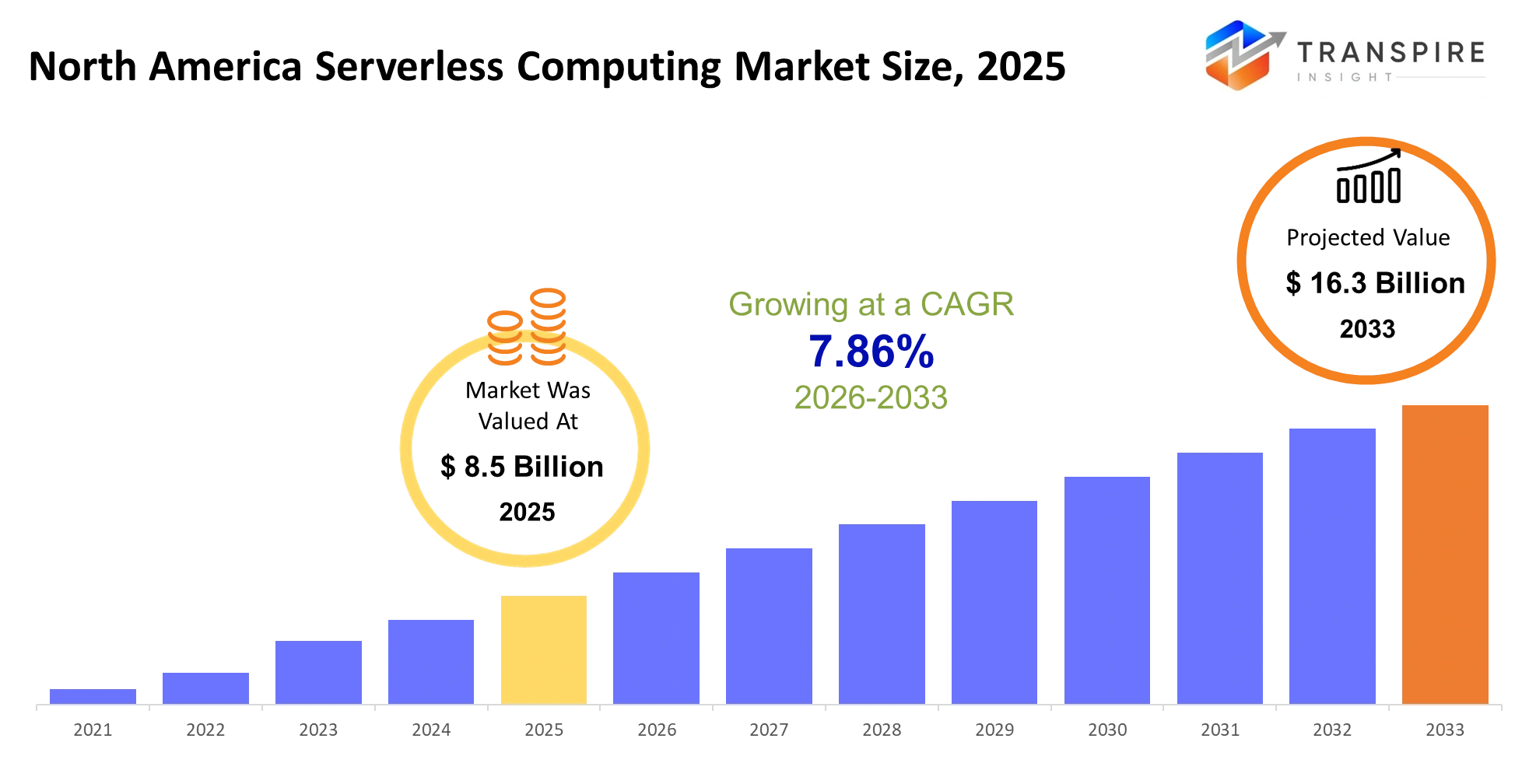
North America Serverless Computing Market Size & Forecast:
- North America Serverless Computing Market Size 2025: USD 8.5 Billion
- North America Serverless Computing Market Size 2033: USD 16.3 Billion
- North America Serverless Computing Market CAGR: 7.86%
- North America Serverless Computing Market Segments: By Service Type (FaaS, BaaS), By Deployment (Public, Private), By End-User (IT, BFSI, Retail).
To learn more about this report,  Download Free Sample Report
North America Serverless Computing Market Summary:
The North America Serverless Computing Market size is estimated at USD 8.5 Billion in 2025 and is anticipated to reach USD 16.3 Billion by 2033, growing at a CAGR of 7.86% from 2026 to 2033. The serverless computing market in North America which includes Canada and the United States and Mexico functions as a subset of the cloud computing market because businesses will choose to run their operations without needing to manage physical infrastructure. Customers demand quicker digital services together with continuous system growth which leads enterprises to adopt event-driven architecture. Developers will focus on creating minimal deployment cycles which will decrease their need for conventional DevOps components. Platform design decisions will be influenced by United States and Canada data residency regulations which receive increasing regulatory attention. The growing digital economy in Mexico will drive businesses to implement localized digital solutions. The development of container orchestration and edge computing technologies enables service providers to develop better pricing models and dependable performance assessments.
Key Market Trends & Insights:
The changing expectations of developers will create new methods for building and deploying applications throughout North America. Serverless frameworks will become the preferred solution for teams because these systems enable them to build prototypes quickly while handling system expansion without needing to manage physical resources. The requirement to release products more quickly with updated features will drive this transformation. Companies will start using tools that help them handle backend work while boosting operational efficiency because market competition has become more intense and serverless technology now fits better with current software development methods.
The growing use of artificial intelligence and machine learning tasks in serverless systems will create a new major trend. Organizations will start to process data through event-based systems which provide them with budget-friendly processing solutions. This system will enable real-time data analysis while creating custom user experiences. Companies need platforms that can manage sudden changes in data volume because their data needs continue to grow which drives service providers to enhance their speed execution and resource control and their ability to automate processes in various business sectors.
The security requirements together with the compliance standards will determine the future adoption rates throughout the entire area. The United States and Canada will see enterprises requiring improved data protection because of upcoming regulatory changes. The market will demand more serverless platforms which provide automatic governance tools together with security encryption methods and auditing capabilities. Businesses that operate in multiple countries need compliance solutions which can adapt to different regulatory standards, which requires vendors to create systems that enable compliance with both domestic and international regulations.
The industry will focus on cost management transparency because usage-based pricing models become more popular. Organizations want better financial oversight because they need to control expenses which arise from using serverless solutions. The demand for sophisticated monitoring systems will increase together with the need for cost prediction analysis tools. Companies will choose platforms which deliver performance results through financial forecast: their business activities need to maintain operational efficiency while they control expenses and secure future planning.
North America Serverless Computing Market Segmentation
By Service Type
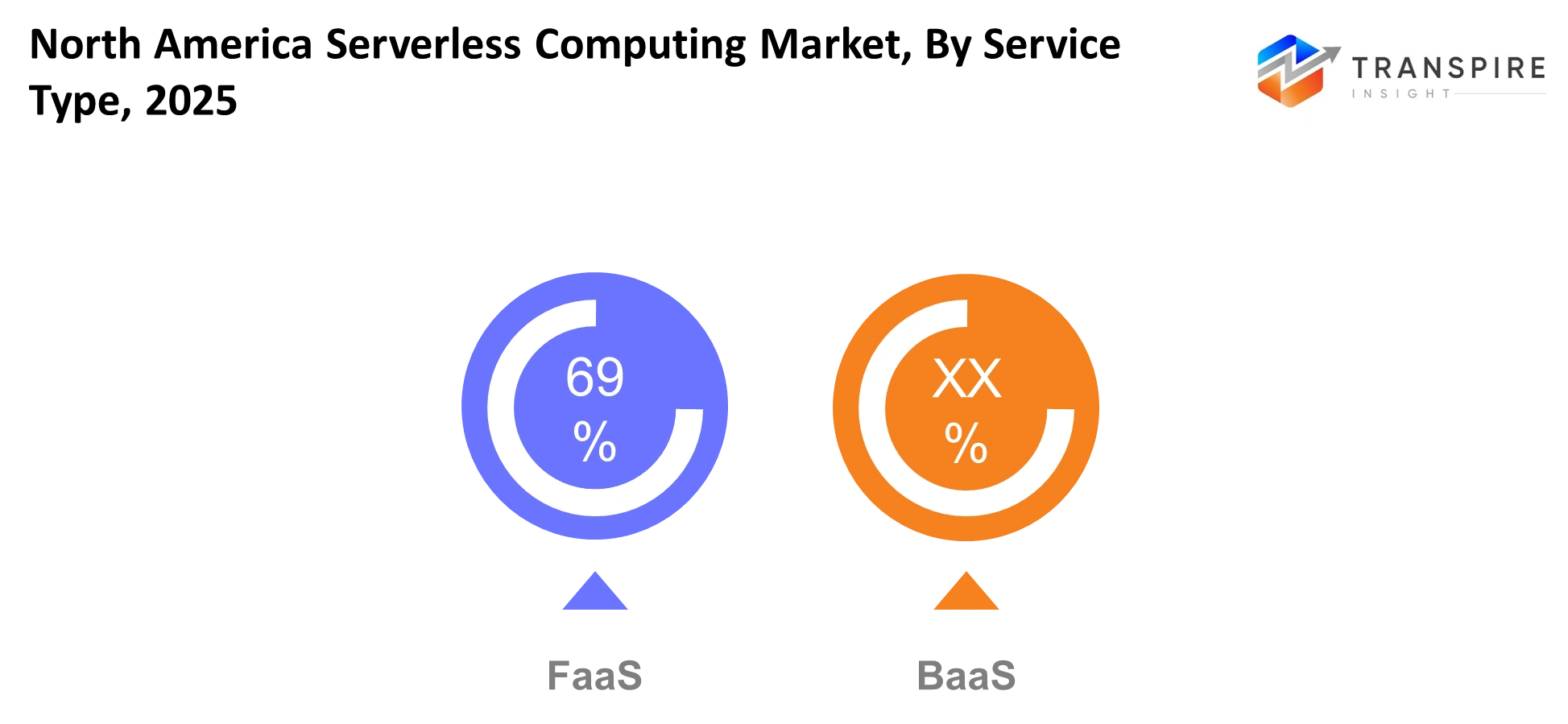
FaaS- Function-as-a-Service will experience increased demand because developers need to execute their code functions at higher speeds while avoiding the need to manage server infrastructure. The system will enable event-driven computing which allows applications to respond immediately when users perform actions or when data undergoes changes. Organizations will use this model to organize their backend processes while saving energy costs and achieving faster development times in situations that require quick system expansion and fast operational response.
BaaS- Backend-as-a-Service will supply developers with complete infrastructure components which include databases and authentication systems and storage facilities, enabling them to concentrate on creating better user interfaces. Businesses will use this model to achieve faster product development while decreasing their business maintenance expenses. BaaS provides consistent performance and easy third-party service integration, which makes it an ideal solution for both startups and large enterprises, as digital products increasingly focus on user needs.
To learn more about this report, Download Free Sample Report
By Deployment
Public- Public deployment will become the most used option because it allows easy access and provides users with various pricing choices. Public environments will become the preferred option for organizations because they need to manage different workloads without spending money on new infrastructure. The business model enables organizations to grow their operations while reaching international markets through their applications which attract broad user bases. Organizations in regulated industries will increase their usage of public deployment models for non-sensitive tasks as cloud providers build better security and compliance systems.
Private- Organizations which need to handle sensitive data will choose private deployment because it gives them total control over their data and system personalization options. Enterprises which need to manage sensitive data will use private environments to implement strict governance rules which help them achieve their regulatory requirements. The model enables users to monitor how systems operate and how security measures protect their data. Organizations will spend more money for business needs yet they will find value in their investment because it helps them achieve compliance while decreasing risks and enhancing their control over essential business processes.
By End-User
IT- The IT sector will lead adoption efforts because organizations need to improve their application development processes and better manage their infrastructure elements. Serverless solutions empower IT departments to decrease their operational workload so they can concentrate on developing new solutions. The system will benefit from continuous integration and deployment practices because they enable faster system updates and better operational performance. IT departments will use those solutions to achieve operational flexibility while sustaining their competitive edge during digital transformation progress.
BFSI- Serverless computing will become an essential technology for the banking financial services and insurance sector because it enhances their transaction processing and customer application systems. Institutions will focus on enhancing digital banking experiences while maintaining strict compliance standards. Real-time data processing and fraud detection systems will benefit from scalable execution models. BFSI organizations will implement these technologies in order to deliver financial services which meet changing customer expectations through fast secure and customizable solutions.
Retail- Retail businesses will increasingly adopt serverless solutions to support dynamic customer engagement and seasonal demand fluctuations. E-commerce platforms will depend on this model to manage their traffic increases which occur during promotional events and holiday seasons. Retailers will also use it to power recommendation engines and personalized shopping experiences. Companies will establish flexible systems because customers now expect businesses to deliver immediate updates and smooth payment processes and better product performance.
Regional Insights
The United States will maintain its position as the primary center for serverless technology because of its robust cloud infrastructure and its established developer ecosystem. Enterprises will continue to test new architectural designs to enhance their digital service delivery capabilities. The need for improved application speed will determine how companies design their technological infrastructure. Organizations will develop their deployment methods according to new data privacy regulations which require them to maintain innovation while meeting compliance requirements and managing operational responsibilities.
Canada will increase its international presence through its dedication to developing secure cloud systems that meet compliance standards. Businesses will prioritize data protection while maintaining their sovereignty which enables them to create national regulation-compliant data strategies. To maintain their digital service competitiveness, local companies will allocate funds for contemporary application development systems. The government will create technology innovation programs which will result in increased technology adoption. Companies that modernize their operations will search for solutions which offer them operational efficiency while they maintain compliance with changing regulatory requirements.
The digital transformation in retail and financial services will create a growing market which will support the development of Mexico.
Businesses will start using flexible computing models because these models will improve customer experiences and enhance their operational efficiency.
The demand for scalable applications will grow because more users will access the internet through mobile devices. Organizations will need cost-effective solutions which enable them to modernize their operations by deploying systems that meet their specific local requirements and infrastructure challenges.
Technology providers and enterprises in the region will work together to create new adoption patterns which will shape future technology use.
The company's solution evaluation process will focus on options which provide both scalability and cost management while allowing seamless system integration.
International business activities will drive companies to create flexible system designs that can adapt to different international regulatory frameworks.
Business competition will force companies to improve their strategies for delivering digital services which need to be faster and more reliable while they maintain excellent governance and performance standards.
Recent Development News
United States: AI Integration and Platform Innovation
Recent developments in the United States highlight how major cloud providers are aligning serverless capabilities with artificial intelligence workloads. Announcements at large-scale industry events have shown deeper integration of AI agents into cloud platforms, enabling automated application management and advanced development tools. This shift will reshape how developers build applications, with increasing reliance on intelligent automation and real-time decision-making embedded directly into serverless environments.
Canada: Security and Compliance-Focused Advancements
In Canada, recent progress will center on strengthening security frameworks within serverless environments, especially as enterprises adopt AI-driven workloads. Research and industry efforts are focusing on improving permission controls and reducing vulnerabilities tied to distributed function-based systems. These advancements will support organizations seeking stronger governance while maintaining flexibility, reflecting a regional emphasis on data protection, privacy regulations, and responsible deployment of cloud-native technologies.
Mexico: Expanding Adoption with Cost and Performance Optimization
Mexico’s recent developments will reflect a growing emphasis on cost efficiency and performance improvements in serverless execution. Industry benchmarks and cloud innovations are demonstrating faster processing speeds and lower operational costs, encouraging wider adoption among businesses. As companies explore scalable digital solutions, these improvements will help reduce entry barriers, allowing enterprises to adopt modern architectures while maintaining affordability and improving overall service responsiveness across emerging digital sectors.
|
Report Metrics |
Details |
|
Market size value in 2025 |
USD 8.5 Billion |
|
Market size value in 2026 |
USD 9.6 Billion |
|
Revenue forecast in 2033 |
USD 16.3 Billion |
|
Growth rate |
CAGR of 7.86% from 2026 to 2033 |
|
Base year |
2025 |
|
Historical data |
2021 – 2024 |
|
Forecast period |
2026 – 2033 |
|
Report coverage |
Revenue forecast, competitive landscape, growth factors, and trends |
|
Regional scope |
North America (Canada, The United States, and Mexico) |
|
Key company profiled |
AWS, Microsoft, Google, IBM, Oracle, Alibaba Cloud, Red Hat, VMware, Cloudflare, DigitalOcean, Netlify, Vercel, TIBCO, SAP, Infosys. |
|
Customization scope |
Free report customization (country, regional & segment scope). Avail customized purchase options to meet your exact research needs. |
|
Report Segmentation |
By Service Type (FaaS, BaaS), By Deployment (Public, Private), By End-User (IT, BFSI, Retail). |
Key North America Serverless Computing Market Company Insights
Key companies operating in the North America (Canada, the United States, and Mexico) serverless computing market will continue to compete through platform depth, pricing clarity, and developer experience. The leading cloud providers will attract enterprises by expanding their function execution speed and integrated monitoring tools and AI-enabled capabilities. Mid-sized players will focus on niche capabilities such as multi-cloud compatibility and simplified deployment layers. Companies will establish more strategic partnerships with enterprises to create customized solutions which apply to particular industries. The vendors will establish billing and performance metric transparency as their main focus because this approach allows businesses to control expenses while achieving dependable and expandable application delivery across fluctuating workload demands.
Company List
- AWS
- Microsoft
- IBM
- Oracle
- Alibaba Cloud
- Red Hat
- VMware
- Cloudflare
- DigitalOcean
- Netlify
- Vercel
- TIBCO
- SAP
- Infosys
North America Serverless Computing Market Report Segmentation
By Service Type
- FaaS
- BaaS
By Deployment
- Public
- Private
By End-User
- IT
- BFSI
- Retail
Frequently Asked Questions
Find quick answers to common questions.
The approximate North America Serverless Computing Market size for the market will be USD 16.3 Billion in 2033.
Key segments for the North America Serverless Computing Market By Service Type (FaaS, BaaS), By Deployment (Public, Private), By End-User (IT, BFSI, Retail).
Major players in the North America Serverless Computing Market are AWS, Microsoft, Google, IBM, Oracle, Alibaba Cloud, Red Hat, VMware, Cloudflare, DigitalOcean, Netlify, Vercel, TIBCO, SAP, Infosys.
The North America Serverless Computing Market size is USD 8.5 Billion in 2025.
The North America Serverless Computing Market CAGR is 7.86%.
- AWS
- Microsoft
- IBM
- Oracle
- Alibaba Cloud
- Red Hat
- VMware
- Cloudflare
- DigitalOcean
- Netlify
- Vercel
- TIBCO
- SAP
- Infosys
Recently Published Reports
-
Apr 2026
3D Optical Profiler Market
3D Optical Profiler Market Size, Share & Analysis Report By Type (Desktop 3D Optical Profiler, and Portable 3D Optical Profiler), By Technology (Confocal Technology, and White Light Interference), By End-Use Industry (Manufacturing, Research Institutions, Automotive, Aerospace and Defense, Medical Devices, and Other), and Geography (North America, Europe, Asia-Pacific, Middle East and Africa, South and Central America), 2021 - 2031
-
Apr 2026
Depth Sensor Market
Depth Sensor Market Size, Share & Analysis Report By Type (Infrared Depth Sensors, Time-of-Flight (ToF) Sensors, Stereo Vision Sensors, Structured Light Sensors, Ultrasonic Depth Sensors), By Application (Automotive, Robotics, Gaming, Consumer Electronics, Industrial Automation, Healthcare, Security & Surveillance, Others), By End Users (Automotive Manufacturers, Consumer Electronics Companies, Healthcare Providers, Industrial Companies, Security Agencies, Gaming Companies, Robotics Companies, Others), and Geography (North America, Europe, Asia-Pacific, Middle East and Africa, South and Central America), 2021 – 2031
-
Apr 2026
Digital Manufacturing Market
Digital Manufacturing Market Size, Share & Analysis Report By Component (Hardware, Software, and Services), By Technology (Robotics, 3D Printing, Internet of Things (IoT), and Others), By Application (Automotive and Transportation, Aerospace and Defense, Consumer Electronics, Industrial Machinery, and Others), By Process Type (Computer-Based Designing, Computer-Based Simulation, Computer 3D Visualization, Analytics, and Others), and Geography (North America, Europe, Asia-Pacific, Middle East and Africa, South and Central America), 2021 – 2031
-
Apr 2026
Digital Visa Services Market
Digital Visa Services Market Size, Share & Analysis Report By Type (Individual Travelers, Group Travelers), By Application (Tourism, Business Travel, Others), and Geography (North America, Europe, Asia-Pacific, Middle East and Africa, South and Central America), 2021 – 2031