
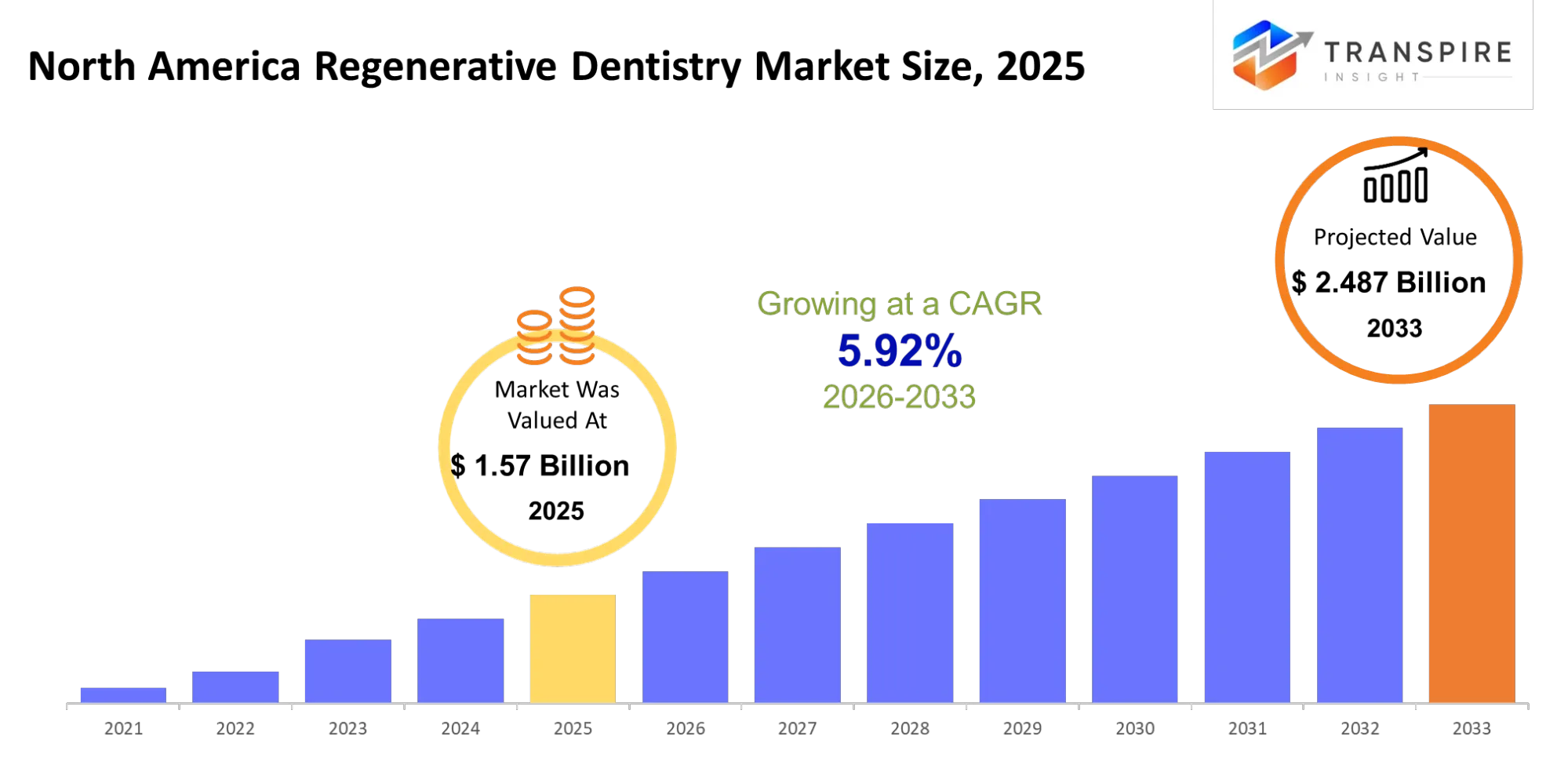
North America Regenerative Dentistry Market Size & Forecast:
- North America Regenerative Dentistry Market Size 2025: USD 1.57 Billion
- North America Regenerative Dentistry Market Size 2033: USD 2.487 Billion
- North America Regenerative Dentistry Market CAGR: 5.92%
- North America Regenerative Dentistry Market Segments: By Product Type (Dental Stem Cell Therapy, Bone Grafts, Tissue Scaffolds, Growth Factors, Biomaterials, Others), By Application (Periodontal Regeneration, Pulp Regeneration, Bone Regeneration, Implantology, Others), By End User (Dental Clinics, Hospitals, Academic Institutes, Others), By Technology (Stem Cell-based Therapy, Tissue Engineering, 3D Bioprinting, Others).
To learn more about this report,  Download Free Sample Report
North America Regenerative Dentistry Market Summary:
The North America Regenerative Dentistry Market size is estimated at USD 1.57 Billion in 2025 and is anticipated to reach USD 2.487 Billion by 2033, growing at a CAGR of 5.92% from 2026 to 2033.The North America regenerative dentistry market is mainly about trying to restore harmed dental tissues using therapies that are biologically driven, you know, so that bone can heal or come back, periodontal ligaments too, plus dental pulp, and other oral structures. In practice, these newer technologies kind of deal with the shortcomings of standard restorative work by helping tissue healing move along better, keeping natural teeth in place, and supporting long term oral function.
Over the last three to five years the whole market has shifted, sort of structurally, away from the classic graft based approaches toward cell based therapies and also growth factors, biomaterials, and broader tissue engineering platforms. This change is linked to improvements in regenerative medicine, and also more practical integration of biologics into everyday dental treatment workflows. A real world nudge that mattered was how elective dental care got disrupted during the COVID-19 pandemic. That situation really pushed investment into treatment solutions aimed at improving clinical outcomes and reducing the odds of repeat interventions. Now, as patients and providers are increasingly aiming for durable, minimally invasive pathways, regenerative procedures are moving out of only niche use and into wider clinical routines, which then creates fresh revenue streams for dental technology developers, biomaterial manufacturers, and specialized care providers.
Key Market Insights
- The United States is basically leading the North America Regenerative Dentistry Market, with roughly 82% of the regional market share in 2025, or so the numbers say.
- A mix of strong reimbursement rules, more advanced dental infrastructure and, honestly, a high willingness to use biologics keeps the U.S. at the front.
- Canada on the other hand is showing the fastest growth all the way to 2032, pushed by broader access to specialized dental care ,and clinics that are more ready to offer it.
- Meanwhile, cross-border research collaborations keep speeding up innovation across the whole North American regenerative dental scene.
- When it comes to what’s selling most, biomaterials and bone graft substitutes grab the largest portion, exceeding 40% of total revenue in 2025.
- After that, growth factors plus regenerative membranes sit in the second-largest position, mainly because periodontal applications keep expanding.
- Stem cell based regenerative therapies are the fastest growing segment over the 2025–2032 forecast window.
- At the same time, the need for more personalized tissue engineering solutions is still shifting the North America Regenerative Dentistry Market landscape, bit by bit, and its direction feels a little unclear.
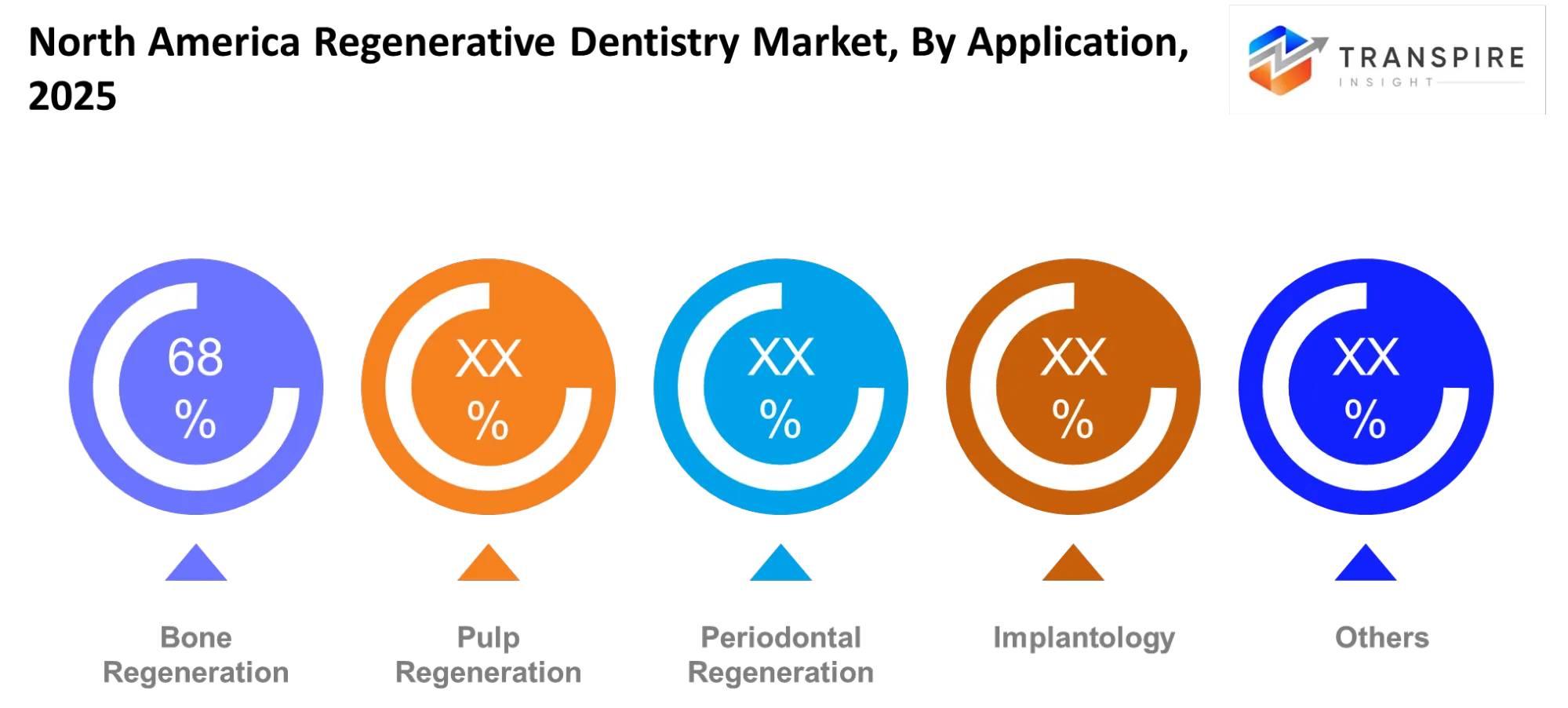
- For applications, periodontal regeneration takes the lead, and it is contributing close to 38% of total revenue in 2025.
- Alveolar bone regeneration stays important too, since implant procedure volumes keep climbing.
- Dental pulp regeneration is starting to pull ahead as the fastest-growing application , helped by improvements in regenerative endodontics.
- Clinically, the attention is shifting toward therapies that help preserve natural tooth structures, and also
- lower the need for repeat procedures.
- In terms of channels, dental clinics account for the largest market share, around 58% of industry revenue in 2025.
- And specialty dental centers continue to grow their presence too, offering more advanced regenerative treatment options.
What are the Key Drivers, Restraints, and Opportunities in the North America Regenerative Dentistry Market?
The strongest force pushing the North America regenerative dentistry market forward, feels like it comes from that overlap between advanced biomaterials, growth factor technologies and digital treatment planning… kind of all at once. Over the past decade clinical evidence has, honestly, been getting more consistent, showing that regenerative approaches can help preserve natural oral structures and also support better long term treatment outcomes compared with older conventional restorative procedures. Because of this change, dental specialists have increasingly started using premium regenerative therapies across implantology, periodontics and endodontics. And once clinicians feel more confident about predictable outcomes, procedure volumes rise alongside average treatment values, which in turn gives a more direct revenue lift to biomaterial manufacturers, biotechnology firms, and specialized dental practices too.
At the same time the most meaningful obstacle is still the high cost and the complicated regulatory pathway tied to regenerative products, especially when those products are cell based or tissue engineered. This is not something that’s easily fixed with small tweaks, it’s structural because there are lengthy clinical validation steps, very strict safety requirements, and specialized manufacturing infrastructure involved. Those constraints, tend to resist quick solutions even if someone increases investment in an incremental way. So commercialization timelines stay long, reimbursement coverage remains uneven, and many providers hesitate to add advanced regenerative solutions into routine care. In practice the market then loses revenue opportunities from delayed product launches, and from slower adoption when compared to general dentistry settings.
A big opportunity seems to sit in how stem cell science connects with personalized regenerative treatment platforms, sort of in one breath, but also you know, in a staged way. Different research institutions and biotechnology companies across the United States and Canada are expanding their spending on dental pulp stem cell applications and scaffold based tissue regeneration tech, it’s not just one group either. As manufacturing processes get more scalable and the clinical evidence starts to look more solid, these therapies may drift out of those highly specialized research spaces and into wider clinical use. When that happens, you basically create new treatment categories, and that can form a higher value segment which might be able to steer the next phase of the market expansion forward.
What Has the Impact of Artificial Intelligence Been on the North America Regenerative Dentistry Market?
Artificial intelligence and advanced digital technologies are more and more reshaping the North America regenerative dentistry market, improving in a practical way treatment planning, clinical precision , and research efficiency. In this environment dental practices and regenerative therapy providers are leaning on AI-powered imaging platforms to sort of automate the review of cone beam computed tomography (CBCT) scans. They help spot bone defects, judge tissue quality, and also assist in picking candidates for regenerative procedures. By doing this, the amount of manual assessment time goes down, and clinicians can standardize the treatment call across complicated cases that otherwise would be inconsistent.
At the same time machine learning models are quietly making predictive work stronger. Researchers are using AI algorithms to examine patient-specific factors, biomaterial performance records , and healing outcomes, so they can roughly anticipate whether tissue regeneration will go well , and then fine tune the treatment protocols accordingly. For implant related bone regeneration, predictive analytics can also flag patients who carry a higher complication likelihood even before surgery starts, which means the interventions are more pointed , and the costly redo procedures get reduced a bit.
Overall, this is translating into operational improvements that can be measured in practice. Digital workflows tend to shorten the overall planning cycles, raise procedural accuracy, and boost the use of regenerative biomaterials. AI-supported diagnostics can cut down on clinical evaluation time, while also enabling better case throughput and steadier outcomes. For manufacturers, advanced analytics support faster product development and more efficient clinical trial evaluation, which is useful when timelines are tight.
Key Market Trends
- Since around 2020 dental providers have been pushing more and more toward regenerative procedures that keep natural tooth structures, instead of leaning only on extraction and replacement, the usual route. Kind of a noticeable shift.
- From 2021 to 2025, the use of growth factors and newer bone graft materials kept growing too, mostly because the clinical evidence got stronger , so treatment outcomes started feeling more reliable in practice.
- At the same time, digital treatment planning platforms that work together with CBCT imaging became sort of standard in many specialty offices, and this cut down on procedural variability while also helping clinicians choose cases better.
- On the research side, funding has been moving toward stem cell based dental regeneration, and universities plus biotechnology companies ramped up translational development programs, faster than before , or at least it seemed that way.
- Manufacturers then backed away from basic, commodity graft materials and put more effort into proprietary regenerative platforms, partly to stand out, and also to shield their pricing position which is obviously a big deal.
- And since the pandemic, many clinicians leaned harder toward therapies that lower the odds of retreatment and that also support long term tissue preservation , not just short term fixes.
- After 2022, strategic collaborations between dental tech companies and regenerative medicine developers increased a lot, so commercialization timelines got squeezed in a good way, quicker launches.
- Regulatory attention toward biologics and cell based therapies also got tighter, which basically forced companies to do more clinical validation work before they could go ahead and push into larger market rollouts, or so it seemed.
- Some leading players, such as Straumann Group , Geistlich Pharma and Zimmer Biomet, expanded their regenerative portfolios via acquisitions, partnerships, and continued product innovation—pretty much in parallel with the stricter oversight.
- Finally, after 2023, artificial intelligence started to show up as a practical clinical tool, helping clinicians estimate bone quality and refine regenerative treatment planning in a more optimized way.
North America Regenerative Dentistry Market Segmentation
By Product Type
In the product type segment, bone grafts and biomaterials kind of keep the strongest market foothold, since dental professionals widely apply these items in implant procedures , periodontal reconstruction and alveolar bone preservation. There’s established clinical evidence, broad regulatory acceptance, and steady reimbursement, so adoption stays steady across both specialty and general dental practices. Growth factors are also getting more momentum as clinicians look for better healing results, while tissue scaffolds are moving into more advanced regenerative workflows.
Dental stem cell therapy still stays a smaller slice, mostly because the overall costs are higher, handling is more complex, and commercial availability is limited. The other regenerative products keep covering more niche needs , so they bring in a smaller revenue contribution overall. Going forward, development is expected to lean toward multifunctional biomaterials that blend structural reinforcement with biological activity. That direction should open up room for manufacturers to launch premium offerings, and it may nudge investors to back innovation platforms aimed at raising treatment predictability and day to day clinical efficiency.
By Application
Application-driven demand is still mostly led by periodontal regeneration, it kind of “holds the lead” because periodontal disease shows up so often and patients really need long-term tissue re building. Bone regeneration comes next, and it’s backed by ongoing growth in dental implant work, plus the reconstructive treatments that go with it. Implantology is now more and more tied to regenerative approaches, mainly since placing an implant successfully usually needs enough bone volume and real tissue stability ,not just a quick fix.
Pulp regeneration is showing up as one of the most promising uses, partly because newer biologics and stem cell research are giving options instead of relying only on conventional endodontic procedures. There are also other applications that support niche treatment pathways, but they make up a smaller portion of total activity. The next wave of market expansion will likely hinge on proving outcomes that last, across a wider set of indications. If that works, adoption could grow faster and people might also invest more in regenerative protocols and the supporting technologies around them.
To learn more about this report, Download Free Sample Report
By End-User
Among end users, dental clinics look like the largest slice, mostly because most regenerative procedures take place in outpatient settings where patient access, procedural efficiency, and specialized know how kinda blend together. Private practices plus group dental clinics keep extending the menu of regenerative services, mainly because the core technology keeps getting cheaper, easier to use, and better backed by clinical validation. Hospitals still matter a lot, especially in the most demanding reconstructive scenarios and when multidisciplinary plans are involved, more so if oral and maxillofacial interventions are in play.
Academic institutes also count , because they help push research forward, run clinical trials, and validate fresh tools, yet their direct revenue figures usually land below those of working providers. Beyond that, specialty centers and research organizations are also showing up as other end users they help fuel innovation and commercialization, in a more enabling fashion. Looking ahead, there should be closer, more steady collaboration between clinical providers and research institutions, and that is expected to move technology transfer along faster. If that happens, it could trim commercialization timelines a bit, create extra training chances, and expand access to advanced regenerative treatments for much wider patient groups.
By Technology
From a technology perspective, stem cell based therapy is drawing a lot of attention because it seems like it can regenerate damaged dental tissues instead of just swapping them out. Even with all that strong scientific interest, actually selling it is still kind of constrained by regulatory complexity, manufacturing costs, and long development timelines, which is honestly slower than many people hope for. In comparison, tissue engineering is holding a stronger market position right now, since it brings together scaffolds, biomaterials, and biological cues into treatment plans that already show clinical usefulness.
Three dimensional bioprinting is still earlier in the whole timeline, but it’s moving fast as teams look into customized tissue configurations and patient specific regenerative solutions, in more or less practical ways. Meanwhile, other technologies keep showing up to support specialized use cases and ongoing experimental development programs .Going forward, growth will probably lean toward integrated platforms that kinda bundle digital planning with advanced biomaterials plus regenerative biology. If this convergence really happens, it might boost treatment precision, reduce procedural variability, and create new chances for manufacturers , investors, and healthcare providers who want more differentiated clinical outcomes.
What are the Key Use Cases Driving the North America Regenerative Dentistry Market?
Periodontal regeneration still, like, is the main thing that keeps pushing market adoption. In day to day dental practice, clinics often lean on regenerative biomaterials membranes, and growth factors to help put back tissue that got damaged from periodontal disease. Because the procedure counts are high, and because clinicians really want to preserve natural teeth, this kind of use ends up being the biggest well spring of clinical demand as well as revenue.
On another front, bone regeneration plus implant related work is growing fast in specialty dental centers and also in hospital based oral surgery departments. Regenerative solutions assist in rebuilding bone volume before implant placement, and that can push treatment success rates upward. The growing use of advanced grafting materials has really reinforced uptake among providers who focus on complicated restorative, and reconstructive care.
More upcoming use cases show up too, like dental pulp regeneration, and stem cell oriented tissue restoration. Academic institutes and research centered treatment facilities are pushing forward these approaches as possible alternatives to the more traditional root canal style care, and to tissue replacement in general. Once clinical evidence keeps stacking up and regulatory pathways mature, these applications could form new treatment categories and widen the whole reach of biologically driven dental care.
|
Report Metrics |
Details |
|
Market size value in 2025 |
USD 1.57 Billion |
|
Market size value in 2026 |
USD 1.663 Billion |
|
Revenue forecast in 2033 |
USD 2.487 Billion |
|
Growth rate |
CAGR of 5.92% from 2026 to 2033 |
|
Base year |
2025 |
|
Historical data |
2021 - 2024 |
|
Forecast period |
2026 - 2033 |
|
Report coverage |
Revenue forecast, competitive landscape, growth factors, and trends |
|
Country scope |
North America (Canada, The United States, and Mexico) |
|
Key company profiled |
Dentsply Sirona, Straumann Group, Zimmer Biomet, Geistlich Pharma, BioHorizons, Nobel Biocare, Organogenesis, Integra LifeSciences, Envista Holdings, CollPlant Biotechnologies, Medtronic, Datum Dental, Septodont, RTI Surgical, OssDsign |
|
Customization scope |
Free report customization (country, regional & segment scope). Avail customized purchase options to meet your exact research needs. |
|
Report Segmentation |
By Product Type (Dental Stem Cell Therapy, Bone Grafts, Tissue Scaffolds, Growth Factors, Biomaterials, Others), By Application (Periodontal Regeneration, Pulp Regeneration, Bone Regeneration, Implantology, Others), By End User (Dental Clinics, Hospitals, Academic Institutes, Others), By Technology (Stem Cell-based Therapy, Tissue Engineering, 3D Bioprinting, Others) |
Which Regions are Driving the North America Regenerative Dentistry Market Growth?
The United States is still kind of the main place in the North America regenerative dentistry market, mostly because it has that advanced healthcare infrastructure, a solid clinical research ecosystem, and it adopts regenerative technologies pretty early on. There’s also a supportive regulatory framework for medical innovation, which has, in practice, encouraged more investment across biomaterials, tissue engineering platforms, and stem cell research programs. Then you have large networks of specialty dental clinics plus academic medical centers, and they basically give a clear route, from research to commercialization, without too many detours. With this mix of innovation capacity, provider know-how, and the patient spending power, the region keeps its top position.
Canada is the second-largest regional market, though the momentum there comes from slightly other drivers compared with what we see in the United States.The healthcare environment is mostly stable, research funding stays consistent, and there’s solid collaboration between universities and healthcare providers which, overall, helps the market expand in a pretty steady pace. Canadian institutions have also kept long-term interest in regenerative medicine, so there’s a dependable groundwork for technology uptake. In the end, this kind of steadiness makes Canada a meaningful player in regional revenue and clinical development activity
Mexico feels like it’s emerging as the fastest growing market a bit overall, because private healthcare investment and dental infrastructure modernization are moving, kinda quicky, and with a lot of emphasis lately. The expansion of specialty dental centers, plus more routine access to advanced regenerative procedures, is making patient access easier in major cities at least for a lot of folks there. Meanwhile, deeper participation in international research collaborations is increasing exposure to newer regenerative technologies and updated treatment protocols, so it really does seem like momentum is forming. By the 2026–2033 window, that momentum should turn into real opportunities for manufacturers, distributors and investors who are looking for consistent room to reach a steadily broadening patient base.
Who are the Key Players in the North America Regenerative Dentistry Market and How Do They Compete?
Competition in the North America regenerative dentistry market is still kinda moderately consolidated, but you can see this mix of big global dental manufacturers, biomaterials specialists, and regenerative medicine developers at the same time, kinda steering how things move. It seems like instead of price being the main deal, technology innovation is the real lever companies pull. Firms try to compete by making clinical outcomes better , helping patients recover faster, and expanding the range of procedures that could benefit from regenerative methods. The older, more established players keep defending their market presence by leaning on lots of clinical evidence , practitioner training programs , and overall integrated treatment ecosystems. Meanwhile the newer entrants look like they center their strategies around stem cell science , tissue engineering, and more advanced biologic platforms, aiming at clinical gaps that still aren’t fully met.
Straumann Group stands out with a wide portfolio that blends dental implants regenerative biomaterials, and digital treatment planning. In practice, this “one-source” style approach lets clinicians obtain several components from a single provider which can improve workflow pace and keep treatment consistency up. Geistlich Pharma, on the other hand, is strongly oriented toward regenerative biomaterials backed by long-term clinical validation. That support gives it a solid foothold especially in periodontal and bone regeneration procedures. Their growth push tends to highlight research collaborations, plus ongoing refinement of next-generation biologic materials, meant to enhance tissue integration and improve healing results, in a more reliable way.
Zimmer Biomet kind of competes with this whole expertise thing in bone regeneration and reconstructive solutions, pulling together what it learned across orthopedic and dental use cases, it also kind of benefits from a wide clinical network, plus it keeps putting money into advanced grafting technologies. Dentsply Sirona feels different because it blends regenerative treatment abilities with digital dentistry platforms, so diagnosis and treatment planning end up being more exact and steady. Then BioHorizons went with a more focused, niche specialization strategy around implant related regeneration, and it has strengthened that position through clinician education programs, and also through partnerships that widen access to regenerative protocols. Overall these moves create competitive advantages, not just by boosting procedural predictability but also by helping with practitioner loyalty, and by backing long term portfolio expansion, even if it all sounds pretty similar when you say it quickly.
Company List
- Dentsply Sirona
- Straumann Group
- Zimmer Biomet
- Geistlich Pharma
- BioHorizons
- Nobel Biocare
- Organogenesis
- Integra LifeSciences
- Envista Holdings
- CollPlant Biotechnologies
- Medtronic
- Datum Dental
- Septodont
- RTI Surgical
- OssDesign
Recent Development News
In March 2026, First-ever Dental Dedicated MRI Validated in Clinical Trial and Cleared by FDA for Advanced Soft-Tissue Diagnostics: Dentsply Sirona and Siemens Healthineers announced FDA clearance of the MAGNETOM Free.Max Dental Edition, the first dental-dedicated MRI system. The clearance followed clinical validation studies and represents a significant product launch for advanced dental diagnostics, supporting applications across multiple dental specialties including regenerative and soft-tissue assessment.
Source: https://investor.dentsplysirona.com
In January 2026, RevBio Advanced TETRANITE Regenerative Bone Adhesive Program: Massachusetts-based RevBio continued advancing its TETRANITE regenerative bone adhesive program following FDA authorization for a dental clinical trial. The company promoted the technology during multiple 2026 industry events, highlighting its application in ridge augmentation and bone regeneration procedures relevant to regenerative dentistry.
Source: https://www.odtmag.com
What Strategic Insights Define the Future of the North America Regenerative Dentistry Market?
The North America regenerative dentistry market is kind of moving, like structurally, toward treatment models that are more biologically integrated, and they really put emphasis on keeping tissue and restoring function, not just mechanical repair alone. What’s driving this change is basically the coming together of regenerative medicine, advanced biomaterials, and digital clinical workflows, which keeps making outcomes more predictable and it also widens the set of conditions that regenerative approaches can tackle. In the next five to seven years, value creation is probably going to gather around platforms that blend biologics, data informed treatment planning, and tailored therapies, sort of as a bundle not separate pieces.
There is also a less noticeable risk , and it has to do with the market becoming concentrated around only a few specialized biomaterial providers and technology developers. If there’s any hiccup with regulatory approvals, manufacturing capacity, or even the availability of key raw materials, you can get delays that become real bottlenecks, slowing commercialization and limiting product availability even when clinical demand stays strong.
There’s a kind of emerging window, in a way, for commercializing dental pulp regeneration and also patient specific tissue building approaches which are supported by stem cell research. Participants, if they’re serious, should look at strategic alliances with universities and regenerative medicine innovators, not just to talk but to secure early access to intellectual property, the clinical evidence, and basically the next generation treatment platforms, before broader adoption starts moving faster. In other words, it’s like positioning early, so the whole thing doesn’t get outpaced later.
North America Regenerative Dentistry Market Report Segmentation
By Product Type
- Dental Stem Cell Therapy
- Bone Grafts
- Tissue Scaffolds
- Growth Factors
- Biomaterials
- Others
By Application
- Periodontal Regeneration
- Pulp Regeneration
- Bone Regeneration
- Implantology
- Others
By End User
- Dental Clinics
- Hospitals
- Academic Institutes
- Others
By Technology
- Stem Cell-based Therapy
- Tissue Engineering
- 3D Bioprinting
- Others
Frequently Asked Questions
Find quick answers to common questions.
The approximate North America Regenerative Dentistry Market size for the market will be USD 2.487 Billion in 2033.
The key segments of the North America Regenerative Dentistry Market are By Product Type (Dental Stem Cell Therapy, Bone Grafts, Tissue Scaffolds, Growth Factors, Biomaterials, Others), By Application (Periodontal Regeneration, Pulp Regeneration, Bone Regeneration, Implantology, Others), By End User (Dental Clinics, Hospitals, Academic Institutes, Others), By Technology (Stem Cell-based Therapy, Tissue Engineering, 3D Bioprinting, Others).
Major players in the North America Regenerative Dentistry Market are Dentsply Sirona, Straumann Group, Zimmer Biomet, Geistlich Pharma, BioHorizons, Nobel Biocare, Organogenesis, Integra LifeSciences, Envista Holdings, CollPlant Biotechnologies, Medtronic, Datum Dental, Septodont, RTI Surgical, OssDsign.
The current market size of the North America Regenerative Dentistry Market is USD 1.57 Billion in 2025.
The North America Regenerative Dentistry Market CAGR is 5.92%.
- Dentsply Sirona
- Straumann Group
- Zimmer Biomet
- Geistlich Pharma
- BioHorizons
- Nobel Biocare
- Organogenesis
- Integra LifeSciences
- Envista Holdings
- CollPlant Biotechnologies
- Medtronic
- Datum Dental
- Septodont
- RTI Surgical
- OssDesign
About the Authors

Pankaj Ghogare Patil
I am Pankaj Ghogare Patil, a Senior Research Analyst at Transpire Insight, specializing in the Pharmaceutical, Chemicals & Materials, Healthcare IT, and Biotechnology industry. My expertise lies in conducting comprehensive market research, analyzing industry trends, evaluating competitive landscapes, and translating complex data into actionable insights. At Transpire Insight, I closely follow emerging technologies, regulatory developments, and market innovations to create accurate, well-researched, and informative content that helps businesses and professionals make informed decisions. I am committed to producing credible, evidence-based articles that reflect industry best practices while making technical topics accessible and valuable for a broad audience.

Chakradhar Khansole
Chakradhar serves as the Research Director at Transpire Insight, bringing over 8 years of experience in technology, innovation, and strategic market intelligence. He specializes in transforming complex market data into actionable business insights that enable organizations to make informed, growth-oriented decisions. Recognized for his strategic vision and analytical expertise, Chakradhar leads high-impact research initiatives, delivering comprehensive market assessments, competitive intelligence, and forward-looking industry analysis.
Recently Published Reports
-
Apr 2026
AI in Diabetic Retinopathy Market
AI in Diabetic Retinopathy Market Size, Share & Analysis Report By Type (Screening AI Systems, Diagnostic AI Systems, and Predictive AI Models), By Application Segment (Hospitals, Ophthalmology Clinics, Diagnostic Centers, and Research and Development), and Geography (North America, Europe, Asia-Pacific, Middle East and Africa, South and Central America), 2021 - 2031
-
Apr 2026
Psychometric Tests Market
Psychometric Tests Market Size, Share & Analysis Report By Type (Personality Tests, Ability/Aptitude Tests, Skill/Knowledge Tests, and Others), By Application (Talent Acquisition and Talent Management), and Geography (North America, Europe, Asia-Pacific, Middle East and Africa, South and Central America), 2021 – 2031
-
Apr 2026
Rare Biological Sample Collection Market
Rare Biological Sample Collection Market Size, Share & Analysis Report By Type (Isolation Kits & Reagent, Blood Collection Tubes, and Others), By Application (Oncology, Transcriptomics, Pharmacogenomics, and Others), and Geography (North America, Europe, Asia-Pacific, Middle East and Africa, South and Central America), 2021 – 2031
-
Jul 2026
Diabetic Retinopathy Market
Diabetic Retinopathy Market Size, Share & Analysis Report By Type (Proliferative Diabetic Retinopathy, and Diabetic Macular Edema (DME)), By Treatment Type (Anti VEGF Drug, Steroid Implants, Laser Surgeries, and Vitrectomy), and Geography (North America, Europe, Asia-Pacific, Middle East and Africa, South and Central America), 2021 – 2031
Our Clients







