

North America Pancreatic and Bile Duct Stone Management Market Size & Forecast:
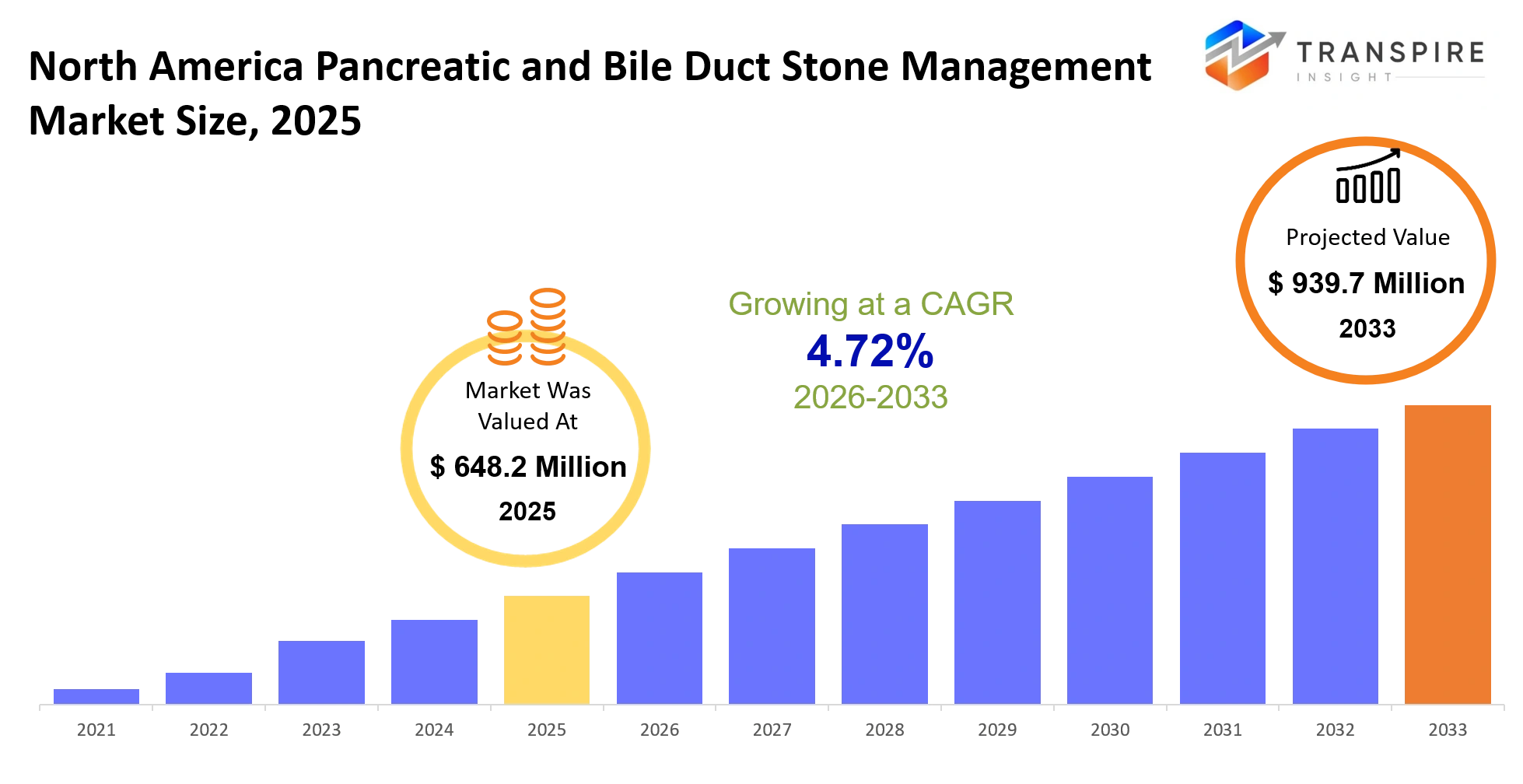
- North America Pancreatic and Bile Duct Stone Management Market Size 2025: USD 648.2 Million
- North America Pancreatic and Bile Duct Stone Management Market Size 2033: USD 939.7 Million
- North America Pancreatic and Bile Duct Stone Management Market CAGR: 4.72%
- North America Pancreatic and Bile Duct Stone Management Market Segments: By Product Type (Stone Retrieval Devices, Lithotripsy Devices, Stents, Endoscopic Devices, Others); By Application (Pancreatic Duct Stones, Bile Duct Stones, Gallstone Management, Others); By End User (Hospitals, Gastroenterology Clinics, Ambulatory Surgical Centers, Others); By Procedure Type (ERCP Procedures, Minimally Invasive Procedures, Surgical Procedures, Others).
To learn more about this report,  Download Free Sample Report
North America Pancreatic and Bile Duct Stone Management Market Summary
The North America Pancreatic and Bile Duct Stone Management Market was valued at USD 648.2 Million in 2025. It is forecast to reach USD 939.7 Million by 2033. That is a CAGR of 4.72% over the period.
The North America Pancreatic and Bile Duct Stone Management Market supports minimally invasive care for obstructive stones that block pancreatic or bile ducts, and yes they usually trigger severe abdominal pain, infection risk, and nasty digestive complications. In practice, hospitals and specialty gastroenterology centers tend to use stone retrieval baskets, lithotripsy systems, guidewires and endoscopic retrograde cholangiopancreatography procedures to clear the obstruction while avoiding open surgery. Patients seem to recover faster, plus there are fewer post procedure complications, so endoscopic intervention stays the preferred clinical approach across the region, pretty consistently.
In the last five years, the market kind of moved toward advanced single-use endoscopic accessories, and also image-guided stone fragmentation technologies, which help with procedural precision and better infection control. During the COVID-19 pandemic, deferred gastrointestinal procedures built up a backlog of untreated biliary disorders, and once elective care resumed across North America, procedure volumes jumped. Meanwhile obesity rates keep rising, populations are aging, and there’s a higher incidence of gallstone related complications, so long-term demand for treatment continues to grow. At the same time outpatient endoscopy expansion is opening fresh revenue pathways for device manufacturers and ambulatory surgical centers, which sort of reshapes how companies plan growth.
Key Market Insights
- In 2025 the United States kinda dominated the North America Pancreatic and Bile Duct Stone Management Market, taking more than 78% of the market share, mainly because they have advanced endoscopy infrastructure already in place.
- Canada turned out to be the fastest growing regional market from 2026 to 2033, backed by an expansion of gastroenterology care networks, plus procedural reimbursement coverage that keeps getting broader.
- Endoscopic stone extraction devices grabbed close to 42% of the industry share in 2025, since many hospitals are leaning more toward minimally invasive bile duct clearance interventions these days.
- Lithotripsy systems stayed in the second-largest product segment, and that position is being fueled by the growing adoption of laser-assisted fragmentation technologies in tertiary healthcare centers.
- Single-use cholangioscopes are projected as the fastest-growing product category up to 2033, because infection prevention protocols basically reshape the way North American hospitals buy equipment and plan purchases.
- For applications, ERCP-guided bile duct stone management led the demand, with over 55% market share in 2025, and that is tied to high procedural success rates.
- Meanwhile, pancreatic duct stone fragmentation procedures showed the quickest application growth after 2023, as chronic pancreatitis diagnoses continued to rise among older patient groups.
- On the end-user side, hospitals stayed on top, holding nearly 61% market share, because complicated stone management procedures need advanced imaging and also surgical backup systems.
- Ambulatory surgical centers meanwhile showed the most quick growth course somewhere between 2026 and 2033, as payers keep pushing lower-cost outpatient gastrointestinal procedures.
- Overall, the North America Pancreatic and Bile Duct Stone Management Market experienced a meaningful demand upturn after COVID-19 procedure backlogs, increased, which in turn raised delayed biliary treatment volumes during 2021 and 2022 .
What are the Key Drivers, Restraints, and Opportunities in the North America Pancreatic and Bile Duct Stone Management Market?
The main thing pushing forward the North America Pancreatic and Bile Duct Stone Management Market is this fast shift towards less invasive gastro intestinal procedures in hospitals, and also outpatient endoscopy centers. A lot more teams are adopting advanced ERCP systems, digital cholangioscopy platforms, and laser lithotripsy tools. Together, these improvements help boost stone extraction accuracy, while at the same time shrinking hospital stays, plus lowering the chance of post procedure issues. On top of that, reimbursement support for these outpatient gastrointestinal interventions made it easier for healthcare providers to move away from open surgery models. And as a result, procedural volumes keep rising in ambulatory surgical centers, while manufacturers gain more steady money flows from disposable retrieval baskets, guidewires, and visualization systems.
The biggest brake still feels like the lack of very well trained gastroenterologists and ERCP specialists, people who can actually handle the complicated pancreatic and bile duct work. These advanced endoscopic stone management methods take years of clinical training, and also specialized imaging know how. So smaller facilities simply can’t keep up, or they can’t schedule enough cases. Rural hospitals and mid sized medical centers are still stuck with long patient wait periods, plus they rely heavily on referrals to tertiary care institutions. That workforce gap slows down adoption of newer technologies and it can quietly hold back the procedural revenue even when patient demand looks strong.
A major future chance is starting to show up, via AI assisted endoscopy and robotic guided stone management platforms. These systems are currently moving into clinical evaluation across North America.Companies working on real-time imaging analytics, plus automated stone detection software, are getting more hospital funding because these tools can up procedural accuracy and, honestly, tamp down physician fatigue. At the same time, the continued expansion of outpatient gastroenterology networks across Canada and the southern United States is creating good momentum for portable, and even single-use, endoscopic device platforms during roughly 2026 to 2033.
What Has the Impact of Artificial Intelligence Been on the North America Pancreatic and Bile Duct Stone Management Market?
Artificial intelligence and more advanced digital technologies are kind of reshaping pancreatic and bile duct stone management, with faster diagnosis, procedure guidance,and workflow automation showing up across a lot of North American gastroenterology centers. AI-enabled endoscopy platforms now help physicians during ERCP by spotting duct abnormalities, stone locations, and even tissue irregularities in real time, using boosted image recognition algorithms. Hospitals are increasingly pairing digital cholangioscopy systems with automated documentation software, which basically cuts down on the manual reporting time and makes procedural practice more uniform. In the end, these tools help care teams shorten the procedure duration, raise stone clearance accuracy, and also reduce repeat interventions in complicated biliary cases.
Meanwhile, machine learning models are improving predictive decision-making across gastrointestinal care networks, too. Clinical analytics platforms review patient history, imaging data, and procedural outcomes to anticipate complications like recurrent bile duct obstruction or post-ERCP pancreatitis. A few tertiary hospitals in the United States are even testing AI-supported navigation tools that help optimize endoscope positioning and also back minimally invasive stone fragmentation approaches. Early adoption studies suggest better procedural efficiency in the right direction, fewer readmissions, and reduced operating room utilization costs—although results vary by site.
That said, current AI adoption still runs into structural limitations, especially around integration complexity and fragmented clinical data environments. A number of hospitals are still working with older imaging infrastructure, so they cannot fully support real-time AI-assisted visualization platforms without major capital investment.Limited availability of standardized training datasets for pancreatic and biliary disorders also affects algorithm accuracy across diverse patient populations, and procedural settings, it’s kind of a quiet bottleneck though.
Key Market Trends
- From 2021 to 2025, outpatient ERCP stuff went up quite a bit, almost like hospitals really re-aimed complex biliary stone care toward cheaper, lower-overhead ambulatory surgical centers. It was not just a tiny shift, it was noticeable.
- Boston Scientific and Olympus, after 2022, kept pushing digital cholangioscopy take-rate by tuning real-time visualization accuracy, especially when physicians were dealing with difficult pancreatic duct stone removal, and it did seem to help during the hard parts.
- After the whole COVID-19 situation, some single-use endoscopic add-ons got more traction in hospitals, there was more preference for disposable retrieval baskets, and also guidewire systems, mostly because infection-control concerns became a faster priority than before.
- In 2024, AI-assisted endoscopy platforms started showing up in more tertiary care centers, and it felt like suddenly everyone had the same pitch in hand. The gist was to help physicians reduce procedural missteps, and make bile duct stone detection more steady and uniform, so day to day the workflow felt a bit smoother even when the cases got messy.
- Around the same time obesity and diabetes rates kept climbing across North America, and that kind of change really feeds into more chronic gallstone-related problems. So gastroenterology departments had to grow their therapeutic endoscopy capacity after 2020, not later, not slowly, but more like, sooner than expected.
- From 2021 through 2025, hospitals also leaned harder on laser lithotripsy systems, replacing open surgical interventions more often than before. The reasoning was pretty straightforward: faster recovery and a lower likelihood of specific complications, at least compared with the older approach that people were more used to.
- Medtronic and Cook Medical then turned up the competitive pressure. They rolled out precision-guided stone fragmentation devices aimed at awkward anatomical access during ERCP, meaning the devices were built to work when the “usual angles” were not really there.
- In Canada, healthcare providers accelerated investment in advanced gastrointestinal imaging systems after 2023, when provincial funding programs expanded minimally invasive treatment access, which made upgrades feel easier to justify.
- Finally, supply chain disruptions during 2021 made hospitals diversify procurement moves. They also tended to keep bigger inventories of key biliary intervention devices, plus disposable parts, just to avoid getting stalled when deliveries got weird.
- Gastroenterology training programs across the United States seemed to have expanded their ERCP specialization capacity after a period of physician shortages, that pushed back those more advanced pancreatic and bile duct procedures in regional hospitals, for a while.
North America Pancreatic and Bile Duct Stone Management Market Segmentation
By Product Type
Stone retrieval devices hold the strongest market position, mostly because many bile duct and pancreatic stone procedures depend on baskets, balloons, and guidewire-assisted extraction systems, during ERCP actions. In practice hospitals and gastroenterology centers lean toward these tools, since teams already know the procedure flow, the operational side feels simpler, and the devices match well with standard endoscopic platforms. At the same time lithotripsy devices keep picking up commercial momentum because the larger, tougher duct stones often need fragmentation first before they can be removed. Stents plus more advanced endoscopic devices also keep steady demand, since more physicians lean on temporary drainage solutions to handle post-procedure complications and obstructive scenarios.
What comes next in competition will revolve around disposable device adoption, retrieval technologies with precision guidance, and closer integration with digital imaging systems. Product teams are putting serious money into smaller-profile extraction tools, able to move through tight or awkward anatomy with reduced tissue trauma risk. Lithotripsy systems should see quicker expansion as laser-based fragmentation becomes more routine in outpatient treatment. Buyers will increasingly care about infection-control optimized devices and single-use accessory platforms, that can cut sterilization expenses and reduce day-to-day procedural delays.
By Application
Bile duct stone management right now counts as the largest application share, mainly because gallstone migration into bile ducts stays one of the more common gastrointestinal complications that basically needs therapeutic action. Strong procedural volumes in hospitals and even in ambulatory centers keeps supporting steady demand for ERCP guided extraction and fragmentation technologies. Gallstone management applications also keep bringing in meaningful revenue, partly because aging populations, plus obesity related metabolic disorders, keeps raising patient incidence rates across North America. Pancreatic duct stone treatment is still a bit more specialized, due to higher procedural complexity and a lower diagnosis frequency overall.
Looking ahead, future application growth should increasingly lean toward chronic pancreatitis related stone management as long term pancreatic problems become more prevalent in older patient groups. Healthcare providers are also moving toward earlier diagnostic imaging routines that spot obstructive stones before severe complications can appear. Advanced visualization systems, along with AI assisted endoscopy technologies, are expected to boost treatment precision during the forecast period. Investors and manufacturers will most likely concentrate on more specialized instruments made for narrow duct access, and for those difficult stone fragmentation settings.
By End-User
Hospitals really drive end-user demand, since complex pancreatic and bile duct work often needs advanced imaging help, surgical backup, and multidisciplinary GI care teams, sort of the whole package. Big tertiary centers keep doing the most ERCP and lithotripsy because they have trained gastroenterologists and dedicated endoscopy units that are already set up. Gastroenterology clinics also show up more often these days, mainly as minimally invasive technologies become easier to access beyond major hospital systems. At the same time, ambulatory surgical centers are ramping up too, partly because payers keep pushing for cheaper outpatient delivery so everything moves faster and costs less.
Going forward, end-user growth will likely hinge on decentralizing gastrointestinal treatment services across suburban and regional networks, not just in big city hospitals. Ambulatory surgical centers are expected to take a bigger slice of procedures as recovery periods get shorter, and as device portability keeps improving. Meanwhile gastroenterology clinics will keep spending on advanced digital imaging, so they can run same-day diagnostic and treatment workflows without too much delay. Device manufacturers too, will increasingly build compact and disposable product sets for outpatient-focused settings, especially places that have limited sterilization infrastructure.
By Procedure Type
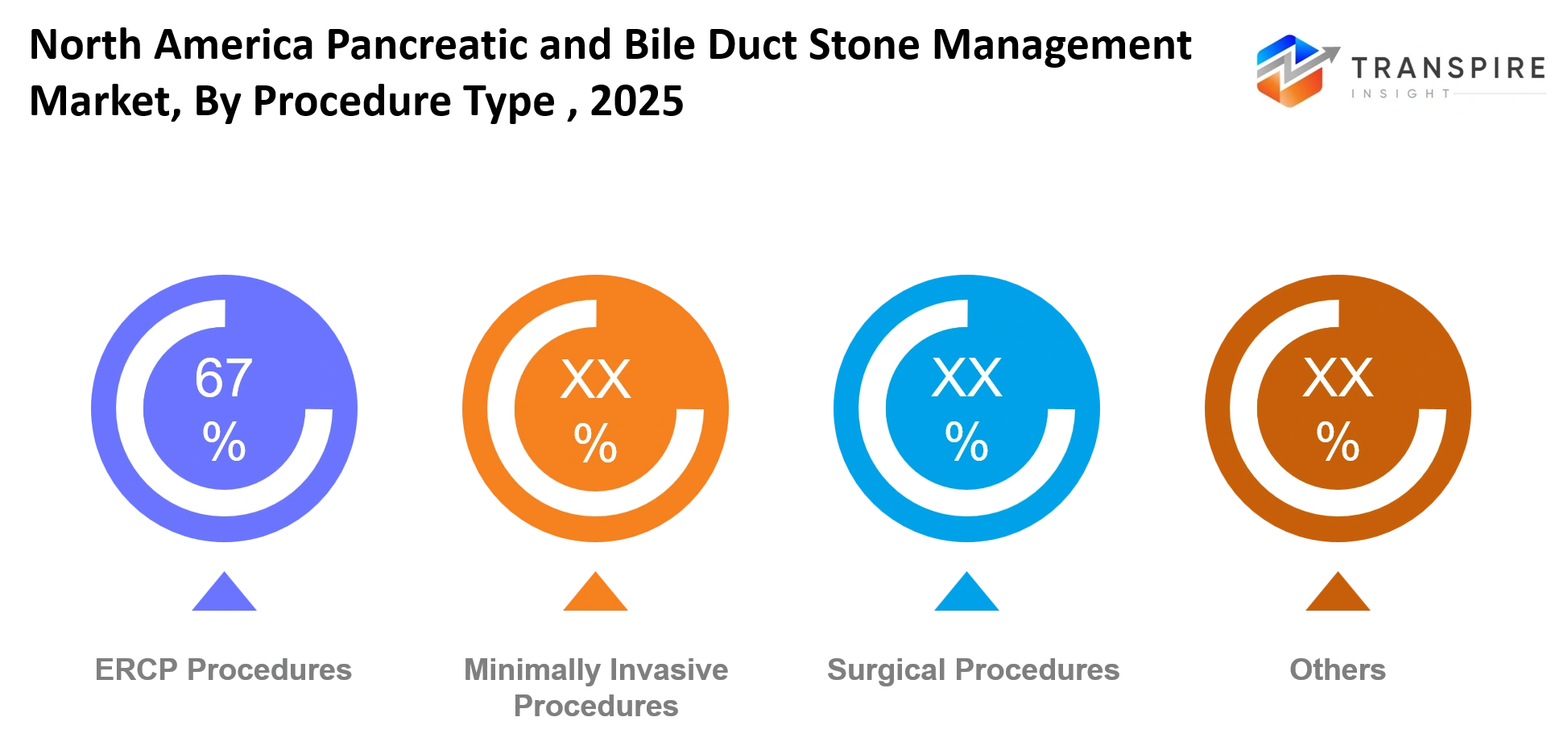
The ERCP procedures kind of stay in the dominant position here, mainly because a lot of pancreatic and bile duct stone work relies on endoscopic visualization, stone removal, and duct drainage all within one procedural setting. There’s a strong clinical liking for minimally invasive gastrointestinal treatment so hospitals and specialty centers keep seeing high procedural volumes. Overall minimally invasive procedures got a lot of momentum too, mostly due to quicker patient recovery, fewer hospital admissions, and fewer complication events compared with traditional surgery. Surgical procedures now take up a smaller segment, because physicians increasingly reserve open interventions for very complex situations, or for cases where the endoscopic attempts failed.
Over the forecast period, advanced minimally invasive technologies are expected to keep trimming down the need for traditional surgical management. AI-assisted navigation systems, digital cholangioscopy platforms, and robotic-guided endoscopy tools should enhance procedural accuracy and help shorten operating times. Healthcare systems will likely keep investing in outpatient ERCP infrastructure, especially as reimbursement models continue to favor lower-cost care pathways. Product developers will probably focus on integrated visualization along with stone fragmentation technologies that can support faster, and more reliable interventions across busy high-volume clinical environments.
To learn more about this report, Download Free Sample Report
What are the Key Use Cases Driving the North America Pancreatic and Bile Duct Stone Management Market?
Bile duct stone removal via ERCP procedures still seems like the main “pull” behind device adoption in most North American hospitals, including those tertiary gastroenterology centers. A lot of physicians lean toward minimally invasive extraction technologies, mainly because these workarounds tend to shrink inpatient stays, ease the risk of complications, and help people bounce back faster versus open surgery.
On top of that, the expanding use cases cover outpatient gallstone management and also post-surgical biliary drainage procedures, typically across ambulatory surgical centers and specialty GI clinics. Meanwhile, the rising use of laser lithotripsy systems for stubborn stone fragmentation, has bumped adoption further in high volume endoscopy units, especially where they treat chronic pancreatitis complications.
For what’s next, emerging scenarios include AI assisted cholangioscopy and robotic guided pancreatic duct interventions, aimed at tricky anatomy access and more precise stone fragmentation. There’s also early stage uptake of disposable digital endoscopy platforms across regional healthcare networks, which looks pretty promising for long term commercialization, as infection-control standards keep tightening.
|
Report Metrics |
Details |
|
Market size value in 2025 |
USD 648.2 Million |
|
Market size value in 2026 |
USD 680.5 Million |
|
Revenue forecast in 2033 |
USD 939.7 Million |
|
Growth rate |
CAGR of 4.72% from 2026 to 2033 |
|
Base year |
2025 |
|
Historical data |
2021 - 2024 |
|
Forecast period |
2026 - 2033 |
|
Report coverage |
Revenue forecast, competitive landscape, growth factors, and trends |
|
Regional scope |
North America (Canada, The United States, and Mexico) |
|
Key company profiled |
Boston Scientific, Olympus Corporation, Cook Medical, Medtronic, CONMED, Karl Storz, Fujifilm Holdings, Stryker, B. Braun, Johnson & Johnson, Teleflex, Merit Medical Systems, Pentax Medical, Steris, Abbott. |
|
Customization scope |
Free report customization (country, regional & segment scope). Avail customized purchase options to meet your exact research needs. |
|
Report Segmentation |
By Product Type (Stone Retrieval Devices, Lithotripsy Devices, Stents, Endoscopic Devices, Others); By Application (Pancreatic Duct Stones, Bile Duct Stones, Gallstone Management, Others); By End User (Hospitals, Gastroenterology Clinics, Ambulatory Surgical Centers, Others); By Procedure Type (ERCP Procedures, Minimally Invasive Procedures, Surgical Procedures, Others). |
Which Regions are Driving the North America Pancreatic and Bile Duct Stone Management Market Growth?
The United States leads the North America Pancreatic and Bile Duct Stone Management Market, sort of plainly because it has stronger gastrointestinal care infrastructure, better reimbursement coverage, and consistently high procedural volumes in large hospital networks. FDA backing of minimally invasive endoscopy technologies helped speed up adoption of AI assisted imaging systems, digital cholangioscopy platforms, and laser lithotripsy devices. Big academic medical centers, plus focused gastroenterology institutes keep pushing clinical training, device innovation, and large scale therapeutic ERCP programs. And yeah, the strong presence of companies like Boston Scientific, Medtronic, and Olympus adds extra momentum, mainly via localized distribution, and physician support networks.
Canada is second largest by regional contribution, it also feels different from the United States, mainly due to steadier public healthcare funding, and slower more gradual technology adoption patterns. Provincial health systems continue putting money into gastrointestinal diagnostic, and therapeutic infrastructure in a steady manner, without the fast buying swings that can happen in larger private hospital markets. Longer physician training paths, and more centralized procurement models create dependable demand for endoscopic stone management systems across key urban healthcare facilities. There is also a strong clinical focus on outpatient care efficiency, which supports steady investment in minimally invasive treatment technologies.
Mexico is showing up as the fastest-growing regional market because private healthcare investment is expanding, and gastrointestinal treatment infrastructure is being modernized across urban medical centers.Recent expansion of specialty endoscopy clinics and cross-border medical tourism increased demand for advanced bile duct and pancreatic stone procedures after 2022. Government-supported healthcare upgrades and rising availability of minimally invasive technologies also improved access to therapeutic ERCP interventions in major metropolitan regions. Growth across Mexico creates attractive opportunities for device manufacturers, outpatient care providers, and investors seeking expansion potential between 2026 and 2033.
Who are the Key Players in the North America Pancreatic and Bile Duct Stone Management Market and How Do They Compete?
Competition in the North America Pancreatic and Bile Duct Stone Management Market stays moderately consolidated, sort of, with big global medical technology companies taking a sizable slice of advanced ERCP and lithotripsy device revenues. The main fight is not just about price really, it leans toward imaging sharpness, how efficiently minimally invasive treatments get done, infection-control strength, and whether physicians get enough training support. Bigger manufacturers still defend their turf through endoscopy ecosystems that feel connected, plus long-term hospital ties. Meanwhile smaller specialty players tend to lean into disposable accessories and more specific stone fragmentation approaches that are a little more focused.
As outpatient procedure volumes keep climbing, competition then gets louder around portable setups and single-use device platforms tailored for ambulatory surgical centers. Boston Scientific stands out with the SpyGlass DS Direct Visualization System, it helps improve bile duct imaging accuracy when procedures get tricky and stone management gets difficult. They also expanded physician training partnerships, and outpatient gastroenterology collaborations, which supported stronger adoption across regional healthcare networks. Olympus competes using high-definition endoscopy systems and integrated imaging software that makes navigation smoother during therapeutic ERCP interventions. Ongoing investment in AI-assisted visualization, along with minimally invasive procedural platforms, helps them hold positioning across large hospital groups.
Cook Medical, on the other hand, focuses on niche specialization with guidewires, extraction baskets, and stent technologies made for anatomically complex pancreatic and bile duct interventions. Medtronic keeps pushing its market presence with precision lithotripsy technologies and with integration of advanced, energy-based stone fragmentation systems into those minimally invasive treatment workflows, which really helps. And FUJIFILM Healthcare keeps expanding across North America through digital endoscopy innovation, plus infection-control optimized disposable accessories that are tailored for outpatient gastrointestinal care settings, kind of. Overall it’s like seamless adoption across clinics, without too much fuss.
Company List
- Boston Scientific
- Olympus Corporation
- Cook Medical
- Medtronic
- CONMED
- Karl Storz
- Fujifilm Holdings
- Stryker
- B. Braun
- Johnson & Johnson
- Teleflex
- Merit Medical Systems
- Pentax Medical
- Steris
- Abbott
Recent Development News
“In March 2025, Olympus announced the launch of an AI-powered surgical planning platform through a strategic partnership with Ziosoft. The platform integrates advanced imaging analytics and machine learning to improve minimally invasive gastrointestinal and hepatobiliary procedure planning, supporting broader adoption of precision-guided endoscopy technologies.
Source: https://content.medical.olympusamerica.com
“In December 2025, Olympus, Gore, and ConMed announced the transition of commercial support and U.S. distribution rights for the GORE VIABIL Biliary Endoprosthesis to Olympus. The transition improved Olympus’ direct market access across the United States and expanded product availability for healthcare providers managing complex biliary obstruction procedures.
Source: https://www.olympus-global.com
What Strategic Insights Define the Future of the North America Pancreatic and Bile Duct Stone Management Market?
The North America Pancreatic and Bile Duct Stone Management Market is kind of moving, toward more fully digital outpatient centered intervention models, driven by that convergence of AI assisted endoscopy disposable device adoption and reimbursement pressure that really leans into same day procedures. Over the next 5 to 7 years, procedural demand will likely concentrate more in ambulatory surgical centers as hospitals offload the routine ERCP cases into lower cost settings while keeping the complex stuff for tertiary centers. That shift also pushes faster tech integration, where imaging, navigation, and lithotripsy systems work like connected procedural ecosystems rather than just standalone tools.
There’s also a less obvious risk that comes from rising reliance on a small set of endoscopy and lithotripsy suppliers, which creates concentration exposure, meaning pricing pressure could get amplified or supply disruptions could show up during component shortages, or when regulatory scrutiny gets sharper. At the same time, a solid emerging chance is forming around AI guided cholangioscopy that brings together real time stone detection with automated procedural mapping, especially across high volume outpatient networks in the United States.
Market players should focus on interoperable platforms that plug into the existing ERCP infrastructure, while investing early in disposable, AI compatible accessory systems, to capture that outpatient procedure expansion.
North America Pancreatic and Bile Duct Stone Management Market Report Segmentation
By Product Type
- Stone Retrieval Devices
- Lithotripsy Devices
- Stents
- Endoscopic Devices
- Others
By Application
- Pancreatic Duct Stones
- Bile Duct Stones
- Gallstone Management
- Others
By End User
- Hospitals
- Gastroenterology Clinics
- Ambulatory Surgical Centers
- Others
By Procedure Type
- ERCP Procedures
- Minimally Invasive Procedures
- Surgical Procedures
- Others
Frequently Asked Questions
Find quick answers to common questions.
The North America Pancreatic and Bile Duct Stone Management Market size is USD 939.7 Million in 2033.
Key segments for the North America Pancreatic and Bile Duct Stone Management Market are By Product Type (Stone Retrieval Devices, Lithotripsy Devices, Stents, Endoscopic Devices, Others); By Application (Pancreatic Duct Stones, Bile Duct Stones, Gallstone Management, Others); By End User (Hospitals, Gastroenterology Clinics, Ambulatory Surgical Centers, Others); By Procedure Type (ERCP Procedures, Minimally Invasive Procedures, Surgical Procedures, Others).
Major North America Pancreatic and Bile Duct Stone Management Market players are Boston Scientific, Olympus Corporation, Cook Medical, Medtronic, CONMED, Karl Storz, Fujifilm Holdings, Stryker, B. Braun, Johnson & Johnson, Teleflex, Merit Medical Systems, Pentax Medical, Steris, Abbott.
The North America Pancreatic and Bile Duct Stone Management Market size is USD 648.2 Million in 2025.
The North America Pancreatic and Bile Duct Stone Management Market CAGR is 4.72% from 2026 to 2033.
- Boston Scientific
- Olympus Corporation
- Cook Medical
- Medtronic
- CONMED
- Karl Storz
- Fujifilm Holdings
- Stryker
- B. Braun
- Johnson & Johnson
- Teleflex
- Merit Medical Systems
- Pentax Medical
- Steris
- Abbott
About the Authors

Pankaj Ghogare Patil
I am Pankaj Ghogare Patil, a Senior Research Analyst at Transpire Insight, specializing in the Pharmaceutical, Chemicals & Materials, Healthcare IT, and Biotechnology industry. My expertise lies in conducting comprehensive market research, analyzing industry trends, evaluating competitive landscapes, and translating complex data into actionable insights. At Transpire Insight, I closely follow emerging technologies, regulatory developments, and market innovations to create accurate, well-researched, and informative content that helps businesses and professionals make informed decisions. I am committed to producing credible, evidence-based articles that reflect industry best practices while making technical topics accessible and valuable for a broad audience.

Chakradhar Khansole
Chakradhar serves as the Research Director at Transpire Insight, bringing over 8 years of experience in technology, innovation, and strategic market intelligence. He specializes in transforming complex market data into actionable business insights that enable organizations to make informed, growth-oriented decisions. Recognized for his strategic vision and analytical expertise, Chakradhar leads high-impact research initiatives, delivering comprehensive market assessments, competitive intelligence, and forward-looking industry analysis.
Recently Published Reports
-
Apr 2026
AI in Diabetic Retinopathy Market
AI in Diabetic Retinopathy Market Size, Share & Analysis Report By Type (Screening AI Systems, Diagnostic AI Systems, and Predictive AI Models), By Application Segment (Hospitals, Ophthalmology Clinics, Diagnostic Centers, and Research and Development), and Geography (North America, Europe, Asia-Pacific, Middle East and Africa, South and Central America), 2021 - 2031
-
Apr 2026
Psychometric Tests Market
Psychometric Tests Market Size, Share & Analysis Report By Type (Personality Tests, Ability/Aptitude Tests, Skill/Knowledge Tests, and Others), By Application (Talent Acquisition and Talent Management), and Geography (North America, Europe, Asia-Pacific, Middle East and Africa, South and Central America), 2021 – 2031
-
Apr 2026
Rare Biological Sample Collection Market
Rare Biological Sample Collection Market Size, Share & Analysis Report By Type (Isolation Kits & Reagent, Blood Collection Tubes, and Others), By Application (Oncology, Transcriptomics, Pharmacogenomics, and Others), and Geography (North America, Europe, Asia-Pacific, Middle East and Africa, South and Central America), 2021 – 2031
-
Jul 2026
Diabetic Retinopathy Market
Diabetic Retinopathy Market Size, Share & Analysis Report By Type (Proliferative Diabetic Retinopathy, and Diabetic Macular Edema (DME)), By Treatment Type (Anti VEGF Drug, Steroid Implants, Laser Surgeries, and Vitrectomy), and Geography (North America, Europe, Asia-Pacific, Middle East and Africa, South and Central America), 2021 – 2031
Our Clients







