
North America P2P Car Sharing Market Size & Forecast:
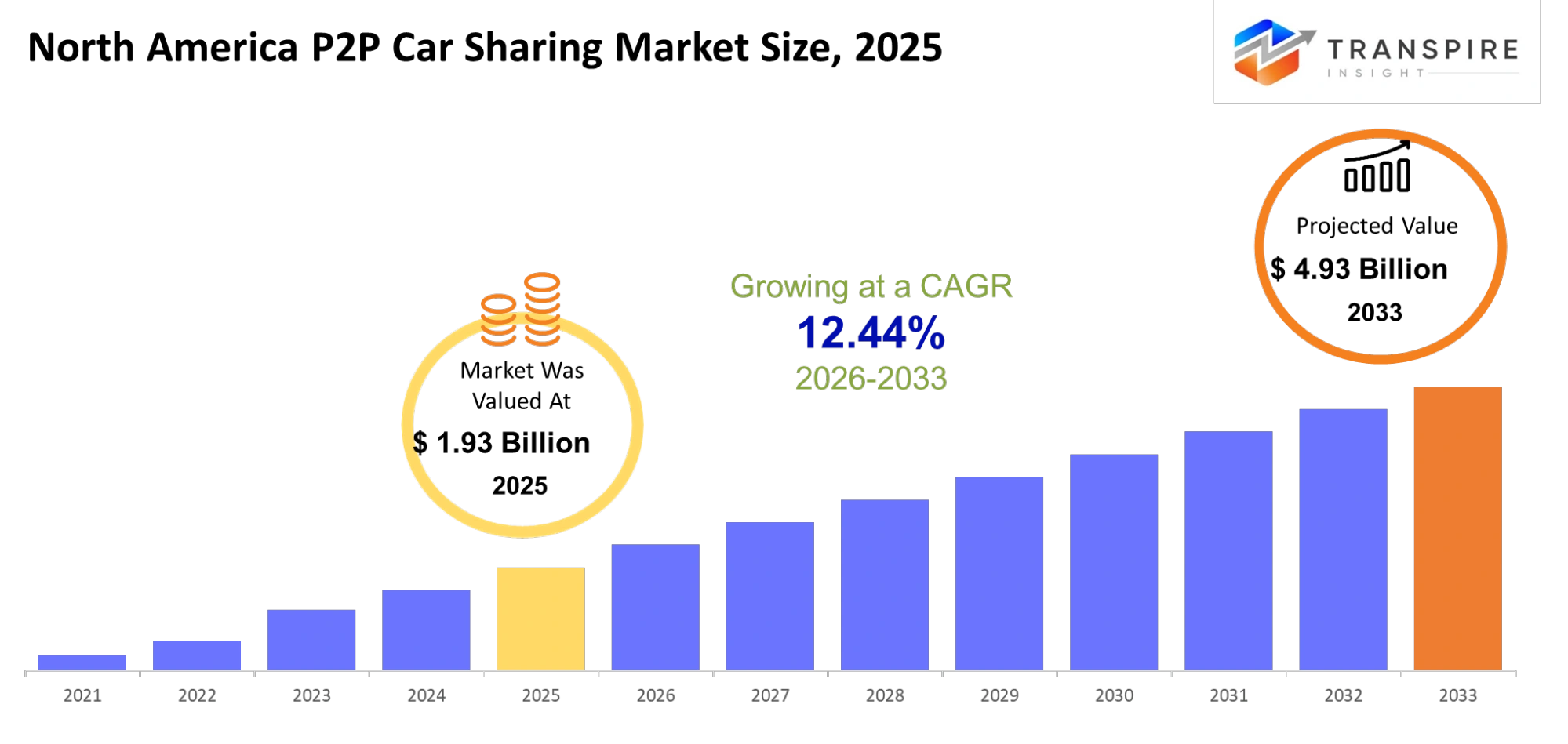
- North America P2P Car Sharing Market Size 2025: USD 1.93 Billion
- North America P2P Car Sharing Market Size 2033: USD 4.93 Billion
- North America P2P Car Sharing Market CAGR: 12.44%
- North America P2P Car Sharing Market Segments: By Type (Round-trip, One-way, Free-floating, Station-based, Subscription, Corporate, Hybrid); By Platform (Mobile App, Web, SaaS, API, Marketplace, Fleet Platform, Cloud); By Vehicle (Economy, Premium, Electric, SUVs, Luxury, Vans, Hybrid); By Application (Personal, Business, Tourism, Commuting, Rentals, Ride-sharing, Urban); By End-User (Individuals, Corporates, Travelers, Urban Users, Fleet Owners, Students, Professionals)
To learn more about this report,  Download Free Sample Report
North America P2P Car Sharing Market Summary:
The North America P2P Car Sharing Market size is estimated at USD 1.93 Billion in 2025 and is anticipated to reach USD 4.93 Billion by 2033, growing at a CAGR of 12.44% from 2026 to 2033. The North American peer-to-peer vehicle rental market will provide a new method for people to obtain vehicles without needing to buy them. The system will utilize digital platforms to enable users to rent out their personal vehicles to other users. The new system will adapt to current market trends which show that customers prefer to pay for their needs as they arise instead of making long-term commitments through traditional vehicle ownership. Urban users, in particular, will continue to favor short-term access over maintaining personal vehicles.
The market will rely heavily on technology as application-based reservations and keyless entry systems together with live vehicle monitoring capabilities will make it easier for users to operate the system while increasing their trust in its functions. The existing insurance systems together with identity verification processes will develop into better systems that address previous issues about establishing trust and determining liability.
What Has the Impact of Artificial Intelligence Been on the North America P2P Car Sharing Market?
Artificial intelligence currently drives transformation in the North American peer-to-peer car sharing industry through its abilities to enhance decision-making processes and boost operational performance across various platforms. The North American peer-to-peer car sharing industry benefits from AI technology because it allows businesses to handle extensive data sets which help them find usage trends and produce useful business intelligence.
Advanced machine learning algorithms enhance market research and data analysis by identifying customer preferences, peak usage times, and regional demand variations. The North American peer-to-peer car-sharing industry enables operators to develop pricing models and manage their fleet resources while adapting to market changes.
Artificial intelligence technology has its greatest impact on North American P2P car-sharing operations through its ability to predict future demand and conduct predictive analytics. The AI-powered models use historical booking data, weather data, and urban mobility patterns to produce highly accurate forecasts of upcoming demand.
The process results in better vehicle distribution for operations while reducing wasted time which increases total asset usage. Smart automation improves operational efficiency by automating user verification, fraud detection, and dynamic pricing processes which results in lower operational expenses. The North America P2P car sharing market benefits from these efficiencies which enable businesses to achieve higher profitability while expanding their operations.
AI systems in North America P2P car sharing platforms show two benefits for their users which include improved operational efficiency together with personalized customer service and technological advancements. The system uses intelligent recommendation systems to match users with appropriate vehicles which users based their selection on their personal preferences and current location and previous usage patterns.
The application of artificial intelligence in supply chain optimization creates better maintenance scheduling for vehicles while also improving cost management. The use of artificial intelligence by companies in North America P2P car sharing market strategies provides them with a competitive edge because it helps them deliver better services and make quicker choices while using data to expand their operations.
Key Market Trends & Insights:
- The United States P2P car sharing market in North America shows complete dominance because it holds more than 75% of the market share which will reach 2025 due to strong platform adoption.
- The fastest-growing region in Canada shows projected annual growth rates above 20% between 2025 and 2030 because of urban mobility initiatives.
- Peer-to-peer car rental platforms dominate the market with their asset-light business models which enable them to maintain higher vehicle availability thus achieving almost 60% market share in 2025.
- Hybrid sharing models hold the second-largest market share because they use both owned and peer-listed fleets to create better supply balance.
- The decentralized platform market segment operates as the fastest-growing part of the industry which will experience rapid expansion until 2030 through its implementation of blockchain-based ownership systems.
- The North America P2P car sharing market remains primarily occupied by leisure activities and short-term travel, which together account for more than 55% of market share, because tourists and weekend travelers use these services.
- The corporate travel sector will experience its quickest expansion through business applications, as organizations increasingly implement affordable transportation solutions for their workforce until 2028.
- The individual user segment will control 2025 market shares with a 70% stake because users increasingly prefer affordable vehicle access.
- The corporate user segment grows at the highest rate, with a 21% compound annual growth rate, because businesses implement fleet optimization and expense reduction strategies.
- The North America P2P car sharing market features Turo, Getaround, HyreCar, Avail, and Hertz as its main industry competitors.
North America P2P Car Sharing Market Segmentation
By Type :
The section studies operational models which establish procedures for vehicle access and vehicle return processes. The round-trip service requires customers to bring back their items to the location from which they first collected their items. The one-way model and free-floating model permit users to choose their drop-off locations, while the round-trip service requires users to return their items to the original collection point. Station-based systems depend on established fixed hubs, whereas subscription and corporate models offer users predetermined usage schedules. The hybrid model enables organizations to maintain operational flexibility while managing their financial expenditures.
Different user behaviors receive support through various systems which enable people to use one-way access for their commuting needs and subscription or corporate services for their scheduled usage. The expansion of flexible service models stems from customer demand for services that offer greater convenience while requiring less time at designated locations, enabling service providers to improve fleet management and enhance the customer experience.
By Platform :
The technological infrastructure which provides service delivery functions is revealed through platform segmentation.Mobile applications dominate because they allow users to book services easily and track their reservations in real time, while web platforms provide access to a wider audience. Organizations achieve scalable data solutions through the combination of SaaS and API systems with cloud infrastructure which enables them to connect their systems with external services.
Marketplace platforms establish connections between vehicle owners and users, which enhances social interaction through peer-to-peer relationships. Fleet platforms enable operators to manage their vehicle operations while tracking usage patterns and assessing performance metrics of their vehicles. The ongoing process of digital system development results in better user experiences and shorter system downtime, which enables smooth transactions between multiple access points.
By Vehicle :
The different vehicle segments display different price levels and various usage purposes. Cost-conscious customers choose economy vehicles, whereas premium and luxury vehicles attract customers who want better comfort. Electric and hybrid vehicles support environmental objectives, but SUVs and vans serve the needs of group travel and cargo transportation.
The demand for electric vehicles continues to increase due to both government policies and the fuel cost savings they offer. The different vehicle types which providers offer to customers enable them to create special travel solutions that meet both budget needs and travel requirements of daily commuters and tourists and business users
By Application :
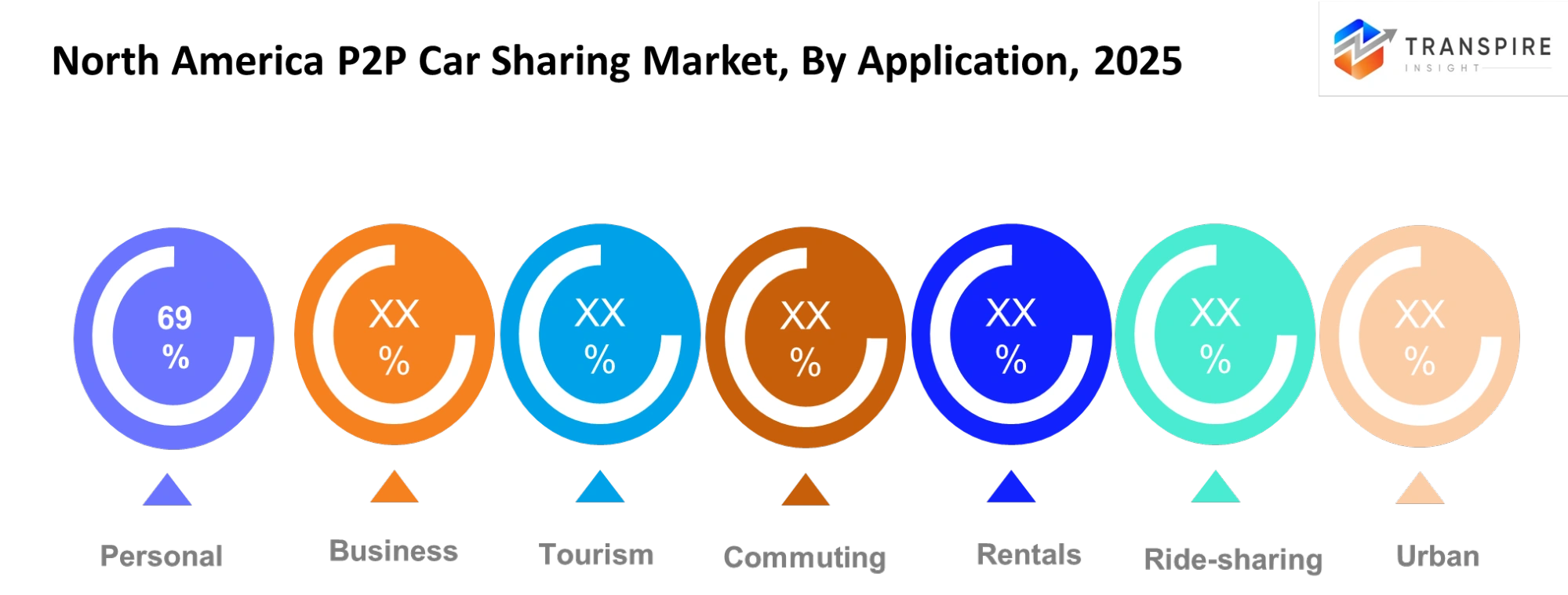
The research uses application-based segmentation to demonstrate how services operate within daily life. Regular demand for services results from personal and commuting needs while business and rental usage meets professional demands. Seasonal demand increases because tourism activities, and ride-sharing services provide additional travel options for people to share rides.
Urban applications stay important because cities experience heavy traffic and face challenges with parking space availability. The shared mobility system achieves better efficiency because its multiple service applications enable uninterrupted usage throughout the year while maintaining balance between peak times and non-peak times.
To learn more about this report, Download Free Sample Report
By End-User :
The study of end-user segmentation shows different customer groups who use shared mobility services. The service base consists of two main user groups which include personal users and business users who use the service for employee transportation. The combination of travelers and students results in different patterns of service usage.
Fleet owners create system supply through their vehicle listing activities. Professionals depend on adaptable transportation options to complete their job-related travel needs. The combination of different user groups creates network effects which maintain vehicle availability and demand throughout various demographic and professional user categories.
What are the Main Challenges for the North America P2P Car Sharing Market Growth?
The North America P2P car sharing market faces significant technical and operational difficulties which hinder its ability to expand and operate effectively. The platform needs to establish dependable service while implementing vehicle tracking systems that operate in real time and provide users with a smooth experience because transaction volume is expected to grow. Maintaining decentralized vehicle inventories results in quality and availability and maintenance standards which vary across different locations. The North America P2P car sharing market needs artificial intelligence for price and demand forecasting but this requires ongoing data processing which demands operating resources and delays system enhancements.
The North American P2P car sharing market suffers from two main growth obstacles which stem from operational requirements for regulatory compliance and insurance procedures. Peer-to-peer platforms need to operate under different regulations which exist in various states and provinces because they operate differently from conventional rental systems that only need federal guidelines. Businesses face higher operational costs because they need to manage three financial risks which include high insurance expenses and potential fraudulent activities and the difficulties of handling claims.
The North America P2P car sharing market faces obstacles to its expansion because suburban areas present greater difficulties for adoption. Supply growth you need to achieve three objectives which include creating trust in vehicle safety and vehicle owners sharing their personal assets and increasing awareness about your service. The user experience suffers from inadequate infrastructure which includes both insufficient parking facilities and missing digital connectivity.
The shortage of skilled workers who can operate advanced mobility platforms and data-driven systems results in decreased innovation and adoption rates. The increasing number of competitors from established car rental companies and new mobility services which include ride-hailing and subscription-based models creates extra difficulties for businesses. The North America P2P car sharing market faces growing competition from alternatives that deliver consistent services to customers who value established brand reliability.
Country Insights
The P2P Car Sharing Market in North America maintains its stable expansion because more people move to cities and they choose flexible transportation options. Digital platforms enable private vehicle owners to rent unused cars which reduces their asset costs. The major metropolitan areas experience increased adoption because cost efficiency together with convenience functions as the primary factor for customers.
Service providers face operational challenges because different cities have inconsistent regulatory requirements. The combination of insurance complex systems together with trust issues between vehicle owners and users will prevent people from using the service. The limited knowledge in smaller cities will stop development until marketing efforts together with better service dependability make users trust the system.
The growth patterns show a slow movement into suburban territories which happens because people recognize the service better and the service area reaches more locations. The United States leads in adoption because it uses advanced technology but Canada improves its adoption rate through its supporting environmental programs. The market will expand when the regulations become clearer and companies keep investing in platform security together with customer service improvements.
Recent Development News
In March 2026, Turo expanded its U.S. airport partnership program to improve peer-to-peer vehicle pickup integration at select large-hub airports. The expansion helps to streamline regulatory compliance while making it easier for travelers to access peer-to-peer rentals during airport fee and access negotiations.
Source https://dwuconsulting.com/
In April 2026, Uber maintained its existing partnership with Turo while expanding their integration of Turo vehicle listings into Uber Rent throughout North America. The partnership enhanced app-based access to peer-to-peer vehicle sharing which resulted in greater visibility and increased booking rates for Turo platform hosts.
Source https://www.reuters.com/
|
Report Metrics |
Details |
|
Market size value in 2025 |
USD 1.93 Billion |
|
Market size value in 2026 |
USD 2.17 Billion |
|
Revenue forecast in 2033 |
USD 4.93 Billion |
|
Growth rate |
CAGR of 12.44% from 2026 to 2033 |
|
Base year |
2025 |
|
Historical data |
2021 - 2024 |
|
Forecast period |
2026 - 2033 |
|
Report coverage |
Revenue forecast, competitive landscape, growth factors, and trends |
|
Regional scope |
North America (Canada, The United States, and Mexico) |
|
Key company profiled |
Turo, Getaround, Zipcar, HyreCar, Enterprise CarShare, Uber Rent, Lyft Rentals, Avis, Hertz, Sixt, BlaBlaCar, Ubeeqo, Virtuo, Kyte, Free2Move |
|
Customization scope |
Free report customization (country, regional & segment scope). Avail customized purchase options to meet your exact research needs. |
|
Report Segmentation |
By Type (Round-trip, One-way, Free-floating, Station-based, Subscription, Corporate, Hybrid); By Platform (Mobile App, Web, SaaS, API, Marketplace, Fleet Platform, Cloud); By Vehicle (Economy, Premium, Electric, SUVs, Luxury, Vans, Hybrid); By Application (Personal, Business, Tourism, Commuting, Rentals, Ride-sharing, Urban); By End-User (Individuals, Corporates, Travelers, Urban Users, Fleet Owners, Students, Professionals) |
How Can New Companies Establish a Strong Foothold in the North America P2P Car Sharing Market?
New companies aiming to enter the North America P2P car sharing market must begin with focused niche targeting and clear value differentiation. Startups should not follow conventional market competition but instead focus on meeting the needs of specific markets which include electric vehicle sharing and luxury peer-to-peer rentals and smart city mobility solutions.
New businesses can achieve their first success when they design their products to match specific customer demands which include both eco-conscious consumers and urban commuters. The North American P2P car sharing market requires businesses to identify local transportation needs as they create customized services which enhance user experience and build customer trust.
Businesses need technology innovation because it serves as a vital tool for creating a solid presence within the North American P2P car sharing industry. Companies which use artificial intelligence for predictive pricing and fraud detection and demand forecasting achieve better fleet management and improved customer service. The organizations obtain improved security together with better operational efficiency through their deployment of contactless access systems together with telematics monitoring systems and personalized recommendation systems. Kyte delivers app-based delivery services that transform customer convenience while Virtuo shows how urban markets can engage tech-savvy customers through their complete digital service offerings.
Market entry is strengthened through strategic partnerships and ecosystem integration. Startups can solve major North America P2P car sharing market problems by working with insurance providers and urban planners and automotive OEMs to develop solutions for liability coverage and vehicle supply and regulatory compliance. The organization establishes partnerships with real estate developers and corporate fleets to gain access to multiple customer bases which experience high demand.
Key North America P2P Car Sharing Market Company Insights
The North America P2P Car Sharing Market experiences growth through urban population expansion as vehicle owners begin to share their unused vehicles for short-term rentals. People choose to use flexible vehicle access methods because parking costs increase and traffic problems emerge. Digital platforms will simplify booking processes while enhancing availability and enabling continuous usage across all urban areas.
The North America P2P Car Sharing Market will develop trust through advanced mobile applications and GPS tracking technology and secure payment methods.The combination of data-driven pricing and real-time vehicle monitoring will enable businesses to decrease downtime while increasing operational efficiency. The platform will attract vehicle owners and renters because it provides them with an easy-to-use interface which works without difficulties.
The North America P2P Car Sharing Market requires better policies and specific insurance solutions to achieve safe and organized development. Local authorities are recognizing shared mobility benefits such as reduced congestion and emissions. Standardized rules will help platforms scale while ensuring protection for users and vehicle owners.
Platform reliability and pricing models and service coverage determine the competition between market players. Businesses use partnerships and customer retention strategies and app development to gain a competitive advantage. New market entrants will compete against established companies through specialized products but brand reputation and service excellence will remain essential for maintaining market presence.
Company List
- Turo
- Getaround
- Zipcar
- HyreCar
- Enterprise CarShare
- Uber Rent
- Lyft Rentals
- Avis
- Hertz
- Sixt
- BlaBlaCar
- Ubeeqo
- Virtuo
- Kyte
- Free2Move
What are the Key Use-Cases Driving the Growth of North America P2P Car Sharing Market?
The North America P2P car sharing market is experiencing fast growth because real-world use cases provide different solutions to current demands for transportation. Users in urban areas need affordable solutions which allow them to travel without owning a vehicle. The platform usage receives a major boost from short-term rentals which people use for daily transportation and errands and first-mile and last-mile travel needs. The use case demonstrates market growth as consumers choose to spend their time and money on immediate vehicle access instead of permanent vehicle ownership.
Leisure and tourism mobility form another important use case which drives the North America P2P car sharing market. Travelers prefer peer-to-peer rentals for affordability, vehicle variety, and localized experiences, especially in major cities and tourist destinations. Companies use P2P platforms to handle employee travel needs while managing temporary assignments and fleet optimization needs which create strong demand for business and enterprise mobility solutions.
The North American P2P car sharing market develops because of its link to electric vehicles and its support for environmentally sustainable development projects. The platforms enable consumers to access electric vehicles together with environmental protection benefits and compliance with legal requirements. The shared vehicle system provides drivers and delivery workers with income opportunities, which creates a business model that can expand into both the automotive and logistics sectors.
North America P2P Car Sharing Market Report Segmentation
By Type
- Round-trip
- One-way
- Free-floating
- Station-based
- Subscription
- Corporate
- Hybrid
By Platform
- Mobile App
- Web
- SaaS
- API
- Marketplace
- Fleet Platform
- Cloud
By Vehicle
- Economy
- Premium
- Electric
- SUVs
- Luxury
- Vans
- Hybrid
By Application
- Personal
- Business
- Tourism
- Commuting
- Rentals
- Ride-sharing
- Urban
By End-User
- Individuals
- Corporates
- Travelers
- Urban Users
- Fleet Owners
- Students
- Professionals
Frequently Asked Questions
Find quick answers to common questions.
The approximate North America P2P Car Sharing Market size for the market will be USD 4.93 Billion in 2033.
Key segments for the North America P2P Car Sharing Market are By Type (Round-trip, One-way, Free-floating, Station-based, Subscription, Corporate, Hybrid); By Platform (Mobile App, Web, SaaS, API, Marketplace, Fleet Platform, Cloud); By Vehicle (Economy, Premium, Electric, SUVs, Luxury, Vans, Hybrid); By Application (Personal, Business, Tourism, Commuting, Rentals, Ride-sharing, Urban); By End-User (Individuals, Corporates, Travelers, Urban Users, Fleet Owners, Students, Professionals).
Major North America P2P Car Sharing Market players are Turo, Getaround, Zipcar, HyreCar, Enterprise CarShare, Uber Rent, Lyft Rentals, Avis, Hertz, Sixt, BlaBlaCar, Ubeeqo, Virtuo, Kyte, Free2Move.
The North America P2P Car Sharing Market size is USD 1.93 Billion in 2025.
The North America P2P Car Sharing Market CAGR is 12.44%.
- Turo
- Getaround
- Zipcar
- HyreCar
- Enterprise CarShare
- Uber Rent
- Lyft Rentals
- Avis
- Hertz
- Sixt
- BlaBlaCar
- Ubeeqo
- Virtuo
- Kyte
- Free2Move
Recently Published Reports
-
Dec 2024
ATV & UTV Market
ATV & UTV Market Size, Share & Analysis Report By Type (ATV, and UTV), By Variants (Less Than 400 CC, 400 CC To 800 CC, and More Than 800 CC), and Geography (North America, Europe, Asia-Pacific, Middle East and Africa, South and Central America), 2021 - 2031
-
Jan 2025
Automotive Central Gateway Module Market
Automotive Central Gateway Module Market Size, Share & Analysis Report By Type (Ethernet Central Gateway Module, CAN Central Gateway Module, LIN Central Gateway Module, and FlexRay), By Application (Powertrain Control, Body Control, Infotainment System, Advanced Driver Assistance Systems (ADAS), and Others), By End User (Passenger Vehicles, and Commercial Vehicles), and Geography (North America, Europe, Asia-Pacific, Middle East and Africa, South and Central America), 2021 - 2031
-
Jan 2025
Automotive Engine Oil Filter Market
Automotive Engine Oil Filter Market Size, Share & Analysis Report By Filter Type (Fuel Filter, Engine Oil Filter, Hydraulic Oil Filter, and Others), By Filter Media (Cellulose, Synthetic, and Micro), By Sales Channel (OEMs, and Aftermarket), By Vehicle Type (Passenger Cars, Light Commercial Vehicles, Heavy Duty Trucks, Buses and Coaches, and Off-road Vehicles), and Geography (North America, Europe, Asia-Pacific, Middle East and Africa, South and Central America), 2021 - 2031
-
Jan 2025
Automotive Parts Aluminium Die Casting Market
Automotive Parts Aluminium Die Casting Market Size, Share & Analysis Report By Production Process (Pressure Die Casting, Vacuum Die Casting, Squeeze Die Casting, Gravity Die Casting), By Application (Body Parts, Engine Parts, Transmission Parts, Battery And Related Components, Other Application Types), and Geography (North America, Europe, Asia-Pacific, Middle East and Africa, South and Central America), 2021 - 2031
Our Clients