North America Medical Adhesive-Related Skin Injury (MARSI) Treatment Market Size & Forecast:
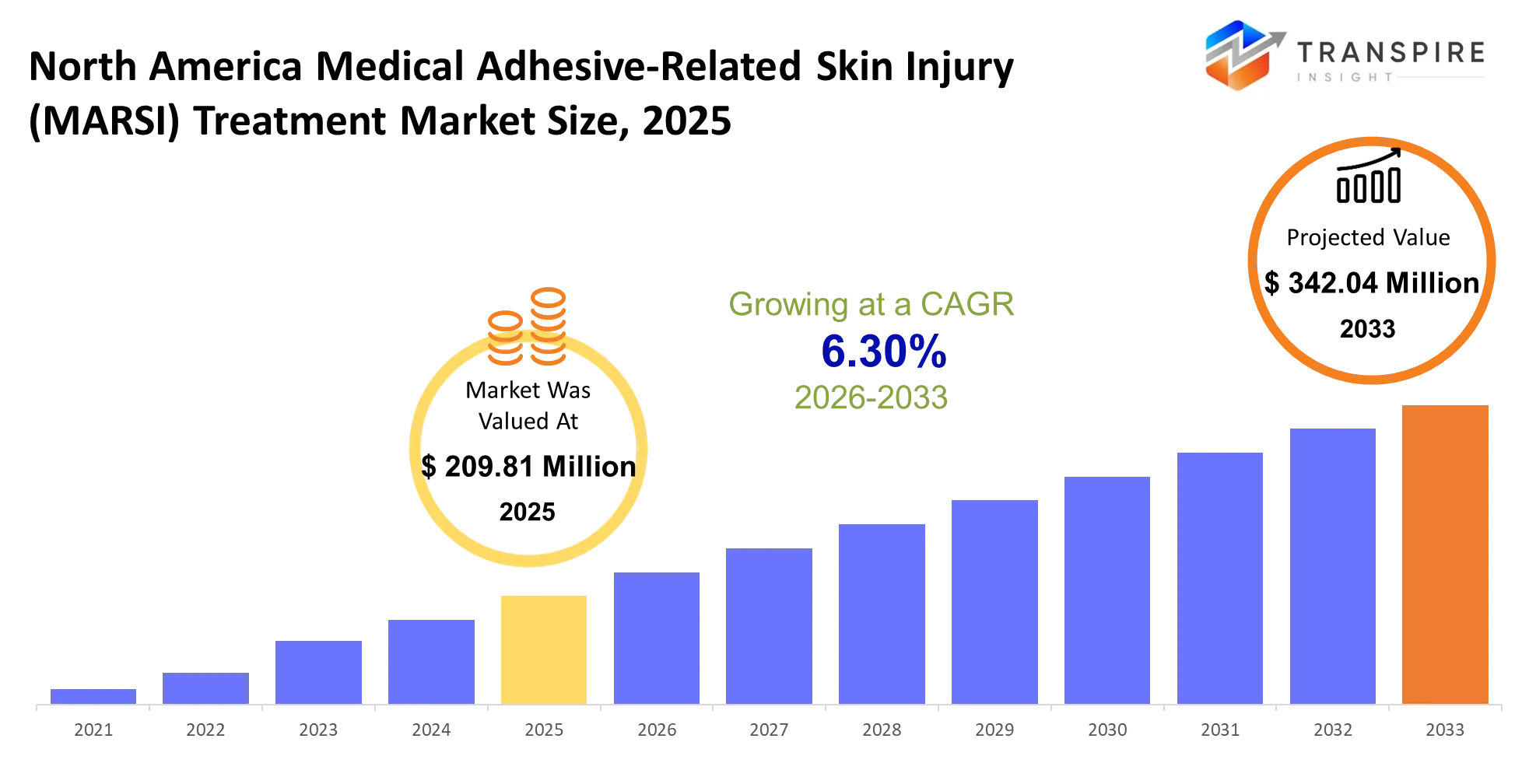
- North America Medical Adhesive-Related Skin Injury (MARSI) Treatment Market Size 2025: USD 209.81 Million
- North America Medical Adhesive-Related Skin Injury (MARSI) Treatment Market Size 2033: USD 342.04 Million
- North America Medical Adhesive-Related Skin Injury (MARSI) Treatment Market CAGR: 6.30%
- North America Medical Adhesive-Related Skin Injury (MARSI) Treatment Market Segments: By Type (Barrier Films, Adhesive Removers, Dressings, Skin Protectants, Others); By Application (Hospitals, Clinics, Homecare, Others); By End-User (Healthcare Providers, Patients, Others); By Form (Sprays, Wipes, Creams, Others)
To learn more about this report,  Download Free Sample Report
North America Medical Adhesive-Related Skin Injury (MARSI) Treatment Market Summary
The North America Medical Adhesive-Related Skin Injury (MARSI) Treatment Market was valued at USD 209.81 Million in 2025. It is forecast to reach USD 342.04 Million by 2033. That is a CAGR of 6.30% over the period.
The North America Medical Adhesive-Related Skin Injury (MARSI) treatment market supports hospitals, long term care facilities, and home healthcare providers, sort of helping them manage skin damage that comes from repeated use of medical tapes dressings and adhesive devices. In day to day practice these products support prevention of skin tears blistering and infections among elderly post surgical and chronically ill patients who need frequent wound care or ongoing device attachment.
Over the last five years the market has moved away from reactive wound management toward preventive skin protection protocols that get folded into hospital care pathways. Silicone based adhesives, and atraumatic dressing technologies have been getting broader adoption because providers are feeling pressure to reduce avoidable patient harm , and also lower treatment costs. Then COVID-19 kind of sped things up, because prolonged use of respiratory devices monitoring equipment and protective dressings increased skin injury cases in critical care. With healthcare systems leaning toward faster recovery and fewer readmissions, providers are putting money into more advanced MARSI treatment solutions that improve patient outcomes while also easing nursing burden, and cutting down on consumable waste.
Key Market Insights
- The United States basically dominated the North America Medical Adhesive-Related Skin Injury (MARSI) Treatment Market, with something like 82% market share in 2025 , so yeah pretty huge.
- Canada is showing the most rapid growth during the 2025–2032 forecast window, mainly because home healthcare infrastructure is expanding out there.
- Also, the higher hospitalization rates and chronic wound prevalence keep pushing the regional industry size upward and making treatment product adoption more common.
- When you look at the materials side, silicone adhesive dressings still lead the market, around 38% in 2025, largely because they lower skin trauma risks.
- Barrier films and skin protectants landed in the second-largest segment , since hospitals are increasingly leaning into preventive care protocols.
- Meanwhile foam dressings are expected to grow the quickest through 2032, supported by newer moisture management technologies that actually work better.
- By care focus, acute wound management led overall, with nearly 44% revenue share in 2025 across hospitals and surgical centers.
- Chronic wound treatment is projected as the fastest-growing application segment too, driven by diabetes-related skin complications and an aging population profile.
- On the provider side, hospitals accounted for more than 56% of North America Medical Adhesive-Related Skin Injury (MARSI) Treatment Market revenue in 2025.
- And for end users, home healthcare is the fastest-growing category, because providers are shifting toward outpatient care, plus remote patient management models.
What are the Key Drivers, Restraints, and Opportunities in the North America Medical Adhesive-Related Skin Injury (MARSI) Treatment Market?
Driver: The biggest growth driver in the North America Medical Adhesive-Related Skin Injury (MARSI) Treatment Market is basically the movement toward hospital-acquired injury prevention, but it’s all tied to reimbursement , and also patient outcome metrics. Over the last several years, healthcare systems in the United States and Canada expanded pressure injury reduction programs and also standardized skin integrity protocols, especially in intensive care, and in postoperative environments. That effort kind of forced hospitals to swap out traditional acrylic adhesives with silicone-based atraumatic dressings and barrier products , which in practice lowers the chance of skin damage. This change also directly lifted product utilization rates , because preventive skin protection now costs less than prolonged wound care , plus it reduces readmissions and liability exposure. So, as a result, premium MARSI treatment products are moving from “optional” procurement categories into routine clinical purchasing frameworks.
Restraint: High product costs and fragmented reimbursement structures are still the market’s most stubborn structural barrier. Advanced silicone dressings and skin barrier systems are often priced quite a bit higher on a unit basis than conventional tapes and adhesives. A lot of long-term care facilities and smaller outpatient centers still run on strict budgets and they don’t have a clear, dedicated reimbursement route for preventive skin injury products. That restriction limits adoption even when clinical benefits are really proven, and it ends up suppressing revenue expansion across non-acute care settings.
Opportunity: Home healthcare looks like the clearest long-term growth opportunity. Remote patient monitoring , wearable infusion devices, and home-based chronic wound management are expanding across North America at a fast pace.This creates demand for low-trauma adhesives designed for frequent application and removal outside hospital supervision. Manufacturers investing in breathable silicone technologies and antimicrobial skin barrier films are well positioned to capture this next adoption cycle.
What Has the Impact of Artificial Intelligence Been on the North America Medical Adhesive-Related Skin Injury (MARSI) Treatment Market?
Artificial intelligence and advanced digital health tech are starting to sort of reshape the North America Medical Adhesive-Related Skin Injury (MARSI) treatment scene by boosting skin assessment accuracy , making wound monitoring more automated, and helping clinicians make better calls. More hospitals and wound care centers are now leaning on AI imaging platforms to catch early skin changes tied to medical adhesives, way before any tearing or blistering is really visible. In practice these tools look at skin color shifts, moisture conditions, and how steady the tissue integrity seems, all in near real time. That means clinicians can step in sooner, and so prevent some complications that otherwise would’ve been avoidable.
Machine learning models are also helping with predictive risk scoring for patients who are more vulnerable , especially elderly people, those with diabetes, and intensive care patients who get repeated adhesive use. When providers connect electronic health records with mobility signals and device usage patterns, they can spot higher odds of MARSI earlier, and then revise dressing protocols ahead of time. The result tends to be a smoother treatment workflow , fewer dressing changes than usual, and less pressure on long hospital stays plus lower readmission related expenses.
On top of that, digital wound documentation platforms are making compliance tracking easier and improving care coordination between acute units and home healthcare settings. But AI adoption still has a big snag: many facilities don’t have standardized wound imaging datasets or truly interoperable clinical systems, so algorithm performance can drop. That also slows down broad deployment across very different care environments, because the data and workflows just don’t match as cleanly as they should.
Key Market Trends
- Since 2021, hospitals have sorta accelerated the switch from acrylic adhesives to silicone dressings, after pressure injury reduction protocols got tighter across critical care units.
- ICU-related skin injuries apparently also ticked up during the COVID-19 period, so by 2023 healthcare systems started standardizing preventive adhesive management, kinda faster than before, yes.
- 3M and Mölnlycke Health Care went and expanded their silicone-based product lines as clinicians kept asking for lower trauma dressing removal technologies.
- At the same time, home healthcare providers increased their buying of atraumatic adhesive products, especially once remote patient monitoring device usage grew a lot between 2022 and 2025.
- Group purchasing organizations then shifted how they evaluate vendors, more toward total treatment cost reduction rather than unit pricing, which kind of rearranged competitive positioning among wound care suppliers.
- Meanwhile AI-enabled wound imaging systems began showing up in big North American hospitals after 2022, to spot early-stage adhesive-related skin damage before any visible breakdown, or at least before it becomes obvious.
- Manufacturers also started integrating antimicrobial coatings and more breathable adhesive materials, since infection-control requirements got stricter in postoperative care settings.
- And during supply chain disruptions in 2020 and 2021, manufacturers were forced into regionalizing production, plus diversifying raw material sourcing, for advanced wound care products.
- Long term care facilities leaned harder into preventive barrier films after reimbursement pressures tied avoidable skin injuries to quality performance metrics.
- Finally, strategic collaborations between wound care companies and digital health providers grew after 2023, to support data driven skin integrity monitoring across outpatient environments.
North America Medical Adhesive-Related Skin Injury (MARSI) Treatment Market Segmentation
By Type
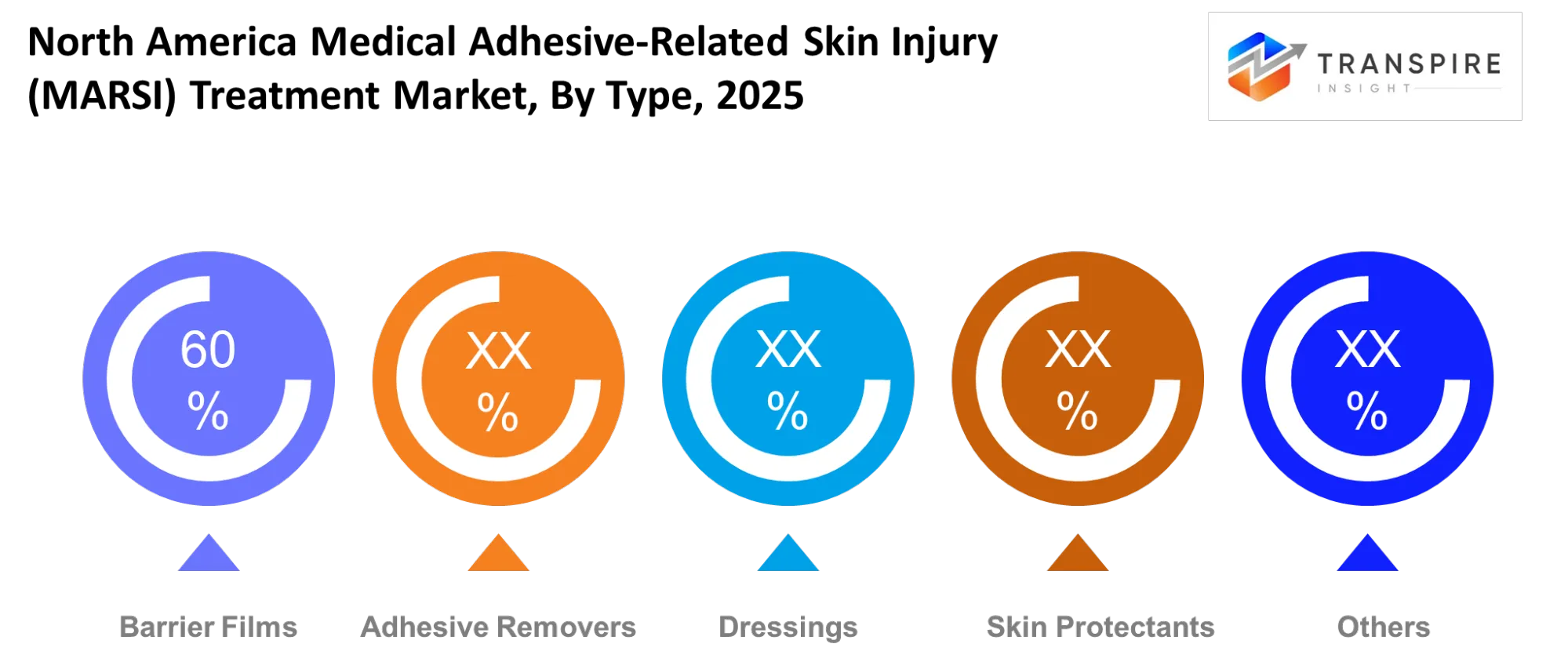
Barrier films currently hold a fairly strong position across adhesive-related skin injury management , mostly because hospitals are leaning more and more toward preventive skin protection rather than just reactive wound treatment. In intensive care, postoperative care, and long-term care settings the usage stays high which in turn supports steady procurement volumes. Also, clinical protocols that came in after the pandemic really sped up the adoption of alcohol-free barrier technologies, mainly because they help reduce skin stripping during repeated dressing changes. Adhesive removers and skin protectants keep that same stable market position too, driven by the expanding use of wearable medical devices and the longer catheter attachment procedures, you know, those stretches where the skin gets stressed over time.
Dressings are the fastest moving segment, partly because silicone-based atraumatic products lower pain and reduce nursing intervention time, plus they cut down on secondary skin complications. Product developers keep investing in breathable materials, antimicrobial coatings, and moisture-balancing technologies that support better recovery in elderly and diabetic patients. Spray-based protectants and integrated adhesive systems are expected to become more accepted during the forecast period as healthcare systems try to push down overall treatment costs , and also aim for fewer readmissions. Investors are increasingly drawn to companies building multifunctional wound care solutions, where preventive and therapeutic capabilities live on the same platform rather than being split.
To learn more about this report, Download Free Sample Report
By Application
Hospitals account for the largest share of adhesive-related skin injury treatment utilization, largely because there are a lot of surgeries, strong needs for intensive monitoring, and constant device attachment procedures. Between 2021 and 2024, major healthcare networks rolled out standardized skin integrity protocols, and that boosted the routine use of silicone dressings and protective barriers .Clinics still hold a pretty moderate market position, sort of because outpatient procedures and chronic wound management services keep expanding across North America. Homecare settings, though, look like the ones with the strongest growth arc, as healthcare delivery kind of drifts toward remote monitoring, and more decentralized treatment models.
In homecare environments, frequent dressing replacement creates a pretty dependable need for low-trauma adhesive systems, the kind patients and caregivers can handle safely, even without clinical supervision. You see momentum around portable wound management kits , single-use wipes , and easy-application spray protectants that fit routine use. Looking ahead, remote patient management plus wearable infusion systems should further support procurement demand outside hospital walls. Manufacturers that simplify application formats, and add digitally supported wound monitoring tools, are likely to lock in steadier long-term placement.
By End-User
Healthcare providers lead end-user adoption because hospitals, ambulatory centers, and long-term care facilities are still the ones managing most of the more advanced wound care. Procurement choices increasingly hinge on overall treatment cost reduction, patient outcome performance, and adherence to skin injury prevention standards. Clinical staff often lean toward silicone-based adhesive technologies, because less skin trauma tends to reduce dressing replacement frequency, and also eases the nursing workload. Patients make up a smaller slice, but that slice keeps growing slowly as home-based wound management becomes more common among aging populations.
Direct involvement of patients in adhesive related skin injury management went up quite a bit after remote healthcare adoption picked up fast during the pandemic period. Nowadays consumer preference leans toward painless adhesive removal, skin friendly materials, and easier wound care products built for frequent use. In the near future market expansion should push manufacturers to craft more patient centered solutions that are easier to handle, connect with digital care tools, and stay more portable. Also investment activity is forecasted to rise for self care wound management platforms aimed at chronic disease groups and elderly users.
By Form
Wipes are still holding a leading market position since healthcare providers tend to favor controlled application methods that lower contamination risk and support smoother workflow, more or less. Single use packaging formats back infection control expectations in hospitals and outpatient care settings. Creams and sprays keep steady adoption too, because both styles offer skin barrier protection during long device attachment periods, and during repetitive dressing changes. Spray based demand climbed notably after intensive care units expanded their continuous monitoring device use in recent years.
Sprays are projected to post the fastest growth over the forecast period because they apply quicker, and they cover a wider surface area in critical care environments. Manufacturers keep rolling out non stinging silicone formulations, and quick drying technologies meant for fragile, or aging skin. Wipes will likely stay important in regulated care spaces where dose consistency and portability are day to day operational priorities. Product developers that focus on residue free application, antimicrobial features, and compatibility with wearable medical devices are positioned to gain stronger commercial advantage.
What are the Key Use Cases Driving the North America Medical Adhesive-Related Skin Injury (MARSI) Treatment Market?
Hospital based postoperative wound management still feels like the main thing that drives people to adopt the product across North America. You see big demand from intensive care units , surgical recovery wards and oncology departments, mainly because repeated dressing changes plus all the device attachment stuff often ends up stressing fragile skin, especially in elderly patients and other high risk groups.
Homecare and outpatient chronic wound treatment have picked up a lot of momentum the last few years. Diabetic care providers, ambulatory surgical centers, and long term care facilities are more and more relying on silicone dressings, barrier films and adhesive removers to cut down on needless skin injuries during remote patient handling and across longer therapy cycles.
Newer use cases are starting to show too, like extra adhesive protection for wearable monitoring devices and infusion systems that are part of remote healthcare programs. Manufacturers also point to growing opportunity in neonatal care and pediatric intensive care environments , where delicate skin really benefits from low trauma adhesive technologies that offer better moisture control along with antimicrobial support .
|
Report Metrics |
Details |
|
Market size value in 2025 |
USD 209.81 Million |
|
Market size value in 2026 |
USD 223.03 Million |
|
Revenue forecast in 2033 |
USD 342.04 Million |
|
Growth rate |
CAGR of 6.30% from 2026 to 2033 |
|
Base year |
2025 |
|
Historical data |
2021 - 2024 |
|
Forecast period |
2026 - 2033 |
|
Report coverage |
Revenue forecast, competitive landscape, growth factors, and trends |
|
Regional scope |
North America (Canada, The United States, and Mexico) |
|
Key company profiled |
3M, Smith & Nephew, ConvaTec, Coloplast, Medline, Cardinal Health, Molnlycke, Hollister, Derma Sciences, BSN Medical, Hartmann, Paul Hartmann, Lohmann & Rauscher, Advancis Medical, Acelity |
|
Customization scope |
Free report customization (country, regional & segment scope). Avail customized purchase options to meet your exact research needs. |
|
Report Segmentation |
By Type (Barrier Films, Adhesive Removers, Dressings, Skin Protectants, Others); By Application (Hospitals, Clinics, Homecare, Others); By End-User (Healthcare Providers, Patients, Others); By Form (Sprays, Wipes, Creams, Others) |
Which Regions are Driving the North America Medical Adhesive-Related Skin Injury (MARSI) Treatment Market Growth?
The United States leads the regional landscape, mostly because big hospital networks, advanced wound care infrastructure, and strict patient safety standards help with widespread adoption of preventive skin protection products. The federal reimbursement frameworks increasingly connect hospital performance to avoidable skin injury reduction , so that kind of thing pushes procurement of silicone-based dressings and barrier films. You also have a strong presence of major wound care manufacturers, plus established distribution networks that make product availability easier across acute and long-term care settings. And yeah, continuous investment in digital wound monitoring , intensive care expansion, and postoperative recovery programs keeps that dominance going across the country for a long time.
Canada contributes a smaller but pretty stable share, because the provincial healthcare systems lean on standardized clinical protocols and evidence-based wound management practices. Unlike the United States, purchasing decisions in Canada tend to flow through centralized healthcare procurement systems, they usually prefer long-term supplier relationships and consistent product quality. Aging demographics and a growing chronic disease burden continue to support steady use of adhesive removers, dressings, and skin protectants across hospitals and community care programs. Stable healthcare funding , plus gradual homecare service expansion, makes Canada a reliable contributor to regional treatment revenue.
Mexico is the fastest-growing regional market, mainly due to expanding private healthcare infrastructure and rising investment in modern surgical and wound care capabilities. Hospital modernization programs that started after 2022 boosted adoption of advanced adhesive management products in urban healthcare facilities. International medical device manufacturer also expanded regional partnerships and distributor networks to capture unmet demand in postoperative and chronic wound treatment. Strong growth potential between 2026 and 2033 is expected to create attractive entry opportunities for suppliers offering cost-effective silicone dressings, portable wound care products, and homecare-focused skin protection technologies.
Who are the Key Players in the North America Medical Adhesive-Related Skin Injury (MARSI) Treatment Market and How Do They Compete?
The competitive environment still looks moderately consolidated , with a small group of multinational wound care and medical technology companies steering a large share of premium product sales across North America. Overall competition seems to shift more and more toward silicone adhesive know-how, clearer clinical outcome evidence, and how well products mesh with hospital skin integrity protocols, not just plain pricing. Bigger incumbents keep defending their space through evidence led product lines and long term procurement deals with hospital networks. Meanwhile, smaller specialist companies are getting in by poking specific pockets, like antimicrobial barrier films, wearable device adhesive protection, and homecare oriented wound management systems.
3M operates with a wide product footprint and pretty strong hospital purchasing relationships, backed by advanced silicone adhesive technologies and skin protection systems. It also leans into integrated dressing plus securement solutions, the kind that fit high acuity settings where device attachment happens a lot. Mölnlycke Health Care leans hard on atraumatic wound care innovation, especially foam dressings that aim to reduce pain when removed and cut down on nursing intervention time. Their expanded clinical collaborations with healthcare systems in North America have made adoption easier across postoperative programs and also chronic wound management pathways.
ConvaTec, in its own way, pushes chronic wound and ostomy care integration, which helps open wider access to long term care and homecare channels where repeat utilization of products tends to stay consistently high.The company keeps expanding its digital wound assessment abilities and remote care support tools, to help maintain continuity for outpatient treatment . Smith+Nephew stands out via more advanced antimicrobial dressing technologies and also through sports medicine ties that, in turn, improve penetration in surgical recovery environments. Coloplast is focusing on patient-first adhesive solutions with simplified apply formats, meant for elderly users and people managing care at home, that helps it extend beyond the usual hospital procurement markets.
Company List
- 3M
- Smith & Nephew
- ConvaTec
- Coloplast
- Medline
- Cardinal Health
- Molnlycke
- Hollister
- Derma Sciences
- BSN Medical
- Hartmann
- Paul Hartmann
- Lohmann & Rauscher
- Advancis Medical
- Acelity
Recent Development News
In May 2026, Smith+Nephew launched ALLEVYN COMPLETE CARE Dressing and RENASYS EDGE tNPWT at EWMA 2026. The launch expanded advanced chronic wound management capabilities with technologies focused on pressure injury prevention, improved exudate control, and reduced clinical workload across hospital care settings. https://www.smith-nephew.com
In July 2025, ConvaTec secured US and European regulatory clearance for Aquacel ConvaFiber wound care technology. The approval strengthened the company’s advanced dressing portfolio with next-generation Hydrofiber technology designed for chronic wounds, surgical wounds, and pressure injury management ahead of commercial rollout in 2026. https://www.convatecgroup.com
What Strategic Insights Define the Future of the North America Medical Adhesive-Related Skin Injury (MARSI) Treatment Market?
The North America Medical Adhesive Related Skin Injury, MARSI, treatment market is moving, toward preventive and more data-driven skin integrity management—integrated right into wider patient safety steps and remote care frameworks. In the next five to seven years healthcare systems are kinda expected to prioritize adhesive technologies that lower nursing workload, speed up recovery timelines, and still back home-based treatment models. At the same time the spread of wearable medical devices , plus remote monitoring programs and more outpatient care, will push procurement further toward low-trauma silicone adhesives and wound management solutions that are digitally supported.
One less-talked about risk is raw material concentration and the whole silicone supply dependency issue. There are only a few specialized material suppliers that keep supporting a large share of advanced wound care manufacturing, so the market can get stuck dealing with pricing swings and supply disruptions during geopolitical or trade instability. And in parallel, AI-assisted wound imaging and predictive skin assessment tools look like a real emerging opportunity, especially in home healthcare and long-term care settings where early intervention still feels pretty inconsistent.
So market participants should really lean into integrated product ecosystems. Think atraumatic adhesives, digital monitoring, and remote care compatibility all together, rather than just competing on standalone dressing performance, or even only on pricing.
North America Medical Adhesive-Related Skin Injury (MARSI) Treatment Market Report Segmentation
By Type
- Barrier Films
- Adhesive Removers
- Dressings
- Skin Protectants
- Others
By Application
- Hospitals
- Clinics
- Homecare
- Others
By End-User
- Healthcare Providers
- Patients
- Others
By Form
- Sprays
- Wipes
- Creams
- Others
Frequently Asked Questions
Find quick answers to common questions.
The expected North America Medical Adhesive-Related Skin Injury (MARSI) Treatment Market size is USD 342.04 Million in 2033.
Key segments for the North America Medical Adhesive-Related Skin Injury (MARSI) Treatment Market are By Type (Barrier Films, Adhesive Removers, Dressings, Skin Protectants, Others); By Application (Hospitals, Clinics, Homecare, Others); By End-User (Healthcare Providers, Patients, Others); By Form (Sprays, Wipes, Creams, Others).
Major North America Medical Adhesive-Related Skin Injury (MARSI) Treatment Market players are 3M, Smith & Nephew, ConvaTec, Coloplast, Medline, Cardinal Health, Molnlycke, Hollister, Derma Sciences, BSN Medical, Hartmann, Paul Hartmann, Lohmann & Rauscher, Advancis Medical, Acelity.
The North America Medical Adhesive-Related Skin Injury (MARSI) Treatment Market size is USD 209.81 Million in 2025.
The North America Medical Adhesive-Related Skin Injury (MARSI) Treatment Market CAGR is 6.30% from 2026 to 2033.
- 3M
- Smith & Nephew
- ConvaTec
- Coloplast
- Medline
- Cardinal Health
- Molnlycke
- Hollister
- Derma Sciences
- BSN Medical
- Hartmann
- Paul Hartmann
- Lohmann & Rauscher
- Advancis Medical
- Acelity
Recently Published Reports
-
Apr 2026
AI in Diabetic Retinopathy Market
AI in Diabetic Retinopathy Market Size, Share & Analysis Report By Type (Screening AI Systems, Diagnostic AI Systems, and Predictive AI Models), By Application Segment (Hospitals, Ophthalmology Clinics, Diagnostic Centers, and Research and Development), and Geography (North America, Europe, Asia-Pacific, Middle East and Africa, South and Central America), 2021 - 2031
-
Apr 2026
Psychometric Tests Market
Psychometric Tests Market Size, Share & Analysis Report By Type (Personality Tests, Ability/Aptitude Tests, Skill/Knowledge Tests, and Others), By Application (Talent Acquisition and Talent Management), and Geography (North America, Europe, Asia-Pacific, Middle East and Africa, South and Central America), 2021 – 2031
-
Apr 2026
Rare Biological Sample Collection Market
Rare Biological Sample Collection Market Size, Share & Analysis Report By Type (Isolation Kits & Reagent, Blood Collection Tubes, and Others), By Application (Oncology, Transcriptomics, Pharmacogenomics, and Others), and Geography (North America, Europe, Asia-Pacific, Middle East and Africa, South and Central America), 2021 – 2031
-
May 2026
Patient Lift Pendant Market
Patient Lift Pendant Market By Product Type (Wired Pendants, Wireless, Programmable), By Operation Type(Manual, Electric), By End-Users (Healthcare Professionals, Patients), By Application (Hospitals, Homecare, Rehabilitation Centers, Others), By Industry Analysis, Size, Share, Growth, Trends, and Forecasts 2021-2033
Our Clients
.jpg)