

North America Materials Informatics Market Size & Forecast:
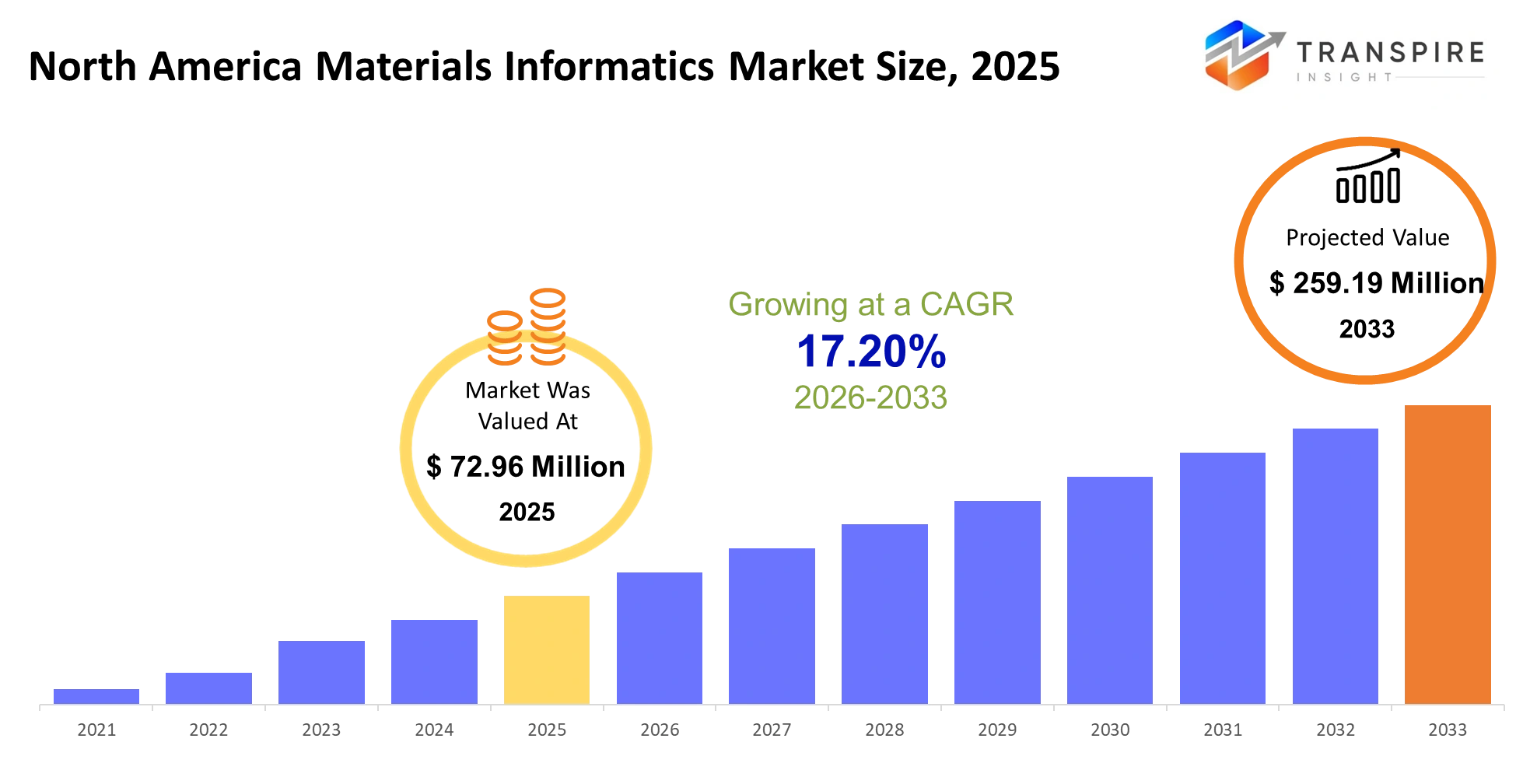
- North America Materials Informatics Market Size 2025: USD 72.96 Million
- North America Materials Informatics Market Size 2033: USD 259.19 Million
- North America Materials Informatics Market CAGR: 17.20%
- North America Materials Informatics Market Segments: By Type (Software, Services, Platforms, Databases, AI Tools, Others), By Application (Material Discovery, Product Design, Quality Control, R&D, Manufacturing, Others), By End-User (Chemical, Pharma, Electronics, Automotive, Aerospace, Others), By Deployment (Cloud, On-Premises, Hybrid, SaaS, AIaaS, Others).
To learn more about this report,  Download Free Sample Report
North America Materials Informatics Market Summary:
The North America Materials Informatics Market size is estimated at USD 72.96 Million in 2025 and is anticipated to reach USD 259.19 Million by 2033, growing at a CAGR of 17.20% from 2026 to 2033. The North America Materials Informatics Market is gaining strong momentum as industries increasingly adopt data-driven approaches to accelerate material discovery and innovation.
Organizations benefit from artificial intelligence machine learning and big data analytics because these technologies enable them to complete research projects at lower costs while shortening their time to completion. The aerospace automotive and electronics industries require organizations to develop better materials at faster rates because these materials directly affect their ability to meet performance targets and sustainability targets.
The North America Materials Informatics Market expands because research institutions and industry partners increase their collaborations to create materials with superior characteristics. Organizations require lightweight and durable and energy-efficient materials which drives them to use informatics platforms for their predictive modeling and simulation needs. The digital transformation of research and development processes will drive market growth because organizations will increase their investments to meet the demands of innovation-based competitive advantage.
What Has the Impact of Artificial Intelligence Been on the North America Materials Informatics Market?
Artificial intelligence has emerged as a disruptive technology which transforms the North America Materials Informatics Market through its ability to accelerate material discovery while achieving higher accuracy through its sophisticated data analysis methods. The North America Materials Informatics Market platforms gain improved market research capabilities through AI integration which enables them to analyze extensive experimental data to find hidden patterns and speed up research and development processes.
The North America Materials Informatics Market enables organizations to use artificial intelligence for predictive analytics and machine learning models which help them discover new material patterns while they optimize formulas and decrease their need for conventional testing methods thus achieving better results in their innovative processes.AI technology drives advanced demand forecasting methods which enhance production efficiency and improve supply chain management in the North America Materials Informatics Market.
Intelligent algorithms provide companies with real-time material performance data and market trend information which enables them to adjust their production strategies according to changing industry requirements while achieving cost reductions and waste minimization. Businesses can achieve better operational efficiency through smart automation which improves their workflow processes while enabling them to grow their operations and maintain accuracy. AI-driven personalization which brings fast innovation to the North America Materials Informatics Market creates a competitive environment that benefits companies through their unique strategic advantage in analyzing data.
Key Market Trends & Insights:
- The materials informatics market in North America experiences strong growth because industries increasingly adopt machine learning together with data-driven material innovation methods.
- The materials informatics market in North America uses AI technology to improve predictive analytics which helps speed up material design processes while decreasing R&D expenses by up to 30%.
- The rising need for environmentally friendly yet high-performing materials drives North American materials informatics market platforms to invest more in artificial intelligence technologies.
- Enterprises now adopt cloud computing with big data tools as their main trend because this combination enables better scalability and real-time data analysis throughout their operations.
- The United States controls more than 75% of the North American materials informatics market in 2025 because of its established research and development facilities.
- Canada holds the title of fastest-expanding area because its artificial intelligence investments will drive growth at a compound annual growth rate of 17% until 2030.
- The software solutions market will reach 60% market share in 2025 because users need simulation and predictive modeling software.
- The services segment maintains its position as the second largest market share which comes from consulting and integration services that serve industrial operations.
- The cloud-based platform market represents the most rapidly expanding section which will experience substantial growth during the 2025 to 2030 forecast period.
- Material discovery and development processes have established their dominance because material scientists require more efficient ways to develop new materials.
- The manufacturing industry experiences its fastest growth through manufacturing optimization because businesses now use smart automation and artificial intelligence process control systems.
- The automotive and aerospace industries control about 40% of the market because they need lightweight materials that maintain high strength.
North America Materials Informatics Market Segmentation
By Type
The software package includes simulation and modeling tools which enable quick testing of material behavior and performance under various conditions. The services provide consulting and integration and maintenance support which enables organizations to implement and operate informatics systems smoothly.
The platforms function as integrated systems which permit multiple tools to operate together thus enhancing team collaboration and data sharing capabilities. The databases maintain both structured and unstructured material data which provides users with simple access and better decision-making abilities.
The AI tools will implement machine learning algorithms to forecast material characteristics while minimizing testing requirements. The tools will enable organizations to accelerate their innovation process by discovering trends within extensive data collections. The other category comprises specialized solutions which will meet particular requirements of various industrial sectors. The different segments work together to create efficient processes which lead to superior research results.
By Application
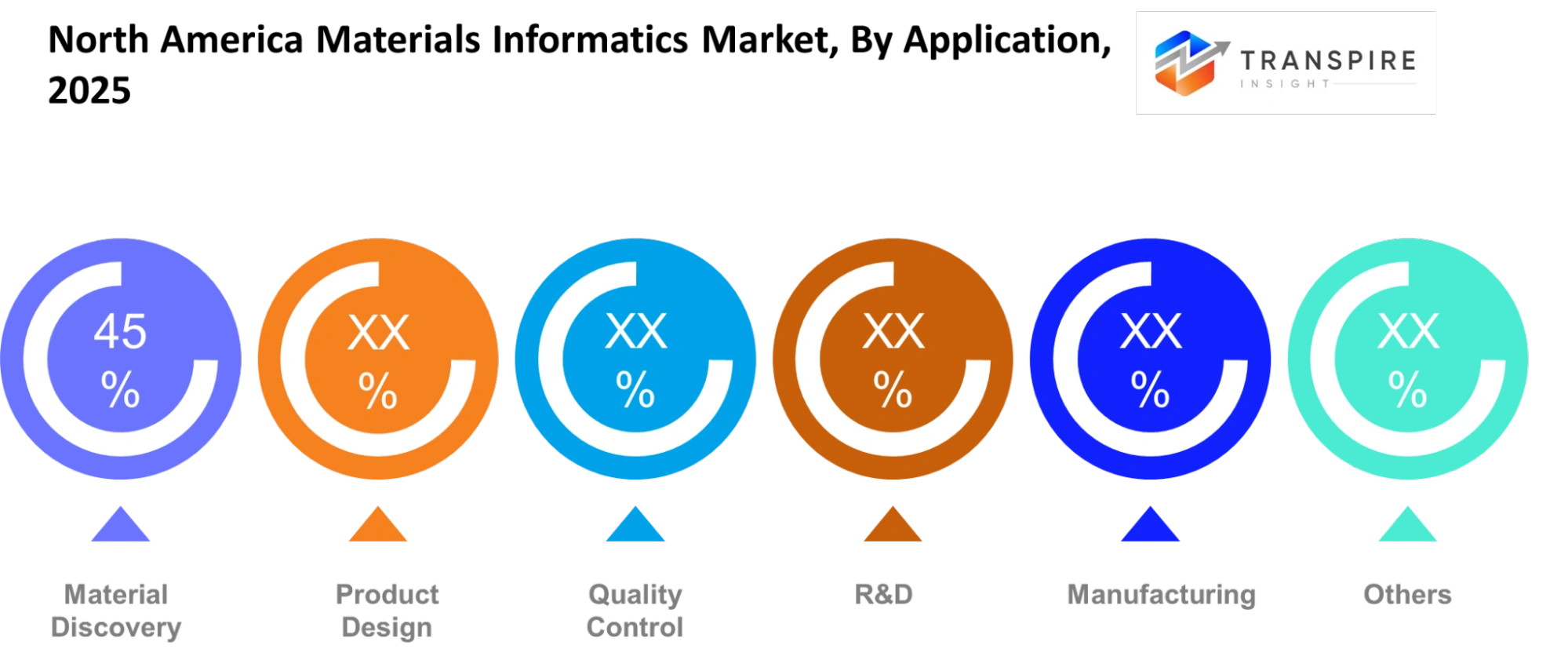
Material discovery focuses on finding new materials which have better strength and durability and environmental sustainability. Informatics tools will help product design teams to choose materials and achieve better product performance. Quality control establishes uniform standards through its assessment of production defects and process variations. Research and development activities will use data-driven insights to accelerate their experimental and innovative processes.
The manufacturing applications will boost production efficiency because they can forecast material behavior. The tools will help industries to minimize their waste and maximize their resource efficiency. The system supports specialized use cases which will fulfill distinct operational needs. The system enables organizations to achieve superior decision-making results and accelerated product development processes.
To learn more about this report, Download Free Sample Report
By End User
Scientists work to discover new materials which have better strength and durability and sustainability than current materials. Product design will use informatics tools to refine material selection and enhance product performance. Quality control uses defect analysis with production process variation analysis to maintain consistent quality standards. Research and development activities will use data-based insights to decrease time needed for testing and development of new ideas.
Manufacturing applications will optimize production efficiency by predicting material behavior in real-time. These tools will reduce waste and improve resource utilization across industries. The system will provide specialized applications which will support specific operational needs. Each application will support better decision-making and faster product development.
By Deployment
The introduction of cloud deployment will enable organizations to expand their operations while providing employees remote access, which simplifies the process of handling extensive data and working with teams in different geographical areas. Organizations will gain enhanced ability to protect critical information through the implementation of on-premises systems which enable them to control their internal operations.
The hybrid model will utilize both methods to deliver operational versatility and optimal performance results. SaaS solutions will enable users to access software applications through the internet without needing to purchase and maintain substantial technology resources.
AIaaS will provide organizations with comprehensive analytical capabilities through its subscription-based service delivery model which businesses in various sectors can use. These services will lower entry barriers for small and medium enterprises. The available deployment options consist of new operational models which will evolve to meet future business requirements. The various deployment options which exist will enhance operational efficiency while providing companies with flexible solutions and financial savings opportunities.
What are the Main Challenges for the North America Materials Informatics Market?
The north america materials informatics market faces significant technical and operational difficulties which restrict its ability to scale operations and achieve peak efficiency. The process of integrating complex data from multiple sources results in data inconsistencies which decrease the precision and dependability of models.
The predictive analytics and machine learning models experience performance restrictions which create obstacles for processing unstructured data and incomplete datasets. The north american materials informatics market faces multiple challenges which lead to both slower innovation processes and decreased trust in data-based results.
The north america materials informatics market encounters growth restrictions which result from manufacturing and commercialization obstacles. The implementation process requires high costs and organizations need to build special infrastructure which makes adoption difficult for many organizations. The combination of regulatory compliance requirements and validation processes creates product development delays which prevent products from entering the market at faster rates.
The adoption process faces major obstacles because there are not enough trained workers and the digital systems of organizations remain underdeveloped. Organizations who do not have artificial intelligence and data science knowledge cannot use their informatics systems successfully. The lack of funding which smaller companies need to purchase cutting-edge technology creates an obstacle for their growth. The north america materials informatics market faces slow adoption rates because market constraints limit industry progress.
The market competition with future threats creates challenges for sustained business growth because new technologies compete against established research methods. The emergence of new solution providers puts pricing pressure on existing companies which results in decreased profit margins and financial sustainability. The combination of fast technology evolution and changing regulatory rules creates unpredictable business conditions which jeopardize investments that require long-term commitment. The combined elements of these factors shape market competition while they determine business strategies within the north america materials informatics industry.
Regional Insights
The United States controls the North America Materials Informatics Market because it possesses superior research centers and its scientific community began using digital technologies before other countries. The market will experience continuous growth because of the strong investment in artificial intelligence and data-driven technologies.Canada will drive international market development through its commitment to academic partnerships and innovative research initiatives.
The main business and research facility distribution within important urban areas shows how regional development progresses. The requirement for fast material development together with cost-effective solutions will lead to increased market penetration. The combination of government funding and private sector initiatives will develop infrastructure while enabling technology adoption. The market conditions will remain advantageous because of ongoing technological advancements together with industry requirements.
The automotive and aerospace and electronics sectors will expand their operations because of economic stability and the presence of a strong industrial base. The establishment of regional partnerships between universities and companies will result in better access to knowledge and increased innovation capacity. The development of the region will depend on the ability of its workforce to acquire skills and the region's digital infrastructure, which will create consistent progress throughout the area.
Recent Development News
In April 2026, Citrine Informatics strengthens funding position to expand AI-driven materials platform: US-based Citrine Informatics has continued strengthening its financial base, supporting expansion of AI-enabled materials discovery solutions. The funding momentum highlights increasing investor confidence in data-driven materials innovation across industrial applications.
Source: https://tracxn.com
In April 2026, the US materials AI sector sees continued investment momentum led by informatics startups: Several US-based firms in the North American materials informatics market, including Citrine Informatics, are strengthening funding and platform capabilities to scale AI-based material innovation. These investments support faster simulation and data-driven product development.
Source: https://www.crunchbase.com
|
Report Metrics |
Details |
|
Market size value in 2025 |
USD 72.96 Million |
|
Market size value in 2026 |
USD 85.36 Million |
|
Revenue forecast in 2033 |
USD 259.19 Million |
|
Growth rate |
CAGR of 17.20% from 2026 to 2033 |
|
Base year |
2025 |
|
Historical data |
2021 – 2024 |
|
Forecast period |
2026 – 2033 |
|
Report coverage |
Revenue forecast, competitive landscape, growth factors, and trends |
|
Country scope |
North America (Canada, The United States, and Mexico) |
|
Key company profiled |
Citrine Informatics, Materials Zone, Exabyte, IBM, Microsoft, Siemens, Dassault Systemes, Schrödinger, Kebotix, Intel, BASF, Dow, Google, Amazon, Hitachi. |
|
Customization scope |
Free report customization (country, regional & segment scope). Avail customized purchase options to meet your exact research needs. |
|
Report Segmentation |
By Type (Software, Services, Platforms, Databases, AI Tools, Others), By Application (Material Discovery, Product Design, Quality Control, R&D, Manufacturing, Others), By End-User (Chemical, Pharma, Electronics, Automotive, Aerospace, Others), By Deployment (Cloud, On-Premises, Hybrid, SaaS, AIaaS, Others). |
How Can New Companies Establish a Strong Foothold in the North America Materials Informatics Market?
Companies entering the North American materials informatics market must first establish their target markets and develop their unique value propositions. The company should concentrate its efforts on fields which need urgent solutions, specifically healthcare materials and advanced manufacturing and energy storage.
Companies can implement innovation strategies through AI-driven platforms which enable better predictive analytics and faster material development processes. Emerging companies can use this method to track existing market development patterns and upcoming industry changes.
The North American materials informatics market requires technology differentiation because data accuracy and model efficiency determine how companies compete with each other. New companies should invest in machine learning models that deliver faster insights and higher reliability compared to traditional methods.
The combination of universities and industrial organizations through strategic partnerships helps companies achieve product validation and market introduction more quickly. Companies can improve their market position and solution performance through partnerships because they gain access to valuable exclusive data.
Kebotix and Citrine Informatics represent how emerging companies can establish themselves in the market through innovative solutions and collaborative efforts. The company develops AI-based material discovery systems which operate on cloud platforms to fulfill customer demand for high-efficiency systems that can scale. New companies can build their reputation and succeed in the North American materials informatics market by solving actual business problems which lead to cost savings and quicker research and development results.
Key North America Materials Informatics Market Company Insights
The North America Materials Informatics Market experiences intense competition which develops through innovative research methods and precise data collection and effective platform operation. The main players in the market will develop advanced analytical tools and artificial intelligence systems to enhance their material discovery processes. Organizations will achieve stronger market presence and better customer acquisition through their ongoing product development work and improvements to user experience.
The organizations will establish strategic partnerships and conduct collaborations to enhance their operational capabilities and obtain fresh data resources. Companies will invest in cloud-based solutions and scalable platforms to meet growing demand.. The company's ability to compete in the market will depend on two factors their technological capabilities and their ability to maintain effective pricing while providing dependable fast solutions to multiple industries.
Company List
- Citrine Informatics
- Materials Zone
- Exabyte
- IBM
- Microsoft
- Siemens
- Dassault Systemes
- Schrödinger
- Kebotix
- Intel
- BASF
- Dow
- Amazon
- Hitachi
What are the Key Use-Cases Driving the Growth of the North America Materials Informatics Market?
The north america materials informatics market is expanding rapidly because it enables faster material discovery across all industrial sectors. Advanced analytics and machine learning models enable faster identification of high-performance materials which decreases development time by 40%.
The north america materials informatics market enables automotive and aerospace industries to create lightweight materials which maintain durability. The materials decrease fuel consumption while lowering greenhouse gas emissions and increasing safety performance. Companies use predictive modeling to digitally evaluate different material combinations which helps them reduce expensive physical testing. Data-driven engineering has become the main force which drives companies toward better operational efficiency and business growth.
The North American materials informatics market transforms manufacturing processes through its implementation in production operations. The system utilizes real-time data analysis to achieve three goals which include optimizing material usage and waste reduction and quality control improvement. The combination of smart automation and informatics platforms increases operational efficiency while maintaining steady production levels. These advantages lead to companies across multiple sectors adopting new operational methods.
The new technologies enable the achievement of renewable energy targets while supporting the development of future technological devices. The increasing need for environmentally friendly and efficient products will create ongoing market growth through these applications.
North America Materials Informatics Market Report Segmentation
By Type
- Software
- Services
- Platforms
- Databases
- AI Tools
- Others
By Application
- Material Discovery
- Product Design
- Quality Control
- R&D
- Manufacturing
- Others
By End-User
- Chemical
- Pharma
- Electronics
- Automotive
- Aerospace
- Others
By Deployment
- Cloud
- On-Premises
- Hybrid
- SaaS
- AIaaS
- Others
Frequently Asked Questions
Find quick answers to common questions.
The approximate North America Materials Informatics Market size for the market will be USD 259.19 Million in 2033.
The key segments of the North America Materials Informatics Market are By Type (Software, Services, Platforms, Databases, AI Tools, Others), By Application (Material Discovery, Product Design, Quality Control, R&D, Manufacturing, Others), By End-User (Chemical, Pharma, Electronics, Automotive, Aerospace, Others), By Deployment (Cloud, On-Premises, Hybrid, SaaS, AIaaS, Others).
Major players in the North America Materials Informatics Market are Citrine Informatics, Materials Zone, Exabyte, IBM, Microsoft, Siemens, Dassault Systemes, Schrödinger, Kebotix, Intel, BASF, Dow, Google, Amazon, Hitachi.
The current market size of the North America Materials Informatics Market is USD 72.96 Million in 2025.
The North America Materials Informatics Market CAGR is 17.20%.
- Citrine Informatics
- Materials Zone
- Exabyte
- IBM
- Microsoft
- Siemens
- Dassault Systemes
- Schrödinger
- Kebotix
- Intel
- BASF
- Dow
- Amazon
- Hitachi
Recently Published Reports
-
Apr 2026
3D Optical Profiler Market
3D Optical Profiler Market Size, Share & Analysis Report By Type (Desktop 3D Optical Profiler, and Portable 3D Optical Profiler), By Technology (Confocal Technology, and White Light Interference), By End-Use Industry (Manufacturing, Research Institutions, Automotive, Aerospace and Defense, Medical Devices, and Other), and Geography (North America, Europe, Asia-Pacific, Middle East and Africa, South and Central America), 2021 - 2031
-
Feb 2025
Depth Sensor Market
Depth Sensor Market Size, Share & Analysis Report By Type (Infrared Depth Sensors, Time-of-Flight (ToF) Sensors, Stereo Vision Sensors, Structured Light Sensors, Ultrasonic Depth Sensors), By Application (Automotive, Robotics, Gaming, Consumer Electronics, Industrial Automation, Healthcare, Security & Surveillance, Others), By End Users (Automotive Manufacturers, Consumer Electronics Companies, Healthcare Providers, Industrial Companies, Security Agencies, Gaming Companies, Robotics Companies, Others), and Geography (North America, Europe, Asia-Pacific, Middle East and Africa, South and Central America), 2021 – 2031
-
Feb 2025
Digital Manufacturing Market
Digital Manufacturing Market Size, Share & Analysis Report By Component (Hardware, Software, and Services), By Technology (Robotics, 3D Printing, Internet of Things (IoT), and Others), By Application (Automotive and Transportation, Aerospace and Defense, Consumer Electronics, Industrial Machinery, and Others), By Process Type (Computer-Based Designing, Computer-Based Simulation, Computer 3D Visualization, Analytics, and Others), and Geography (North America, Europe, Asia-Pacific, Middle East and Africa, South and Central America), 2021 – 2031
-
Feb 2025
Digital Visa Services Market
Digital Visa Services Market Size, Share & Analysis Report By Type (Individual Travelers, Group Travelers), By Application (Tourism, Business Travel, Others), and Geography (North America, Europe, Asia-Pacific, Middle East and Africa, South and Central America), 2021 – 2031