
North America Mass Spectrometry Market Size & Forecast:
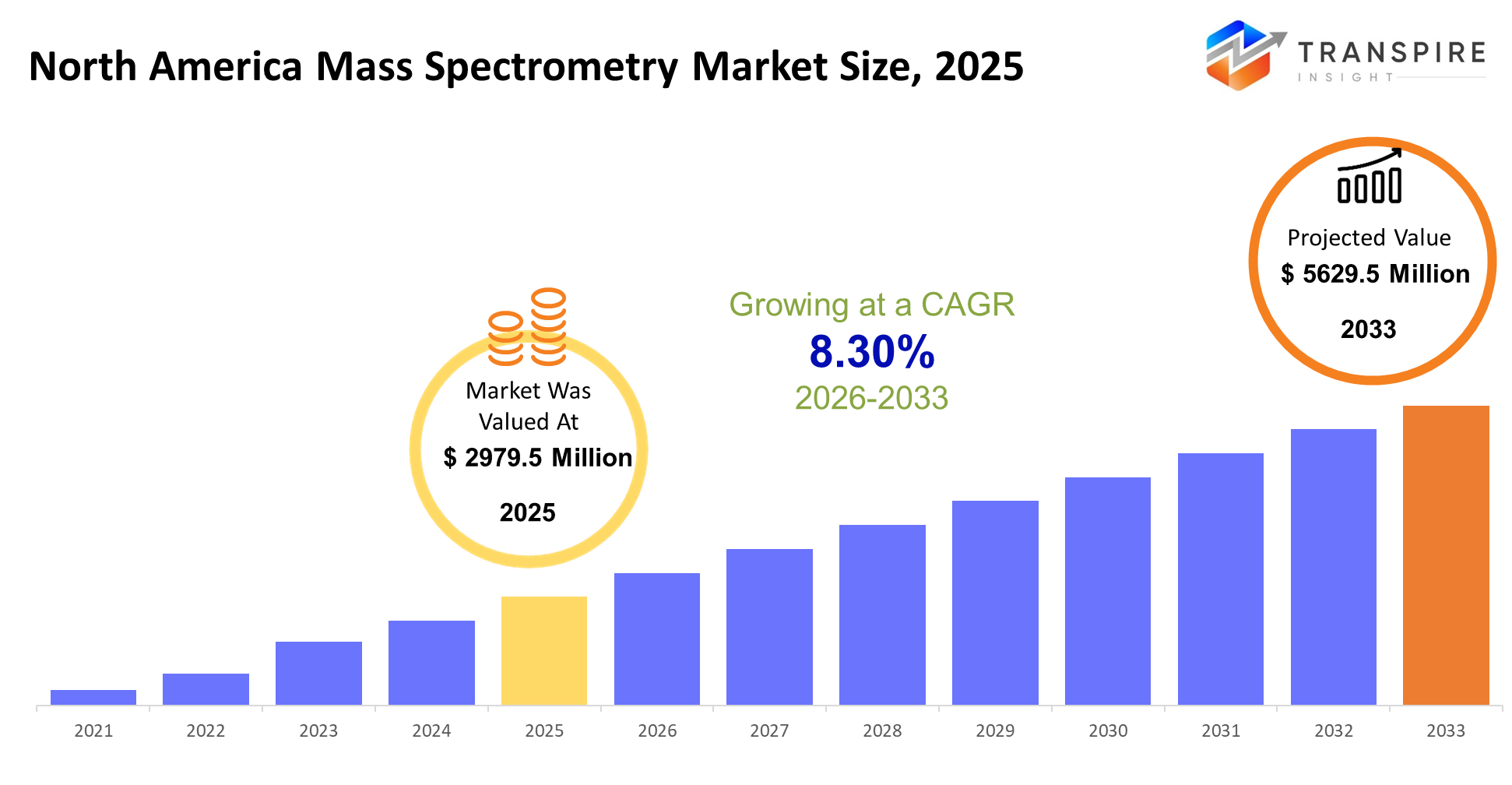
- North America Mass Spectrometry Market Size 2025: USD 2979.5 Million
- North America Mass Spectrometry Market Size 2033: USD 5629.5 Million
- North America Mass Spectrometry Market CAGR: 8.30%
- North America Mass Spectrometry Market Segments:By Type (LC-MS, GC-MS, MALDI-TOF, ICP-MS, Orbitrap, Quadrupole, TOF), By Application (Proteomics, Metabolomics, Pharma, Environmental, Food, Clinical, Forensics), By Technology (Ionization, Tandem MS, High-resolution, Imaging, Portable, Hybrid, Automated), By End-User (Pharma, Labs, Academia, Govt, Hospitals, CROs, Industry), By Component (Instruments, Software, Consumables, Services, Detectors, Ion Sources, Columns).
To learn more about this report,  Download Free Sample Report
North America Mass Spectrometry Market Summary:
The North America Mass Spectrometry Market size is estimated at USD 2979.5 Million in 2025 and is anticipated to reach USD 5629.5 Million by 2033, growing at a CAGR of 8.30% from 2026 to 2033. The North America Mass Spectrometry Market is currently experiencing rapid expansion because pharmaceutical and biotechnology and environmental testing industries need advanced analytical techniques. Mass spectrometry enables drug discovery and proteomics and clinical diagnostics by providing accurate methods to identify and measure complex compounds. The region sees increased adoption of personalized medicine because researchers are investing money into life sciences studies. The industries are required to use high-performance analytical instruments because regulatory authorities focus on quality control and safety testing.
The North America Mass Spectrometry Market benefits from technological progress which includes hybrid systems and automated functions that improve operational precision and productivity. The market is expanding because of increasing uses in food safety testing and forensic analysis and environmental monitoring. The United States and Canada have both research institutions and top market companies which create an environment for innovative developments. Companies that want to make decisions based on data will create a continuous need for dependable analytical systems which can process large amounts of information.
What Has the Impact of Artificial Intelligence Been on the North America Mass Spectrometry Market?
Artificial intelligence is rapidly transforming the north american mass spectrometry industry by creating new methods to handle and evaluate data which industries now use for their operations. The north american mass spectrometry market uses AI applications to analyze complex spectral data, which helps identify pharmaceutical and proteomic and environmental testing compounds at faster speeds with greater precision.
Companies use advanced machine learning algorithms to process data in real time while creating predictive analytics functions which help them conduct market research and speed up their innovation processes. Artificial intelligence systems which operate in the north american mass spectrometry market help organizations make better decisions while improving their ability to compete with other businesses.
The north american mass spectrometry industry uses smart automation and machine learning technology to create better workflows which help organizations achieve higher production rates while spending less money. Companies use AI technologies for demand forecasting and trend prediction to better understand upcoming market changes, which helps them distribute resources more efficiently.
Predictive models for supply chain optimization create better inventory control processes which help organizations avoid supply chain interruptions. These improvements enhance operational efficiency while creating tailored solutions and new product developments which establish the north american mass spectrometry market as a leader in technological advancement and sustainable expansion.
Key Market Trends & Insights:
- The North American mass spectrometry market in 2024 appears to be controlled by the United States which holds more than 75 percent of the market.
- The Canadian market exhibits the fastest growth because it will achieve more than 7 percent compound annual growth rate from 2025 to 2030 due to biotech investments and academic research expansion.
- Hybrid mass spectrometry systems maintain their market leadership with 45 percent market share because they deliver accurate results and multiple testing functions to various sectors.
- Single mass spectrometers remain the second-largest segment which laboratory facilities commonly use for testing and budget-friendly needs.
- The software and data analytics market experiences its fastest expansion through AI-powered systems which enable better automated data analysis solutions.
- Pharmaceutical and biotechnology applications dominate the market which controls almost 50% of the market through its extensive application in drug discovery and proteomics research.
- The environmental testing sector experiences rapid growth because stricter regulations create a higher demand for pollution monitoring systems.
- Research laboratories and academic institutes lead the market with more than 40 percent market share which they maintain through their ongoing funding and innovation projects.
- Contract research organizations (CROs) experience rapid growth because outsourced work and increased clinical trial activities provide new business opportunities.
North America Mass Spectrometry Market Segmentation
By Type
LC-MS systems will maintain their status as essential tools because they deliver exceptional results which researchers require for their studies of pharmaceutical drugs and biochemical compounds. GC-MS instruments will support applications involving volatile compounds, especially in environmental and forensic testing.
MALDI-TOF systems will gain attention for rapid microbial identification in clinical settings. ICP-MS maintains its role as a powerful instrument which detects trace elements at high sensitivity in both industrial environments and environmental testing. The combination of Orbitrap and quadrupole technologies enables researchers to achieve high accuracy and stability during their complex sample testing procedures.
Time-of-flight systems will provide rapid data collection capabilities which enable their use in environments that require automated testing processes. The different types of instruments will enable various analytical tasks which will result in industries maintaining a steady need for their products. The various instrument types will create a research environment which researchers and practitioners will adopt throughout their work.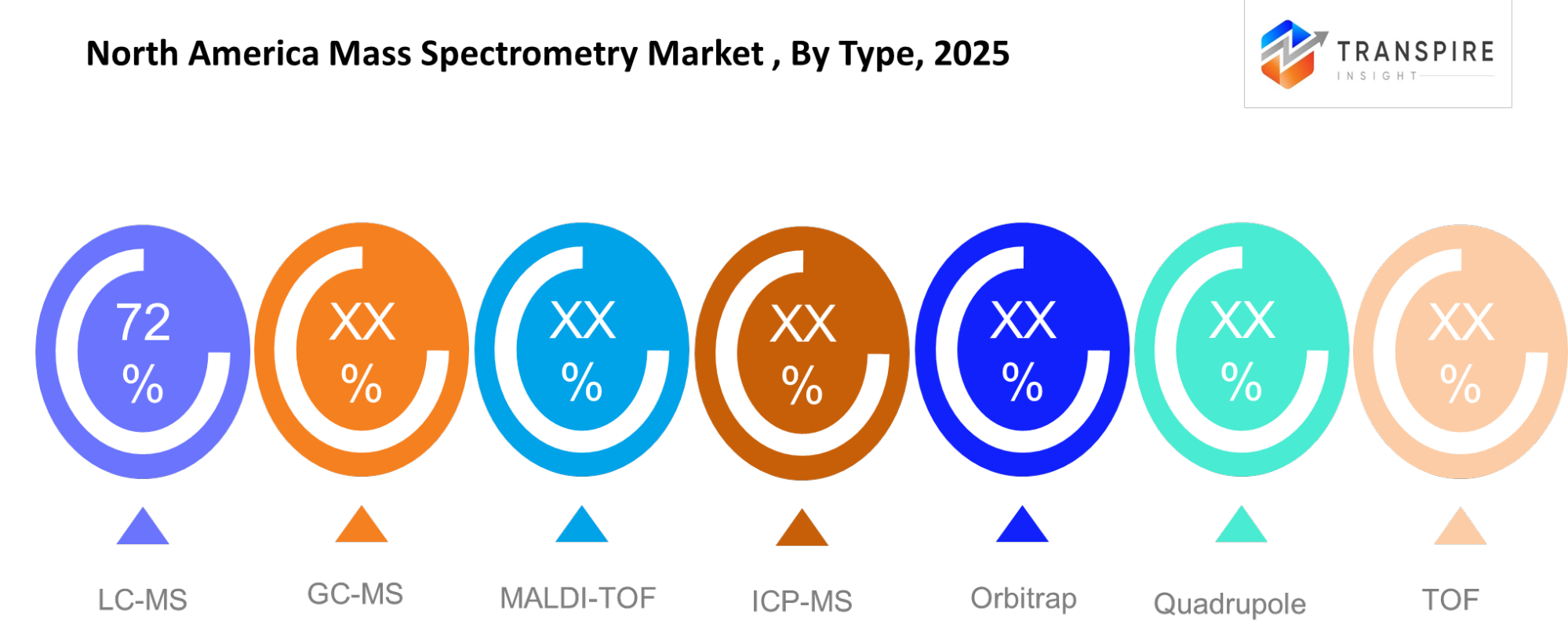
To learn more about this report, Download Free Sample Report
By Application
The need for proteomics applications will increase because organizations now focus on protein analysis and biomarker discovery research. Metabolomics research enables scientists to investigate metabolic pathways and identify diseases. The pharmaceutical industry will maintain its leading position because drug developers require accurate identification of compounds for their testing work. Environmental testing will expand at a steady pace because organizations need to increase their compliance with regulatory monitoring requirements.
Food safety analysis will ensure quality control and contamination detection across supply chains. Clinical diagnostics will expand with improved testing accuracy and faster processing time. Forensic applications will support law enforcement through substance identification and toxicology analysis. The different application areas will generate consistent growth through their respective patterns of demand.
By Technology
The system will use ionization techniques as its main operational method which will enable sample analysis through conversion. Tandem MS will provide deeper insights through multi-stage analysis, improving detection accuracy. Advanced research environments will use high-resolution systems to perform in-depth studies of complicated mixtures. Imaging mass spectrometry will enable spatial examination of biological specimens which will advance medical research.
Field testing and on-site analysis will drive the adoption of portable systems. Hybrid technologies will use multiple systems together to create better performance and flexible operational capabilities. Automated systems will decrease the amount of work that employees need to do while they perform their tasks at laboratories. The continuous development of these technologies will enable their use in different industries.
By End User
Pharmaceutical companies will continue to be major customers because they need ongoing drug development work and drug quality testing services. The laboratory will provide analytical solutions and testing services which will serve all business sectors. Academic institutions will drive research-based demand, supported by funding and innovation programs. Government organizations will focus on regulatory compliance and environmental monitoring activities.
Hospitals will use systems for clinical diagnostics and disease detection. Contract research organizations will expand usage through outsourced research and testing services. Industrial users will apply systems in quality control and production processes. The various needs of end-users will create continuous growth opportunities for different sectors.
By Component
The equipment will generate the highest revenue because of its expensive price and vital function in research activities. The software will become more crucial for handling data and interpreting results and managing system operations. The laboratory will need to purchase consumables which include reagents and columns to maintain its operational capacity. The company will provide services through maintenance and calibration and training programs which will help maintain system performance for extended periods.
Detectors and ion sources will continue to function as essential elements for producing precise signal detection and sample ionization. The columns will function as essential elements which separate samples before they undergo testing. The system will achieve better performance through the particular functions of each element. The market will experience steady growth because the different components will receive equal demand from customers.
What are the Main Challenges for the North America Mass Spectrometry Market Growth?
The north america mass spectrometry market encounters multiple technical and operational obstacles which disrupt both its operational efficiency and its ability to grow. The combination of complex instruments and their requirement for accurate calibration results in both operational performance issues and higher equipment upkeep needs. North america mass spectrometry market processes face data interpretation challenges because workers must handle extensive complex data sets. Supply chain interruptions for essential parts together with advanced technology requirements create additional obstacles that prevent development.
The north america mass spectrometry market expansion faces restrictions from both manufacturing and commercialization challenges. The combination of high production expenses and stringent regulatory standards together with compliance requirements for quality control measures such as GMP results in extended timeframes and increased costs for product development. The existing market limitations cause product development delays which prevent smaller companies from accessing products. Manufacturers face two economic challenges which lead to decreased profit margins that make it difficult to maintain operations over time.
The north america mass spectrometry market experiences slow growth because adoption challenges persist which stem from two main issues. Many laboratories face infrastructure gaps especially in smaller institutions that lack funding for advanced analytical tools The need for specialized training and technical expertise further restricts widespread adoption. The combination of these factors creates obstacles which prevent industries from implementing full-scale operations.
Country Insights
Canada will show stable growth which biotechnology sector expansion and research funding growth will drive. Scientific studies and innovation programs will create demand which universities and research centers will use to meet their needs. Government support and regulatory focus will drive increased adoption of environmental testing and clinical research methods.
The system usage will increase because healthcare advancements and precision medicine development become more accessible. The increasing collaboration between public agencies and private companies will boost technological progress. Better access to sophisticated scientific equipment will enable laboratories and research facilities to grow their operations.
Industrial applications together with environmental monitoring requirements will provide gradual growth for all regions in North America. The testing facilities and laboratory infrastructure expansion will create more demand for their services. Organizations will adopt new systems at a moderate rate because of their high costs and the difficulties they face in accessing sophisticated systems.
The government initiatives which aim to enhance research capabilities will benefit future development efforts. The food processing and chemical analysis industries will generate ongoing demand. The market will experience steady growth because companies will continue to prioritize regulatory compliance and quality control.
Recent Development News
In January 2026, Thermo Fisher Expands U.S. Production Contracts Amid Pharma Shift: Thermo Fisher Scientific secured multiple new contracts as pharmaceutical companies shifted production to the United States, strengthening demand for analytical tools, including mass spectrometry systems. This move reflects growing domestic manufacturing and testing needs, supporting instrument adoption across drug development workflows.
Source: https://www.reuters.com
In February 2026, Agilent Reports Earnings Impacted by Market Conditions: Agilent Technologies reported quarterly results slightly below expectations, citing external disruptions affecting U.S. operations. Performance pressures reflect broader demand fluctuations in analytical instrumentation markets, including mass spectrometry used in diagnostics and research.
Source: https://www.reuters.com
|
Report Metrics |
Details |
|
Market size value in 2025 |
USD 2979.5 Million |
|
Market size value in 2026 |
USD 3220.7 Million |
|
Revenue forecast in 2033 |
USD 5629.5 Million |
|
Growth rate |
CAGR of 8.30% from 2026 to 2033 |
|
Base year |
2025 |
|
Historical data |
2021 – 2024 |
|
Forecast period |
2026 – 2033 |
|
Report coverage |
Revenue forecast, competitive landscape, growth factors, and trends |
|
Regional scope |
North America (Canada, The United States, and Mexico) |
|
Key company profiled |
Thermo Fisher, Agilent, Waters, Bruker, Shimadzu, PerkinElmer, SCIEX, JEOL, Hitachi, Rigaku, LECO, Analytik Jena, Advion, Dani Instruments, Extrel |
|
Customization scope |
Free report customization (country, regional & segment scope). Avail customized purchase options to meet your exact research needs. |
|
Report Segmentation |
By Type (LC-MS, GC-MS, MALDI-TOF, ICP-MS, Orbitrap, Quadrupole, TOF), By Application (Proteomics, Metabolomics, Pharma, Environmental, Food, Clinical, Forensics), By Technology (Ionization, Tandem MS, High-resolution, Imaging, Portable, Hybrid, Automated), By End-User (Pharma, Labs, Academia, Govt, Hospitals, CROs, Industry), By Component (Instruments, Software, Consumables, Services, Detectors, Ion Sources, Columns). |
How Can New Companies Establish a Strong Foothold in the North America Mass Spectrometry Market?
New entrants aiming to build a strong position in the north america mass spectrometry market will benefit from focusing on niche applications where demand is rising but competition remains moderate. Emerging players who want to develop their business should focus on clinical diagnostics and environmental testing and food safety because these sectors have specific needs which require solutions. Companies that create solutions which solve existing problems will create unique products which enable them to secure initial market presence while enabling market expansion.
The north america mass spectrometry market will depend on companies developing their innovation strategies to achieve market success. Startups that invest in compact, cost-effective instruments or AI-enabled data analysis platforms can reduce complexity and improve usability for end users. 908 Devices markets portable mass spectrometry products which enable customers to conduct real-time tests at their work locations. The industry currently demands technological progress which should improve operational speed and precision and business efficiency.
Companies will gain better access to the north america mass spectrometry market through their strategic partnerships and collaborative efforts. Product validation and market entry will proceed faster through strategic partnerships with research institutions and healthcare organizations and contract research organizations. BaySpec represents the way forward for emerging companies because they utilize cooperation and technology integration to develop new solutions which work across various fields. Companies benefit from these partnerships because they help them handle their regulatory requirements more successfully.
Key North America Mass Spectrometry Market Company Insights
The company will establish partnerships with research institutes and biotechnology companies and healthcare organizations to create new technologies and enter new markets. The partnerships will enable companies to validate their products more effectively while increasing their market presence within specific use cases. The partnerships will enable companies to reach new customer audiences through their joint ventures and contractual agreements.
The partnerships will enable organizations to develop solutions faster while lowering development risks. The shared knowledge between the two parties will drive innovation while boosting product performance. Partnership networks enable organizations to extend their market presence while building their competitive advantages.
The companies will maintain their market advantage through their work on product differentiation and pricing methods and their dedication to delivering high-quality services. The company will enhance customer retention through its delivery of personalized solutions and its commitment to providing excellent post-sale customer service.
Company List
- Thermo Fisher
- Agilent
- Waters
- Bruker
- Shimadzu
- PerkinElmer
- SCIEX
- JEOL
- Hitachi
- Rigaku
- LECO
- Analytik Jena
- Advion
- Dani Instruments
- Extrel
What are the Key Use-Cases Driving the Growth of the North America Mass Spectrometry Market?
The North American mass spectrometry market exists because pharmaceutical and biotechnology research require accurate compound identification and quantification via mass spectrometry. Advanced mass spectrometry systems enable drug discovery, clinical trials and biomarker analysis to achieve greater accuracy while shortening their development timelines. Life sciences organizations now adopt reliable analytical tools because they need dependable testing solutions.
Environmental and food safety testing represents another major application that drives mass spectrometry adoption in the North American market. The regulatory agencies require organizations to conduct thorough checks for contaminants, pesticides and pollutants, which drives the demand for advanced detection systems that operate at high sensitivity. Mass spectrometry provides fast and precise analytical results which enable companies to meet regulatory standards while safeguarding public health which helps to expand the market.
The North American mass spectrometry market identifies clinical diagnostics as an important emerging market segment. Hospitals and diagnostic laboratories increasingly use these systems to identify diseases, conduct toxicology tests and create tailored medical treatments.
The North American mass spectrometry market now extends beyond its healthcare boundaries to include industrial and forensic uses. Manufacturing industries use these systems to test product quality and analyze materials while forensic labs use these systems to identify substances and conduct criminal investigations. The ongoing process of developing new technologies through AI and automation will enhance operational efficiency and system capacity for different applications.
North America Mass Spectrometry Market Report Segmentation
By Type
- LC-MS
- GC-MS
- MALDI-TOF
- ICP-MS
- Orbitrap
- Quadrupole
- TOF
By Application
- Proteomics
- Metabolomics
- Pharma
- Environmental
- Food
- Clinical
- Forensics
By Technology
- Ionization
- Tandem MS
- High-resolution
- Imaging
- Portable
- Hybrid
- Automated
By End-User
- Pharma
- Labs
- Academia
- Govt
- Hospitals
- CROs
- Industry
By Component
- Instruments
- Software
- Consumables
- Services
- Detectors
- Ion Sources
- Columns
Frequently Asked Questions
Find quick answers to common questions.
The Approximate North America Mass Spectrometry Market size for the Market will be USD 5629.5 Million in 2033.
The key Segments of the North America Mass Spectrometry Market are By Type (LC-MS, GC-MS, MALDI-TOF, ICP-MS, Orbitrap, Quadrupole, TOF), By Application (Proteomics, Metabolomics, Pharma, Environmental, Food, Clinical, Forensics), By Technology (Ionization, Tandem MS, High-resolution, Imaging, Portable, Hybrid, Automated), By End-User (Pharma, Labs, Academia, Govt, Hospitals, CROs, Industry), By Component (Instruments, Software, Consumables, Services, Detectors, Ion Sources, Columns).
Major Players in the North America Mass Spectrometry Market are Thermo Fisher, Agilent, Waters, Bruker, Shimadzu, PerkinElmer, SCIEX, JEOL, Hitachi, Rigaku, LECO, Analytik Jena, Advion, Dani Instruments, Extrel.
The Current Market size of the North America Mass Spectrometry Market is USD 2979.5 Million in 2025.
The North America Mass Spectrometry Market CAGR is 8.30%.
- Thermo Fisher
- Agilent
- Waters
- Bruker
- Shimadzu
- PerkinElmer
- SCIEX
- JEOL
- Hitachi
- Rigaku
- LECO
- Analytik Jena
- Advion
- Dani Instruments
- Extrel
Recently Published Reports
-
Dec 2025
Biosimilars Market
Biosimilars Market By Product Type (Monoclonal Antibodies, Recombinant Hormones, Erythropoietin, G-CSF, Others), By Indication (Oncology, Autoimmune Diseases, Blood Disorders, Diabetes, Others), By Manufacturing Type (In-House Manufacturing, Contract Manufacturing), By Distribution Channel (Hospital Pharmacies, Retail Pharmacies, Online Pharmacies), By Industry Analysis, Size, Share, Growth, Trends, and Forecasts 2021-2033
-
Dec 2025
Gastrointestinal Endoscopy Market
Gastrointestinal Endoscopy Market By Type (Rigid Gastrointestinal Endoscope, Flexible Gastrointestinal Endoscopes, Disposable Gastrointestinal Endoscope), By Procedure Type (Colonoscopy, Gastroscopy, Duodenoscopy, Enteroscopy, Flexible Sigmoidoscopy, Others), By Application (Diagnosis, Treatment), By End-Users (Hospitals, Ambulatory Surgical Centers, Specialty Clinics, Laboratories, Others), By Industry Analysis, Size, Share, Growth, Trends, and Forecasts 2021-2033
-
Jan 2026
Rare Inherited Metabolic Disorder Drug Market
Rare Inherited Metabolic Disorder Drug Market By Drug Class (Enzyme Replacement Drugs, Gene Therapy Drugs, Substrate Reduction Drugs, Small Module Drugs, Protein Drugs), By Route of Administration(Parenteral, Oral, Intrathecal), By Clinical Development (Marketed Drugs, Late Stage Clinical Phase III, Early Stage Clinical Phase I-II, Preclinical Candidates), By Indication (Lysosomal Storage Disorders, Urea Cycle Disorders, Amino Acid Metabolic Disorders, organic Acidemias, Peroximal Disorders), By Industry Analysis, Size, Share, Growth, Trends, and Forecasts 2021-2033
-
Jan 2026
Pharmaceutical Cleanroom Technology Market
Pharmaceutical Cleanroom Technology Market By Product (Equipment, Consumables, Services); By Cleanroom Type (Standard Cleanrooms, Modular Cleanrooms); By End Use (Pharmaceutical Companies, Biotechnology Companies), By Industry Analysis, Size, Share, Growth, Trends, and Forecasts 2021-2033