
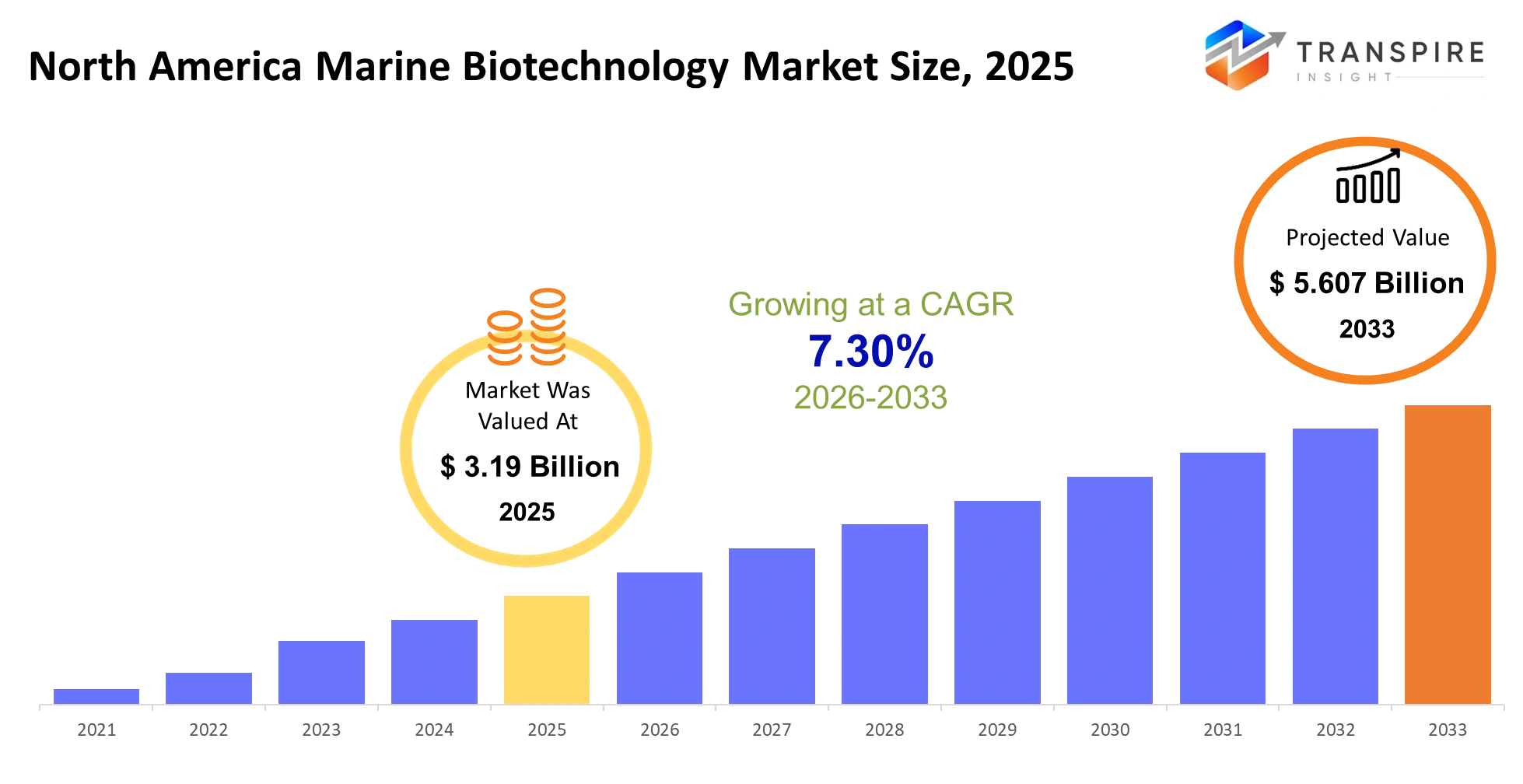
North America Marine Biotechnology Market Size & Forecast:
- North America Marine Biotechnology Market Size 2025: USD 3.19 Billion
- North America Marine Biotechnology Market Size 2033: USD 5.607 Billion
- North America Marine Biotechnology Market CAGR: 7.30%
- North America Marine Biotechnology Market Segments: By Source (Algae, Microorganisms, Corals, Sponges, Fish, Others), By Application (Pharmaceuticals, Cosmetics, Food, Biofuel, Agriculture, Others), By Product (Enzymes, Bioactive Compounds, Polymers, Proteins, Others, Pigments), By End-User (Pharma, Food Industry, Research, Cosmetics, Energy, Others).
To learn more about this report,  Download Free Sample Report
North America Marine Biotechnology Market Summary:
The North America Marine Biotechnology Market size is estimated at USD 3.19 Billion in 2025 and is anticipated to reach USD 5.607 Billion by 2033, growing at a CAGR of 7.30% from 2026 to 2033. The North America Marine Biotechnology Market is expanding rapidly because pharmaceutical companies and nutraceutical businesses and cosmetic manufacturers all seek marine-based bioactive substances.
Scientists use ocean biological resources to create new medicinal drugs and enzymes and biomaterials which provide eco-friendly solutions that replace conventional materials. The region's advanced research and development facilities together with its major financial support for biotechnology research help scientists discover new things from marine organisms. Marine biotechnology is receiving increased attention because it provides sustainable industrial solutions which help address growing environmental issues.
The North America Marine Biotechnology Market experiences innovation growth because government programs support research efforts and academic institutions work together with biotech companies. The marine-based compounds market is growing because personalized medicine and natural product therapies require marine-based compounds in their treatment methods. The market will achieve continuous growth because medical facilities and industrial companies adopt new advances in marine genomics and bio-processing technologies. The region's long-term growth potential benefits from increasing public understanding about the valuable natural resources found in ocean territories.
What Has the Impact of Artificial Intelligence Been on the North America Marine Biotechnology Market?
The artificial intelligence technology conducts research within North America marine biotechnology markets to create better methods for researchers and companies to examine marine resources while producing biological solutions. The North America marine biotechnology market benefits from AI-driven tools which enable scientists to discover marine compounds at a faster rate while decreasing research development time and enhancing their ability to interpret data.
Organizations use machine learning models to create predictive analytics which help them find valuable biological resources within ocean environments. The existing research methods face transformation because scientists now utilize data analysis methods which produce precise results.Artificial intelligence applications within the North America marine biotechnology market for artificial intelligence systems lead to better market research results which improve demand forecasting accuracy.The AI-powered systems process extensive datasets to detect market trends and consumer demand patterns and investment opportunities.
The implementation of smart automation in laboratory processes leads to improved production efficiency and decreased human error and reduced operational expenses. AI systems analyze massive datasets to discover market trends and study consumer demand and find investment opportunities.The implementation of smart automation in laboratory environments leads to increased production efficiency while minimizing human mistakes and cutting down operational expenses. The companies achieve better resource management, which enables them to expedite the market introduction of marine-based products throughout their business operations.
The north america marine biotechnology market establishes its market advantage through its use of AI-powered supply chain optimization which enables efficient handling of marine-based material procurement and distribution. Predictive analytics helps firms anticipate supply disruptions and manage costs effectively. The north america marine biotechnology market uses AI technology to create new products and develop customized medical treatments which use marine bioactive compounds.
Key Market Trends & Insights:
- The north america marine biotechnology market shows fast growth because marine genomics becomes more popular and pharmaceutical applications will reach 35 percent market share in 2025.
- The combination of artificial intelligence with biotechnology research enables faster discovery processes which create better operational results in the north america marine biotechnology market by using predictive bio-data analytics together with compound screening methods.
- The U.S. controls about 70% of the north america marine biotechnology market in 2025 because the region possesses advanced biotech infrastructure and funding resources.
- The Canadian market segment shows the highest growth rate because it will expand at 8.5% CAGR until 2030 driven by increasing marine research activities.
- The north america marine biotechnology market generates its highest revenues from marine bioactive compounds which lead the market, while enzymes and biomaterials follow as the second highest revenue sources.
- The industrial biotechnology market shows increasing demand for marine enzymes which has become the fastest expanding product category.
- The north america marine biotechnology market shows its highest application usage through pharmaceuticals, which reach a 40% market share because of advancements in drug discovery research.
- The nutraceutical market shows the highest growth rate through increasing consumer demand for natural health supplements.
- The pharmaceutical industry demands marine biotechnology products for its main operations, which results in more than 45% market share for this end-user group.
- The government-funded marine research programs drive research institutes and biotech startups to become the fastest developing end-user group.
North America Marine Biotechnology Market Segmentation
By Source
The segment maintains strong market power through the biochemical properties of algae and microorganisms which industrial applications use. Algae serve as a primary source for obtaining proteins and lipids and bioactive compounds that researchers use in developing pharmaceuticals and nutraceuticals. Microorganisms provide essential functions for producing enzymes and discovering drugs which enhance research results across various laboratories. Sponges and corals provide researchers with essential bioactive compounds that enable them to conduct advanced medical research and therapeutic studies. Fish-derived resources create nutritional and biochemical advantages which multiple industrial sectors use. The segment keeps growing because biotechnological development requires natural sustainable marine resources which organizations currently seek.
By Application
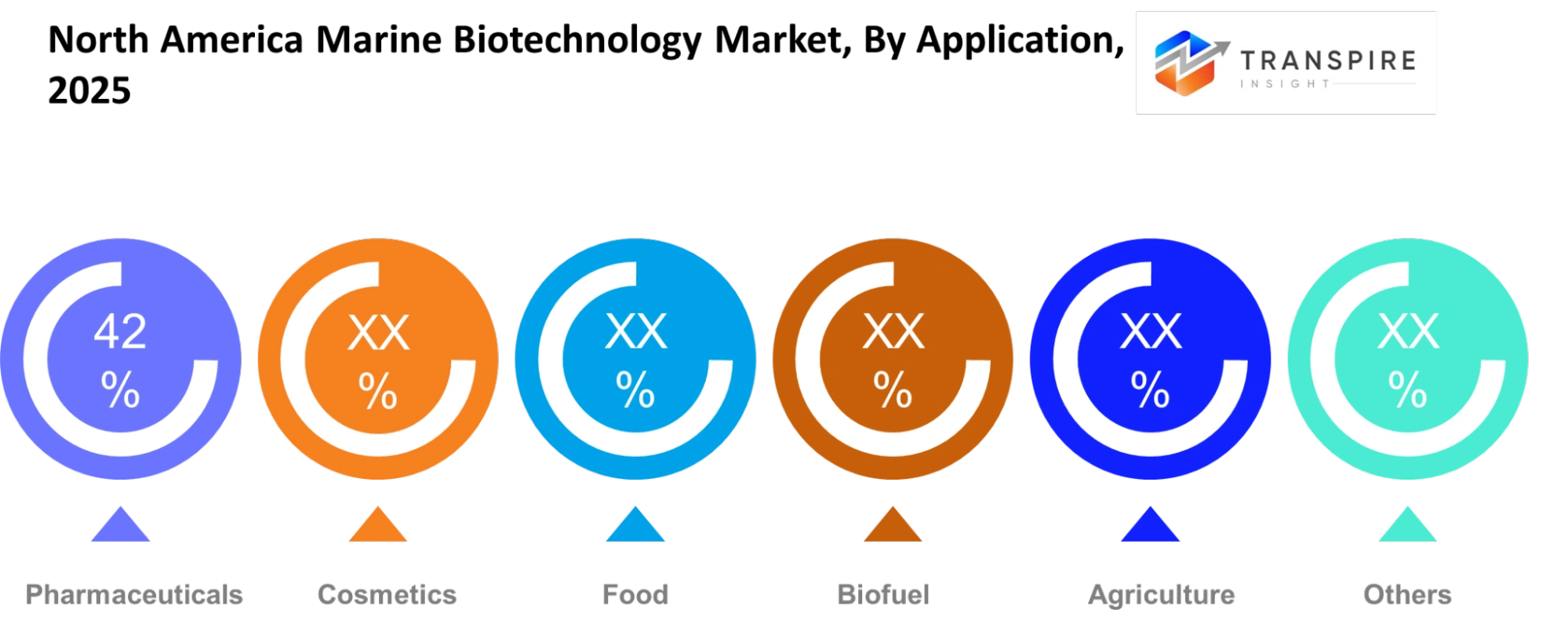
Pharmaceuticals remain the most dominant application area, supported by growing use of marine compounds in drug development and disease treatment research. Cosmetics also show strong demand as marine extracts are used in skincare products for hydration and anti-aging benefits. The use of marine proteins and supplements in functional nutrition products has led to increased growth of food applications. Biofuel development is gaining attention as marine organisms offer renewable energy alternatives. The agricultural industry uses bio-based fertilizers and growth enhancers which originate from marine sources. This segment reflects steady expansion as industries shift toward natural and sustainable solutions.
To learn more about this report, Download Free Sample Report
By Product
The segment depends mainly on enzymes and bioactive compounds because these substances find extensive use across pharmaceuticals and food processing and industrial biotechnology. Enzymes from marine organisms provide industrial systems with capability to create sustainable biochemical production methods. Scientists conduct extensive research on bioactive compounds to explore their potential as therapeutic and antimicrobial agents. The development of biodegradable materials now focuses on polymers derived from marine sources. Marine life proteins serve as vital resources for both nutrition research and pharmaceutical development work.Natural pigments that exist in cosmetics and food coloring products serve as genuine alternatives to synthetic chemical substances. The market for marine-based materials keeps growing because customers choose products that are both environmentally friendly and meet their high-quality standards.
By End User
Marine-derived compounds are growing rapidly, especially in the areas of development and clinical research. The largest end-users of these compounds are pharmaceutical companies. Additionally, the food industry is increasing their use of marine-derived ingredients for both nutritional and functional enhancement. Many research institutions are active in developing marine biotechnologies and have been key in developing new uses of these technologies. Cosmetics manufacturers utilize marine extracts in creating skin and beauty products with naturally-based benefits. Additionally, the renewable energy industry is evaluating marine organisms as possible sources of biofuels and renewable energy. The emphasis that we see across many industries on sustainability, innovation, and resource/energy efficiency will continue to cause this segment to grow.
What are the Main Challenges for the North America Marine Biotechnology Market Growth?
The north america marine biotechnology market faces several technical and operational challenges which prevent the industry from achieving sustainable growth. The process of extracting bioactive compounds from marine organisms through complex procedures results in bioactive compounds losing stability, which creates difficulty for producing these substances at industrial levels. The north america marine biotechnology market faces a significant challenge because its expansion depends on marine resources which react to climate changes and seasonal patterns. Research consistency and product development timelines face obstacles because marine-derived materials have low reproducibility. The existing growth barriers reduce operational performance while increasing reliance on sophisticated technologies which are needed for product stabilization and processing.
The north america marine biotechnology market faces two main barriers which prevent its manufacturing and commercialization activities from growing. The combination of high production costs with strict regulatory requirements and GMP standards leads to product development delays which extend product time to market. The north america marine biotechnology market requires pharmaceutical companies to spend extended time periods for their marine-based product applications to achieve regulatory approval. The extraction and purification processes used in marine environments bring about high operational costs, which lead to decreased profit margins. The existing limitations in the business operations create obstacles for product launch while maintaining control over market entry speed.
The north america marine biotechnology market faces major adoption obstacles which stem from both inadequate infrastructure and insufficient skilled labor availability. The lack of marine research facilities in many areas prevents staff from developing innovative solutions which would take their organizations forward. The funding gaps which exist in early-stage research projects create barriers for development in the north america marine biotechnology market.
Regional Insights
The North American marine biotechnology market operates with its primary activities centered in the United States because the country possesses both advanced research facilities and substantial funding for marine scientific research. The region maintains its position as a leading biotechnology center because of ongoing government support and the existing pharmaceutical infrastructure. The North American marine biotechnology market in this region benefits from continuous innovation in marine-derived drug development and bioactive compound research. The strong partnership between universities and biotech companies will create stable advancement throughout important application areas.
The Canadian marine biotechnology sector is experiencing growth through its marine research programs and protection of coastal biodiversity. The region's research performance is improving because of its increased dedication to developing sustainable biotechnology solutions and natural product research activities. The North American marine biotechnology market in Canada receives support from increasing financial resources allocated to ocean research and environmental biotechnology research programs. The establishment of modern marine research facilities together with improved cooperation between academic institutions and business sectors will drive both innovation development and future market growth.
Recent Development News
In March 2026, Blue Biotechnology Collaboration Expands Research Infrastructure in Maine: The United States is strengthening its marine biotech ecosystem through new collaborative initiatives focused on aquaculture innovation and marine bio-discovery. A major 2026 industry event in Maine highlighted startup–investor partnerships aimed at scaling blue biotechnology applications in seafood and bioactive compound development. The initiative supports long-term growth of the North America Marine Biotechnology Market by improving commercialization pathways and R&D integration in marine sciences.
Source: https://www.seafoodsource.com
In March 2026, Marine Robotics Dataset Launch Boosts Marine Biotech AI Applications: Researchers in the United States introduced a new marine robotics dataset designed to improve underwater tracking, mapping, and environmental monitoring systems. This development supports AI-driven marine biotechnology applications by enhancing data accuracy in ocean-based research and biological resource mapping. The advancement is expected to strengthen innovation pipelines within the North America Marine Biotechnology Market, particularly in smart automation and predictive marine analytics.
Source: https://arxiv.org
|
Report Metrics |
Details |
|
Market size value in 2025 |
USD 3.19 Billion |
|
Market size value in 2026 |
USD 3.423 Billion |
|
Revenue forecast in 2033 |
USD 5.607 Billion |
|
Growth rate |
CAGR of 7.30% from 2026 to 2033 |
|
Base year |
2025 |
|
Historical data |
2021 – 2024 |
|
Forecast period |
2026 – 2033 |
|
Report coverage |
Revenue forecast, competitive landscape, growth factors, and trends |
|
Country scope |
North America (Canada, The United States, and Mexico) |
|
Key company profiled |
BASF, DSM, Lonza, CP Kelco, Marinova, Cyanotech, AlgaEnergy, Corbion, FMC, Novozymes, Thermo Fisher, Ginkgo Bioworks, Evonik, DuPont, BlueBioTech. |
|
Customization scope |
Free report customization (country, regional & segment scope). Avail customized purchase options to meet your exact research needs. |
|
Report Segmentation |
By Source (Algae, Microorganisms, Corals, Sponges, Fish, Others), By Application (Pharmaceuticals, Cosmetics, Food, Biofuel, Agriculture, Others), By Product (Enzymes, Bioactive Compounds, Polymers, Proteins, Others, Pigments), By End-User (Pharma, Food Industry, Research, Cosmetics, Energy, Others). |
How Can New Companies Establish a Strong Foothold in the North America Marine Biotechnology Market?
Businesses which start their operations today can build strong market presence throughout North America by using their resources to develop specialized marine products which remain less contested while customers require new solutions. Startups should focus their initial market entry efforts on developing pharmaceutical products from marine sources and bioactive substances and environmentally friendly bioproducts in order to establish their presence in the North American marine biotechnology sector.
The case of Aker BioMarine together with new companies which develop biotechnology through Marinova demonstrates how businesses can create significant value by using specialized marine extraction methods. Research excellence together with scalable solutions will enable the company to establish itself as a permanent competitor in this market.
Companies will achieve greater success when they form strategic partnerships with universities and research institutions and pharmaceutical companies to enter the North American marine biotechnology market.
The North American marine biotechnology market depends on technology-based advancements as the main element for achieving success which operates through AI and machine learning and smart automation technologies for processing marine research data. The research process for new compounds will become faster and more efficient when organizations start using predictive analytics technology in their compound discovery process.
Key North America Marine Biotechnology Market Company Insights
The North America marine biotechnology market demonstrates intense rivalry between existing biotechnology companies and new marine-based innovation startups. Major companies allocate significant resources to research activities which enable them to develop new products and sustain their market dominance.
The North America marine biotechnology sector develops through cooperative research activities between pharmaceutical companies and marine research facilities which enable them to create bioactive substances more efficiently. Continuous focus on innovation and sustainability will remain a key factor for gaining competitive advantage in this space.
New companies entering the North America marine biotechnology market encounter challenges from established companies which possess substantial financial resources and cutting-edge technological capabilities. The companies Roche, BASF, DSM, Aker BioMarine and Marinova maintain their market leadership through ongoing product development efforts and international partnership initiatives. The North America marine biotechnology industry rewards companies that implement cutting-edge technologies such as AI-based compound discovery and intelligent research automation. Companies will enhance their competitive advantage through strategic expansion into pharmaceutical and nutraceutical markets which originate from marine sources.
Company List
- BASF
- DSM
- Lonza
- CP Kelco
- Marinova
- Cyanotech
- AlgaEnergy
- Corbion
- FMC
- Novozymes
- Thermo Fisher
- Ginkgo Bioworks
- Evonik
- DuPont
- BlueBioTech
What are the Key Use-Cases Driving the Growth of the North America Marine Biotechnology Market?
The North America marine biotechnology market is experiencing stable growth because of increasing demand for marine-based pharmaceuticals which are essential for drug discovery and disease treatment. Marine organisms provide bioactive compounds which enable researchers to develop cancer treatments and antibiotic medications and anti-inflammatory drugs. Healthcare applications represent the primary application of North America marine biotechnology according to companies which develop natural treatment solutions that compete with synthetic medications. The medical research field and biopharmaceutical industry both experience increasing adoption because of rising chronic diseases and personalized medicine needs.
The North America marine biotechnology market receives another major boost from the increasing use of marine enzymes and proteins and bio-compounds which have entered the food and nutraceutical markets. The nutritional value of these ingredients is enhanced and their use enables the development of functional foods and the creation of improved dietary supplements.
North American food companies increasingly incorporate marine-based ingredients into their products to satisfy consumer interest in clean-label and natural food options. The current trend toward healthier eating establishes significant possibilities for businesses to create new products and develop their existing product lines.
The biofuel development field and sustainable manufacturing solutions sector together form an essential part of North America marine biotechnology market which includes industrial and environmental applications. Marine algae serve as a source for renewable energy generation while bio-polymers enable the creation of compostable materials. The North American marine biotechnology market is using these applications to help businesses achieve their environmental sustainability goals while maximizing their resource use.
North America Marine Biotechnology Market Report Segmentation
By Source
- Algae
- Microorganisms
- Corals
- Sponges
- Fish
- Others
By Application
- Pharmaceuticals
- Cosmetics
- Food
- Biofuel
- Agriculture
- Others
By Product
- Enzymes
- Bioactive Compounds
- Polymers
- Proteins
- Others
- Pigments
By End-User
- Pharma
- Food Industry
- Research
- Cosmetics
- Energy
- Others
Frequently Asked Questions
Find quick answers to common questions.
The approximate North America Marine Biotechnology Market size for the market will be USD 5.607 Billion in 2033.
The key segments of the North America Marine Biotechnology Market are By Source (Algae, Microorganisms, Corals, Sponges, Fish, Others), By Application (Pharmaceuticals, Cosmetics, Food, Biofuel, Agriculture, Others), By Product (Enzymes, Bioactive Compounds, Polymers, Proteins, Others, Pigments), By End-User (Pharma, Food Industry, Research, Cosmetics, Energy, Others).
Major players in the North America Marine Biotechnology Market are BASF, DSM, Lonza, CP Kelco, Marinova, Cyanotech, AlgaEnergy, Corbion, FMC, Novozymes, Thermo Fisher, Ginkgo Bioworks, Evonik, DuPont, BlueBioTech.
The current market size of the North America Marine Biotechnology Market is USD 3.19 Billion in 2025.
The North America Marine Biotechnology Market CAGR is 7.30%.
- BASF
- DSM
- Lonza
- CP Kelco
- Marinova
- Cyanotech
- AlgaEnergy
- Corbion
- FMC
- Novozymes
- Thermo Fisher
- Ginkgo Bioworks
- Evonik
- DuPont
- BlueBioTech
Recently Published Reports
-
Apr 2026
Cord Blood Banking Services Market
Cord Blood Banking Services Market Size, Share & Analysis Report By Type of Service (Collection, Processing, Storage), By Bank Type (Private Banks, Public Banks, and Hybrid Banks), By Component (Cord Blood, and Cord Tissue), By End User (Hospitals, Research Institutions, Biotechnology Companies, and Others) and Geography (North America, Europe, Asia-Pacific, Middle East and Africa, South and Central America), 2021 - 2031
-
Apr 2026
ELISA Processors Market
ELISA Processors Market Size, Share & Analysis Report By Type (Optical Filter ELISA Analyzer, and Optical Grating ELISA Analyzers), By Mode (Automated ELISA Analyzers, and Semi-Automated ELISA Analyzers), By Applications (Immunology, Vaccine development, Drug Monitoring, and Others), By End Users (Biotechnology Companies, Pharmaceutical Companies, Contract Research Organization, and Diagnostic Laboratories) and Geography (North America, Europe, Asia-Pacific, Middle East and Africa, South and Central America), 2021 - 2031
-
Apr 2026
Microscope Slide Scanner Market
Microscope Slide Scanner Market Size, Share & Analysis Report By Type (Portable Microscope Slide Scanner, and Desktop Microscope Slide Scanner), By Application (Biological Research, Medicine, Veterinary, and Other) and Geography (North America, Europe, Asia-Pacific, Middle East and Africa, South and Central America), 2021 - 2031
-
Apr 2026
Microwave Cookware Market
Microwave Cookware Market Size, Share & Analysis Report By Material Type (Plastic, Glass, Ceramic, Silicone, and Metal), By Application (Cooking, Reheating, and Defrosting), By End User (Household, Commercial (Restaurants, Hotels, and Cafes), and Food Service Industry), By Sales Channel (Online Retail, Offline Retail (Supermarkets, Hypermarkets, Specialty Stores), and Direct Sales (Company Outlets)) and Geography (North America, Europe, Asia-Pacific, Middle East and Africa, South and Central America), 2021 - 2031