
North America Liquid Crystal On Silicon (LCoS) Display Market Size & Forecast:
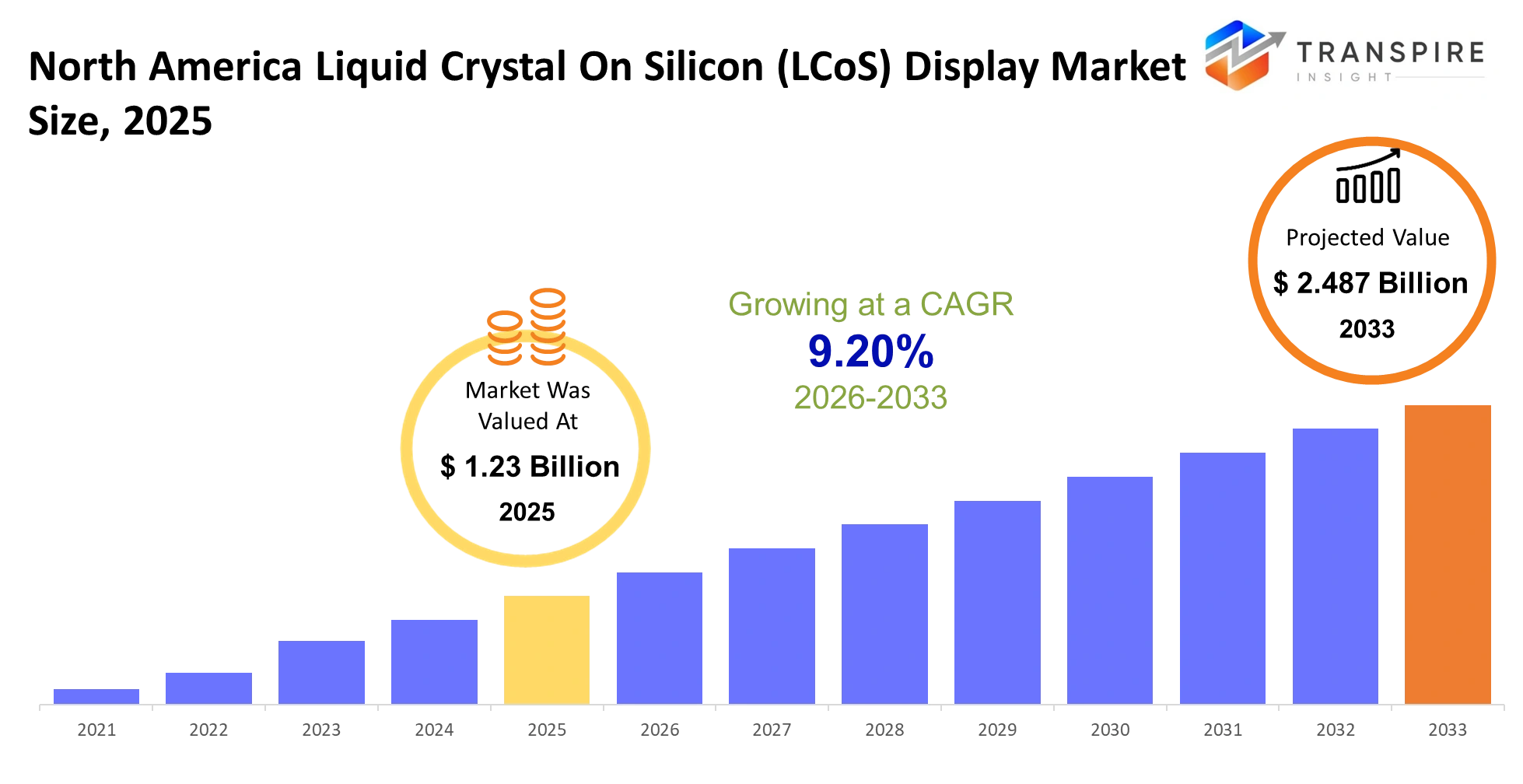
- North America Liquid Crystal On Silicon (LCoS) Display Market Size 2025: USD 1.23 Billion
- North America Liquid Crystal On Silicon (LCoS) Display Market Size 2033: USD 2.487 Billion
- North America Liquid Crystal On Silicon (LCoS) Display Market CAGR: 9.20%
- North America Liquid Crystal On Silicon (LCoS) Display Market Segments: By Type (Reflective LCoS, Transmissive LCoS, Microdisplay, Projection Display, Near-eye Display, Others), By Application (Consumer Electronics, AR/VR, Automotive HUD, Aerospace, Healthcare, Others), By End-User (Electronics, Automotive, Defense, Healthcare, Enterprises, Others), By Resolution (HD, Full HD, 4K, 8K, Custom, Others).
To learn more about this report,  Download Free Sample Report
North America Liquid Crystal On Silicon (LCoS) Display Market Summary:
The North America Liquid Crystal On Silicon (LCoS) Display Market size is estimated at USD 1.23 Billion in 2025 and is anticipated to reach USD 2.487 Billion by 2033, growing at a CAGR of 9.20% from 2026 to 2033. The North America Liquid Crystal On Silicon (LCoS) Display Market is experiencing steady growth because consumers demand high-quality and space-saving display solutions for their electronic devices and automotive vehicles and medical equipment. LCoS displays are widely adopted in applications such as projectors head-mounted displays and augmented reality systems because they provide better image quality and consume less power. The North America Liquid Crystal On Silicon (LCoS) Display Market continues to grow because businesses implement more sophisticated visual technologies in their workspaces.
The North America Liquid Crystal On Silicon (LCoS) Display Market experiences growth because augmented reality and virtual reality technologies and smart wearable devices develop at a fast pace. Industries use LCoS-based displays to create realistic training and simulation environments which medical and defense professionals need. The market growth will accelerate because manufacturers continue to innovate while companies increase their funding for upcoming display technology developments.
What Has the Impact of Artificial Intelligence Been on the North America Liquid Crystal On Silicon (LCoS) Display Market?
Artificial intelligence is changing the North American liquid crystal on silicon display market because it improves market research and data analysis methods according to market research consultants. The North American liquid crystal on silicon display market uses advanced machine learning models together with predictive analytics to allow companies to track market trends and consumer behavior plus new application development with better accuracy. North American liquid crystal on silicon display market strategies use artificial intelligence to provide immediate market data which helps companies create product development strategies and forecast upcoming market changes.
Artificial intelligence systems which operate in the North American liquid crystal on silicon display market use their capabilities to boost factory production rates while optimizing supply chain management effectiveness. Smart automation systems streamline manufacturing processes, reduce operational costs, and enhance product quality by minimizing errors. AI-powered forecasting tools improve inventory management and logistics across the North American liquid crystal on silicon display market because they optimize resource distribution. Intelligent technologies enable companies to create new products faster while modifying existing products to meet market needs which gives them a competitive edge in the industry.
Key Market Trends & Insights:
- The North America liquid crystal on silicon (LCOS) display market experiences growth because consumers and businesses seek small, bright display technologies for their display needs.
- The North America liquid crystal on silicon (LCOS) display market experiences growth because AR/VR technologies become more popular which leads to new technological advancements and broader usage possibilities.
- Market leaders achieve better operational results through AI and smart automation which helps them produce more products while decreasing operational costs.
- Investments in microdisplay technology research and development create new market developments because they enable display systems to achieve better resolution and color accuracy while using less energy.
- The United States controls the North America liquid crystal on silicon (LCOS) display market which will reach 75% market share in 2025 because advanced technology solutions are widely used.
- Canada is the fastest-growing region which will achieve a CAGR above 9% until 2030 because R&D expenditures are increasing.
- Projectors maintain a market share above 45% during 2025 because business and educational organizations need displays that can show high-resolution content.
- Near-to-eye display systems maintain the second-largest market share because AR/VR devices and wearable technologies increasingly adopt these displays.
- The automotive head-up display segment will grow until 2030 because smart vehicle technology becomes more popular.
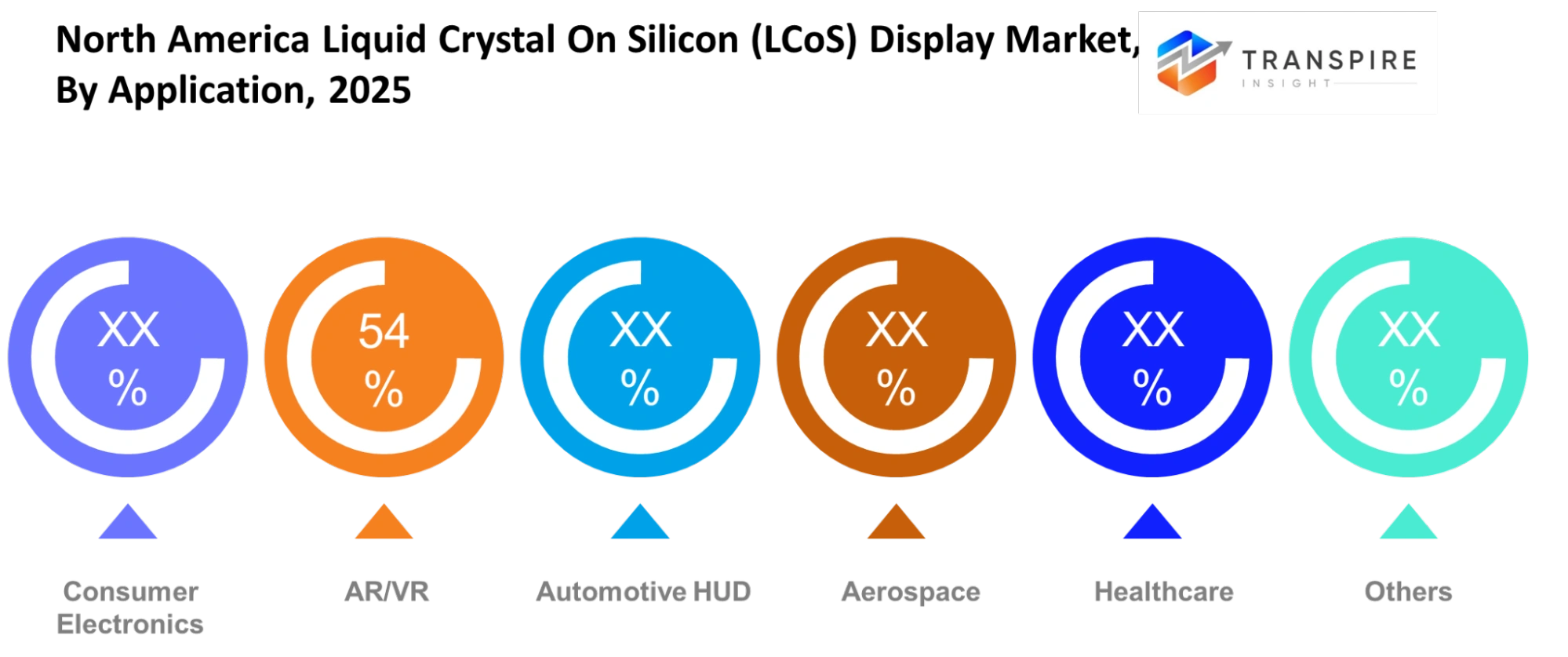
- The consumer electronics segment controls around 40% of the market because consumers want improved display technology for their entertainment and gaming products.
- Healthcare imaging and simulation applications are emerging as the fastest-growing segment due to precision visualization requirements.
North America Liquid Crystal On Silicon (LCoS) Display Market Segmentation
By Type
The technology of reflective LCoS serves as the preferred choice because it delivers superior resolution capabilities and controls light in an efficient manner which benefits both projection systems and professional imaging equipment. The application of transmissive LCoS technology remains limited because it only serves specific markets which require that particular method of light transmission. Microdisplay technology continues to gain traction because it delivers high-quality visuals through its small form factor, which can be used in portable devices.
The education sector together with business environments uses projection display technology as the primary solution because it provides high-definition image quality and supports both presentation delivery and large-screen viewing needs. The use of near-eye display technology will experience substantial growth because augmented reality and virtual reality devices require it to create engaging visual experiences. The category encompasses various types of systems that use unique designs to meet specific needs in industrial and research applications, which exist throughout different business sectors.
By Application
Consumer electronics drives significant demand because people need advanced display features for their televisions and gaming systems and portable devices. AR and VR applications will develop at a continuous rate because entertainment and training and simulation fields increasingly accept immersive technologies. The demand for automotive HUD systems increases because drivers need safety features and real-time information display.
Aerospace applications use exact visualization systems for their navigation and simulation needs which display data correctly in essential situations. Healthcare use includes imaging and surgical support systems where clarity and detail are essential. Other applications cover industrial design research and specialized visualization tasks that need dependable display capabilities.
To learn more about this report, Download Free Sample Report
By End-User
The electronics sector consumes most display components because both consumers and professionals require high-quality display technologies. The automotive industry will grow because new display technologies emerge as essential features in contemporary automobiles. The defense industry requires secure systems that provide high-definition visual information for both training and operational purposes.
The healthcare industry uses display technologies to support diagnostics and imaging procedures which need accurate results for making clinical decisions. Display systems enable enterprises to conduct meetings and design work while their simulation operations proceed which helps them communicate better and work more efficiently. The education and research institutions use visual output systems that provide high reliability and clear visibility to their end-users.
By Resolution
People continue to use HD and Full HD because these technologies provide affordable solutions that meet basic requirements in both home and business settings. 4K resolution becomes increasingly popular because people now demand devices that provide them with better visual details. 8K resolution offers a high-end solution which delivers exceptional visual quality to qualified professionals and businesses.
The industry requires custom resolution solutions because standard formats fail to deliver the necessary performance standards. Experimental and evolving formats which assist next-generation display technologies and enhance viewing quality make up the other resolution categories. Users will experience improved results because resolution capabilities will keep advancing which will lead to more people using the technology.
What are the Main Challenges for the North America Liquid Crystal On Silicon (LCoS) Display Market Growth?
The north america liquid crystal on silicon (LCoS) display market faces multiple technical and operational problems which prevent it from maintaining stable performance and expanding its operations. The system operates at decreased efficiency because of three specific problems which include heat management issues and environmental brightness limitations and difficulties with optical alignment. The production process experiences delays and higher production risks because the supply chain for essential components and materials faces severe limitations. The current operational challenges which affect north america liquid crystal on silicon (LCoS) display market operations lead to problems which decrease product stability and hinder its ability to work in the field.
The North America liquid crystal on silicon (LCoS) display market experiences slow growth because of manufacturing and commercialization obstacles which exist in the industry. The production process remains highly complex which requires factories to create exact product specifications while maintaining complete product criteria. The manufacturing process requires businesses to make large financial commitments while following established industry regulations which creates problems for smaller companies. The result of this situation leads to longer commercialization periods which create obstacles for business expansion while restricting fast entry into new markets.
The North america liquid crystal on silicon (LCoS) display market faces adoption obstacles because of its insufficient infrastructure and lack of qualified workers. The ongoing use of other display technologies by various industries causes delays in their adoption of new display systems. The lack of funding together with public unawareness about new applications creates obstacles which prevent their broad adoption. The current market restrictions prevent demand to increase while they also postpone the implementation of large scale projects which should happen across different industries.
Regional Insights
The United States will maintain strong demand because businesses will adopt advanced technologies and they will make substantial research and development investments. The presence of top display manufacturers enables faster product development through their technological advancements. The consumer electronics and defense industries generate steady demand which will be further enhanced by the increasing adoption of AR and VR technologies across different business sectors.
Market expansion in Canada will continue at a steady rate because businesses are placing more emphasis on developing innovative solutions and implementing digital transformation strategies. The government will create demand for advanced technologies through its support initiatives which will boost healthcare and automotive industries to implement new systems. Organizations will enhance their manufacturing capabilities through research partnerships with international businesses while they develop high-resolution display technologies.
Industrial growth combined with rising electronics production in Mexico will create new market demand. The market will expand because production expenses are lower and international companies are increasing their investments. The automotive and enterprise sectors will adopt new technologies at a slow pace while the development of infrastructure and skilled professionals will drive regional economic progress.
Recent Development News
In April 2026, Himax returns with Front-lit LCoS innovation at Display Week 2026: Himax announced a new Front-lit LCoS microdisplay upgrade targeting AR/VR and head-mounted displays, building on its 2025 prototype. The focus is on improving contrast and energy efficiency for U.S.-driven immersive display markets.
Source: https://www.gurufocus.com
|
Report Metrics |
Details |
|
Market size value in 2025 |
USD 1.23 Billion |
|
Market size value in 2026 |
USD 1.343 Billion |
|
Revenue forecast in 2033 |
USD 2.487 Billion |
|
Growth rate |
CAGR of 9.20% from 2026 to 2033 |
|
Base year |
2025 |
|
Historical data |
2021 – 2024 |
|
Forecast period |
2026 – 2033 |
|
Report coverage |
Revenue forecast, competitive landscape, growth factors, and trends |
|
Country scope |
North America (Canada, The United States, and Mexico) |
|
Key company profiled |
Sony, Himax Technologies, JVC Kenwood, Canon, Syndiant, Jasper Display, OmniVision, Epson, LG Display, Samsung, Toshiba, Huawei, Panasonic, Texas Instruments, BOE Technology. |
|
Customization scope |
Free report customization (country, regional & segment scope). Avail customized purchase options to meet your exact research needs. |
|
Report Segmentation |
By Type (Reflective LCoS, Transmissive LCoS, Microdisplay, Projection Display, Near-eye Display, Others), By Application (Consumer Electronics, AR/VR, Automotive HUD, Aerospace, Healthcare, Others), By End-User (Electronics, Automotive, Defense, Healthcare, Enterprises, Others), By Resolution (HD, Full HD, 4K, 8K, Custom, Others). |
How Can New Companies Establish a Strong Foothold in the North America Liquid Crystal On Silicon (LCoS) Display Market?
The north american liquid crystal on silicon display market currently presents new entrants with an opportunity to establish dominance through their efforts to develop specialized applications which exhibit performance superiority and experience reduced competition. Companies will develop effective solutions through their focus on healthcare imaging and industrial visualization and AR/VR training solutions which need targeted product development to solve their specific problems.
The new market entrants will achieve product differentiation through their innovation efforts which seek to enhance brightness and energy efficiency while creating smaller product designs. The early adoption process and market development will proceed faster when companies present a clear value proposition which matches existing industry trends.
The North American liquid crystal on silicon display market requires companies to establish strategic partnerships as their fundamental method for achieving market growth. The company will accelerate the product development process through its partnerships with component suppliers and software developers and system integrators. The company will create a competitive advantage through its unique technology which combines AI and advanced optics and customized solutions. The startup companies Himax Technologies and HOLOEYE Photonics show how innovation and R&D specialization create growth opportunities which establish business credibility with enterprise customers.
The North American liquid crystal on silicon display market requires new companies to focus on two essential elements which include cost control methods and production processes that can expand. Production costs will decrease through the implementation of smart automation together with effective supply chain systems which will also ensure product quality remains intact. The company will establish customer confidence through its investments in marketing and customer education and its after-sales support services. The combination of innovation and partnerships together with operational efficiency will enable new market entrants to create a steady business foundation.
Key North America Liquid Crystal On Silicon (LCoS) Display Market Company Insights
The established businesses that dominate the market will use their market presence to create ongoing product innovations and superior display technologies. The company will use its research funding to create new resolution and efficiency solutions. The company will maintain consistent demand across its consumer electronics and defense and enterprise products because of its brand reputation and its established relationships with the industry.
New companies entering the market will concentrate their efforts on developing specialized products that serve augmented reality and virtual reality markets. The company will develop its unique product identity through its new compact design and energy-saving technology. The company will enhance its market access by forming partnerships with technology providers and component manufacturers while decreasing its development time.
The display industry faces a price and performance challenge because of the competition between OLED and DLP display technologies. The industry requires brightness and contrast and cost efficiency advancements to be developed continuously. To remain competitive in the market companies will develop their optical systems and artificial intelligence systems to meet evolving industry requirements.
Company List
- Sony
- Himax Technologies
- JVC Kenwood
- Canon
- Syndiant
- Jasper Display
- OmniVision
- Epson
- LG Display
- Samsung
- Toshiba
- Huawei
- Panasonic
- Texas Instruments
- BOE Technology
What are the Key Use-Cases Driving the Growth of the North America Liquid Crystal On Silicon (LCoS) Display Market?
The North American liquid crystal on silicon display market experiences growth because consumer electronics demands for high-end projectors and immersive home entertainment systems. The gaming and media industries require better resolution and color accuracy therefore users need to adopt this technology. The market expansion receives direct backing from these use cases because they drive businesses to upgrade their products while spending more on advanced display systems.
The North American liquid crystal on silicon display market grows through medical imaging and surgical visualization and training simulation applications in healthcare. LCoS displays deliver precise and clear visuals which make them suitable for critical procedures that need exact visual representation. Advanced imaging solutions are now essential in hospitals and research institutions which leads to continuous market growth.
The North American liquid crystal on silicon display market depends on the automotive and aerospace industries because these fields use head-up displays and simulation systems. Drivers receive better visibility through real-time data projections in vehicles while aerospace training and navigation applications need high-performance displays. The demand for display systems is increasing because users require better performance which drives display technology development.
The North American liquid crystal on silicon display market receives additional support from enterprise and industrial applications which use design visualization and virtual prototyping and training environments. More businesses are using AR and VR technologies in their manufacturing and corporate environments which creates new growth opportunities. The business will use these scalable use cases to drive future growth and technological progress.
North America Liquid Crystal On Silicon (LCoS) Display Market Report Segmentation
By Type
- Reflective LCoS
- Transmissive LCoS
- Microdisplay
- Projection Display
- Near-eye Display
- Others
By Application
- Consumer Electronics
- AR/VR
- Automotive HUD
- Aerospace
- Healthcare
- Others
By End-User
- Electronics
- Automotive
- Defense
- Healthcare
- Enterprises
- Others
By Resolution
- HD
- Full HD
- 4K
- 8K
- Custom
- Others
Frequently Asked Questions
Find quick answers to common questions.
The approximate North America Liquid Crystal On Silicon (LCoS) Display Market size for the market will be USD 2.487 Billion in 2033.
The key segments of the North America Liquid Crystal On Silicon (LCoS) Display Market are By Type (Reflective LCoS, Transmissive LCoS, Microdisplay, Projection Display, Near-eye Display, Others), By Application (Consumer Electronics, AR/VR, Automotive HUD, Aerospace, Healthcare, Others), By End-User (Electronics, Automotive, Defense, Healthcare, Enterprises, Others), By Resolution (HD, Full HD, 4K, 8K, Custom, Others).
Major players in the North America Liquid Crystal On Silicon (LCoS) Display Market are Sony, Himax Technologies, JVC Kenwood, Canon, Syndiant, Jasper Display, OmniVision, Epson, LG Display, Samsung, Toshiba, Huawei, Panasonic, Texas Instruments, BOE Technology.
The current market size of the North America Liquid Crystal On Silicon (LCoS) Display Market is USD 1.23 Billion in 2025.
The North America Liquid Crystal On Silicon (LCoS) Display Market CAGR is 9.20%.
- Sony
- Himax Technologies
- JVC Kenwood
- Canon
- Syndiant
- Jasper Display
- OmniVision
- Epson
- LG Display
- Samsung
- Toshiba
- Huawei
- Panasonic
- Texas Instruments
- BOE Technology
Recently Published Reports
-
Apr 2026
Fiber Optic Faceplates Market
Fiber Optic Faceplates Market Size, Share & Analysis Report By Type (< 300 mm2, 300-350 mm2, and > 350 mm2, By Application (Night Vision, Holographic Imaging, Medical, and Others), and Geography (North America, Europe, Asia-Pacific, Middle East and Africa, South and Central America), 2021 - 2031
-
Apr 2026
High Temperature Superconductors Market
High Temperature Superconductors Market Size, Share & Analysis Report By Type (1G HTS, and 2G HTS), By Application (Power Cable, Fault Current Limiter, and Transformer), and Geography (North America, Europe, Asia-Pacific, Middle East and Africa, South and Central America), 2021 - 2031
-
Apr 2026
Industrial Plugs and Socket Market
Industrial Plugs and Socket Market Size, Share & Analysis Report By Type (Industrial Plugs, Industrial Sockets), By Current (Up to 32 A, 32 to 125 A, Above 125 A), By Protection (Dustproof and Splash Proof, Waterproof, Explosion Proof), By End User (Heavy Industries, Oil and Gas, Chemicals and Pharmaceuticals, Power Generation, Others), and Geography (North America, Europe, Asia-Pacific, Middle East and Africa, South and Central America), 2021 - 2031
-
Apr 2026
InGaAs Avalanche Photodiodes Market
InGaAs Avalanche Photodiodes Market Size, Share & Analysis Report By Type (1100 - 1700 nm, and 1000 - 1600 nm), By Application (Missile Warning System, Muzzle Flash Detection, Wafer Defect Inspection, Laser Rangefinders, and Others), and Geography (North America, Europe, Asia-Pacific, Middle East and Africa, South and Central America), 2021 - 2031