

North America Lab Consumables Market Size & Forecast:
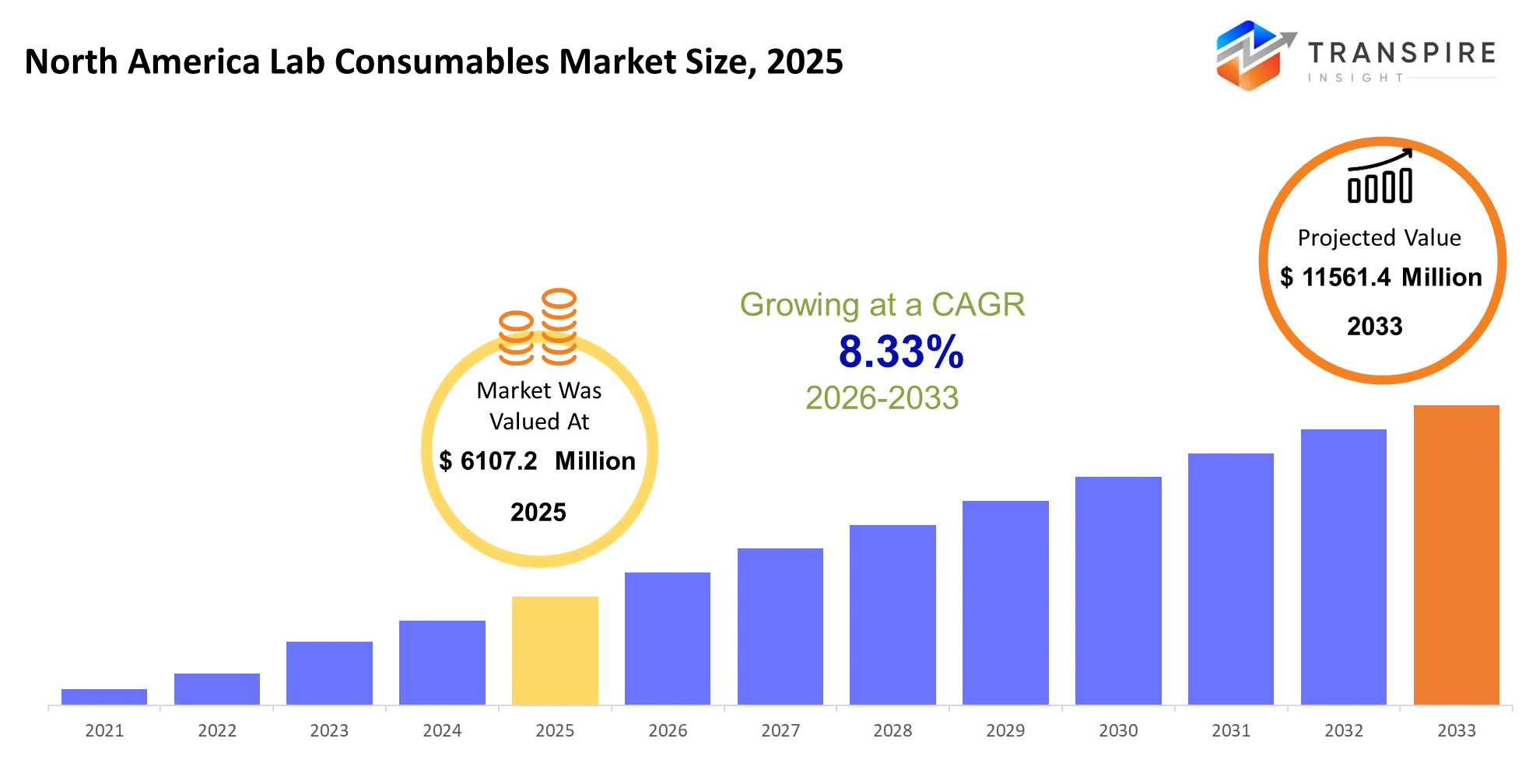
- North America Lab Consumables Market Size 2025: USD 6107.2 Million
- North America Lab Consumables Market Size 2033: USD 11561.4 Million
- North America Lab Consumables Market CAGR: 8.33%
- North America Lab Consumables Market Segments: By Product Type (Pipettes, Tubes, Petri Dishes, Tips, Reagents, Others); By Application (Diagnostics, Drug Discovery, Clinical Research, Genomics, Others); By End User (Hospitals, Diagnostic Laboratories, Research Institutes, Pharmaceutical Companies, Others); By Material (Plastic Consumables, Glass Consumables, Metal Consumables, Others)
To learn more about this report,  Download Free Sample Report
North America Lab Consumables Market Summary
The North America Lab Consumables Market was valued at USD 6107.2 Million in 2025. It is forecast to reach USD 11561.4 Mn by 2033. That is a CAGR of 8.33% over the period.
The North America Lab Consumables Market basically underpins the daily operational rhythm of modern labs , by moving out single-use plastics, reagents, and sterile instruments that let diagnostics, drug discovery, and life sciences research stay on track, without cross contamination or those annoying workflow halts . For real world operations , it helps keep hospitals, biotech outfits, and research institutes running their high-volume testing loops where dependability, and repeatability, are often valued more than the per-unit price.
Over the last 3–5 years, the market has leaned more and more toward automated , single-use centered laboratory ecosystems, where consumables are now more integrated with robotics and digital lab platforms instead of mostly relying on manual benchwork. One big catalyst was the post-pandemic jump in diagnostic testing capacity, it kind of highlighted weak points in supply steadiness and encouraged organizations to widen their set of approved suppliers , and hold larger “always-on” inventory levels.
That shift has altered purchasing habits, labs now tend to place supply assurance first, along with regulatory adherence, and clear compatibility with high-throughput setups, rather than sticking to older procurement cycles. So in practice, recurring demand has given suppliers steadier revenue forecasting, while also speeding up uptake of higher-end, application tuned product lines across both pharmaceutical work and clinical research environments.
Key Market Insights
- North America pretty much dominates the North America Lab Consumables Market, sitting at something like ~40–45% share in 2025 because the biotech setup is strong , plus the clinical research networks are kinda advanced and well connected.
- Europe looks steadier overall, while Asia-Pacific is the fastest-moving growth engine through 2033 , largely due to lower-cost research outsourcing and that whole “get it done quickly” workflow.
- Meanwhile, US-led innovation ecosystems keep the global edge, especially where there is high-value consumables demand and regulatory compliance adoption is a must.
- Pipette tips along with plastic consumables still take the top spot, mainly from the constant, high-frequency lab routines people run every day.
- Culture plates , and reagent kits come next, since cell-based research applications keep rising.
- Single-use bioprocess consumables are the fastest-growing group though, they expand quickly through 2033 as biopharma manufacturing scales up.
- Clinical diagnostics lead the way with nearly 35% share, which basically locks in strong baseline need across hospital and pathology laboratories.
- Genomics and molecular diagnostics are growing the quickest, supported by precision medicine expansion and more targeted study programs.
- Pharmaceutical and biotechnology firms are the main spenders, showing the highest consumption share in the North America Lab Consumables Market.
Contract research organizations are growing fastest, mostly because outsourcing of drug discovery pipelines is becoming routine, kind of a standard approach now.
What are the Key Drivers, Restraints, and Opportunities in the North America Lab Consumables Market?
The main driver behind the North America lab consumables market is the speeding up of biopharmaceutical research and clinical diagnostics, especially when it comes to precision medicine and molecular testing. If you think about it, this momentum was kicked off by continuing investment in mRNA platforms, oncology work, and fast-throughput genomic sequencing, and all of that still needs steady replenishment of sterile plastics, reagents, and single use laboratory items. When labs bring in more automation and shave down development timelines, consumables end up as recurring day-to-day operational inputs, not just one-off buys, which kind of keeps revenue steadier for suppliers spanning pharmaceutical companies, contract research organizations, and hospital networks.
On the other hand, a big restraint is how the industry relies on specialized raw materials along with tightly validated manufacturing processes, in particular sterile-grade polymers and high-purity reagents. It’s not something that’s easy to fix, because regulatory requalification cycles tend to be lengthy and expensive, so suppliers can’t pivot production very quickly, even when they want to diversify. That means if there’s any disruption in a relatively narrow supplier pool, procurement decisions can get slowed, labs may have to stretch equipment lifecycles or ration those high-spec consumables, and even with solid demand underneath, it can still pull down near-term market throughput.
The best opportunity seems to be the quick commercialization of cell and gene therapy manufacturing ecosystems, mainly in US biotech pockets like Boston and California’s Bay Area. Those therapies depend on consumables that are highly traceable, GMP-certified, and integrated into closed-system bioprocessing workflows, so it drives demand for specialized product families.Companies that are putting money into end-to-end validated consumable platforms, aligned with regulatory traceability standards, can end up securing longer term contracts with next-generation therapy developers and snag that steady high-margin growth. It’s sort of the whole package, right, not just a piece or a pilot, and it tends to hold up over time, in practice.
What Has the Impact of Artificial Intelligence Been on the North America Lab Consumables Market?
Artificial intelligence with advanced digital technologies is, kind of, changing the way scrubber performance systems work and how marine emission control technologies get handled across North America. It is improving monitoring precision, it is making operations more efficient and it is also bolstering compliance workflows across vessel fleets, you know, the routine stuff. With AI-enabled sensor networks plus cloud based platforms, exhaust gas cleaning units can be tracked without stopping, and dosing parameters get tuned automatically. Compliance reporting also becomes less of a pain, because it is streamlined and aligned with IMO sulfur regulations, so operators are relying much less on manual oversight.
Then machine learning comes in and boosts predictive ability by reading older patterns like fuel sulfur content, pressure differences, washwater chemistry, and engine load behaviors. This helps to foresee maintenance needs ahead of time, before failures actually happen. The models can also help with emissions forecasting. In practice this means operators can notice potential deviations earlier, and tweak operational settings in a proactive way. Because of that, many shipping companies and service providers say they are seeing double-digit improvements in uptime reliability, plus maintenance scheduling becomes more efficient. Along with that, they report less unplanned downtime and reduced consumption of key consumables.
Still, adoption is limited by big integration expenses, and by the ongoing issue of keeping dependable real time connectivity at sea. When connection reliability drops, continuous model updates can get interrupted, and predictive accuracy in remote operating conditions may suffer.
Key Market Trends
- North American labs started moving, kind of gradually from manual procurement to AI-enabled e-procurement platforms sometime between 2020 and 2025, and yes it did help with inventory forecasting accuracy, and also it cut down stockouts across different facilities in a more noticeable way.
- Manufacturers such as Thermo Fisher Scientific also went further into machine learning based predictive maintenance for consumables tracking since 2021, which apparently reduced the unexpected equipment downtime, especially in high throughput labs where everything stacks up fast.
- Since 2022 , environmental rules in the United States got stricter, so labs began adopting recyclable, and even reduced plastic consumables more often, particularly within academic and pharmaceutical procurement contracts.
- After the disruptions in the supply chain that hit around post 2021, North American manufacturers like Corning and Avantor started bringing production back home, as in reshore production for lab consumables, and that shortened lead times while also helping calm down pricing volatility.
- Starting in 2023, laboratories leaned into IoT enabled inventory systems that automatically reorder consumables. This lowered manual tracking mistakes, and it improved stock visibility across multi-site research networks, which is kind of the big point.
- After 2022, competitive consolidation sped up. Danaher and Merck KGaA expanded their portfolios, which intensified pricing pressure, and it also helped standardize consumable offerings across North American labs.
- The pandemic driven demand peaks from 2020–2021 eased off by 2023, so procurement attention shifted away from emergency sourcing and more toward long-term supplier contracts, plus inventory resilience strategies too.
- Automation integration increased from 2021 into 2025, with robotic handling systems improving consumable throughput efficiency, and generally trimming human error rates especially in high volume labs.
North America Lab Consumables Market Segmentation
By Product Type
Pipettes and tips still sit in the top spot in lab purchasing, mostly because they get used, day after day, in routine liquid handling, and that never really slows down. Their replacement cadence stays high, and because most labs standardize their protocols, the demand remains pretty steady. You see this especially in diagnostics and in pharmaceutical quality control setups. Reagents also keep a solid slice, since they are basically woven into nearly every experimental step, and that matters a lot in molecular biology, plus clinical assays.
What’s pushing growth here is not only more automation in liquid handling systems but also labs leaning harder into precision-led workflows for genomics and drug discovery. In the replacement cycle, plastic consumables clearly lead, laboratories often favor contamination control and cost efficiency, rather than reusable alternatives which can complicate things. Reagents benefit at the same time from biomarker research expanding, and from assays getting more complex across clinical pipelines.
Looking ahead, demand is likely to lean toward smart consumables with built in traceability, and with smoother automation compatibility. To win, manufacturers will have to pay attention to robotic system fit, and also keep batch to batch performance from drifting. From an investor view, stronger upside may appear in firms building out higher-margin reagent lines and moving toward digitally enabled consumable ecosystems.
By Application
Diagnostics is the main application area, largely because clinical labs and hospitals keep running high testing volumes. The overall utilization intensity stays strong thanks to high throughput expectations, plus regulatory compliance requirements that don’t bend easily. Drug discovery tracks closely behind, supported by growing pharmaceutical R&D activity and the ongoing expansion of biologics development.
Growth in diagnostics has kind of accelerated because chronic disease screening keeps rising, and decentralized testing models got adopted after pandemic disruptions. In the meantime, genomics paired with clinical research applications seem to have more momentum too, since sequencing costs are dropping and precision medicine adoption keeps expanding. On top of that, automation in laboratory workflows has really pushed up consumable turnover across those high volume testing environments, so it becomes a loop, you know.
Next, future expansion will likely concentrate in genomics and molecular diagnostics as personalized medicine gets wider clinical acceptance. Drug discovery workflows will rely more often on high precision consumables that are compatible with automated platforms, rather than older manual styles. Suppliers should also start prioritizing scalable production systems so they can handle fluctuating research demand cycles without getting stuck.
By End User
Pharmaceutical companies hold the leading position, largely because they run big R&D operations and keep moving along continuous drug pipeline development. Diagnostic laboratories still keep strong demand from routine clinical testing, especially with high sample volumes. Research institutes contribute a steady pace of consumption, supported by academic and government funded projects.
In terms of where growth is strongest, pharmaceutical companies that adopt automation and high throughput screening technologies tend to accelerate faster. Diagnostic laboratories are also increasing consumable usage due to testing complexity growing, and the integration of molecular assays taking place.
Hospitals are showing moderate growth, as point of care testing systems slowly reduce reliance on centralized laboratory services, sort of. Future demand will more and more bunch up around pharmaceutical firms that invest heavily in biologics, plus advanced therapeutics. Diagnostic laboratories will gradually lean toward fully automated sample processing setups and that usually means standardized consumables. So suppliers, they’ll need to make sure their product lines fit regulatory compliance requirements, and also workflow integration needs, in practice.
By Material
Plastic consumables still take the lead in the material segment, mainly because of cost efficiency, disposability, and the fact they lower contamination risk in day to day lab settings. Glass consumables hold a smaller but steady position, especially where chemical resistance matters, and where high temperature tolerance is required. Metal consumables stay more of a niche choice, mostly tied to specialized instrumentation and durable lab equipment components.
The rise in plastic consumables has been faster lately because laboratories favor single use workflows to boost safety , and efficiency too. At the same time, environmental concerns have pushed slow but real innovation toward recyclable and biodegradable plastic alternatives. Glass demand remains steady, particularly in analytical chemistry applications that require high purity plus chemical stability.
Looking ahead, the outlook favors sustainable plastic innovation, and even hybrid material designs that cut environmental impact without sacrificing performance. Glass will still matter for specialized uses but it won’t meaningfully grow in volume terms. Manufacturers putting money into eco-friendly material innovation should see stronger long term positioning with institutional buyers, over time.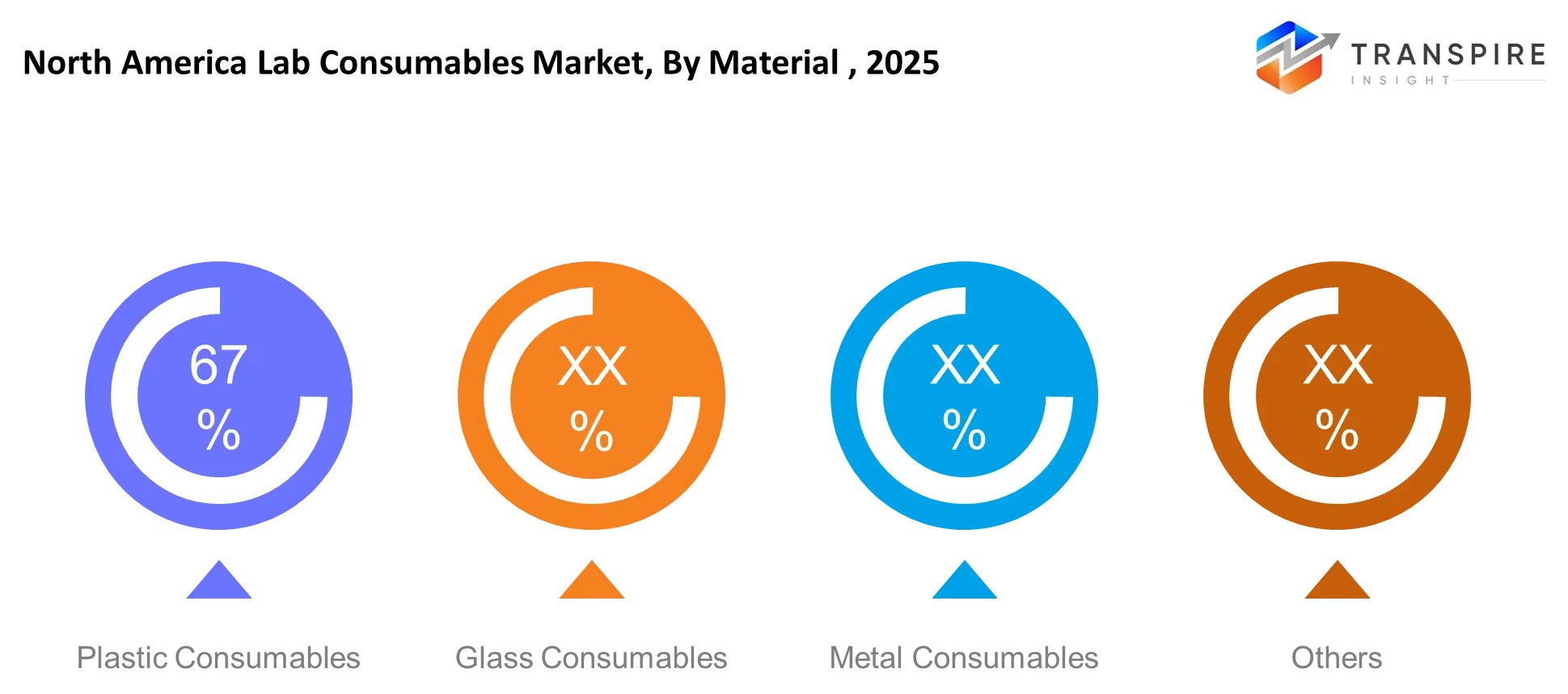
To learn more about this report, Download Free Sample Report
What are the Key Use Cases Driving the North America Lab Consumables Market?
The core use case is kind of clinical diagnostics, plus pharmaceutical research laboratories, where those consumables— like pipette tips, tubes, reagents, and culture plates— help with high-volume testing, molecular diagnostics and drug development workflows. In practice, the demand is pushed by continuous sample throughput and also by pretty strict contamination control requirements, without any real slack.
There are expanding applications too, such as drug discovery programs inside pharmaceutical companies and contract research organizations , and at the same time more hospitals are adopting these tools for advanced molecular testing, and for personalized medicine workflows. This shift is basically tied to the rising need for faster but also more accurate analytical capabilities, which people notice quickly once turnaround times matter.
More emerging use cases are showing up like single-cell genomics, cell and gene therapy manufacturing, and automated high-throughput screening platforms. These are being backed by stricter regulatory validation requirements , and over the forecast period there’s also increasing integration of robotic laboratory systems, which feels like the main direction most teams are moving toward.
|
Report Metrics |
Details |
|
Market size value in 2025 |
USD 6107.2 Million |
|
Market size value in 2026 |
USD 6601.6 Million |
|
Revenue forecast in 2033 |
USD 11561.4 Million |
|
Growth rate |
CAGR of 8.33% from 2026 to 2033 |
|
Base year |
2025 |
|
Historical data |
2021 - 2024 |
|
Forecast period |
2026 - 2033 |
|
Report coverage |
Revenue forecast, competitive landscape, growth factors, and trends |
|
Regional scope |
North America (Canada, The United States, and Mexico) |
|
Key company profiled |
Thermo Fisher Scientific, Corning, Eppendorf, Merck KGaA, Sartorius AG, Danaher Corporation, Bio-Rad Laboratories, Agilent Technologies, Avantor, PerkinElmer, Qiagen, VWR International, Tecan Group, Hamilton Company, Waters Corporation |
|
Customization scope |
Free report customization (country, regional & segment scope). Avail customized purchase options to meet your exact research needs. |
|
Report Segmentation |
By Product Type (Pipettes, Tubes, Petri Dishes, Tips, Reagents, Others); By Application (Diagnostics, Drug Discovery, Clinical Research, Genomics, Others); By End User (Hospitals, Diagnostic Laboratories, Research Institutes, Pharmaceutical Companies, Others); By Material (Plastic Consumables, Glass Consumables, Metal Consumables, Others) |
Which Regions are Driving the North America Lab Consumables Market Growth?
Asia-Pacific stays in the lead , mostly because there’s a dense cluster of manufacturing hubs and big port infrastructure spanning China, Japan and South Korea. There are high vessel traffic volumes and real tight links with global supply chains, so the need for maritime services and the supporting markets just keeps running. On top of that, shipbuilding capacity and already-set logistics corridors make the whole thing even more locked-in, it kind of keeps Asia-Pacific at the front of worldwide trade flows. And there’s also a fairly well-developed ecosystem of suppliers , repair yards, and port operators, which helps keep day to day operations from slowing down.
Europe sits in a stable second position, but it feels more influenced by regulatory consistency and economic resilience, not purely by raw volume growth. The European Union’s environmental rules are tough , so fleet and port equipment modernization tends to move steadily. Long-standing shipping companies keep putting money into upgrades instead of chasing aggressive expansion, so demand looks fairly predictable. This kind of mature setup makes Europe a reliable and steady contributor to global maritime market revenues, in a calmer way.
Meanwhile the Middle East is showing up as the fastest-growing region, and it’s being pushed by large investments in port infrastructure across the Gulf states. Places like the UAE and Saudi Arabia are building out logistics hub networks to reduce reliance on oil and make trade connections stronger. New free zone rules and improved customs frameworks are also pulling in international shipping lines and operators. For new players, entrants and investors, this quick reshaping is basically a strong hint that there will be meaningful opportunities for longer-term expansion between 2026 and 2033.
Who are the Key Players in the North America Lab Consumables Market and How Do They Compete?
Competition in the North America lab consumables market is kinda moderately consolidated, with a few global life science instruments firms taking a meaningful slice, while plenty of smaller specialists still exist and support very specific workflows. The main players usually don’t just fight on price, instead they try to secure long term contracts with hospitals, biotech firms,and research labs. Decision makers often care more about sterility assurance, batch-to-batch consistency, and distribution that actually shows up on time then “cheaper” SKUs alone.
Thermo Fisher Scientific leans on integrated supply agreements across hospitals and biotech sites, and they also bundle consumables with instrumentation, so customers get real switching costs. Corning is more about differentiating with high performance cell culture plastics as well as surface treatment know how that gets used a lot in biologics research. Avantor meanwhile, tries to hold ground through customized laboratory sourcing services and direct procurement routes for bigger research organizations, and it grows via distribution partnerships plus selective acquisitions across lab supply networks.
Eppendorf keeps attention on precision liquid handling consumables, like pipette tips and microtubes, built for reproducibility across academic and clinical environments. Danaher, through Beckman Coulter and Cytiva, tends to stress integrated workflow platforms that tie consumables into automation systems, which helps with scalable high throughput testing. MilliporeSigma uses its regulatory strength and a GMP grade consumables catalog for pharmaceutical manufacturing and cell therapy work, and it expands through bioprocessing collaborations along with facility level supply agreements.
Company List
- Thermo Fisher Scientific
- Corning,
- Eppendorf
- Merck KGaA
- Sartorius AG
- Danaher Corporation
- Bio-Rad Laboratories
- Agilent Technologies
- Avantor
- PerkinElmer
- Qiagen
- VWR International
- Tecan Group
- Hamilton Company
- Waters Corporation
Recent Development News
In January 2026, Thermo Fisher Scientific announced expansion of its North American bioprocessing consumables manufacturing capacity through upgraded production lines for sterile single-use lab plastics. The move strengthens supply continuity for pharmaceutical and clinical research customers relying on high-throughput workflows and reduces lead times across key US and Canada distribution hubs. This development reinforces vertically integrated supply chain control across its consumables and instrumentation ecosystem.https://www.fortunebusinessinsights.com/lab-consumables-market-112390 (Fortune Business Insights)
In February 2026, Avantor committed additional investment in its US distribution network for laboratory consumables, focusing on automated fulfillment systems for academic and contract research organization clients. The upgrade improves inventory visibility and accelerates replenishment cycles for pipettes, reagents, and sterile labware across large-scale research campuses. This initiative strengthens its service-driven procurement model that integrates logistics with customized sourcing programs.https://www.grandviewresearch.com/industry-analysis/laboratory-consumables-market-market-report (Grand View Research)
What Strategic Insights Define the Future of the North America Lab Consumables Market?
The North America lab consumables market is moving toward deeper integration with automated and digitally connected laboratory ecosystems, where demand will get shaped more and more by workflow standardization and high throughput life science research, instead of these more standalone product purchases. This structural shift is being pulled along by the rapid growth of biopharmaceutical pipelines and the rising need for reproducible contamination controlled environments inside precision medicine, you know.
There is also a less obvious risk that sits under the surface, like supplier concentration across key sterile plastics and high grade reagents where disruptions at a small number of validated production sites could still cause serious bottlenecks even if the overall market keeps expanding. Meanwhile the gradual shift away from traditional consumables toward reusable microfluidic platforms might start to slow down volume growth in certain academic workflows and screening use cases, it could.
On the opportunity side, cell and gene therapy manufacturing is really starting to scale, and regulatory focus on traceability plus GMP compliant consumables is driving demand for more specialized product lines. So market participants should push harder on vertical integration with bioprocessing workflows, and they should also invest in validated therapy specific consumables portfolios to lock in long term contracts with advanced therapy developers.
North America Lab Consumables Market Report Segmentation
By Product Type
- Pipettes
- Tubes
- Petri Dishes
- Tips
- Reagents
- Others
By Application
- Diagnostics
- Drug Discovery
- Clinical Research
- Genomics
- Others
By End User
- Hospitals
- Diagnostic Laboratories
- Research Institutes
- Pharmaceutical Companies
- Others
By Material
- Plastic Consumables
- Glass Consumables
- Metal Consumables
- Others
Frequently Asked Questions
Find quick answers to common questions.
The North America Lab Consumables Market size is USD 11561.4 Million in 2033.
Key Segments for the North America Lab Consumables Market are By Product Type (Pipettes, Tubes, Petri Dishes, Tips, Reagents, Others); By Application (Diagnostics, Drug Discovery, Clinical Research, Genomics, Others); By End User (Hospitals, Diagnostic Laboratories, Research Institutes, Pharmaceutical Companies, Others); By Material (Plastic Consumables, Glass Consumables, Metal Consumables, Others).
Major North America Lab Consumables Market Players are Thermo Fisher Scientific, Corning, Eppendorf, Merck KGaA, Sartorius AG, Danaher Corporation, Bio-Rad Laboratories, Agilent Technologies, Avantor, PerkinElmer, Qiagen, VWR International, Tecan Group, Hamilton Company, Waters Corporation.
The North America Lab Consumables Market size is USD 6107.2 Million in 2025.
The North America Lab Consumables Market CAGR is 8.33% from 2026 to 2033.
- Thermo Fisher Scientific
- Corning,
- Eppendorf
- Merck KGaA
- Sartorius AG
- Danaher Corporation
- Bio-Rad Laboratories
- Agilent Technologies
- Avantor
- PerkinElmer
- Qiagen
- VWR International
- Tecan Group
- Hamilton Company
- Waters Corporation
Recently Published Reports
-
Apr 2026
Cord Blood Banking Services Market
Cord Blood Banking Services Market Size, Share & Analysis Report By Type of Service (Collection, Processing, Storage), By Bank Type (Private Banks, Public Banks, and Hybrid Banks), By Component (Cord Blood, and Cord Tissue), By End User (Hospitals, Research Institutions, Biotechnology Companies, and Others) and Geography (North America, Europe, Asia-Pacific, Middle East and Africa, South and Central America), 2021 - 2031
-
Apr 2026
ELISA Processors Market
ELISA Processors Market Size, Share & Analysis Report By Type (Optical Filter ELISA Analyzer, and Optical Grating ELISA Analyzers), By Mode (Automated ELISA Analyzers, and Semi-Automated ELISA Analyzers), By Applications (Immunology, Vaccine development, Drug Monitoring, and Others), By End Users (Biotechnology Companies, Pharmaceutical Companies, Contract Research Organization, and Diagnostic Laboratories) and Geography (North America, Europe, Asia-Pacific, Middle East and Africa, South and Central America), 2021 - 2031
-
May 2026
Microscope Slide Scanner Market
Microscope Slide Scanner Market Size, Share & Analysis Report By Type (Portable Microscope Slide Scanner, and Desktop Microscope Slide Scanner), By Application (Biological Research, Medicine, Veterinary, and Other) and Geography (North America, Europe, Asia-Pacific, Middle East and Africa, South and Central America), 2021 - 2031
-
Apr 2026
Microwave Cookware Market
Microwave Cookware Market Size, Share & Analysis Report By Material Type (Plastic, Glass, Ceramic, Silicone, and Metal), By Application (Cooking, Reheating, and Defrosting), By End User (Household, Commercial (Restaurants, Hotels, and Cafes), and Food Service Industry), By Sales Channel (Online Retail, Offline Retail (Supermarkets, Hypermarkets, Specialty Stores), and Direct Sales (Company Outlets)) and Geography (North America, Europe, Asia-Pacific, Middle East and Africa, South and Central America), 2021 - 2031