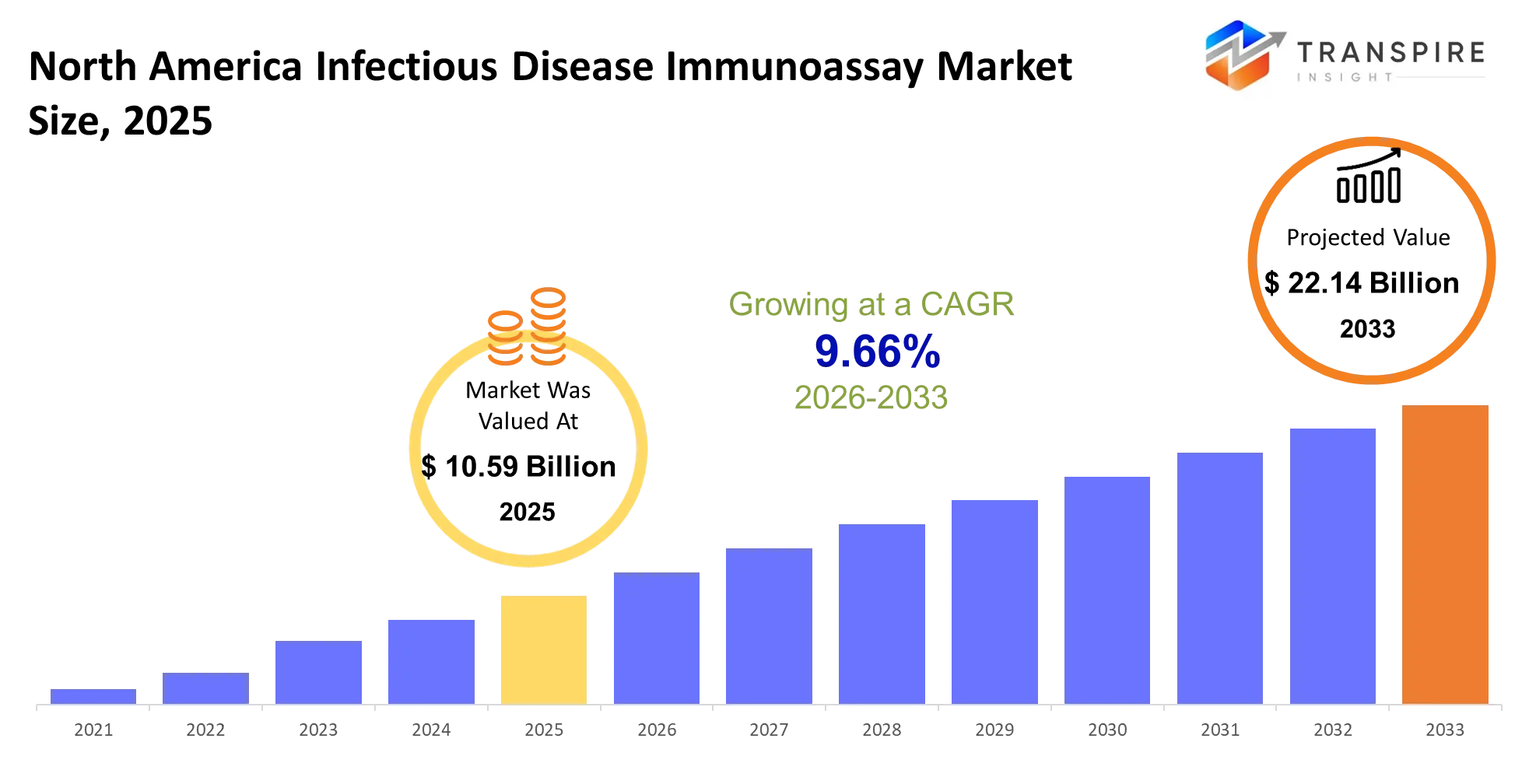
North America Infectious Disease Immunoassay Market Size & Forecast:
- North America Infectious Disease Immunoassay Market Size 2025: USD 10.59 Billion
- North America Infectious Disease Immunoassay Market Size 2033: USD 22.14 Billion
- North America Infectious Disease Immunoassay Market CAGR: 9.66%
- North America Infectious Disease Immunoassay Market Segments: By Type (ELISA, CLIA, Rapid Tests, Multiplex Assays, Others), By Application (HIV, Hepatitis, COVID-19, Influenza, Others), By End-User (Hospitals, Labs, Clinics, Others), By Technology (Automated, Semi-automated, Manual, Others).
To learn more about this report,  Download Free Sample Report
North America Infectious Disease Immunoassay Market Summary:
The North America Infectious Disease Immunoassay Market size is estimated at USD 10.59 Billion in 2025 and is anticipated to reach USD 22.14 Billion by 2033, growing at a CAGR of 9.66% from 2026 to 2033. The North America Infectious Disease Immunoassay Market, really kind of sits in the front line when it comes to spotting pathogens fast enough, so hospitals, diagnostic labs, blood banks, and public health agencies can decide on treatment and containment in real time. These assays are now pretty well stitched into emergency care routines, transplant screening, respiratory disease monitoring and even more spread out testing setups, where clinicians want fast plus scalable diagnostic precision, not the slower culture based style.
In the past five years, the whole market has moved in a noticeable structural way from centralized lab immunoassay tools toward automation, multiplex panels, and near patient testing systems. The COVID-19 pandemic was basically the main spark that pushed investment forward, into high throughput analyzers, more local manufacturing ability, and better digital reporting backbones. That shock changed procurement habits across the healthcare landscape, in a lasting way. So now providers tend to favor assay menus that can rapidly sort between several infectious agents at once, and that is helping lift repeat reagent income while also nudging longer term instrument usage in both hospital environments and outpatient networks.
Key Market Insights
- The United States kinda dominated the North America Infectious Disease Immunoassay Market, with more than 78% market share in 2025, mostly because the diagnostic infrastructure there is more advanced than elsewhere .
- Canada looks like the fastest-growing regional market up to 2032 , backed by public healthcare modernization and also a broader push toward molecular-immunoassay integration .
- Overall, the region’s industry growth is speeding up , since healthcare systems are putting more emphasis on quick pathogen detection and basically streamlined automated testing workflows for infectious diseases .
- Meanwhile , cross-border investments in lab automation keep adding momentum, which is helping the North America infectious disease diagnostics market size, and the long-term revenue story too .
- Reagents and kits were the main drivers , taking up nearly 64% of the revenue share in 2025 .
- Instruments stayed in second place, largely due to the growing deployment of high throughput immunoassay analyzers across hospital networks .
- On the segment side , multiplex immunoassay systems are projected as the fastest-growing through 2032 , because labs need simultaneous multi pathogen detection options .
- Chemiluminescence immunoassays keep grabbing meaningful share, due to stronger sensitivity, automation compatibility, and faster turnaround periods.
- For applications, HIV and hepatitis testing were out front, holding around 35% market share in 2025 .
- Respiratory infection testing is emerging as the fastest-growing application, especially as influenza, RSV and COVID-19 surveillance programs expand .
- Blood screening demand is also starting to rise, mainly tied to stricter transfusion safety rules across healthcare systems in North America .
- Hospitals and diagnostic laboratories are still leading end-user demand , with roughly 58% share , because they run high daily testing volumes and need scale .
What are the Key Drivers, Restraints, and Opportunities in the North America Infectious Disease Immunoassay Market?
The strongest force pushing the North America Infectious Disease Immunoassay Market forward is kinda obvious, the healthcare system’s shift toward faster, higher-throughput diagnostics after the COVID-19 pandemic showed the centralized lab capacity had limitations. So hospitals and public health agencies started boosting capital spending on automated immunoassay analyzers, to shorten the turnaround time for respiratory , bloodstream, and sexually transmitted infection testing. That change got another boost from federal preparedness money and tighter surveillance requirements across the United States and Canada. And once laboratories started folding more testing workflows onto multiplex platforms, reagent use rose quite a lot. That in turn builds recurring revenue for diagnostic manufacturers , and it also strengthens long-term instrument placement contracts
Meanwhile, reimbursement inconsistencies and the high cost of advanced immunoassay systems still act like the market’s most stubborn structural roadblock. Smaller hospitals and independent labs often can’t really justify the purchase of automated analyzers , because reimbursement rates do not always balance out the full equipment costs, plus calibration, plus ongoing compliance expenses. This is hard to fix quickly because reimbursement policies depend on multiple public and private payers, with approval timelines that can be very long. So modernization gets delayed especially for mid-tier healthcare facilities, which then lowers the adoption rates for premium diagnostic platforms
The next major chance seems to be decentralized infectious disease testing, powered by AI-enabled point of care immunoassays. Healthcare providers are investing more in compact diagnostic systems that can deliver quick results in urgent care centers, pharmacies, and rural clinics.
What Has the Impact of Artificial Intelligence Been on the North America Infectious Disease Immunoassay Market?
Artificial intelligence plus advanced digital technologies are kinda reshaping the North America Infectious Disease Immunoassay Market, mostly by sharpening diagnostic precision, making labs run more efficient and helping with outbreak coordination a bit better. More and more clinical laboratories now lean on AI-enabled immunoassay analyzers, to automate sample handling, interpret results, and even prioritize the workflow when things get busy. In practice these setups shrink the manual processing time and let labs manage very high testing volumes with less operational friction. At the same time, hospitals and diagnostic networks are also rolling out digital laboratory information systems, they track assay performance, keep an eye on reagent utilization and support smoother compliance reporting across multiple sites.
Machine learning is also boosting predictive abilities, by spotting unusual testing patterns , and supporting earlier detection of infectious disease surges. Meanwhile advanced analytics platforms are able to forecast instrument maintenance needs, which cuts down on unexpected downtime for the high-throughput analyzers, and in turn improves laboratory uptime. Some healthcare systems mention faster turnaround, and fewer repeat-tests, once they bring AI-assisted quality control tools into their infectious disease diagnostics routines. Plus cloud-connected platforms add operational transparency, because they allow real-time data sharing between hospitals, public health agencies, and reference laboratories.
Still, AI adoption hits a big obstacle , since many healthcare facilities run on fragmented legacy IT systems, which makes data integration harder than it should be. On top of that, inconsistent diagnostic datasets and cybersecurity concerns , they both lower the accuracy and limit scalability for machine learning applications across decentralized lab environments.
Key Market Trends
- Since 2021, lots of hospitals kinda moved away from stand alone analyzers and toward integrated multiplex platforms that can catch influenza , RSV, and COVID-19 all from one sample.
- Abbott Laboratories and Siemens Healthineers also kept expanding their automated immunoassay lineups, after pandemic-era test volumes showed some real bottlenecks in routine lab processing.
- Between 2020 and 2024, U.S. healthcare systems put more money into diagnostic manufacturing at home, mainly so they don’t feel so stuck on overseas reagent supply chains, like 24/7 dependency stuff.
- At the same time, public health agencies shifted what they buy, leaning more toward cloud connected immunoassay setups, those that can push real-time disease updates and help with outbreak monitoring across several facilities.
- Chemiluminescence immunoassays saw big uptake after many labs reduced their reliance on manual ELISA workflows. The goal was faster turnaround , better scalability, and fewer workflow headaches.
- Point-of-care infectious disease testing grew pretty fast in pharmacies and urgent care, especially once reimbursement models slowly started to favor decentralized diagnostics after 2022.
- Diagnostic manufacturers have also been teaming up more often with AI software providers, using automation for quality control. This helped lower repeat test rates, and minimized instrument downtime, particularly in high volume labs.
- In Canada, infectious disease lab modernization accelerated after provincial healthcare systems expanded funding for automated diagnostic infrastructure, starting in 2023.
- Blood screening laboratories strengthened their move toward multiplex assays too, following regulators tightening transfusion safety protocols for newer viral and bacterial threats.
- And overall competitive behavior seems to be shifting toward long term reagent rental deals, so hospitals can use premium analyzers without huge upfront capital costs, or so they can avoid the big one time spend.
North America Infectious Disease Immunoassay Market Segmentation
By Type
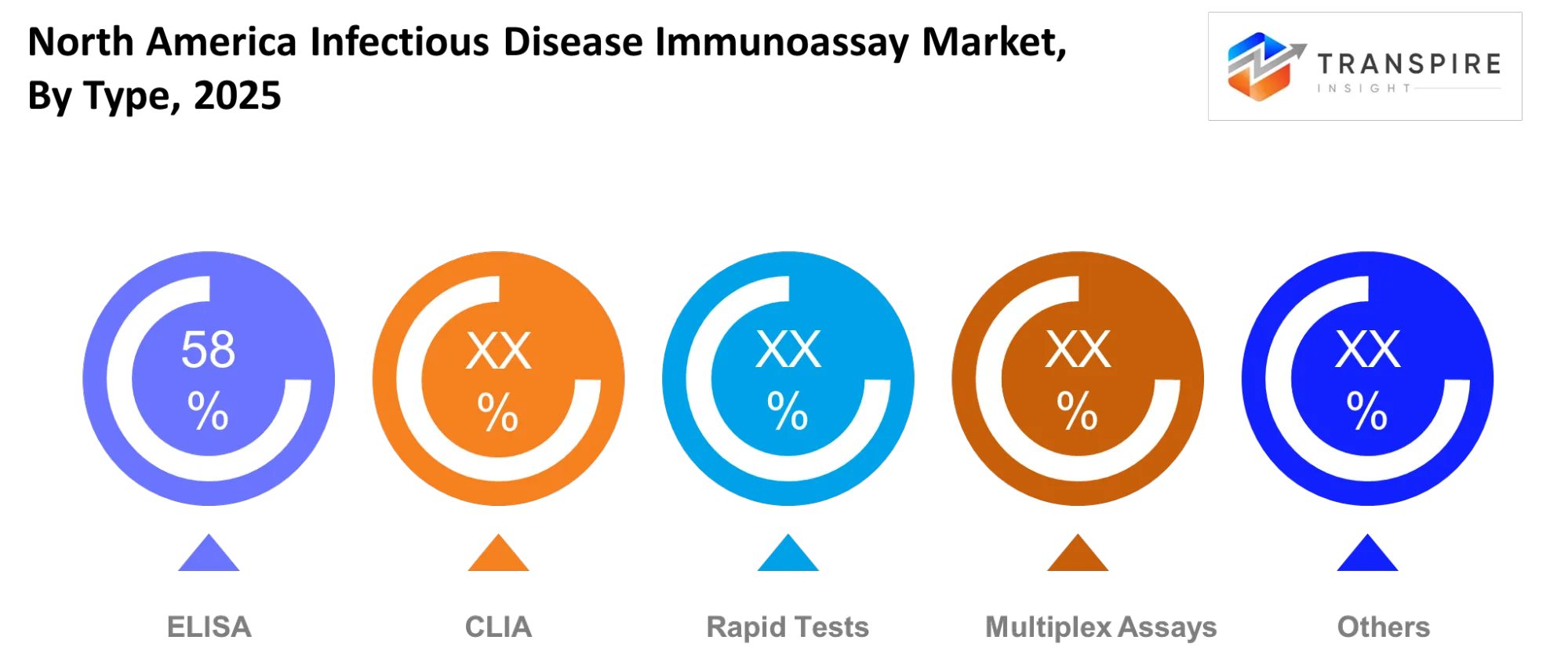
Chemiluminescence immunoassays right now still seem to be in the leading position in that particular segment, mainly because big hospitals and reference labs really want very high sensitivity, they also care a lot about automation compatibility, and of course fast turnaround. ELISA systems keep holding a fairly steady share too, mostly because they come with lower operating costs and they’re already well used in medium volume diagnostic environments. Rapid tests picked up steam quite a bit after the pandemic, when infectious disease screening got pushed out in a more decentralized way, you know , across pharmacies and urgent care facilities. Multiplex assays are kind of the fastest growing option, since clinicians increasingly need to detect several pathogens at the same time, using one patient sample, that kind of thing.
Growth in broad respiratory panel testing and blood screening applications is continuing to strengthen adoption rates. But even so, multiplex platforms still run into cost issues and reimbursement limitations, especially in smaller labs. Looking ahead, future growth probably will lean toward integrated assay platforms that blend quick workflows, scalability, and digital connectivity , all together. Manufacturers are expected to widen their reagent portfolio, while healthcare purchasers are increasingly preferring flexible systems that can handle changing infectious disease surveillance needs, without forcing a full replacement.
To learn more about this report, Download Free Sample Report
By Application
HIV and hepatitis testing still kind of dominate the application landscape, mostly because of those old national screening programs, tighter blood safety rules, and steady diagnostic needs across healthcare networks. COVID-19 testing pushed a lot of infrastructure investment over the last five years, but now volumes are slowly leveling off , since the emergency response measures have eased. Influenza diagnostics picked up more commercial weight after healthcare systems broadened respiratory surveillance, and then folded seasonal pathogen monitoring into regular lab routines, not just special projects.
At the same time, there’s rising attention on sepsis detection and sexually transmitted infection screening, and that’s changing what applications get prioritized. Hospitals are more and more asking for multiplex respiratory panels that cut down diagnostic uncertainty, and help clinicians make better treatment calls, especially during the busiest infection peaks. Public health agencies keep backing wider surveillance initiatives which means testing demand keeps showing up, even when we are past the pandemic phase.
Looking ahead, the biggest openings will likely be around syndromic testing panels and real time disease monitoring tools, which could mean better revenue potential for assay developers that can deliver faster clinical interpretation and scalable infectious disease management solutions.
By End-User
Hospitals and big diagnostic laboratories keep the dominant spot in the end user segment because high patient throughput really needs automated analyzers, centralized reporting systems ,and a steady reagent supply agreements. Independent laboratories still take a meaningful slice too, mostly because smaller healthcare providers are outsourcing more often to cut operational costs or “expenses” in general. Clinics and urgent care centers grew a lot in recent years after decentralized testing models got more acceptance, especially during the pandemic period, which felt like a turning point. Pharmacies and retail healthcare locations are also getting more involved in infectious disease diagnostics via rapid point of care testing services that fit in busy schedules.
Overall demand now seems to lean more toward speed, convenience, and integrated digital reporting rather than just relying on centralized lab work. At the same time, budget constraints keep technology upgrades out of reach for many smaller community facilities, in particular in rural areas where testing volumes stay lower . Future investment activity will likely concentrate on portable diagnostic platforms and cloud connected systems, which could expand testing access and at the same time ease the workflow pressure inside major hospital networks.
By Technology
Automated systems really dominate the technology segment, largely because healthcare providers push for operational efficiency, fewer mistakes, and more testing capacity, especially when they run centralized laboratories. Semi-automated platforms still get used by medium-sized facilities that want a decent level of throughput but don’t want to pay for fully integrated systems, like not yet. Even manual testing methods linger in smaller labs and in certain specialized research environments, yes, though overall adoption keeps sliding down. That is mostly tied to labor shortages and mounting compliance pressures which add operational risk. Automation demand picked up fast after healthcare systems hit workforce limitations and then saw major testing surges during pandemic conditions.
Right now, artificial intelligence integration, plus digital lab management tools, are enhancing quality control, helping with predictive maintenance and supporting better workflow optimization across diagnostic operations. Still, high implementation costs and interoperability challenges keep slowing down adoption in places that are resource constrained. If we look forward, the future direction seems to lean toward compact automated analyzers, with remote monitoring features and more advanced data analytics. Manufacturers that invest in scalable, AI-enabled platforms should end up in a stronger long-term competitive position as laboratories modernize their testing infrastructure.
What are the Key Use Cases Driving the North America Infectious Disease Immunoassay Market?
Hospital based HIV, hepatitis and respiratory infection testing is still the main driver for immunoassay adoption all around North America, you know, it just keeps being the core use case. Big diagnostic labs end up doing the most work here, largely because blood screening rules, emergency care routines, and inpatient infection control programs all push for fast and very precise outcomes, not just “good enough”.
Meanwhile point of care infectious disease testing is growing fast, showing up in pharmacies, urgent care facilities, and different outpatient clinics. More and more retail healthcare providers are relying on quick immunoassays for influenza, RSV, and sexually transmitted infection checks. The idea is to cut the lab load a bit and speed up treatment decisions when seasonal outbreaks start getting going.
There are also newer angles, like syndromic multiplex testing , plus AI supported outbreak monitoring platforms that help spot patterns sooner. Public health groups and academic research centers are putting money into cloud connected diagnostic systems. These can flag several pathogens at once , while also enabling real time epidemiological tracking and more distributed response plans.
|
Report Metrics |
Details |
|
Market size value in 2025 |
USD 10.59 Billion |
|
Market size value in 2026 |
USD 11.61 Billion |
|
Revenue forecast in 2033 |
USD 22.14 Billion |
|
Growth rate |
CAGR of 9.66% from 2026 to 2033 |
|
Base year |
2025 |
|
Historical data |
2021 - 2024 |
|
Forecast period |
2026 - 2033 |
|
Report coverage |
Revenue forecast, competitive landscape, growth factors, and trends |
|
Country scope |
North America (Canada, The United States, and Mexico) |
|
Key company profiled |
Abbott, Roche, Siemens Healthineers, Beckman Coulter, Thermo Fisher, Danaher, Bio-Rad, Ortho Clinical Diagnostics, Randox, Sysmex, Mindray, Hologic, Qiagen, Agilent, PerkinElmer |
|
Customization scope |
Free report customization (country, regional & segment scope). Avail customized purchase options to meet your exact research needs. |
|
Report Segmentation |
By Type (ELISA, CLIA, Rapid Tests, Multiplex Assays, Others), By Application (HIV, Hepatitis, COVID-19, Influenza, Others), By End-User (Hospitals, Labs, Clinics, Others), By Technology (Automated, Semi-automated, Manual, Others) |
Which Regions are Driving the North America Infectious Disease Immunoassay Market Growth?
The United States is basically leading the North America Infectious Disease Immunoassay Market. This happens because the big healthcare infrastructure already in place, plus solid reimbursement systems, and the federal disease surveillance programs, kind of keep testing volumes really high . Large hospital networks , and reference laboratories, are still putting money into automated immunoassay platforms, mainly to speed up turnaround times, and improve overall lab efficiency. At the same time, regulatory bodies like the Centers for Disease Control and Prevention and the FDA hold tight to infectious disease screening rules, and that keeps diagnostic demand coming back again and again. On top of that, there’s this more mature ecosystem of diagnostic manufacturers, academic research centers, and digital health providers , which ends up reinforcing long-term market dominance across the country.
Canada shows up as the second-largest regional contributor, though the growth story is a bit different from the United States. Healthcare expansion there is driven more by coordinated public investment, than by private laboratory consolidation. Provincial healthcare systems continue modernizing diagnostic infrastructure through centralized procurement , and long-running laboratory automation programs. Because funding stays relatively stable , and infectious disease monitoring is consistently carried out, immunoassay manufacturers get more predictable purchasing cycles. The market also benefits from steady collaboration between public health agencies and research institutions, which helps multiplex testing adoption and outbreak surveillance technologies move forward without too much disruption.
Mexico seems to be coming up as the fastest-growing market, mostly because expanding healthcare access , more infectious disease screening programs, and also a heavier push in decentralized diagnostics. On top of that, government-backed healthcare modernization—along with private laboratory growth—helped speed up the uptake of rapid immunoassay systems after the pandemic showed testing capacity gaps. Meanwhile, international diagnostic firms are setting up more regional collaborations and local distribution routes to strengthen market presence across bigger cities as well as secondary healthcare facilities. With all this happening, the growth path likely opens real chances for manufacturers and investors from 2026 to 2033, especially around affordable automated platforms , plus point-of-care solutions focused on infectious disease testing.
Who are the Key Players in the North America Infectious Disease Immunoassay Market and How Do They Compete?
The competitive landscape in North America for the Infectious Disease Immunoassay Market is still kinda moderately consolidated, where just a small set of multinational diagnostics companies essentially controls the high-throughput lab testing infrastructure. What happens more and more is that competition is not just about price, instead it leans on automation strength, the breadth of the assay menu, digital integration capabilities and those long-term reagent supply arrangements. The bigger established manufacturers keep pushing to hold their market share via installed analyzer networks, plus the steady, recurring consumable income, while smaller specialized diagnostic firms try to carve out space with decentralized testing and point-of-care approaches. At the same time, the market is seeing more rivalry from players building AI-enabled workflow systems, and multiplex testing technology that boosts lab efficiency and speeds up clinical turnaround times.
Abbott Laboratories leans into decentralized diagnostics pretty aggressively, using fast immunoassay platforms meant for pharmacies, outpatient clinics, and urgent care networks. Their strong distribution relationships plus scalable point-of-care systems create an advantage in high-volume community testing settings. Danaher Corporation on the other hand strengthens its position using integrated laboratory automation, along with wide infectious disease assay offerings across its diagnostics subsidiaries. They stand out by pairing high-throughput analyzers with workflow optimization tools, aimed at large hospital organizations and reference laboratories, in a more end-to-end sort of way.
Siemens Healthineers seems to compete via digital lab integration and chemiluminescence immunoassay advancements, which help deliver faster processing speeds and less manual handling, pretty much less messing around by staff. At the same time the firm keeps pushing cloud-connected diagnostic infrastructure, plus AI assisted quality management tools that make customers stick around. bioMérieux focuses more on infectious disease surveillance, and microbiology-linked immunoassay products, they build their edge through tight public health ties and hospital laboratory relationships, not only sales. Then Thermo Fisher Scientific grows through acquisitions with research collaborations, and also with specialized diagnostic reagent development, this tends to support academic research centers and smoother advanced molecular immunoassay integration.
Company List
- Abbott
- Roche
- Siemens Healthineers
- Beckman Coulter
- Thermo Fisher
- Danaher
- Bio-Rad
- Ortho Clinical Diagnostics
- Randox
- Sysmex
- Mindray
- Hologic
- Qiagen
- Agilent
- PerkinElmer
Recent Development News
In April 2026, Abbott Lowers 2026 Profit Forecast Following Exact Sciences Acquisition Impact: Abbott Laboratories revised its 2026 earnings outlook after accounting for the financial impact of its large Exact Sciences acquisition. The company highlighted continued strength in cancer diagnostics and infectious disease testing businesses, reinforcing its broader diagnostics expansion strategy in North America.
Source: https://www.reuters.com
In March 2026, Agilent to Acquire Biocare Medical in $950 Million Deal: Agilent Technologies announced a major acquisition of Biocare Medical, a California-based clinical pathology company known for tissue diagnostic and infectious disease detection products. The deal strengthens Agilent’s immunoassay and pathology portfolio across North America and expands its reach in infectious disease diagnostics laboratories.
Source: https://www.reuters.com
What Strategic Insights Define the Future of the North America Infectious Disease Immunoassay Market?
The North America Infectious Disease Immunoassay Market is sort of shifting, in a decentralized direction, toward connected diagnostic ecosystems where faster testing, AI - assisted interpretation, and real time surveillance kind of work together like part of the same healthcare setup, not just separate lab tasks. This change seems pushed by constant pressure on hospitals to cut the diagnostic turnaround time, while also getting better at outbreak readiness and population level tracking. In the next five to seven years, whoever wins competition will likely lean more on software integration, multiplex assay options, and ongoing reagent ecosystems rather than only counting on instrument sales.
One risk that gets talked about less than it should is the rising reliance on a small number of reagent suppliers and semiconductor-enabled analyzer components. If there are supply disruptions or trade restrictions, it could throw laboratories into operational bottlenecks, especially for groups that depend a lot on a centralized procurement network. At the same time, community based infectious disease surveillance, through pharmacies and retail healthcare systems , looks like a meaningful new opportunity, mainly as governments reinforce decentralized public health response structures.
Market participants should focus on interoperable diagnostic platforms that blend automation, cloud connectivity, and expandable assay menus. That’s because healthcare buyers are now more often selecting vendors based on long term operational flexibility, not only on standalone testing results or performance.
North America Infectious Disease Immunoassay Market Report Segmentation
By Type
- ELISA
- CLIA
- Rapid Tests
- Multiplex Assays
- Others
By Application
- HIV
- Hepatitis
- COVID-19
- Influenza
- Others
By End-User
- Hospitals
- Labs
- Clinics
- Others
By Technology
- Automated
- Semi-automated
- Manual
- Others
Frequently Asked Questions
Find quick answers to common questions.
The approximate North America Infectious Disease Immunoassay Market size for the market will be USD 22.14 Billion in 2033.
The key segments of the North America Infectious Disease Immunoassay Market are By Type (ELISA, CLIA, Rapid Tests, Multiplex Assays, Others), By Application (HIV, Hepatitis, COVID-19, Influenza, Others), By End-User (Hospitals, Labs, Clinics, Others), By Technology (Automated, Semi-automated, Manual, Others).
Major players in the North America Infectious Disease Immunoassay Market are Abbott, Roche, Siemens Healthineers, Beckman Coulter, Thermo Fisher, Danaher, Bio-Rad, Ortho Clinical Diagnostics, Randox, Sysmex, Mindray, Hologic, Qiagen, Agilent, PerkinElmer.
The current market size of the North America Infectious Disease Immunoassay Market is USD 10.59 Billion in 2025.
The North America Infectious Disease Immunoassay Market CAGR is 9.66%.
- Abbott
- Roche
- Siemens Healthineers
- Beckman Coulter
- Thermo Fisher
- Danaher
- Bio-Rad
- Ortho Clinical Diagnostics
- Randox
- Sysmex
- Mindray
- Hologic
- Qiagen
- Agilent
- PerkinElmer
Recently Published Reports
-
Apr 2026
AI in Diabetic Retinopathy Market
AI in Diabetic Retinopathy Market Size, Share & Analysis Report By Type (Screening AI Systems, Diagnostic AI Systems, and Predictive AI Models), By Application Segment (Hospitals, Ophthalmology Clinics, Diagnostic Centers, and Research and Development), and Geography (North America, Europe, Asia-Pacific, Middle East and Africa, South and Central America), 2021 - 2031
-
Apr 2026
Psychometric Tests Market
Psychometric Tests Market Size, Share & Analysis Report By Type (Personality Tests, Ability/Aptitude Tests, Skill/Knowledge Tests, and Others), By Application (Talent Acquisition and Talent Management), and Geography (North America, Europe, Asia-Pacific, Middle East and Africa, South and Central America), 2021 – 2031
-
Apr 2026
Rare Biological Sample Collection Market
Rare Biological Sample Collection Market Size, Share & Analysis Report By Type (Isolation Kits & Reagent, Blood Collection Tubes, and Others), By Application (Oncology, Transcriptomics, Pharmacogenomics, and Others), and Geography (North America, Europe, Asia-Pacific, Middle East and Africa, South and Central America), 2021 – 2031
-
May 2026
Patient Lift Pendant Market
Patient Lift Pendant Market By Product Type (Wired Pendants, Wireless, Programmable), By Operation Type(Manual, Electric), By End-Users (Healthcare Professionals, Patients), By Application (Hospitals, Homecare, Rehabilitation Centers, Others), By Industry Analysis, Size, Share, Growth, Trends, and Forecasts 2021-2033
Our Clients
.jpg)