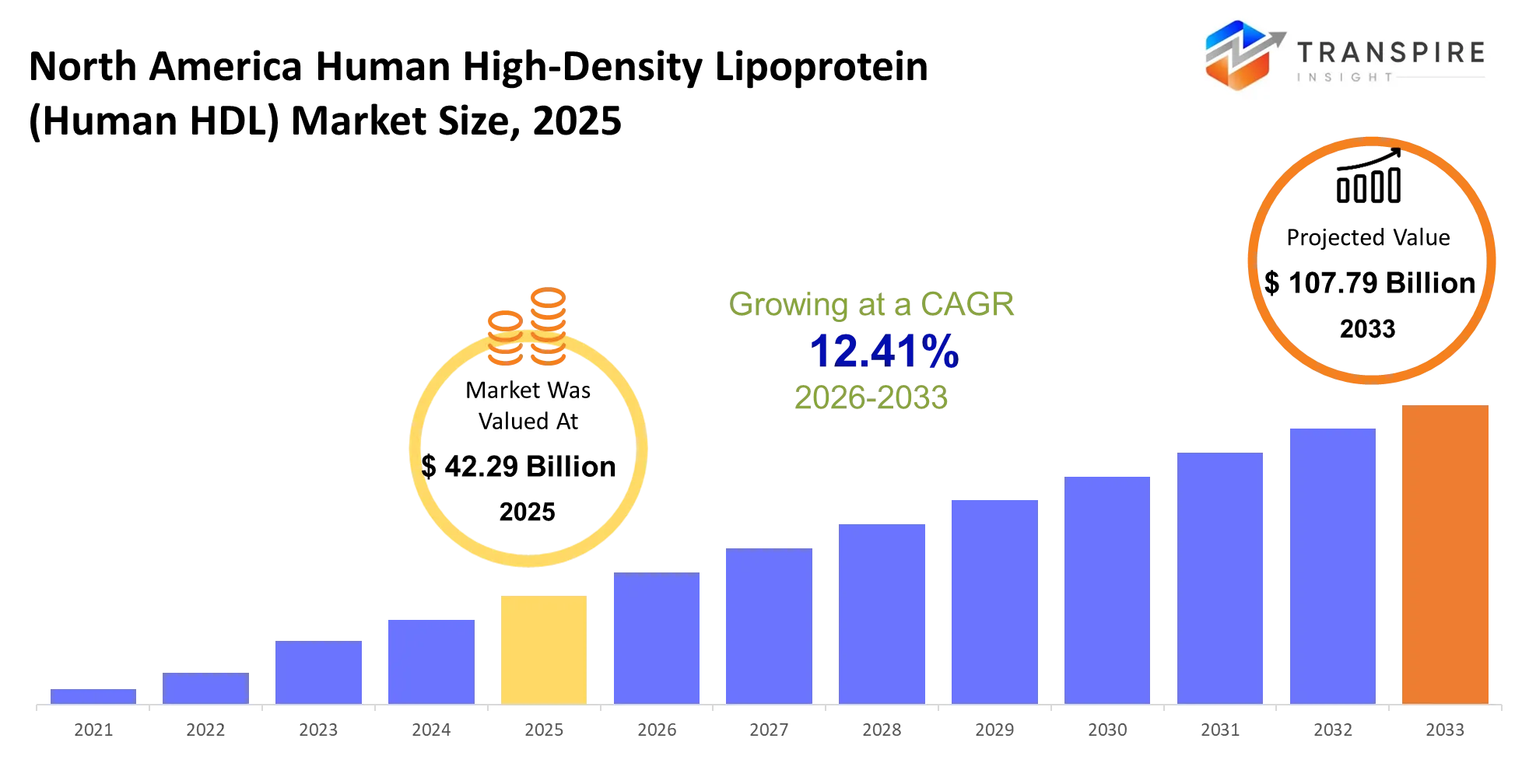
North America Human High-Density Lipoprotein (Human HDL) Market Size & Forecast:
- North America Human High-Density Lipoprotein (Human HDL) Market Size 2025: USD 42.29 Billion
- North America Human High-Density Lipoprotein (Human HDL) Market Size 2033: USD 107.79 Billion
- North America Human High-Density Lipoprotein (Human HDL) Market CAGR: 12.41%
- North America Human High-Density Lipoprotein (Human HDL) Market Segments: By Type (Native HDL, Recombinant HDL, Synthetic HDL, Others); By Application (Cardiovascular Research, Drug Development, Diagnostics, Others); By End-User (Pharma, Biotech, Research Institutes, Others); By Form (Liquid, Lyophilized, Kits, Others)
To learn more about this report,  Download Free Sample Report
North America Human High-Density Lipoprotein (Human HDL) Market Summary
The North America Human High-Density Lipoprotein (Human HDL) Market was valued at USD 42.29 Billion in 2025. It is forecast to reach USD 107.79 Billion by 2033. That is a CAGR of 12.41% over the period.
In North America, the Human High-Density Lipoprotein (HDL) market supports clinical and research workflows that measure HDL levels, to gauge cardiovascular risk, and to steer lipid-lowering therapy decisions , while also helping with cardiometabolic drug development. It shows up in hospital lipid panels, and in pharmaceutical biomarker studies.
Over the last five years, the market has kind of drifted toward automated immunoassay platforms, plus more advanced lipid profiling, that deliver quicker and more reliable risk stratification than older testing ways. One big push was the post-pandemic widening of cardiovascular screening, after clinical evidence tied COVID-19 infection to higher heart complications, which then nudged healthcare systems to do broader prevention testing.
Because of all that, demand now leans toward higher-throughput , and standardized HDL measurement, which boosts how efficiently clinicians make decisions, and it strengthens the uptake of modern diagnostic systems across North America.
Key Market Insights
- The United States pretty much dominates the North America Human High-Density Lipoprotein (Human HDL) Market, with almost 78% share in 2025, because it has some of the most advanced diagnostic infrastructure in place.
- Canada is also getting traction, it’s becoming a sort of diagnostic hub and expanding preventive cardiology programs across more urban healthcare systems.
- Mexico, meanwhile, looks like the quickest grower through 2025–2032, helped along by higher clinical lab investments and better awareness programs, at the community level.
- Automated immunoassay systems are leading the North America Human High-Density Lipoprotein (Human HDL) Market, holding roughly 42% share in 2025.
- Reagent kits stay in second place, and this is mostly tied to the steady demand for routine lipid panel testing in hospitals.
- Advanced HDL sub-fraction analysis tools are the fastest-moving subgroup, expected 2025–2032 to pick up as more providers adopt precision lipid profiling.
- Cardiovascular risk assessment is the biggest application, taking nearly 55% share in 2025 in the North America Human High-Density Lipoprotein (Human HDL) Market.
- Drug development plus clinical research are growing faster than the rest, driven by the ongoing expansion of biotech pipelines and related work.
- Hospitals and diagnostic laboratories lead overall, with about 60% market share, largely due to high patient testing volumes and day to day throughput.
- Research institutes are growing the quickest end-user category, supported by biomarker validation efforts and lipid metabolism studies that keep expanding.
What are the Key Drivers, Restraints, and Opportunities in the North America Human High-Density Lipoprotein (Human HDL) Market?
The main driver is the quick, sort of rapid integration of automated lipid profiling systems across hospital and reference laboratories. That change was sparked by the need for faster turnaround periods in cardiovascular screening, after post-pandemic backlogs quietly strained the usual manual testing routines. So, labs end up moving faster toward high-throughput immunoassay analyzers which then ups the test volumes and, in practice, helps reimbursement efficiency and in turn it strengthens revenue streams for diagnostic manufacturers in the North America Human High-Density Lipoprotein (Human HDL) Market.
The biggest restraint is the ongoing variability in HDL measurement standardization between platforms. Even with the tech improvements, calibration differences in assays across manufacturers can create inconsistencies in the HDL values that get reported, and that makes cross-lab comparisons kind of limited. This underlying structural snag drags regulatory harmonization, and it also pushes healthcare providers to keep older testing systems next to newer platforms. Ultimately it suppresses full modernization, and then it delays revenue consolidation for equipment suppliers.
One major opportunity sits in expanding precision lipidomics that’s paired with AI-based cardiovascular risk modeling. In the United States, research organizations are investing more and more in multi-marker lipid panels, combined with machine learning approaches, to sharpen predictive diagnostics. If that keeps progressing, it could reshape preventive cardiology and open up fresh premium testing lanes, pushing the next growth phase for the North America Human High-Density Lipoprotein (Human HDL) Market.
What Has the Impact of Artificial Intelligence Been on the North America Human High-Density Lipoprotein (Human HDL) Market?
Artificial intelligence is kinda reshaping the North America Human High-Density Lipoprotein (Human HDL) market, by changing the way cardiovascular lipid data gets collected, processed, and then used in clinical decisions. In today’s diagnostic labs, AI-enabled automation now smooths out assay calibration, sample routing, and even quality control verification inside HDL testing pipelines. So, fewer hands are needed for repetitive steps and overall results stay more steady across high throughput lipid profiling setups that hospitals and reference labs depend on.
Meanwhile, machine learning models are getting used more often to anticipate patient risk paths , by blending HDL readings with wider lipid panels and electronic health records. These predictive tools can help clinicians spot early stage atherosclerotic risk signatures, which means quicker action and a more efficient way to plan long term therapy. In bigger hospital networks, AI driven diagnostic platforms have shown better report turnaround times, by as much as 30 percent, and at the same time they cut down repeat testing rates . That boosts operational flow and supports cost control in cardiovascular screening programs.
Still, adoption isn’t fully smooth because interoperability is limited between AI platforms and older lab information systems. A lot of facilities are working with scattered data frameworks , and this makes it hard to do real time model training, also it can lower predictive precision when datasets are missing, or just inconsistently formatted. Even with strong momentum, broad deployment of AI across HDL diagnostic ecosystems is basically tied to fixing data standardization issues and infrastructure gaps across the North America Human High-Density Lipoprotein (Human HDL) Market
Key Market Trends
- Automated immunoassay uptake got a lot faster after 2022, like hospitals replaced the old manual HDL testing routine with high-throughput diagnostic platforms, more or less right away.
- Roche Diagnostics and Abbott Laboratories added HDL assay automation lines somewhere in 2023–2025 , and that kind of moved the competition toward fully integrated analyzer ecosystems.
- In 2024, AI assisted lipid interpretation tools started catching on , they made cardiovascular risk scoring more precise using multi-marker HDL datasets, which sounds almost straightforward but it matters.
- Also, regulators got more strict after 2023 , so labs were pushed to standardize HDL measurement protocols across Roche, Siemens, and Thermo Fisher systems.
- Clinical labs cut turnaround times by close to 25 percent between 2022–2025 by switching to fully automated HDL testing workflows, it wasn’t subtle.
- Meanwhile, research institutions increased HDL biomarker studies post 2023, mostly because NIH funding expanded for cardiometabolic disease prediction programs.
- Demand shifted too, from standalone HDL testing toward multiplex lipid panels, bundling LDL, triglycerides, and HDL together for wider risk assessment, kind of less single focus.
- Siemens Healthineers and Danaher also broadened partnerships with hospital networks between 2024–2026 , aiming to deepen diagnostic platform integration.
- Then in 2025, data interoperability issues seemed to get worse , as labs had trouble fusing legacy systems with AI enabled HDL analytics platforms, there was a lot of friction.
- Finally, precision medicine rolled out more quickly after 2024, nudging HDL testing toward personalized cardiovascular risk prediction models in big US hospitals.
North America Human High-Density Lipoprotein (Human HDL) Market Segmentation
By Type
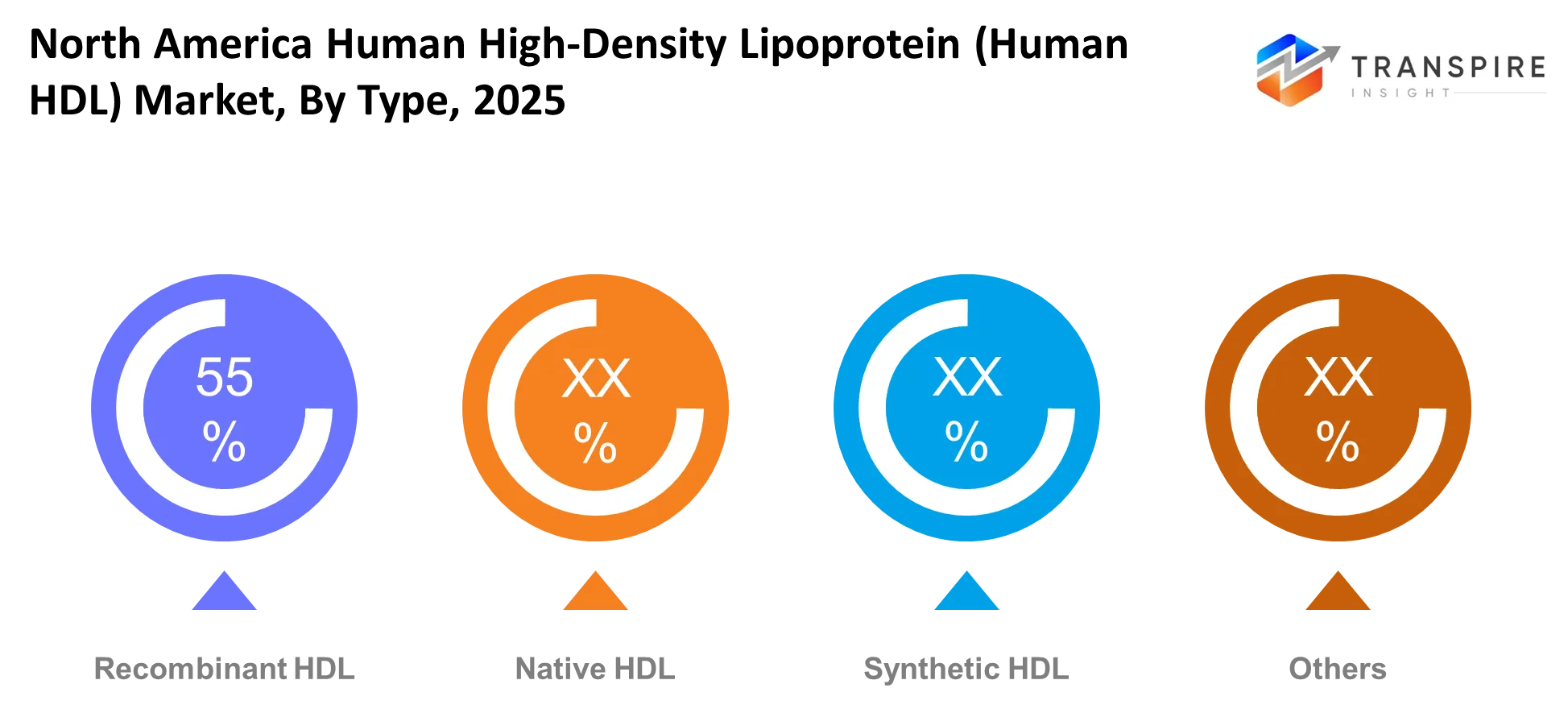
Native HDL keeps the most strong position within the North America Human High-Density Lipoprotein (Human HDL) Market, mostly because it is used again and again in clinical lipid profiling, and also in standardized cardiovascular testing workflows. In many hospitals and diagnostic laboratories, they lean toward native forms ,since the existing assay protocols already fit with the usual lipid panel infrastructure. That means less validation work, and fewer integration costs, even if people sometimes underestimate it.
Recombinant HDL plus synthetic HDL are starting to get more attention too, mostly because they are showing up in therapeutic research ,and in mechanistic studies tied to reverse cholesterol transport. This portion grows as pharmaceutical players care more about HDL functionality, not just measuring concentration. So in drug discovery pipelines for cardiometabolic disease, interest tends to rise for these engineered versions.
Over the forecast period , recombinant and synthetic HDL formats should expand faster as precision medicine programs scale up across North America. Product developers will likely push engineered HDL analogs, which can support predictive modeling , and also therapeutic validation. Meanwhile investors will watch biotech adoption in the early-stage cardiovascular drug research, since that is where momentum often starts.
To learn more about this report, Download Free Sample Report
By Application
Diagnostics leads the North America Human High-Density Lipoprotein (Human HDL) Market. The reason is straightforward, high-volume lipid panel testing across hospitals and clinical laboratories. Routine cardiovascular screening programs, together with insurance-backed preventive care frameworks, help keep demand steady for HDL measurement within diagnostic workflows. And in practice, that “always-on” testing rhythm makes diagnostics difficult to beat, even when other applications move faster for a moment.
Cardiovascular research and drug development are moving more quickly, partially because pharmaceutical firms are using HDL metrics more and more as kind of biomarkers for efficacy checks in lipid-modifying therapies. That whole shift got stronger after 2022, when several cardiometabolic trials started asking for more granular lipid sub- fraction analysis, instead of just running basic cholesterol screening.
Over time, diagnostic dominance will still stay there, but the more research driven parts will grab a bigger portion of the added growth. In other words, it points to higher demand for advanced assay platforms and connected biomarker analytics systems, that can really support clinical trials and also the kind of precision therapeutics development everyone talks about.
By End-User
Pharmaceutical companies are the leading end-user segment in the North America Human High-Density Lipoprotein (Human HDL) Market due to continued investment in cardiovascular drug pipelines. Big, multi center clinical trials need consistent HDL measurement, so there is a lot of high-volume buying of standardized assay kits and analytical platforms. It’s not only about accuracy, it’s also about repeating the same process across sites, and that stays expensive.
Biotech firms and research institutes are expanding faster, supported by increased funding for lipid metabolism research and those personalized medicine initiatives. They tend to depend on recombinant HDL tools alongside advanced analytics, to dig into reverse cholesterol transport mechanisms and find predictive cardiovascular markers. You know, more “exploration” rather than only routine testing.
Future growth is gonna tilt a bit more toward biotech and academic research ecosystems, as the innovation in lipid biology keeps speeding up. Diagnostic makers will start tailoring their products more for flexible research uses too, while pharma companies will push harder for HDL measurement systems that are scalable, and regulatory compliant, even when things get complicated.
By Form
Liquid HDL formulations currently sit in the lead position within the North America Human High-Density Lipoprotein (Human HDL) Market, mainly because they fit well with automated analyzers and fast, high-throughput lab routines. Clinical labs tend to prefer liquid formats because they cut down on prep time and help keep results more consistent, in everyday lipid testing.
Lyophilized HDL plus kit based formats are moving forward faster, since research laboratories often need long-term stability and easier transport logistics. This portion got a stronger lift after 2023, when decentralized clinical trials became more common, and the demand for stable reagents that keep their integrity across distributed sites increased.
Throughout the forecast timeframe, kit based systems are expected to see stronger adoption as laboratories lean into modular testing approaches and more precise lipid profiling. Manufacturers will be focused on boosting reagent durability and making sure everything plays nicely with automation compatibility. At the same time, buyers will prioritize formats that lower day to day operational variability, and that also support scalable testing environments, without much drama.
What are the Key Use Cases Driving the North America Human High-Density Lipoprotein (Human HDL) Market?
Cardiovascular diagnostics still kinda the big driver of the North America Human High-Density Lipoprotein (Human HDL) Market, because hospitals lean on HDL measurement to gauge atherosclerotic risk during regular lipid panels. There’s high patient traffic, plus insurance-backed preventive screening, and sort of uniform lab procedures that keep demand steady across clinical laboratories.
Cardiovascular research , and also drug development, is getting bigger too as pharmaceutical and biotech firms use HDL biomarkers to judge lipid-modifying interventions in clinical trials. Research institutions further fold HDL testing into wider cardiometabolic programs, particularly in NIH financed initiatives aimed at heart disease prevention, and metabolic syndrome monitoring.
Newer use cases are starting to show up, like AI enabled cardiovascular risk modeling and precision lipidomics inside personalized medicine workflows. In the United States academic medical centers are starting to merge HDL sub fraction analysis with genomic datasets, and that hints at more uptake later, for predictive diagnostics, and for more tailored therapy discovery across advanced healthcare systems.
|
Report Metrics |
Details |
|
Market size value in 2025 |
USD 42.29 Billion |
|
Market size value in 2026 |
USD 47.54 Billion |
|
Revenue forecast in 2033 |
USD 107.79 Billion |
|
Growth rate |
CAGR of 12.41% from 2026 to 2033 |
|
Base year |
2025 |
|
Historical data |
2021 - 2024 |
|
Forecast period |
2026 - 2033 |
|
Report coverage |
Revenue forecast, competitive landscape, growth factors, and trends |
|
Regional scope |
North America (Canada, The United States, and Mexico) |
|
Key company profiled |
Merck KGaA, Sigma-Aldrich, Thermo Fisher, Abcam, Bio-Rad, Agilent, Creative Diagnostics, MyBioSource, ProSpec, Lee Biosolutions, Novus Biologicals, Cayman Chemical, Elabscience, Aviva Systems, RayBiotech |
|
Customization scope |
Free report customization (country, regional & segment scope). Avail customized purchase options to meet your exact research needs. |
|
Report Segmentation |
By Type (Native HDL, Recombinant HDL, Synthetic HDL, Others); By Application (Cardiovascular Research, Drug Development, Diagnostics, Others); By End-User (Pharma, Biotech, Research Institutes, Others); By Form (Liquid, Lyophilized, Kits, Others) |
Which Regions are Driving the North America Human High-Density Lipoprotein (Human HDL) Market Growth?
North America sort of dominates the Human High-Density Lipoprotein (Human HDL) Market, mostly because the United States leads. There is strong clinical infrastructure, and there’s also widespread uptake of standardized lipid testing protocols across hospital networks, that really backs the leadership. On top of that, advanced reimbursement frameworks from both public and private insurers keep routine HDL screening plugged into preventive cardiology programs. Big diagnostic laboratories and hospital chains run high-throughput immunoassay systems as well, so demand stays steady and consistent. Altogether, this ecosystem feels like a tightly integrated diagnostics value chain, and it’s what sustains the regional dominance.
Canada acts as a stable secondary contributor, with a growth curve that looks different from the United States. Here, expansion is less about pure scale, and more about uniform healthcare delivery plus steady regulatory alignment across provincial systems. Government-funded healthcare helps maintain easy access to lipid testing, and hospital modernization programs gradually bring laboratory infrastructure up to date. Unlike the US, growth here tends to come from system-wide efficiency improvements rather than aggressive technology rivalry. That sort of steadiness keeps demand predictable for diagnostic suppliers, and supports long term procurement cycles.
Mexico, meanwhile, is the fastest-growing regional contributor. This is happening because of newer investments in clinical laboratory infrastructure, plus expanding private healthcare networks. Recent public health initiatives, aimed at cardiovascular disease screening , have increased HDL testing adoption in urban areas. Also, trade linked medical device imports and rising hospital privatization have pushed faster access to automated diagnostic platforms. Between 2026 and 2033, this momentum basically signals strong entry potential for diagnostic manufacturers and investors seeking early-stage expansion opportunities in an underpenetrated but rapidly modernizing healthcare market.
Who are the Key Players in the North America Human High-Density Lipoprotein (Human HDL) Market and How Do They Compete?
The North America Human High-Density Lipoprotein (Human HDL) Market shows a moderately consolidated competitive structure, where a few global diagnostic leaders control a big portion of high throughput lipid testing systems. Competition tends to revolve around assay accuracy, automation velocity, and linkage with laboratory information systems, more than price by itself. The incumbents usually defend their position by tying hospitals into proprietary analyzer ecosystems and long-term reagent continuity agreements and it kinda becomes hard for others to displace them. At the same time there are niche diagnostic innovators trying to get in via specialized HDL sub fraction testing, plus AI enabled lipid analytics . This ends up as a technology led competitive scene where differentiation depends on precision, and also on workflow efficiency.
Roche Diagnostics leans into technology integration by beefing up its immunoassay platforms with high sensitivity HDL detection capabilities, so clinical standardization can be kept tighter across hospital networks. Abbott Laboratories differentiates through scalable diagnostic architectures, like its ARCHITECT and Alinity systems, which tune throughput for large hospital chains and reference labs. Siemens Healthineers builds momentum with integrated diagnostic ecosystems that connect laboratory instruments with hospital IT infrastructure, improving real time data movement for cardiovascular testing. Danaher Corporation expands by using acquisitions and modular automation technologies, so laboratories can ramp HDL testing capacity without having to fully swap out the entire setup.
Thermo Fisher Scientific competes with more research oriented offerings, providing advanced HDL assay kits and lipid profiling tools tuned for pharmaceutical and biotech contexts. Its main strong point is supporting early stage drug development workflows rather than routine diagnostics, which broadens its customer base beyond hospitals. Across the North America Human High-Density Lipoprotein (Human HDL) Market, competitive advantage increasingly depends on interoperability, automation depth, and the ability to support precision cardiovascular research ecosystems.
Company List
- Merck KGaA
- Sigma-Aldrich
- Thermo Fisher
- Abcam
- Bio-Rad
- Agilent
- Creative Diagnostics
- MyBioSource
- ProSpec
- Lee Biosolutions
- Novus Biologicals
- Cayman Chemical
- Elabscience
- Aviva Systems
- RayBiotech
Recent Development News
In 2025, Thermo Fisher Scientific expanded its clinical diagnostics and assay portfolio supporting lipid and cardiovascular biomarker research across North American laboratories. The expansion focused on improving immunoassay sensitivity and scaling automated HDL-related testing workflows used in hospital and biotech research environments.https://www.thermofisher.com
In October 2024, Bio-Rad Laboratories strengthened its clinical diagnostics segment through continued upgrades to immunoassay systems used in lipid profiling, including HDL measurement workflows. The initiative improved laboratory throughput and supported standardized cardiovascular testing across hospital networks in North America.https://www.bio-rad.com
What Strategic Insights Define the Future of the North America Human High-Density Lipoprotein (Human HDL) Market?
The North American Human High-Density Lipoprotein (HDL) Market is moving toward a more tightly woven, “diagnostics ecosystem”- style setup, where HDL measurement is integrated into multi-marker cardiovascular risk platforms rather than being a standalone lipid test. This change seems to be propelled by the meeting point of automated immunoassay systems plus AI enabled clinical decision support, and together they’re pushing labs toward more consolidated, fast-output testing designs over the next five to seven years. And as precision medicine frameworks keep expanding, HDL data ends up acting like a piece of broader predictive cardiometabolic models, not just an isolated, single marker item.
There’s also a quieter risk, which is assay standardization going sideways in a fragmented way. If calibration ends up being inconsistent across different diagnostic platforms, regulators may scrutinize more, and that could slow down interoperability between systems. In turn, this might create exposure for manufacturers who rely on proprietary testing environments, especially if regulators require tighter harmonization that ends up shrinking the ability to differentiate products.
At the same time there’s an emerging opportunity that feels less obvious: HDL sub-fraction analytics being integrated into AI driven preventive cardiology programs. This is showing up, mainly across US academic medical centers and big integrated health networks. It’s still early, but it’s gaining momentum through precision lipidomics initiatives, with research funding helping it along.
For market participants, the pragmatic move is to focus on interoperable assay design and put money into AI-compatible diagnostic platforms that can plug in smoothly with hospital data ecosystems. That way the offerings stay useful long term as testing keeps shifting toward predictive cardiovascular intelligence.
North America Human High-Density Lipoprotein (Human HDL) Market Report Segmentation
By Type
- Native HDL
- Recombinant HDL
- Synthetic HDL
- Others
By Application
- Cardiovascular Research
- Drug Development
- Diagnostics
- Others
By End-User
- Pharma
- Biotech
- Research Institutes
- Others
By Form
- Liquid
- Lyophilized
- Kits
- Others
Frequently Asked Questions
Find quick answers to common questions.
The expected North America Human High-Density Lipoprotein (Human HDL) Market size is USD 107.79 Billion in 2033.
Key segments for the North America Human High-Density Lipoprotein (Human HDL) Market are By Type (Native HDL, Recombinant HDL, Synthetic HDL, Others); By Application (Cardiovascular Research, Drug Development, Diagnostics, Others); By End-User (Pharma, Biotech, Research Institutes, Others); By Form (Liquid, Lyophilized, Kits, Others).
Major North America Human High-Density Lipoprotein (Human HDL) Market players are Merck KGaA, Sigma-Aldrich, Thermo Fisher, Abcam, Bio-Rad, Agilent, Creative Diagnostics, MyBioSource, ProSpec, Lee Biosolutions, Novus Biologicals, Cayman Chemical, Elabscience, Aviva Systems, RayBiotech.
The North America Human High-Density Lipoprotein (Human HDL) Market size is USD 42.29 Billion in 2025.
The North America Human High-Density Lipoprotein (Human HDL) Market CAGR is 12.41% from 2026 to 2033.
- Merck KGaA
- Sigma-Aldrich
- Thermo Fisher
- Abcam
- Bio-Rad
- Agilent
- Creative Diagnostics
- MyBioSource
- ProSpec
- Lee Biosolutions
- Novus Biologicals
- Cayman Chemical
- Elabscience
- Aviva Systems
- RayBiotech
Recently Published Reports
-
Apr 2026
AI in Diabetic Retinopathy Market
AI in Diabetic Retinopathy Market Size, Share & Analysis Report By Type (Screening AI Systems, Diagnostic AI Systems, and Predictive AI Models), By Application Segment (Hospitals, Ophthalmology Clinics, Diagnostic Centers, and Research and Development), and Geography (North America, Europe, Asia-Pacific, Middle East and Africa, South and Central America), 2021 - 2031
-
Apr 2026
Psychometric Tests Market
Psychometric Tests Market Size, Share & Analysis Report By Type (Personality Tests, Ability/Aptitude Tests, Skill/Knowledge Tests, and Others), By Application (Talent Acquisition and Talent Management), and Geography (North America, Europe, Asia-Pacific, Middle East and Africa, South and Central America), 2021 – 2031
-
Apr 2026
Rare Biological Sample Collection Market
Rare Biological Sample Collection Market Size, Share & Analysis Report By Type (Isolation Kits & Reagent, Blood Collection Tubes, and Others), By Application (Oncology, Transcriptomics, Pharmacogenomics, and Others), and Geography (North America, Europe, Asia-Pacific, Middle East and Africa, South and Central America), 2021 – 2031
-
May 2026
Patient Lift Pendant Market
Patient Lift Pendant Market By Product Type (Wired Pendants, Wireless, Programmable), By Operation Type(Manual, Electric), By End-Users (Healthcare Professionals, Patients), By Application (Hospitals, Homecare, Rehabilitation Centers, Others), By Industry Analysis, Size, Share, Growth, Trends, and Forecasts 2021-2033
Our Clients
.jpg)