

North America High-fructose Corn Syrup (HFCS) Market Size & Forecast:
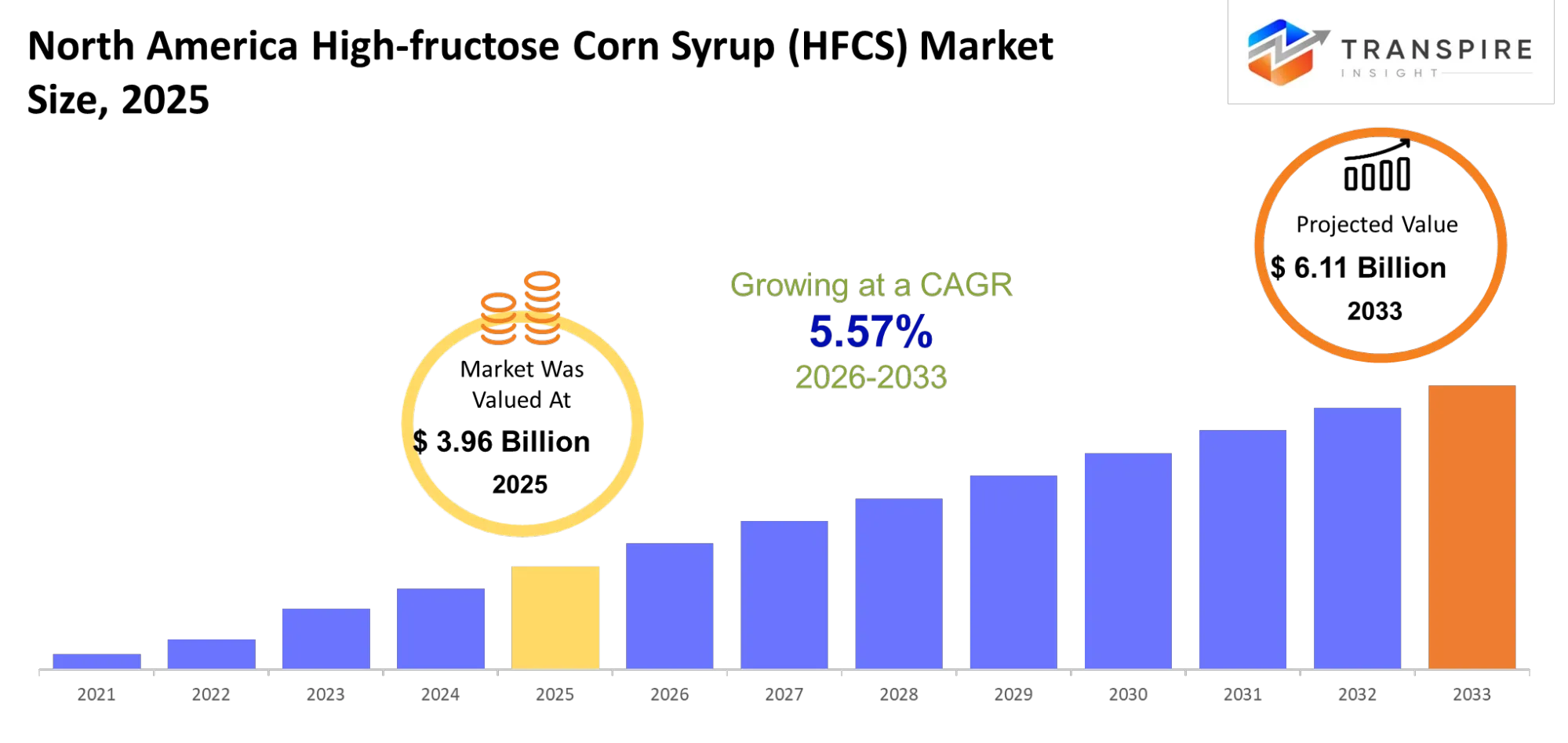
- North America High-fructose Corn Syrup (HFCS) Market Size 2025: USD 3.96 Billion
- North America High-fructose Corn Syrup (HFCS) Market Size 2033: USD 6.11 Billion
- North America High-fructose Corn Syrup (HFCS) Market CAGR: 5.57%
- North America High-fructose Corn Syrup (HFCS) Market Segments: By Type (HFCS 42, HFCS 55, HFCS 90, Liquid HFCS, Powder HFCS, Others), By Application (Beverages, Bakery, Confectionery, Dairy, Processed Foods, Others), By End-User (Food Industry, Beverage Industry, Retail, Industrial, Commercial, Others), By Form (Liquid, Syrup, Powder, Crystals, Blends, Others).
To learn more about this report,  Download Free Sample Report
North America High-fructose Corn Syrup (HFCS) Market Summary:
The North America High-fructose Corn Syrup (HFCS) Market size is estimated at USD 3.96 Billion in 2025 and is anticipated to reach USD 6.11 Billion by 2033, growing at a CAGR of 5.57% from 2026 to 2033. North America shows steady demand for High-fructose Corn Syrup (HFCS) because the food and beverage industry uses the sweetener in various products.
The food industry uses HFCS as a sweetener because it provides cheaper prices and better sweetness compared to standard sugar for soft drinks and baked goods and dairy products and processed foods. The North American High-fructose Corn Syrup (HFCS) Market experiences growth because consumers increasingly choose packaged foods and convenience foods.The United States especially feels this impact because major beverage companies use HFCS-based products to make their drinks.
The North America High-fructose Corn Syrup (HFCS) Market experiences development through improved supply chain operations and the region's well-established corn farming capacity. Manufacturers maintain their production output through food processing technology improvements and raw material supply which provides ongoing support. Product development and reformulation processes now focus on natural sweeteners because health concerns have increased and people want natural sweeteners. The regional sweeteners market still depends on HFCS because it delivers multiple functional benefits and exists in different commercial uses.
What Has the Impact of Artificial Intelligence Been on the North America High-fructose Corn Syrup (HFCS) Market?
Artificial Intelligence is changing how businesses compete in the North American High-fructose Corn Syrup (HFCS) Market through its ability to produce data-based decisions which enhance operational transparency throughout the entire supply chain. The North American High-fructose Corn Syrup (HFCS) Market uses AI-driven market research tools together with predictive analytics to assist manufacturers and suppliers in identifying changes in beverage and processed food consumption patterns.
The system achieves this purpose by enhancing demand forecasting accuracy while decreasing uncertainty throughout procurement processes. Artificial intelligence in North America High-fructose Corn Syrup (HFCS) market applications enables producers to obtain immediate information about pricing developments and raw material supply conditions which enhances their strategic planning process.
Smart automation combined with machine learning technology creates better production results because it enables companies in the North American High-fructose Corn Syrup (HFCS) Market to operate more effectively while managing their supply chains better. AI-driven systems decrease energy waste during corn processing while they achieve better yield results which lead to significant cost reductions. The North American High-fructose Corn Syrup (HFCS) Market uses intelligent logistics models to achieve two benefits because they help reduce delivery times while they create better distribution systems that operate throughout North America.
North America High-fructose Corn Syrup (HFCS) Market artificial intelligence systems use consumer research data to create new products which help companies develop health-related products that meet current consumer needs. The use of artificial intelligence provides businesses with a substantial market edge because it boosts their operational speed while increasing their overall efficiency and their permanent capacity to stay competitive.
Key Market Trends & Insights:
- The United States controls 85 percent of North America High-fructose Corn Syrup (HFCS) Market which will reach this level by 2025 because it operates extensive corn processing facilities.
- Canada serves as a reliable secondary market because its demand for products from the beverage and bakery sectors remains constant.
- The region of Mexico will become the fastest-growing market which will continue to develop until 2030 because of increasing soft drink sales.
- HFCS-55 holds the leading share of around 60% in the north america high-fructose corn syrup (HFCS) market, widely used in soft drinks.
- The second largest segment of HFCS-42 mostly serves as an ingredient in baked goods and packaged food products.
- Specialty HFCS blends are the fastest-growing segment due to customized formulation demand.
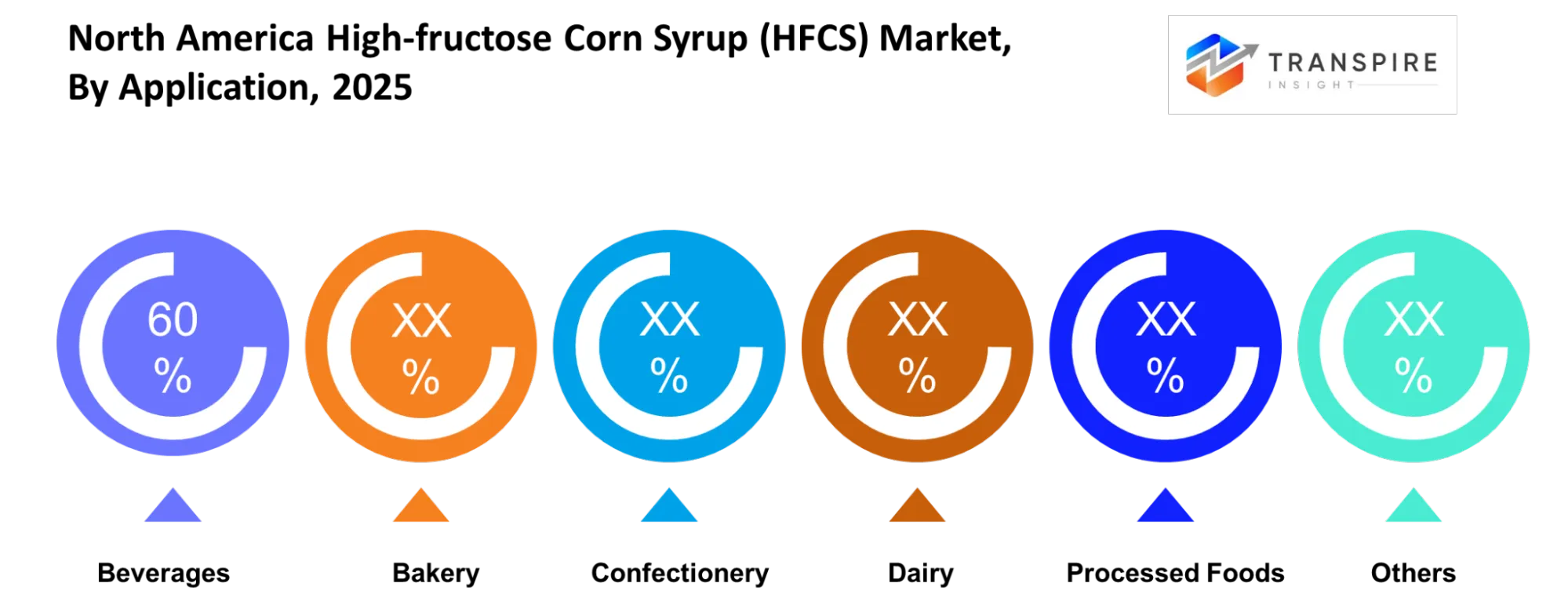
- Beverages dominate the North America High-fructose Corn Syrup (HFCS) Market with a nearly 45% share which carbonated soft drinks support.
- The packaged food consumption trends create the fastest growth for bakery and confectionery applications.
- Food and beverage manufacturers represent the largest portion of the north america high-fructose corn syrup (HFCS) market because they generate more than 70% of total market demand.
- The end-user segment of industrial food processors shows the fastest growth because these facilities require substantial production capabilities.
North America High-fructose Corn Syrup (HFCS) Market Segmentation
By Type
HFCS 42 remains widely used in bakery and processed food products due to its ability to create sweet flavors which maintain their taste throughout baking. HFCS 55 continues to dominate beverage production especially in soft drinks because of its higher sweetness level which matches the sweetness of sucrose. The market share of HFCS 90 remains small since it serves specialized formulations which need extremely sweet flavors. The liquid HFCS form leads the market because it allows for simple integration into production systems which operate at large scales.
Dry mix applications start to show interest in powder HFCS because it provides simpler storage and transportation solutions. The food processing sector maintains steady demand for HFCS variants which drives continuous growth in North America. Manufacturers adopt the product because it offers cost savings together with dependable supply networks which help maintain stable HFCS markets even when consumer tastes change.
By Application
The biggest market for applications exists in beverages because soft drinks create constant demand for HFCS throughout North America. Products from the bakery and confectionery industries use HFCS because it maintains their desired texture and sweetness levels. Dairy products and processed food items use HFCS to improve their taste stability and product longevity. The North America HFCS market continues to benefit from rising consumption of packaged and convenience foods across urban populations.
The beverage industry will maintain strong demand for HFCS because carbonated drinks undergo production at a large scale. Food manufacturers are also reformulating products to balance cost and taste efficiency. The increasing adoption of processed food in urban areas creates steady growth across various application segments.
To learn more about this report, Download Free Sample Report
By End-User
Food industry remains the primary end-user, accounting for the highest consumption of HFCS in manufacturing processed goods. Soft drink production depends on high fructose corn syrup which makes the beverage industry the second largest user of this sweetener. The retail and commercial sectors create demand through their distribution of packaged foods to consumers. Industrial applications also contribute through large-scale food processing operations across North America.
Food processors increase demand for sweeteners because they seek budget-friendly sweetener alternatives. Beverage companies need to expand their production capacity because consumption trends are increasing. Industrial food manufacturing remains a steady contributor to overall market stability. The retail distribution channels help packaged products move to supermarkets and convenience stores. Commercial food service operators maintain consistent demand through large-scale food preparation needs.
By Form
Liquid form dominates industrial food and beverage production systems because it enables easy mixing. Syrup HFCS serves as the primary sweetener for soft drinks and packaged foods because it maintains consistent flavor throughout the products. Dry mixes and specialty food products are starting to accept powder and crystalline forms as their preferred options. Food manufacturers use blended formulations to achieve their required functional needs throughout their production processes.
Manufacturers prefer liquid and syrup forms because these options reduce production costs and enable quicker system integration. The demand for storage-friendly powder and crystal formats is increasing which drives their gradual market expansion. Blended HFCS solutions are becoming more popular among businesses which want to achieve both custom sweetness levels and consistent product performance.
What are the Main Challenges for the North America High-fructose Corn Syrup (HFCS) Market Growth?
The North America High-fructose Corn Syrup (HFCS) Market faces ongoing production efficiency challenges and supply chain stability issues due to both technical difficulties and operational problems. Manufacturers need to produce standard products because corn quality and seasonal corn availability cause variations that lead to unpredictable output. North America High-fructose Corn Syrup (HFCS) producers need to operate their processing facilities with high energy consumption and precise operational monitoring because this requirement restricts their ability to respond to changes in market demand. The production process experiences delays when growth obstacles emerge which makes it harder for producers to manage their operations.
The North America High-fructose Corn Syrup (HFCS) Market faces major challenges due to both manufacturing and commercialization barriers. Food safety regulations and quality certification requirements and new labeling standards require businesses to allocate more resources which extends their production times. The high capital requirements for refining and enzymatic processing systems create obstacles that prevent smaller companies from entering the market. The north america high-fructose corn syrup (hfcs) market faces two major challenges because production expenses keep rising and businesses must comply with new regulatory requirements which make it harder to bring products to market and to grow their operations.
The North America High-fructose Corn Syrup (HFCS) Market expansion faces two main obstacles which include adoption issues and infrastructure shortages that particularly impact small food manufacturing businesses. The production facilities experience operational delays because they lack advanced processing systems and skilled technical personnel. The funding limitations for innovation together with the modernization needs of businesses create obstacles for their adoption of niche applications. The north america high-fructose corn syrup (hfcs) market faces adoption difficulties which result in various end-use industries experiencing different rates of market growth.
Country Insights
The study demonstrates that North American regions exhibit different sweetener consumption patterns for their food and beverage production requirements. The region experiences sustained consumption patterns which industrial food processing and beverage manufacturing activities create.
The United States maintains its leading role in regional demand because it possesses a large beverage manufacturing industry and advanced corn processing facilities. The food industry maintains constant sweetener consumption through its extensive use of sweeteners in soft drinks and bakery products and packaged food items. The existing supply chain network provides production facilities with dependable product availability and cost-effective operational services.
The Canadian market displays continuous demand because processed food and beverage sectors maintain their operations at half the production capacity of United States facilities. The market depends on imports to secure sweetener supplies which drives up costs and restricts product availability. The packaged food market expands in urban centers which leads to gradual growth in market share despite still holding a minor position in the regional market.
Mexico displays the fastest growth in consumption because of increased soft drink consumption and rising demand for processed food products. The combination of urban population growth and new dietary trends leads to higher sweetener consumption. The food manufacturing industry and North American trade agreements contribute to the regional economic development through their expansion.
The United States functions as the main regional force while Canada shows continuous consumption patterns and Mexico demonstrates increasing demand growth. The North American region maintains stable supply conditions because of its strong agricultural production and established food processing infrastructure. The market forecast for the future remains affected by two factors which include food industry growth and the demand for cost-effective sweeteners.
Recent Development News
In April 2026, Bunge lifts 2026 outlook on strong crush margins, biofuel demand : Bunge raised its full-year 2026 earnings outlook after stronger crush margins and a better biofuel backdrop. For the HFCS market, this is an upstream corn-processing signal worth watching because it reflects broader grain economics in North America.
Source: https://www.reuters.com
In April 2026, Coca-Cola plays down impact of high oil prices to raise profit forecast: Coca-Cola lifted its 2026 earnings outlook after a strong first quarter, while continuing to lean into zero- and low-sugar drinks. For HFCS watchers, the important signal is that the company is still steering product mix toward healthier formats rather than broadening sugary volume.
Source: https://www.reuters.com
|
Report Metrics |
Details |
|
Market size value in 2025 |
USD 3.96 Billion |
|
Market size value in 2026 |
USD 4.18 Billion |
|
Revenue forecast in 2033 |
USD 6.11 Billion |
|
Growth rate |
CAGR of 5.57% from 2026 to 2033 |
|
Base year |
2025 |
|
Historical data |
2021 – 2024 |
|
Forecast period |
2026 – 2033 |
|
Report coverage |
Revenue forecast, competitive landscape, growth factors, and trends |
|
Country scope |
North America (Canada, The United States, and Mexico) |
|
Key company profiled |
ADM, Cargill, Ingredion, Tate & Lyle, Roquette, Global Sweeteners, COFCO, Showa Sangyo, Gulshan Polyols, Samyang, Daesang, Meelunie, Beneo, Südzucker, Tereos |
|
Customization scope |
Free report customization (country, regional & segment scope). Avail customized purchase options to meet your exact research needs. |
|
Report Segmentation |
By Type (HFCS 42, HFCS 55, HFCS 90, Liquid HFCS, Powder HFCS, Others), By Application (Beverages, Bakery, Confectionery, Dairy, Processed Foods, Others), By End-User (Food Industry, Beverage Industry, Retail, Industrial, Commercial, Others), By Form (Liquid, Syrup, Powder, Crystals, Blends, Others). |
How Can New Companies Establish a Strong Foothold in the North America High-fructose Corn Syrup (HFCS) Market?
New companies entering the North America High-fructose Corn Syrup (HFCS) Market have the opportunity to establish strong market positions through their dedication to niche product development and their commitment to efficient production processes. The North America High-fructose Corn Syrup (HFCS) Market needs companies to develop unique product offerings which will help them succeed in this highly competitive market. Sweet Green Fields demonstrates how startups achieve success through their specific product development work which enables them to meet customer needs in the food formulation market.
Buyers in the north america high-fructose corn syrup (hfcs) market will establish long-term trust because companies maintain their product quality while demonstrating dedication to environmental responsibility. Food and beverage manufacturers serve as strategic partners for businesses that want to succeed in the North America High-fructose Corn Syrup (HFCS) Market. New market entrants can establish reliable customer bases through their partnerships with major processors which include beverage bottlers and packaged food manufacturers.
Companies which operate through Cargill-backed innovation units showcase how businesses can enhance their market reach through their supply chain partnerships. North America high-fructose corn syrup (HFCS) market participants will achieve lower operational risks and better scalability through their partnerships with distribution networks and corn refining companies. The critical strategy of technological differentiation uses machine learning together with smart automation to enhance production efficiency while reducing operational expenses.
The North America High-fructose Corn Syrup (HFCS) Market increasingly values predictive analytics for demand forecasting and supply optimization. Companies that focus on enzyme-based processing through Ingredion startup partnerships will achieve greater yield stability according to their research. In the north america high-fructose corn syrup (hfcs) market, companies that invest in advanced processing systems and digital monitoring tools will gain a stronger competitive advantage.
The new companies can create operational strength by solving industry challenges which include pricing unpredictability and dependency on raw materials and environmental sustainability issues. The North America High-fructose Corn Syrup (HFCS) Market maintains its current trajectory through shifting consumer choices which create business opportunities for flexible companies that prioritize innovation. Companies will achieve sustained market presence through efficient operations and strategic alliances and their commitment to technology development.
Key North America High-fructose Corn Syrup (HFCS) Market Company Insights
The North American High-fructose Corn Syrup (HFCS) Market experiences competition because the major corn processing companies maintain control over all critical supply and distribution functions. The industry maintains its leadership positions through three factors which include strong production capabilities and permanent contracts with beverage and food companies and access to corn-based materials.
The North America High-fructose Corn Syrup (HFCS) Market operates under stable competitive conditions which require companies to achieve scale efficiency while controlling expenses to succeed in the market. Companies develop operational systems which deliver steady product quality and consistent supply availability because this approach enables them to retain their current market presence. The North American High-fructose Corn Syrup (HFCS) Market remains under the control of Archer Daniels Midland (ADM) because the company operates extensive corn refining facilities which provide complete supply chain capabilities.
The company achieves steady demand from beverage and processed food markets through its production efficiency and established customer networks. The company will enhance its operational efficiency through ongoing processing improvements and better logistics management. The company uses strong distribution networks to sustain its long-term contractual relationships with major food manufacturers throughout North America.
Company List
- ADM
- Cargill
- Ingredion
- Tate & Lyle
- Roquette
- Global Sweeteners
- COFCO
- Showa Sangyo
- Gulshan Polyols
- Samyang
- Daesang
- Meelunie
- Beneo
- Südzucker
- Tereos
What are the Key Use-Cases Driving the Growth of the North America High-fructose Corn Syrup (HFCS) Market?
The North America High-fructose Corn Syrup (HFCS) Market exists because beverage producers need to maintain constant sweetness while keeping production costs low. HFCS delivers consistent taste quality to soft drinks and flavored beverages which manufacturers can easily use during their large-scale production processes. Beverage companies use North America High-fructose Corn Syrup (HFCS) to create stable product formulas which can endure extended time periods without spoiling. The industrial use of this technology shows consistent demand patterns which drive business growth.
Another important use-case is in bakery and confectionery production, where HFCS improves texture, moisture retention, and product softness. The combination of HFCS and packaged cakes, cookies, and sweet snacks creates products which maintain their original taste and taste throughout their entire shelf life. The North America High-fructose Corn Syrup (HFCS) Market benefits from rising demand for packaged and ready-to-eat food products, especially in urban areas with fast consumption lifestyles. Food manufacturers prefer HFCS due to its functional performance in mass production systems.
Processed food applications also contribute significant value because HFCS-based sauces and dressings and frozen meals use HFCS to preserve their taste qualities. The North America High-fructose Corn Syrup (HFCS) Market experiences business growth because food manufacturers are developing methods to reduce expenses while increasing their ability to produce products. Industrial food service providers also use HFCS for its advantages in handling bulk food preparation. The market maintains its upward trend because consumers increasingly prefer ready-to-eat meals which retailers sell through different distribution channels.
Food formulation innovation together with production efficiency improvements will create stronger market demand in the future. The North America High-fructose Corn Syrup (HFCS) Market will experience growth through automated systems and enhanced supply chain operations and better ingredient blending methods. The market will continue to grow because of increasing packaged food consumption and large-scale food processing activities which will make these use-cases essential.
North America High-fructose Corn Syrup (HFCS) Market Report Segmentation
By Type
- HFCS 42
- HFCS 55
- HFCS 90
- Liquid HFCS
- Powder HFCS
- Others
By Application
- Beverages
- Bakery
- Confectionery
- Dairy
- Processed Foods
- Others
By End-User
- Food Industry
- Beverage Industry
- Retail
- Industrial
- Commercial
- Others
By Form
- Liquid
- Syrup
- Powder
- Crystals
- Blends
- Others
Frequently Asked Questions
Find quick answers to common questions.
The approximate North America High-fructose Corn Syrup (HFCS) Market size for the market will be USD 6.11 Billion in 2033.
The key segments of the North America High-fructose Corn Syrup (HFCS) Market are By Type (HFCS 42, HFCS 55, HFCS 90, Liquid HFCS, Powder HFCS, Others), By Application (Beverages, Bakery, Confectionery, Dairy, Processed Foods, Others), By End-User (Food Industry, Beverage Industry, Retail, Industrial, Commercial, Others), By Form (Liquid, Syrup, Powder, Crystals, Blends, Others).
Major players in the North America High-fructose Corn Syrup (HFCS) Market are ADM, Cargill, Ingredion, Tate & Lyle, Roquette, Global Sweeteners, COFCO, Showa Sangyo, Gulshan Polyols, Samyang, Daesang, Meelunie, Beneo, Südzucker, Tereos.
The current market size of the North America High-fructose Corn Syrup (HFCS) Market is USD 3.96 Billion in 2025.
The North America High-fructose Corn Syrup (HFCS) Market CAGR is 5.57%.
- ADM
- Cargill
- Ingredion
- Tate & Lyle
- Roquette
- Global Sweeteners
- COFCO
- Showa Sangyo
- Gulshan Polyols
- Samyang
- Daesang
- Meelunie
- Beneo
- Südzucker
- Tereos
Recently Published Reports
-
Apr 2026
Baby Infant Formula Market
Baby Infant Formula Market Size, Share & Analysis Report By ype (Infant Milk, Follow On Milk, Specialty Baby Milk, Growing-Up Milk), By Ingredient (Carbohydrate, Fat, Protein, Minerals, Vitamins, and Others), By Product Form (Powder, Liquid, and Ready-to-feed), By Distribution Channels (Supermarket/Hypermarket, Specialty Store, Pharmacies, Online Retail, and Others), and Geography (North America, Europe, Asia-Pacific, Middle East and Africa, South and Central America), 2021 - 2031
-
Apr 2026
Edible Insects for Animal Feed Market
Edible Insects for Animal Feed Market Size, Share & Analysis Report By Type (Insect Powder, Insect Meal, Insect Bar, Insect Paste, Insect Oil, and Others), By Insect Type (Beetles, Cricket, Caterpillar, Hymenoptera, Orthoptera, Tree Bugs, and Others), By Application (Livestock, Pet Food, and Aquaculture), By Livestock Type (Poultry, Swine, and Others), and Geography (North America, Europe, Asia-Pacific, Middle East and Africa, South and Central America), 2021 - 2031
-
Apr 2026
Food Industry Disinfection and Bacterial Control Market
Food Industry Disinfection and Bacterial Control Market Size, Share & Analysis Report By Type (Chemical Disinfectants, Physical Disinfectants, and Biocides and Antimicrobials), By Application (Food Processing Equipment Surface Disinfection, Food Preparation Areas Surface Disinfection, Storage Areas Surface Disinfection, Anti-microbial Coatings Food Preservation, and Preservative Solutions Food Preservation), By End User (Meat and Poultry Processing, Dairy Processing, Seafood Processing, Bakery and Confectionery, Restaurants and Commercial Kitchens, and Food Service Providers), By Sales Channel (Online, Offline), and Geography (North America, Europe, Asia-Pacific, Middle East and Africa, South and Central America), 2021 - 2031
-
Apr 2026
Freeze Dried Food Market
Freeze Dried Food Market Size, Share & Analysis Report By Product Type (Fruits, Vegetables, Freeze-Dried Dairy Products, Freeze-Dried Meat and Seafood, Freeze-Dried Pet Food, and Prepared Meal), By Nature (Organic, and Conventional), By Form (Powdered, Granules, and Diced), By End Use (Breakfast Cereals, Dairy Products, Bakery & Confectionery, Nutritional Bars & Supplements, Powdered Beverages, Snacks, and Retail (Household)), and Geography (North America, Europe, Asia-Pacific, Middle East and Africa, South and Central America), 2021 - 2031