North America Forensic Equipment Supplies Market Size & Forecast:
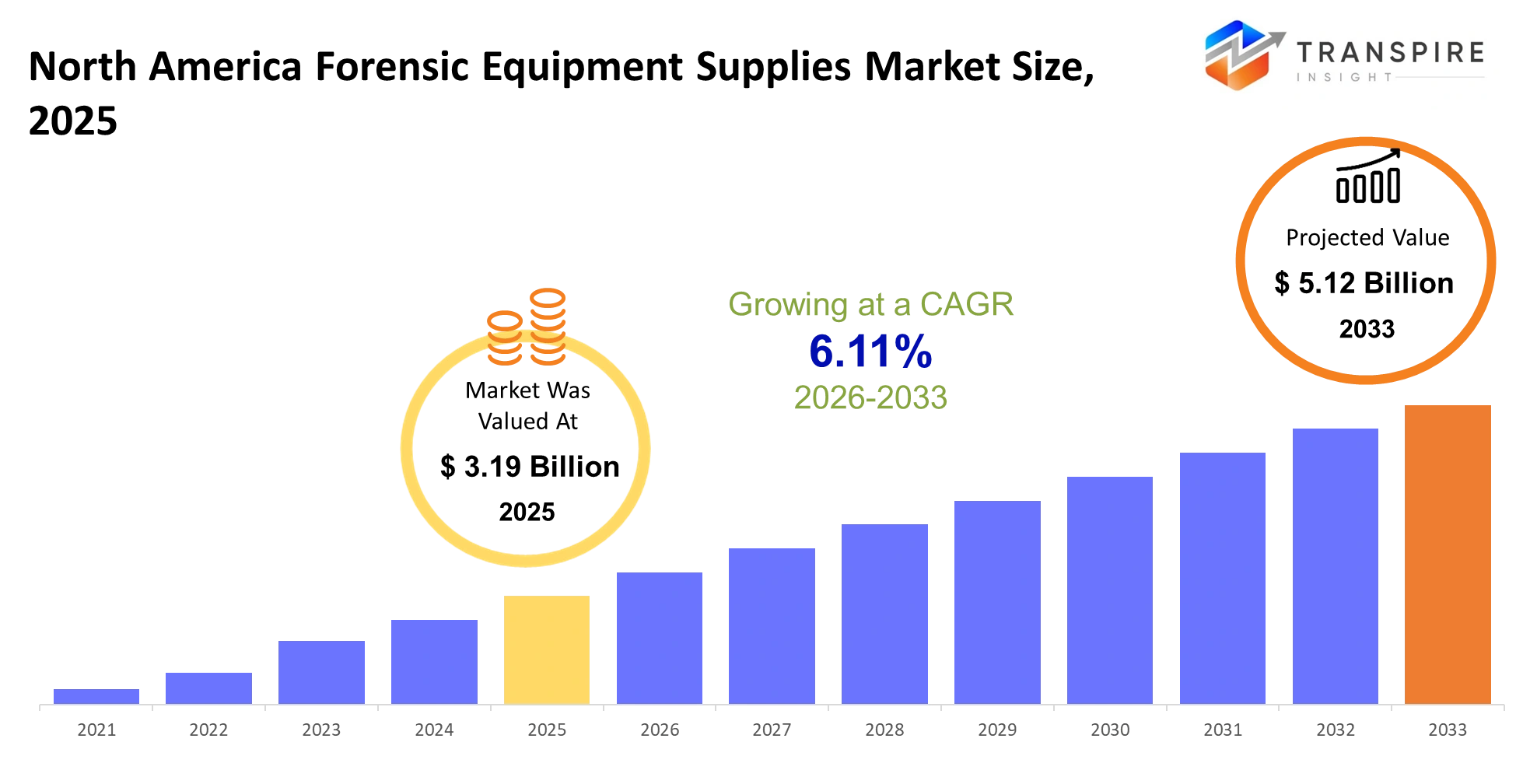
- North America Forensic Equipment Supplies Market Size 2025: USD 3.19 Billion
- North America Forensic Equipment Supplies Market Size 2033: USD 5.12 Billion
- North America Forensic Equipment Supplies Market CAGR: 6.11%
- North America Forensic Equipment Supplies Market Segments: By Type (DNA Analysis Equipment, Fingerprint Kits, Imaging Systems, Ballistics Equipment, Others); By Application (Crime Investigation, Law Enforcement, Research, Others); By End-User (Forensic Labs, Police, Govt Agencies, Others); By Technology (PCR, Spectroscopy, Chromatography, Imaging, Others).
To learn more about this report,  Download Free Sample Report
North America Forensic Equipment Supplies Market Summary:
The North America Forensic Equipment Supplies Market size is estimated at USD 3.19 Billion in 2025 and is anticipated to reach USD 5.12 Billion by 2033, growing at a CAGR of 6.11% from 2026 to 2033. The North America Forensic Equipment Supplies Market kind of underpins criminal investigations, border safety, disaster victim identification, and digital evidence recovery too, because it gives laboratories and field teams the kinds of tools that can preserve, evaluate, and confirm evidence. Day to day, these setups help law enforcement agencies run DNA samples a lot faster, pull out workable info from damaged devices, and tighten the precision of toxicology as well as ballistic testing, which ends up affecting how steady convictions feel and how quickly cases move through.
Over the past five years, the market has drifted away from purely traditional lab centered routines toward more connected digital forensics and automated evidence handling platforms. That change sped up when cybercrime rose, opioid related probes increased, and cross-border digital fraud kept showing up during and after the COVID-19 period, exposing some painful delays in how evidence is managed, plus staffing gaps across public forensic labs. Governments and organizations then reacted by putting more money into rapid DNA systems, AI assisted analytics, and cloud linked case management software. And as forensic backlogs start looking more like legal exposure and operational risk instead of just paperwork, purchasing decisions increasingly revolve around throughput efficiency, evidentiary rigor, and strict chain of custody alignment, so demand stays steadier for advanced consumables, software, and laboratory instrumentation, year after year.
Key Market Insights
- The United States kind of dominated the North America Forensic Equipment Supplies Market, with more than 78% of the market share in 2025, mainly because law enforcement spending has been pretty extensive these years.
- Canada is showing the fastest growth through 2032, partly from forensic laboratory upgrades and also from cross border cybersecurity enforcement initiatives—so yeah, it’s not just one thing.
- Between 2021 and 2025 federal funding programs helped expand forensic testing capacity across North America, which also improved evidence processing turnaround times, in practical terms, faster cases.
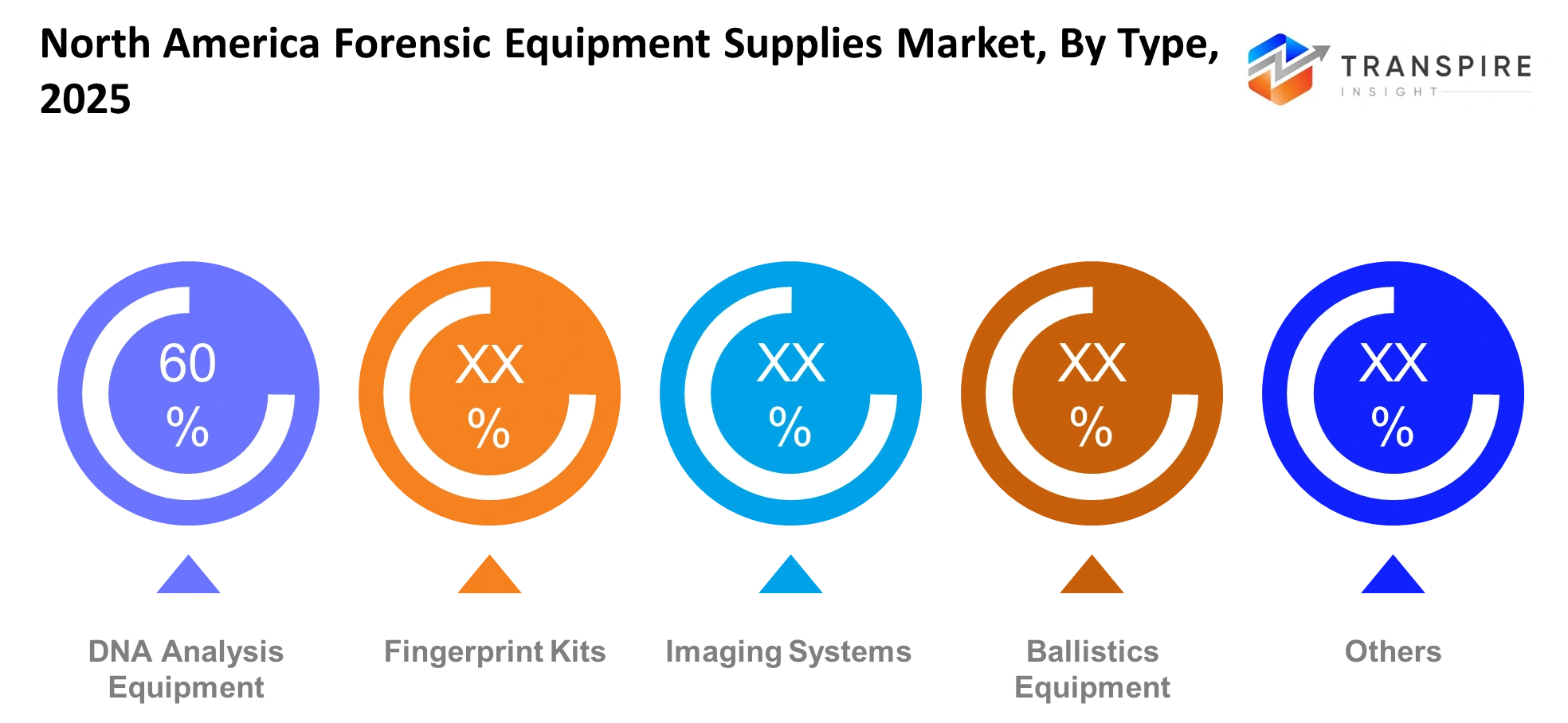
- In 2025, DNA analysis instruments held the largest part of the forensic equipment industry size, with close to a 34% revenue share, because criminal identification applications keep growing.
- Then toxicology and drug testing supplies took the second largest share, largely due to opioid related investigations happening across the United States and Canada.
- Digital forensic equipment is projected to become the fastest growing segment through 2032, supported by rising cybercrime, plus encrypted device investigations that keep increasing.
- Automated forensic consumables also saw strong demand, since laboratories started prioritizing higher throughput, contamination control and chain of custody compliance, without too much delay.
- For criminal investigation applications, they held over 46% share of the North America forensic equipment supplies market in 2025 , largely driven by requirements for analyzing violent crime cases.
- Cybercrime investigation showed up as the fastest growing application segment from 2025 to 2032, fueled by ransomware attacks, and financial fraud cases as well.
- Homeland security and border surveillance applications expanded rapidly after more digital evidence monitoring and biometric screening investments, so the systems keep getting tighter.
- Finally, government forensic laboratories led the North America Forensic Equipment Supplies Market with about 58% revenue share in 2025 , and it really stayed that way.
What are the Key Drivers, Restraints, and Opportunities in the North America Forensic Equipment Supplies Market?
The strongest force pushing the North America Forensic Equipment Supplies Market forward is kinda the rapid spread of digital plus DNA-based investigations, especially after 2020 when cybercrime rose sharply, opioid trafficking increased, and cross border financial fraud went up. Government agencies basically reacted by putting more money into forensic modernization, and also by rolling out stricter ways to validate evidence for use in criminal cases. So labs started leaning more on automated DNA extraction systems, high-throughput toxicology analyzers, and AI aided digital forensic platforms. The direct result is higher recurring revenue streams for consumables, software subscriptions, and maintenance agreements , since labs can now process larger evidence volumes even while facing tighter turnaround deadlines.
Still, the market’s biggest structural obstacle is the fragmented forensic setup across public labs and local law enforcement groups. A lot of regional facilities run on older instrumentation , have weak interoperability, and deal with long standing staffing shortages. Swapping legacy systems out takes multi year procurement approvals, specialized training programs and strict accreditation compliance. So modernization becomes both capital intensive and slow to roll out. That delays the take up of advanced forensic technologies , increases evidence backlogs, and basically limits revenue chances for vendors that really depend on connected laboratory ecosystems working as one.
Cloud connected forensic intelligence platforms are, honestly, pretty big growth prospects . A lot of agencies are moving toward centralized evidence management setups, where biometrics , digital forensics, and case analytics kind of all live in one continuous workflow , not all scattered . Canada and also some U.S. state labs are boosting their budgets for interoperable forensic databases, which makes it easier to sell for vendors that can offer AI enabled investigation platforms that scale well, plus portable field testing devices. In other words the conditions feel favorable, you know .
What Has the Impact of Artificial Intelligence Been on the North America Forensic Equipment Supplies Market?
Artificial intelligence, plus advanced digital technologies, are reshaping forensic labs all over North America, kind of speeding up evidence processing, sharpening analytical precision, and yes lowering the backlogged mess in investigations. AI powered forensic imaging setups are now able to do fingerprint enhancement, facial recognition, ballistic matching, and DNA sequence interpretation in a more automated way, so labs can push through evidence much quicker than those old manual routines. At the same time, digital forensic platforms use automation to sort mobile data, retrieve removed or “deleted” files, and highlight odd communication behaviors during cyber investigations, which cuts down how long cases sit in review, from weeks to days especially when the volume spikes.
Also, machine learning models are being used more and more for what you could call predictive lab operations and evidence management. Forensic organizations apply AI driven analytics to estimate when instruments need service, spot calibration drift in DNA instruments, and even arrange workflow times based on evidence inflow patterns. This, in turn, boosts instrument availability, lowers the likelihood of sample contamination, and supports tighter chain of custody requirements. A number of bigger public forensic facilities have said they saw actual reductions in evidence backlog and operating expenses after they plugged in automated case handling and digital evidence tracking tools, which sounds simple but it is pretty impactful.
Still though, AI rollouts run into a big roadblock because forensic databases are often scattered and evidence formatting isn’t consistent across agencies. A lot of labs rely on older systems that can’t easily connect with cloud based analytics services, and the training material isn’t always standardized enough either. When standardized training datasets are limited or not representative, algorithm performance can drop in messy, real world scenarios, where cases get complicated fast and the context matters a lot.
Key Market Trends
- From 2021 to 2025 the U.S. forensic labs started spending more on automated DNA extraction platforms, they claimed this helped bring down the evidence backlog processing time by almost 30% .
- Digital forensics kind of moved from a niche support role in cybercrime to more like core investigative infrastructure, and this happened after ransomware complaints spiked quite hard in North America post 2020 .
- Law enforcement agencies now often swap out standalone tools for integrated cloud connected evidence management systems, with real time chain of custody tracking built in, not just stored later.
- Portable forensic analyzers also got more traction after border security teams expanded field based operations for narcotics and biometric checks across busy checkpoints.
- Manufacturers like Thermo Fisher Scientific and QIAGEN have broadened AI assisted forensic workflows, aiming for steadier evidence interpretation consistency and better lab throughput, basically more work with fewer bottlenecks.
- In procurement, the behavior changed too, public labs leaned toward long term service contracts, mainly so they can lock in uptime guarantees, receive software updates, and keep recurring consumable supplies more stable.
- Starting around 2022, many forensic laboratories have taken up predictive maintenance software, to reduce calibration failures in high throughput toxicology and DNA analysis equipment.
- Cross agency data sharing efforts in the United States and Canada also sped up demand for interoperable forensic databases, and more centralized digital evidence platforms to avoid mismatched formats.
- Meanwhile, private forensic laboratories grew their market presence after some state agencies outsourced overflow testing, mostly because staffing shortages and accreditation delays kept building up.
- And earlier supply chain disruptions during 2020 and 2021 basically pressured equipment makers to regionalize consumable production, plus diversify semiconductor sourcing strategies, so the next disruption wouldn’t hit as broadly.
North America Forensic Equipment Supplies Market Segmentation
By Type
DNA analysis equipment is kinda holding the leading spot in that whole segment, mostly because it is used a lot for criminal identification, paternity checking, narcotics casework, and missing person records. Lots of high-throughput DNA analyzers and automated extraction systems got major traction after public labs had serious evidence delays between 2020 and 2023, you know, the backlog period was rough. Meanwhile, fingerprint kits and imaging systems stay pretty steady in demand, since field investigators still need portable, quick evidence capture tools for everyday case handling.
Ballistics gear has also moved forward in a steady way, as firearm related investigations rose across urban law enforcement networks in the United States and Canada. Still, advanced imaging and digital forensic solutions come with bigger purchase and upkeep expenses, so smaller regional labs can hesitate or slow down adoption. Looking ahead the direction seems to be integrated forensic platforms, basically systems that blend DNA processing with digital evidence review, plus automated reporting. Companies are also leaning harder into smaller, more compact instruments, ongoing consumable sales, and cloud enabled workflow management, to keep customers for longer and improve day to day efficiency.
To learn more about this report, Download Free Sample Report
By Application
Crime investigation still feels like the main application segment , since forensic technologies directly back homicide analysis, drug trafficking enforcement , cybercrime detection , and the prosecution of violent offenses. Law enforcement agencies bumped up their investment in quick forensic testing , after digital fraud cases went up and opioid-related probes basically started squeezing evidence processing deadlines. On the research side, things also picked up , because universities and forensic institutes have been expanding work in genomic sequencing, toxicology, and AI-assisted interpretation of evidence.
Border security and homeland protection initiatives added more pull , especially for portable narcotics detection tools and biometric analysis systems. Funding availability keeps steering adoption patterns, because advanced forensic platforms need sizable operational budgets and also accreditation compliance, no joke. Looking ahead, growth is expected to lean toward predictive digital investigations and cross-agency data integration. Tech providers should do well with solutions that help lower investigative turnaround time, strengthen evidentiary accuracy, and make real-time collaboration easier between labs, prosecutors, and federal enforcement agencies .
By End-User
Forensic laboratories are still taking the biggest end user share, mostly because centralized testing facilities handle lots of evidence, you know, and they run DNA profiling alongside toxicology analysis, plus they do digital device examinations too. Government funded labs keep steering most of the buying activity , since they have the direct responsibility for confirming criminal evidence and they also have to meet judicial compliance levels. Police departments are another big customer group , especially when we talk about portable testing kits, fingerprint systems, and mobile forensic tools that get used right out in the field during investigations. After 2020, federal agencies bumped up spending on integrated digital evidence platforms, mainly because cybercrime events went up and cross border financial fraud cases picked up speed.
Meanwhile, private forensic service providers are popping up as a meaningful growth segment, because public laboratories run into staffing shortages and they often have long evidence backlogs. The outsourcing trend is pushing investment toward very specific skill areas like specialized toxicology, digital forensics, and DNA testing capabilities. Going forward, competition between suppliers will probably depend more and more on workflow automation, maintenance support, training services, and software compatibility with national forensic databases , as well as with law enforcement systems.
By Technology
PCR technology basically still rules the tech segment, because DNA amplification is, well, it stays essential for identifying a suspect, matching biological evidence, and doing fast checks on what the evidence actually means. Meanwhile, chromatography and spectroscopy systems keep a big presence too, mainly because they’re used a lot in toxicology screening, narcotics discovery, and chemical residue investigation. Imaging technologies are growing in a steady way as well, since agencies keep adopting more advanced facial recognition, ballistic comparison and digital reconstruction setups, for better investigative precision and less guesswork.
There was also strong pull for high-throughput analytical platforms after labs leaned harder into quicker evidence processing and a lower chance of contamination during the post-pandemic period. Still, when you have more advanced instruments it isn’t just “buy and go,” you need trained personnel, regular calibration, and careful compliance management, so the whole thing becomes operationally heavy for smaller facilities.
What are the Key Use Cases Driving the North America Forensic Equipment Supplies Market?
Criminal investigation is still, like the main driver for forensic equipment being adopted across North America. Public labs and law enforcement orgs depend a lot on DNA analyzers, toxicology systems, and fingerprint imaging tools , to handle homicide, narcotics, and firearm related evidence, but always with very strict court timelines.
Digital forensics and border security stuff is really picking up momentum too, especially with federal agencies and the cybersecurity enforcement teams. More investigators are turning to mobile device extraction systems and cloud based evidence platforms , because ransomware attacks, financial fraud, and cross-border cybercrime operations keep happening. On top of that, private forensic labs are also growing their toxicology testing services, mainly to help with outsourced case processing, you know.
More emerging use cases are showing up as well, like AI assisted behavioral analysis and quick field screening. Agencies are also testing portable genomic sequencing devices and predictive evidence analytics, to speed up disaster victim identification, missing person cases and big emergency response coordination over the forecast period.
|
Report Metrics |
Details |
|
Market size value in 2025 |
USD 3.19 Billion |
|
Market size value in 2026 |
USD 3.38 Billion |
|
Revenue forecast in 2033 |
USD 5.12 Billion |
|
Growth rate |
CAGR of 6.11% from 2026 to 2033 |
|
Base year |
2025 |
|
Historical data |
2021 - 2024 |
|
Forecast period |
2026 - 2033 |
|
Report coverage |
Revenue forecast, competitive landscape, growth factors, and trends |
|
Country scope |
North America (Canada, The United States, and Mexico) |
|
Key company profiled |
Thermo Fisher, Agilent, Bio-Rad, Danaher, GE Healthcare, Siemens Healthineers, Leica Microsystems, ZEISS, Olympus, Nikon, PerkinElmer, Promega, Qiagen, Bruker, Waters Corporation. |
|
Customization scope |
Free report customization (country, regional & segment scope). Avail customized purchase options to meet your exact research needs. |
|
Report Segmentation |
By Type (DNA Analysis Equipment, Fingerprint Kits, Imaging Systems, Ballistics Equipment, Others); By Application (Crime Investigation, Law Enforcement, Research, Others); By End-User (Forensic Labs, Police, Govt Agencies, Others); By Technology (PCR, Spectroscopy, Chromatography, Imaging, Others). |
Which Regions are Driving the North America Forensic Equipment Supplies Market Growth?
The United States kinda leads the North America forensic equipment supplies market, mostly because federal enforcement agencies, advanced forensic labs, and huge criminal databases keep pushing steady procurement demand. The legal and investigative institutions bring strong regulatory oversight, so investment in DNA sequencing systems, digital forensic platforms, and automated toxicology analyzers is moving faster than before. Also there’s extensive cooperation between public laboratories, cybersecurity agencies, and private forensic service providers, which supports a quicker rollout of newer technology across criminal investigation networks. Big manufacturers like Thermo Fisher Scientific and Agilent Technologies also have a strong operational footprint in the United States, that in turn helps the local supply chains and research partnerships stay active.
Canada comes in as the second-largest regional contributor, but the growth story looks a bit different than the United States, since purchasing tends to lean more toward long-term laboratory modernization, and national evidence standardization initiatives. Government funding that stays relatively stable, plus consistent forensic accreditation policies, has helped drive steady adoption of chromatography systems, digital evidence management software, and forensic imaging technologies. Provincial laboratories keep putting money into interoperable forensic databases, in order to boost coordination between law enforcement agencies and judicial institutions. All of this makes the Canada environment pretty predictable, so suppliers looking for lower volatility and ongoing replacement orders for forensic instrumentation and consumables can view it as a reliable revenue market.
Mexico is starting to look like the fastest growing regional market, mostly because more and more money is moving into organized crime investigations, border surveillance programs, and the whole forensic laboratory expansion deal. Lately the modernization push, backed by federal security reforms and cross border enforcement cooperation, seems to make adoption happen quicker for portable forensic testing systems, and for digital investigation tools too. Public agencies, from what we see, are giving extra focus to quick DNA processing, and also narcotics analysis capabilities, so they can cut down investigative delays . and help cases land better in court. This kind of momentum should keep building, and it is likely to open up real chances for global suppliers, regional distributors, and forensic software providers sometime from 2026 to 2033, as infrastructure spending plus technical training programs keep expanding , around the country.
Who are the Key Players in the North America Forensic Equipment Supplies Market and How Do They Compete?
North America forensic equipment supplies market looks like it has some moderate consolidation, kind of, where a small cluster of multinational diagnostics and analytical instrumentation companies run the high-value forensic platforms, while smaller players stay busy with niche consumables, and digital evidence services. The rivalry is shifting more and more to automation strength, analytical precision, software fit, and even long-term lab support , not just equipment pricing. The big incumbents still try to hold on to their market share by leaning on proprietary forensic databases, repeat consumable agreements, and integrated workflow platforms that make switching expensive, especially for public laboratories. Meanwhile, there’s also a bit of a disruption wave coming from specialized digital forensics providers and AI evidence analytics firms , they’re basically changing procurement habits by selling cloud based investigation tooling and portable field testing systems.
Thermo Fisher Scientific stands out because it delivers tightly integrated forensic workflows, it sort of bundles DNA extraction, sequencing, and evidence management software into one platform. They also have strong ties with federal labs and law enforcement, which helps drive recurring consumable income, plus long term service agreements. QIAGEN , on the other hand, leans into rapid DNA processing and automated sample preparation technologies , which cut down manual handling and lower contamination exposure in high-throughput labs. Their expansion lately often means partnerships with public forensic agencies, and investing in cloud connected genomic analysis capabilities.
Agilent Technologies sort of competes using advanced chromatography with mass spectrometry systems, tuned for toxicology and narcotics investigations, and in that space the analytical precision really matters, because it feeds into evidentiary reliability. They also seem to hold on to their market position by tying their lab software in more tightly, plus predictive maintenance stuff, which helps keep operational uptime higher. Danaher Corporation, meanwhile extends its competitive reach via acquisitions and cross brand technology integration, especially across molecular diagnostics and imaging platforms. Promega Corporation seems to keep a kind of niche advantage with forensic DNA kits and authentication reagents, mainly for labs that want validated testing consistency , so they can meet judicial compliance and accreditation standards.
Company List
- Thermo Fisher
- Agilent
- Bio-Rad
- Danaher
- GE Healthcare
- Siemens Healthineers
- Leica Microsystems
- ZEISS
- Olympus
- Nikon
- PerkinElmer
- Promega
- Qiagen
- Bruker
- Waters Corporation
Recent Development News
In January 2026, Wrap Technologies launched the Next-Generation Body-Worn Camera Platform for Public Safety Agencies: Wrap Technologies introduced an upgraded WrapVision body-worn camera platform integrated with IONODES PERCEPT technology. The launch focuses on NDAA-compliant forensic video capture and evidence management capabilities for regulated North American law enforcement deployments.
Source: https://www.nasdaq.com
In February 2026, Cellebrite Reports Record 2025 Results Driven by Digital Forensics Demand in North America: Cellebrite announced record fourth-quarter and full-year 2025 financial results, highlighting strong adoption of its cloud-based forensic investigation platforms across U.S. law enforcement and public safety agencies. The company also emphasized growth in AI-powered evidence analysis solutions and expansion of its North American customer base.
Source: https://www.nasdaq.com
What Strategic Insights Define the Future of the North America Forensic Equipment Supplies Market?
The North America forensic equipment supplies market is moving, kind of, toward fully integrated data driven forensic ecosystems where AI assisted analytics and cloud based evidence management plus automated lab workflows end up acting like linked platforms not really standalone tools. The main push behind this shift is the heavier day to day load on public forensic systems, mainly because digital evidence volumes are climbing, cybercrime is getting more tangled , and criminal prosecution keeps tightening evidentiary rules. Over the next five to seven years suppliers that blend instrumentation with software, predictive maintenance, and chain-of-custody automation into one unified service approach are the ones that will likely grab more of the recurring revenue.
One less obvious issue is that the market could end up concentrating around only a few forensic database platforms and proprietary consumable ecosystems. If agencies lean too hard on closed systems, it can set off procurement bottlenecks, interoperability conflicts, and eventually pricing pressure that public buyers can’t really absorb. At the same time there’s an opening for portable AI enabled forensic devices aimed at border security and field investigations, especially as Mexico and nearby U.S. enforcement groups expand decentralized testing capability. Players in this space should lean into interoperable platforms and cybersecurity centered evidence infrastructure to lower integration friction and keep long term institutional contracts more stable.
North America Forensic Equipment Supplies Market Report Segmentation
By Type
- DNA Analysis Equipment
- Fingerprint Kits
- Imaging Systems
- Ballistics Equipment
- Others
By Application
- Crime Investigation
- Law Enforcement
- Research
- Others
By End-User
- Forensic Labs
- Police
- Govt Agencies
- Others
By Technology
- PCR
- Spectroscopy
- Chromatography
- Imaging
- Others
Frequently Asked Questions
Find quick answers to common questions.
The approximate North America Forensic Equipment Supplies Market size for the market will be USD 5.12 Billion in 2033.
The key segments of the North America Forensic Equipment Supplies Market are By Type (DNA Analysis Equipment, Fingerprint Kits, Imaging Systems, Ballistics Equipment, Others); By Application (Crime Investigation, Law Enforcement, Research, Others); By End-User (Forensic Labs, Police, Govt Agencies, Others); By Technology (PCR, Spectroscopy, Chromatography, Imaging, Others).
Major players in the North America Forensic Equipment Supplies Market are Thermo Fisher, Agilent, Bio-Rad, Danaher, GE Healthcare, Siemens Healthineers, Leica Microsystems, ZEISS, Olympus, Nikon, PerkinElmer, Promega, Qiagen, Bruker, Waters Corporation.
The current market size of the North America Forensic Equipment Supplies Market is USD 3.19 Billion in 2025.
The North America Forensic Equipment Supplies Market CAGR is 6.11%.
- Thermo Fisher
- Agilent
- Bio-Rad
- Danaher
- GE Healthcare
- Siemens Healthineers
- Leica Microsystems
- ZEISS
- Olympus
- Nikon
- PerkinElmer
- Promega
- Qiagen
- Bruker
- Waters Corporation
Recently Published Reports
-
Apr 2026
AI in Diabetic Retinopathy Market
AI in Diabetic Retinopathy Market Size, Share & Analysis Report By Type (Screening AI Systems, Diagnostic AI Systems, and Predictive AI Models), By Application Segment (Hospitals, Ophthalmology Clinics, Diagnostic Centers, and Research and Development), and Geography (North America, Europe, Asia-Pacific, Middle East and Africa, South and Central America), 2021 - 2031
-
Apr 2026
Psychometric Tests Market
Psychometric Tests Market Size, Share & Analysis Report By Type (Personality Tests, Ability/Aptitude Tests, Skill/Knowledge Tests, and Others), By Application (Talent Acquisition and Talent Management), and Geography (North America, Europe, Asia-Pacific, Middle East and Africa, South and Central America), 2021 – 2031
-
Apr 2026
Rare Biological Sample Collection Market
Rare Biological Sample Collection Market Size, Share & Analysis Report By Type (Isolation Kits & Reagent, Blood Collection Tubes, and Others), By Application (Oncology, Transcriptomics, Pharmacogenomics, and Others), and Geography (North America, Europe, Asia-Pacific, Middle East and Africa, South and Central America), 2021 – 2031
-
May 2026
Patient Lift Pendant Market
Patient Lift Pendant Market By Product Type (Wired Pendants, Wireless, Programmable), By Operation Type(Manual, Electric), By End-Users (Healthcare Professionals, Patients), By Application (Hospitals, Homecare, Rehabilitation Centers, Others), By Industry Analysis, Size, Share, Growth, Trends, and Forecasts 2021-2033
Our Clients
.jpg)