
North America Extracellular Matrix Patches Market Size & Forecast:
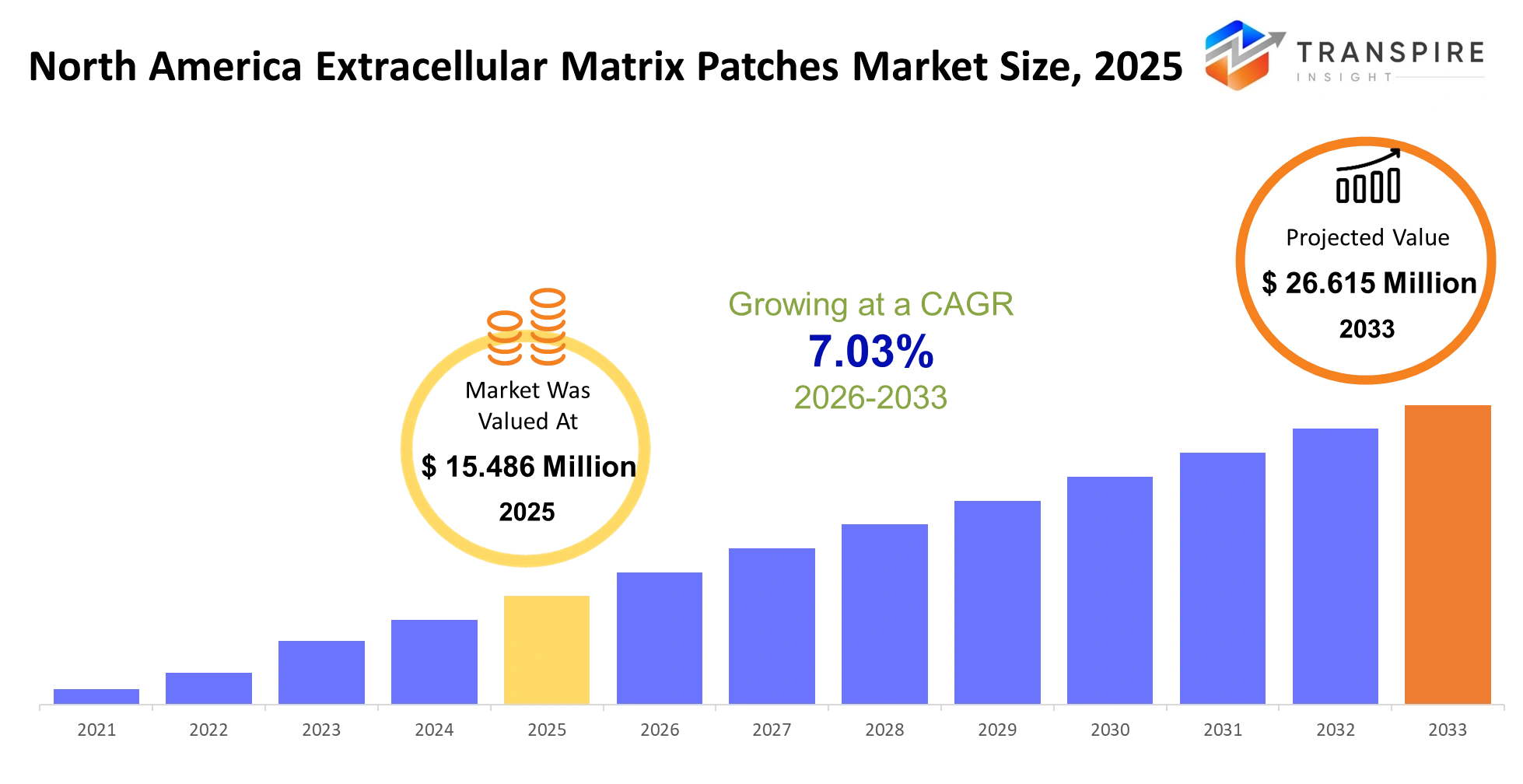
- North America Extracellular Matrix Patches Market Size 2025: USD 15.486 Million
- North America Extracellular Matrix Patches Market Size 2033: USD 26.615 Million
- North America Extracellular Matrix Patches Market CAGR: 7.03%
- North America Extracellular Matrix Patches Market Segments: By Type (Biologic Patches, Synthetic Patches, Hybrid Patches, Others), By Application (Cardiac Repair, Soft Tissue Repair, Hernia Repair, Others), By End-User (Hospitals, Clinics, Surgical Centers, Others), By Material (Collagen, Polymers, ECM-based, Others).
To learn more about this report,  Download Free Sample Report
North America Extracellular Matrix Patches Market Summary:
The North America Extracellular Matrix Patches Market size is estimated at USD 15.486 Million in 2025 and is anticipated to reach USD 26.615 Million by 2033, growing at a CAGR of 7.03% from 2026 to 2033. The North America Extracellular Matrix Patches Market is basically sitting in that space where regenerative medicine sort of meets surgical reconstruction, helping surgeons mend injured tissue while nudging the body’s own healing response. These biologic patches are used more and more in hernia repair, cardiovascular surgery, orthopedic reconstruction, and ongoing chronic wound management, mostly because they can reduce the problems that show up with synthetic implants and also help tissue integrate sooner, at least in many clinical settings. Hospitals, in practice , are starting to lean on extracellular matrix patches to raise surgical durability while also lowering readmission risk and keeping long term revision costs a bit more under control.
Over the last 3–5 years the market has moved away from plain structural repair, and toward bioactive regenerative platforms that actively steer tissue remodeling. This shift speeded up after the pandemic, when the financial stress from longer hospital stays and repeat procedures became harder to ignore, so providers started prioritizing products connected to better recovery results. Meanwhile , supply chain disruptions tied to synthetic medical materials pushed procurement teams to look around and diversify toward biologic alternatives. And as outpatient care and minimally invasive procedures keep expanding across North America, manufacturers that can show clinically validated regenerative performance are getting more pricing leverage and wider surgical adoption.
Key Market Insights
- In 2025, the United States basically ruled the North America Extracellular Matrix Patches Market, taking about 82% market share , mostly because the surgical infrastructure is more advanced and well funded .
- Canada is likely to be the fastest moving regional market through 2032, fueled by growing uptake of biologics and wider reimbursement backing for regenerative therapies.
- With solid healthcare spending and more orthopedic procedure volumes showing up every year, the overall North America Extracellular Matrix Patches Market size and revenue outlook keep getting stronger.
- Also, academic research collaborations across North America helped speed up extracellular matrix biomaterial commercialization between 2021 and 2025, which is kinda noticeable in the adoption curve .
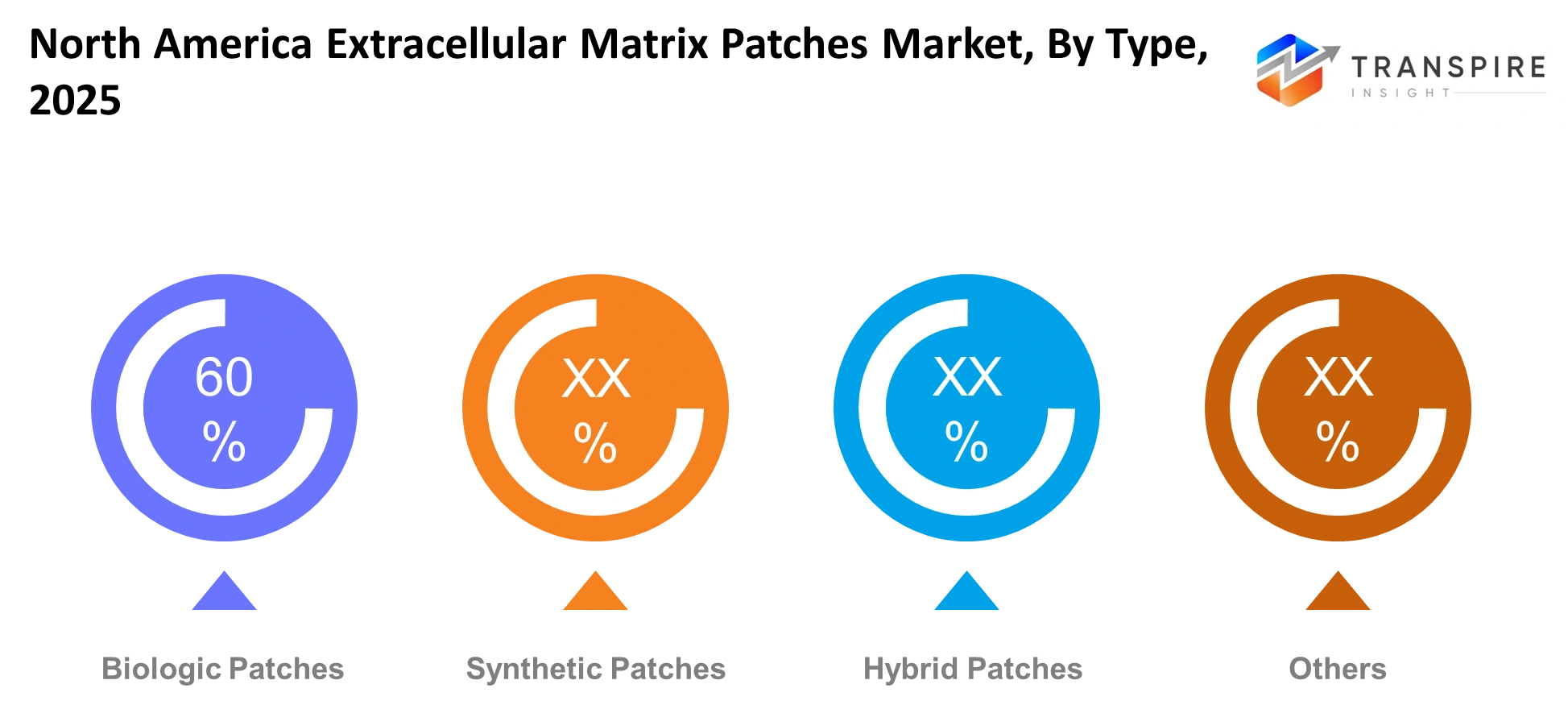
- In 2025, biologic extracellular matrix patches made up more than 64% share because surgeons keep leaning toward regenerative repair options rather than synthetic materials , as preferences shift over time.
- Porcine sourced extracellular matrix products stayed in the second spot, supported by good tissue compatibility and a wide range of surgical uses.
- Decellularized human tissue patches are projected to become the fastest-growing segment across the forecast window due to stronger remodeling performance and better integration outcomes.
- Meanwhile, multi-layer regenerative scaffold technologies gained real traction in cardiovascular and tendon reconstruction cases starting after 2023, sort of aligning with how complex repairs are done.
- For applications, hernia repair led demand , holding roughly 38% market share in 2025, largely because minimally invasive surgical procedures are rising .
- Chronic wound management showed up as the fastest-growing application area as diabetic ulcer treatment volumes increased across North America.
- Finally, cardiovascular reconstruction applications recorded meaningful growth, since extracellular matrix patches appear to lower inflammatory complications compared with synthetic alternatives , especially in sensitive patient groups.
What are the Key Drivers, Restraints, and Opportunities in the North America Extracellular Matrix Patches Market?
The most force pushing forward the North America Extracellular Matrix Patches Market is kinda the healthcare system’s shift toward outcomes-first surgical economics, not just the sticker price. Hospitals and payers are now increasingly judging products by fewer complications, less readmission, and better recovery speed , instead of only looking at upfront implant cost. This change really picked up after the post-pandemic surgical backlogs made the financial pain of revision surgeries obvious, plus prolonged inpatient stays. Extracellular matrix patches are getting more attention because they back tissue regeneration while also lowering risks like synthetic mesh rejection, and chronic inflammation, you know the usual headaches. And when surgeons keep saying they’re seeing improved integration results in hernia repair, wound reconstruction, and cardiovascular workflows, hospitals tend to widen their procurement spend for biologic patch platforms, which in turn boosts premium product revenue.
Still, the biggest structural headache in the market is the expensive production plus regulatory maze for biologic materials. Extracellular matrix patches need dedicated tissue sourcing, decellularization, sterilization, and clinical validation steps that can’t scale fast without major capital spending. On top of that, regulators scrutinize biologic consistency and long-term safety, which stretches commercialization timelines out even more. So you get pricing pressure hitting hospitals, especially ones operating inside fixed reimbursement rules, particularly community-based systems. In the end adoption moves slower outside major surgical centers, and penetration lags in more cost-sensitive care environments.
The next big chance for growth is kind of in the middle of combining extracellular matrix scaffolds with bioengineered regenerative methods like stem cell integration, and yeah 3D bioprinting platforms. There are already research collaborations across the United States working on hybrid biologic patches that are meant for tough orthopedic cases as well as chronic wound uses, so it’s not just one lane. With personalized regenerative medicine getting more reimbursement backing and outpatient surgical infrastructure gradually maturing, these newer patch systems may be able to stretch the market past traditional soft tissue repair and into advanced tissue restoration procedures, which is the broader idea.
What Has the Impact of Artificial Intelligence Been on the North America Extracellular Matrix Patches Market?
Artificial intelligence and advanced digital technologies are quietly reshaping the North America Extracellular Matrix Patches Market, mostly by nudging biologic manufacturing toward more precise control, better surgical planning and also postoperative outcome tracking that feels more measurable. A lot of manufacturers now rely on AI-driven imaging tools, plus automated quality control, to look at decellularized tissue structures while they’re still in production. These setups can spot oddities in collagen density, sterilization integrity and scaffold architecture, quicker than manual inspection can ever do, and that helps companies waste less material while keeping each batch more consistent than before. On top of that, digital manufacturing platforms tend to organize regulatory paperwork and traceability in a smoother way, so production review cycles get shorter and regenerative biomaterials can reach commercialization sooner.
Beyond that, machine learning models are adding extra strength to predictive capabilities across regenerative medicine use cases. Hospitals and research centers are using AI-assisted analytics to gauge patient specific healing responses, possible infection risks, and tissue integration outcomes before implantation. For orthopedic care and chronic wound procedures, predictive algorithms assist surgeons in choosing the most compatible extracellular matrix scaffold based on tissue status, along with comorbidity factors. The idea is that this improves procedural flow, decreases the chance of revision, and can support a shorter recovery window for patients.
Operationally, these technologies are helping manufacturers lower production deviations, and also refine inventory planning, while healthcare providers can improve surgical success rates. Still, AI adoption has a major limitation, because biologic tissue datasets are fragmented and remain highly variable from one institution to another.
Key Market Trends
- Since 2021 , hospitals have more or less started replacing synthetic mesh with biologic extracellular matrix patches in those complex hernia cases, mostly to reduce inflammatory problems and also the frequent readmissions, it felt like.
- Between 2022 and 2025 , outpatient surgical centers moved faster on adopting these biologic patches, because minimally invasive procedures were gradually shifting away from inpatient hospital routines.
- Manufacturers like Integra LifeSciences and Cook Biotech poured more resources into decellularization technologies, basically to raise tissue integration consistency, especially after pandemic-era supply hiccups, you know.
- Since 2023, procurement teams have increasingly assessed extracellular matrix products using outcome based purchasing models rather than just picking the lowest cost implant every single time.
- Chronic wound care applications grew a lot after diabetic ulcer treatment protocols started incorporating regenerative scaffolds into more advanced outpatient pathways, kinda seamlessly.
- North American manufacturers expanded their domestic biologic processing capacity after 2020, in order to limit dependence on those globally fragmented tissue sourcing networks.
- Regulatory scrutiny got more intense between 2021 and 2024, as agencies asked for stronger long-term clinical evidence on biologic scaffold durability and safety performance, no wiggle room.
- After 2022, AI driven tissue imaging systems appeared across manufacturing sites, helping improve scaffold quality inspection accuracy and also cutting down on production batch inconsistencies that used to slip through.
- Orthopedic reconstruction demand has strengthened as sports medicine providers started using extracellular matrix patches more often, for tendon and ligament regeneration procedures, which is kind of the point.
- Strategic collaborations involving Baxter International, research hospitals, and regenerative medicine startups increased the commercialization speed for next generation hybrid biologic scaffolds, apparently faster than before.
North America Extracellular Matrix Patches Market Segmentation
By Type
Biologic patches kinda hold the lead in the type segment , mainly because healthcare providers are increasingly leaning toward regenerative implants that help natural tissue remodeling along and , at the same time, cut down on postoperative complications. Meanwhile strong clinical results in hernia repair , wound healing , and cardiovascular reconstruction keep pushing adoption across big surgical networks. Synthetic patches still matter in cost-sensitive cases where durability and quick structural support are the main priorities, but inflammatory response worries basically cap the long-range growth.
Hybrid patches are turning into a fast growing category, since manufacturers blend a biologic scaffold with reinforced synthetic frameworks so the whole thing stays stronger without giving up regenerative potential. A bunch of other niche patch formats continue to service specialized reconstructive procedures , yet commercialization moves slower, mostly due to narrower clinical validation. Looking ahead, competition within this segment should probably revolve around better tissue integration, manufacturing scalability, and how efficiently regulators can approve new products, because hospitals are prioritizing outcome based purchasing choices.
To learn more about this report, Download Free Sample Report
By Application
Hernia repair is the big one, like, the leading application segment because surgeons are increasingly using extracellular matrix patches to lower recurrence risk and to boost tissue regeneration results in more complicated abdominal cases. Soft tissue repair also takes a large slice, mainly because orthopedic reconstruction volumes are climbing, tied to sports injuries but also to the aging demographic trends across North America. Cardiac repair keeps growing in a steady way as regenerative biologic materials keep getting wider traction in vascular and pericardial reconstructions, where managing inflammation basically stays a make or break factor.
Other uses, such as chronic wound management and reconstructive surgery, are expanding too, especially as outpatient care models fold advanced biologic therapies into longer term healing routines. Each application area shows its own demand rhythm. Hernia repair leans toward structural durability, whereas orthopedic and wound care routines lean more heavily on regenerative healing efficiency. Going forward, growth will depend on stronger clinical evidence, broader reimbursement backing, and product customization that fits specific procedural environments in the operating room.
By End-User
Hospitals still seem like the biggest end-user bit, because complex surgical work where a biologic patch is placed keeps landing inside big acute care systems and academic medical centers. They have strong buying muscle, they carry specialized surgical know-how, and they can deliver connected postoperative care too, so hospitals stay leading across cardiovascular, orthopedic, and reconstructive uses. Clinics are slowly raising adoption, especially for chronic wound management, plus outpatient regenerative therapies, but there’s some limits in the supporting infrastructure that hold back wider entry.
Surgical centers are the quickest grower segment, since minimally invasive procedures keep migrating toward lower-cost, more outpatient style settings with quicker recovery timelines. The rest of the healthcare facilities show more careful demand for certain reconstructive needs, though they bring a smaller chunk of revenue overall. Procurement is also shifting, across basically all end-user groups, as providers look at longer-term recovery outcomes, not just the initial implant price. What comes next in market positioning will likely favor suppliers who can back outpatient surgical speed, clinical training, and evidence-led performance reporting, without too many bumps along the way.
By Material
ECM based materials tend to dominate the material segment because biologic scaffoldings that are pulled from decellularized tissue kinda give strong regenerative compatibility , and they also come with a lower rejection risk across several surgical uses. Collagen based materials still keep a meaningful presence too, mainly because they’re used a lot in wound healing and soft tissue reconstruction where flexibility and tissue integration stay pretty vital, even when the protocols get more complex . Polymer materials keep getting used for applications that need higher tensile strength and structural reinforcement, especially in procedures that benefit from longer mechanical support.
That said, the adoption of synthetic polymers has some pushback in regenerative oriented treatment pathways, since inflammatory concerns keep nudging surgeon preferences, and honestly that affects decision making in real life. Other material categories , like composite biomaterials and engineered tissue matrices are catching attention through research collaborations tied to advanced regenerative medicine technologies. Material innovation is starting to shape competitive differentiation more and more, as manufacturers invest in bio engineered scaffolds, mixed compositions , plus better sterilization methods. Looking ahead, growth in this segment will probably lean toward materials that can balance structural performance, regenerative healing, and scalable production economics without making things too expensive.
What are the Key Use Cases Driving the North America Extracellular Matrix Patches Market?
Hernia repair is still sort of the main reason people are adopting extracellular matrix patch tech across North America, because hospitals keep leaning toward biologic reinforcement materials that lower the chance of recurrence and reduce postoperative complications, a lot of them kinda want that. When you look at complex abdominal reconstruction procedures, they create serious demand for regenerative scaffolds that can help tissues settle in over time, long-term integration.
For orthopedic soft tissue repair and chronic wound management it’s also growing fast, especially inside outpatient surgical centers and those specialty wound clinics where they deal with this day after day. Sports medicine clinicians increasingly use biologic patches for tendon and ligament reconstruction. At the same time, diabetic ulcer treatment programs are integrating regenerative matrices so healing moves along quicker, and so there are fewer repeat interventions later.
Newer angles are popping up too, like cardiac tissue reconstruction and advanced regenerative procedures. These are often enabled by bioengineered scaffold technologies that make clinicians feel more confident. Research hospitals and regenerative medicine startups are additionally testing extracellular matrix platforms for personalized tissue restoration, plus stem-cell-supported surgical therapies, which has long-term commercial potential that everyone seems to be watching.
|
Report Metrics |
Details |
|
Market size value in 2025 |
USD 15.486 Million |
|
Market size value in 2026 |
USD 16.539 Million |
|
Revenue forecast in 2033 |
USD 26.615 Million |
|
Growth rate |
CAGR of 7.03% from 2026 to 2033 |
|
Base year |
2025 |
|
Historical data |
2021 - 2024 |
|
Forecast period |
2026 - 2033 |
|
Report coverage |
Revenue forecast, competitive landscape, growth factors, and trends |
|
Country scope |
North America (Canada, The United States, and Mexico) |
|
Key company profiled |
Cook Medical, Medtronic, BD, Smith & Nephew, Baxter, Boston Scientific, Integra LifeSciences, Organogenesis, Acelity, Gore Medical, Coloplast, Zimmer Biomet, Johnson & Johnson, Stryker, Terumo. |
|
Customization scope |
Free report customization (country, regional & segment scope). Avail customized purchase options to meet your exact research needs. |
|
Report Segmentation |
By Type (Biologic Patches, Synthetic Patches, Hybrid Patches, Others), By Application (Cardiac Repair, Soft Tissue Repair, Hernia Repair, Others), By End-User (Hospitals, Clinics, Surgical Centers, Others), By Material (Collagen, Polymers, ECM-based, Others). |
Which Regions are Driving the North America Extracellular Matrix Patches Market Growth?
The United States is leading in the North America Extracellular Matrix Patches Market, mainly because things like advanced surgical infrastructure strong reimbursement structures, and really high procedural volumes keep making biologic implant usage feel natural and easy. Big academic hospitals plus connected healthcare networks are still putting money into regenerative medicine approaches for hernia repair, cardiovascular rebuilding, and that chronic wound sort of care. There are also smoother regulatory routes for biologic breakthroughs, and a solid level of clinical research funding, so commercialization keeps moving fast across the country. Over time a kind of mature ecosystem shows up—biotechnology firms, tissue processing locations, and focused surgical centers—this whole setup basically keeps the long-term dominance going, while also helping premium pricing stay feasible.
Canada sits as the second largest regional contributor, though the growth story is not exactly the same as the United States. In Canada, market momentum depends more on steady public healthcare support, evidence based purchasing, and a slow but careful integration of regenerative therapies into the provincial systems. Hospitals and outpatient providers tend to choose clinically verified extracellular matrix products, the kind that show clear reductions in repeat procedures and lower recovery related costs. On top of that, continual investment in orthopedic care, diabetic wound treatment, and the management needs tied to an aging population gives manufacturers a reliable revenue foundation across Canada’s healthcare environment.
Mexico seems to be coming up as the fastest-growing regional market, mostly because private healthcare keeps expanding pretty quick and there’s more money going into modern surgical infrastructure. In the last few years, bigger urban hospital groups expanded access to minimally invasive plus regenerative surgical procedures and in turn, the demand for biologic repair materials got stronger. Also, medical tourism is growing, and meanwhile rising partnerships between multinational device manufacturers and private healthcare providers helped push the adoption of extracellular matrix technologies. So, all that momentum is really opening up entry chances for investors and suppliers, looking for long-term growth potential from 2026 to 2033. Especially when it comes to orthopedic reconstruction and advanced wound management use cases.
Who are the Key Players in the North America Extracellular Matrix Patches Market and How Do They Compete?
The competitive landscape for the North America Extracellular Matrix Patches Market is still pretty moderately consolidated, and honestly a small cluster of regenerative medicine and surgical biomaterial companies kind of ends up holding a meaningful chunk of hospital procurement channels. As of now the fight feels more on clinical performance, tissue integration quality, and the long term surgical outcomes— not just price, so you see that shift clearly. Bigger established manufacturers defend their position using proprietary biologic processing technologies, meanwhile smaller regenerative medicine firms slip in through specialized orthopedic and wound care pockets with scaffold innovations that are more targeted. There’s also regulatory compliance know-how surgeon training programs, and reimbursement support services that really matter in buying decisions across those large healthcare systems.
Integra LifeSciences competes with advanced regenerative biomaterial engineering, plus strong reach in neurosurgical and reconstructive procedure categories. Their proprietary collagen matrix technologies, together with a wide body of clinical evidence, gives them a differentiation advantage when it comes to complex tissue repair scenarios. Cook Biotech leans heavily into extracellular matrix science derived from porcine small intestine submucosa , which builds a solid placement in soft tissue repair and wound healing procedures where regenerative compatibility is still critical. The company keeps moving forward via research collaborations with surgical institutions, and it also broadens its product portfolio across outpatient treatment environments.
Baxter International seems to strengthen competitiveness by stitching biologic repair products into wider hospital supply ties, plus the perioperative care networks sort of around them. Their distribution reach is extensive , and the existing procurement contracts offer real operational leverage inside big healthcare systems. BD meanwhile leans on procedural integration technologies, which help support surgical efficiency while also keeping infection control tight during biologic implantation procedures. So it’s more than simple products— it’s the way the pieces are connected. AbbVie keeps moving too , by pouring more investment into regenerative medicine research partnerships and advanced tissue engineering programs. The aim is to grow future uses that go past the usual soft tissue reconstruction, and then toward personalized restorative therapies instead.
Company List
- Cook Medical
- Medtronic
- BD
- Smith & Nephew
- Baxter
- Boston Scientific
- Integra LifeSciences
- Organogenesis
- Acelity
- Gore Medical
- Coloplast
- Zimmer Biomet
- Johnson & Johnson
- Stryker
- Terumo
Recent Development News
In May 2026, Elutia Reports Q1 2026 Results and Highlights NXT-41x Progress: U.S.-based regenerative medicine company Elutia announced first-quarter 2026 financial results while highlighting progress of its NXT-41x drug-eluting biomatrix platform, a technology closely linked to extracellular matrix-based tissue repair applications. The company also reported growth in cardiovascular product sales, signaling continued commercialization momentum in North America’s ECM repair segment.
Source: https://investors.elutia.com
In March 2026, Elutia Confirms Continued Investment in Drug-Eluting Biomatrix Development: In early 2026, Elutia reiterated its focus on expanding biomatrix-based regenerative technologies despite ongoing operating losses. The company identified NXT-41x and related biologic matrix platforms as key future growth drivers within reconstructive and tissue repair markets in North America.
Source: https://www.stocktitan.net
What Strategic Insights Define the Future of the North America Extracellular Matrix Patches Market?
The North America Extracellular Matrix Patches Market is kind of moving toward more focused regenerative platforms where biologic scaffolds merge with personalized medicine, AI aided surgical planning, and bioengineered tissue restoration, kind of all at once. The main push behind this shift is the healthcare sector’s growing desire for verifiable long range outcomes, not just procedural volume. Over the next five to seven years, hospitals and payers will lean more heavily toward extracellular matrix technologies that can show fewer repeat revisions, quicker healing timelines, and also a reduction in overall treatment spend across outpatient surgical pathways.
There is also a less obvious risk, which is tied to raw biologic material concentration plus a dependency on tissue sourcing. If the supplier pool for high quality biologic inputs stays limited, manufacturers could get exposed to pricing swings, regulatory interruptions, or even production bottlenecks, especially if demand ramps up sooner than tissue processing capacity gets expanded. At the same time, hybrid regenerative scaffolds that are integrated with stem cell therapies, they actually offer a notable emerging opportunity. This is especially relevant in orthopedic reconstruction, and in chronic wound care where the dynamics are, well, more complex.
Organizations should really put weight on strategic partnerships with research hospitals and also invest early in scalable biologic manufacturing infrastructure. That way they can lock in long term competitive positioning before advanced regenerative platforms become standard, and not just something for a small niche.
North America Extracellular Matrix Patches Market Report Segmentation
By Type
- Biologic Patches
- Synthetic Patches
- Hybrid Patches
- Others
By Application
- Cardiac Repair
- Soft Tissue Repair
- Hernia Repair
- Others
By End-User
- Hospitals
- Clinics
- Surgical Centers
- Others
By Material
- Collagen
- Polymers
- ECM-based
- Others
Frequently Asked Questions
Find quick answers to common questions.
The approximate North America Extracellular Matrix Patches Market size for the market will be USD 26.615 Million in 2033.
The key segments of the North America Extracellular Matrix Patches Market are By Type (Biologic Patches, Synthetic Patches, Hybrid Patches, Others), By Application (Cardiac Repair, Soft Tissue Repair, Hernia Repair, Others), By End-User (Hospitals, Clinics, Surgical Centers, Others), By Material (Collagen, Polymers, ECM-based, Others).
Major players in the North America Extracellular Matrix Patches Market are Cook Medical, Medtronic, BD, Smith & Nephew, Baxter, Boston Scientific, Integra LifeSciences, Organogenesis, Acelity, Gore Medical, Coloplast, Zimmer Biomet, Johnson & Johnson, Stryker, Terumo.
The current market size of the North America Extracellular Matrix Patches Market is USD 15.486 Million in 2025.
The North America Extracellular Matrix Patches Market CAGR is 7.03%.
- Cook Medical
- Medtronic
- BD
- Smith & Nephew
- Baxter
- Boston Scientific
- Integra LifeSciences
- Organogenesis
- Acelity
- Gore Medical
- Coloplast
- Zimmer Biomet
- Johnson & Johnson
- Stryker
- Terumo
Recently Published Reports
-
Apr 2026
AI in Diabetic Retinopathy Market
AI in Diabetic Retinopathy Market Size, Share & Analysis Report By Type (Screening AI Systems, Diagnostic AI Systems, and Predictive AI Models), By Application Segment (Hospitals, Ophthalmology Clinics, Diagnostic Centers, and Research and Development), and Geography (North America, Europe, Asia-Pacific, Middle East and Africa, South and Central America), 2021 - 2031
-
Apr 2026
Psychometric Tests Market
Psychometric Tests Market Size, Share & Analysis Report By Type (Personality Tests, Ability/Aptitude Tests, Skill/Knowledge Tests, and Others), By Application (Talent Acquisition and Talent Management), and Geography (North America, Europe, Asia-Pacific, Middle East and Africa, South and Central America), 2021 – 2031
-
Apr 2026
Rare Biological Sample Collection Market
Rare Biological Sample Collection Market Size, Share & Analysis Report By Type (Isolation Kits & Reagent, Blood Collection Tubes, and Others), By Application (Oncology, Transcriptomics, Pharmacogenomics, and Others), and Geography (North America, Europe, Asia-Pacific, Middle East and Africa, South and Central America), 2021 – 2031
-
May 2026
Patient Lift Pendant Market
Patient Lift Pendant Market By Product Type (Wired Pendants, Wireless, Programmable), By Operation Type(Manual, Electric), By End-Users (Healthcare Professionals, Patients), By Application (Hospitals, Homecare, Rehabilitation Centers, Others), By Industry Analysis, Size, Share, Growth, Trends, and Forecasts 2021-2033
Our Clients
.jpg)