
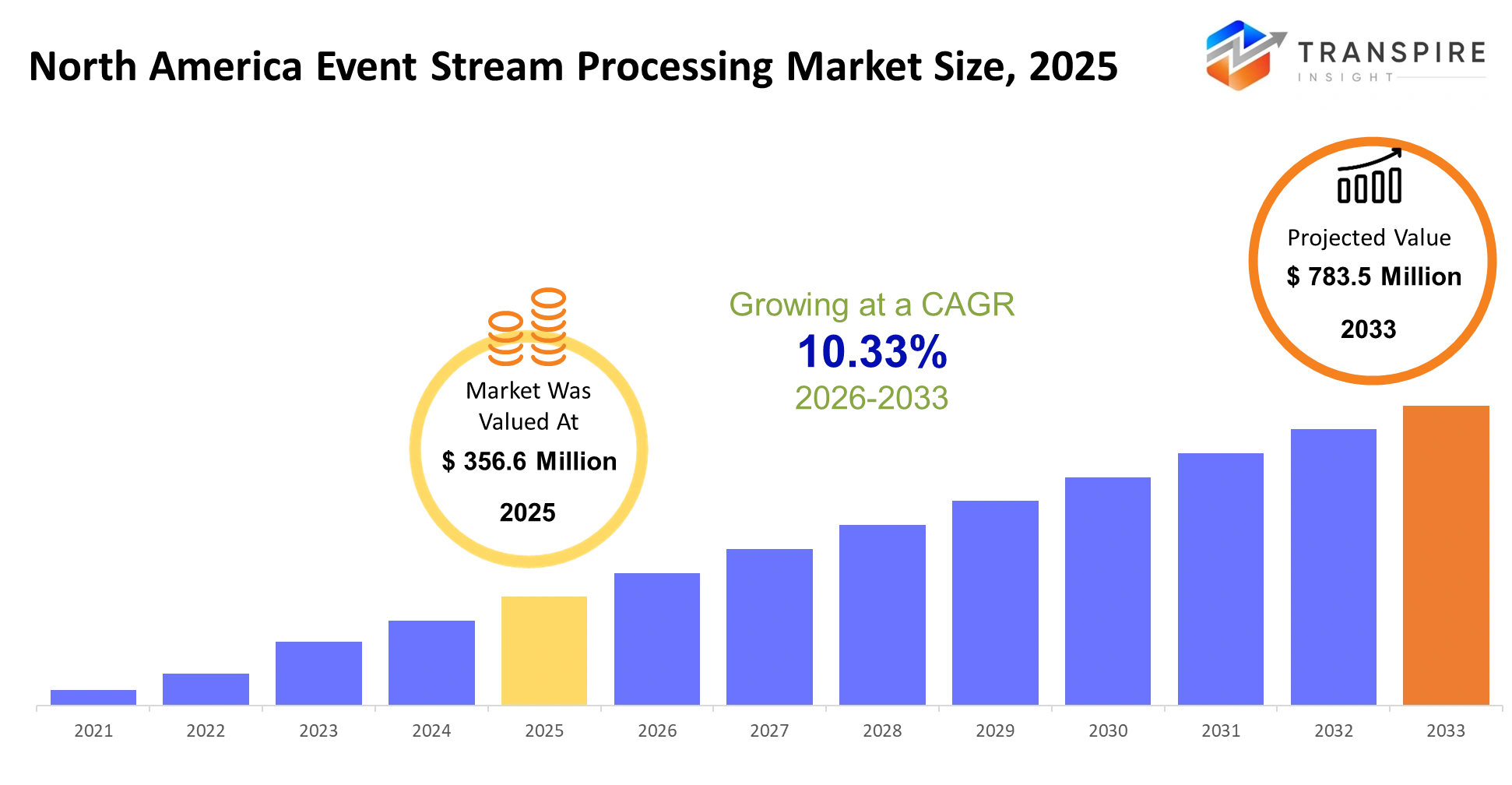
North America Event Stream Processing Market Size & Forecast:
- North America Event Stream Processing Market Size 2025: USD 356.6 Million
- North America Event Stream Processing Market Size 2033: USD 783.5 Million
- North America Event Stream Processing Market CAGR: 10.33%
- North America Event Stream Processing Market Segments: By Component (Software, Services), By Deployment (Cloud, On-Premise), By Application (Fraud Detection, Algorithmic Trading, IoT Analytics), By End-User (BFSI, IT & Telecom, Retail).
To learn more about this report,  Download Free Sample Report
North America Event Stream Processing Market Summary:
The North America Event Stream Processing Market size is estimated at USD 356.6 Million in 2025 and is anticipated to reach USD 783.5 Million by 2033, growing at a CAGR of 10.33% from 2026 to 2033. The event stream processing market in North America, which includes Canada, the United States, and Mexico, is a part of a larger data analytics and real-time computing sector in which businesses will increasingly have to rely on instant data interpretation to act in real time. There is also a move towards systems that can process data from connected devices, financial transactions, and digital platforms in real time. The need for instant interpretation in order to meet business needs for quicker digital services will force businesses to adopt solutions that can help them do so. The development of edge computing technology in tandem with AI-based analytical methods is expected to open up new forms in which insights can be created, and existing data governance regulations will dictate the forms in which this data can be obtained.
Key Market Trends & Insights:
The North america (canada, the united states, and mexico) event stream processing market will see enterprises moving toward real-time decision environments where milliseconds shape outcomes. Financial services and e-commerce and logistics companies will spend money on streaming platforms to identify unusual patterns and deliver customized experiences to their customers without delay. Organizations will choose data pipelines which enable ongoing feedback mechanisms because customer journeys now require immediate adjustments to their services based on current customer behavior instead of using delayed batch analysis.
Businesses will accelerate their cloud-native adoption process because they need deployment models which can handle their varying data requirements. Teams will spend more time on analytics work because managed streaming services will decrease infrastructure needs which managed streaming services will handle. Hybrid architectures will become more popular because regulated industries need both on-premise security measures and cloud resources to manage their operations. The shift will lead vendors to create systems which work together to deliver system performance and compliance and operational cost savings across different working environments.
The development of artificial intelligence in streaming services will reach new levels of advancement through the direct integration of machine learning models into streaming operations. The system enables organizations to make automatic decisions which include detecting fraud and predicting equipment failures and estimating future product requirements. The evolution of algorithms toward increased adaptability will create a need for businesses to establish continuous model training systems which use real-time data streams to develop models that adjust to market trends and customer preferences without needing manual updates.
The design of streaming systems will be influenced by the regulatory requirements which focus on data protection and data sovereignty. The region's governments will implement stricter regulations which control cross-border data transfers and monitor digital transaction activities in real time. To meet these requirements companies will enhance their security measures by using better encryption methods and creating audit trails and establishing local data oversight procedures. Organizations will meet regulatory requirements through these changes while also establishing consumer confidence in systems that depend on ongoing data monitoring and instant decision-making.
North America Event Stream Processing Market Segmentation
By Component
Software- The operational backbone of streaming ecosystems will depend on software solutions which permit organizations to ingest, process and analyze high-velocity data streams. The platforms will develop further through their embedded analytics and visualization components which enable seamless connection to enterprise systems. Software providers will develop their products to meet growing customer demand for instant information through features which support high system scalability and fast response times and simple operation for both experts and non-experts who need to analyze ongoing data streams.
Services- The success of streaming infrastructures depends on services which provide crucial support for their implementation process and their customization work and their ongoing system optimization. Consulting firms will assist enterprises in developing streaming strategies which support their business objectives while managed service providers will maintain system functionality and performance. Organizations will increasingly depend on external expertise to handle their integration work and system monitoring and security needs because of rising operational complexity. Training and support services will expand to assist teams in their transition to new technologies and changes in operational requirements.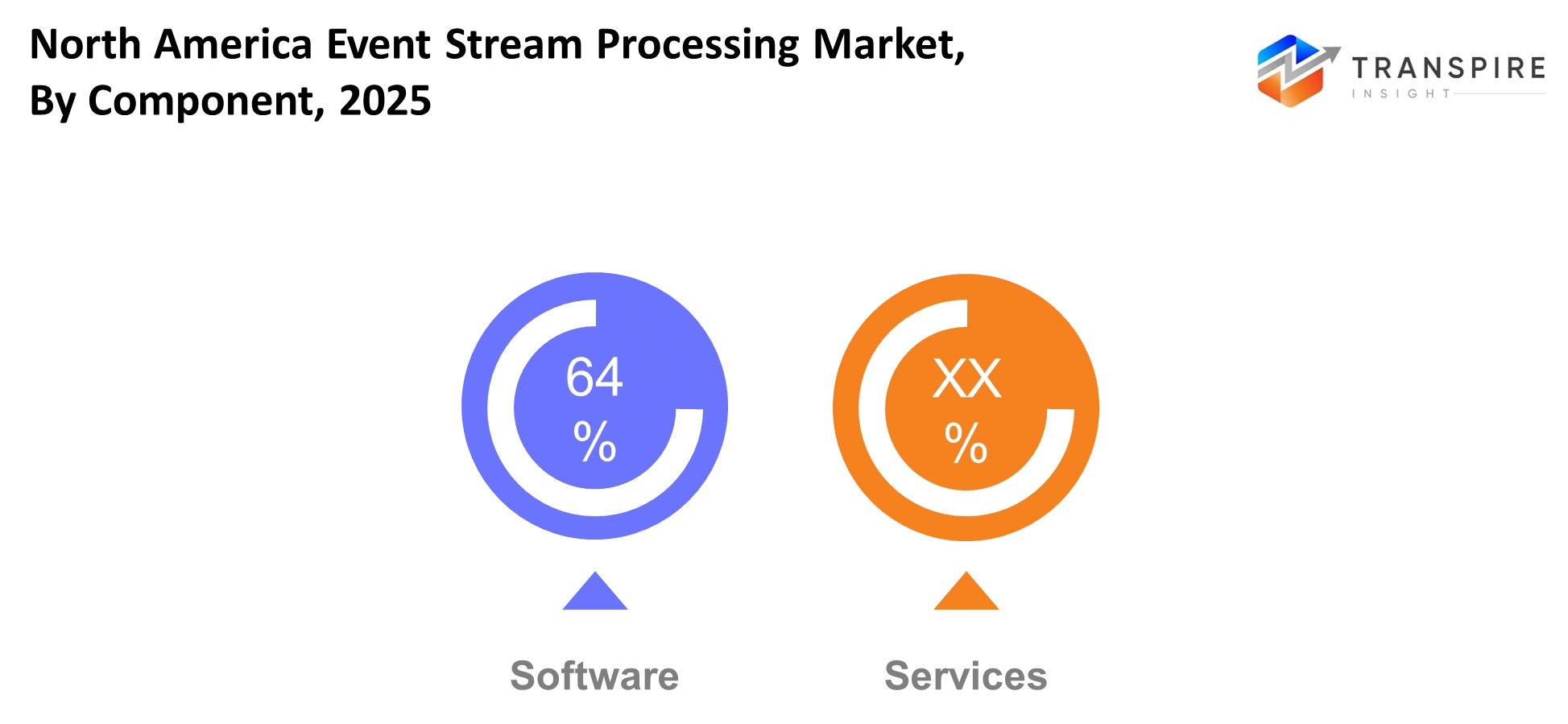
To learn more about this report, Download Free Sample Report
By Deployment
Cloud- The cloud-based solution will become the preferred choice because it offers flexible deployment options and it supports unpredictable data volume requirements without needing significant initial costs. Organizations will select cloud environments because they provide fast scalability for streaming operations and they enable businesses to connect with advanced analytics systems. Cloud service providers will keep developing new automated capabilities which will simplify streaming pipeline operations for organizations. This method will benefit organizations that need to achieve flexible operations and quick software deployment and less need for infrastructure upkeep.
On-Premise- Organizations that need complete control over their data and must follow local compliance requirements will continue to use on-premise deployment. Organizations that handle sensitive financial information and personal details will select in-house systems because these systems provide complete control over their data processing operations. The systems will deliver enhanced security features and customization options to users who are willing to invest more money at the beginning and throughout their system's life cycle. Organizations will assess these advantages and disadvantages when they create their data infrastructure plans.
By Application
Fraud Detection- Fraud Detection The most essential application which organizations need to develop will become fraud detection for industries which process large volumes of digital transactions. The streaming systems will perform real-time analysis to detect unusual activities which will lead to financial losses. Organizations will use continuous monitoring together with adaptive algorithms for instant detection of security threats which will become more sophisticated. The proactive security approach will enhance security systems while decreasing emergency response times.
Algorithmic Trading- Algorithmic Trading High-speed trading for algorithmic trading requires real-time data processing to execute market-driven trades within one-tenth of a second. Financial organizations will spend money on streaming solutions which enable them to handle market data without experiencing processing delays. The systems will allow traders to make quick responses to price changes which will enhance their decision-making abilities. Trading organizations need to use fast and precise methods because market competition exists.
IoT Analytics- IoT Analytics The continuous data processing requirement will emerge from IoT analytics because connected devices produce uninterrupted data streams. The manufacturing industry, as well as the healthcare and logistics industries, will use streaming for the purpose of monitoring their equipment performance, including the prediction of failures. The ability to perform immediate device data processing will become a significant feature as the IoT devices become more common.
By End-User
BFSI- The BFSI sector will continue to adopt streaming technologies for bettering its transaction monitoring system and customer engagement methods and risk management practices. Financial institutions will use real-time insights to detect fraud and personalize services and comply with regulatory requirements. Organizations need to build advanced streaming infrastructures because digital banking requires immediate data processing which will become more essential in the future.
IT & Telecom- IT and telecom companies will utilize streaming systems to manage network performance and deliver uninterrupted services. Operators will use real-time monitoring to identify outages and optimize bandwidth usage and enhance customer experience. The organizations will use streaming analytics to maintain service quality because data traffic increases with more connections to the network.
Retail- Retail organizations will use this streaming technology to have a better understanding of their customers’ behavior, thus improving their engagement strategies. The ability to process customer interactions in online stores and physical stores will help them make informed decisions about their products. The retail industry will use the streaming technology to make informed decisions regarding their supply chains. The retail industry will require the ability to constantly process customer interactions since they will need to keep up with the changing needs of their customers.
Regional Insights
The United States will lead regional adoption because of its substantial digital infrastructure investments and advanced analytics development efforts. All enterprises in finance, retail, and technology sectors will use real-time data processing to boost their customer engagement and operational efficiency. The presence of major technology providers will further accelerate innovation. Organizations will continuously implement streaming solutions into their main systems because businesses need quick data insights to compete in data-driven markets.
The Canadian economy will achieve consistent progress because the country is increasingly focusing on establishing data governance and privacy protection standards. Enterprises will use streaming technologies in a controlled manner while they assess their compliance with national and provincial regulations. Banking, telecommunications, and public service organizations will start using real-time analytics to enhance their service delivery processes. Digital initiatives that receive government support will drive organizations to adopt new technologies because these initiatives enable infrastructure modernization while organizations maintain secure data protection systems.
The digital transformation process will lead to more businesses in Mexico adopting new technologies which will spread across the retail sector and manufacturing sector and financial services sector. Businesses will invest in streaming solutions to improve operational visibility and respond quickly to customer demands. The ongoing development of connectivity and cloud services infrastructure will enable wider network implementation even though some regions experience ongoing technical difficulties. Organizations will concentrate not only on cost-efficient solutions capable of providing real-time insights, but not requiring complex system overhauls.
The region's streaming system deployment and management will receive regulatory guidance while using cross-border data protection laws. Companies that operate in multiple countries must comply with different data protection regulations while maintaining their ability to share information between locations. The public and private sectors will work together to create new innovations while North American businesses adapt their adoption methods based on rising customer demand for immediate digital services.
Recent Development News
United States: Expansion of Cloud-Native Streaming Platforms
Recent developments across the United States highlight increased investments in cloud-native data ecosystems, where enterprises are shifting toward managed streaming solutions for faster deployment and scalability. Companies are strengthening real-time fraud detection and customer analytics capabilities, aligning with rising demand for instant digital experiences. Industry reports indicate that cloud-based streaming and IoT-driven analytics adoption will continue accelerating, supported by strong enterprise spending and innovation in real-time processing technologies.
Canada: Rising Focus on Data Governance and Secure Streaming
In Canada, recent activity shows a growing emphasis on secure and compliant data streaming frameworks. Organizations are aligning streaming infrastructures with stricter privacy expectations, particularly around financial and telecom data. Businesses are adopting localized processing strategies to address regulatory requirements while maintaining performance. This shift reflects a broader regional push toward balancing innovation with accountability, especially as real-time analytics becomes more embedded in public and private sector operations.
Mexico: Increasing Adoption Driven by IoT and Digital Commerce
Mexico is witnessing steady progress as companies expand the use of streaming technologies in retail, manufacturing, and financial services. Recent developments point toward increased adoption of IoT-enabled analytics, allowing businesses to monitor operations and customer interactions in real time. As digital commerce grows, organizations are investing in cost-efficient streaming solutions to improve responsiveness. Industry insights suggest that expanding connectivity and cloud access will further strengthen adoption across emerging business segments.
|
Report Metrics |
Details |
|
Market size value in 2025 |
USD 356.6 Million |
|
Market size value in 2026 |
USD 393.7 Million |
|
Revenue forecast in 2033 |
USD 783.5 Million |
|
Growth rate |
CAGR of 10.33% from 2026 to 2033 |
|
Base year |
2025 |
|
Historical data |
2021 – 2024 |
|
Forecast period |
2026 – 2033 |
|
Report coverage |
Revenue forecast, competitive landscape, growth factors, and trends |
|
Regional scope |
North America (Canada, The United States, and Mexico) |
|
Key company profiled |
IBM Corporation, Microsoft Corporation, Oracle Corporation, SAP SE, Amazon Web Services Inc., Google LLC, TIBCO Software Inc., Software AG, Confluent Inc., Red Hat Inc., Apache Software Foundation (Kafka), Informatica Inc., Splunk Inc., Cloudera Inc., Databricks Inc. |
|
Customization scope |
Free report customization (country, regional & segment scope). Avail customized purchase options to meet your exact research needs. |
|
Report Segmentation |
By Component (Software, Services), By Deployment (Cloud, On-Premise), By Application (Fraud Detection, Algorithmic Trading, IoT Analytics), By End-User (BFSI, IT & Telecom, Retail). |
Key North America Event Stream Processing Market Company Insights
The North America event stream processing market which includes Canada and the United States and Mexico will experience ongoing competition as its main companies develop new technologies for real-time data analysis and scalable data processing systems. The major technology companies which include Microsoft Google IBM Oracle and Amazon Web Services will expand their market presence through cloud-based streaming services while Confluent and Databricks concentrate on building modern event-based systems. The companies will develop solutions which use artificial intelligence for processing data while achieving fast performance and enabling companies to manage multiple data systems and react to business operations and customer needs in real time.
Company List
- IBM Corporation
- Microsoft Corporation
- Oracle Corporation
- SAP SE
- Amazon Web Services Inc.
- Google LLC
- TIBCO Software Inc.
- Software AG
- Confluent Inc.
- Red Hat Inc.
- Apache Software Foundation (Kafka)
- Informatica Inc.
- Splunk Inc.
- Cloudera Inc.
- Databricks Inc
North America Event Stream Processing Market Report Segmentation
By Component
- Software
- Services
By Deployment
- Cloud
- On-Premise
By Application
- Fraud Detection
- Algorithmic Trading
- IoT Analytics
By End-User
- BFSI
- IT & Telecom
- Retail
Frequently Asked Questions
Find quick answers to common questions.
The Approximate North America Event Stream Processing Market size for the Market will be USD 783.5 Million in 2033.
Key Segments for the North America Event Stream Processing Market By Component (Software, Services), By Deployment (Cloud, On-Premise), By Application (Fraud Detection, Algorithmic Trading, IoT Analytics), By End-User (BFSI, IT & Telecom, Retail).
Major Players in the North America Event Stream Processing Market are IBM Corporation, Microsoft Corporation, Oracle Corporation, SAP SE, Amazon Web Services Inc., Google LLC, TIBCO Software Inc., Software AG, Confluent Inc., Red Hat Inc., Apache Software Foundation (Kafka), Informatica Inc., Splunk Inc., Cloudera Inc., Databricks Inc.
The Current North America Event Stream Processing Market size is USD 356.6 Million in 2025.
The North America Event Stream Processing Market CAGR is 10.33%.
- IBM Corporation
- Microsoft Corporation
- Oracle Corporation
- SAP SE
- Amazon Web Services Inc.
- Google LLC
- TIBCO Software Inc.
- Software AG
- Confluent Inc.
- Red Hat Inc.
- Apache Software Foundation (Kafka)
- Informatica Inc.
- Splunk Inc.
- Cloudera Inc.
- Databricks Inc
Recently Published Reports
-
Apr 2026
3D Optical Profiler Market
3D Optical Profiler Market Size, Share & Analysis Report By Type (Desktop 3D Optical Profiler, and Portable 3D Optical Profiler), By Technology (Confocal Technology, and White Light Interference), By End-Use Industry (Manufacturing, Research Institutions, Automotive, Aerospace and Defense, Medical Devices, and Other), and Geography (North America, Europe, Asia-Pacific, Middle East and Africa, South and Central America), 2021 - 2031
-
Apr 2026
Depth Sensor Market
Depth Sensor Market Size, Share & Analysis Report By Type (Infrared Depth Sensors, Time-of-Flight (ToF) Sensors, Stereo Vision Sensors, Structured Light Sensors, Ultrasonic Depth Sensors), By Application (Automotive, Robotics, Gaming, Consumer Electronics, Industrial Automation, Healthcare, Security & Surveillance, Others), By End Users (Automotive Manufacturers, Consumer Electronics Companies, Healthcare Providers, Industrial Companies, Security Agencies, Gaming Companies, Robotics Companies, Others), and Geography (North America, Europe, Asia-Pacific, Middle East and Africa, South and Central America), 2021 – 2031
-
Apr 2026
Digital Manufacturing Market
Digital Manufacturing Market Size, Share & Analysis Report By Component (Hardware, Software, and Services), By Technology (Robotics, 3D Printing, Internet of Things (IoT), and Others), By Application (Automotive and Transportation, Aerospace and Defense, Consumer Electronics, Industrial Machinery, and Others), By Process Type (Computer-Based Designing, Computer-Based Simulation, Computer 3D Visualization, Analytics, and Others), and Geography (North America, Europe, Asia-Pacific, Middle East and Africa, South and Central America), 2021 – 2031
-
Apr 2026
Digital Visa Services Market
Digital Visa Services Market Size, Share & Analysis Report By Type (Individual Travelers, Group Travelers), By Application (Tourism, Business Travel, Others), and Geography (North America, Europe, Asia-Pacific, Middle East and Africa, South and Central America), 2021 – 2031