
North America Utility Billing Software Market Size & Forecast:
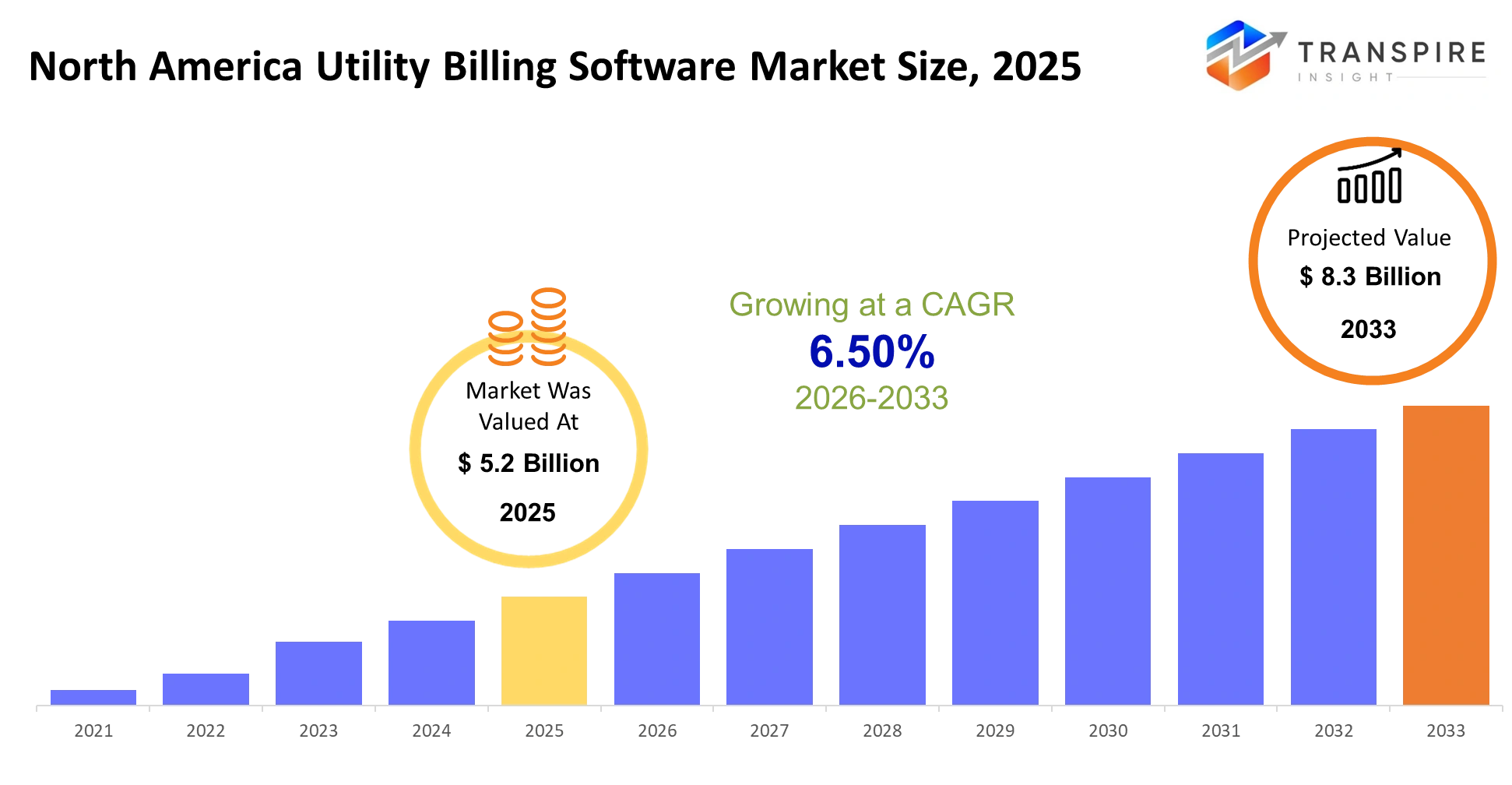
- North America Utility Billing Software Market Size 2025: USD 5.2 Billion
- North America Utility Billing Software Market Size 2033: USD 8.3 Billion
- North America Utility Billing Software Market CAGR: 6.50%
- North America Utility Billing Software Market Segments: By Deployment (Cloud, On-Premise), By Application (Electricity Billing, Water Billing, Gas Billing), By End-User (Utilities, Municipalities).
To learn more about this report,  Download Free Sample Report
North America Utility Billing Software Market Summary:
The North America Utility Billing Software Market size is estimated at USD 5.2 Billion in 2025 and is anticipated to reach USD 8.3 Billion by 2033, growing at a CAGR of 6.50% from 2026 to 2033. The utility billing software market in North America which includes Canada and the United States and Mexico operates within the digital utilities and infrastructure technology industry. The industry now uses billing systems as a data-driven service layer instead of handling them through back-office operations. Utilities will adopt platforms that unify metering, customer portals, and payment ecosystems because consumers want their companies to provide them with real-time usage data and flexible billing options. The need for compliance with carbon reporting and rate transparency regulations will force vendors to develop compliance rules that operate within their existing workflows. The combination of cloud-native architectures together with AI-powered anomaly detection and mobile-first interfaces will create a new set of vendor services while municipalities search for systems that can provide cost-effective solutions which enhance citizen services.
Key Market Trends & Insights:
The North America (Canada, the United States, and Mexico) utility billing software market is shifting toward consumption-aware billing models, where customers will expect precise, near real-time visibility into their usage. Utilities will replace their current static monthly invoicing system with new dynamic billing cycles that use smart metering data for their billing process. The new system will establish better transparency, which will enable consumers to change their actions according to cost information while providers improve their pricing methods through increased precision.
Cloud deployment will continue to reshape how billing platforms are delivered and maintained. Utilities will prefer flexible, subscription-based systems that reduce infrastructure burden and allow faster updates. Vendors will design solutions that integrate easily with legacy grids while supporting modern APIs. As cybersecurity expectations tighten, providers will invest in secure cloud environments, which will protect sensitive customer and payment data across distributed systems and digital touchpoints.
The upcoming customer experience will become the main competitive factor which utility companies will use to evaluate their service performance. The industry will establish multilingual support together with mobile apps and self-service portals as mandatory requirements. The billing platforms will feature user-friendly dashboard systems which will generate automatic notifications and create customized user suggestions. The shift shows how people now expect to interact with businesses through digital channels which offer them the same convenient experience they find in banking and retail and other digital-first sectors.
The regulatory frameworks which exist throughout the United States and Canada and Mexico will determine the design and implementation of billing systems. The governments will establish more rigorous requirements for protecting data privacy and monitoring emissions and providing tariff information. Software providers will respond by embedding compliance features directly into billing engines. The alignment will enable utilities to handle policy changes efficiently while they sustain their core business activities throughout various regional obligations.
North America Utility Billing Software Market Segmentation
By Deployment
Cloud- The cloud-based utility billing platforms will become the preferred choice The solutions enable users to access systems from remote locations while providing fast system updates and seamless connections to smart meters and digital payment systems. The vendors will continue to develop their multi-tenant systems through the implementation of advanced encryption methods and additional compliance protection mechanisms. The system enables utilities to operate their essential services through automatic data storage and processing capabilities which help them manage operations across multiple locations.
On-Premise- The organizations that value complete control over their data and wish to create specific system setups will continue to use on-premise deployments. The organizations that operate large utility networks and those backed by government funding will maintain their development of internal systems to meet their strict organizational standards and to support their existing systems. The system will enable organizations to establish complete security over their sensitive information through dedicated data protection and security management systems. The organization must invest in dedicated IT personnel for system upkeep while system enhancement will follow a controlled process that occurs only after all operational and regulatory standards have been met.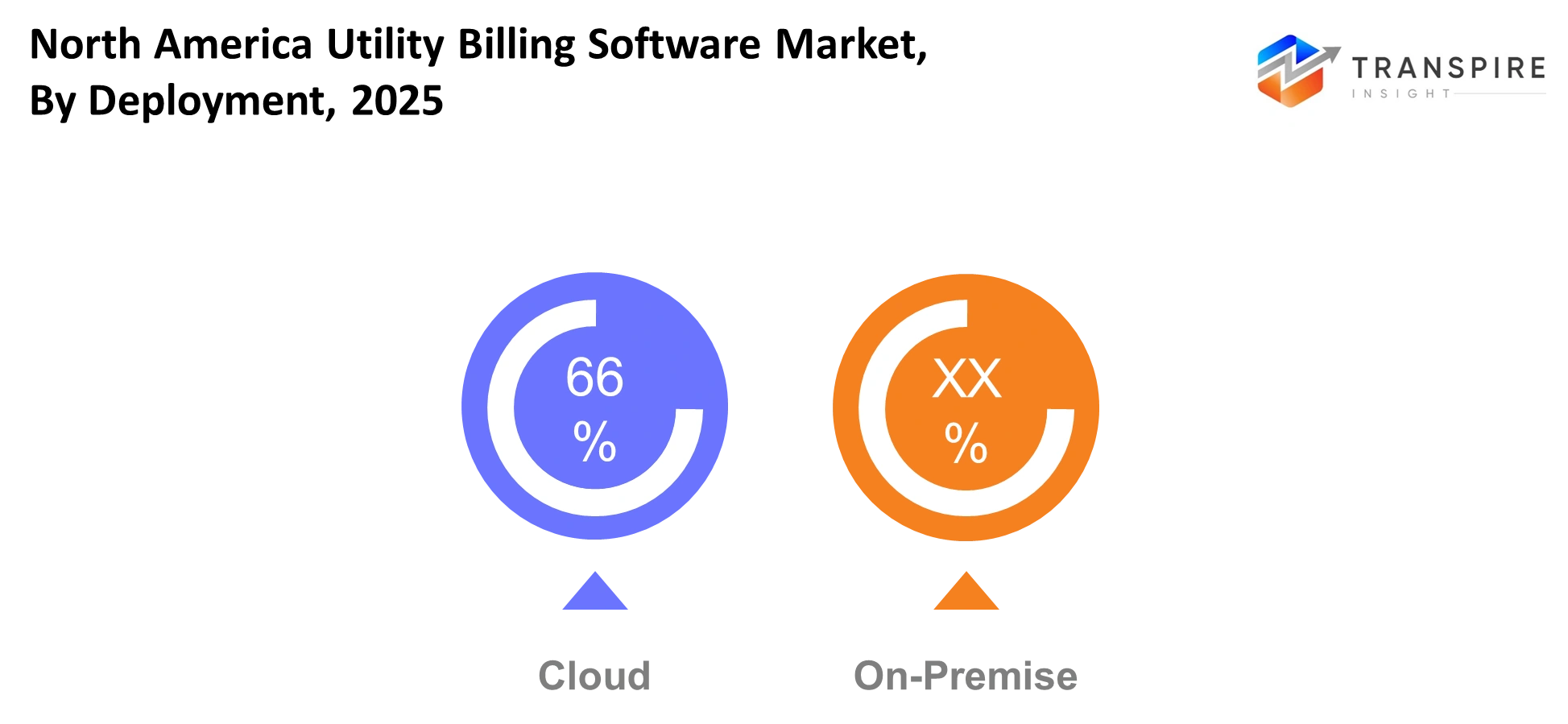
To learn more about this report, Download Free Sample Report
By Application
Electricity Billing- The usage of applications will become increasingly dependent on electricity billing because renewable energy sources and smart grid systems create unpredictable power usage patterns. The billing systems will develop new capabilities which will enable them to manage time-based electricity tariffs and peak electricity demand charges and power distribution from residential solar systems. The utilities require advanced algorithms to process their high-frequency meter data which enables them to generate correct bills. Consumers demand their usage information to be presented in detailed formats which requires providers to create billing systems that offer greater visibility and customer engagement.
Water Billing- Water billing solutions will focus on accurate consumption tracking and leak detection support. Municipal bodies will adopt systems that integrate with smart water meters to monitor usage in real time. The platforms will help identify unusual consumption patterns which will motivate people to reduce their water usage. The billing software will enable authorities to create tiered pricing structures while meeting regulatory requirements for resource management which will help them generate revenue while maintaining sustainable water distribution operations.
Gas Billing- Gas billing applications will adapt to fluctuating consumption trends which are driven by seasonal demand and energy transitions. The systems will have capabilities to determine pricing which will include safety data inputs combined with variable pricing elements. Utilities will increasingly use billing platforms to provide customers with insights into usage efficiency. The integration of IoT-enabled meters will improve accuracy while automated alerts will assist both providers and consumers in better controlling their consumption patterns.
By End-User
Utilities- Utility companies will continue to utilize billing software as their main tool for handling extensive customer bases and their intricate pricing structures. They will choose platforms which provide unified billing solutions that connect to their existing customer relationship management and outage tracking systems. Automation will decrease the need for human work thus enhancing billing precision and operational effectiveness. The utilities will apply analytics tools from these systems to predict their upcoming needs while they develop methods to maximize their revenue collection.
Municipalities- Municipalities will increasingly implement billing software to streamline public service management and improve citizen engagement. The systems will enable local governments to operate their water and waste and utility services through a transparent management system. Users will benefit from digital billing combined with online payment solutions and automated notification systems. Municipal bodies will also use these platforms to ensure compliance with regional policies while maintaining accountability in service delivery and financial reporting.
Regional Insights
The utility billing systems throughout North America will demonstrate their shift toward digital systems which provide better service to customers. Providers will prioritize unified platforms that connect metering, billing, and engagement tools. The market will require solutions that handle large amounts of consumption data while delivering precise results. The region will continue aligning billing frameworks with sustainability targets, which will drive software vendors to develop systems that include energy tracking and reporting capabilities.
The utilities in the United States will focus on updating their outdated billing systems because customers now demand modern services. Customers will demand multiple payment options, while they also expect to see their account information in real time and choose when to pay their bills. The billing process will become subject to regulatory supervision, which will determine how companies handle customer information and their payment procedures. Vendors will introduce adjustable systems that comply with state regulations, which will enable utilities to fulfill legal requirements while maintaining their regular business operations and customer service efficiency.
2023 Canadian environmental billing procedures will develop progressively because national and provincial sustainability commitments exist throughout the country. The utilities sector will require systems which provide carbon tracking and optimization monitoring solutions. Digital platforms must offer bilingual support because they need to enable customers to interact with their services. Software vendors will develop applications which maintain system reliability through ability to work with already installed systems, enabling utilities to enhance their operational capacity without major interference to their current service delivery.
Utilities in Mexico will implement modern billing systems because they want to achieve better operational results while decreasing their revenue losses. Smart metering investments will enable more precise billing and improved consumption tracking. System upgrades will receive government support through initiatives which promote transparent practices and responsible management. Vendors will create affordable solutions which their customers can use to solve specific problems, while they will make advanced system features available to customers through gradual implementation.
Recent Development News
Expansion of Cloud-Native Billing Platforms Across Utilities
Recent developments across North America highlight a strong shift toward cloud-native billing systems, especially among electric and water utilities. Vendors are introducing platforms that support real-time data processing, API integrations, and remote accessibility. Utilities are replacing legacy systems to improve billing accuracy and operational flexibility. This transition is also influenced by the need to manage distributed energy resources more efficiently through modern, scalable digital infrastructures.
Rising Focus on Smart Meter Integration and Data Accuracy
Utilities in the United States and Canada are increasingly investing in smart metering infrastructure, which is directly impacting billing software innovation. New solutions are being designed to process high-frequency consumption data, enabling precise and timely invoicing. This development is helping utilities reduce billing disputes and improve transparency. As more regions adopt advanced metering, billing systems are evolving to handle complex pricing models and detailed consumption insights.
Emergence of Specialized Billing Solutions for Local Governments
Another notable development is the rise of tailored billing platforms for municipalities and smaller utility providers. These solutions are focusing on user-friendly interfaces, automation, and improved citizen engagement tools. Vendors are targeting local governments with cost-effective systems that integrate billing with service management. This trend reflects growing demand for streamlined operations at the municipal level, where efficiency and transparency are becoming key priorities in public service delivery.
|
Report Metrics |
Details |
|
Market size value in 2025 |
USD 5.2 Billion |
|
Market size value in 2026 |
USD 5.5 Billion |
|
Revenue forecast in 2033 |
USD 8.3 Billion |
|
Growth rate |
CAGR of 6.50% from 2026 to 2033 |
|
Base year |
2025 |
|
Historical data |
2021 – 2024 |
|
Forecast period |
2026 – 2033 |
|
Report coverage |
Revenue forecast, competitive landscape, growth factors, and trends |
|
Regional scope |
North America (Canada, The United States, and Mexico) |
|
Key company profiled |
Oracle Corporation, SAP SE, IBM Corporation, Microsoft Corporation, Accenture plc, CGI Inc., Capgemini SE, Infosys Ltd., Tata Consultancy Services Ltd., Wipro Limited, VertexOne Inc., Harris Computer Systems, Cayenta (N. Harris), Fluentgrid Ltd., Open International LLC. |
|
Customization scope |
Free report customization (country, regional & segment scope). Avail customized purchase options to meet your exact research needs. |
|
Report Segmentation |
By Deployment (Cloud, On-Premise), By Application (Electricity Billing, Water Billing, Gas Billing), By End-User (Utilities, Municipalities). |
Key North America Utility Billing Software Market Company Insights
North America (Canada, the United States, and Mexico) utility billing software market company insights highlight a competitive landscape where vendors will focus on platform flexibility, data intelligence, and customer-centric design. Leading providers will invest in cloud-native systems, enabling utilities to streamline billing operations while adapting to evolving regulatory expectations. Companies will also prioritize AI-driven analytics to improve billing accuracy and detect anomalies. Strategic partnerships with metering and payment solution providers will strengthen product ecosystems. Firms will differentiate through customization capabilities, cybersecurity standards, and seamless integration with legacy infrastructure, ensuring utilities can modernize without disrupting existing service frameworks or customer relationships.
Company List
- Oracle Corporation
- SAP SE
- IBM Corporation
- Microsoft Corporation
- Accenture plc
- CGI Inc.
- Capgemini SE
- Infosys Ltd.
- Tata Consultancy Services Ltd.
- Wipro Limited
- VertexOne Inc.
- Harris Computer Systems
- Cayenta (N. Harris)
- Fluentgrid Ltd.
- Open International LLC.
North America Utility Billing Software Market Report Segmentation
By Deployment
- Cloud
- On-Premise
By Application
- Electricity Billing
- Water Billing
- Gas Billing
By End-User
- Utilities
- Municipalities
Frequently Asked Questions
Find quick answers to common questions.
The Approximate North America Utility Billing Software Market size for the Market will be USD 8.3 Billion in 2033.
Key Segments for the North America Utility Billing Software Market By Deployment (Cloud, On-Premise), By Application (Electricity Billing, Water Billing, Gas Billing), By End-User (Utilities, Municipalities).
Major Players in the North America Utility Billing Software Market are Oracle Corporation, SAP SE, IBM Corporation, Microsoft Corporation, Accenture plc, CGI Inc., Capgemini SE, Infosys Ltd., Tata Consultancy Services Ltd., Wipro Limited, VertexOne Inc., Harris Computer Systems, Cayenta (N. Harris), Fluentgrid Ltd., Open International LLC.
The Current North America Utility Billing Software Market size is USD 5.2 Billion in 2025.
The North America Utility Billing Software Market CAGR is 6.50%.
- Oracle Corporation
- SAP SE
- IBM Corporation
- Microsoft Corporation
- Accenture plc
- CGI Inc.
- Capgemini SE
- Infosys Ltd.
- Tata Consultancy Services Ltd.
- Wipro Limited
- VertexOne Inc.
- Harris Computer Systems
- Cayenta (N. Harris)
- Fluentgrid Ltd.
- Open International LLC.
Recently Published Reports
-
Apr 2026
3D Optical Profiler Market
3D Optical Profiler Market Size, Share & Analysis Report By Type (Desktop 3D Optical Profiler, and Portable 3D Optical Profiler), By Technology (Confocal Technology, and White Light Interference), By End-Use Industry (Manufacturing, Research Institutions, Automotive, Aerospace and Defense, Medical Devices, and Other), and Geography (North America, Europe, Asia-Pacific, Middle East and Africa, South and Central America), 2021 - 2031
-
Apr 2026
Depth Sensor Market
Depth Sensor Market Size, Share & Analysis Report By Type (Infrared Depth Sensors, Time-of-Flight (ToF) Sensors, Stereo Vision Sensors, Structured Light Sensors, Ultrasonic Depth Sensors), By Application (Automotive, Robotics, Gaming, Consumer Electronics, Industrial Automation, Healthcare, Security & Surveillance, Others), By End Users (Automotive Manufacturers, Consumer Electronics Companies, Healthcare Providers, Industrial Companies, Security Agencies, Gaming Companies, Robotics Companies, Others), and Geography (North America, Europe, Asia-Pacific, Middle East and Africa, South and Central America), 2021 – 2031
-
Apr 2026
Digital Manufacturing Market
Digital Manufacturing Market Size, Share & Analysis Report By Component (Hardware, Software, and Services), By Technology (Robotics, 3D Printing, Internet of Things (IoT), and Others), By Application (Automotive and Transportation, Aerospace and Defense, Consumer Electronics, Industrial Machinery, and Others), By Process Type (Computer-Based Designing, Computer-Based Simulation, Computer 3D Visualization, Analytics, and Others), and Geography (North America, Europe, Asia-Pacific, Middle East and Africa, South and Central America), 2021 – 2031
-
Apr 2026
Digital Visa Services Market
Digital Visa Services Market Size, Share & Analysis Report By Type (Individual Travelers, Group Travelers), By Application (Tourism, Business Travel, Others), and Geography (North America, Europe, Asia-Pacific, Middle East and Africa, South and Central America), 2021 – 2031