

North America Endotoxin Testing Market Size & Forecast:
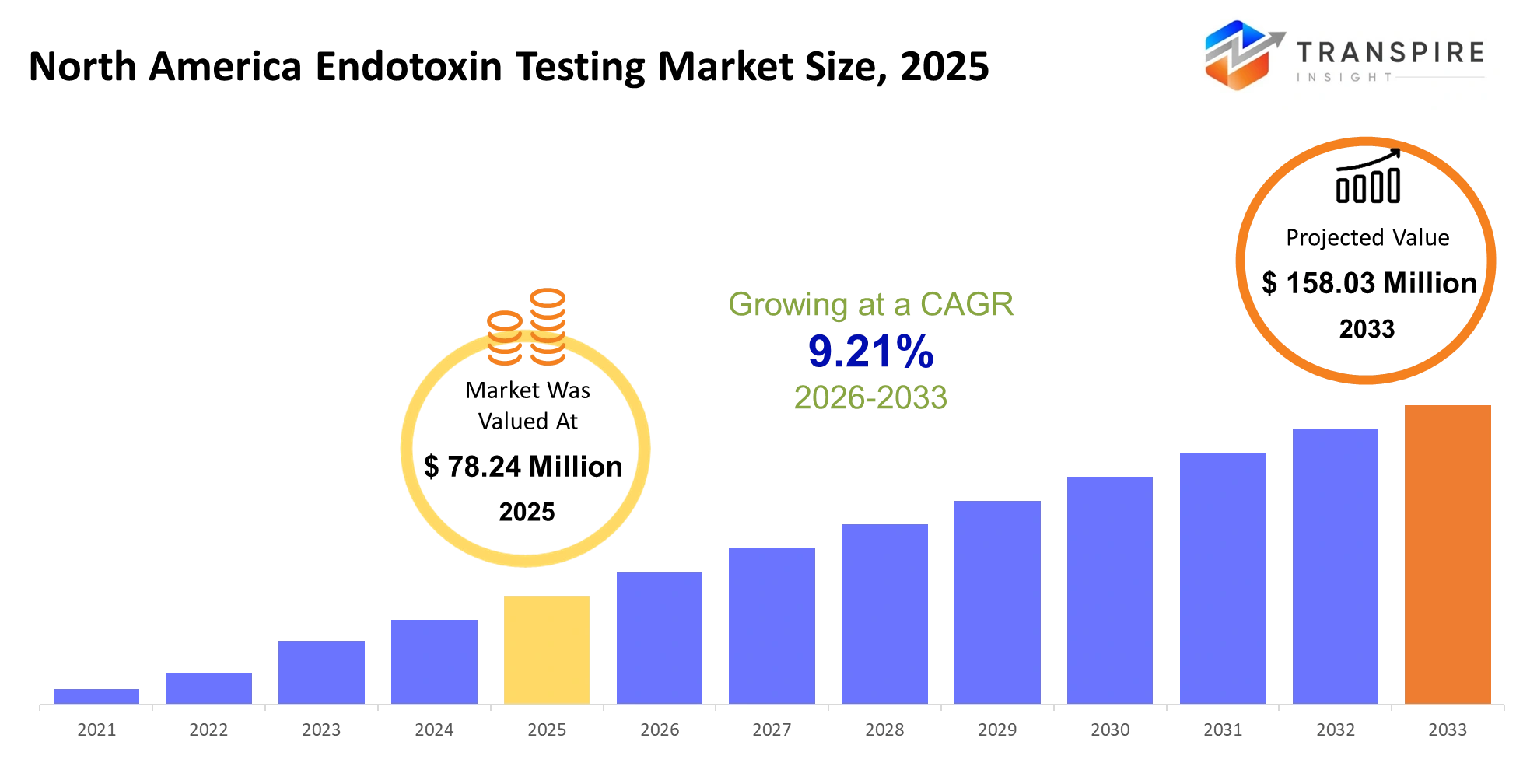
- North America Endotoxin Testing Market Size 2025: USD 78.24 Million
- North America Endotoxin Testing Market Size 2033: USD 158.03 Million
- North America Endotoxin Testing Market CAGR: 9.21%
- North America Endotoxin Testing Market Segments: By Product Type (Consumables, Instruments, Reagents & Kits, Assay Cartridges, Software Solutions, Services, Others), By Test Type (LAL Test, Gel Clot Test, Chromogenic Test, Turbidimetric Test, Recombinant Factor C Assay, Monocyte Activation Test, Others), By Application (Pharmaceutical Manufacturing, Medical Device Manufacturing, Biologics Testing, Vaccine Testing, Raw Material Testing, Others), By End User (Pharmaceutical Companies, Biotechnology Companies, CROs, Research Institutes, Medical Device Manufacturers, Others).
To learn more about this report,  Download Free Sample Report
North America Endotoxin Testing Market Summary:
The North America Endotoxin Testing Market size is estimated at USD 78.24 Million in 2025 and is anticipated to reach USD 158.03 Million by 2033, growing at a CAGR of 9.21% from 2026 to 2033.North America Endotoxin Testing Market, if you think about it, plays a big part in how pharmaceutical and biotechnology manufacturing gets done right, because injectable drugs , vaccines , dialysis fluids , and various medical devices have to be kept free of bacterial endotoxins. Those endotoxins can cause severe immune reactions in patients so it’s not just “nice to have” stuff , it’s basically required.
In day to day practice, endotoxin testing is treated like a release checkpoint for higher risk sterile products. That means manufacturers can sidestep product recalls , regulatory penalties, and the whole patient safety failure scenario, especially when the healthcare supply chains are kept very tightly controlled and timelines are not really flexible.
Over the last five years, things moved away from older style gel clot assays toward faster, automated, and recombinant reagent based testing platforms. The change really picked up after pandemic-era vaccine production made it clear how limited manual testing workflows can be, and how much pressure there is for quicker batch release timelines. At the same time, supply chain disruptions connected to horseshoe crab derived lysate materials made people look harder at synthetic alternatives, mainly because they tend to have more stable sourcing profiles.So now adoption is widening beyond just the big pharmaceutical companies. Smaller biologics groups and cell therapy manufacturers are also taking this on, since they need scalable contamination control systems to satisfy stricter regulatory scrutiny. And honestly, they often face compressed production cycles, so the testing has to keep up without turning into a bottleneck.
Key Market Insights
- North America endotoxin testing market, it kind of just keeps leading global revenue, and that’s mostly because the whole biopharmaceutical manufacturing setup is pretty advanced, plus the regulatory compliance rules are strict, like they’re not optional or anything.
- In 2025, the United States grabbed almost 82% of the market share, mostly tied to big biologics production volumes and the scale of pharmaceutical R&D spending, which stays high year after year.
- Canada looks like the fastest mover for regional growth all the way through 2030, and it’s being pulled along by more biotech startups and government-backed life sciences funding programs, kind of accelerating at once.
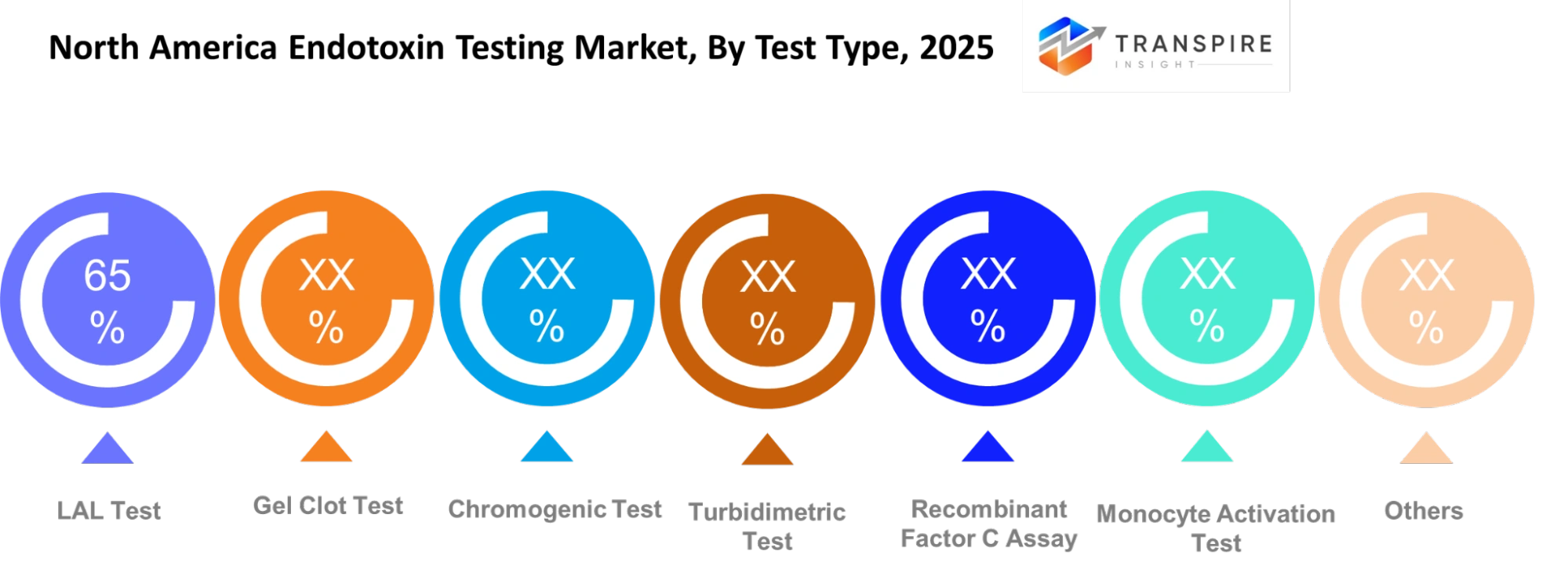
- Limulus Amebocyte Lysate testing products still held well over 58% of the industry share in 2025, mainly because many pharmaceutical manufacturers keep leaning on validated, classic endotoxin detection approaches, even if newer methods exist.
- Recombinant Factor C assays are the fastest-growing part during the forecast window since companies are actively looking for sustainable, animal-free endotoxin testing alternatives, instead of relying only on older workflows.
- Consumables and reagents remain the second-largest product grouping, largely due to recurring lab purchasing cycles and the fact that continuous batch testing never really stops.
- When it comes to applications, pharmaceutical manufacturing took nearly 46% market share in 2025, which lines up with rising production of sterile injectable drugs and vaccines.
- Cell and gene therapy testing is also starting to outpace the rest as the quickest-growing application area, because newer advanced therapies tend to demand very sensitive contamination screening procedures, no room for guesswork.
- On the end-user side, pharmaceutical and biotechnology companies dominate demand with around 54% share, supported by expanding biologics commercialization pipelines and related trial activity.
- Meanwhile contract research and manufacturing organizations are seeing rapid adoption growth, because outsourced drug development plus quality assurance operations keep getting more common, and companies want flexibility.
What are the Key Drivers, Restraints, and Opportunities in the North America Endotoxin Testing Market?
The most powerful driver behind the North America Endotoxin Testing Market is basically the fast growth of biologics injectable drugs and cell-based therapies, all of which need rigorous sterility validation before anything can be released. Over time, this trend kind of got even stronger after the COVID-19 vaccine manufacturing ramp up, showed how risky slow batch release testing can be in real operations. Regulatory bodies, especially the FDA, then tightened their rules around contamination control for sterile products, so manufacturers started pushing money into automated kinetic chromogenic assays and quicker endotoxin detection platforms. And as manufacturing cycles shrink while biologics pipelines keep expanding, many labs are upping spend on high throughput testing setups that cut release delays and boost manufacturing efficiency, more or less directly.
But the biggest structural hurdle in this market is the long validation work that comes with switching from older Limulus Amebocyte Lysate assays to recombinant options. Companies in this space run under strict manufacturing governance, where even small changes in testing can trigger broad comparability studies, regulatory sign offs, and additional process requalification too. So even if recombinant testing has clear operational advantages, the migration still moves slow. In practice it means delayed adoption of faster synthetic testing systems, plus continued reliance on legacy methods that limit scale, and quietly restrain revenue momentum for newer next generation providers.
A major growth opportunity is kind of brewing up out of North America’s expanding cell and gene therapy manufacturing ecosystem. Advanced therapy developers are now more and more asking for ultra-sensitive, rapid release endotoxin testing, stitched right into automated bioprocessing workflows, or something along those lines. Meanwhile investments in modular biologics facilities and continuous manufacturing platforms are making the whole environment more welcoming for AI enabled endotoxin monitoring systems and recombinant reagent technologies. Together they back the aim of faster therapeutic commercialization, and honestly the timing feels right.
What Has the Impact of Artificial Intelligence Been on the North America Endotoxin Testing Market?
Artificial intelligence and newer digital technologies are, sort of, reshaping the North America Endotoxin Testing Market, mainly by speeding up lab automation, keeping contamination history more traceable and improving batch release efficiency across pharmaceutical production environments. With AI enabled laboratory information management systems, endotoxin data capture gets automated, assay validation checks are run in the background, and deviation monitoring becomes more routine. This cuts down the amount of manual review work in busy, high throughput biologics sites. At the same time, automated testing platforms that plug into robotic sample handling are letting some manufacturers compress batch release timelines for injectable drugs and vaccines too.
On top of that, machine learning models are tightening predictive quality control, because they can flag contamination risks earlier before batch failures actually happen. Pharmaceutical firms can pull from older assay records, environmental monitoring signals, and production variables, then forecast endotoxin deviations, and adjust testing frequency accordingly. In practice, these predictive setups can reduce needless retesting cycles, support steadier manufacturing uptime, and help lower product discard rates in sterile production areas. A few advanced biologics manufacturers even say they’ve seen real, measurable reductions in release cycle delays after adding AI assisted analytics into their quality assurance routines.
Digital twins, plus cloud connected analytics platforms, are also boosting process consistency by enabling real time visibility across multiple manufacturing sites. Still, rollout is not always smooth, since integration costs can be high, and validating AI driven testing workflows is difficult under strict FDA and GMP compliance requirements. Many players continue leaning on legacy validation protocols, which can slow down the adoption of fully autonomous quality control systems.
Key Market Trends
- Since 2021, pharmaceutical makers have been slowly but surely replacing manual gel clot assays with automated kinetic chromogenic systems, to move sterile batch-release timelines along faster, and yeah kinda keep up with demand.
- After 2020, the take up of Recombinant Factor C kinda shot up a lot, mainly when supply issues in horseshoe crab lysate basically showed procurement risk, during the pandemic era vaccine manufacturing cycles.
- Also the FDA focus on injectable drug contamination got stronger between 2020 and 2025 , and it basically nudged larger budgets toward real-time endotoxin monitoring, and digital quality systems that can actually demonstrate what happened, not just say it did.
- At the same time, cell and gene therapy groups leaned harder into ultra-sensitive endotoxin platforms. This is because personalized therapies often mean smaller batches, faster turnarounds, and higher value runs, and that shifts the whole testing rhythm a bit.
- Big names like Thermo Fisher Scientific and Lonza Group have also increased automation-oriented product launches, supporting continuous biologics manufacturing setups where downtime is basically not optional.
- Contract manufacturing organizations followed suit by expanding their endotoxin testing capacity, after pharma companies started outsourcing more of the sterile injectable production work post-2020, sometimes across several sites.
- Cloud-connected laboratory information systems gained momentum too, because manufacturers wanted centralized compliance tracking across multi-site biologics production facilities, and less “where is that record again” type searching.
- Between 2022 and 2025, AI-assisted quality analytics platforms cut down on repetitive retesting, by spotting contamination trends before full batch deviations happen, which is kind of the whole point.
- Meanwhile, smaller biotech companies increasingly used outsourced endotoxin testing services, since setting up internal GMP laboratories became too expensive, like internal costs surpassing several million dollars per facility and then some.
- Competitive edge has shifted as well, not only toward assay sensitivity anymore, but toward faster turnaround times, integrated automation, and FDA-ready digital audit documentation, so teams can respond quickly when questions arrive.
North America Endotoxin Testing Market Segmentation
By Product Type
Consumables, reagents and kits kind of sit in the leading spot in the product-type segment, mostly because pharmaceutical and biologics manufacturers need nonstop replenishment for every endotoxin testing round. With high frequency testing happening inside sterile injectable production, you end up seeing recurring procurement patterns, so that pretty much backs fairly stable revenue generation for the suppliers. Instruments come in as the second-largest category, and it feels like laboratories are increasingly putting in automated readers, plus robotic handling systems, to squeeze more speed into batch-release workflows.
Assay cartridges and software solutions are also getting more attention, mainly because the industry keeps pushing integrated digital compliance tracking, and, to be honest, for faster data interpretation. Services keep expanding as well, especially among smaller biotechnology firms that would rather avoid big capital spending on house testing infrastructure.Looking ahead, growth is likely to edge toward fully automated testing ecosystems where consumables, instrumentation, and cloud-connected analytics kinda work together, in one flow. Manufacturers that put money into bundled platforms and ongoing service contracts are expected to raise customer retention, and in turn improve longer-term profitability across regulated pharmaceutical settings .
By Test Type
LAL testing keeps on dominating the test type segment, mostly because for decades of regulatory validation and wide pharma acceptance, people just got really dependent on the older endotoxin detection approaches. Gel clot tests stay relevant in smaller labs kind of because they’re easier to run, and the start up costs are fairly manageable too, but chromogenic and turbidimetric assays have been taking a bigger slice in high-throughput manufacturing plants. Automated chromogenic systems are spreading fast now, since pharmaceutical companies want release timelines that are shorter and results that are more consistent, not almost the same.
Recombinant Factor C assays are showing up as the fastest growing category, and it’s tied to sustainability worries, plus horseshoe crab lysate supply constraints, so there’s a push toward synthetic alternatives, even if adoption is gradual. Monocyte activation tests are still mostly limited to specialized uses, because the technical complexity is higher and regulatory adoption is narrower, not because they’re useless. Going forward, competition within the segment will depend more and more on how fast assays run, how well they plug into existing automation , and what kind of validation support vendors can provide. The suppliers that can lower transition friction for regulated manufacturers should end up with stronger market positioning through the next decade or so.
To learn more about this report, Download Free Sample Report
By Application
Pharmaceutical manufacturing holds the largest application share, kinda because sterile injectable drugs, monoclonal antibodies, and infusion therapies do need very strict endotoxin control before everything gets a commercial go ahead. Vaccine testing actually grew a lot after those pandemic-era production spikes, since companies ramped up testing frequency, and well, started pushing contamination control investment faster across a lot of North American manufacturing plants. Biologics testing is still climbing in importance, especially as cell-based therapies and personalized medicine show up with smaller but more sensitive production batches. Those batches then need more advanced endotoxin detection abilities.
Raw material testing stays critical too, since contamination risk often appears during upstream ingredient sourcing, and processing—like earlier steps, before the “real” production even feels underway. Medical device manufacturing adds steady demand as well, most notably for implantable devices and surgical instruments that get bloodstream exposure. Going forward, growth should mostly concentrate on advanced therapies plus continuous manufacturing systems, where rapid-release testing integration is basically expected, not optional. Testing providers that can deliver real-time monitoring and high-sensitivity platforms are likely to gain, as pharmaceutical production architecture shifts, and commercialization timelines get tighter, more compressed.
By End-User
Pharmaceutical companies still look like the big end-user segment, because the large-scale drug manufacturers kind of have to follow strict FDA quality standards, and they do endotoxin screening across many production stages—so it’s never really a casual “maybe later” thing. Biotechnology companies are also a fast-growing customer group, since more biologics pipelines keep popping up, and that naturally increases the need for flexible but very high-sensitivity contamination testing systems.
Meanwhile, contract research organizations, and contract manufacturing organizations keep taking more market share, largely because a lot of pharmaceutical firms decide to outsource quality assurance activities. They do it to reduce operational complexity and to make production scale up more smoothly. Research institutes still show steady testing demand for preclinical studies and experimental biologics development, but budgets being budgets means there’s less appetite for big equipment investments.Medical device manufacturers keep moving toward automated endotoxin testing platforms, mainly to satisfy compliance needs for cardiovascular implants orthopedic devices and surgical products, where downtime and documentation really matter. Going forward, the market direction seems to lean toward more collaboration, between testing providers and outsourced manufacturing partners. In other words, companies that can offer integrated digital compliance solutions and fast turnaround services should stand out, particularly as outsourced pharmaceutical production continues expanding across North America.
What are the Key Use Cases Driving the North America Endotoxin Testing Market?
Pharmaceutical manufacturing just keeps being the biggest use case, really pushing endotoxin testing adoption across North America, it’s not only a passing phase. Injectable drugs, monoclonal antibodies, and intravenous therapies end up needing endotoxin screening that is basically mandatory before the FDA batch release, so the demand stays level from large pharmaceutical production sites and biologics manufacturers.
In the last few years , vaccine production has also shown up more clearly, alongside medical device manufacturing, as secondary applications that actually matter. Quite a few biotechnology companies , plus contract manufacturing organizations, are moving toward rapid endotoxin assays to help accelerate vaccine timelines. Meanwhile, device makers for implantable cardiovascular and orthopedic work tend to focus on contamination control more intensely, because they have to satisfy those strict sterility rules.
Cell and gene therapy production is starting to look like an emerging use case with real long term potential. Developers of personalized medicine are gradually weaving ultra-sensitive endotoxin monitoring into small batch manufacturing routines, and a few continuous bioprocessing facilities are experimenting with AI enabled real time contamination tracking, so they can reduce production pauses and improve release efficiency, without dragging the whole workflow.
|
Report Metrics |
Details |
|
Market size value in 2025 |
USD 78.24 Million |
|
Market size value in 2026 |
USD 85.28 Million |
|
Revenue forecast in 2033 |
USD 158.03 Million |
|
Growth rate |
CAGR of 9.21% from 2026 to 2033 |
|
Base year |
2025 |
|
Historical data |
2021 - 2024 |
|
Forecast period |
2026 - 2033 |
|
Report coverage |
Revenue forecast, competitive landscape, growth factors, and trends |
|
Country scope |
North America (Canada, The United States, and Mexico) |
|
Key company profiled |
Charles River Laboratories, Lonza Group, Thermo Fisher Scientific, Merck KGaA, Associates of Cape Cod, bioMérieux, FUJIFILM Wako, Sartorius AG, Eurofins Scientific, GenScript, WuXi AppTec, Bioendo Technology, Pacific BioLabs, Nelson Laboratories, Steris. |
|
Customization scope |
Free report customization (country, regional & segment scope). Avail customized purchase options to meet your exact research needs. |
|
Report Segmentation |
By Product Type (Consumables, Instruments, Reagents & Kits, Assay Cartridges, Software Solutions, Services, Others), By Test Type (LAL Test, Gel Clot Test, Chromogenic Test, Turbidimetric Test, Recombinant Factor C Assay, Monocyte Activation Test, Others), By Application (Pharmaceutical Manufacturing, Medical Device Manufacturing, Biologics Testing, Vaccine Testing, Raw Material Testing, Others), By End User (Pharmaceutical Companies, Biotechnology Companies, CROs, Research Institutes, Medical Device Manufacturers, Others). |
Which Regions are Driving the North America Endotoxin Testing Market Growth?
The United States is at the front of the North America Endotoxin Testing Market, mainly because the country houses the regions biggest pharmaceutical manufacturing base, and also has the densest cluster of FDA- regulated biologics facilities. There’s still tough regulatory oversight for sterile injectable output, this keeps pushing steady spending on automated endotoxin detection systems, plus faster batch-release capabilities. Add in large vaccine manufacturing capacity, solid lab infrastructure , and notable biologics research budgets, and you get a setup that helps the market stay dominant across drug makers and biotech groups. And the fact that major players like Thermo Fisher Scientific , and Charles River Laboratories are active there, just adds extra momentum for product novelty, validation support, and supply chain dependability.
Canada comes in as the second biggest regional contributor, but market behavior is kinda different compared with the United States, especially when it comes to how investments are organized, and how quickly new tools get adopted. Canadian expansion leans more toward government-supported life sciences funding, research collaborations with universities, and a calmer but steady growth pattern among biotechnology startups, instead of relying on huge pharmaceutical production volume. Regulatory alignment with international GMP expectations has formed a more predictable environment for operations, so companies can invest gradually , but they still keep it consistent in endotoxin testing infrastructure. Plus, strong public healthcare research networks and more biologics manufacturing projects are making Canada a dependable source of revenue for testing providers, and for lab automation firms too.
Mexico seems to be moving ahead as the fastest-growing regional market, mostly because there are more pharmaceutical manufacturing investments showing up and contract manufacturing operations keep expanding to serve North American drug supply chains. Also, the whole nearshoring thing lately pushed multinational pharma companies to raise production capacity nearer to the United States market , so suddenly the demand for sterility assurance and contamination control systems is rising. At the same time , upgrades to industrial infrastructure and more involvement in biologics packaging plus injectable drug manufacturing have sped up the adoption of endotoxin testing technologies, starting since 2022. This current momentum should keep generating appealing chances for suppliers of testing equipment , validation service providers and automation firms that want to expand across cost-competitive pharmaceutical production hubs from 2026 through 2033.
Who are the Key Players in the North America Endotoxin Testing Market and How Do They Compete?
The North America Endotoxin Testing Market stays pretty moderately consolidated, with a relatively small cluster of global life sciences firms that basically steer a big portion of automated testing platforms, assay reagents, and validation services. At the same time, competition is shifting toward tech integration, faster assay cycles, regulatory compatibility, and digital workflow automation, not really just price. Bigger suppliers keep defending their positions through proprietary testing platforms and long-term pharmaceutical manufacturing agreements, while smaller newcomers tend to lean into recombinant technologies and AI-assisted quality analytics, more or less. Because regulatory validation requirements are still strict, entry isn’t easy, so companies that can handle FDA-aligned implementation and also support large scale manufacturing setups usually hold the upper hand.
Charles River Laboratories stands out by offering integrated endotoxin testing services, plus regulatory consulting and biologics safety assessment ability. The company also seems to benefit from long-standing relationships with pharmaceutical manufacturers, where many choose to outsource sterility assurance tasks so internal lab complexity can be reduced. Lonza Group puts more emphasis on recombinant Factor C assay development, giving it a clear edge among manufacturers who want sustainable alternatives to horseshoe crab-derived reagents. Ongoing strategic investments in automated endotoxin platforms and digital data management tools keep improving laboratory flow efficiency for high-throughput biologics production.
Thermo Fisher Scientific seems to compete via pretty wide laboratory automation ecosystems that mesh endotoxin testing into the bigger pharmaceutical quality control setup, kind of like one continuous loop. With this , they can handle centralized purchasing and keep compliance management pretty standardized across several manufacturing facilities, even when the sites are different. Merck KGaA on the other hand leans hard on high sensitivity assay methods, plus long term bioprocessing partnerships, especially in advanced therapy manufacturing environments where the timing and the nuance matter. Then you have Associates of Cape Cod , they hold a more niche sort of edge, through specialized endotoxin know how, and they also deliver customized assay validation help, aimed at regulated injectable drug manufacturers.
Company List
- Charles River Laboratories
- Lonza Group
- Thermo Fisher Scientific
- Merck KGaA
- Associates of Cape Cod
- bioMérieux
- FUJIFILM Wako
- Sartorius AG
- Eurofins Scientific
- GenScript
- WuXi AppTec
- Bioendo Technology
- Pacific BioLabs
- Nelson Laboratories
- Steris
Recent Development News
In May 2026, Charles River Reports Strong Q1 2026 Performance Amid Rising Demand for Drug Development and Endotoxin Testing Services: Charles River Laboratories announced better-than-expected quarterly results in May 2026, supported by steady pharmaceutical outsourcing demand and continued expansion of biologics quality-control services, including bacterial endotoxin testing. The update highlighted improving momentum in regulated testing operations across North America.
Source: https://www.reuters.com
In February 2026, Charles River Raises 2026 Profit Forecast Following Portfolio Optimization Strategy: Charles River Laboratories raised its annual profit outlook in February 2026 after divesting underperforming assets and sharpening focus on core laboratory and microbiological testing businesses. The company emphasized stronger margins and growing demand for rapid endotoxin and microbial testing solutions used in pharmaceutical manufacturing.
Source: https://www.reuters.com
What Strategic Insights Define the Future of the North America Endotoxin Testing Market?
The North America Endotoxin Testing Market is moving, structurally, toward more automated and quick-release quality assurance systems that get woven right into biologics plus advanced therapy manufacturing workflows. The main push behind it feels like the pharmaceutical industry shifting to continuous manufacturing , smaller tailor made treatment lots, and tighter go-to-market clocks, so there is basically no room for manual testing delays. Over the next five to seven years, winning in this space will lean more on digital interlinking, predictive contamination analytics, and recombinant reagent usage, rather than just thinking about assay capacity by itself.
There is also a not-so-obvious risk, because the market is becoming more concentrated, with only a limited set of validated reagent suppliers and automated platform providers. If regulatory alignment around recombinant testing guidelines moves a bit slow, manufacturers might stay stuck with older supply chains , that are shaky when raw material shortages show up and pricing pressure gets louder. At the same time modular biologics facilities are keep popping up across Mexico and a few other secondary North American production hubs, and that also creates room for cloud-linked endotoxin monitoring systems made for decentralized output, like more distributed checking without the whole plant being centralized. In practical terms companies should lean into partnerships with contract manufacturers while they start investing early in FDA-ready AI-assisted validation platforms, so they can keep a solid hold in the next generation sterile manufacturing ecosystems, even if it all feels a little fragmented at first.
North America Endotoxin Testing Market Report Segmentation
By Product Type
- Consumables
- Instruments
- Reagents & Kits
- Assay Cartridges
- Software Solutions
- Services
- Others
By Test Type
- LAL Test
- Gel Clot Test
- Chromogenic Test
- Turbidimetric Test
- Recombinant Factor C Assay
- Monocyte Activation Test
- Others
By Application
- Pharmaceutical Manufacturing
- Medical Device Manufacturing
- Biologics Testing
- Vaccine Testing
- Raw Material Testing
- Others
By End User
- Pharmaceutical Companies
- Biotechnology Companies
- CROs
- Research Institutes
- Medical Device Manufacturers
- Others
Frequently Asked Questions
Find quick answers to common questions.
The approximate North America Endotoxin Testing Market size for the market will be USD 158.03 Million in 2033.
The key segments of the North America Endotoxin Testing Market are By Product Type (Consumables, Instruments, Reagents & Kits, Assay Cartridges, Software Solutions, Services, Others), By Test Type (LAL Test, Gel Clot Test, Chromogenic Test, Turbidimetric Test, Recombinant Factor C Assay, Monocyte Activation Test, Others), By Application (Pharmaceutical Manufacturing, Medical Device Manufacturing, Biologics Testing, Vaccine Testing, Raw Material Testing, Others), By End User (Pharmaceutical Companies, Biotechnology Companies, CROs, Research Institutes, Medical Device Manufacturers, Others).
Major players in the North America Endotoxin Testing Market are Charles River Laboratories, Lonza Group, Thermo Fisher Scientific, Merck KGaA, Associates of Cape Cod, bioMérieux, FUJIFILM Wako, Sartorius AG, Eurofins Scientific, GenScript, WuXi AppTec, Bioendo Technology, Pacific BioLabs, Nelson Laboratories, Steris.
The current market size of the North America Endotoxin Testing Market is USD 78.24 Million in 2025.
The North America Endotoxin Testing Market CAGR is 9.21%.
- Charles River Laboratories
- Lonza Group
- Thermo Fisher Scientific
- Merck KGaA
- Associates of Cape Cod
- bioMérieux
- FUJIFILM Wako
- Sartorius AG
- Eurofins Scientific
- GenScript
- WuXi AppTec
- Bioendo Technology
- Pacific BioLabs
- Nelson Laboratories
- Steris
Recently Published Reports
-
Apr 2026
Cord Blood Banking Services Market
Cord Blood Banking Services Market Size, Share & Analysis Report By Type of Service (Collection, Processing, Storage), By Bank Type (Private Banks, Public Banks, and Hybrid Banks), By Component (Cord Blood, and Cord Tissue), By End User (Hospitals, Research Institutions, Biotechnology Companies, and Others) and Geography (North America, Europe, Asia-Pacific, Middle East and Africa, South and Central America), 2021 - 2031
-
Apr 2026
ELISA Processors Market
ELISA Processors Market Size, Share & Analysis Report By Type (Optical Filter ELISA Analyzer, and Optical Grating ELISA Analyzers), By Mode (Automated ELISA Analyzers, and Semi-Automated ELISA Analyzers), By Applications (Immunology, Vaccine development, Drug Monitoring, and Others), By End Users (Biotechnology Companies, Pharmaceutical Companies, Contract Research Organization, and Diagnostic Laboratories) and Geography (North America, Europe, Asia-Pacific, Middle East and Africa, South and Central America), 2021 - 2031
-
May 2026
Microscope Slide Scanner Market
Microscope Slide Scanner Market Size, Share & Analysis Report By Type (Portable Microscope Slide Scanner, and Desktop Microscope Slide Scanner), By Application (Biological Research, Medicine, Veterinary, and Other) and Geography (North America, Europe, Asia-Pacific, Middle East and Africa, South and Central America), 2021 - 2031
-
Apr 2026
Microwave Cookware Market
Microwave Cookware Market Size, Share & Analysis Report By Material Type (Plastic, Glass, Ceramic, Silicone, and Metal), By Application (Cooking, Reheating, and Defrosting), By End User (Household, Commercial (Restaurants, Hotels, and Cafes), and Food Service Industry), By Sales Channel (Online Retail, Offline Retail (Supermarkets, Hypermarkets, Specialty Stores), and Direct Sales (Company Outlets)) and Geography (North America, Europe, Asia-Pacific, Middle East and Africa, South and Central America), 2021 - 2031