North America Endoscope Reprocessing Chemicals Market Size & Forecast:
- North America Endoscope Reprocessing Chemicals Market Size 2025: USD 0.69 Billion
- North America Endoscope Reprocessing Chemicals Market Size 2033: USD 1.33 Billion
- North America Endoscope Reprocessing Chemicals Market CAGR: 8.55%
- North America Endoscope Reprocessing Chemicals Market Segments: By Type (High-level Disinfectants, Detergents, Enzymatic Cleaners, Sterilants, Others); By Application (Hospitals, Clinics, Labs, Ambulatory Centers, Others); By End-User (Healthcare Facilities, Diagnostic Centers, Others); By Form (Liquid, Powder, Concentrates, Others)
To learn more about this report,  Download Free Sample Report
North America Endoscope Reprocessing Chemicals Market Summary
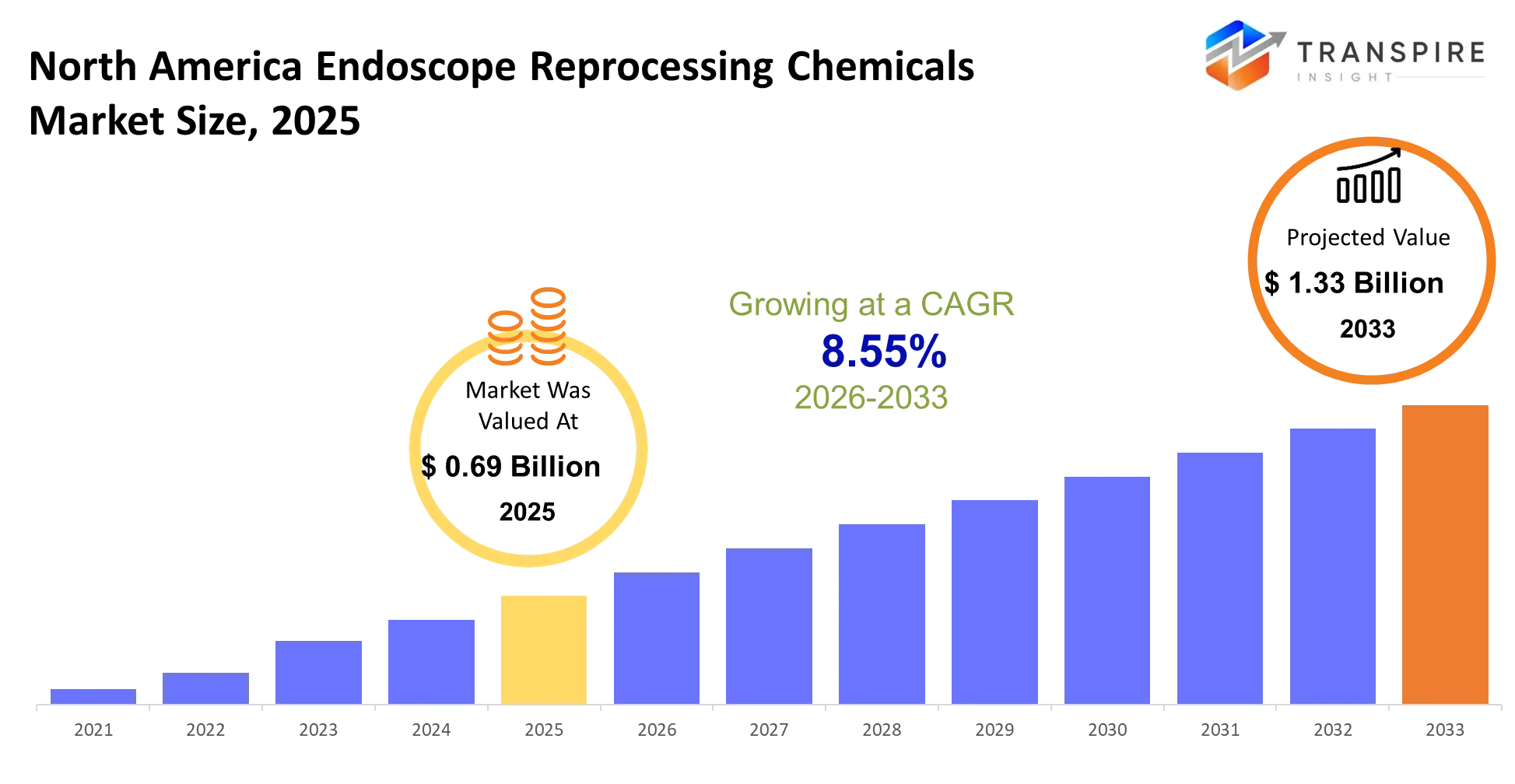
The North America Endoscope Reprocessing Chemicals Market was valued at USD 0.69 Billion in 2025. It is forecast to reach USD 1.33 Billion by 2033. That is a CAGR of 8.55% over the period.
In North American hospitals, endoscope reprocessing chemicals are used to clean and high level disinfect reusable gastrointestinal and respiratory endoscopes after procedures, so there’s less chance of cross contamination between patients. In the last 3–5 years, the market has changed in a more structural way, toward automated endoscope reprocessors and standardized chemistry that’s focused on compatibility, and it’s sort of moving away from mostly manual workflows and the old style glutaraldehyde heavy protocols. One big trigger was more intense attention from FDA safety communications about duodenoscope related infection risks, and that was also backed up by the post COVID infection control push which made hospitals recheck, tighten and document reprocessing validation. At the same time, supply chain hiccups showed how risky it can be to depend on just a short list of disinfectants, and that helped accelerate the shift into peracetic acid systems , plus more stable formulations. Taken together, these pressures lead hospitals to standardize procurement and sort of lock in validated chemical workflows, and that then drives higher recurring consumption per procedure, while also supporting steady growth in revenue for the manufacturers.
Key Market Insights
- U.S. kind of dominates the North America Endoscope Reprocessing Chemicals Market, with about 78% share in 2025,mostly because procedure volumes run high and the compliance expectations are pretty strict, like FDA rules and such.
- Canada is also moving forward at a steady pace, backed by public healthcare spending and infection prevention modernization programs that keep going through 2030.
- Meanwhile Mexico looks like the fastest riser region, pushed by hospital infrastructure improvements, and also a gradual increase in surgical capacity.
- High-level disinfectants account for around 52% of the North America Endoscope Reprocessing Chemicals Market in 2025, as safety requirements are critical.
- Detergents + enzymatic cleaners sit in the second-largest spot, they’re usually the go-to for pre-cleaning the endoscope channels.
- Peracetic acid-based formulations are growing the quickest from 2024–2030, gradually stepping in for older glutaraldehyde solutions, which were used before.
- Gastrointestinal endoscopy takes the biggest slice, nearly 46% share in the North America Endoscope Reprocessing Chemicals Market, mainly tied to the frequent diagnostic workflow.
- Bronchoscopy is the fastest-growing application, with support from rising respiratory disease screening and the post-pandemic push for more diagnostics.
- Hospitals still lead as the main end-user in the North America Endoscope Reprocessing Chemicals Market, about 61% share in 2025.
- Ambulatory surgical centers are the fastest-growing category, since cost efficiency matters a lot and outpatient procedures are rising.
What are the Key Drivers, Restraints, and Opportunities in the North America Endoscope Reprocessing Chemicals Market?
North America Endoscope Reprocessing Chemicals Market is mostly pushed by tighter infection prevention rules and a growing clinical “accountability mood” in endoscopy rooms. Some FDA safety communications tied to duodenoscope contamination events, made hospitals re-check their cleaning practices and switch toward high-level disinfectants that actually show proven efficacy. That kind of regulatory pressure, along with more endoscopic procedure volumes showing up across gastroenterology and pulmonology, keeps speeding up repeat chemical usage cycles. It also helps solidify longer procurement contracts over time. So revenue steadiness has gotten better for companies that provide standardized reprocessing chemistries.
Still, there’s a major restraint, which is the stubborn operational complexity of how endoscope reprocessing gets done. Quite a few hospitals use semi-manual cleaning steps before chemical disinfection, and that can lead to outcome variability. It also ramps up staff training, not in a small way. Because of that, full adoption of advanced automated systems stays slower, especially in mid-tier healthcare facilities where capital budgets are tight, and decision making is less flexible. On top of it all, compliance validation requirements tend to add more minutes to every cycle, which raises cost per cycle too. In the end, throughput gets indirectly limited, and margin expansion becomes harder for providers.
On the opportunity side, integration of automated endoscope reprocessors with digitally traceable chemical dosing systems is starting to look pretty practical. In the U.S., many hospitals are putting money into connected infection control platforms that record chemical usage, cycle validation events, and device tracking details. Early momentum is already visible across large hospital networks, and ambulatory surgical centers that are upgrading to peracetic acid-compatible automated setups.This convergence of automation and data-driven compliance is expected to unlock the next phase of scalable growth in the North America Endoscope Reprocessing Chemicals Market.
What Has the Impact of Artificial Intelligence Been on the North America Endoscope Reprocessing Chemicals Market?
Artificial intelligence, along with advanced digital technologies are, step by step, reshaping scrubber performance systems and the wider marine emission control world, mostly by changing how chemical dosing, compliance tracking, and system efficiency are handled in real time. In day-to-day operations, AI enabled control setups are starting to automate the monitoring of exhaust gas cleaning technology, and they tune chemical injection rates depending on fuel sulfur content, the current load situation, and emission thresholds. This kind of approach cuts down the need for manual presence and makes compliance reporting feel more consistent across different fleets.
Then there’s machine learning, which is being rolled out for predictive maintenance in a very practical way. Sensor signals from pumps, scrubbers, and circulation loops get processed to anticipate fouling behavior, corrosion risks, and component wear, before any failure shows up. In multiple fleet trials, operators have said uptime improves and the number of surprise maintenance events goes down. In many cases, the efficiency gains can land in the double digit range for operational availability, and it also matches better with fuel optimization goals. On top of that, these systems can assist with emissions forecasting too, so ship owners can align routes and engine load profiles to stay within regulatory limits without constantly second-guessing.
Still, adoption isn’t smooth everywhere, since offshore connectivity is often limited. That means real-time data transmission becomes difficult, and cloud based model updates are delayed or reduced. Also, integration costs can be high, and vessel specific calibration is required which slows down scaling, especially for older fleets that have legacy configurations. Even with all that, digital optimization continues to move forward, steadily improving compliance efficiency and trimming operational expenses across marine emission control systems.
Key Market Trends
- After the U.S. Food and Drug Administration contamination alerts for endoscopes, from around 2015 to 2019, many hospitals kinda moved toward stricter high level disinfection procedures, and they also made sure chemical cycles were properly validated.
- At the same time, the use of glutaraldehyde dropped fairly hard, like clinicians went more toward ortho-phthalaldehyde and peracetic acid mixtures, because the reprocessing turnaround can be faster, and the whole thing fits their workflow better
- Later on, more automated endoscope reprocessors got adopted across North America, which helped lock in the chemical exposure times, and it also cut down the messy manual handling variation.
- Then during the COVID-19 stretch, 2020–2021, procedural backlogs sort of piled up, and this boosted demand for rapid high level disinfectants, plus reprocessing chemicals, at a pretty noticeable pace
- In 2021, STERIS ' acquisition of Cantel Medical ended up consolidating leadership in the market, and it also helped bring together disinfectant portfolios, while supporting stronger North American supply chains.
- Around the same period, Ecolab expanded into enzymatic and low-toxicity chemistries, basically responding to the shift in hospital preferences away from harsher aldehyde based disinfectants
- But then supply chain disruptions in 2021–2022 led to intermittent shortages of disinfectant chemicals, so hospitals had to diversify vendors and even swap formulations.
- Also, from about 2018 onward, increased infection prevention scrutiny, plus antimicrobial resistance worries, pushed facilities toward more validated, trackable chemical reprocessing workflows, no longer just “good enough”
- More recently, the rise of single-use endoscopes reduced how much reprocessing chemicals were needed, and that reshaped the demand picture across North American healthcare systems.
North America Endoscope Reprocessing Chemicals Market Segmentation
By Type
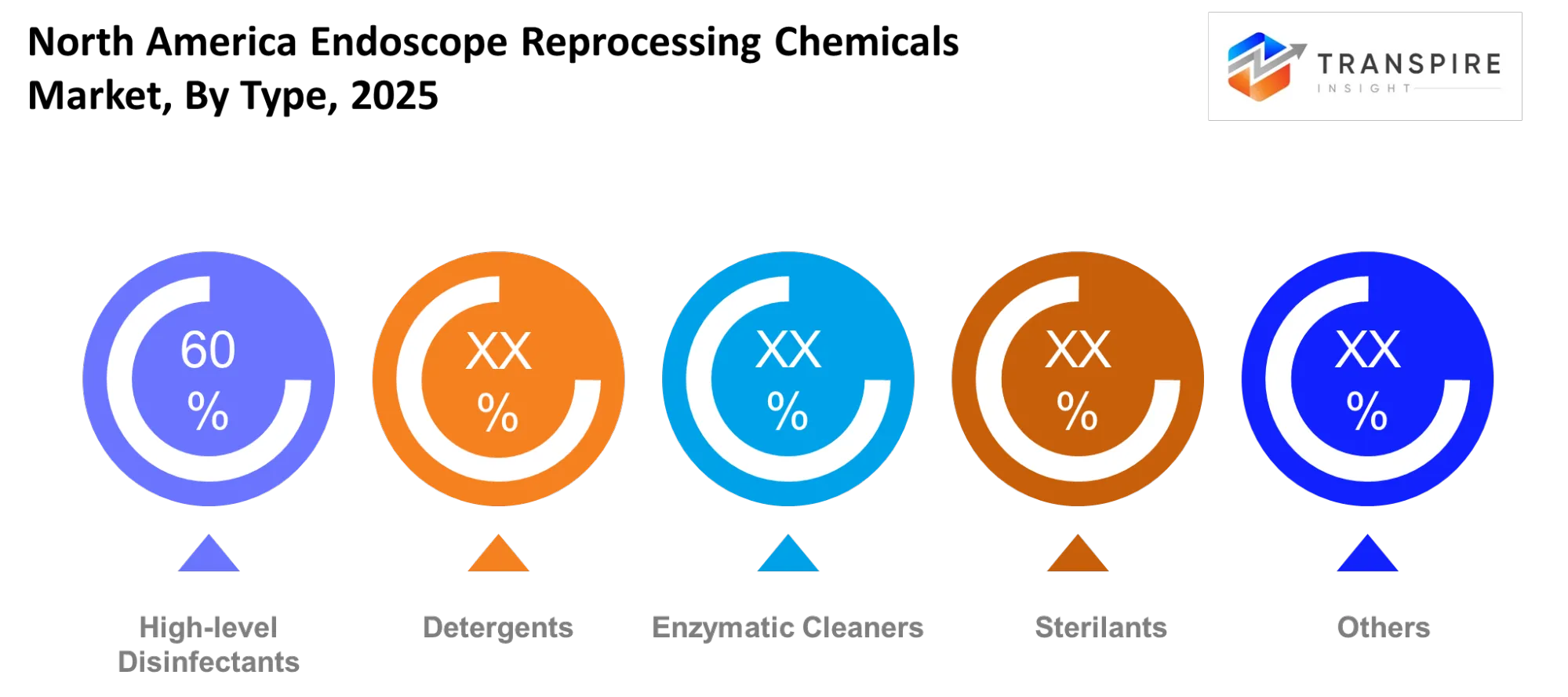
High- level disinfectants keep the strongest position in chemical reprocessing across North American healthcare settings, mainly because they sit right at the center of endoscope decontamination flows that have to work every day. Hospitals and ambulatory centers lean on these solutions heavily, since regulatory expectations from agencies like the FDA and CDC often stress validated microbial kill efficacy, not just “general hygiene”. Their continued dominance also mirrors older clinical protocols where chemical disinfection is preferred over full sterilization for heat-sensitive devices, and yes that preference is pretty entrenched.
Enzymatic cleaners and detergents have also gained momentum, especially as pre-cleaning steps became more strictly enforced following repeated contamination incidents in the early 2010s. These products tackle biofilm removal in ways that high-level disinfectants alone can’t fully handle, so the demand kind of builds up as a supporting step. Sterilants still represent a smaller slice because many delicate instruments don’t tolerate them well, but certain niche surgical uses keep usage steady.
Looking ahead, demand is expected to tilt toward multi-enzyme and lower-toxicity formulations as hospitals try to reduce hazardous chemical exposure risks. Manufacturers will likely push for quicker-action chemistries, the idea is to shorten reprocessing cycles while staying effective. And product differentiation will probably depend more and more on compatibility with automated systems, as well as on how strong the regulatory validation story looks.
To learn more about this report, Download Free Sample Report
By Application
Hospitals account for the largest share of chemical reprocessing usage, largely due to high procedural volumes and very large endoscopy departments. Big inpatient systems need standardized infection control practices and that tends to reinforce consistent procurement of validated disinfectant chemistries. Their dominance also mirrors a kind of centralized purchasing structures where bulk chemical contracts win out, and long term supplier agreements tend to get locked in.
Ambulatory surgical centers have shown quicker growth in chemical consumption too, mainly since outpatient procedures expanded quite a bit after 2018. In these places shorter turnaround times push the need for rapid-acting disinfectants and sort of simplified reprocessing workflows. Clinics and diagnostic labs add a smaller share but still steady demand, usually leaning toward cost efficient and lower-volume usage patterns.
Looking ahead, future growth seems like it will concentrate in outpatient environments, since care keeps shifting away from hospitals and toward decentralized treatment centers. Chemical suppliers will likely need to develop faster-cycle solutions compatible with compact reprocessing units. Procurement strategies will increasingly place greater weight on efficiency, safety compliance, and reduced operational downtime, not just price.
By End User
Healthcare facilities dominate consumption of endoscope reprocessing chemicals because they have integrated infection control departments and relatively high patient throughput. They also maintain strict compliance frameworks that require the continuous use of validated chemical disinfectants across many procedure rooms. Because of that, their buying behavior strongly prefers standardized formulations that lower training complexity, and also reduce operational risk.
Diagnostic centers are becoming a more visible end-user group as preventive screening programs expanded after 2020. These centers aim for consistent microbial safety while still staying sensitive to cost, so they tend to adopt mid-range disinfectant chemistries in a selective way. Other end users, such as specialty clinics, maintain smaller but recurring demand based on procedure specific requirements, and they do it in a more uneven rhythm
Future demand patterns will start to lean toward more decentralized diagnostic settings as early detection programs roll out wider across North America. Supplier teams will probably have to juggle high-efficacy formulations with actual affordability, because many buyers are price sensitive. Also, as regulatory audits keep getting tougher, all end-users will be pushed into using traceable and standardized chemical documentation systems, more and more.
By Form
Liquid formulations currently hold the lead, mostly because they’re easy to apply, they work well with automated reprocessors, and clinicians are already used to them. Hospitals tend to stick with liquid disinfectants because they fit into existing workflows without fuss and reduce preparation errors. This dominance is tied to older purchasing habits too, the kind that often reward ready-to-use solutions.
Concentrates and powder forms have slowly but noticeably gained interest, especially as cost control became a bigger deal after supply chain disruptions in 2021. These formats can cut storage needs and reduce shipping expenses which makes them appealing for large health systems. Still, the risk with dilution, plus prep inconsistencies, keeps them from spreading everywhere, particularly not in smaller facilities where routines are less uniform.
Looking ahead, development will likely emphasize stabilized concentrates that bring safety along with logistical efficiency. Manufacturers are expected to push packaging improvements, to reduce handling errors and help with dosing accuracy. Overall market movement should tilt toward formats that cut total cost of ownership while still meeting strict infection control performance requirements, end of story.
What are the Key Use Cases Driving the North America Endoscope Reprocessing Chemicals Market?
High-volume, flexible endoscope reprocessing in hospital gastroenterology and pulmonology units remains the primary scenario, and it continues to account for the largest share of disinfectants and enzymatic cleaners. The whole thing creates a steady churn of reusable instruments, so strict infection-prevention rules, aligned with FDA and CDC guidance, keep routine high-level disinfection cycles running almost every day.
Meanwhile, ambulatory surgical centers and diagnostic clinics are taking it up more and more, since outpatient endoscopy is growing, particularly around screening colonoscopies, plus a range of minimally invasive diagnostics. In these places, teams tend to prefer faster reprocessing chemistries and rely on automated endoscope reprocessors to keep the day on schedule and reduce downtime between patients.
There are also newer use patterns showing up, like decentralized diagnostic laboratories and mobile endoscopy units that support early detection, especially in rural and underserved areas. At the same time, more single-use validation workflows are getting attention, and some hybrid reprocessing models are gaining traction too, because providers are trying to balance cost efficiency with infection control compliance.
|
Report Metrics |
Details |
|
Market size value in 2025 |
USD 0.69 Billion |
|
Market size value in 2026 |
USD 0.749 Billion |
|
Revenue forecast in 2033 |
USD 1.33 Billion |
|
Growth rate |
CAGR of 8.55% from 2026 to 2033 |
|
Base year |
2025 |
|
Historical data |
2021 - 2024 |
|
Forecast period |
2026 - 2033 |
|
Report coverage |
Revenue forecast, competitive landscape, growth factors, and trends |
|
Regional scope |
North America (Canada, The United States, and Mexico) |
|
Key company profiled |
STERIS, Getinge, 3M, Ecolab, Cantel Medical, ASP, Metrex, Ruhof, Schulke & Mayr, MMM Group, Steelco, Belimed, Olympus, Medivators, Wassenburg |
|
Customization scope |
Free report customization (country, regional & segment scope). Avail customized purchase options to meet your exact research needs. |
|
Report Segmentation |
By Type (High-level Disinfectants, Detergents, Enzymatic Cleaners, Sterilants, Others); By Application (Hospitals, Clinics, Labs, Ambulatory Centers, Others); By End-User (Healthcare Facilities, Diagnostic Centers, Others); By Form (Liquid, Powder, Concentrates, Others) |
Which Regions are Driving the North America Endoscope Reprocessing Chemicals Market Growth?
Asia Pacific basically dominates global maritime activity, because its port systems are very tightly woven together, and also because the export focused manufacturing base stays busy most of the time. Nations like China, Singapore, and South Korea end up having a big edge, since their policy settings really do back high volume shipping, plus customs handling that feels smoother. There is also this large scale port build out, and then the extensive fleet ownership thing, which keeps the region locked into a kind of steady throughput advantage compared with other areas. And you can see an interconnected ecosystem too shipbuilding yards, logistics partners, and even more modern digital port management systems, all of that sort of reinforces the long standing leadership, even when markets wobble a bit.
Europe is still the second-largest contributor, though, and its strength lies more in stability than in raw volume. The regulatory setup, with emissions control requirements, safety standards, and compliance rules, makes operating conditions more predictable for shipowners and operators. On top of that, there are consistent investment streams coming from well established maritime finance hubs, think London, Athens, and Hamburg. So instead of sudden aggressive scaling, Europe does gradual fleet renewal that keeps moving. That mix of strict oversight and mature infrastructure lets Europe maintain a reliable revenue contribution without having to sprint ahead all the time.
Meanwhile the Middle East is showing up as the fastest growing maritime region, mostly due to big port expansion plans. More recent infrastructure efforts in the UAE and Saudi Arabia have shifted the positioning of key hubs right along major trade lanes. Fleet modernization programs, together with new logistics corridor development, are improving capacity and connection faster than before. For investors and people entering the market, this momentum is basically saying there may be meaningful opportunities from 2026 through 2033 as the region grows its maritime footprint, step by step but with serious speed.
Who are the Key Players in the North America Endoscope Reprocessing Chemicals Market and How Do They Compete?
Competition in the North America endoscope reprocessing chemicals market is, sort of, moderately consolidated. You’ve got the big hygiene and sterilization firms holding strong share, while smaller suppliers usually end up in those niche clinical segments. Incumbents tend to defend their positions via validated formulations and long hospital contracts. Day to day competition tends to revolve around cleaning efficacy, device compatibility, plus FDA and EPA compliance.
STERIS drives technology based differentiation, leaning on validated enzymatic detergents and an end-to-end infection prevention workflow for hospital endoscopy units. And when they integrate acquired endoscope reprocessing portfolios, that helps compatibility across devices. It also quietly reinforces switching costs, because changing systems isn’t trivial. Ecolab leans into a service-heavy approach, bundling chemistry programs with hospital hygiene contracts, which basically locks in recurring demand. Metrex keeps attention on niche enzymatic cleaners aimed at rapid manual reprocessing, and they push expansion via distributor networks that reach ambulatory surgical centers.
Getinge emphasizes integrated reprocessing systems that pair washer disinfectors with compatible chemical detergents, and they frame their value around workflow automation inside sterile processing departments. The differentiation here is more about equipment, and chemical alignment, which can reduce cycle variability. Advanced Sterilization Products, on the other hand, focuses on low-temperature sterilisation ecosystems that influence neighboring chemical usage protocols in endoscope reprocessing. They expand through capital equipment placements and long term service agreements with hospital networks.
Company List
- STERIS
- Getinge
- 3M
- Ecolab
- Cantel Medical
- ASP
- Metrex
- Ruhof
- Schulke & Mayr
- MMM Group
- Steelco
- Belimed
- Olympus
- Medivators
- Wassenburg
Recent Development News
“In June 2025, Ecolab advanced its healthcare infection prevention platform by expanding bundled hospital reprocessing service programs that integrate chemical disinfectants with hygiene management systems. The initiative improves hospital compliance with reprocessing protocols by linking chemistry supply with continuous service support across surgical and endoscopy units in North America.https://www.pharmiweb.com
What Strategic Insights Define the Future of the North America Endoscope Reprocessing Chemicals Market?
The North America endoscope reprocessing chemicals market is kinda moving toward tighter tie ins between chemistry , automation and digital compliance systems, even as hospitals keep focusing on consistent infection prevention results. In the next five to seven years , you’ll likely see demand get shaped less by just standalone disinfectant products and more by ecosystem based procurement that links those chemicals with automated reprocessing equipment plus audit ready traceability tools.
A risk that isn’t super obvious is the chance of too much concentration in hospital purchasing, especially when it comes through bundled service contracts. That situation can squeeze supplier margins a bit, and then smaller formulators end up with less room to maneuver because switching costs start to rise.
At the same time, an opportunity is starting to form around next generation low temperature chemistries, which should be compatible with increasingly delicate endoscope designs. There’s also movement toward AI enabled reprocessing validation systems, and regulators are beginning to recognize these approaches.
Market participants, if they want to stay ahead, should prioritize interoperability certification and invest in chemistry formulations that are validated across multiple device platforms. The reason is simple, control over compatibility standards will likely become a real competitive moat as healthcare systems consolidate procurement and tighten up infection control mandates.
North America Endoscope Reprocessing Chemicals Market Report Segmentation
By Type
- High-level Disinfectants
- Detergents
- Enzymatic Cleaners
- Sterilants
- Others
By Application
- Hospitals
- Clinics
- Labs
- Ambulatory Centers
- Others
By End-User
- Healthcare Facilities
- Diagnostic Centers
- Others
By Form
- Liquid
- Powder
- Concentrates
- Others
Frequently Asked Questions
Find quick answers to common questions.
The expected North America Endoscope Reprocessing Chemicals Market size is USD 1.33 Billion in 2033.
Key segments for the North America Endoscope Reprocessing Chemicals Market are By Type (High-level Disinfectants, Detergents, Enzymatic Cleaners, Sterilants, Others); By Application (Hospitals, Clinics, Labs, Ambulatory Centers, Others); By End-User (Healthcare Facilities, Diagnostic Centers, Others); By Form (Liquid, Powder, Concentrates, Others).
Major North America Endoscope Reprocessing Chemicals Market players are STERIS, Getinge, 3M, Ecolab, Cantel Medical, ASP, Metrex, Ruhof, Schulke & Mayr, MMM Group, Steelco, Belimed, Olympus, Medivators, Wassenburg.
The North America Endoscope Reprocessing Chemicals Market size is USD 0.69 Billion in 2025.
The North America Endoscope Reprocessing Chemicals Market CAGR is 8.55% from 2026 to 2033.
- STERIS
- Getinge
- 3M
- Ecolab
- Cantel Medical
- ASP
- Metrex
- Ruhof
- Schulke & Mayr
- MMM Group
- Steelco
- Belimed
- Olympus
- Medivators
- Wassenburg
Recently Published Reports
-
Apr 2026
AI in Diabetic Retinopathy Market
AI in Diabetic Retinopathy Market Size, Share & Analysis Report By Type (Screening AI Systems, Diagnostic AI Systems, and Predictive AI Models), By Application Segment (Hospitals, Ophthalmology Clinics, Diagnostic Centers, and Research and Development), and Geography (North America, Europe, Asia-Pacific, Middle East and Africa, South and Central America), 2021 - 2031
-
Apr 2026
Psychometric Tests Market
Psychometric Tests Market Size, Share & Analysis Report By Type (Personality Tests, Ability/Aptitude Tests, Skill/Knowledge Tests, and Others), By Application (Talent Acquisition and Talent Management), and Geography (North America, Europe, Asia-Pacific, Middle East and Africa, South and Central America), 2021 – 2031
-
Apr 2026
Rare Biological Sample Collection Market
Rare Biological Sample Collection Market Size, Share & Analysis Report By Type (Isolation Kits & Reagent, Blood Collection Tubes, and Others), By Application (Oncology, Transcriptomics, Pharmacogenomics, and Others), and Geography (North America, Europe, Asia-Pacific, Middle East and Africa, South and Central America), 2021 – 2031
-
May 2026
Patient Lift Pendant Market
Patient Lift Pendant Market By Product Type (Wired Pendants, Wireless, Programmable), By Operation Type(Manual, Electric), By End-Users (Healthcare Professionals, Patients), By Application (Hospitals, Homecare, Rehabilitation Centers, Others), By Industry Analysis, Size, Share, Growth, Trends, and Forecasts 2021-2033
Our Clients
.jpg)