

North America DNA Ligases Market Size & Forecast:
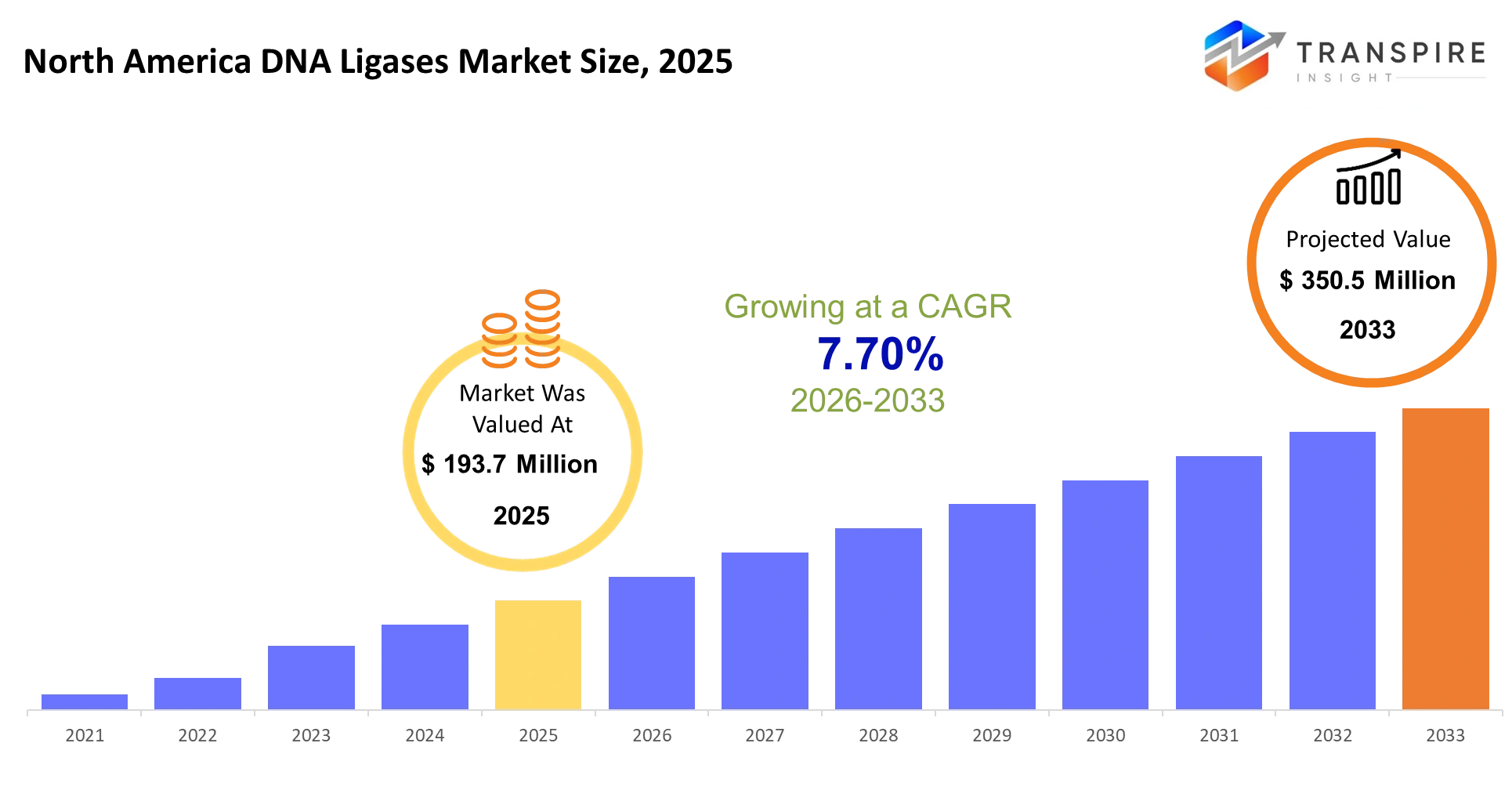
- North America DNA Ligases Market Size 2025: USD 193.7 Million
- North America DNA Ligases Market Size 2033: USD 350.5 Million
- North America DNA Ligases Market CAGR: 7.70%
- North America DNA Ligases Market Segments: By Type (T4 DNA Ligase, Taq DNA Ligase, E. coli DNA Ligase, Others, Thermostable, Recombinant); By Application (Cloning, PCR, Sequencing, Others, Research, Diagnostics); By End-User (Research Institutes, Pharma, Biotech, Others, CROs, Labs); By Product (Kits, Enzymes, Reagents, Others, Tools, Consumables)
To learn more about this report,  Download Free Sample Report
North America DNA Ligases Market Summary:
The North America DNA Ligases Market size is estimated at USD 193.7 Million in 2025 and is anticipated to reach USD 350.5 Million by 2033, growing at a CAGR of 7.70% from 2026 to 2033.
The North America DNA Ligases Market exists as an independent part of the biotechnology and life sciences market which develops through research needs and clinical breakthroughs. The market depends on how laboratories respond to increasing demand for quick gene assembly solutions and dependable sequencing operations and affordable research methods.
The demand will come from academic laboratories and diagnostic companies and synthetic biology companies which need enzymes that maintain their performance under different testing conditions. Customers will evaluate products based on their ability to maintain quality during storage and work with automated systems which handle repetitive tasks in laboratories instead of using base pricing as their main consideration.
Engineers will develop new methods to create and apply these enzymes because engineered versions of the enzymes will produce better ligation results with fewer errors. North America will experience heightened regulatory scrutiny for reagent quality and its traceability and reproducibility requirements especially in clinical and therapeutic applications.
The advancement of user expectations will require suppliers to deliver complete kits which include ready-to-use formats and integrated systems that minimize their setup requirements. The market will demand personalized medical solutions according to research trends which focus on gene editing and personalized medicine which need customized solutions instead of standard solutions.
What Has the Impact of Artificial Intelligence Been on the North America DNA Ligases Market?
The North American DNA Ligases Market now undergoes transformation because artificial intelligence technologies create new competitive advantages which help businesses make better decisions while they develop products throughout their entire operational process. The North American DNA Ligases Market applications of artificial intelligence enable businesses to analyze complex genomic datasets through real-time analytics and advanced data mining techniques. The implementation of machine learning algorithms into market research operations enables stakeholders to acquire better understanding of customer patterns and new market developments which results in more effective planning and investment strategies.
The use of artificial intelligence technology through North America DNA Ligases Market operations has transformed demand prediction methods and trend analysis capabilities. The predictive analytics tools use historical sales data together with research and development activities and healthcare demand patterns to forecast future DNA ligase requirements in diagnostics and biotechnology applications.
The capability enables manufacturers to synchronize their production schedules with actual market requirements while decreasing inventory risks and enhancing their logistical operations. The production system benefits from smart automation because it reduces human errors and enhances enzyme production efficiency while maintaining high product standards which are essential for life sciences applications that require precise results.
Artificial intelligence methods for supply chain optimization achieve two benefits which include decreased operational expenses and enhanced responsiveness throughout the North America DNA Ligases Market. The intelligent systems of the organization improve procurement processes and distribution operations by detecting process problems and suggesting budget-friendly solutions.
AI generates customized enzyme solutions which researchers and clinical professionals can use to develop specific solutions for their research and clinical needs. The increased level of customization that companies offer their products enables them to gain a competitive edge because they can quickly adapt to scientific progress while maintaining their presence in the data-oriented market.
Key Market Trends & Insights:
- The United States DNA ligases market in North America is controlled by American companies who hold more than 75% of the market share in 2024 because of their advanced biotech capabilities.
- The fastest-growing area in Canada will experience a compound annual growth rate above 7% from 2025 to 2030 because of rising research funding and genomic research programs.
- T4 DNA ligase dominates with nearly 45% share in 2024, owing to widespread use in cloning and sequencing workflows.
- The second largest market share in thermostable DNA ligases exists because of their application in PCR-based processes and their improved enzyme performance.
- The built ligases segment represents the highest growth potential because the market requires precise molecular measurement instruments which will drive expansion until 2030.
- The market will be led by molecular cloning which holds a 40% market share in 2024 because genetic engineering research continues to grow.
- The adoption of next-generation sequencing (NGS) in clinical diagnostics and personalized medicine drives its status as the fastest-expanding application.
- Biotechnology and pharmaceutical companies control approximately 50% market share because they invest heavily in research and development combined with their drug discovery efforts.
- The academic and research institutes market segment represents the highest growth potential because government funding and collaborative research programs work together to support this segment.
- The north america DNA ligases market features major players which include Thermo Fisher Scientific and New England Biolabs and Merck KGaA and Promega Corporation and Agilent Technologies.
North America DNA Ligases Market Segmentation
By Type :
Scientists prefer T4 DNA ligase because it effectively connects DNA fragments that have cohesive and blunt ends which scientists use for cloning and recombinant DNA experiments. Taq DNA ligase gains importance for high-temperature testing because it helps scientists find mutations in their samples. E. coli DNA ligase provides essential repair capabilities whereas thermostable and recombinant variants enable usage in complex molecular research techniques.
Scientists require accurate DNA manipulation equipment which they need for laboratory activities according to their research results. The demand for products increases because synthetic biology and gene editing techniques continue to expand. The regulated environments receive support from recombinant ligases which maintain their operational performance and product quality. The research and diagnostic fields adopt new technologies because scientists keep improving enzyme stability and reaction speed.
By Application :
Cloning remains a central application, as DNA ligases enable fragment insertion into vectors with accuracy. The polymerase chain reaction (PCR) procedure works better when researchers use ligase to identify mutations and improve their results. Sequencing workflows depend on ligases to complete library preparation because they maintain fragment continuity. Research and diagnostics further drive usage across genetic analysis and disease identification processes.
The ligase-supported workflows will increase their usage because genomic studies and personalized medicine initiatives continue to grow. Diagnostic laboratories use ligase-based assays to identify genetic variations and detect pathogens. Research environments maintain steady demand because researchers conduct experiments on a continuous basis. The various applications of the product create a consistent demand pattern which academic institutions and clinical facilities and commercial laboratories use but they do not rely on one specific market segment.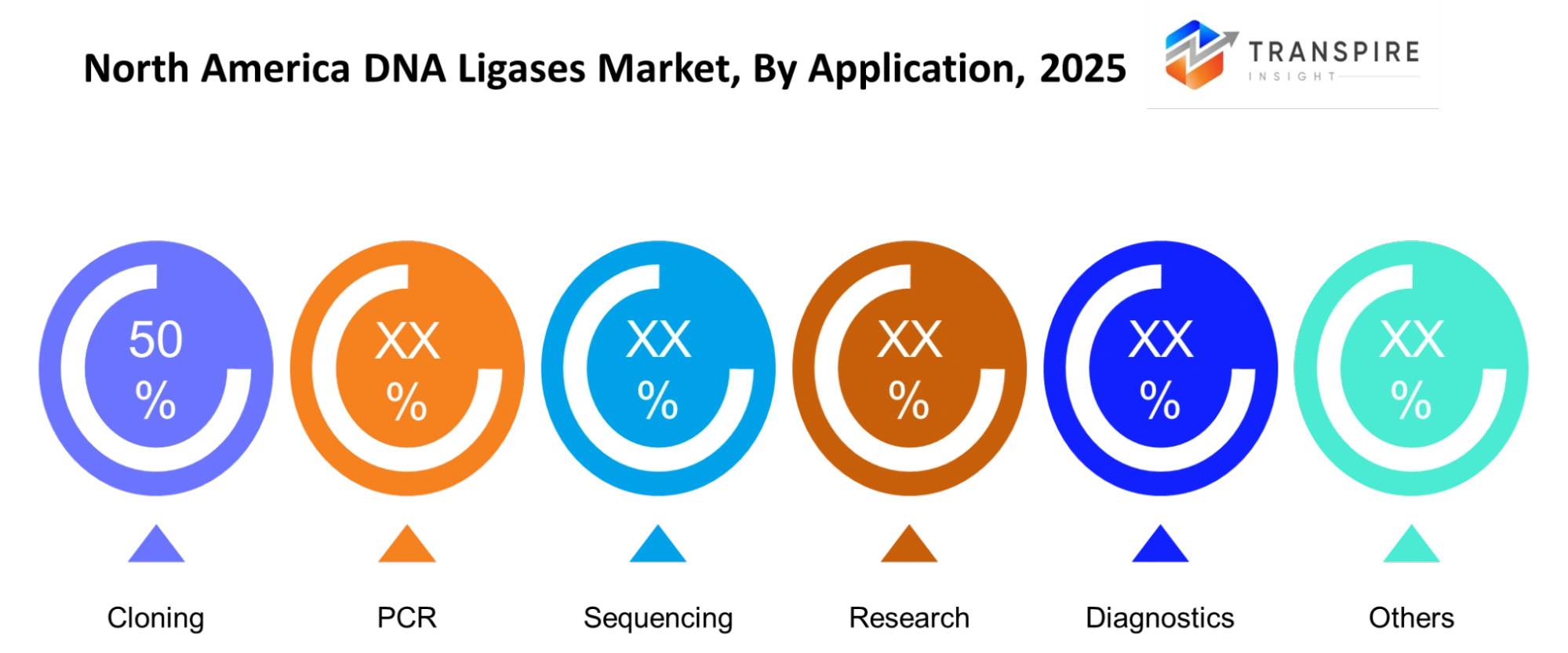
To learn more about this report, Download Free Sample Report
By End-User :
Research institutes form a primary user base because they conduct academic studies and government-funded projects which study genetics and molecular biology. Pharmaceutical and biotechnology companies use DNA ligases to support their processes of drug discovery, vaccine development and gene therapy. The research operations of CROs and independent laboratories will grow because they provide support for outsourced research activities.
The growing partnerships between academic institutions and commercial companies will lead to increased demand from all customer segments. Pharmaceutical pipelines need exact molecular tools which help them maintain steady enzyme usage. CROs use outsourcing to manage their various testing needs. The laboratory growth in North America will create ongoing demand for ligases which will be used in both common and advanced laboratory procedures.
By Product :
Enzymes represent the core product category, supported by consistent demand for ligase activity in molecular workflows. The kits provide ready-to-use solutions which enable laboratories to conduct experiments without needing to develop their own procedures. The laboratory activities require both reagents and consumables which enable scientists to perform their research without interruptions. The laboratory equipment enables scientists to use enzymes through its various integrated systems.
The company develops new products which provide easy handling and maintain their stability while working with automated systems. The kits become more popular because they require less time to prepare and they decrease the chances of making mistakes. The laboratory needs for daily operations create ongoing demand for consumable products which laboratories need to use. Molecular biology workflows require core enzymes together with additional materials which need to be balanced through development across all product areas.
What are the Main Challenges for the North America DNA Ligases Market Growth?
The north america dna ligases market faces multiple technical and operational obstacles which disrupt both performance stability and system scalability. The stability of the enzyme remains a vital issue because DNA ligases demonstrate extreme sensitivity to both temperature and storage conditions which leads to potential workflow interruptions in intricate processes.
The different ligation efficiency results which occur with different substrates prevent advanced genomic research from achieving its full potential. The north america dna ligases market experiences production delays because supply chain problems which affect high-purity reagents and raw materials create production bottlenecks that increase operational hazards.
The north america dna ligases market needs to overcome manufacturing and commercialization obstacles which prevent its expansion. The production of high-quality ligases mandates manufacturers to follow Good Manufacturing Practices (GMP) which results in increased operational expenses and operational complexity.
The validation and regulatory compliance processes create product approval delays which particularly affect clinical-grade enzymes that diagnostic tests require. The high R&D costs together with cost pressures lead to decreased profit margins which create entry obstacles for smaller organizations thus establishing primary growth obstacles for the northern american dna ligases industry.
The process of adopting new technologies brings about major difficulties which hinder the expansion of their operations. Research facilities face budget limitations which prevent them from using advanced ligase technologies. The adoption process experiences delays because small institutions lack enough trained experts who understand molecular biology methods.
The north america dna ligases market faces market restrictions because the region lacks essential infrastructure needed to conduct large-scale genomics research projects. Competitive pressure from alternative technologies, such as polymerase-based assembly methods and CRISPR-based tools, poses additional risks. The north america dna ligases market faces ongoing challenges because competitors use pricing strategies while technological progress maintains its current pace.
Country Insights
The North America DNA Ligases Market experiences continuous expansion because of two factors which include rising biotechnology research and increasing need for advanced genetic tools and increasing life sciences funding. Research and diagnostic work depends on DNA ligases which academic institutes and pharmaceutical companies use to perform cloning and sequencing tasks.
The United States DNA Ligases Market leads the North American market because it has developed strong research facilities and spends heavily on healthcare and maintains continuous genomic research advancements. The Canadian government funds research programs which support industry-academia partnerships between universities and biotech companies to develop molecular biology tools, thus driving market growth.
The public-private partnerships during product development process lead to improved product development and marketing of new products according to the Regional Insights report. The North America DNA Ligases Market maintains its growth because of specialized personnel and state-of-the-art research facilities which exist throughout the region while research activities receive backing from regulatory bodies that facilitate steady funding and advancements in this sector.
Recent Development News
In March 2026, Merck KGaA strengthened its North American life sciences portfolio through continued investment in enzyme-based reagent supply. The move supports increasing demand for ligase enzymes used in diagnostics and pharmaceutical R&D applications.Source https://www.merckgroup.com/
In April 2026, Thermo Fisher Scientific reported strong quarterly performance driven by demand for molecular biology reagents. The company highlighted increased sales of enzyme-based kits, including DNA ligases, supported by growth in genomics and biopharma research across North America.Source https://www.thermofisher.com/
|
Report Metrics |
Details |
|
Market size value in 2025 |
USD 193.7 Million |
|
Market size value in 2026 |
USD 208.6 Million |
|
Revenue forecast in 2033 |
USD 350.5 Million |
|
Growth rate |
CAGR of 7.70% from 2026 to 2033 |
|
Base year |
2025 |
|
Historical data |
2021 - 2024 |
|
Forecast period |
2026 - 2033 |
|
Report coverage |
Revenue forecast, competitive landscape, growth factors, and trends |
|
Regional scope |
North America (Canada, The United States, and Mexico) |
|
Key company profiled |
Thermo Fisher, New England Biolabs, Merck, Promega, Takara Bio, Qiagen, Agilent, Bio-Rad, Illumina, Danaher, GenScript, LGC Biosearch, Eurofins, Enzo Life Sciences, Abcam |
|
Customization scope |
Free report customization (country, regional & segment scope). Avail customized purchase options to meet your exact research needs. |
|
Report Segmentation |
By Type (T4 DNA Ligase, Taq DNA Ligase, E. coli DNA Ligase, Others, Thermostable, Recombinant); By Application (Cloning, PCR, Sequencing, Others, Research, Diagnostics); By End-User (Research Institutes, Pharma, Biotech, Others, CROs, Labs); By Product (Kits, Enzymes, Reagents, Others, Tools, Consumables) |
How Can New Companies Establish a Strong Foothold in the North America DNA Ligases Market?
New entrants can build a strong position in the north america dna ligases market by targeting specialized niches that have unmet needs through their development of high-fidelity ligases for next-generation sequencing and point-of-care diagnostics optimized enzymes. Startups can solve essential healthcare and biotechnology problems by developing new enzyme stability solutions which enhance ligation effectiveness and improve advanced genomic workflow compatibility. Companies develop products according to industry trends which include precision medicine and fast diagnostics to gain initial market presence while establishing their unique identity in the north america dna ligases market.
Strategic partnerships are essential for accelerating market entry and credibility. The emerging players use partnerships with academic institutions and contract research organizations and biotech firms to validate their technologies while building their distribution capabilities. North america dna ligases market positioning can be enhanced through technology differentiation which includes AI-powered enzyme design and intelligent production automation. Startups such as “LigaseX Bio” and “GeneSwift Technologies” demonstrate through their work that machine learning enables them to develop ligases which achieve greater precision and shorter reaction times.
The growth of new companies requires them to establish two essential capabilities which include making their production processes expandable and their operations ready for regulatory compliance. The establishment of production facilities which meet legal requirements should begin at an early stage because this investment leads to reduced costs and enables businesses to achieve their commercialization targets.
The provision of personalized solutions that meet specific research and clinical needs will improve customer retention while creating lasting business value for the company. Niche targeting with collaborative expansion and continuous innovation enables companies to successfully address market growth challenges which helps them build permanent market presence in the north america dna ligases market.
Key North America DNA Ligases Market Company Insights
The North American DNA Ligases Market will experience continuous development because research laboratories and biotechnology companies need more molecular biology equipment. The genetic research field will see increased adoption because of academic institutions and clinical laboratories who will use genetic testing for their sequencing and cloning work. T
he competitive analysis will show established biotechnology companies together with new companies which develop specific enzyme products. The competition will be determined through product development and pricing methods and research organization partnerships. The market players will develop better enzyme performance and durability to enhance their market position while they pursue growing demand in the healthcare and research fields.
Company List
- Thermo Fisher
- New England Biolabs
- Merck
- Promega
- Takara Bio
- Qiagen
- Agilent
- Bio-Rad
- Illumina
- Danaher
- GenScript
- LGC Biosearch
- Eurofins
- Enzo Life Sciences
- Abcam
What are the Key Use-Cases Driving the Growth of North America DNA Ligases Market?
The North America DNA ligases market is growing quickly because molecular cloning requires DNA ligases as its most essential biotechnology and pharmaceutical research application. DNA ligases enable scientists to join DNA segments through precise methods which they use for gene creation and recombinant DNA work and protein development. Companies expand their genomic research and therapeutic development operations which leads to market expansion of this application that serves drug discovery pipelines and biologics creation processes.
The North America DNA ligases market experiences growth because more people adopt next-generation sequencing (NGS) and advanced diagnostic technologies. DNA ligases serve as essential components for library creation and mutation confirmation processes which researchers use to study oncology and infectious diseases. The rise of precision medicine drives an increasing need for precise and rapid ligation methods which establishes DNA ligases as vital components for clinical diagnostics and personalized treatment methods.
The North America DNA ligases market has multiple advantages because its products find use in both the healthcare sector and synthetic biology and industrial biotechnology applications. Scientists utilize DNA ligases to create genetically modified organisms which they use for biofuel production and agricultural development and enzyme production.
The combination of CRISPR-based editing systems and automated laboratory equipment enables scientists to conduct research more efficiently while developing new scientific methods. The diverse high-impact use cases of DNA ligases market in North America lead to continuous market growth which will sustain technology-driven expansion throughout the industry.
North America DNA Ligases Market Report Segmentation
By Type
- T4 DNA Ligase
- Taq DNA Ligase
- E. coli DNA Ligase
- Thermostable
- Recombinant
By Application
- Cloning
- PCR
- Sequencing
- Research
- Diagnostics
By End-User
- Research Institutes
- Pharma
- Biotech
- CROs
- Labs
By Product
- Kits
- Enzymes
- Reagents
- Tools
- Consumables
Frequently Asked Questions
Find quick answers to common questions.
The Approximate North America DNA Ligases Market size for the Market will be USD 350.5 Million in 2033.
Key Segments for the North America DNA Ligases Market are By Type (T4 DNA Ligase, Taq DNA Ligase, E. coli DNA Ligase, Others, Thermostable, Recombinant); By Application (Cloning, PCR, Sequencing, Others, Research, Diagnostics); By End-User (Research Institutes, Pharma, Biotech, Others, CROs, Labs); By Product (Kits, Enzymes, Reagents, Others, Tools, Consumables).
Major North America DNA Ligases Market Players are Thermo Fisher, New England Biolabs, Merck, Promega, Takara Bio, Qiagen, Agilent, Bio-Rad, Illumina, Danaher, GenScript, LGC Biosearch, Eurofins, Enzo Life Sciences, Abcam.
The Current North America DNA Ligases Market size is USD 193.7 Million in 2025.
The North America DNA Ligases Market CAGR is 7.70%.
- Thermo Fisher
- New England Biolabs
- Merck
- Promega
- Takara Bio
- Qiagen
- Agilent
- Bio-Rad
- Illumina
- Danaher
- GenScript
- LGC Biosearch
- Eurofins
- Enzo Life Sciences
- Abcam
Recently Published Reports
-
Apr 2026
Cord Blood Banking Services Market
Cord Blood Banking Services Market Size, Share & Analysis Report By Type of Service (Collection, Processing, Storage), By Bank Type (Private Banks, Public Banks, and Hybrid Banks), By Component (Cord Blood, and Cord Tissue), By End User (Hospitals, Research Institutions, Biotechnology Companies, and Others) and Geography (North America, Europe, Asia-Pacific, Middle East and Africa, South and Central America), 2021 - 2031
-
Apr 2026
ELISA Processors Market
ELISA Processors Market Size, Share & Analysis Report By Type (Optical Filter ELISA Analyzer, and Optical Grating ELISA Analyzers), By Mode (Automated ELISA Analyzers, and Semi-Automated ELISA Analyzers), By Applications (Immunology, Vaccine development, Drug Monitoring, and Others), By End Users (Biotechnology Companies, Pharmaceutical Companies, Contract Research Organization, and Diagnostic Laboratories) and Geography (North America, Europe, Asia-Pacific, Middle East and Africa, South and Central America), 2021 - 2031
-
Apr 2026
Microscope Slide Scanner Market
Microscope Slide Scanner Market Size, Share & Analysis Report By Type (Portable Microscope Slide Scanner, and Desktop Microscope Slide Scanner), By Application (Biological Research, Medicine, Veterinary, and Other) and Geography (North America, Europe, Asia-Pacific, Middle East and Africa, South and Central America), 2021 - 2031
-
Apr 2026
Microwave Cookware Market
Microwave Cookware Market Size, Share & Analysis Report By Material Type (Plastic, Glass, Ceramic, Silicone, and Metal), By Application (Cooking, Reheating, and Defrosting), By End User (Household, Commercial (Restaurants, Hotels, and Cafes), and Food Service Industry), By Sales Channel (Online Retail, Offline Retail (Supermarkets, Hypermarkets, Specialty Stores), and Direct Sales (Company Outlets)) and Geography (North America, Europe, Asia-Pacific, Middle East and Africa, South and Central America), 2021 - 2031