

North America Dental Turbines Market Size & Forecast:
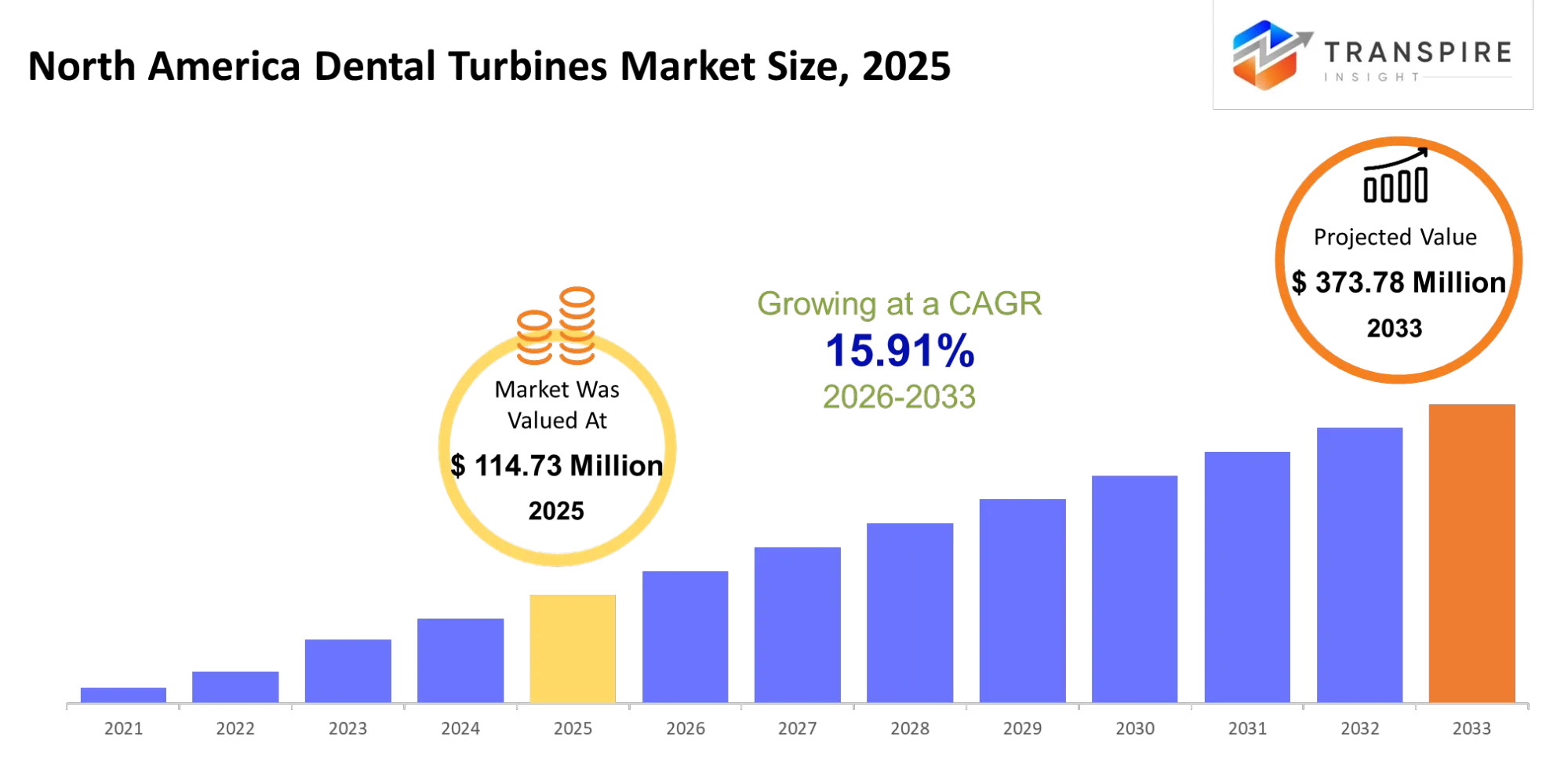
- North America Dental Turbines Market Size 2025: USD 114.73 Million
- North America Dental Turbines Market Size 2033: USD 373.78 Million
- North America Dental Turbines Market CAGR: 15.91%
- North America Dental Turbines Market Segments: By Product Type (Air-driven Turbines, Electric Turbines, Fiber-optic Turbines, Others), By Application (Restorative Dentistry, Orthodontics, Endodontics, Oral Surgery, Others), By End User (Dental Clinics, Hospitals, Academic Institutes, Others), By Speed Range (High-speed Turbines, Low-speed Turbines, Others).
To learn more about this report,  Download Free Sample Report
North America Dental Turbines Market Summary:
The North America Dental Turbines Market size is estimated at USD 114.73 Million in 2025 and is anticipated to reach USD 373.78 Million by 2033, growing at a CAGR of 15.91% from 2026 to 2033.The North America Dental Turbines Market backs one of the most frequently used tools in modern dentistry: high-speed handpieces that help enable precise cutting shaping and, removal of tooth structure, during restorative cosmetic and surgical work. These devices affect treatment pace, clinical accuracy, and also patient throughput in a real-world sense, so they become a big component of day to day dental practice operations.
In the last three to five years, the market has been kind of shifting structurally toward ergonomically designed, quieter turbine systems, and more digitally integrated setups. The idea is better practitioner control while still aligning with dental workflows that are increasingly technology-enabled. Meanwhile, the disruption of global medical device supply chains, during and after the COVID-19 pandemic, made procurement weak points easier to see. Because of that, clinics and distributors began to lean more heavily on equipment reliability and on supplier diversification, not just price.
So current market expansion is not only about more procedure volume. Dental providers are also investing in advanced turbines to reduce chair time, sharpen treatment precision, and improve operational efficiency. As private dental networks keep expanding and clinics update their equipment fleets, the uptake of premium turbines is leading to higher equipment spending. It also opens up recurring aftermarket revenue opportunities across the region, and this is noticeable in multiple markets at once.
Key Market Insights
- The United States sort of dominates the North America Dental Turbines Market, it pulls in over 75% of regional revenue in 2024 , mainly because it has an extensive dental infrastructure that keeps getting upgraded.
- Canada sits in second place, backed by rising adoption of advanced dental technologies and solid healthcare expenditure that keeps clinics well supplied.
- Mexico is the fastest-growing regional market over the forecast period, largely pushed by expanding private dental networks ,and also dental tourism activities that bring in extra demand.
- Air-driven dental turbines lead the market, taking roughly 60% of market share in 2024 , largely tied to affordability and how commonly they’re used in everyday clinical workflows.
- Electric dental turbines have the second-largest share, mainly because they deliver stronger torque control and more steady operational performance through long use cycles.
- High-speed premium turbine systems are the fastest-growing segment from 2025–2032 as clinics chase procedural efficiency, and also precision dentistry, without delays.
- For applications, restorative dentistry is the clear dominant one, accounting for almost 45% of total demand , due to the sheer volume of procedures across North America.
- Cosmetic dentistry is growing the quickest, supported by higher consumer spending on aesthetic dental treatments, which is getting more normalized year over year.
- More and more advanced turbines are being used for implantology procedures, that is creating emerging demand across specialized dental practices.
- Dental clinics are the top end-user group, they contribute more than 65% of market revenue in 2024 , because equipment replacement cycles never really stop.
- Dental hospitals and specialty centers take a meaningful share too, driven by complex surgical work, and also restorative procedures that need stronger performance.
What are the Key Drivers, Restraints, and Opportunities in the North America Dental Turbines Market?
The most robust growth driver in the North America Dental Turbines Market is really the continuing modernization of dental practices, sort of through digital dentistry, even if people say it in different ways. You can see it in how more clinics are taking up CAD/CAM systems digital imaging platforms, plus chairside restorative workflows. Because of all that, the demand for high-performance turbine handpieces has jumped, mainly since they can deliver more precision and those shorter procedure times everyone wants. This tech move didn’t happen slowly, it was sped up by stronger competition among dental service organizations and multi-clinic networks that are chasing higher patient throughput, and also better operational efficiency. So when practices invest in more advanced treatment capabilities, they tend to upgrade their turbine systems too, which basically opens a direct revenue channel for premium equipment manufacturers and also for aftermarket service providers.
Meanwhile, the biggest market brake is the high total ownership cost that comes with advanced dental turbines. It is not only the upfront purchase price. Clinics also have to plan for maintenance and sterilization compliance, repairs, and then periodic replacement of key components. And that’s sort of structural, because most reimbursement models do not compensate in a direct way for equipment upgrades. So the return-on-investment math becomes tricky, especially for smaller practices. As a consequence, a lot of independent clinics keep their devices in service longer, meaning equipment replacement cycles get stretched out. That delays adoption, and it also reduces the overall market revenue potential.
A big future chance is in how corporate dental service organizations are expanding across North America. In recent years these groups tend to standardize the buying of equipment across many sites, so manufacturers can tap into large volume purchasing. Then if you add smart turbines with predictive maintenance features and also digital workflow connectivity, that could really speed up fleet wide upgrades. Especially for dental networks that are growing fast and want more operational uniformity, plus less downtime, well, in practice.
What Has the Impact of Artificial Intelligence Been on the North America Dental Turbines Market?
Artificial intelligence along with advanced digital technologies is slowly reshaping the North America Dental Turbines Market, mostly by making equipment management a lot smoother, pushing clinical workflow efficiency forward, and improving how assets actually perform day to day. Newer dental turbine systems often include sensors that watch things like rotational speed, temperature, vibration levels and operating hours. Then AI-enabled software can do this sort of automatic tracking of equipment usage, maintenance timelines, and sterilization cycles, which cuts down admin burden, and also helps clinics stay aligned with infection-control requirements.
On top of that, machine learning models are being used for predictive maintenance in a more practical way. When these tools pull in performance data from the connected handpieces, they can catch early hints of bearing wear, unusual airflow curves, or slow component decline before anything actually fully breaks, so clinics usually see fewer surprise outages. Also, it gives a longer usable equipment lifespan and generally less in repair expenses, which feels like a pretty solid win overall. Larger dental service organizations are especially curious about this, since they oversee equipment fleets across multiple locations, and they need operations to stay consistent, even when conditions change.
There is also the digital side of it, like how integration with practice management software and connected treatment platforms helps bump up asset utilization and scheduling efficiency. The end effect is usually higher equipment uptime, fewer interruptions during appointments, and maintenance spending that feels more predictable, rather than reactive.
Still, AI adoption is not fully flowing everywhere because integration costs can be high and historical performance datasets are often limited. A lot of independent dental practices run older, legacy equipment, that does not have real connectivity, so it becomes hard to collect the high-quality data needed for reliable predictive analytics and more advanced performance tuning.
Key Market Trends
- Since 2020, dental practices have kind of moved away from just shopping based on cost, and toward premium turbine systems that cut procedure times while also upping clinical precision, you know a bit more consistent.
- From 2021 into 2025 adoption of electric dental turbines climbed, because practitioners wanted more torque consistency for restorative work and implant procedures.
- Big manufacturers like Dentsply Sirona KaVo NSK and W&H also kept expanding their digital-ready lines, basically to fit connected dental workflows that are used day to day.
- After the pandemic, supply chain problems kept showing up, so clinics started diversifying suppliers, and they maintained bigger inventories for the turbine replacement parts that seem critical.
- Then, multi site dental service organizations ramped up procurement standardization after 2021, which helped bulk purchasing agreements move faster and pushed equipment fleet modernization programs along.
- Noise reduction became a much more serious buying factor, and manufacturers started rolling out quieter turbine designs to make patient comfort better, and also to improve the overall practitioner experience.
- Preventive maintenance strategies also changed, since clinics began adopting sensor enabled equipment tracking more often, in order to reduce the surprise failures and the service interruptions.
- And honestly integration between CAD/CAM systems and chairside treatment workflows is now steering turbine choices more than it did five years ago.
- On top of that, infection-control requirements got stricter, so clinics leaned toward handpieces with stronger sterilization durability and designs meant to prevent contamination better.
- Overall, competition shifted too, not only toward product durability but also toward ergonomics, digital compatibility, maintenance efficiency, and the long term ownership value.
North America Dental Turbines Market Segmentation
By Product Type
By product type , air-driven turbines are still kind of taking the lead in the market, mainly because they’re broadly accepted across general dentistry, plus the lower acquisition cost, and they also work with the clinic setup people already have. Lots of independent practices end up sticking with air-driven systems since the replacement and servicing expenses stay pretty reasonable. Electric turbines are sitting in the second-largest segment, and they’re steadily moving upward as clinicians start asking for better torque stability, tighter precision control, and more reliable cutting performance when procedures get complicated during restorative work.
Fiber-optic turbines have also carved out a solid role in premium treatment settings, where improved visibility helps procedural accuracy, or at least that’s what clinics tend to value in practice. There are also other specialized turbine categories that handle specific clinical needs, but they only add a smaller slice to total revenue overall. Looking ahead, growth should tilt more toward more technologically advanced electrical and fiber optic systems, as digital dentistry keeps getting folded into everyday workflows. The manufacturers that manage to blend ergonomic design, connection features and long term dependability will probably strengthen their competitive position. And meanwhile buyers are increasingly judging products by lifecycle worth rather than just the upfront purchase price.
To learn more about this report, Download Free Sample Report
By Application
By application, restorative dentistry keeps feeling like the dominant segment, mainly because things like fillings, crown work, and cavity preparation take up a big portion of everyday dental time. People show up consistently and treatments tend to repeat,so turbine equipment gets used a lot here. Orthodontics and endodontics still hold solid ground in the market, yet turbine usage in those areas can be more niche, and more tied to particular steps in the procedure.
Oral surgery looks like a notable growth area too, since implant placement, plus more advanced surgical interventions, are becoming more common in private practices and specialty centers. The rest of the applications add extra pull through preventive care, and cosmetic oriented procedures as well. You can see different growth patterns forming as advanced treatment planning technologies get used more often, and these tools depend on handpiece performance that is both precise and dependable. What comes next will probably revolve around applications where procedural accuracy matters even more, so manufacturers have a reason to build turbines tuned for specialized clinic workflows and the newer treatment approaches that keep emerging.
By End-User
By end user, dental clinics have the biggest share because most common, along with the more specialized dental procedures, tend to happen in private practice environments, kinda. The steady cycle of swapping out equipment, plus the expansion of corporate dental networks and the continued push toward better treatment efficiency, all keep this segment in the lead. Hospitals come in next, and it makes sense, since complex oral surgery and multidisciplinary care settings need the kind of advanced equipment that can cover a wide range of procedures.
Academic institutes are smaller, but still matter in a quieter way, they support training programs, clinical research, and technology evaluation activities, so they influence what gets adopted later. Other end users include community health facilities and focused treatment centers that still need dependable turbine systems for day by day operations, consistently. Demand also shifts between these groups, larger organizations usually lean toward standardization plus service agreements, while smaller facilities often care more about acquisition costs, upfront. Going forward, market growth will likely be shaped by consolidation among dental service organizations, which creates larger procurement opportunities and helps drive adoption of premium equipment platforms.
By Speed Range
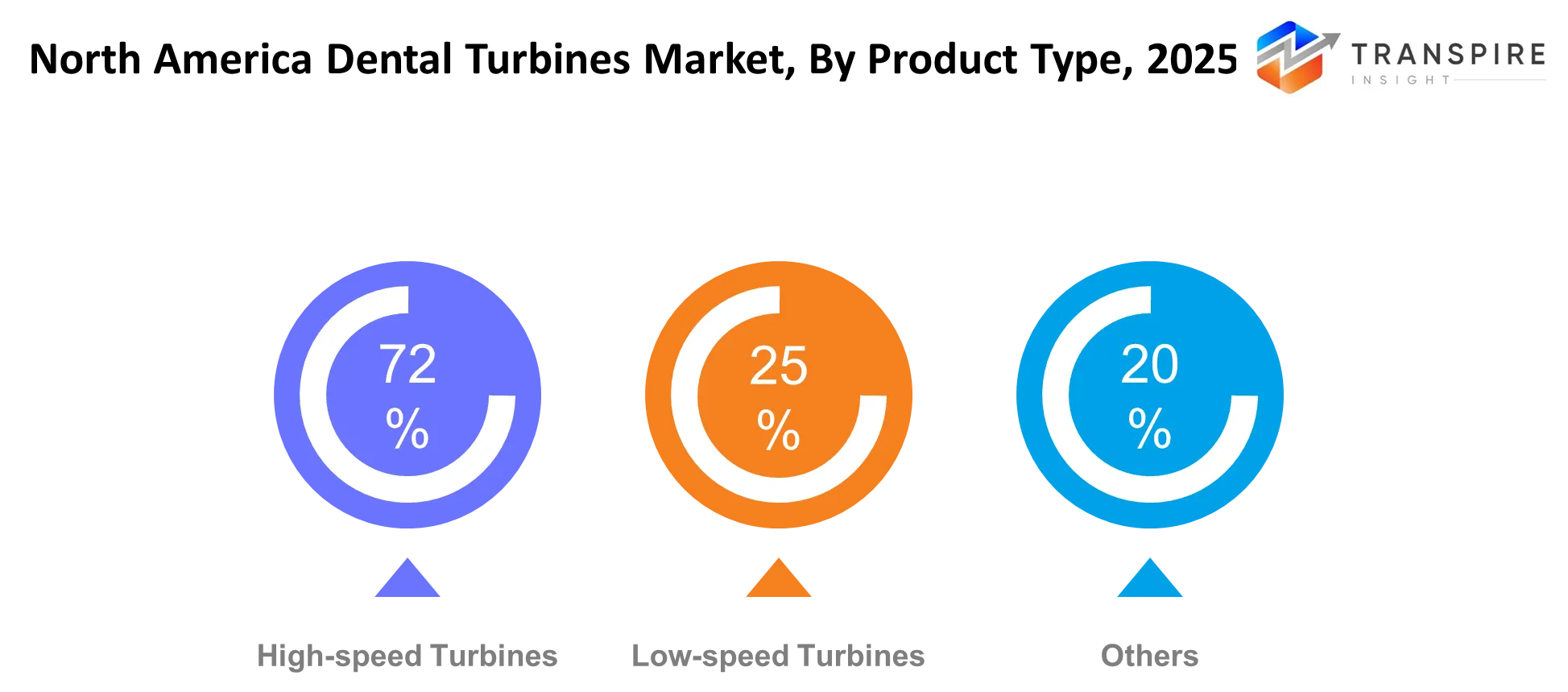
In terms of speed range, high speed turbines are basically leading the market because most restorative and operative procedures still demand fast cutting, clean material removal, and a shorter chair time , kinda all at once. These high-speed setups have turned into a necessary piece of modern clinical workflows, where productivity and treatment precision straight up influence the real operational results. Meanwhile, low-speed turbines handle an important backup job for polishing, finishing, and careful precision adjustments, but their revenue impact stays smaller, mainly because they get used less broadly.
The other speed categories, they’re there too, for specialized tasks that need particular performance traits. Demand for high speed units keeps climbing as clinics push for smoother workflow efficiency and higher patient throughput. At the same time, better noise reduction and vibration control, plus improved durability, are making the newer turbine models look much more attractive. Looking ahead, investment should lean toward high-speed platforms that can blend digital monitoring, and predictive maintenance functions. That way, manufacturers can stand out more easily, while buyers can cut downtime and keep equipment performance on track.
What are the Key Use Cases Driving the North America Dental Turbines Market?
The main use case for dental turbines still looks like restorative dentistry, where clinicians do cavity prep, crown placement and reshaping, all that kinda stuff. it happens daily in dental clinics, and the cutting needs to be fast precise, so restorative care ends up being the biggest reason equipment gets used heavily and replaced more often.
Also, it is not only that. adoption is getting broader for oral surgery and cosmetic dentistry. more specialty centers are bringing in advanced turbine systems for implant related steps, plus aesthetic restorations that really need better control and procedure accuracy. Meanwhile, big dental service organizations are upgrading their equipment fleets to keep treatment quality consistent across many locations, not just one room, or one team.
Then there are the newer things forming, around digitally guided dentistry and minimally invasive methods. when CAD/CAM workflows and chairside restoration systems get integrated, it drives demand for premium turbine platforms for precision based procedures. and academic institutes, plus advanced specialty practices are expected to be the first ones to adopt these next generation clinical applications during the forecast period.
|
Report Metrics |
Details |
|
Market size value in 2025 |
USD 114.73 Million |
|
Market size value in 2026 |
USD 132.98 Million |
|
Revenue forecast in 2033 |
USD 373.78 Million |
|
Growth rate |
CAGR of 15.91% from 2026 to 2033 |
|
Base year |
2025 |
|
Historical data |
2021 - 2024 |
|
Forecast period |
2026 - 2033 |
|
Report coverage |
Revenue forecast, competitive landscape, growth factors, and trends |
|
Country scope |
North America (Canada, The United States, and Mexico) |
|
Key company profiled |
Dentsply Sirona, NSK, KaVo Dental, Bien-Air Dental, W&H Dentalwerk, Dentamerica, A-dec, Morita, Anthogyr, SciCan, Dentflex, Sinol Dental, Castellini, Being Foshan Medical Equipment, DentalEZ |
|
Customization scope |
Free report customization (country, regional & segment scope). Avail customized purchase options to meet your exact research needs. |
|
Report Segmentation |
By Product Type (Air-driven Turbines, Electric Turbines, Fiber-optic Turbines, Others), By Application (Restorative Dentistry, Orthodontics, Endodontics, Oral Surgery, Others), By End User (Dental Clinics, Hospitals, Academic Institutes, Others), By Speed Range (High-speed Turbines, Low-speed Turbines, Others) |
Which Regions are Driving the North America Dental Turbines Market Growth?
The United States still leads the North America Dental Turbines Market, mostly because of its huge network of private dental practices, specialty centers, and corporate dental service organizations. There is also solid reimbursement coverage for many dental treatments, plus high overall healthcare spending, and then the fast take up of advanced clinical technologies that help keep equipment spending going. Another point is that the U.S. basically has the major dental equipment makers, distributors, and maintenance service providers nearby , so parts and updates are usually available on time. With that kind of established setup, replacement cycles can happen more quickly and demand stays steady for higher end turbine systems.
Canada ranks as the second biggest region, but the way it moves is not exactly the same as in the United States. Growth is backed by fairly stable healthcare funding , clear and predictable regulatory rules , and continued spending to upgrade dental infrastructure. In many cases, clinics and dental providers lean toward long run reliability and clinical efficiency , rather than chasing short term volume. So there is a consistent appetite for advanced turbine technologies. Overall, Canada feels more like a steady, dependable contributor to regional revenue, with a focus on balance and durability, not rapid expansion.
Mexico is showing up as the fastest growing regional market, kind of at speed, as private dental networks expand, and dental tourism keeps pulling in international patients. Lately there have been new investments in modern clinics and better treatment abilities, which is pushing the need for high performance dental equipment. Even more, easier access to specialized dental services is making providers upgrade their clinical tools and use more sophisticated treatment workflows. If we look at the 2026–2033 period, this overall upward move should open up interesting prospects for manufacturers, distributors, and investors who want to get exposure to a larger, evolving healthcare market.
Who are the Key Players in the North America Dental Turbines Market and How Do They Compete?
Competition in the North America Dental Turbines Market is kind of moderately consolidated, with a small cluster of global manufacturers that end up controlling a big chunk of premium equipment sales, while regional suppliers still fight it out in more value based segments. The market doesn’t get seriously shaken by low cost entrants because clinical reliability and sterilization durability, plus service support and even day to day practitioner preference, all build high switching barriers. Instead of price, technology innovation has turned into the main lever of competition, in a lot of buying decisions. Manufacturers also push harder on ergonomics, digital workflow compatibility, maintenance efficiency and overall lifecycle performance, not only the acquisition cost.
Dentsply Sirona tends to lean into technology integration and clinical workflow optimization. They differentiate by linking treatment equipment with digital dentistry platforms, so practices can build more connected restorative workflows, you know, that kind of thing. KaVo Dental highlights precision engineering, low vibration operation, and ergonomic design, which is attractive to high volume practices that prioritize clinician comfort and procedural consistency. Both groups keep expanding through product development initiatives and tighter distribution partnerships, which should improve access to advanced equipment across North America.
NSK Ltd. kinda competes by leaning hard into high-performance turbine engineering and a serious emphasis on durability ,so clinics see less maintenance and fewer operational interruptions. Then W&H Group shows up with its own angle, mostly advanced infection-control designs plus sterilization-resistant components, which kinda helps meet those tighter clinical standards that keep getting more strict. Bien-Air Dental is taking a more specialized route, kind of sticking to lightweight handpieces and smooth operation and then all those design choices that feel more practitioner-focused, not just marketing fluff. And together these firms are pushing their market presence forward with stuff like digital connectivity investments, a premium product portfolio, and a broader service network, which should then help with longer customer retention and more recurring aftermarket revenue.
Company List
- Dentsply Sirona
- NSK
- KaVo Dental
- Bien-Air Dental
- W&H Dentalwerk
- Dentamerica
- A-dec
- Morita
- Anthogyr
- SciCan
- Dentflex
- Sinol Dental
- Castellini
- Being Foshan Medical Equipment
- DentalEZ
Recent Development News
In March 2026, First-ever dental MRI machine receives FDA clearance: Dentsply Sirona and Siemens Healthineers have announced that their dental MRI system, MAGNETOM Free.Max Dental Edition, has received US Food and Drug Administration (FDA) clearance, and they shared key findings from a clinical trial conducted to validate the system. In addition to confirming its potential across multiple dental specialties, the trial underscored the system’s specialised features designed to meet the unique needs of dental imaging. Among these features is a field of view specific to dento-maxillofacial structures, allowing for accurate imaging of dental structures without visualising brain tissue.
Source: https://www.dental-tribune.com
In February 2026, Dentsply Sirona expands distribution partnership with Burkhart Dental Supply: Dentsply Sirona announced an expansion of its longstanding partnership with Burkhart Dental Supply. Effective April 2026, Burkhart broadened the range of Dentsply Sirona products available through its distribution network, strengthening access to dental equipment and clinical workflow solutions across the U.S. market. This development is relevant to turbine and handpiece distribution channels in North America.
Source: https://us.dental-tribune.com
What Strategic Insights Define the Future of the North America Dental Turbines Market?
The North America Dental Turbines Market is kinda moving, not just toward higher specs but toward a connected equipment ecosystem where turbine performance, maintenance scheduling, and clinical workflow integration become just as important as cutting efficiency. Under the surface, the real push behind this shift seems to be that more dental practices are consolidating into larger networks that want standardization, stronger asset utilization, and outcomes they can actually measure. Over the next five to seven years, purchasing decisions may gradually swing away from plain product based comparisons and toward platform based procurement, where service, analytics, and digital compatibility are bundled in.
There’s also a less obvious risk, and it has to do with market concentration among a small set of premium manufacturers and component suppliers. If something interrupts specialized bearing production, precision engineering inputs, or the service infrastructure that supports replacements, then supply constraints could show up. Even when demand is still solid, replacement cycles might end up lasting longer, which is kind of a quiet but meaningful problem.
On the other hand, there’s an emerging opportunity around sensor enabled turbines, with predictive maintenance capabilities that plug into practice management software. Adoption is still limited today, but for multi location dental organizations this could become pretty valuable, fast. Market participants should plan early for connected equipment platforms and stronger aftermarket service ecosystems, because recurring service revenue may become a better competitive edge than hardware sales, alone.
North America Dental Turbines Market Report Segmentation
By Product Type
- Air-driven Turbines
- Electric Turbines,
- Fiber-optic Turbines
- Others
By Application
- Restorative Dentistry
- Orthodontics
- Endodontics
- Oral Surgery
- Others
By End User
- Dental Clinics
- Hospitals
- Academic Institutes
- Others
By Speed Range
- High-speed Turbines
- Low-speed Turbines
- Others
Frequently Asked Questions
Find quick answers to common questions.
The approximate North America Dental Turbines Market size for the market will be USD 373.78 Million in 2033.
The key segments of the North America Dental Turbines Market are By Product Type (Air-driven Turbines, Electric Turbines, Fiber-optic Turbines, Others), By Application (Restorative Dentistry, Orthodontics, Endodontics, Oral Surgery, Others), By End User (Dental Clinics, Hospitals, Academic Institutes, Others), By Speed Range (High-speed Turbines, Low-speed Turbines, Others).
Major players in the North America Dental Turbines Market are Dentsply Sirona, NSK, KaVo Dental, Bien-Air Dental, W&H Dentalwerk, Dentamerica, A-dec, Morita, Anthogyr, SciCan, Dentflex, Sinol Dental, Castellini, Being Foshan Medical Equipment, DentalEZ.
The current market size of the North America Dental Turbines Market is USD 114.73 Million in 2025.
The North America Dental Turbines Market CAGR is 15.91%.
- Dentsply Sirona
- NSK
- KaVo Dental
- Bien-Air Dental
- W&H Dentalwerk
- Dentamerica
- A-dec
- Morita
- Anthogyr
- SciCan
- Dentflex
- Sinol Dental
- Castellini
- Being Foshan Medical Equipment
- DentalEZ
About the Authors

Pankaj Ghogare Patil
I am Pankaj Ghogare Patil, a Senior Research Analyst at Transpire Insight, specializing in the Pharmaceutical, Chemicals & Materials, Healthcare IT, and Biotechnology industry. My expertise lies in conducting comprehensive market research, analyzing industry trends, evaluating competitive landscapes, and translating complex data into actionable insights. At Transpire Insight, I closely follow emerging technologies, regulatory developments, and market innovations to create accurate, well-researched, and informative content that helps businesses and professionals make informed decisions. I am committed to producing credible, evidence-based articles that reflect industry best practices while making technical topics accessible and valuable for a broad audience.

Chakradhar Khansole
Chakradhar serves as the Research Director at Transpire Insight, bringing over 8 years of experience in technology, innovation, and strategic market intelligence. He specializes in transforming complex market data into actionable business insights that enable organizations to make informed, growth-oriented decisions. Recognized for his strategic vision and analytical expertise, Chakradhar leads high-impact research initiatives, delivering comprehensive market assessments, competitive intelligence, and forward-looking industry analysis.
Recently Published Reports
-
Apr 2026
AI in Diabetic Retinopathy Market
AI in Diabetic Retinopathy Market Size, Share & Analysis Report By Type (Screening AI Systems, Diagnostic AI Systems, and Predictive AI Models), By Application Segment (Hospitals, Ophthalmology Clinics, Diagnostic Centers, and Research and Development), and Geography (North America, Europe, Asia-Pacific, Middle East and Africa, South and Central America), 2021 - 2031
-
Apr 2026
Psychometric Tests Market
Psychometric Tests Market Size, Share & Analysis Report By Type (Personality Tests, Ability/Aptitude Tests, Skill/Knowledge Tests, and Others), By Application (Talent Acquisition and Talent Management), and Geography (North America, Europe, Asia-Pacific, Middle East and Africa, South and Central America), 2021 – 2031
-
Apr 2026
Rare Biological Sample Collection Market
Rare Biological Sample Collection Market Size, Share & Analysis Report By Type (Isolation Kits & Reagent, Blood Collection Tubes, and Others), By Application (Oncology, Transcriptomics, Pharmacogenomics, and Others), and Geography (North America, Europe, Asia-Pacific, Middle East and Africa, South and Central America), 2021 – 2031
-
Jul 2026
Diabetic Retinopathy Market
Diabetic Retinopathy Market Size, Share & Analysis Report By Type (Proliferative Diabetic Retinopathy, and Diabetic Macular Edema (DME)), By Treatment Type (Anti VEGF Drug, Steroid Implants, Laser Surgeries, and Vitrectomy), and Geography (North America, Europe, Asia-Pacific, Middle East and Africa, South and Central America), 2021 – 2031
Our Clients







