

North America Cattle Feed Market Size & Forecast:
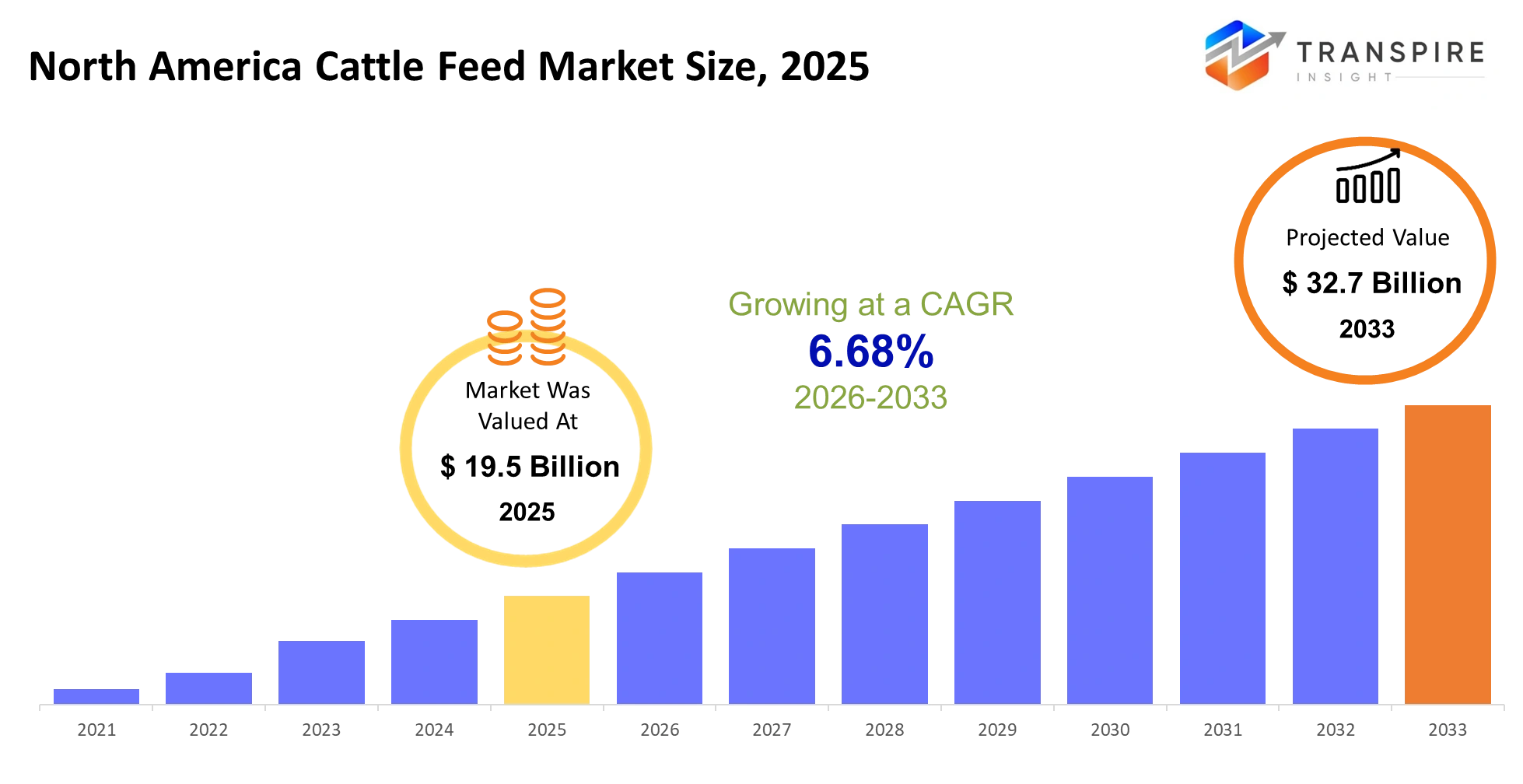
- North America Cattle Feed Market Size 2025: USD 19.5 Billion
- North America Cattle Feed Market Size 2033: USD 32.7 Billion
- North America Cattle Feed Market CAGR: 6.68%
- North America Cattle Feed Market Segments: By Type (Forage Feed, Concentrates, Supplements, Others, Silage, Mixed Feed), By Ingredient (Corn, Soybean Meal, Wheat, Others, Barley, Additives), By Form (Pellets, Mash, Crumbles, Others, Liquid, Blocks), By End-User (Dairy Farms, Beef Farms, Others, Livestock Farms, Commercial, Small-scale).
To learn more about this report,  Download Free Sample Report
North America Cattle Feed Market Summary:
The North America Cattle Feed Market size is estimated at USD 19.5 Billion in 2025 and is anticipated to reach USD 32.7 Billion by 2033, growing at a CAGR of 6.68% from 2026 to 2033. The North America Cattle Feed Market displays consistent expansion because customers in the region demand premium meat and dairy products.
Farmers today better understand how balanced nutrition and feed efficiency and livestock health work together to drive their adoption of new feed technologies. The North America Cattle Feed Market benefits from feed additive innovations which include probiotics and enzyme-based supplements because they boost cattle productivity while promoting sustainable farming methods.
Precision feeding methods and cost optimization become more important for the North America Cattle Feed Market because producers need to control their expenses. Livestock producers today spend more on nutritionally optimized feed because it helps them achieve better yields while decreasing their environmental footprint. The North America Cattle Feed Market experiences positive growth prospects because regulatory bodies support animal health and food safety standards which encourage the use of high-quality feed ingredients.
What Has the Impact of Artificial Intelligence Been on the North America Cattle Feed Market?
The north american cattle feed market undergoes rapid transformation through artificial intelligence which improves operational accuracy and supports data-based decision processes. North american cattle feed market applications of artificial intelligence enable businesses to process extensive data sets which they use to identify market patterns and develop business strategies through predictive analytics.
Advanced machine learning models support accurate demand forecasting, helping producers align feed supply with livestock needs while minimizing waste. The development of artificial intelligence in north america cattle feed market research strengthens market research capabilities while it increases market reaction speed to changing consumer preferences and agricultural practice requirements.
The north american cattle feed market uses AI-powered smart automation to enhance production efficiency and improve supply chain operations. The automated systems feed formulation process while they monitor livestock health and cut operational expenses by directing resources toward their most effective application.
The supply chain operations of predictive analytics improve their performance through two main functions which include supply chain disruption prediction and inventory management system optimization. The feed solution advancements enable more customized options which provide businesses an edge in competition and help sustain their growth throughout the North American livestock feed industry
Key Market Trends & Insights:
- The north america cattle feed market size is expanding due to growing beef and dairy demand which better feed efficiency and nutritional optimization trends support.
- High demand drivers arise from three factors which include livestock productivity requirements and animal health development priorities and safe feed ingredient standards that meet regulatory requirements.
- The combination of smart automation and AI-based feed formulation tools results in better production accuracy while decreasing waste and increasing total business profits.
- The United States dominates the north america cattle feed market with over 70% share in 2025 because of its large commercial livestock operations.
- Canada is the fastest-growing region which will experience more than 4.5% CAGR growth until 2030 because of its sustainable farming initiatives.
- Concentrates dominate with nearly 45% market share because they provide high nutritional value and enable efficient cattle growth.
- The second-largest market segment remains forage-based feed because it offers cost savings and exists as a common feed option on many farms.
- Feed additives represent the fastest-growing segment which will experience significant growth until 2030 because of increasing demand for both probiotics and enzymes.
- Dairy cattle application dominates with approximately 55% share which results from higher milk production and better quality standards.
- Beef cattle feed serves as the fastest-growing application segment because of increasing meat consumption and demand for beef exports.
- The north america cattle feed market in commercial livestock farms generates more than 60% market share because these farms use modern feeding systems and buy in bulk.
- The small and medium-scale farming sector is expanding quickly because farmers now understand how proper nutrition helps them achieve better productivity results.
North America Cattle Feed Market Segmentation
By Type
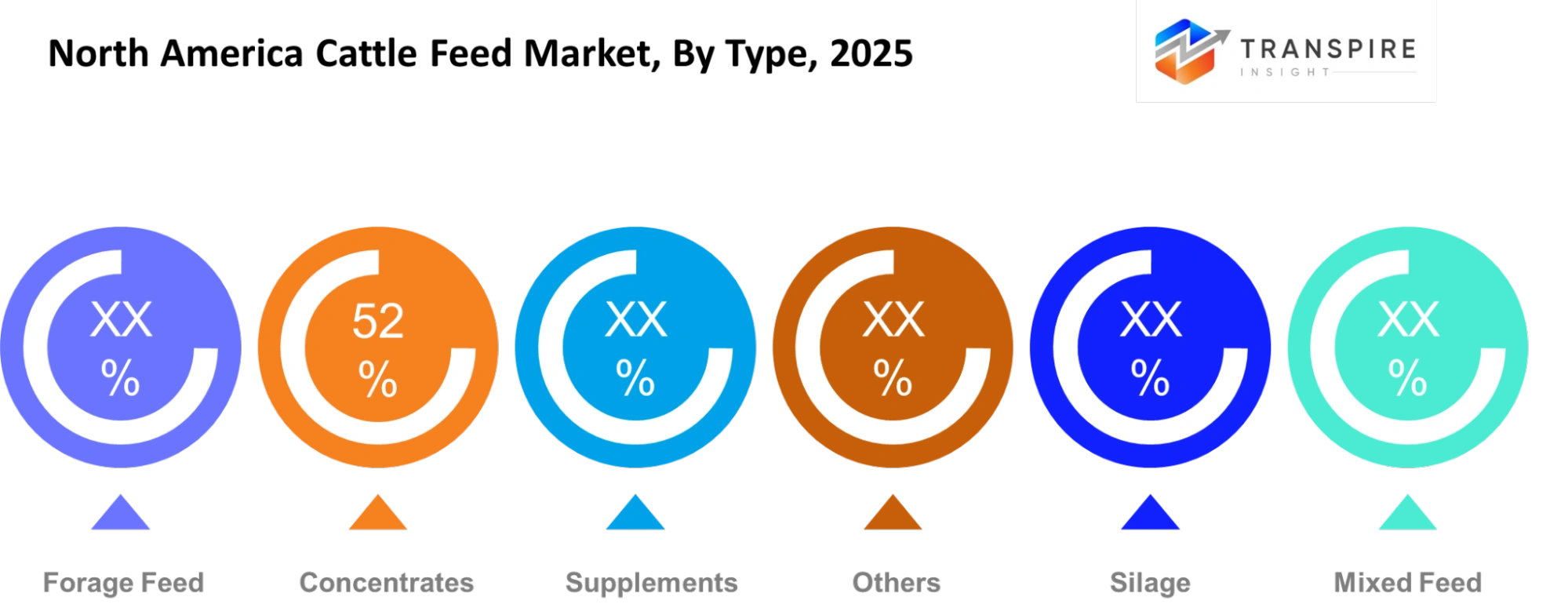
The natural sources of forage feed which include grass and hay, provide widespread availability and economical benefits which make them common feed options. Cattle require concentrates because these feeds deliver essential nutritional components which help them achieve optimal performance and growth. The basic feed needs to receive supplements which will provide missing vitamins and minerals to establish proper nutritional balance.
The use of silage together with mixed feed solutions will deliver steady nutritional support which will continue through all seasonal periods. The process of mixed feed production involves combining multiple ingredients to create a feed which provides complete nutritional needs for cattle while decreasing their time spent on eating.
Silage functions as a critical method for maintaining feed quality during extended time periods because it enables feed preservation in areas that experience seasonal weather patterns. The different animal feed types which are available on the market enable farmers to select the most suitable options for their particular farm size and operational requirements.
To learn more about this report, Download Free Sample Report
By Route
Corn functions as a primary energy source for cattle feed because it contains high carbohydrate levels and is readily accessible. Livestock use soybean meal as a protein source which helps them build muscle and achieve their growth targets. Wheat and barley will also provide essential nutrients to help achieve proper nutritional balance through their fiber content.
The addition of vitamins and enzymes to feed will enhance both digestion and feed performance.Barley serves two purposes because it increases energy consumption while it helps maintain digestive well-being. The use of additives will become more important for both performance enhancement and health problem prevention.
The selection of ingredients will occur based on their market price and their product availability and their nutritional content. Cattle require a specific combination of ingredients which will help them achieve their highest growth potential and production capacity.
By Form
The uniformity and simple handling of pellets lead to better feeding results which decrease waste. Farmers choose mash feed because it costs less and requires less processing than other feeds. The crumbles will provide a combination of pellet and mash advantages which will enhance animal feed intake and digestive efficiency.
The combination of liquid feed and blocks will create an easy feeding option that delivers specific nutritional needs. Grazing areas use blocks for two purposes which include controlled feeding and mineral supplementation. The liquid feed system provides necessary hydration for animals while helping them absorb essential nutrients during special feeding programs.
Different farming operations will require different forms of animal feed according to their specific needs. Feed form selection requires consideration of three factors which include handling convenience and expenses and animal requirements.
By End-User
Dairy farms need feed which contains essential nutrients to produce milk and keep their cattle healthy. Beef farms use special feed which helps their animals gain weight while their beef quality improves during the meat aging process. Commercial farms will implement sophisticated feeding systems to achieve optimal operational performance and production results. Small-scale farms will choose feed solutions which provide them with both affordability and convenient access to their needs.
Livestock farms need nutritional programs that provide complete nutritional needs to achieve their productivity goals and keep their animals healthy. The mixed farming operations which handle multiple animal types will also serve as additional users. Each end-user group will have unique needs based on production goals and resources. Growth across these segments will drive overall demand for cattle feed products.
What are the Main Challenges for the North America Cattle Feed Market Growth?
North America cattle feed market growth faces major obstacles because of technical and operational challenges which include problems with feed consistency and raw material supply and supply chain interruptions. The production process faces difficulties because of fluctuating core ingredient prices which include corn and soybean meal. Product quality and shelf life are affected by storage limitations and contamination risks.
The North America cattle feed market faces challenges which decrease production efficiency and create higher operational dangers for producers.The North America cattle feed market expansion faces obstacles because of manufacturing and commercialization obstacles which exist due to strict regulatory frameworks and compliance requirements. Safety standards and quality certifications require additional resources which result in higher production expenses and longer approval periods.
Smaller manufacturers often face difficulties when they need to invest money and optimize their production processes. The market restrictions prevent businesses from developing new products while they take time to bring modern feed technologies to market.Adoption challenges also affect the north america cattle feed market, particularly among small and medium-scale farmers with limited access to advanced feeding technologies. The implementation of precision nutrition and automated systems faces restrictions because of two factors which include insufficient technical expertise and the current state of infrastructure development.
The restricted budget together with the insufficient public knowledge about feed optimization advantages results in limited adoption throughout various industries. The market growth barriers restrict the speed at which industry modernization progresses through the entire market system. The north america cattle feed market faces increased pressure from market competition together with imminent threats because customers show growing interest in alternative feeding methods and economical replacement products.
The main companies in the market compete with each other through aggressive pricing strategies which create challenges for their financial performance and their ability to maintain operations. The emergence of new environmental regulations together with sustainability standards will result in higher compliance expenses for businesses. The development of the north america cattle feed market faces ongoing challenges because these factors continue to exist.
Regional Insights
North America Cattle Feed Market exhibits prominent regional differences which arise from two factors: livestock distribution and feed production capabilities. The United States will maintain its leading position because of its extensive cattle operations and its well-established feeding technologies. Canada will show consistent growth because its environmental farming methods help maintain demand throughout the year while its enhanced feed efficiency system. Mexico will experience slow development because of its growing livestock industry and increasing knowledge about proper nutritional practices.
The different regions will experience different demand patterns which will depend on two factors: climate conditions and raw material supply and infrastructure development. The United States will keep its market leadership position because of its existing distribution networks and its widespread use of modern feeding technologies. Canada will gain advantages from government funding and its commitment to producing high-quality animal feed. Mexico will continue its economic advancement through growing investments which will boost livestock production and make feed more accessible.
Recent Development News
In April 2026, Wildfires Disrupt Cattle Farming Across U.S. Plains: Severe wildfires across the Great Plains have destroyed grazing land and caused livestock losses, creating feed shortages and operational challenges for cattle producers. This environmental disruption is adding pressure on feed availability and pricing.
Source: https://www.theguardian.com
In April 2026, Texas Invests $750M in Livestock Protection Facility: A major $750 million project has been launched in Texas to combat the New World screwworm threat affecting cattle. The initiative, supported by the United States Department of Agriculture, will produce sterile flies to control parasite spread and protect livestock productivity.
Source: https://www.chron.com
|
Report Metrics |
Details |
|
Market size value in 2025 |
USD 19.5 Billion |
|
Market size value in 2026 |
USD 20.8 Billion |
|
Revenue forecast in 2033 |
USD 32.7 Billion |
|
Growth rate |
CAGR of 6.68% from 2026 to 2033 |
|
Base year |
2025 |
|
Historical data |
2021 – 2024 |
|
Forecast period |
2026 – 2033 |
|
Report coverage |
Revenue forecast, competitive landscape, growth factors, and trends |
|
Country scope |
North America (Canada, The United States, and Mexico) |
|
Key company profiled |
Cargill, ADM, Land O’Lakes, Purina Animal Nutrition, Alltech, Nutreco, BASF, DSM, Evonik, Charoen Pokphand, Tyson Foods, JBS, Kent Nutrition, De Heus, ForFarmers. |
|
Customization scope |
Free report customization (country, regional & segment scope). Avail customized purchase options to meet your exact research needs. |
|
Report Segmentation |
By Type (Forage Feed, Concentrates, Supplements, Others, Silage, Mixed Feed), By Ingredient (Corn, Soybean Meal, Wheat, Others, Barley, Additives), By Form (Pellets, Mash, Crumbles, Others, Liquid, Blocks), By End-User (Dairy Farms, Beef Farms, Others, Livestock Farms, Commercial, Small-scale). |
How Can New Companies Establish a Strong Foothold in the North America Cattle Feed Market?
New companies can build a strong position in the north america cattle feed market by focusing on niche segments such as organic feed, precision nutrition, or antibiotic-free formulations. New businesses can establish their unique market presence by addressing unfulfilled customer demands which include better digestion systems and better disease protection methods and eco-friendly feed production methods.
The company will achieve quick market acceptance through its product development which meets present industry standards for clean-label feed products and traceability systems. The company needs to create a strong value proposition which demonstrates how its product will enhance livestock output while minimizing operational expenses.
The north america cattle feed market requires innovation strategies which use technology to establish strong market presence. BinSentry uses AI-powered sensors to monitor feed inventory and reduce waste while Cainthus uses computer vision technology to track cattle health and optimize their feeding patterns.
The advancements provide better decision-making abilities which lead to enhanced operational efficiency. Farmers experience measurable performance improvements when companies combine predictive analytics with smart automation technologies.The north america cattle feed market requires both strategic partnerships and distribution networks to achieve successful business growth.
The company can build its market presence by working together with local feed mills and livestock farms and agricultural technology companies. The companies which develop regional supply chains together with logistics management systems will achieve better operational efficiency and faster product deliveries. The development of strong partnerships enables organizations to share knowledge which helps them quickly adopt advanced feed innovation.
Key North America Cattle Feed Market Company Insights
The North America Cattle Feed Market shows strong competition which large global companies and regional producers use to compete through their product quality and pricing approaches. Leading players will invest in advanced feed solutions and efficient supply chains to maintain market share. Continuous product development and improved formulations will support better livestock performance and customer retention.
Market position improvement will proceed through companies using two main strategies: developing strategic partnerships and expanding into new regions. Companies will focus on three primary areas: controlling costs, creating new products, and building dependable distribution systems to establish competitive superiority. Smaller players will compete by offering specialized feed and flexible pricing models. The competitive intensity of the industry will drive growth while pushing companies to improve their operational efficiency.
Company List
- Cargill
- ADM
- Land O’Lakes
- Purina Animal Nutrition
- Alltech
- Nutreco
- BASF
- DSM
- Evonik
- Charoen Pokphand
- Tyson Foods
- JBS
- Kent Nutrition
- De Heus
- ForFarmers
What are the Key Use-Cases Driving the Growth of the North America Cattle Feed Market?
The north american cattle feed market operates because the feed maintains essential functions which boost dairy and beef farming through its increased efficiency. Animal health improvement through high-performance feed solutions enables farmers to achieve higher milk production and weight growth results. The farm profitability and operational efficiency benefits from these use cases which require optimized feed formulations to achieve their goals.
Large-scale commercial farms increase their protein-rich food product demand which drives them to adopt new feeding methods.The north america cattle feed market employs precision nutrition as a core use-case which creates customized feed formulas through data analysis for particular cattle requirements. The method establishes sustainable livestock management through its three benefits which include feed waste reduction and enhanced digestion capacity.
The implementation of automated feeding systems and monitoring tools which use smart technologies leads to enhanced operational performance. The new technological developments lead farmers toward adopting feeding methods which emphasize performance and controlled animal feeding. The North america cattle feed market demonstrates expansion because of the rising demand for cattle feed which helps with disease prevention and promotes animal health. The functional feed additives which include probiotics and enzymes help to strengthen animal immune systems while decreasing the need for antibiotic treatments.
The statement meets both regulatory standards and consumer preferences which demand safer and superior meat and dairy products. The specialized feed solutions create strong growth opportunities through their various applications. The North America cattle feed market will experience future growth because new use cases related to sustainability and environmental impact develop. Feed innovations which reduce methane emissions and enhance resource efficiency have become popular in the industry.
North America Cattle Feed Market Report Segmentation
By Type
- Forage Feed
- Concentrates
- Supplements
- Others
- Silage
- Mixed Feed
By Ingredient
- Corn
- Soybean Meal
- Wheat
- Others
- Barley
- Additives
By Form
- Pellets
- Mash
- Crumbles
- Others
- Liquid
- Blocks
By End-User
- Dairy Farms
- Beef Farms
- Others
- Livestock Farms
- Commercial
- Small-scale
Frequently Asked Questions
Find quick answers to common questions.
The approximate North America Cattle Feed Market size for the market will be USD 32.7 Billion in 2033.
The key segments of the North America Cattle Feed Market are By Type (Forage Feed, Concentrates, Supplements, Others, Silage, Mixed Feed), By Ingredient (Corn, Soybean Meal, Wheat, Others, Barley, Additives), By Form (Pellets, Mash, Crumbles, Others, Liquid, Blocks), By End-User (Dairy Farms, Beef Farms, Others, Livestock Farms, Commercial, Small-scale).
Major players in the North America Cattle Feed Market are Cargill, ADM, Land O’Lakes, Purina Animal Nutrition, Alltech, Nutreco, BASF, DSM, Evonik, Charoen Pokphand, Tyson Foods, JBS, Kent Nutrition, De Heus, ForFarmers.
The current market size of the North America Cattle Feed Market is USD 19.5 Billion in 2025.
The North America Cattle Feed Market CAGR is 6.68%.
- Cargill
- ADM
- Land O’Lakes
- Purina Animal Nutrition
- Alltech
- Nutreco
- BASF
- DSM
- Evonik
- Charoen Pokphand
- Tyson Foods
- JBS
- Kent Nutrition
- De Heus
- ForFarmers
Recently Published Reports
-
Apr 2026
Baby Infant Formula Market
Baby Infant Formula Market Size, Share & Analysis Report By ype (Infant Milk, Follow On Milk, Specialty Baby Milk, Growing-Up Milk), By Ingredient (Carbohydrate, Fat, Protein, Minerals, Vitamins, and Others), By Product Form (Powder, Liquid, and Ready-to-feed), By Distribution Channels (Supermarket/Hypermarket, Specialty Store, Pharmacies, Online Retail, and Others), and Geography (North America, Europe, Asia-Pacific, Middle East and Africa, South and Central America), 2021 - 2031
-
Apr 2026
Edible Insects for Animal Feed Market
Edible Insects for Animal Feed Market Size, Share & Analysis Report By Type (Insect Powder, Insect Meal, Insect Bar, Insect Paste, Insect Oil, and Others), By Insect Type (Beetles, Cricket, Caterpillar, Hymenoptera, Orthoptera, Tree Bugs, and Others), By Application (Livestock, Pet Food, and Aquaculture), By Livestock Type (Poultry, Swine, and Others), and Geography (North America, Europe, Asia-Pacific, Middle East and Africa, South and Central America), 2021 - 2031
-
Apr 2026
Food Industry Disinfection and Bacterial Control Market
Food Industry Disinfection and Bacterial Control Market Size, Share & Analysis Report By Type (Chemical Disinfectants, Physical Disinfectants, and Biocides and Antimicrobials), By Application (Food Processing Equipment Surface Disinfection, Food Preparation Areas Surface Disinfection, Storage Areas Surface Disinfection, Anti-microbial Coatings Food Preservation, and Preservative Solutions Food Preservation), By End User (Meat and Poultry Processing, Dairy Processing, Seafood Processing, Bakery and Confectionery, Restaurants and Commercial Kitchens, and Food Service Providers), By Sales Channel (Online, Offline), and Geography (North America, Europe, Asia-Pacific, Middle East and Africa, South and Central America), 2021 - 2031
-
Apr 2026
Freeze Dried Food Market
Freeze Dried Food Market Size, Share & Analysis Report By Product Type (Fruits, Vegetables, Freeze-Dried Dairy Products, Freeze-Dried Meat and Seafood, Freeze-Dried Pet Food, and Prepared Meal), By Nature (Organic, and Conventional), By Form (Powdered, Granules, and Diced), By End Use (Breakfast Cereals, Dairy Products, Bakery & Confectionery, Nutritional Bars & Supplements, Powdered Beverages, Snacks, and Retail (Household)), and Geography (North America, Europe, Asia-Pacific, Middle East and Africa, South and Central America), 2021 - 2031