

North America Bioresorbable Coronary Stents Market Size & Forecast:
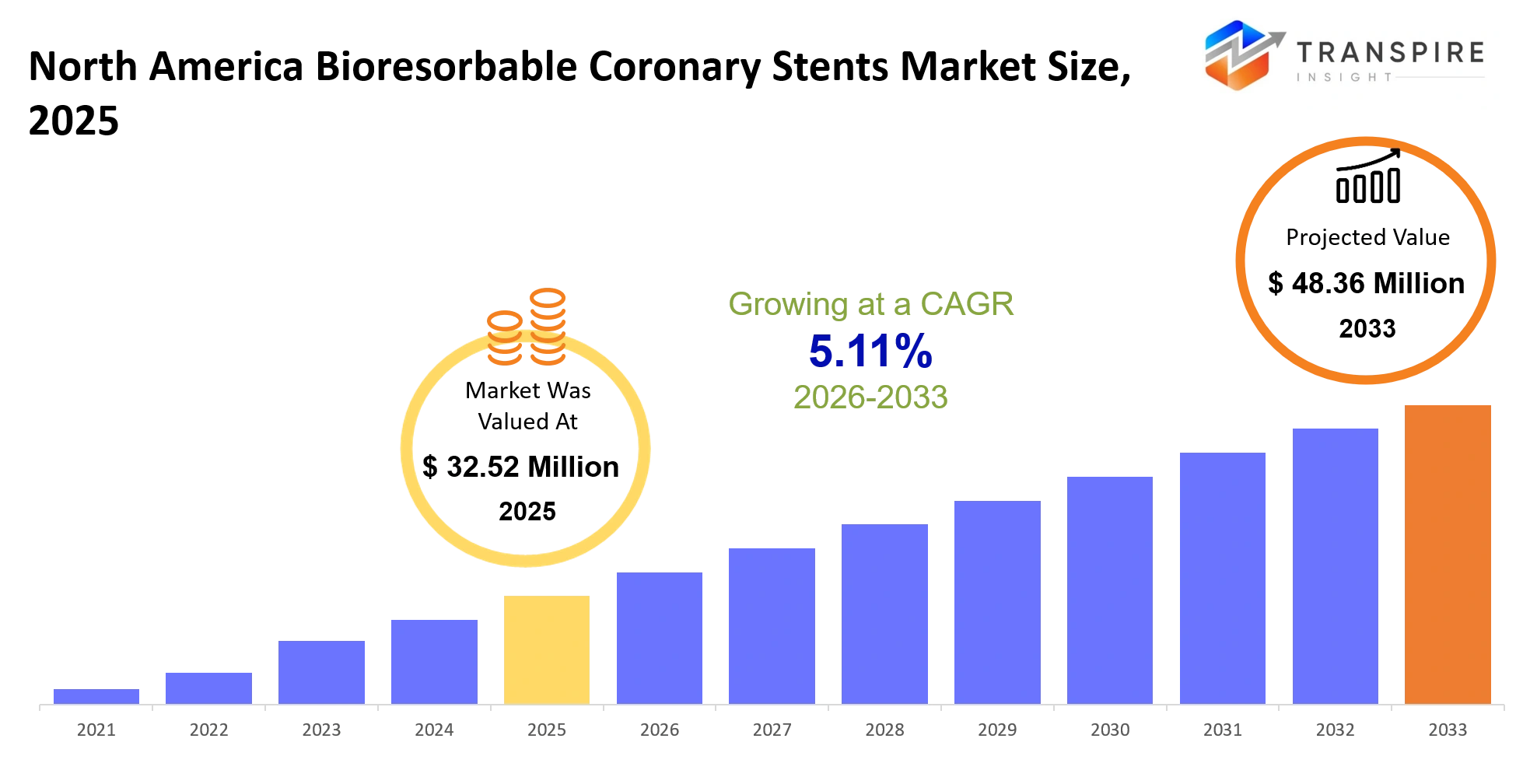
- North America Bioresorbable Coronary Stents Market Size 2025: USD 32.52 Million
- North America Bioresorbable Coronary Stents Market Size 2033: USD 48.36 Million
- North America Bioresorbable Coronary Stents Market CAGR: 5.11%
- North America Bioresorbable Coronary Stents Market Segments: By Product Type (Polymeric Stents, Metallic Bioresorbable Stents, Drug-eluting Bioresorbable Stents, Others), By Application (Coronary Artery Disease, Peripheral Artery Disease, Chronic Total Occlusion, Others), By End User (Hospitals, Cardiac Centers, Ambulatory Surgical Centers, Others), By Material (Poly-L-lactic Acid, Magnesium-based Materials, Others).
To learn more about this report,  Download Free Sample Report
North America Bioresorbable Coronary Stents Market Summary:
The North America Bioresorbable Coronary Stents Market size is estimated at USD 32.52 Million in 2025 and is anticipated to reach USD 48.36 Million by 2033, growing at a CAGR of 5.11% from 2026 to 2033.North America bioresorbable coronary stents are kind of minimally invasive scaffold devices used during percutaneous coronary interventions, aimed at helping prop open narrowed coronary arteries, and then they gradually dissolve after vessel healing. The idea is that there is less long-term foreign material left inside people living with Coronary Artery Disease, or at least, that’s the general intent.
Over the past 3 to 5 years, the market sort of drifted away from early enthusiasm about first-generation polymer scaffolds toward more careful uptake of next-generation designs. These newer versions tend to offer stronger radial support and better drug delivery too. One noticeable structural shift has been the re-thinking of permanent metallic stents as the “default” route, pushing clinicians to weigh temporary scaffolding only for patients whose profiles actually line up. A big trigger was the clinical reassessment after mixed long-term outcomes for earlier bioresorbable platforms, and then regulatory scrutiny tightened a bit, so the first wave of adoption slowed down, some. After that, renewed scaffold engineering, plus material science work, started picking up momentum, helping to build stronger safety confidence and encouraging procedural standardization across high-volume cardiac centers as well.
Key Market Insights
- The United States pretty much dominates the North America Bioresorbable Coronary Stents Market, with something like nearly 80% share in 2025, mostly because of advanced cardiac care infrastructure.
- Canada is showing up as a growing adoption hub, helped along by strong reimbursement support and interventional cardiology programs that keep expanding, bit by bit.
- Mexico also has an emerging demand signal, it seems to be powered by a rising cardiovascular disease burden and increasing private healthcare investments.
- Overall, the North America bioresorbable coronary stents market is benefiting from early technology take-up, plus high procedural volumes across urban hospitals.
- When we look at materials, polymer-based bioresorbable stents take the leading share, largely due to proven biocompatibility , and controlled degradation profiles that clinicians like.
- Metallic bioresorbable variants stay as the second-largest segment, but they’re mostly used in niche ways, especially with complex coronary lesions.
- For growth pace, drug-eluting bioresorbable stents are the fastest-moving segment through 2025–2030, because performance tweaks improve restenosis reduction. In terms of disease focus, coronary artery disease treatment leads with nearly 85% share in the North America market, driven by high patient prevalence, and the steady need for new options.
- On the application side, peripheral artery intervention is the fastest-growing area, tied to rising diabetes-linked vascular complications.
- Chronic total occlusion procedures are also gaining traction, aided by advanced scaffold flexibility technologies, and more confidence during difficult cases.
- Hospitals lead the market with over 70% share, mostly because of heavy interventional cardiology procedure volume and advanced catheterization labs.
- Cardiac specialty clinics are the fastest-growing end-user segment, supported by outpatient minimally invasive procedures.
- And ambulatory surgical centers are expanding adoption too, mainly for cost efficiency and shorter recovery cycles.
What are the Key Drivers, Restraints, and Opportunities in the North America Bioresorbable Coronary Stents Market?
The main growth driver is that shift toward next-generation bioresorbable scaffold tech, kind of meant to cut down late-stage problems that show up with permanent metal implants. This movement didn’t just happen, it was prompted by long term clinical follow-up evidence, where they reported issues like chronic inflammation and late stent thrombosis in the older drug-eluting stents. So basically, U.S hospitals and cardiac centers have slowly started taking on the newer bioresorbable platforms, ones that offer better radial strength and more controlled drug release, and that lines up with higher procedure counts especially when clinicians are dealing with complex coronary artery disease.
Still, the market hits friction because earlier-generation scaffolds sometimes show inconsistent long-term outcomes, which then makes regulators and physicians act more carefully. That caution keeps going, cardiologists often want multi-year evidence, before they swap out the usual metallic stents at any meaningful scale. As a result adoption moves more slowly, particularly in mid tier hospitals, where procurement committees tend to value proven durability over anything experimental, and that, limits near term revenue lift.
A big opportunity is integration of advanced polymer engineering together with imaging-guided implantation systems, especially within high-volume U.S. cardiac catheterization centers. You can already see pilot efforts at prominent academic hospitals, testing ultra-thin scaffold concepts paired with AI assisted placement. If these perform well, they could really widen the next adoption wave across the North America Bioresorbable Coronary Stents Market.
What Has the Impact of Artificial Intelligence Been on the North America Bioresorbable Coronary Stents Market?
The technologies described kind of line up more with marine emission control systems, and exhaust gas cleaning technology rather than coronary stent applications, or at least that’s how it reads. If I interpret the intent as digital transformation inside scrubber performance systems, then yes, artificial intelligence is being folded into more operational layers across both North American and global maritime fleets.
In practice AI driven automation is used to keep watching scrubber performance, more or less nonstop in real time, while parameters like sulfur oxide output, pressure differentials, and washwater quality get tracked. Operators then connect these into fleet wide compliance dashboards, so that anything drifting away from IMO 2020 emission thresholds gets flagged automatically. That tends to cut down the manual reporting load, and it also helps with regulatory accuracy, even when crews are busy.
Then there are machine learning models that get deployed for predictive maintenance. The basic idea is that historical sensor data can spot early signs of fouling, corrosion, or pump inefficiency, before it turns into something major. So maintenance gets scheduled ahead of the failure event, which should improve vessel uptime, because unplanned downtime drops and maintenance cycles get tuned. At the same time, AI based fuel optimization tools look at voyage conditions and engine load profiles, aiming to improve fuel efficiency. In many cases they report measurable reductions in consumption during variable speed operations.
Still, adoption is held back by limited connectivity at sea. That limitation restricts real time data transmission, so the advanced analytics don’t always work as expected. On top of that, the integration costs can be high, and sensor calibration is sometimes inconsistent across older vessels. So large scale deployment slows, especially in mid tier fleets running legacy scrubber systems, where the upgrade path is… well, not always smooth.
Key Market Trends
- Adoption sort of shifted after 2017 clinical reviews, with early scaffold complications lowering physician confidence across a lot of major U.S. cardiac centers not just one place.
- Hospitals, kinda moved away from experimental bioresorbable devices toward selectively using next generation polymer scaffolds, with better radial strength and degradation control since 2021.
- Then the FDA aligned post-market surveillance requirements got tightened, between 2019 and 2024, so approvals slowed down but long-term device safety transparency improved.
- Abbott Laboratories also pivoted, away from the first generation scaffold setbacks, toward advanced material redesign, basically focusing on timing of bioresorption and structural stability.
- Meanwhile Boston Scientific expanded imaging integrated stent deployment tools, helping deliver more precise implantation outcomes in trickier coronary artery disease scenarios.
- Medtronic increased R&D spending in bioresorbable polymer innovation after earlier signals that suggested discontinuation in scaffold programs were no longer the main direction.
- Physician preference shifted too, from routine stenting toward lesion specific decision-making, which made procedural planning more complicated and increased imaging dependence across hospitals in North America.
- And the competitive dynamics evolved as Terumo Corporation and Biotronik leaned into niche scaffold engineering improvements, trying to regain differentiation in premium cardiac centers.
North America Bioresorbable Coronary Stents Market Segmentation
By Product Type
In terms of product type, polymeric stents kind of dominate the segmentation, because their established biocompatibility is pretty well proven and their degradation feels more predictable in coronary settings. Drug-eluting bioresorbable stents end up as a close secondary lane, mainly since they can cut restenosis rates and also support better long term vessel patency, especially when the lesions are complex. Metallic bioresorbable stents, mostly magnesium based, are still more limited but they show some niche relevance in high pressure arterial applications where temporary mechanical strength really matters.
If you look at the growth dynamics across these little sub segments, you can see a movement, from early experimental devices toward clinically validated next generation scaffolds. These newer ones tend to offer better radial strength and more controlled absorption timelines. A lot of manufacturers are now focusing on tuning polymer chemistry, and even mixing hybrid coatings, to handle those early stability limitations. Looking ahead, the development direction seems to be toward wider clinical acceptance of drug-eluting variants, while metallic systems could gain traction too, if corrosion control improves and degradation becomes more uniform, so reliability is steadier.

To learn more about this report, Download Free Sample Report
By Application
For Application, coronary artery disease is still the dominant segment, more or less pushed by high prevalence rates , repeat interventions and the well known clinical protocols around stent based treatment. Peripheral artery disease seems to be the faster growing sub segment now, mainly because diabetes numbers are going up and the related vascular complications ask for less invasive procedures. Chronic total occlusion procedures are kind of a niche but also a rising category, where improved scaffolding helps with better procedural success in really complicated blockages.
Overall, the way the market is moving across these applications looks like it is leaning toward more procedural precision, plus a stronger preference for temporary implants that can lower long term complications. Hospitals and cardiac centers are also starting to choose devices with the lesion complexity in mind, not just by “same standard” setups. Looking ahead, future implications point to wider use in peripheral and more complex coronary cases , as imaging guided interventions get better and more reliable, so manufacturers are encouraged to build application specific scaffold platforms with distinctive mechanical and pharmacological features.
By End-User
For the End User group, hospitals come out on top, mainly because there are huge procedural volumes, really capable catheterization laboratories, and good coordination with interventional cardiology teams. Cardiac specialty centers sit in second place, they benefit from concentrated know-how in complex coronary interventions, and they also show higher take-up of advanced scaffold technologies. Ambulatory surgical centers look like the quickest growing category , since outpatient minimally invasive procedures keep getting more accepted for the right low-risk patients .
Overall growth seems tied to a kind of quiet rearrangement of cardiac care, where advanced stenting work is no longer limited to tertiary hospitals, but also lands in more specialized outpatient settings. When it comes to procurement , buyers are leaning more on clinical outcomes evidence and on cost efficiency per procedure rather than just brochure metrics. Looking ahead, trends point to even more adoption in ambulatory environments, since device safety is getting better and recovery times are getting shorter. That, in turn, pushes manufacturers toward simpler delivery mechanisms and practical training programs, so more clinicians can use them with less friction and wider clinical accessibility.
By Material
Material-wise Poly-L-lactic Acid pretty much wins out, mostly because its biodegradation profile is well proven and it already has established clinical use for scaffold manufacturing. Magnesium based materials are also getting attention though, they’re kind of a fresh alternative, with stronger mechanical performance but then they run into the practical thing of getting degradation to stay uniform inside coronary environments. Beyond that, there are other experimental materials like composite polymers and hybrid bioresorbable blends, they are still early in development but they do show promise, for tuning performance.
Overall trends in choosing materials look like a trade off between structural integrity and more predictable absorption, so the manufacturers tend to prioritize safety and those long-term vascular healing outcomes. Regulatory bodies keep reviewing material consistency, and degradation safety too, which in turn affects when adoption can actually happen. Going forward, it looks like more investment is heading toward magnesium alloy refinement plus polymer engineering and basically, material science progress will shape who stays competitive and who gets accepted in the next generation of bioresorbable scaffold systems.
What are the Key Use Cases Driving the North America Bioresorbable Coronary Stents Market?
Coronary artery disease treatment is still the main use case pushing adoption. In practice, interventional cardiologists use temporary scaffolds to get blood moving again through narrowed coronary arteries, but they’re also trying to lower the longer term implant burden, you know. And because patient volumes stay high in catheterization labs across the United States, procedural demand keeps ticking along, especially when the lesions are complex where healing has to be controlled with care.
More use cases are starting to show up too. For example, chronic total occlusion treatment, plus high-risk vascular complications in diabetics, handled in cardiac specialty centers and larger hospital networks. In those places, bioresorbable scaffolds are being adopted more often, partly for extra procedural flexibility, and partly to reduce repeat interventions. This is especially noticeable in multi-lesion coronary scenarios, where staged treatment strategies kind of decide the whole rhythm.
On the newer side, people are testing applications in outpatient ambulatory surgical centers and preventive intervention programs. The idea there is to catch early-stage coronary narrowing using advanced imaging, then act sooner rather than later. Adoption is even starting within hybrid cardiac care pathways where minimally invasive procedures are paired with AI-guided diagnostic screening, so interventions based on scaffolds can be earlier, and also more targeted.
|
Report Metrics |
Details |
|
Market size value in 2025 |
USD 32.52 Million |
|
Market size value in 2026 |
USD 34.12 Million |
|
Revenue forecast in 2033 |
USD 48.36 Million |
|
Growth rate |
CAGR of 5.11% from 2026 to 2033 |
|
Base year |
2025 |
|
Historical data |
2021 - 2024 |
|
Forecast period |
2026 - 2033 |
|
Report coverage |
Revenue forecast, competitive landscape, growth factors, and trends |
|
Country scope |
North America (Canada, The United States, and Mexico) |
|
Key company profiled |
Abbott Laboratories, Biotronik, Kyoto Medical Planning, Elixir Medical, REVA Medical, Arterius, Amaranth Medical, Boston Scientific, Medtronic, Meril Life Sciences, Lepu Medical, OrbusNeich, Svelte Medical Systems, Terumo Corporation, MicroPort Scientific. |
|
Customization scope |
Free report customization (country, regional & segment scope). Avail customized purchase options to meet your exact research needs. |
|
Report Segmentation |
By Product Type (Polymeric Stents, Metallic Bioresorbable Stents, Drug-eluting Bioresorbable Stents, Others), By Application (Coronary Artery Disease, Peripheral Artery Disease, Chronic Total Occlusion, Others), By End User (Hospitals, Cardiac Centers, Ambulatory Surgical Centers, Others), By Material (Poly-L-lactic Acid, Magnesium-based Materials, Others). |
Which Regions are Driving the North America Bioresorbable Coronary Stents Market Growth?
The United States comes first in the North America Bioresorbable Coronary Stents Market, partly because the interventional cardiology ecosystem is so advanced, and also because there’s a high concentration of catheterization laboratories. The FDA keeps a strong grip on regulation, and that has made companies validate the next-generation scaffold technologies early on in clinical settings. Plus, broad reimbursement coverage helps hospitals adopt these devices more often, both private and public. This shows up most in complicated coronary artery disease cases, where repeat procedures are common. There’s also a dense web of academic medical centers, which speeds up clinical trials and makes procedural routines more uniform, so the country keeps leading in technology uptake.
Canada sits as the second major region, supported by a stable healthcare system, and by structured adoption pathways for advanced cardiovascular devices. Health Canada takes a careful stance, but approvals remain consistent, so manufacturers get a more predictable timing for market entry. Adoption doesn’t surge wildly there—it stays steady, driven by public hospital procurement cycles, and by long-term cost control priorities. Also, compared with the United States, Canada tends to stress uniform clinical guidelines, so bioresorbable scaffold technologies become integrated gradually but with solid reliability across provincial health systems.
Mexico is the fastest-growing region, mostly due to rising cardiovascular disease incidence and the continued expansion of private healthcare investment. Upgrades in urban hospital infrastructure and greater involvement from international device manufacturers have broadened access to advanced interventional procedures. Medical tourism in cardiology adds extra momentum too, supporting demand for minimally invasive treatments. Over 2026–2033, this progression is expected to open major entry opportunities for device companies aiming at cost-sensitive buyers, but still a rapidly modernizing healthcare landscape
Who are the Key Players in the North America Bioresorbable Coronary Stents Market and How Do They Compete?
The North America Bioresorbable Coronary Stents Market has this kind of moderately consolidated competitive structure, where a small set of global medtech players really controls most of the advanced scaffold adoption. The competition kind of revolves around clinical performance proof, longer term safety evidence, and how well the platform fits with imaging-guided implantation systems, not just price. Incumbents tend to defend their position by using regulatory know-how with the FDA and relying on strong hospital contracting ties. Meanwhile innovation-led entrants, they try to stand out via newer bioresorbable material approaches and better degradation management, which is more “in the lab” but still clinical in nature.
Abbott Laboratories, leans on technology leadership for scaffold redesign, aiming for better radial strength and resorption timelines that are more precisely tuned, to reduce those older clinical constraints. Boston Scientific focuses more on procedural precision tools and delivery systems that are imaging-friendly, so implantation stays accurate even when the lesion is complicated, or at least harder to navigate. Medtronic pushes material science advances and grows its clinical trial footprint, to rebuild confidence in bioresorbable platforms over time.
Overall, these firms usually grow through strategic partnerships with cardiac research hospitals, plus targeted product upgrades, rather than going head to head on aggressive price moves.
Terumo Corporation is kinda boosting its standing via niche catheter-based delivery, and also by keeping really strong distribution networks across those high-volume cardiac centers in North America. Biotronik meanwhile leans into more refined polymer engineering, plus very specialized scaffold designs that fit complex coronary anatomies, not just generic ones. In practice, both companies chase selective regional partnerships, and then do incremental product differentiation, to get into the more specialized procedure segments. And yes, it’s basically set up to support gradual share growth in premium hospital segments where clinical performance, and device precision, beat out pure cost considerations.
Company List
- Abbott Laboratories
- Biotronik
- Kyoto Medical Planning
- Elixir Medical
- REVA Medical
- Arterius
- Amaranth Medical
- Boston Scientific
- Medtronic
- Meril Life Sciences
- Lepu Medical
- OrbusNeich
- Svelte Medical Systems
- Terumo Corporation
- MicroPort Scientific
Recent Development News
In April 2026, Abbott Reports Positive Early Data from Esprit BTK Post-Approval Study: Abbott announced encouraging 30-day results from its post-approval study of the Esprit BTK everolimus-eluting resorbable scaffold. The findings support the real-world safety and effectiveness of the company's dissolvable scaffold technology and reinforce Abbott’s position in the bioresorbable vascular scaffold segment.
Source: https://vascularnews.com
In April 2026, Five-Year FUTURE-II Results Highlight Long-Term Performance of Firesorb Bioresorbable Scaffold: New five-year clinical outcomes presented at EuroPCR 2026 demonstrated sustained performance of the Firesorb bioresorbable scaffold. Sponsored by MicroPort Medical, the data provide additional long-term evidence supporting next-generation bioresorbable scaffold technologies used in coronary interventions.
Source: https://www.tctmd.com
What Strategic Insights Define the Future of the North America Bioresorbable Coronary Stents Market?
The North America Bioresorbable Coronary Stents Market seems to be moving toward a more selective and evidence-driven adoption thing over the next five to seven years. Growth is likely to hinge on the alignment of more advanced biomaterials, imaging-guided procedures , and longer-term clinical outcome evidence, not just on the broad idea of replacing metallic stents. What’s really driving this shift is that the healthcare system is trying to reduce lifetime cardiovascular complications, while still keeping procedural efficiency and reimbursement financial viability in place.
There’s also a risk that’s a bit harder to see, kinda like technology substitution creeping in. If next-generation drug-eluting metallic stents keep improving, they could shrink the practical clinical edge that bioresorbable platforms currently have, and then it gets tougher for physicians to justify switching. On top of that, market concentration is another pressure point, because only a small set of companies often control key intellectual property and development pipelines. That can raise commercialization risk if some clinical programs hit delays or stall.
But there is an opportunity starting to show up. Think about AI-assisted imaging plus patient-specific treatment planning tied directly to bioresorbable scaffold implantation. If major U.S. academic cardiac centers adopt early , it could open up a kind of premium treatment corridor. Market players should focus their investment on building strong clinical evidence and digital procedure support, because in the future, competitive strength may depend more on proven outcomes than on scaffold design by itself, or at least not on design alone.
North America Bioresorbable Coronary Stents Market Report Segmentation
By Product Type
- Polymeric Stents
- Metallic Bioresorbable Stents
- Drug-eluting Bioresorbable Stents
- Others
By Application
- Coronary Artery Disease
- Peripheral Artery Disease
- Chronic Total Occlusion
- Others
By End User
- Hospitals
- Cardiac Centers
- Ambulatory Surgical Centers
- Others
By Material
- Poly-L-lactic Acid
- Magnesium-based Materials
- Others
Frequently Asked Questions
Find quick answers to common questions.
The approximate North America Bioresorbable Coronary Stents Market size for the market will be USD 48.36 Million in 2033.
The key segments of the North America Bioresorbable Coronary Stents Market are By Product Type (Polymeric Stents, Metallic Bioresorbable Stents, Drug-eluting Bioresorbable Stents, Others), By Application (Coronary Artery Disease, Peripheral Artery Disease, Chronic Total Occlusion, Others), By End User (Hospitals, Cardiac Centers, Ambulatory Surgical Centers, Others), By Material (Poly-L-lactic Acid, Magnesium-based Materials, Others).
Major players in the North America Bioresorbable Coronary Stents Market are Abbott Laboratories, Biotronik, Kyoto Medical Planning, Elixir Medical, REVA Medical, Arterius, Amaranth Medical, Boston Scientific, Medtronic, Meril Life Sciences, Lepu Medical, OrbusNeich, Svelte Medical Systems, Terumo Corporation, MicroPort Scientific.
The current market size of the North America Bioresorbable Coronary Stents Market is USD 32.52 Million in 2025.
The North America Bioresorbable Coronary Stents Market CAGR is 5.11%.
- Abbott Laboratories
- Biotronik
- Kyoto Medical Planning
- Elixir Medical
- REVA Medical
- Arterius
- Amaranth Medical
- Boston Scientific
- Medtronic
- Meril Life Sciences
- Lepu Medical
- OrbusNeich
- Svelte Medical Systems
- Terumo Corporation
- MicroPort Scientific
About the Authors

Pankaj Ghogare Patil
I am Pankaj Ghogare Patil, a Senior Research Analyst at Transpire Insight, specializing in the Pharmaceutical, Chemicals & Materials, Healthcare IT, and Biotechnology industry. My expertise lies in conducting comprehensive market research, analyzing industry trends, evaluating competitive landscapes, and translating complex data into actionable insights. At Transpire Insight, I closely follow emerging technologies, regulatory developments, and market innovations to create accurate, well-researched, and informative content that helps businesses and professionals make informed decisions. I am committed to producing credible, evidence-based articles that reflect industry best practices while making technical topics accessible and valuable for a broad audience.

Chakradhar Khansole
Chakradhar serves as the Research Director at Transpire Insight, bringing over 8 years of experience in technology, innovation, and strategic market intelligence. He specializes in transforming complex market data into actionable business insights that enable organizations to make informed, growth-oriented decisions. Recognized for his strategic vision and analytical expertise, Chakradhar leads high-impact research initiatives, delivering comprehensive market assessments, competitive intelligence, and forward-looking industry analysis.
Recently Published Reports
-
Apr 2026
AI in Diabetic Retinopathy Market
AI in Diabetic Retinopathy Market Size, Share & Analysis Report By Type (Screening AI Systems, Diagnostic AI Systems, and Predictive AI Models), By Application Segment (Hospitals, Ophthalmology Clinics, Diagnostic Centers, and Research and Development), and Geography (North America, Europe, Asia-Pacific, Middle East and Africa, South and Central America), 2021 - 2031
-
Apr 2026
Psychometric Tests Market
Psychometric Tests Market Size, Share & Analysis Report By Type (Personality Tests, Ability/Aptitude Tests, Skill/Knowledge Tests, and Others), By Application (Talent Acquisition and Talent Management), and Geography (North America, Europe, Asia-Pacific, Middle East and Africa, South and Central America), 2021 – 2031
-
Apr 2026
Rare Biological Sample Collection Market
Rare Biological Sample Collection Market Size, Share & Analysis Report By Type (Isolation Kits & Reagent, Blood Collection Tubes, and Others), By Application (Oncology, Transcriptomics, Pharmacogenomics, and Others), and Geography (North America, Europe, Asia-Pacific, Middle East and Africa, South and Central America), 2021 – 2031
-
Jul 2026
Diabetic Retinopathy Market
Diabetic Retinopathy Market Size, Share & Analysis Report By Type (Proliferative Diabetic Retinopathy, and Diabetic Macular Edema (DME)), By Treatment Type (Anti VEGF Drug, Steroid Implants, Laser Surgeries, and Vitrectomy), and Geography (North America, Europe, Asia-Pacific, Middle East and Africa, South and Central America), 2021 – 2031
Our Clients







