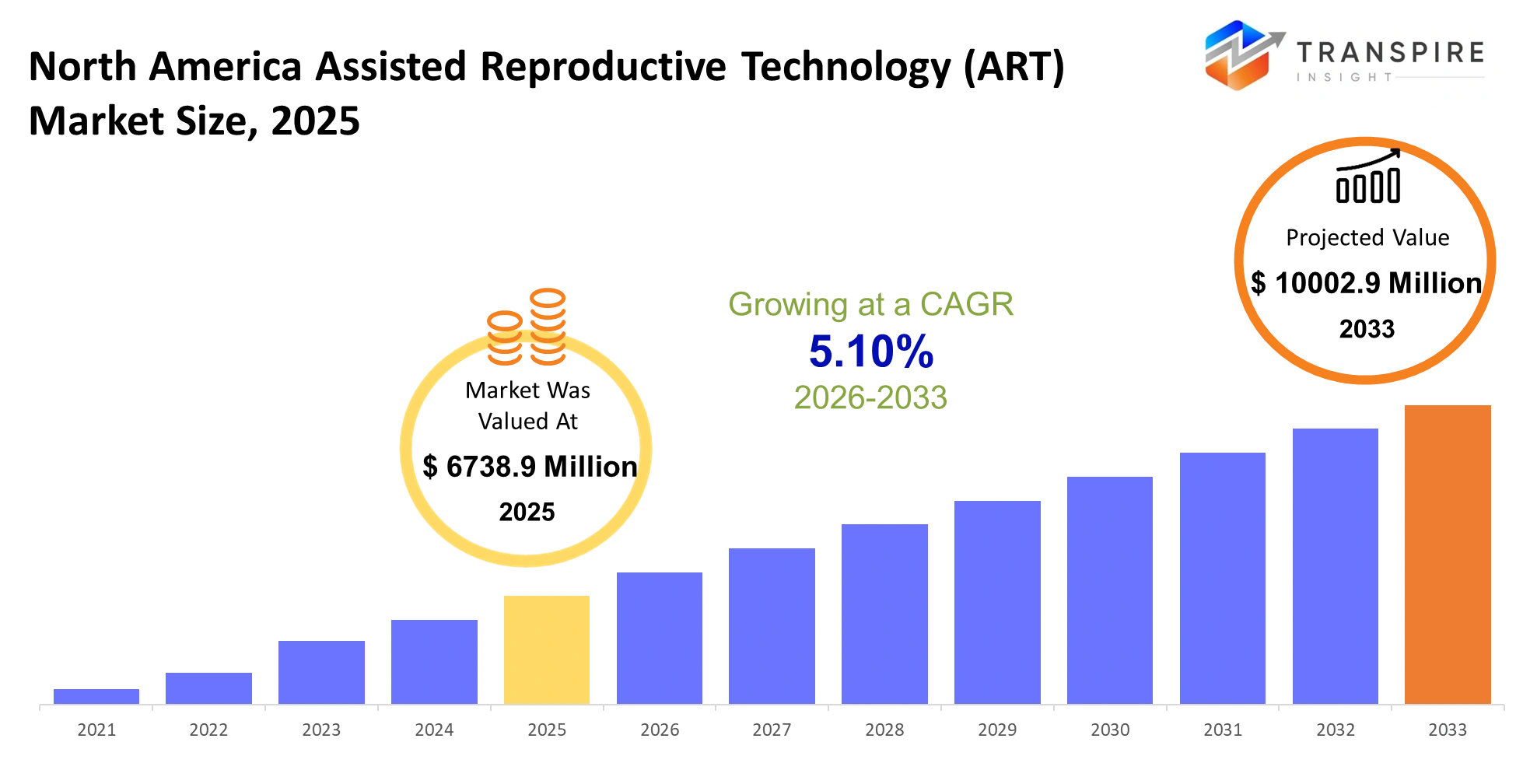
North America Assisted Reproductive Technology (ART) Market Size & Forecast:
- North America Assisted Reproductive Technology (ART) Market Size 2025: USD 6738.9 Million
- North America Assisted Reproductive Technology (ART) Market Size 2033: USD 10002.9 Million
- North America Assisted Reproductive Technology (ART) Market CAGR: 5.10%
- North America Assisted Reproductive Technology (ART) Market Segments: By Type (IVF, ICSI, Surrogacy, Fertility Drugs), By Procedure (Fresh Embryo, Frozen Embryo, Donor), By Application (Male Infertility, Female Infertility, Genetic Disorders), By End-User (Fertility Clinics, Hospitals, Patients, Research Centers).
To learn more about this report,  Download Free Sample Report
North America Assisted Reproductive Technology (ART) Market Summary:
The North America Assisted Reproductive Technology (ART) Market size is estimated at USD 6738.9 Million in 2025 and is anticipated to reach USD 10002.9 Million by 2033, growing at a CAGR of 5.10% from 2026 to 2033.
The North America Assisted Reproductive Technology (ART) Market in the healthcare and fertility services industry will function as an independent sector that provides medical treatments to help people and couples achieve pregnancy through clinical methods. The treatment will consist of in vitro fertilization and egg freezing and embryo transfer procedures which will be performed at fertility clinics and hospitals and research facilities.
The medical field will undergo changes as patients begin to expect treatment methods that increase their privacy while delivering customized care which includes better success rates and shorter treatment durations and professional emotional assistance. The design and delivery of services will continue to evolve because of changing family structures and delayed parenthood and growing acceptance of non-traditional methods of parenting which require medical and cultural adjustments from healthcare providers.
The development of laboratory techniques and genetic testing will enable better outcome prediction while automation and data-driven technologies will improve clinical processes. The United States and Canada will undergo changes in their regulatory systems which will impact how people access services and their affordability and the ethical standards that govern embryo research and genetic assessment.
What Has the Impact of Artificial Intelligence Been on the North America Assisted Reproductive Technology (ART) Market?
The North American market for assisted reproductive technology (ART) is undergoing a rapid transformation because artificial intelligence systems are changing both the operational methods of clinics and laboratories and the decision-making processes of all market participants.
Healthcare providers use this data-driven method to enhance their predictive analytics capabilities which enable them to forecast demand changes and distribute resources efficiently while adjusting to new market dynamics. The North American assisted reproductive technology (ART) market operations benefit from artificial intelligence because it enhances laboratory workflows and administrative tasks through automated smart systems.
AI-powered image analysis tools assist embryologists in selecting viable embryos with higher precision, while automated systems streamline scheduling, documentation, and patient management. The new technologies reduce costs for organizations while decreasing the chance of human mistakes which results in higher success rates and better patient outcomes. AI technology enables supply chain optimization by predicting future equipment and consumable requirements which guarantees both timely delivery and effective cost management.
The North American assisted reproductive technology market experiences both innovation and personalized services through artificial intelligence implementation. The clinics develop customized treatment programs which improve patient results and satisfaction by using specific information from each patient. The market competition forces organizations that use artificial intelligence technology to create customized reproductive solutions because this approach enables them to deliver their services more quickly and precisely than their competitors.
Key Market Trends & Insights:
- The United States dominates the North America assisted reproductive technology (ART) market, which will reach 80% market share in 2025 because of its advanced healthcare infrastructure.
- Canada represents the fastest-growing region because it will achieve a compound annual growth rate above 9% until 2030, which results from supportive reimbursement policies and rising public awareness.
- The sector of non-donor IVF cycles will achieve its highest market share of approximately 35 to 40 percent in 2025 because clinics have adopted the treatment due to its better success rates.
- The frozen embryo transfer (FET) segment stands as the second-largest market segment, which holds almost 30 percent market share that results from better cryopreservation technology.
- Preimplantation genetic testing (PGT) serves as the fastest-growing market segment because it will grow at a 10 percent compound annual growth rate until 2030 due to increasing demand for genetic testing.
- The market for infertility treatment exists as the main treatment option because it will account for more than 70 percent of the market share in 2025.
- The human body experiences infertility treatment as the main treatment option which leads to more than 70 percent of the market share.
- The human body experiences infertility treatment as the main treatment option which leads to more than 70 percent of the market share.
- Fertility clinics lead with more than 60% share in 2025 because they offer specialized services and advanced ART procedures.
- Hospitals become the most rapidly expanding end-user segment because they grow at approximately 8 to 9 percent annual compound rate which results from their ART service capacity.
- The North America assisted reproductive technology market includes CooperSurgical and Vitrolife and Thermo Fisher Scientific and Cook Medical and Progyny as its main market competitors.
- Companies are focusing on product innovation which includes AI-enabled embryo selection and time-lapse imaging systems to improve success rates.
North America Assisted Reproductive Technology (ART) Market Segmentation
By Type :
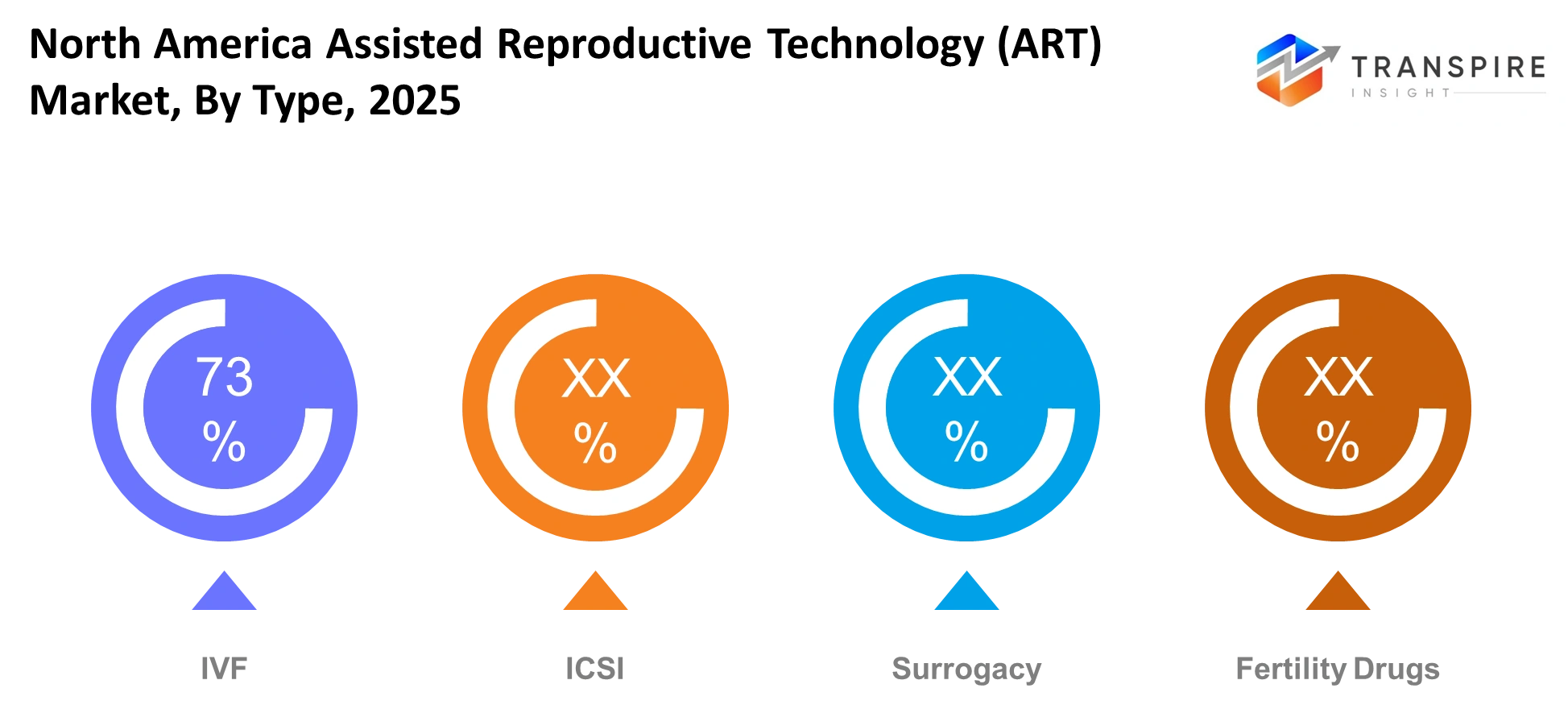
The North America Assisted Reproductive Technology (ART) Market provides multiple service categories which will meet the various needs of different medical conditions.IVF will continue its widespread application because it enables controlled fertilization and provides better success rate assessment. ICSI will serve cases with male infertility challenges while surrogacy will address complex reproductive barriers and fertility drugs will assist hormonal preparation and cycle regulation.
The increasing need for customized medical solutions will determine which treatment method doctors choose because they will base their decisions on specific medical conditions and patient age. The combination of technological advancements together with clinical expertise will help healthcare systems achieve better treatment results while making their treatment methods more structured and accessible to patients.
To learn more about this report, Download Free Sample Report
By Procedure :
The North America Assisted Reproductive Technology (ART) Market will implement different procedures which depend on how clinics manage embryos and their origin because these factors will determine both patient results and treatment duration. The fresh embryo transfer process needs to perform implantation immediately after the fertilization process whereas the frozen embryo transfer process provides storage capabilities which allow different time periods for future implementation through its adaptable cycle planning method. The donor procedures will assist people who face genetic or reproductive challenges.
The development of medical technologies will enhance freezing methods which will boost the success rates of frozen embryo transfer procedures. The expansion of donor programs will occur through enhanced screening methods and improved ethical standards which will establish a safe and trustworthy system. The available medical procedures will allow patients to decide their treatment schedule and health care choices.
By Application :
The North America Assisted Reproductive Technology (ART) Market will develop specific applications which will treat particular reproductive health issues through focused treatment methods. The treatment of male infertility will depend on ICSI methods whereas female infertility will be treated through hormonal therapies and IVF treatment methods. The applications for genetic disorders will utilize embryo screening methods to decrease the transmission of hereditary disorders.
The ART usage will increase because people understand their conditions better and doctors can identify these conditions earlier. The integration of genetic testing will enhance treatment planning processes which will result in improved patient health outcomes. Medical institutions will continue to develop better solutions which will enable them to match specific applications with the most appropriate procedures and technologies.
By End-User :
The North America Assisted Reproductive Technology (ART) Market will include multiple end-users who will participate in both service delivery and market development. Fertility clinics will operate as main service providers through their dedicated treatment facilities, while hospitals will provide complete medical services. Patients will maintain their role as main decision-makers, while research centers will drive both innovation and clinical progress.
The treatment quality and accessibility will improve through collaboration between all end-user groups. Research centers will develop better methods which clinics and hospitals will implement in their operations. Patient involvement will increase because of enhanced knowledge which will enable them to make better decisions and participate more in their treatment.
What are the Main Challenges for the North America Assisted Reproductive Technology (ART) Market Growth?
The North America assisted reproductive technology (ART) market faces several technical and operational challenges which directly impact its ability to scale operations and deliver successful treatment results. The various laboratory procedures which involve embryo culture and cryopreservation and genetic screening require laboratory technicians to work under precise environmental conditions while using sophisticated laboratory equipment.
The clinical success rates show different levels of success while biological samples exhibit different levels of performance ability. Supply chain restrictions which affect specialized reagents and culture media and laboratory equipment cause interruptions which reduce operational productivity and create significant obstacles to growth in the North America assisted reproductive technology (ART) market.
The North America assisted reproductive technology (ART) market faces challenges because of manufacturing and product distribution obstacles which inhibit its growth. The need to comply with Good Manufacturing Practices (GMP) and changing clinical standards which form strict regulatory frameworks increases business expenses while it extends the time needed to obtain product authorizations.
Advanced fertility laboratories and equipment require providers to make considerable capital investments which create financial difficulties. The combination of these factors with pricing limitations and reimbursement difficulties creates barriers which decrease profitability while it postpones the market entry of new solutions which results in persistent industry constraints.
The North America assisted reproductive technology (ART) market faces substantial market effects from adoption challenges. The lack of trained embryologists and medical professionals creates service delivery problems which primarily affect areas beyond major urban centers. The high costs of treatment combined with insufficient insurance coverage create barriers that prevent patients from accessing treatment while the lack of advanced equipment in smaller clinics prevents them from performing complex medical procedures.
Region Insights
The North America Assisted Reproductive Technology (ART) Market will experience continuous growth because rising infertility rates and increasing public knowledge about ART will drive market demand. Medical centers will implement advanced treatment methods because they include in vitro fertilization and genetic testing which enhance treatment outcomes. The demand for services will increase because people now become parents at older ages and their daily activities have changed but the government and insurance companies will provide backing that enables more people to access treatment.
The United States will lead because it possesses a robust healthcare system and its citizens spend more on fertility treatments. Public healthcare programs and growing public support for assisted reproduction will enable Canada to achieve steady development. The majority of service demand will come from urban centers while smaller areas will extend their service reach through clinic networks and technological advancements which will enhance overall accessibility.
Recent Development News
In April 2026, CooperCompanies, Inc. reported strong quarterly revenue growth driven by its CooperSurgical fertility segment. The company highlighted increased demand for IVF consumables and genetic testing solutions across North America, supporting continued expansion in ART services.
Source: https://investor.coopercos.com/
In April 2026, Thermo Fisher Scientific Inc. announced expansion of its reproductive health and IVF laboratory solutions portfolio. The company introduced upgraded embryo culture media and lab automation tools aimed at improving clinical outcomes in North American fertility clinics.
Source: https://www.thermofisher.com/
|
Report Metrics |
Details |
|
Market size value in 2025 |
USD 6738.9 Million |
|
Market size value in 2026 |
USD 7062.7 Million |
|
Revenue forecast in 2033 |
USD 10002.9 Million |
|
Growth rate |
CAGR of 5.10% from 2026 to 2033 |
|
Base year |
2025 |
|
Historical data |
2021 - 2024 |
|
Forecast period |
2026 - 2033 |
|
Report coverage |
Revenue forecast, competitive landscape, growth factors, and trends |
|
Regional scope |
North America (Canada, The United States, and Mexico) |
|
Key company profiled |
Vitrolife, CooperSurgical, Merck, Thermo Fisher, Cook Medical, Irvine Scientific, Hamilton Thorne, Genea, OvaScience, Oxford Gene, Eppendorf, Esco Micro, Rocket Medical, Nidacon, Labotect. |
|
Customization scope |
Free report customization (country, regional & segment scope). Avail customized purchase options to meet your exact research needs. |
|
Report Segmentation |
By Type (IVF, ICSI, Surrogacy, Fertility Drugs), By Procedure (Fresh Embryo, Frozen Embryo, Donor), By Application (Male Infertility, Female Infertility, Genetic Disorders), By End-User (Fertility Clinics, Hospitals, Patients, Research Centers). |
How Can New Companies Establish a Strong Foothold in the North America Assisted Reproductive Technology (ART) Market?
New companies can achieve successful market entry into the North America assisted reproductive technology (ART) market by creating their businesses to serve unserved market segments while resolving existing medical deficiencies. The establishment of market differentiation for new companies requires them to select specific research fields between advanced embryo screening and fertility preservation and male infertility diagnostic methods.
The North America assisted reproductive technology (ART) market operates through precise operations which deliver measurable results and businesses that provide data-based solutions with verified success rates can establish their reputation. The company enhances its market presence through the development of medical solutions which meet current industry demands for customized healthcare and less invasive treatment methods.
The North America assisted reproductive technology (ART) market requires continuous innovation as its main element for achieving market success. Startups that use artificial intelligence and machine learning and automation technology can enhance their embryo selection process while improving their laboratory operations and decreasing their business expenses.
Alife Health uses AI-based predictive analytics to enhance IVF decision-making while Future Fertility uses image analysis to evaluate egg quality. The innovation strategies create a strong value proposition which clinics need to achieve better outcomes and increased efficiency because they address critical business challenges.
For sustainable expansion of a business both strategic partnerships and scalable business models need to be developed. The company establishes partnerships with fertility clinics and research institutions and healthcare providers to achieve two benefits which include faster entry into new markets and improved access to clinical data. The companies need to develop their business operations through three key areas which include regulatory compliance and cost reduction and digital system implementation. New companies in the North America assisted reproductive technology market can achieve market share growth through their technological advantages and strategic partnerships and their solutions which focus on patient needs.
Key North America Assisted Reproductive Technology (ART) Market Company Insights
The North America Assisted Reproductive Technology (ART) Market will experience growth because of increasing infertility rates and people choosing to become parents at later ages and because more people now believe in using medical treatments to help them conceive. The market will see constant demand because advanced clinical practices and enhanced success rates and existing healthcare systems provide support for ART procedures, which will make patients and providers more willing to proceed with ART treatments according to regulatory standards.
The competitive environment of the market will display a strong presence of three types of businesses which include specialized fertility clinics and hospital-based centers and new private healthcare facilities. The organization will continue to develop modern technologies which will enhance patient satisfaction and improve success rates of medical treatments. The market competition will shape its development through strategic alliances and service expansions and transparent pricing, while genetic testing and embryo selection advancements will enable major market players to create unique product offerings.
Company List
- Vitrolife
- CooperSurgical
- Merck
- Thermo Fisher
- Cook Medical
- Irvine Scientific
- Hamilton Thorne
- Genea
- OvaScience
- Oxford Gene
- Eppendorf
- Esco Micro
- Rocket Medical
- Nidacon
- Labotect
What are the Key Use-Cases Driving the Growth of North America Assisted Reproductive Technology (ART) Market?
The North America assisted reproductive technology (ART) market is expanding rapidly because it serves as a vital solution for two major challenges which include increasing infertility rates and decreasing age of parenthood. The main reason for market expansion comes from in vitro fertilization (IVF) procedures which fertility clinics use to enhance their success rates for conception. The market experiences faster growth because working professionals increasingly seek elective fertility preservation options which include both egg and sperm freezing. The applications establish clinical importance for the North America assisted reproductive technology (ART) market while they extend their services to more patients.
Preimplantation genetic testing (PGT) serves as another main application for the North America assisted reproductive technology (ART) market because it enables medical professionals to identify genetic disorders at an early stage and achieve better outcomes for healthy births. This system proves essential especially for patients who face high medical risks and for individuals who belong to older age groups.The combination of AI-based embryo selection methods and time-lapse imaging systems enables medical professionals to achieve greater accuracy during their procedures while making better clinical decisions. The technology-driven applications create multiple growth opportunities which lead to improved success rates at fertility centers.
The North America assisted reproductive technology market shows growth both through essential fertility procedures and through its research and healthcare innovation activities. Biotech firms and research institutions are using ART techniques for their stem cell studies and their research on reproductive health. The system now provides two major benefits which include personalized treatment development and capacity to deliver treatments on a large scale through its digital health platform and data analytics capabilities. The market demonstrates potential for prolonged expansion through these developing use cases which are becoming essential components of contemporary medical systems.
North America Assisted Reproductive Technology (ART) Market Report Segmentation
By Type
- IVF
- ICSI
- Surrogacy
- Fertility Drugs
By Procedure
- Fresh Embryo
- Frozen Embryo
- Donor
By Application
- Male Infertility
- Female Infertility
- Genetic Disorders
By End-User
- Fertility Clinics
- Hospitals
- Patients
- Research Centers
Frequently Asked Questions
Find quick answers to common questions.
The approximate North America Assisted Reproductive Technology (ART) Market size for the market will be USD 10002.9 Million in 2033.
Key segments for the North America Assisted Reproductive Technology (ART) Market are By Type (IVF, ICSI, Surrogacy, Fertility Drugs), By Procedure (Fresh Embryo, Frozen Embryo, Donor), By Application (Male Infertility, Female Infertility, Genetic Disorders), By End-User (Fertility Clinics, Hospitals, Patients, Research Centers).
Major North America Assisted Reproductive Technology (ART) Market players are Vitrolife, CooperSurgical, Merck, Thermo Fisher, Cook Medical, Irvine Scientific, Hamilton Thorne, Genea, OvaScience, Oxford Gene, Eppendorf, Esco Micro, Rocket Medical, Nidacon, Labotect.
The North America Assisted Reproductive Technology (ART) Market size is USD 6738.9 Million in 2025.
The North America Assisted Reproductive Technology (ART) Market CAGR is 5.10%.
- Vitrolife
- CooperSurgical
- Merck
- Thermo Fisher
- Cook Medical
- Irvine Scientific
- Hamilton Thorne
- Genea
- OvaScience
- Oxford Gene
- Eppendorf
- Esco Micro
- Rocket Medical
- Nidacon
- Labotect
Recently Published Reports
-
Apr 2026
AI in Diabetic Retinopathy Market
AI in Diabetic Retinopathy Market Size, Share & Analysis Report By Type (Screening AI Systems, Diagnostic AI Systems, and Predictive AI Models), By Application Segment (Hospitals, Ophthalmology Clinics, Diagnostic Centers, and Research and Development), and Geography (North America, Europe, Asia-Pacific, Middle East and Africa, South and Central America), 2021 - 2031
-
Apr 2026
Psychometric Tests Market
Psychometric Tests Market Size, Share & Analysis Report By Type (Personality Tests, Ability/Aptitude Tests, Skill/Knowledge Tests, and Others), By Application (Talent Acquisition and Talent Management), and Geography (North America, Europe, Asia-Pacific, Middle East and Africa, South and Central America), 2021 – 2031
-
Apr 2026
Rare Biological Sample Collection Market
Rare Biological Sample Collection Market Size, Share & Analysis Report By Type (Isolation Kits & Reagent, Blood Collection Tubes, and Others), By Application (Oncology, Transcriptomics, Pharmacogenomics, and Others), and Geography (North America, Europe, Asia-Pacific, Middle East and Africa, South and Central America), 2021 – 2031
-
May 2026
Patient Lift Pendant Market
Patient Lift Pendant Market By Product Type (Wired Pendants, Wireless, Programmable), By Operation Type(Manual, Electric), By End-Users (Healthcare Professionals, Patients), By Application (Hospitals, Homecare, Rehabilitation Centers, Others), By Industry Analysis, Size, Share, Growth, Trends, and Forecasts 2021-2033
Our Clients
.jpg)