North America Anatomic Pathology Track Trace Solution Market Size & Forecast:
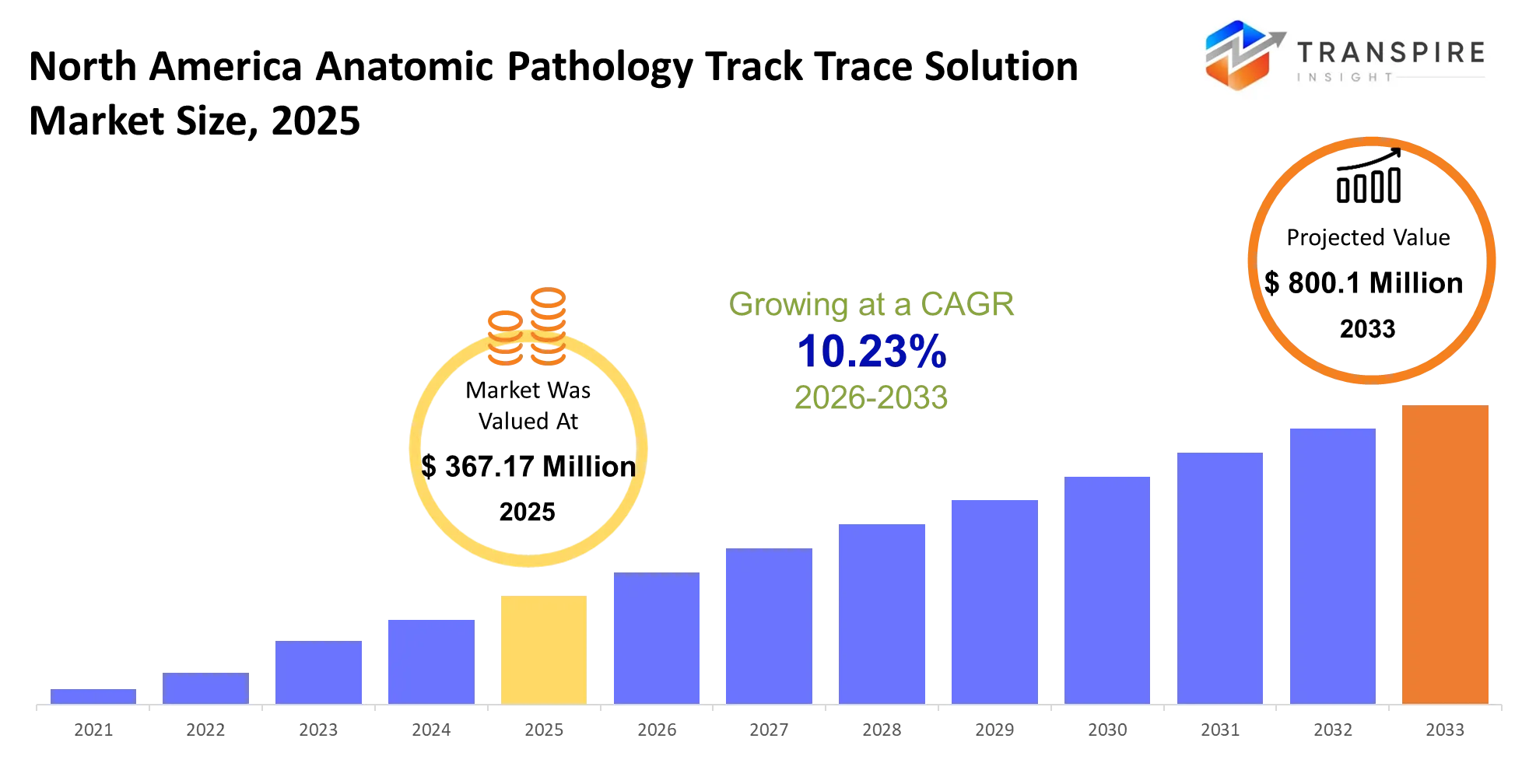
- North America Anatomic Pathology Track Trace Solution Market Size 2025: USD 367.17 Million
- North America Anatomic Pathology Track Trace Solution Market Size 2033: USD 800.1 Million
- North America Anatomic Pathology Track Trace Solution Market CAGR: 10.23%
- North America Anatomic Pathology Track Trace Solution Market Segments: By Type (Barcode Systems, RFID Systems, Software Solutions, Labeling Systems, Tracking Systems, Others), By Application (Specimen Tracking, Workflow Mgmt, Lab Automation, Diagnostics, Others), By End-User (Hospitals, Labs, Research Institutes, Others), By Deployment (Cloud, On-premises, Hybrid, Others).
To learn more about this report,  Download Free Sample Report
North America Anatomic Pathology Track Trace Solution Market Summary:
The North America Anatomic Pathology Track Trace Solution Market size is estimated at USD 367.17 Million in 2025 and is anticipated to reach USD 800.1 Million by 2033, growing at a CAGR of 10.23% from 2026 to 2033.The North America anatomic pathology track and trace solution market is basically about making tissue samples, biopsy slides, and pathology specimens fully traceable from capture through to the final diagnosis. In real practice, these systems help reduce specimen mix-ups , labeling missteps, and chain-of-custody gaps that otherwise slow down cancer diagnoses. They can also cause compliance issues, and sometimes even create malpractice exposure for labs. More and more, hospitals and reference labs lean on barcode driven workflows, RFID tracking, and connected laboratory information systems so they can keep accuracy high while they process bigger and bigger testing volumes.
Over the last five years, the market has sort of moved away from stand alone labeling gadgets and toward enterprise wide digital pathology environments, that plug into hospital IT infrastructure. That shift really started to pick up after the COVID-19 pandemic because it disrupted lab staffing and, it kind of exposed operational bottlenecks across diagnostic networks. In response, labs automated specimen handling and began using real time tracking platforms, which help keep turnaround times steady even when staffing levels are leaner.In response, laboratories automated specimen handling and began using real-time tracking platforms, which help keep turnaround times steady even when the staffing levels are leaner. Around that same period, tougher accreditation requirements and reimbursement pressure nudged providers to trim repeat tests and reduce diagnostic errors.As pathology networks consolidate across North America, track and trace offerings are turning into everyday operational infrastructure, not just “nice-to-have” compliance tools, so software subscriptions and integration based revenue keep expanding.
Key Market Insights
- The United States pretty much dominated the North America Anatomic Pathology Track Trace Solution Market, taking nearly 78% of the market share in 2025 , mostly because it has stronger laboratory infrastructure and more mature workflows in place.
- Canada is looking like the fastest-growing regional market during the forecast period , driven by healthcare digitization programs, and also by the steady expansion of pathology laboratory networks.
- Across North America, integrated care systems are pushing adoption of barcode-enabled specimen tracking platforms, aimed at cutting down those diagnostic turnaround delays which can really add up.
- At the same time, regulatory compliance obligations plus CAP accreditation standards keep pushing demand for end-to-end pathology traceability solutions across regional healthcare facilities.
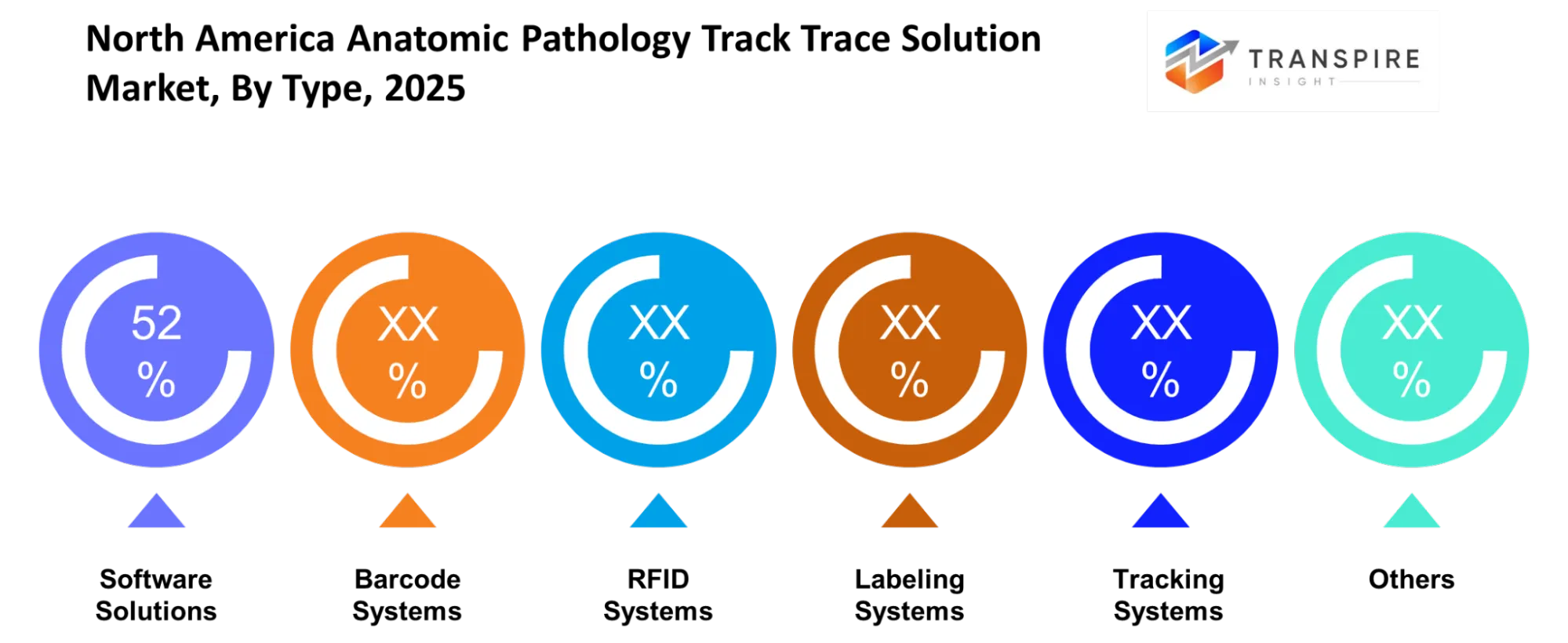
- Product & Service Software solutions led the North America Anatomic Pathology Track Trace Solution Market, with more than 46% revenue share in 2025 , and a lot of that comes down to enterprise-wide integration needs.
- Hardware systems—barcode printers and RFID scanners , for example—grab the second-largest market share because laboratories still need dependable specimen identification infrastructure that they can trust every day.
- Cloud-based pathology tracking platforms are projected to be the fastest-growing segment through 2032, supported by scalable deployment models and remote laboratory management capabilities, so teams don’t have to be on-site all the time.
- AI-enabled workflow management tools are starting to show up as higher-value options, especially for lowering specimen handling mistakes while improving laboratory productivity measurements.
- Specimen tracking and identification held around 52% market share in 2025, because pathology labs place serious emphasis on error prevention and chain-of-custody correctness , without exceptions.
- Digital pathology workflow management is the fastest-growing application segment too, helped by the increasing use of telepathology and broader cross-site diagnostic collaboration activities.
What are the Key Drivers, Restraints, and Opportunities in the North America Anatomic Pathology Track Trace Solution Market?
The most powerful pull speeding up the North America anatomic pathology track trace solution market is the fast move toward digital pathology, plus enterprise laboratory automation, kind of together, you know. That shift really picked up after the COVID-19 pandemic showed how staffing shortages, messy specimen handling, and diagnostic turnarounds delays were already happening across hospital networks. Around the same time, tighter CAP and CLIA compliance rules urged laboratories to nail down chain-of-custody precision for tissue specimens and biopsy slides. In practice, many clinicians and lab leaders now treat track-and-trace systems like core operational infrastructure, not something “nice to have” or optional software. And this mindset change, directly supports recurring revenue streams for vendors via software subscriptions, workflow integration services, and ongoing upkeep agreements.
The biggest obstacle is still the split up IT landscape inside hospitals, and also within diagnostic laboratories. A lot of pathology groups still rely on older laboratory information systems that can’t properly speak with newer barcode, RFID, and digital imaging tools. Upgrading or swapping these platforms means heavy upfront capital, plus workflow redesign, and staff re-education. Since pathology work can’t afford downtime, modernization attempts get pushed out and postponed for multiple budget cycles. This structural snag ends up slowing enterprise deployments and it also dampens uptake among mid-sized labs with limited technology budgets, even when the need feels urgent.
A pretty big growth chance sits in AI-empowered digital pathology networks, sort of, tied together via cloud infrastructure. In the United States and Canada, large healthcare systems are slowly, or maybe quickly, becoming more central about pathology operations across multiple locations, partly to deal with pathologist shortages and to push better diagnostic consistency. Cloud-based track and trace platforms that also plug in AI image analysis can help with remote case sharing, more or less automated specimen verification, and kind of real-time workflow oversight. The vendors that bring traceability together with predictive analytics along with telepathology features are, honestly, in a strong place to catch the next wave of enterprise lab spending.
What Has the Impact of Artificial Intelligence Been on the North America Anatomic Pathology Track Trace Solution Market?
Artificial intelligence and modern digital tech are quietly reshaping pathology track and trace platforms, not just as passive labeling setups anymore but more like kind of real time operational management tools. In a lot of labs, teams are using AI enabled workflow engines to take over specimen routing, barcode checks, slide tracking, plus chain-of-custody oversight across those big high volume pathology networks. With integrated control systems, it becomes possible to catch mismatched patient identifiers, spot missing specimens, and also nudge urgent oncology cases to the front, all without someone standing there doing manual intervention every time. As a result there are fewer specimen handling mistakes and turnaround timing stays steadier across multi site lab environments.
On top of that, machine learning models are bolstering predictive choices within pathology operations. Analytics platforms look at specimen flow patterns, scanner utilization, and lab throughput metrics, to anticipate workflow bottlenecks before delays really appear. Some hospital groups even run predictive maintenance routines that watch digital slide scanners and automated staining systems, this helps reduce unexpected downtime. Labs rolling out AI supported workflow orchestration have noted directional gains in processing efficiency, fewer repeat tests, and quicker diagnostic reporting, especially for cancer diagnostics where turnaround speed basically feeds straight into treatment planning.
Still, AI adoption has a big obstacle, the integration complexity with older laboratory information systems. A lot of pathology departments sit on fragmented IT landscapes, with inconsistent data structures, which makes broad scale AI rollouts costly, time heavy, and operationally disruptive, sometimes more than teams expect at first.
Key Market Trends
- RFID platforms to cut pathology identification errors by double digit percentages , honestly . After the post pandemic staffing shortages hit, labs started leaning harder into automated slide tracking systems and it kinda sped up digital pathology spending across multi site healthcare networks , especially after 2022 and beyond.
- Between 2020 and 2025, CAP and CLIA compliance audits got noticeably more strict , so pathology laboratories had to tighten chain of custody records and beef up specimen traceability infrastructure , no exceptions.
- Then after 2023, cloud based pathology workflow platforms started catching on more, because labs cared about remote diagnostics, centralized reporting, and that cross site collaboration angle , like , all together.
- Brands like Roche Diagnostics and Leica Biosystems also expanded AI enabled pathology offerings, aiming to improve lab throughput and smooth out turnaround variability, which is the whole point.
- Independent diagnostic laboratories began outsourcing IT infrastructure management more often after 2022. So vendor competition shifted, from hardware sales to subscription driven software deals and managed service contracts, pretty straightforward.
- By 2024, AI powered workflow analytics turned into a real differentiator, since it helps laboratories anticipate bottlenecks, improve specimen routing , and lower repeat testing rates.
- And consolidation among North American healthcare systems kept rising, which increased demand for enterprise scale pathology informatics platforms that can standardize procedures across labs in different locations.
- For labs dealing with heavy oncology testing loads, real time specimen monitoring technologies were adopted more between 2021 and 2025, mainly to minimize biopsy misidentification risks.
- Lastly, vendors changed how they compete: less focus on hardware focused sales, more on integrated digital ecosystems that blend laboratory information systems, slide imaging, and predictive workflow analytics in one package .
North America Anatomic Pathology Track Trace Solution Market Segmentation
By Type
Software solutions are still kinda holding the lead in this type of segment, mainly because healthcare organizations are pushing harder for centralized specimen visibility, smoother workflow linking, and tighter compliance management across pathology departments, you know, all at once. Barcode systems keep seeing solid adoption too, mostly since the setup expenses are lower, and the identification reliability stays steady even in busy high-volume labs.
RFID systems are also getting more momentum, especially across bigger hospital networks, where having real-time specimen whereabouts helps operational throughput a bit and also lowers chain of custody risks. Labeling systems and tracking hardware are still basically needed for day-to-day lab work , even if the competition there has become sharper lately, partly because many products are getting standardized. Demand is starting to lean toward integrated platforms that blend software analytics with automatic scanning and digital pathology infrastructure. Manufacturers are already reacting by rolling out AI enabled workflow aids and more cloud connectivity, almost as a default feature now. Looking ahead, investment will likely drift toward predictive workflow management, remote diagnostics support , and enterprise systems that scale up, so multiple laboratory sites can connect under one shared pathology informatics framework.
To learn more about this report, Download Free Sample Report
By Application
Specimen tracking still is the main application segment, at least for now, because pathology labs are under more and more pressure to stop identification errors and still stay inside regulatory compliance all the way through diagnostic workflows. In parallel, workflow management applications have kept growing, almost quietly, as teams try to optimize slide processing, squeeze turnaround times, and coordinate operations across several departments—somewhat like a careful chain reaction. Laboratory automation systems are also getting serious traction due to staffing shortages and the rising oncology testing volumes in North America. Diagnostic focused applications are increasingly tying together digital imaging and AI assisted analysis, to make reporting more consistent, and also to back precision medicine programs.
Meanwhile, smaller application categories keep showing up for those more specific needs, like sample storage monitoring and quality assurance management, they are not going away. Overall, demand trends kind of lean toward end to end automation, not merely isolated pathology functions. So tech providers are really prioritizing interoperable systems that can link specimen tracking, lab analytics, and digital pathology workflows together with less friction, more or less. Looking ahead, the market direction points toward stronger investment in predictive operational tools, tools that can boost productivity while cutting repeat testing, and reducing specimen handling delays.
By End-User
Hospitals make up the biggest slice inside the end-user segment, mainly because big healthcare systems handle very high daily specimen volumes and they need pretty standardized pathology workflows across several sites. Independent diagnostic laboratories come next as the second-largest chunk, largely as more hospitals outsource pathology work to gain cost efficiency, plus a bit more operational wiggle-room. Research institutes are still moving forward by adopting more advanced pathology tracking systems, mainly to help biobanking efforts, translational medicine, and clinical trial work that never really stops. Smaller health facilities and specialty clinics, meanwhile, tend to be slower at adoption, not because they don’t care, but mostly because budgets are tight, and the testing volumes are lower.
Overall demand is starting to show a clear preference for scalable systems, able to back enterprise-wide lab consolidation, and even remote teamwork between pathologists. Hospitals also lean toward integrated platforms where pathology operations connect into the wider hospital information systems, so it all feels connected not scattered, y’know. Looking ahead, future momentum will probably go with vendors who can deliver subscription based software models and AI enabled analytics, plus centralized workflow control tools , meaning more of those “one place to manage” vibes. It should fit big regional lab networks and academic medical centers better too.
By Deployment
On premises deployment still pretty much dominates the overall segment since quite a few pathology laboratories keep putting data control first, alongside cybersecurity oversight and the need for direct linkage with legacy hospital information systems. Cloud style deployment models are growing fast though, mainly because healthcare providers want more flexible infrastructure, remote access, and frankly lower upfront hardware costs. Hybrid deployment, in the middle, seems to be getting more traction too, especially for multi-site health organizations that need secure local storage, but also want cloud based cooperation and shared workflows. Smaller deployment categories are still around and they keep supporting specialized lab environments, where regulatory rules or day to day operations are a bit more unusual. In general, the momentum is tilting toward cloud connected platforms, because digital pathology really relies on high volume image sharing, centralized analytics, and real time specimen tracking across facilities that are spread out geographically. Providers are putting a lot of money into secure cloud architecture and interoperability features, partly to calm the old worries about patient data protection and awkward system integration. Going forward, the competitive edge will likely come down to deployment flexibility, scalable subscription pricing, and smooth integration with enterprise laboratory informatics platforms, that sort of thing.
What are the Key Use Cases Driving the North America Anatomic Pathology Track Trace Solution Market?
The main use case kinda revolves around specimen identification plus chain of custody management in hospitals and these high volume diagnostic labs. In practice, pathology departments lean on barcode and tracking platforms to minimize biopsy labeling errors , speed up cancer diagnostics, and also keep CAP and CLIA compliance steady during the whole daily specimen workflow.
There are also these nearby applications that are growing fast into lab workflow orchestration and digital pathology collaboration. Independent laboratories and academic medical centers are using integrated tracking systems more often to help coordinate slide imaging, automate case routing, and enable remote pathology consultations across wider regional healthcare networks , not just one site.
On top of that, emerging use cases show up with AI assisted specimen prioritization and predictive laboratory analytics. Big healthcare systems are trying out cloud connected pathology platforms that surface workflow bottlenecks, forecast equipment maintenance requirements, and help precision oncology programs via centralized multi site diagnostic management.
|
Report Metrics |
Details |
|
Market size value in 2025 |
USD 367.17 Million |
|
Market size value in 2026 |
USD 404.7 Million |
|
Revenue forecast in 2033 |
USD 800.1 Million |
|
Growth rate |
CAGR of 10.23% from 2026 to 2033 |
|
Base year |
2025 |
|
Historical data |
2021 - 2024 |
|
Forecast period |
2026 - 2033 |
|
Report coverage |
Revenue forecast, competitive landscape, growth factors, and trends |
|
Country scope |
North America (Canada, The United States, and Mexico) |
|
Key company profiled |
Thermo Fisher, Danaher, Roche, Abbott, Siemens Healthineers, Agilent, Bio-Rad, Qiagen, BD, Sakura Finetek, Leica Biosystems, Philips, GE Healthcare, Oracle, IBM |
|
Customization scope |
Free report customization (country, regional & segment scope). Avail customized purchase options to meet your exact research needs. |
|
Report Segmentation |
By Type (Barcode Systems, RFID Systems, Software Solutions, Labeling Systems, Tracking Systems, Others), By Application (Specimen Tracking, Workflow Mgmt, Lab Automation, Diagnostics, Others), By End-User (Hospitals, Labs, Research Institutes, Others), By Deployment (Cloud, On-premises, Hybrid, Others) |
Which Regions are Driving the North America Anatomic Pathology Track Trace Solution Market Growth?
The United States is in the lead for this regional market, mostly because the big healthcare organizations keep putting serious money into digital pathology infrastructure, lab automation and, enterprise specimen tracking platforms. Strict CAP and CLIA rules have really nudged hospitals and diagnostic labs to modernize chain-of-custody handling for tissue specimens and biopsy slides. You can see it in how major academic medical centers, national lab networks, and oncology-driven healthcare providers together form a mature ecosystem that helps with ongoing upgrades and also keeps long-term software agreements running. And then, the strong working relationship between pathology software vendors, hospital IT teams, and diagnostic equipment makers kind of locks in that leadership position.
Canada sits as the second-largest regional contributor, but the steadiness there is more about coordinated healthcare digitization plans than about heavy private spending. Provincial healthcare systems are increasingly aligning pathology workflows across centralized laboratory networks, to improve diagnostic consistency and cut down on repetitive operations. Compared with the United States, adoption feels a bit more gradual, still, the long procurement timelines plus government-supported modernization efforts end up making revenue for solution providers more predictable. Research groups and university-affiliated medical centers matter as well, since they expand digital pathology rollouts for precision medicine and clinical research tasks.
Mexico seems to be moving, like quickly, into the fastest growing regional market because of new investments in private diagnostic infrastructure plus those lab modernization programs. At the same time, cancer screening initiatives keep expanding, and people are asking for better diagnostic accuracy, so private hospital groups are starting to use barcode based specimen tracking and cloud connected pathology systems. On top of that, international healthcare partnerships and the growth of medical tourism are adding pressure on labs to match North American quality standards, and also to get reports out faster, like sooner than before. So, all this momentum is opening up real chances for vendors with scalable, cost efficient pathology informatics platforms from 2026 to 2033. Especially where urban healthcare networks are growing fast, and there’s a lot of room to expand.
Who are the Key Players in the North America Anatomic Pathology Track Trace Solution Market and How Do They Compete?
So the competitive landscape looks kinda like there’s moderate consolidation, but not fully, with a smaller set of diagnostics and pathology technology firms that still hold a big chunk of enterprise lab contracts. In the past it was more about who could undercut hardware pricing, now it seems competition leans hard into workflow integration, AI enabled pathology analytics , and making everything play nicely with hospital information systems. The bigger incumbents keep defending their spot using long term healthcare partnerships and broader digital pathology ecosystems, not just one product. Meanwhile the smaller, more software focused players go after specific , sort of overlooked laboratory automation gaps with cloud based platforms.
And buyers, they now tend to prioritize vendors who can bundle specimen traceability, digital imaging, and predictive workflow administration all together in one operating environment, instead of piece by piece.
Roche Diagnostics stands out with integrated digital pathology systems that bring slide imaging together with AI assisted analysis and specimen tracking, all folded into its wider oncology diagnostics infrastructure. They also do strategic collaborations with healthcare providers and software developers, which helps interoperability across hospital networks and makes enterprise deployment feel more scalable. Leica Biosystems , on the other hand, competes by emphasizing automation driven pathology workflows that are built for high volume labs handling complicated oncology cases. Their advantage comes from tight integration between tissue processing equipment, slide scanners, and laboratory informatics platforms, which supports operational efficiency in centralized pathology settings.
Thermo Fisher Scientific is kind of zeroing in on expanding laboratory informatics and specimen management through acquisitions and some cross platform software integration, so it’s not just one thing. They’ve got broad diagnostic infrastructure, plus decent long term ties with hospitals ,which helps lock in enterprise contracts across North America. On the other side Sakura Finetek differentiates more via specialized pathology automation systems, these improve workflow consistency and also cut down on manual specimen handling mistakes, kinda directly. Then Hamamatsu Photonics keeps pushing forward in digital slide imaging and high resolution pathology scanning, aiming at academic medical centers and research driven healthcare networks that are actively looking for advanced telepathology ,and remote diagnostic features.
Company List
- Thermo Fisher
- Danaher
- Roche
- Abbott
- Siemens Healthineers
- Agilent
- Bio-Rad
- Qiagen
- BD
- Sakura Finetek
- Leica Biosystems
- Philip
- GE Healthcare
- Oracle
- IBM
Recent Development News
In May 2026, Roche to Acquire U.S.-Based PathAI to Expand Digital Pathology Capabilities: Swiss healthcare major Roche announced an agreement to acquire Boston-based PathAI in a deal valued at up to $1.05 billion. The acquisition strengthens Roche’s AI-enabled pathology workflow portfolio and supports automated specimen analysis and precision diagnostics across North American laboratories.
Source: https://www.reuters.com
In March 2026, Leica Biosystems launched the Next-Generation Aperio GT Elite Scanner: Leica Biosystems introduced the Aperio GT Elite scanner and Aperio iQC software to improve digital pathology workflows and slide quality management. The launch is aimed at helping pathology labs increase specimen traceability, workflow automation, and diagnostic efficiency in North America.
Source: https://www.prnewswire.com
What Strategic Insights Define the Future of the North America Anatomic Pathology Track Trace Solution Market?
The North America anatomic pathology track trace solution market feels like it is slowly, sorta structurally moving toward fully integrated digital pathology ecosystems, where specimen tracking, AI assisted diagnostics, and lab analytics all kinda run through one unified cloud based platform. The main driver behind this shift is healthcare network consolidation, which then forces standardized pathology workflows across labs that are spread out geographically, and also tries to cope with pathologist shortages and the growing complexity in oncology testing. In the next five to seven years, the vendors that can bring interoperability, predictive workflow intelligence , and real enterprise scale deployment together will probably win the most solid long-term contract value.
There is also a lesser talked about risk, vendor concentration inside the digital pathology infrastructure. Bigger healthcare systems are leaning on a small set of software and imaging providers, so if interoperability is limited, or if a cybersecurity incident hits, or if pricing pressure suddenly shows up , the whole operation can be a bit fragile. At the same time, there is a real opportunity growing too, AI enabled remote pathology networks in underserved regional healthcare systems and community hospitals. Strategic edge is likely to go to companies investing early in open architecture platforms , plus partnership driven integration models rather than those proprietary stand alone systems that make cross network scale harder.
North America Anatomic Pathology Track Trace Solution Market Report Segmentation
By Type
- Barcode Systems
- RFID Systems
- Software Solutions
- Labeling Systems
- Tracking Systems
- Others
By Application
- Specimen Tracking
- Workflow Mgmt
- Lab Automation
- Diagnostics
- Others
By End-User
- Hospitals
- Labs
- Research Institutes
- Others
By Deployment
- Cloud
- On-premises
- Hybrid
- Others
Frequently Asked Questions
Find quick answers to common questions.
The approximate North America Anatomic Pathology Track Trace Solution Market size for the market will be USD 800.1 Million in 2033.
The key segments of the North America Anatomic Pathology Track Trace Solution Market are By Type (Barcode Systems, RFID Systems, Software Solutions, Labeling Systems, Tracking Systems, Others), By Application (Specimen Tracking, Workflow Mgmt, Lab Automation, Diagnostics, Others), By End-User (Hospitals, Labs, Research Institutes, Others), By Deployment (Cloud, On-premises, Hybrid, Others).
Major players in the North America Anatomic Pathology Track Trace Solution Market are Thermo Fisher, Danaher, Roche, Abbott, Siemens Healthineers, Agilent, Bio-Rad, Qiagen, BD, Sakura Finetek, Leica Biosystems, Philips, GE Healthcare, Oracle, IBM.
The current market size of the North America Anatomic Pathology Track Trace Solution Market is USD 367.17 Million in 2025.
The North America Anatomic Pathology Track Trace Solution Market CAGR is 10.23%.
- Thermo Fisher
- Danaher
- Roche
- Abbott
- Siemens Healthineers
- Agilent
- Bio-Rad
- Qiagen
- BD
- Sakura Finetek
- Leica Biosystems
- Philip
- GE Healthcare
- Oracle
- IBM
Recently Published Reports
-
Apr 2026
AI in Diabetic Retinopathy Market
AI in Diabetic Retinopathy Market Size, Share & Analysis Report By Type (Screening AI Systems, Diagnostic AI Systems, and Predictive AI Models), By Application Segment (Hospitals, Ophthalmology Clinics, Diagnostic Centers, and Research and Development), and Geography (North America, Europe, Asia-Pacific, Middle East and Africa, South and Central America), 2021 - 2031
-
Apr 2026
Psychometric Tests Market
Psychometric Tests Market Size, Share & Analysis Report By Type (Personality Tests, Ability/Aptitude Tests, Skill/Knowledge Tests, and Others), By Application (Talent Acquisition and Talent Management), and Geography (North America, Europe, Asia-Pacific, Middle East and Africa, South and Central America), 2021 – 2031
-
Apr 2026
Rare Biological Sample Collection Market
Rare Biological Sample Collection Market Size, Share & Analysis Report By Type (Isolation Kits & Reagent, Blood Collection Tubes, and Others), By Application (Oncology, Transcriptomics, Pharmacogenomics, and Others), and Geography (North America, Europe, Asia-Pacific, Middle East and Africa, South and Central America), 2021 – 2031
-
May 2026
Patient Lift Pendant Market
Patient Lift Pendant Market By Product Type (Wired Pendants, Wireless, Programmable), By Operation Type(Manual, Electric), By End-Users (Healthcare Professionals, Patients), By Application (Hospitals, Homecare, Rehabilitation Centers, Others), By Industry Analysis, Size, Share, Growth, Trends, and Forecasts 2021-2033
Our Clients
.jpg)