

North America Advanced Structural Ceramics Market Size & Forecast:
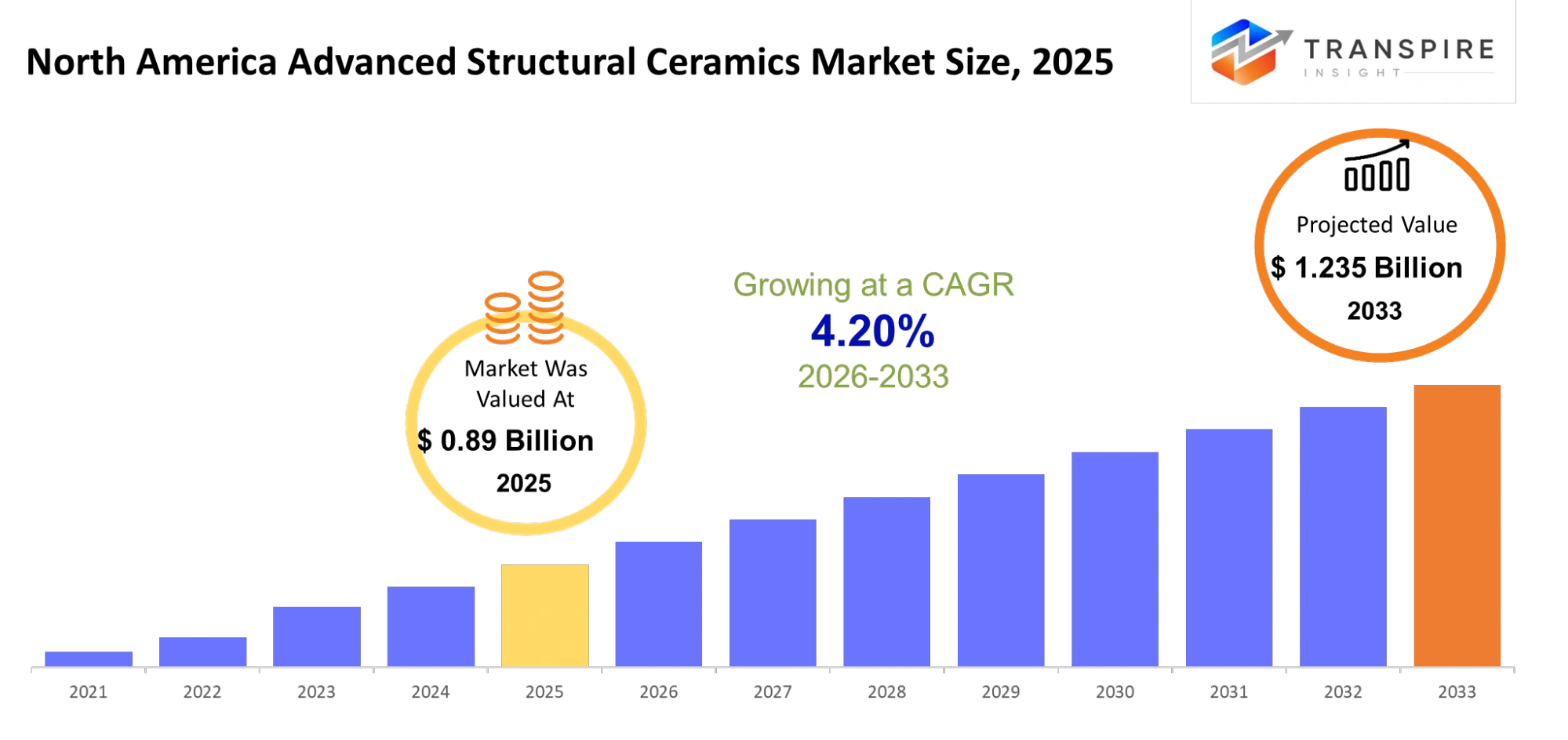
- North America Advanced Structural Ceramics Market Size 2025: USD 0.89 Billion
- North America Advanced Structural Ceramics Market Size 2033: USD 1.235 Billion
- North America Advanced Structural Ceramics Market CAGR: 4.20%
- North America Advanced Structural Ceramics Market Segments: By Material (Alumina, Zirconia, Silicon Carbide), By Application (Electronics, Automotive, Aerospace), By End-User (Industrial, Defense)
To learn more about this report,  Download Free Sample Report
North America Advanced Structural Ceramics Market Summary:
The North America Advanced Structural Ceramics Market size is estimated at USD 0.89 Billion in 2025 and is anticipated to reach USD 1.235 Billion by 2033, growing at a CAGR of 4.20% from 2026 to 2033. Developing advanced structural ceramics for North America which includes Canada and the United States and Mexico requires precise part engineering to create high-performance materials used in aerospace medical and semiconductor applications. Customers demand products with extended durability thus manufacturers will focus on creating items that offer lightweight strength and thermal stability and wear resistance. The ceramic solutions will become essential for manufacturers because they provide a solution that meets both emission control and energy efficiency regulations. The introduction of three-dimensional printing and nano-ceramic technology will create new design possibilities. The United States will implement stricter supply chain regulations which will result in higher domestic production while companies will choose products based on their ability to meet specific needs and maintain consistent performance. All industries will continue to prioritize the need for consistent performance throughout their operations.
Key Market Trends & Insights:
The demand for advanced ceramics will increase through time because industries need materials that provide both precise measurement and long-lasting performance. Aerospace and defense buyers will shift toward components that can withstand high temperatures but remain unchanged in shape. Medical device manufacturers will use ceramic materials because of their biocompatibility with human tissue which will require suppliers to improve production processes while delivering higher quality products that meet rigorous performance standards.
Additive manufacturing and better sintering methods will become the main factors driving manufacturing technological advancements. The new developments will create opportunities to produce more complex shapes which can be manufactured with greater precision while reducing both material waste and production duration. Companies will choose to invest in digital modeling tools which will enable them to create accurate designs that can be quickly modified in response to changing industrial standards and customer needs.
Sustainability pressures will influence material selection across sectors. The US and Canadian governments will promote emission reductions and energy-efficient systems which will lead industries to adopt ceramic materials instead of traditional metals. Although recycling remains challenging, eco-friendly processing innovations will help businesses achieve their environmental targets and fulfill their commitment to social responsibility.
The growing significance of regional production will lead companies to modify their supply chain management strategies. Companies will establish domestic supply networks to maintain product quality while decreasing their dependence on global suppliers. Customization will become the primary factor that differentiates businesses as clients demand customized ceramic solutions which meet their specific operational needs and reliability requirements.
North America Advanced Structural Ceramics Market Segmentation
By Material
Alumina- Alumina will continue to dominate because it provides both affordable pricing and reliable mechanical strength. The material will become a common choice for electrical insulation and durable components which need to perform consistently under moderate stress conditions. Manufacturers will focus on improving purity levels to enhance thermal resistance and extend product durability across demanding industrial environments.
Zirconia- Zirconia will become more popular for applications which need high material strength and resistance to cracking. The material will suit medical implants and precision tools because it can withstand mechanical shock. Future developments will target further structural stabilization which will enable the material to meet the needs of industries that require dependable performance and structural strength.
Silicon Carbide- Silicon carbide will experience increasing demand from applications which need to operate in extreme temperature and corrosive environments. The material will become suitable for aerospace and energy applications because of its lightweight design and high strength properties. New processing methods will provide improved results which will enable industries to use high-performance systems that require both efficiency and endurance.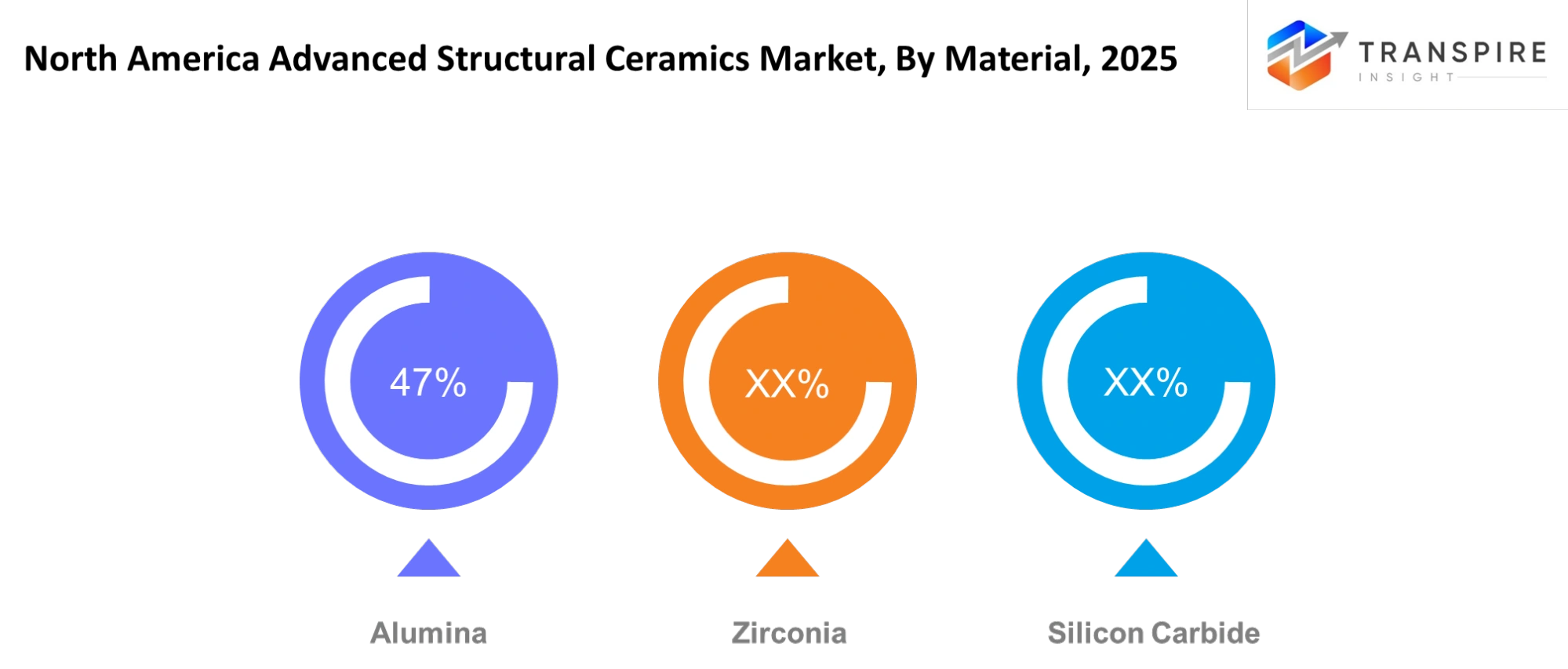
To learn more about this report, Download Free Sample Report
By Application
Electronics- The electronics sector will increase its use of ceramic materials because these materials provide both insulation and heat management capabilities. The need for materials that can withstand higher thermal loads without breaking down will emerge because devices continue to develop smaller sizes and greater power efficiency. The development of ceramic substrates and components for semiconductors and circuit systems will experience a major boost from this situation.
Automotive- Automotive applications will shift toward ceramics to support fuel efficiency and emission control requirements. The components which include sensors and catalytic converters and braking systems will receive advantages from enhanced thermal and wear resistance properties. The growing electric vehicle market will utilize ceramics for both battery systems and power electronics which will improve safety and performance standards.
Aerospace- The aerospace industry will recognize the value of ceramics because they can endure extreme conditions which occur during their operational use. The materials will be used in aircraft and spacecraft systems to achieve weight reductions while keeping their structural integrity. The future adoption of these materials will increase because manufacturers require materials which provide fuel savings and engine efficiency improvements without safety risks.
By End-User
Industrial- Industrial users will also use the advanced ceramics materials to boost the performance of their industrial equipment and increase their lifespan. The materials will be used to boost the performance of industrial machines that are exposed to conditions of abrasion and heat and chemical contacts. The industrial sector will increasingly prefer to use the ceramics materials to boost the performance of their industrial equipment and increase their lifespan, especially in the production of heavy machines and processing plants where the lifespan of the machines is a critical determinant of their productivity.
Defense- Defense will also be a sector where the ceramics materials will be applied, and this will be based on the fact that the materials have the advantage of offering high strength-to-weight ratios and protection against extreme environmental conditions. The materials will be applied in the production of armor and surveillance machines, and this will be influenced by the future needs of the sector, which will be driven by the need to have materials that will enhance the reliability of their operations.
Regional Insights
The United States will lead regional demand because aerospace and semiconductor and defense activities will create strong economic demand. Companies will invest in advanced ceramic solutions to meet strict performance expectations and regulatory standards. Research institutions and private firms will work together to create new materials which they will develop into commercial products for precision industrial and technological uses.
Canada will focus on manufacturing sustainability and clean technology adoption which will determine how ceramics are used within energy and environmental applications. Local industries will investigate materials which enhance operational efficiency while complying with ecological regulations. University and manufacturer partnerships will enhance product development processes and government backing will help develop domestic manufacturing capabilities which reduce dependence on imported high-quality materials.
Mexico will experience gradual expansion because its automotive and electronics manufacturing sectors continue to grow. The need for long-lasting materials which withstand high temperatures will increase because production standards become more demanding. Manufacturers will search for budget-friendly ceramic materials which will boost their product durability. Cross-border trade agreements will facilitate material distribution while helping local businesses adopt new components that drive supply chain progress.
North American countries will work together to build supply chain networks which combine their technological advancements. Companies will choose to source materials from local suppliers because it helps them maintain operations while reducing potential interruptions. The need for performance enhancement and personalized solutions will drive center-based research activities. Advanced ceramics will enter fundamental industrial processes which need high strength materials as sectors advance their technologies.
Recent Development News
Expansion of Domestic Manufacturing and Semiconductor Integration
Recent developments in the United States highlight a strong push toward domestic production of advanced ceramics, supported by policy initiatives aimed at strengthening semiconductor supply chains. Materials such as silicon carbide are gaining traction in power electronics and electric systems, enabling more efficient and compact designs across industries.
Focus on Sustainable and High-Performance Material Innovation
Canada is witnessing increased attention toward environmentally aligned ceramic processing and clean technology integration. Research collaborations are advancing materials that support energy-efficient systems and industrial decarbonization. This shift reflects broader national priorities to reduce environmental impact while maintaining high-performance standards in sectors such as energy, aerospace, and advanced manufacturing.
|
Report Metrics |
Details |
|
Market size value in 2025 |
USD 0.89 Billion |
|
Market size value in 2026 |
USD 0.926 Billion |
|
Revenue forecast in 2033 |
USD 1.235 Billion |
|
Growth rate |
CAGR of 4.20% from 2026 to 2033 |
|
Base year |
2025 |
|
Historical data |
2021 – 2024 |
|
Forecast period |
2026 – 2033 |
|
Report coverage |
Revenue forecast, competitive landscape, growth factors, and trends |
|
Country scope |
North America (Canada, The United States, and Mexico) |
|
Key company profiled |
Kyocera, CoorsTek, CeramTec, Morgan Advanced Materials, Saint-Gobain, NGK Insulators, 3M, Rauschert, McDanel, Superior Technical Ceramics, Blasch Precision, Elan Technology, Ortech, LSP Industrial Ceramics, Advanced Ceramics Manufacturing |
|
Customization scope |
Free report customization (country, regional & segment scope). Avail customized purchase options to meet your exact research needs. |
|
Report Segmentation |
By Material (Alumina, Zirconia, Silicon Carbide), By Application (Electronics, Automotive, Aerospace), By End-User (Industrial, Defense) |
Key North America Advanced Structural Ceramics Market Company Insights
Key players in the North America (Canada, The United States, and Mexico) advanced structural ceramics market will continue to strengthen their position through material innovation and sector-specific solutions. Companies such as CoorsTek, Kyocera, Saint-Gobain, 3M, and Morgan Advanced Materials will focus on high-performance ceramics for electronics, aerospace, and defense applications, enhancing durability and efficiency. Their strategies will emphasize localized manufacturing, research partnerships, and advanced processing technologies to meet evolving industrial demands.
Company List
- Kyocera
- CoorsTek
- CeramTec
- Morgan Advanced Materials
- Saint-Gobain
- NGK Insulators
- 3M
- Rauschert
- McDanel
- Superior Technical Ceramics
- Blasch Precision
- Elan Technology
- Ortech
- LSP Industrial Ceramics
- Advanced Ceramics Manufacturing
North America Advanced Structural Ceramics Market Report Segmentation
By Material
- Alumina
- Zirconia
- Silicon Carbide
By Application
- Electronics
- Automotive
- Aerospace
By End-User
- Industrial
- Defense
Frequently Asked Questions
Find quick answers to common questions.
The Approximate North America Advanced Structural Ceramics Market size for the Market will be USD 1.235 Billion in 2033.
Key Segments for the North America Advanced Structural Ceramics Market By Material (Alumina, Zirconia, Silicon Carbide), By Application (Electronics, Automotive, Aerospace), By End-User (Industrial, Defense).
Major Players in the North America Advanced Structural Ceramics Market are Kyocera, CoorsTek, CeramTec, Morgan Advanced Materials, Saint-Gobain, NGK Insulators, 3M, Rauschert, McDanel, Superior Technical Ceramics, Blasch Precision, Elan Technology, Ortech, LSP Industrial Ceramics, Advanced Ceramics Manufacturing.
The Current North America Advanced Structural Ceramics Market size is USD 0.89 Billion in 2025.
The North America Advanced Structural Ceramics Market CAGR is 4.20%.
- Kyocera
- CoorsTek
- CeramTec
- Morgan Advanced Materials
- Saint-Gobain
- NGK Insulators
- 3M
- Rauschert
- McDanel
- Superior Technical Ceramics
- Blasch Precision
- Elan Technology
- Ortech
- LSP Industrial Ceramics
- Advanced Ceramics Manufacturing
Recently Published Reports
-
Apr 2026
Healthcare Polymer Packaging Market
Healthcare Polymer Packaging Market Size, Share & Analysis Report By Packaging Type (Syringes, IV Bottles and Pouches, Clamshells, Blisters, Bottles & Jars, Containers, Tubes, IV Parental Packaging, Others), By Type (Regulated, Non-regulated), By Polymer Type (LDPE (Low-Density Polyethylene), HDPE (High-Density Polyethylene), Homo-polymer (Homo), Random Copolymer (Random), Block Copolymer (Block), PET, Polystyrene, Polyvinyl Chloride, Polyamide/EVOH, Others), and Geography (North America, Europe, Asia-Pacific, Middle East and Africa, South and Central America), 2021 - 2031
-
Apr 2026
Hydrophilic Tape (Waterstop) Market
Hydrophilic Tape (Waterstop) Market Size, Share & Analysis Report By Type (Bentonite-Based Hydrophilic Tape, Rubber-Based Hydrophilic Tape), By Application (Residential Buildings, Commercial Buildings, Infrastructure Projects), and Geography (North America, Europe, Asia-Pacific, Middle East and Africa, South and Central America), 2021 - 2031
-
Apr 2026
Metalens Market
Metalens Market Size, Share & Analysis Report By Type (Visible Light Metalens, and Infrared Metalens), By Application (Consumer Electronics, Automotive Electronics, Industrial, Medical, and Others), and Geography (North America, Europe, Asia-Pacific, Middle East and Africa, South and Central America), 2021 - 2031
-
Apr 2026
PBT Resin Market
PBT Resin Market Size, Share & Analysis Report By Type (Reinforced PBT Resin, Unreinforced PBT Resin), By Processing Method (Injection Molding, Extrusion, Blow Molding, Others), By End-User (Automotive, Electrical & Electronics, Consumer Appliances, Industrial Machinery, Medical Devices, Packaging, Others), and Geography (North America, Europe, Asia-Pacific, Middle East and Africa, South and Central America), 2021 - 2031