
Global Automotive Vents Market Size & Forecast:
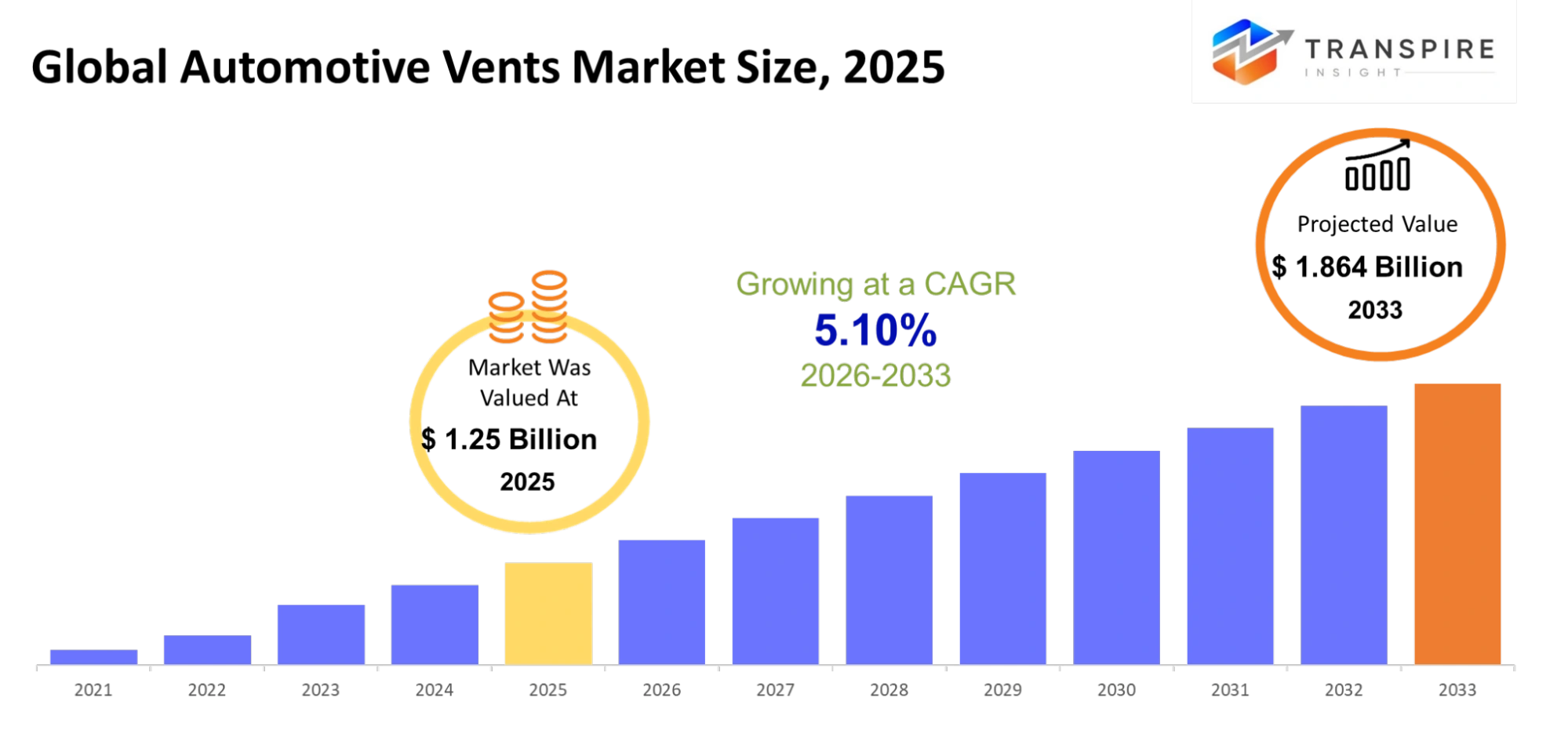
Global Automotive Vents Market Size 2025: USD 1.25 Billion
Global Automotive Vents Market Size 2033: USD 1.864 Billion
Global Automotive Vents Market CAGR: 5.10%
Global Automotive Vents Market Segments: By Component (Vent Grilles, Vent Registers, Vent Motors), By Vehicle Type (Passenger Cars, Commercial Vehicles), By Sales Channel (OEM, Aftermarket), By Material (Plastic, Metal).
To learn more about this report,  Download Free Sample Report
Global Automotive Vents Market Summary:
The Global Automotive Vents Market was valued at USD 1.25 billion in 2025 and is on track to reach USD 1.864 billion by 2033, expanding at a CAGR of 5.10% from 2026 to 2033. Automotive vents are the physical components that manage airflow through a vehicle's cabin: the grilles direct air, the registers allow occupants to redirect it, and the motors drive the mechanical opening and closing of vent systems in automated HVAC setups. Together they sit at the intersection of comfort, cabin air quality, and increasingly, software-controlled climate management.
Passenger cars account for around 66% of market demand. That share reflects both the sheer volume of passenger vehicles produced globally and the fact that car buyers increasingly treat cabin climate as a non-negotiable feature rather than an upgrade. As base-trim vehicles have come to include multi-zone climate systems as standard, the per-unit vent content has grown. This pulls demand upward even in years when overall vehicle production is flat.
Commercial vehicles present a different story. Truck cabins, transit buses, and delivery vans require vent systems built for more demanding duty cycles than passenger cars. Thermal loading is higher, replacement intervals are shorter, and buyers prioritize durability over refinement. This supports a steady aftermarket business alongside OEM supply.
Metal components remain relevant in higher-stress applications and in vehicles where customers expect a premium tactile experience. The choice of material increasingly runs through weight and cost targets set at the platform level rather than segment-level preference.
Key Market Trends & Insights:
- The Global Automotive Vents Market is growing as multi-zone and automated HVAC systems become standard equipment across more vehicle segments.
- Electric vehicle platforms are changing thermal management requirements, with some EV architectures using modified vent configurations to manage battery and cabin heat together.
- Plastic remains the dominant material, though manufacturers are exploring lighter composite options to contribute to overall vehicle weight reduction.
- The aftermarket channel is holding up, driven by commercial fleet operators and consumers in high-mileage vehicle segments who replace worn vent components outside the warranty window.
- OEM relationships continue to drive the bulk of revenue, with Tier 1 suppliers investing in design integration to embed vent components into broader climate module assemblies.
Global Automotive Vents Market Segmentation
By Component
- Vent Grilles: Vent grilles are the visible face of the automotive vent system, covering the openings in dashboards, door panels, and rear cabin areas. They direct airflow and contribute to interior styling. As cabin design has become a stronger differentiator among automakers, grille design has followed, with manufacturers offering color-matched, wood-trimmed, and metallic finish options in premium trims. Volume demand is driven by passenger car production, where grille count per vehicle has risen with the spread of multi-zone climate systems.
- Vent Registers: Vent registers are the adjustable louvers that allow occupants to redirect and control airflow direction within the cabin. They are among the most frequently touched interior components and must hold up to repeated mechanical adjustment over the vehicle's life. Fit, feel, and the absence of rattles at speed are the main performance criteria buyers and automakers focus on. Registers are a high-volume component across both passenger and commercial vehicle segments.
- Vent Motors: Vent motors drive the automated operation of vent flaps and blend doors within HVAC systems. As automatic climate control has moved down from luxury to mainstream segments, demand for vent motors has grown accordingly. These components are increasingly integrated with vehicle HVAC control modules rather than sold as standalone parts. Failure rates over the vehicle lifetime create a secondary aftermarket replacement demand that supports this sub-segment's revenue beyond the OEM channel.
By Vehicle Type
- Passenger Cars: Passenger cars account for approximately 66% of the Global Automotive Vents Market. High global production volumes, rising per-vehicle vent content, and growing consumer expectations around cabin comfort all drive this segment. The transition toward premium interiors in the mid-range segment has been particularly supportive, as automakers fit multi-zone HVAC, rear-seat vents, and automated register systems across a wider range of models than they did a decade ago.
- Commercial Vehicles: Commercial vehicles, including heavy trucks, transit buses, light commercial vans, and specialty vehicles, form the remaining share of the market. Vent systems in this segment are specified for durability rather than refinement. Fleet buyers and transport operators focus on total cost of ownership, which means vent components that hold up without requiring early replacement. The aftermarket channel is proportionally more important here than in passenger cars.

To learn more about this report, Download Free Sample Report
By Sales Channel
- OEM: The OEM channel is the primary revenue source in the Global Automotive Vents Market. Automotive vent suppliers work directly with vehicle manufacturers and their Tier 1 system integrators to secure program contracts that can run for the full lifecycle of a vehicle platform, often six to eight years. Pricing is negotiated at the program level, and suppliers are expected to contribute to cost-down targets over the life of the contract. OEM relationships also determine the product development roadmap, since supplier designs must align with each automaker's platform specifications.
- Aftermarket: The aftermarket channel covers replacement parts sold through independent distributors, retail auto parts chains, and online platforms. Aftermarket demand for vent components is driven by wear, damage, and the extended life of vehicles in use. Commercial fleets and high-mileage consumer vehicles generate the most consistent aftermarket activity. Some aftermarket buyers also upgrade factory vent assemblies for appearance or improved function, creating a small but active performance segment.
By Material
- Plastic: Plastic is the predominant material in the Global Automotive Vents Market. Injection-molded thermoplastics allow complex geometries to be produced at the high volumes and low per-part costs that automotive programs require. Plastic vent components are lighter than metal alternatives, which contributes to fuel economy targets at the vehicle level. Material formulation has improved over time, with modern engineering plastics delivering better UV resistance, reduced off-gassing, and improved surface quality for visible components.
- Metal: Metal vent components appear in higher-stress applications and in premium or performance vehicle interiors where buyers expect a tactile and visual quality that plastic cannot match at the same cost. Aluminum and zinc die-cast parts are used in visible registers and grille trim where a solid feel is part of the product's perceived value. In commercial vehicles, metal components appear in locations exposed to higher thermal loads or mechanical stress that would degrade plastic over time.
Country Insights
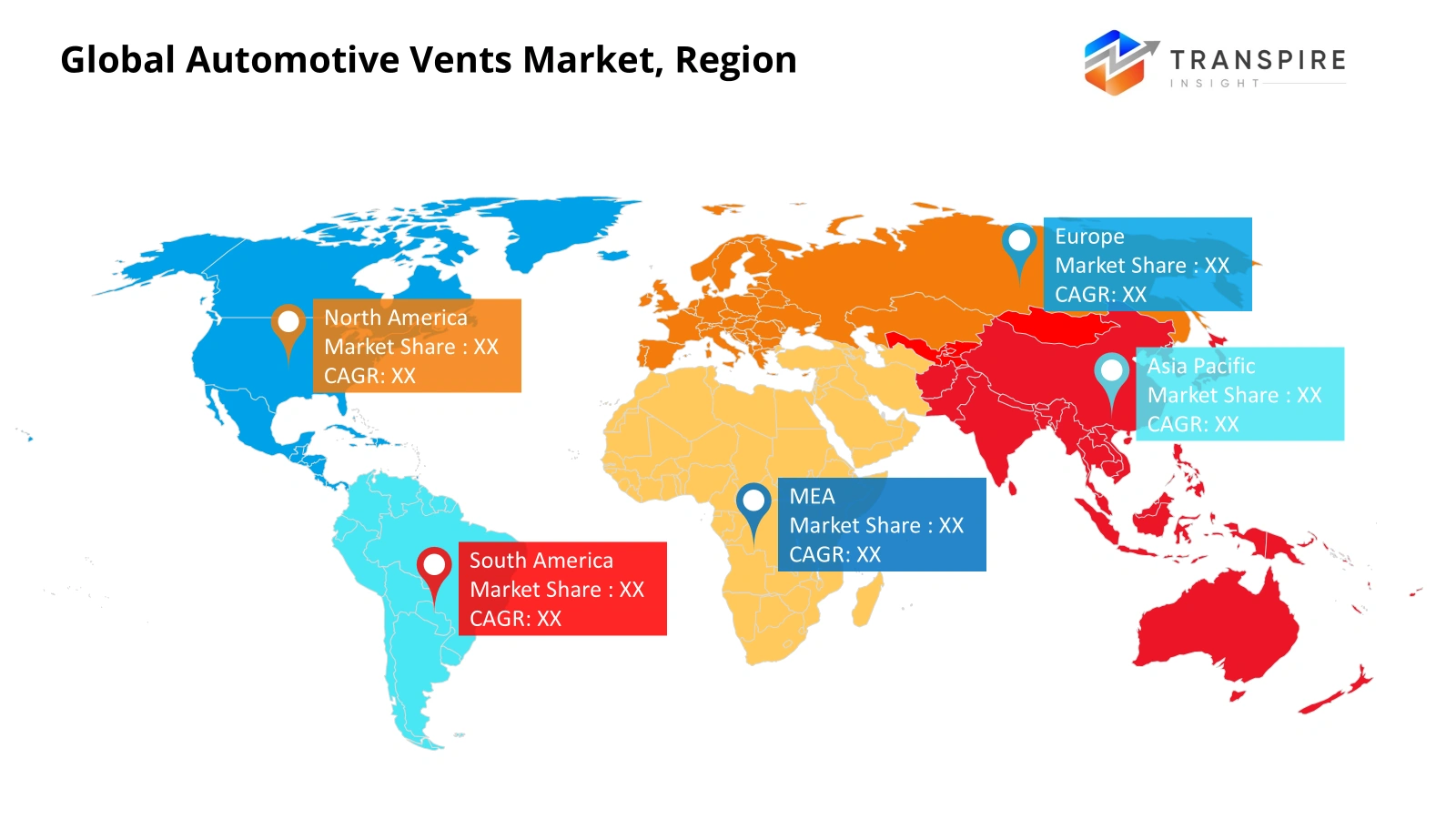
The Global Automotive Vents Market follows vehicle production geography closely. Asia-Pacific is the largest regional market by both production volume and revenue. China is the single biggest contributor, with its massive domestic vehicle production base and a growing consumer preference for well-equipped cabin interiors. Japan and South Korea host major supplier operations for both domestic automakers and global export programs. India is an increasingly active market as domestic vehicle production scales up and per-vehicle content rises.
North America remains a strong market, with the United States driving the bulk of regional demand. Pickup trucks and SUVs, which make up a large portion of US vehicle sales, tend to have higher vent content per vehicle than compact passenger cars, supporting per-unit revenue even when total production volumes are not exceptional. Mexico's growing role as an automotive manufacturing hub also feeds into regional supplier activity.
Europe is a mature but technically demanding market. Emission regulations and the push toward electrification are driving changes in how thermal management is integrated into vehicle platforms, which has downstream effects on vent system design. Germany, France, and the Czech Republic are significant production centers for both vehicles and their suppliers.
The Middle East and parts of Latin America show steady aftermarket activity, particularly in commercial vehicle segments where fleets are maintained over long service lives. Brazil is the most active market in Latin America for both OEM and aftermarket vent products.
To learn more about this report, Download Free Sample Report
Recent Development News
Several suppliers in the Global Automotive Vents Market have been investing in integrating vent motor controls with vehicle HVAC software platforms, reducing the number of discrete components required per assembly and lowering installation complexity on the line.
There is also activity around sustainable materials, with suppliers testing partially recycled plastic content in non-structural vent components to help automakers meet their own sustainability reporting targets. A few programs have moved to recycled-content grades without measurable changes in fit or durability.
Report Metrics
|
Report Metrics |
Details |
|
Market size value in 2025 |
USD 1.25 Billion |
|
Market size value in 2026 |
USD 1.316 Billion |
|
Revenue forecast in 2033 |
USD 1.864 Billion |
|
Growth rate |
CAGR of 5.10% from 2026 to 2033 |
|
Base year |
2025 |
|
Historical data |
2021 - 2024 |
|
Forecast period |
2026 - 2033 |
|
Report coverage |
Revenue forecast, competitive landscape, growth factors, and trends |
|
Country scope |
Global |
|
Key company profiled |
Denso Corporation, Valeo SA, Mahle GmbH, Marelli Holdings Co. Ltd., Brose Fahrzeugteile GmbH & Co. KG, Hanon Systems, Johnson Electric Holdings Ltd., Continental AG, Visteon Corporation, Faurecia SE, Keihin Corporation, Toyota Boshoku Corporation, Sanden Holdings Corporation, Delphi Technologies, Calsonic Kansei Corporation. |
|
Customization scope |
Free report customization (country, regional & segment scope). Avail customized purchase options to meet your exact research needs. |
|
Report Segmentation |
By Component (Vent Grilles, Vent Registers, Vent Motors), By Vehicle Type (Passenger Cars, Commercial Vehicles), By Sales Channel (OEM, Aftermarket), By Material (Plastic, Metal). |
Key Global Automotive Vents Company Insights
The Global Automotive Vents Market is served by a mix of large diversified Tier 1 automotive suppliers and more specialized HVAC and interior component manufacturers. The major players maintain long-term OEM program relationships with the world's leading automakers and invest in modular component architectures that can be adapted across multiple platforms. Research and development spending in this space is focused on integration with automated climate systems, lighter material use, and quieter motor operation at low fan speeds.
Competition is intense at the program award stage, with suppliers differentiating on design capability, global manufacturing footprint, and the ability to support just-in-time delivery to vehicle assembly plants. Cost pressure from automakers is a constant, but suppliers with deeper integration into the HVAC module design process tend to defend margins better than those competing purely on component price.
Company List
- Denso Corporation
- Valeo SA
- Mahle GmbH
- Marelli Holdings Co. Ltd.
- Brose Fahrzeugteile GmbH & Co. KG
- Hanon Systems
- Johnson Electric Holdings Ltd.
- Continental AG
- Visteon Corporation
- Faurecia SE
- Keihin Corporation
- Toyota Boshoku Corporation
- Sanden Holdings Corporation
- Delphi Technologies
- Calsonic Kansei Corporation
Global Automotive Vents Market Report Segmentation
By Component
- Vent Grilles
- Vent Registers
- Vent Motors
By Vehicle Type
- Passenger Cars
- Commercial Vehicles
By Sales Channel
- OEM
- Aftermarket
By Material
- Plastic
- Metal
Frequently Asked Questions
Find quick answers to common questions.
The Global Automotive Vents Market is expected to reach approximately USD 1.864 billion by 2033.
Key segments include Component (Vent Grilles, Vent Registers, Vent Motors), Vehicle Type (Passenger Cars, Commercial Vehicles), Sales Channel (OEM, Aftermarket), and Material (Plastic, Metal).
Major players include Denso Corporation, Valeo SA, Mahle GmbH, Marelli Holdings Co. Ltd., Brose Fahrzeugteile GmbH & Co. KG, Hanon Systems, Johnson Electric Holdings Ltd., Continental AG, Visteon Corporation, Faurecia SE, Keihin Corporation, Toyota Boshoku Corporation, Sanden Holdings Corporation, Delphi Technologies, and Calsonic Kansei Corporation.
The Global Automotive Vents Market size is approximately USD 1.25 billion in 2025.
The Global Automotive Vents Market is expected to grow at a CAGR of 5.10% from 2026 to 2033.
- Denso Corporation
- Valeo SA
- Mahle GmbH
- Marelli Holdings Co. Ltd.
- Brose Fahrzeugteile GmbH & Co. KG
- Hanon Systems
- Johnson Electric Holdings Ltd.
- Continental AG
- Visteon Corporation
- Faurecia SE
- Keihin Corporation
- Toyota Boshoku Corporation
- Sanden Holdings Corporation
- Delphi Technologies
- Calsonic Kansei Corporation
Recently Published Reports
-
Apr 2026
ATV & UTV Market
ATV & UTV Market Size, Share & Analysis Report By Type (ATV, and UTV), By Variants (Less Than 400 CC, 400 CC To 800 CC, and More Than 800 CC), and Geography (North America, Europe, Asia-Pacific, Middle East and Africa, South and Central America), 2021 - 2031
-
Apr 2026
Automotive Central Gateway Module Market
Automotive Central Gateway Module Market Size, Share & Analysis Report By Type (Ethernet Central Gateway Module, CAN Central Gateway Module, LIN Central Gateway Module, and FlexRay), By Application (Powertrain Control, Body Control, Infotainment System, Advanced Driver Assistance Systems (ADAS), and Others), By End User (Passenger Vehicles, and Commercial Vehicles), and Geography (North America, Europe, Asia-Pacific, Middle East and Africa, South and Central America), 2021 - 2031
-
Apr 2026
Automotive Engine Oil Filter Market
Automotive Engine Oil Filter Market Size, Share & Analysis Report By Filter Type (Fuel Filter, Engine Oil Filter, Hydraulic Oil Filter, and Others), By Filter Media (Cellulose, Synthetic, and Micro), By Sales Channel (OEMs, and Aftermarket), By Vehicle Type (Passenger Cars, Light Commercial Vehicles, Heavy Duty Trucks, Buses and Coaches, and Off-road Vehicles), and Geography (North America, Europe, Asia-Pacific, Middle East and Africa, South and Central America), 2021 - 2031
-
Apr 2026
Automotive Parts Aluminium Die Casting Market
Automotive Parts Aluminium Die Casting Market Size, Share & Analysis Report By Production Process (Pressure Die Casting, Vacuum Die Casting, Squeeze Die Casting, Gravity Die Casting), By Application (Body Parts, Engine Parts, Transmission Parts, Battery And Related Components, Other Application Types), and Geography (North America, Europe, Asia-Pacific, Middle East and Africa, South and Central America), 2021 - 2031
Our Clients