

Nitinol Medical Devices Market Summary:
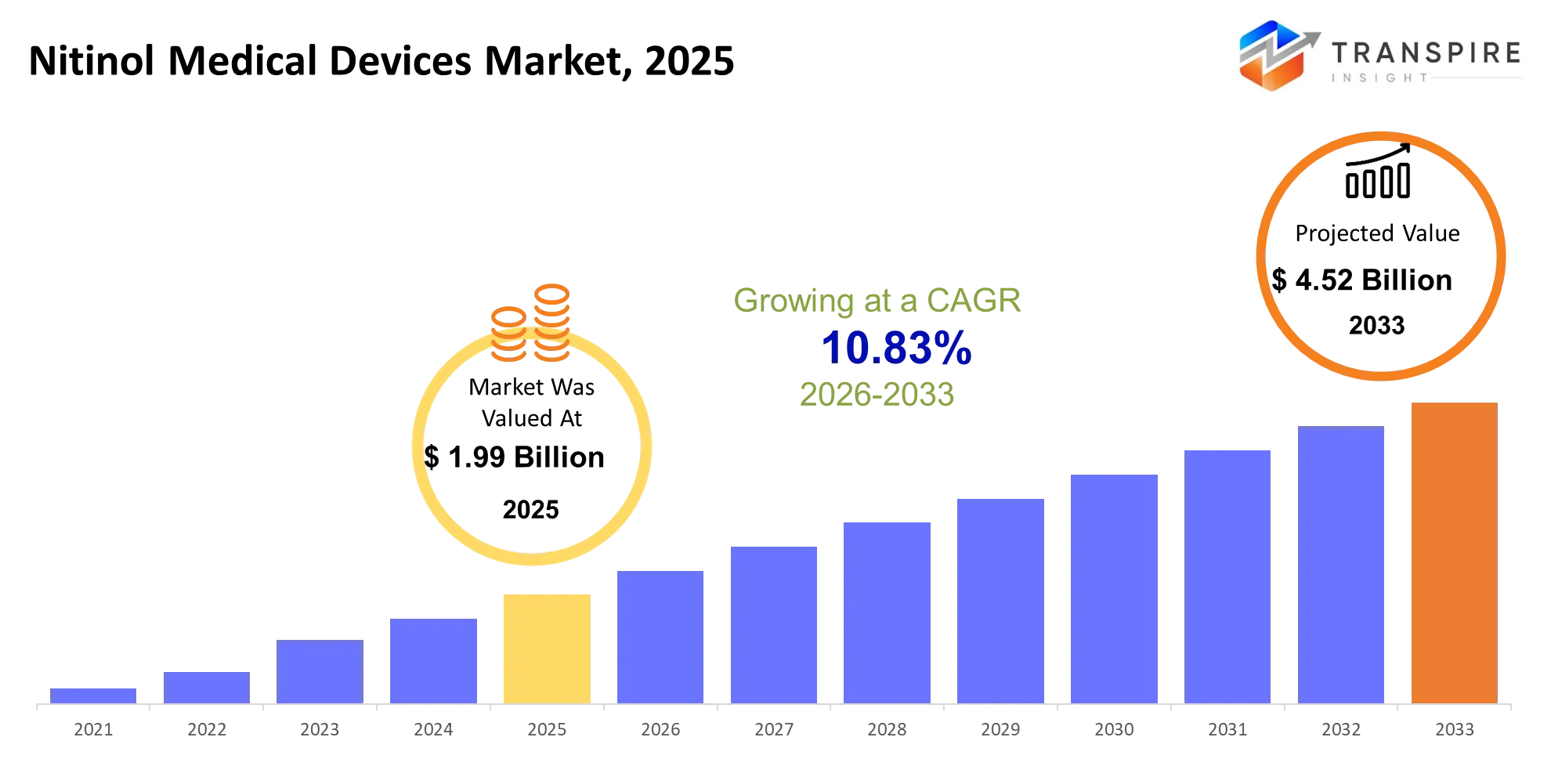
As per Transpire Insight, the Nitinol Medical Devices Market size is estimated at USD 1.99 billion in 2025 and is anticipated to reach USD 4.52 billion by 2033, growing at a CAGR of 10.83% from 2026 to 2033.
The nitinol medical devices market supports the creation of strong medical products that are used in procedures that don’t need big cuts. These products are used in treating blood vessels and in treatments that use implants. Nitinol is a mix of nickel and titanium. It is special because it can remember its shape and stretch a lot, which lets the devices move through places in the body and go back to the shape they need to be. In the three to five years the companies making these devices have focused more on making things exactly right, better catheter systems and making smaller devices so that the treatments are even less invasive. A big change is that more and more they are using lasers, computer models and better ways to test materials to make devices that have complicated shapes. The growth of treatments that use catheters for heart problems and ongoing new ideas in treatments for the brain’s blood vessels are reasons for these changes. These changes make hospitals and companies that make medical devices want to use nitinol products. At the time, better ways to make the products help companies handle more complicated needs from doctors and patients.
Nitinol Medical Devices Market Size & Forecast:
- Market Size 2025: USD 1.99 Billion
- Expected Market Value (2033): USD 4.52 Billion
- Forecast CAGR (2026–2033): 10.83%
- Leading Region in 2025: North America
- Fastest Growing Region: Asia-Pacific
- Key Company Profiles: Medtronic, Abbott Laboratories, Boston Scientific, Cook Medical, B. Braun, Terumo, Stryker, Endologix, Confluent Medical Technologies, Nitinol Devices & Components, Memry Corporation, Fort Wayne Metals, Admedes, MicroPort, Nipro Corporation
Key Market Insights:
The market is shifting from the traditional use of nitinol stents to the advent of specific tools to perform more intricate minimally invasive surgeries. Production accuracy, materials and regional manufacturing investments will become crucial factors of competitiveness.
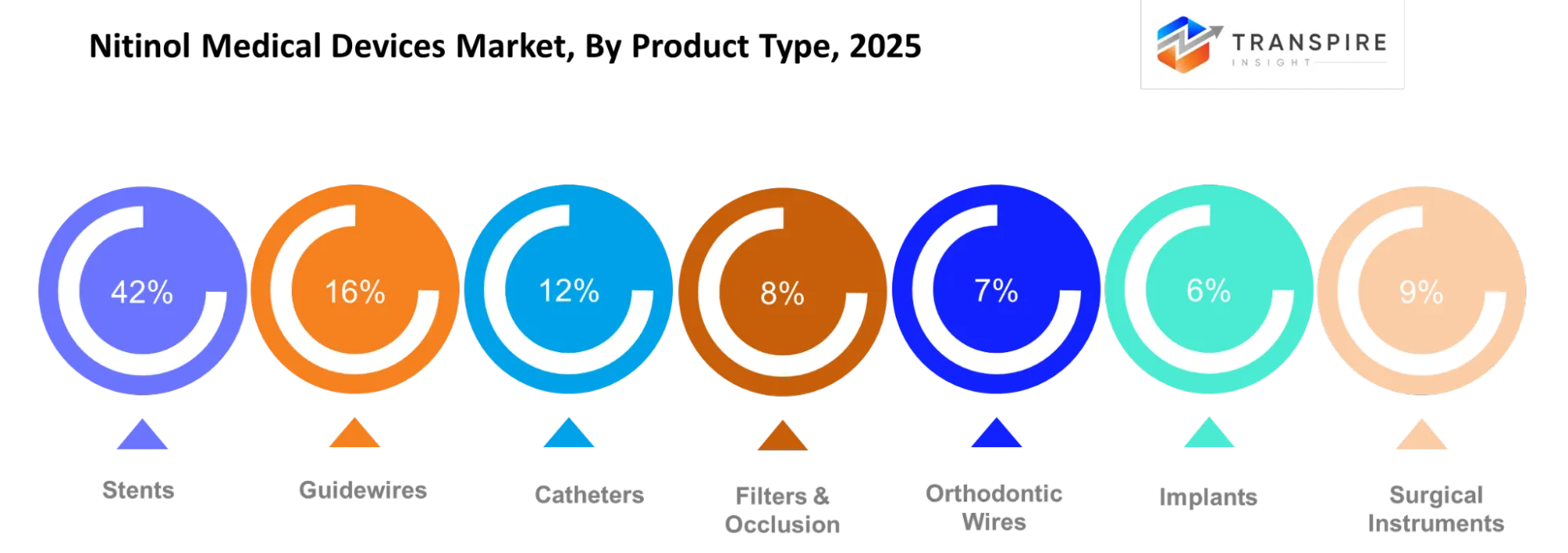
- Stents constitute 42.10% of the market, due to their significance in vascular operations and their medical importance in the form of self-expanding nitinol stents.
- Guidewires make up 16.00% due to their role in navigation through difficult-to-reach vessels.
- Catheters account for 12.00%. As the steerability and tips of catheters improve, more complex operations are made possible with their use.
- Filters and occlusions have a share of 8.00%, being the fastest-growing product line with a predicted CAGR of 10.55%, according to the given information about the market.
- Orthodontic wires are a 7.00% share of the market and demonstrate the utilisation of the properties of shape-memory materials in the field of dentistry.
- Implants hold 6.00% of the market. Further development in implants will be targeted at enhancing the durability and geometrical features of the product.
- Surgical instruments represent 4.00% of the market, while precision manufacturing allows the production of different surgical instruments. Other medical products account for 4.90%.
What are the Key Drivers, Restraints, and Opportunities in the Nitinol Medical Devices Market?
Drivers:
The increasing demand for minimally invasive procedures involving heart and neurological diseases is among the major drivers of this market. The features of nitinol, such as flexibility, shape memory, and superelasticity, enable developers to create stents, guidewires, and other instruments for procedures in challenging anatomy. Advancements in catheter technology and improvements in manufacturing technologies also contribute to the growth in development activities. Medical device makers need materials to match the advanced needs of healthcare providers.
Restraints:
Higher costs related to material processing, high standards of quality control, and complex manufacturing processes may limit the growth of the market. The characteristics of the mechanical properties of nitinol depend on the composition of the alloy and the process parameters and are affected by heat treatment, surface finish, fatigue assessment, and precision.
Opportunities:
Opportunities created through advanced manufacturing and regional investments in manufacturing, suppliers can find additional possibilities to increase their output and supply OEMs of medical devices. Confluent Medical Technologies introduced a new plant for manufacturing nitinol wire in Hyderabad, India, thus increasing production capacity. Investments into manufacturing may help suppliers to support the manufacturing of complex medical devices by their customers. Other promising areas for development include additive manufacturing, data-driven design, and neurovascular and cardiovascular products.
What Has the Impact of artificial intelligence on the Nitinol Medical Devices Market?
AI is used to enable the nitinol medical devices industry by means of material modelling, design simulation, manufacturing and quality control. Machine learning techniques can provide understanding of the relationships between alloy composition, processing, temperature, and mechanics. This can help engineers predict stress-strain characteristics and identify good candidates for a design. In manufacturing processes, AI-assisted inspection and process monitoring can help recognise deviations in dimensions, surface conditions, or other irregularities in the manufacturing process itself. Predictive models can be helpful in fatigue analysis and help to better understand the possible reaction of the device under repeated loading conditions. all these benefits depend on the quality of training data, accuracy of material models, and the possibility to validate predictions according to laboratory and clinical standards. Thus, incorporating AI into manufacturing processes may be costly and time-consuming. It is better to regard AI as decision support and not a substitute for physical tests and engineering judgments.
Instance:
In July 2025, GE HealthCare announced continued investment in AI-enabled medical devices, with 100 AI-enabled device authorisations recorded by the U.S. FDA. Such trends show how AI is increasingly being used in medical imaging and decision-making, which can help in planning and monitoring the use of nitinol-based stents and other minimally invasive devices.
Key Market Trends:
The trend in the industry is toward complex geometries of devices, material properties control, and manufacturing systems optimised for tough clinical applications. Competitive advantage in the industry is being achieved through the integration of materials knowledge with engineering and manufacturing skills.
- Device development has moved towards the direction of more compact devices with flexibility of structure to traverse complicated anatomical routes.
- Manufacturers are developing laser cutting, welding, and finishing to create complicated components that have defined sizes.
- The design and engineering group are applying computational analysis to test material behaviours and to cut down physical prototyping.
- Development of machine learning for the prediction of mechanical behaviour and parameter optimisation in the processing of nitinol.
- Medical device OEMs are relying on specialised suppliers for the processing of materials, engineering of components, and manufacturing processes.
- Greater scrutiny of repetitive loading, surface finish, and mechanical performance of products.
Nitinol Medical Devices Market Segmentation
By product type:
Stents lead with 42.10% of the market share, followed by guidewires and catheters with 16.00% and 12.00%, . Filters and occlusion devices constitute 8.00%, orthodontic wires comprise 7.00%, implants comprise 6.00%, surgical instruments have 4.00%, and other devices have 4.90%. The leading products have well-established usage in the vascular therapy application. Meanwhile, guidewires and catheters facilitate the positioning of the device and delivery during minimally invasive surgery. Filters and occlusion devices are projected to grow at the highest rate of 10.55% CAGR, according to the available information.
By application:
The market is applicable in cardiovascular, peripheral vascular, neurovascular, gastroenterological, orthopaedic, urology, dentistry, and other medical applications. Cardiovascular procedures are key application areas, as nitinol material is used in stents and other devices that require flexibility and reliable shape recovery. Peripheral and neurovascular procedures also have components that allow for navigating through complicated paths and delivering therapy to a specific location. In orthodontics, the elastic quality of nitinol wires makes it an ideal material; orthopaedic and urological areas give more opportunities to use special designs.
By device type:
The market contains self-expanding, balloon-expandable, retrievable, implantable, non-implantable, single-use and reusable, and other devices. Self-expanding devices are the most suitable for use by using nitinol as such materials can reliably recover a pre-programmed shape during a process of delivery through a constrained delivery system. The balloon-expandable devices and some other special devices can be used in specific procedures, but the retrievable devices can be applied in procedures which involve temporary implantation and removal of a product.
By material:
The market consists of nitinol wire, tube, sheet, strip, mesh, braid, laser-cut structures, and other shapes. Wire is used in guidewires, orthodontic items, and other flexible parts, while tubing is utilised for catheter assemblies and tubular medical devices. Sheets and strips provide the choice for specialised components, and mesh, braided, and laser-cut structures allow the manufacturers to make complex geometries. Further development in precision machining, laser machining, and additive manufacturing technologies may increase design possibilities, but each manufacturing technique should comply with proper quality and performance standards.
By end user:
The market provides hospitals, ambulatory surgical centres, speciality clinics, research institutes, diagnostic centres, academic hospitals, medical device OEMs, and other institutions. Hospitals are still an important sales channel as they perform a broad spectrum of cardiovascular, neurovascular and other complex procedures. Ambulatory surgical centres and speciality clinics give rise to devices needed for focused procedures, and research institutes and academic hospitals provide the research and clinical evaluation of devices. Medical device OEMs purchase nitinol materials and components for further use in their devices.
What are the Key Use Cases Driving the Nitinol Medical Devices Market?
Use cases are cardiovascular interventions, where nitinol stents are used to keep the vessels open. Shape memory and superelasticity characteristics make them a good fit for the delivery and deployment of devices via constrained systems in particular locations. Such a use case is consistent with the fact that stents represent the largest segment of the market in the provided information. Other significant use cases are guidewires and catheters used in peripheral vascular and neurovascular interventions. They are used to help doctors manoeuvre during surgery and deliver therapeutic devices with more precision. Some emerging use cases include steerable microcatheters, complex geometries of implants, and components made with additive manufacturing techniques. Development of nitinol steerable microcatheter tips for stroke thrombectomy shows how material engineering can be helpful for such use cases.
|
Report Metrics |
Details |
|
Market size value in 2025 |
USD 1.99 Billion |
|
Market size value in 2026 |
USD 2.20 Billion |
|
Revenue forecast in 2033 |
USD 4.52 Billion |
|
Growth rate |
CAGR of 10.83% from 2026 to 2033 |
|
Base year |
2025 |
|
Historical data |
2021 - 2024 |
|
Forecast period |
2026 - 2033 |
|
Report coverage |
Revenue forecast, competitive landscape, growth factors, and trends |
|
Regional scope |
United States; Canada; Mexico; United Kingdom; Germany; France; Italy; Spain; Denmark; Sweden; Norway; China; Japan; India; Australia; South Korea; Thailand; Brazil; Argentina; South Africa; Saudi Arabia; United Arab Emirates |
|
Key company profiled |
Medtronic, Abbott Laboratories, Boston Scientific, Cook Medical, B. Braun, Terumo, Stryker, Endologix, Confluent Medical Technologies, Nitinol Devices & Components, Memry Corporation, Fort Wayne Metals, Admedes, MicroPort, Nipro Corporation |
|
Customization scope |
Free report customization (country, regional & segment scope). Avail customized purchase options to meet your exact research needs. |
|
Report Segmentation |
Product Type (Stents, Guidewires, Catheters, Filters & Occlusion Devices, Orthodontic Wires, Surgical Instruments, Implants, Others); Application (Cardiovascular, Peripheral Vascular, Neurovascular, Gastroenterology, Orthopedic, Urology, Dental, Others); Device Type (Self-Expanding, Balloon-Expandable, Retrievable, Implantable, Non-Implantable, Single-Use, Reusable, Others); Material Form (Nitinol Wire, Tubing, Sheet, Strip, Mesh, Braided Structures, Laser-Cut Structures, Others); End User (Hospitals, Ambulatory Surgical Centers, Specialty Clinics, Research Institutes, Diagnostic Centers, Academic Hospitals, Medical Device OEMs, Others) |
Which Regions are Driving the Nitinol Medical Devices Market Growth?
North America:
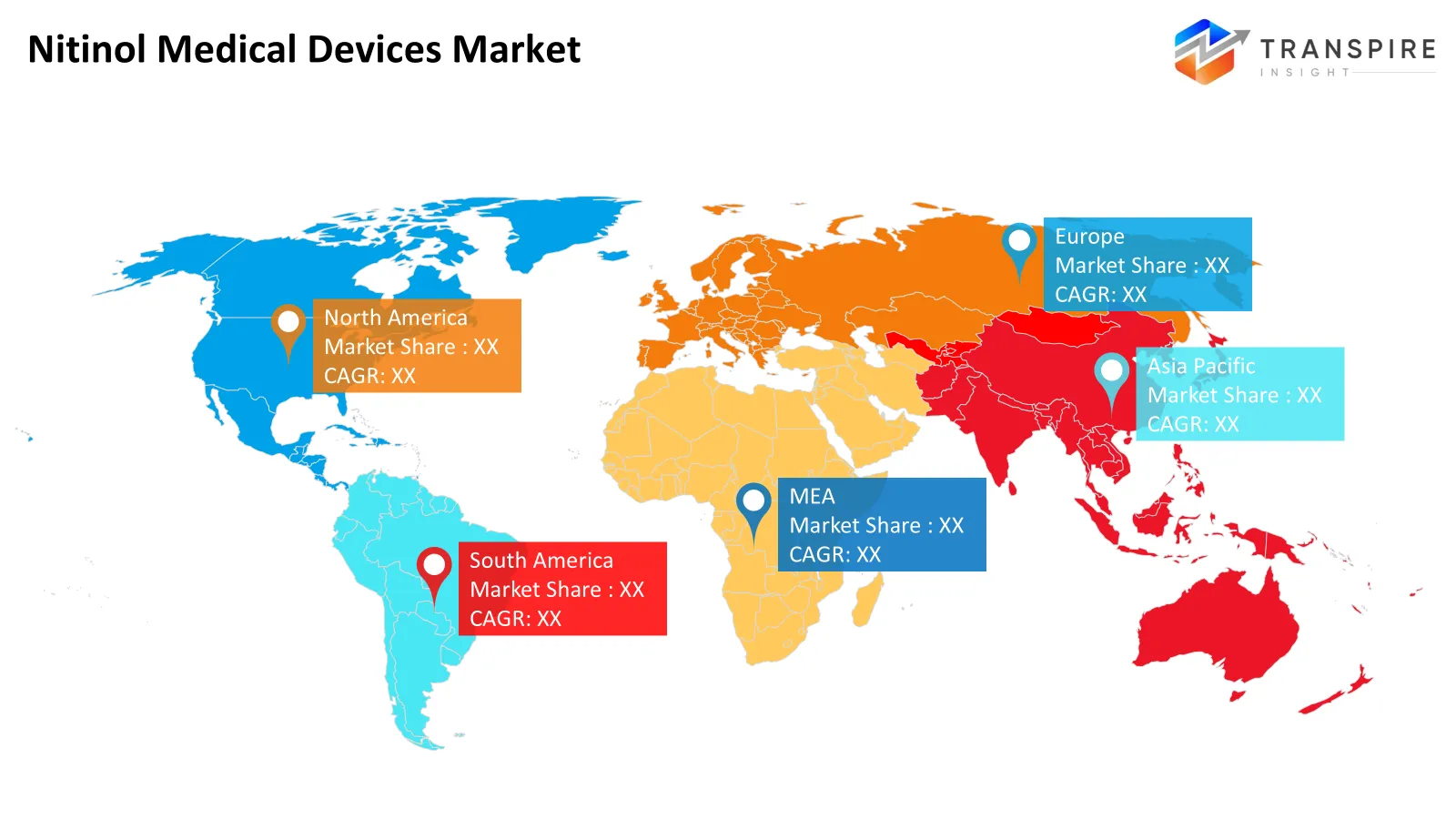
North America dominates the world's nitinol medical devices market with a share of 43.10%. This dominance can be attributed to the presence of several medical device manufacturers, specialist suppliers of components, modern healthcare facilities, as well as the need for complicated interventional techniques. The framework provided by the U.S. Food and Drug Administration for assessing nitinol-containing devices also adds to the evaluation process.
In October 2025 – U.S. Food and Drug Administration (FDA), Cordis was approved for its manufacturing process change concerning PRECISE PRO RX and PRECISE PRO Transcarotid nitinol stent systems. The process change includes moving post-laser manufacturing steps for the stent element from California to Costa Rica, thus showing how manufacturing continues to adapt within the nitinol medical devices supply chain.
https://www.accessdata.fda.gov/scripts/cdrh/cfdocs/cfpma/pma.cfm?ID=P030047S052
Europe:
Europe holds 25.00% of the market because of the presence of medical technology companies, manufacturing specialisation, and healthcare systems utilising advanced interventional products. Unlike the North American market, the European market demonstrates a different combination of medical device manufacturers, research organisations, and healthcare systems procurement in the region. The quality standards and the necessity of proving the safety and performance of the devices prompt suppliers to have reliable production and testing processes.
In June 2025 , Europe signed the MEDALLOY research project, led by the University of Galway, Ireland. The MEDALLOY project targets the development of advanced nitinol alloys, improving manufacturing processes and fatigue properties for advanced medical devices. The MEDALLOY project promotes research collaboration between European universities and medical technology companies.https://cordis.europa.eu/project/id/101227596
Asia-Pacific:
The Asia Pacific region constitutes 23.00% of the market and is considered the fastest-growing region at an expected CAGR of 10.98%. The presence of dedicated manufacturing industries, development in technologies of the medical field in the region, and accessibility to health care are a few factors that provide an opportunity to the suppliers in the region.
In May 2026, the company opened its Nitinol Wire Centre of Excellence in Hyderabad, India. This 26,000-square-foot facility was created to double the nitinol wire production capacity at this facility, while its Fremont, California, facility will be able to concentrate on nitinol tubing production. This initiative increases India's presence in the worldwide nitinol supply chain.
Who are the Key Players in the Nitinol Medical Devices Market and how do they compete?
In the nitinol medical devices market, competition is identified between device manufacturers and material and component suppliers. In addition, competition includes performance, engineering accuracy, production, regulatory knowledge and support for medical device OEM’s during design. Some of the companies operating in the market are Boston Scientific, Medtronic, Abbott, Cordis, Cook Medical, Confluent Medical Technologies and Resonetics.Finished-device companies compete on the basis of speciality in cardiovascular and vascular intervention products, product development, and connections with healthcare providers. Expansion strategies for finished-device companies may involve introduction of new products, enhancement of delivery systems, and application in other clinical areas where the product performance complies with the regulatory requirements. Specialist suppliers compete on the basis of expertise in materials, precision manufacturing, and manufacturing of complex components with high consistency. Resonetics has expanded its nitinol gun-drilling manufacturing capability through an asset acquisition
Nitinol Medical Devices Market companies
- Medtronic
- Abbott Laboratories
- Boston Scientific
- Cook Medical
- B. Braun
- Terumo
- Stryker
- Endologix
- Confluent Medical Technologies
- Nitinol Devices & Components
- Memry Corporation
- Fort Wayne Metals
- Admedes
- MicroPort
- Nipro Corporation
Recent Development News
- In May 2025, Resonetics purchased the nitinol gun drilling process and other related assets from Medical Component Specialists. This was meant to enhance their development of implant-grade nitinol tubing products. https://resonetics.com/news/resonetics-invests-in-nitinol-gun-drilling-capabilities-through-purchase-of-assets-from-medical-component-specialists/
- In July 2026, Quasar Medical bought out Medres' Nitinol Design & Development Centre. Through this move, Quasar enhanced its nitinol product design, development and manufacturing capabilities. https://quasarmedical.com/news/quasar-medical-acquires-nitinol-design-and-development-center/
What Strategic Insights Define the Future of the Nitinol Medical Devices Market?
The future of the nitinol medical devices market will hinge upon the ability of the manufacturers to bring together material knowledge, precision engineering, and consistent production. Existing applications like stents will form a solid base, whereas specialised filters, occlusion devices, and catheters will provide the developers with further opportunities for innovation. Increased investment in regional manufacturing facilities could also ensure better availability of materials and allow OEMs to have access to more specialised components. An inherent challenge associated with the future of the market would be the complexity of ensuring consistency in mechanical properties during manufacturing processes. Any variation in material composition, heat treatment, and surface finish could influence the performance of the device and increase the need for testing. As a result, companies should focus more on process validation, fatigue testing, and quality control measures rather than on expanding production. One of the emerging trends would be the use of AI-based material modeling in combination with advanced manufacturing technologies in order to improve design efficiency and analyze new device geometries.
Key Segmentations are:
Product Type
- Stents
- Guidewires
- Catheters
- Filters & Occlusion Devices
- Orthodontic Wires
- Surgical Instruments
- Implants
- Others
Application
- Cardiovascular
- Peripheral Vascular
- Neurovascular
- Gastroenterology
- Orthopedic
- Urology
- Dental
- Others
Device Type
- Self-Expanding
- Balloon-Expandable
- Retrievable
- Implantable
- Non-Implantable
- Single-Use
- Reusable
- Others
Material Form
- Nitinol Wire
- Tubing
- Sheet
- Strip
- Mesh
- Braided Structures
- Laser-Cut Structures
- Others
End User
- Hospitals
- Ambulatory Surgical Centers
- Specialty Clinics
- Research Institutes
- Diagnostic Centers
- Academic Hospitals
- Medical Device OEMs
- Others
By Regional Analysis
North America
- US
- Canada
- Mexico
Europe
- Germany
- UK
- France
- Italy
- Spain
- Russia
- Rest of Europe
Asia Pacific
- China
- Japan
- India
- South Korea
- Australia
- Rest of Asia Pacific
South America
- Brazil
- Argentina
- Rest of South America
Middle East & Africa
- UAE
- Saudi Arabia
- Qatar
- South Africa
- Rest of the Middle East & Africa
Frequently Asked Questions
Find quick answers to common questions.
The nitinol medical devices market size was valued at USD 1.99 billion in 2025 and is poised to reach USD 4.52 billion by 2033, expanding at a 10.83% CAGR.
Key segments for the nitinol medical devices market are Product Type (Stents, Guidewires, Catheters, Filters & Occlusion Devices, Orthodontic Wires, Surgical Instruments, Implants, Others); Application (Cardiovascular, Peripheral Vascular, Neurovascular, Gastroenterology, Orthopedic, Urology, Dental, Others); Device Type (Self-Expanding, Balloon-Expandable, Retrievable, Implantable, Non-Implantable, Single-Use, Reusable, Others); Material Form (Nitinol Wire, Tubing, Sheet, Strip, Mesh, Braided Structures, Laser-Cut Structures, Others); End User (Hospitals, Ambulatory Surgical Centers, Specialty Clinics, Research Institutes, Diagnostic Centers, Academic Hospitals, Medical Device OEMs, Others).
Growth is primarily driven by increased cases of cardiovascular diseases, increasing use of medical implants, and continuous development of medical technology using nitinol.
The market is led by major manufacturers including Medtronic, Abbott Laboratories, Boston Scientific, Cook Medical, B. Braun, Terumo, Stryker, Endologix, Confluent Medical Technologies, Nitinol Devices & Components, Memry Corporation, Fort Wayne Metals, Admedes, MicroPort, Nipro Corporation.
North America accounts for a 43.10% share in the worldwide nitinol medical devices market due to its well-developed health care infrastructure, extensive use of minimally invasive surgeries, medical device manufacturing abilities, and medical technology research and development.
Opportunities in the nitinol medical devices industry include increasing demand for minimally invasive surgeries, increasing applications of nitinol in cardiovascular and orthopaedic devices, advancements in medical implants, and increasing investments in healthcare in developing nations.
- Medtronic
- Abbott Laboratories
- Boston Scientific
- Cook Medical
- B. Braun
- Terumo
- Stryker
- Endologix
- Confluent Medical Technologies
- Nitinol Devices & Components
- Memry Corporation
- Fort Wayne Metals
- Admedes
- MicroPort
- Nipro Corporation
About the Authors

Pankaj Ghogare Patil
I am Pankaj Ghogare Patil, a Senior Research Analyst at Transpire Insight, specializing in the Pharmaceutical, Chemicals & Materials, Healthcare IT, and Biotechnology industry. My expertise lies in conducting comprehensive market research, analyzing industry trends, evaluating competitive landscapes, and translating complex data into actionable insights. At Transpire Insight, I closely follow emerging technologies, regulatory developments, and market innovations to create accurate, well-researched, and informative content that helps businesses and professionals make informed decisions. I am committed to producing credible, evidence-based articles that reflect industry best practices while making technical topics accessible and valuable for a broad audience.

Chakradhar Khansole
Chakradhar serves as the Research Director at Transpire Insight, bringing over 8 years of experience in technology, innovation, and strategic market intelligence. He specializes in transforming complex market data into actionable business insights that enable organizations to make informed, growth-oriented decisions. Recognized for his strategic vision and analytical expertise, Chakradhar leads high-impact research initiatives, delivering comprehensive market assessments, competitive intelligence, and forward-looking industry analysis.
Recently Published Reports
-
Apr 2026
AI in Diabetic Retinopathy Market
AI in Diabetic Retinopathy Market Size, Share & Analysis Report By Type (Screening AI Systems, Diagnostic AI Systems, and Predictive AI Models), By Application Segment (Hospitals, Ophthalmology Clinics, Diagnostic Centers, and Research and Development), and Geography (North America, Europe, Asia-Pacific, Middle East and Africa, South and Central America), 2021 - 2031
-
Apr 2026
Psychometric Tests Market
Psychometric Tests Market Size, Share & Analysis Report By Type (Personality Tests, Ability/Aptitude Tests, Skill/Knowledge Tests, and Others), By Application (Talent Acquisition and Talent Management), and Geography (North America, Europe, Asia-Pacific, Middle East and Africa, South and Central America), 2021 – 2031
-
Apr 2026
Rare Biological Sample Collection Market
Rare Biological Sample Collection Market Size, Share & Analysis Report By Type (Isolation Kits & Reagent, Blood Collection Tubes, and Others), By Application (Oncology, Transcriptomics, Pharmacogenomics, and Others), and Geography (North America, Europe, Asia-Pacific, Middle East and Africa, South and Central America), 2021 – 2031
-
Jul 2026
Diabetic Retinopathy Market
Diabetic Retinopathy Market Size, Share & Analysis Report By Type (Proliferative Diabetic Retinopathy, and Diabetic Macular Edema (DME)), By Treatment Type (Anti VEGF Drug, Steroid Implants, Laser Surgeries, and Vitrectomy), and Geography (North America, Europe, Asia-Pacific, Middle East and Africa, South and Central America), 2021 – 2031
Our Clients







