

Natural Stone Market Summary:
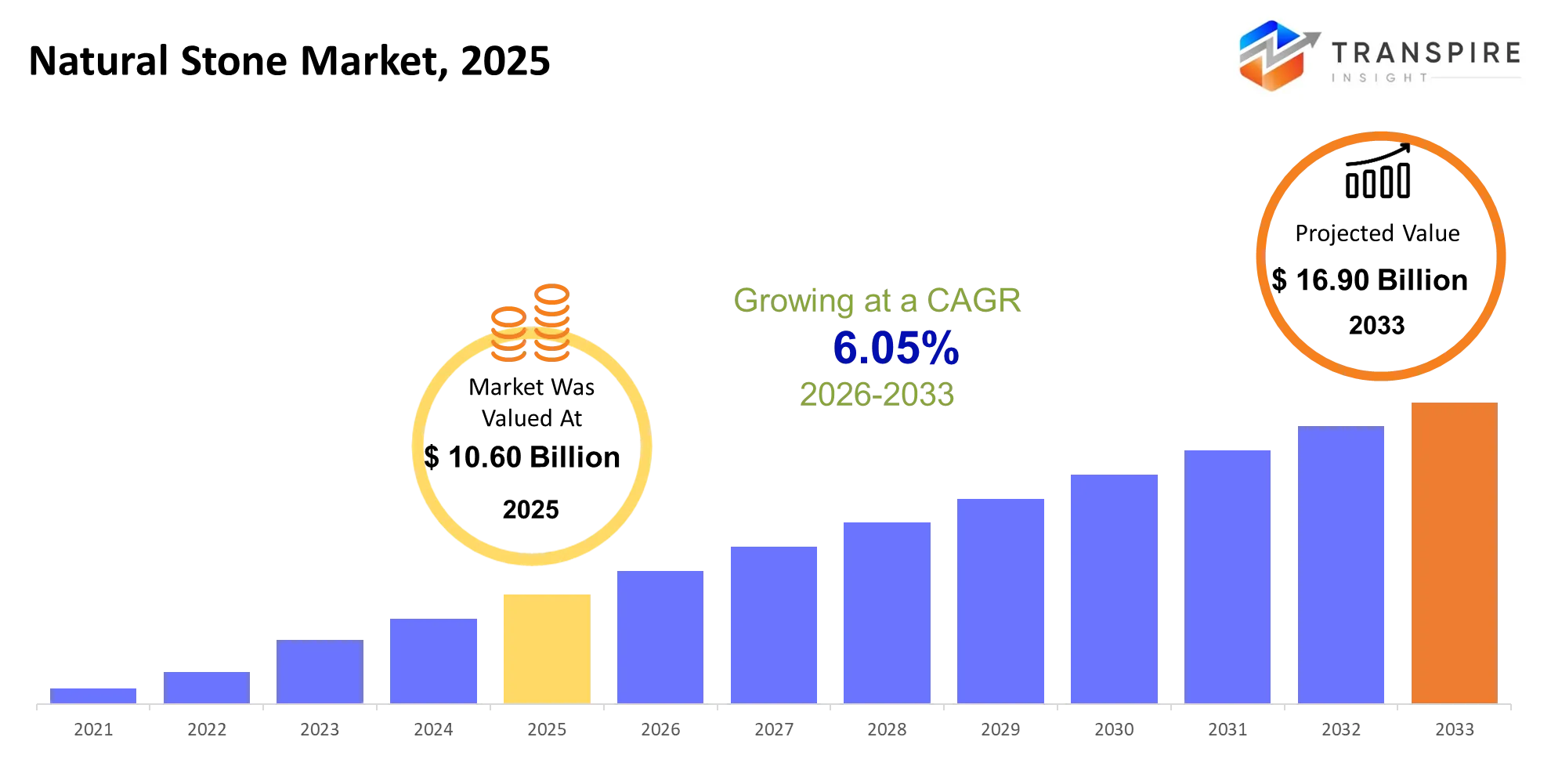
As per Transpire Insight, The Natural Stone Market size is estimated at USD 10.60 billion in 2025 and is anticipated to reach USD 16.90 billion by 2033, growing at a CAGR of 6.05% from 2026 to 2033.
The world market for natural stone is changing direction from the quarry to the construction supply chain towards more valuable, digitally specified stone products. Fabricators have been integrating CNC cutting, robotic finishing, digital templating, and online material sourcing into the process during the last three to five years. There is less rework and more opportunity to create architectural form from complex geometries. We are also seeing more structural market shift to circularity, as processors begin to treat offcuts, powders and sludge as recoverable inputs rather than waste. Marmomac 2026 focused on digital fabrication, stone by-product reuse and the lower-carbon range of products, showing how sustainability is now part of the product stories, not just compliance. A practical driver for the change is the renovation and high-end internal pipeline, where interior designers and homeowners are demanding more design-specific, textured finishes, bespoke CNC-cut features and unique slabs – adding value with an existing resource, but also making supply chain margin arguments for traceability and resource efficiency credentials for suppliers in other markets.
Natural Stone Market Size & Forecast:
- Market Size 2025: USD 10.60 Billion
- Expected Market Value (2033): USD 16.90 Billion
- Forecast CAGR (2026–2033): 6.05%
- Leading Region in 2025: Asia Pacific
- Fastest Growing Region: Middle East & Africa
- Key Company Profiles: Cosentino, Antolini, Levantina, Polycor, Dermitzakis, Temmer Marble, Mármoles de la Cruz, Pokarna, Fox Marble, Mapei, Daltile, MSI Surfaces, Island Stone, Arizona Tile, Artistic Tile.
Key Natural Stone Market Insights:
The market is becoming more and more inclined towards higher-value, traceable, and digitally created stone, and sustainability is becoming a more important factor in specification in addition to aesthetics. Company innovation is reducing the difference between natural-stone look and engineered performance, and automation is helping to increase yield and design flexibility with materials.
- Granite is the main material, and Pokarna utilises automated cutting and polishing to ensure greater precision and consistency in granite processing.
- With such a growth rate, it's no surprise that Antolini is sharing technologically advanced TEXTURES+ surfaces for high-end architecture.
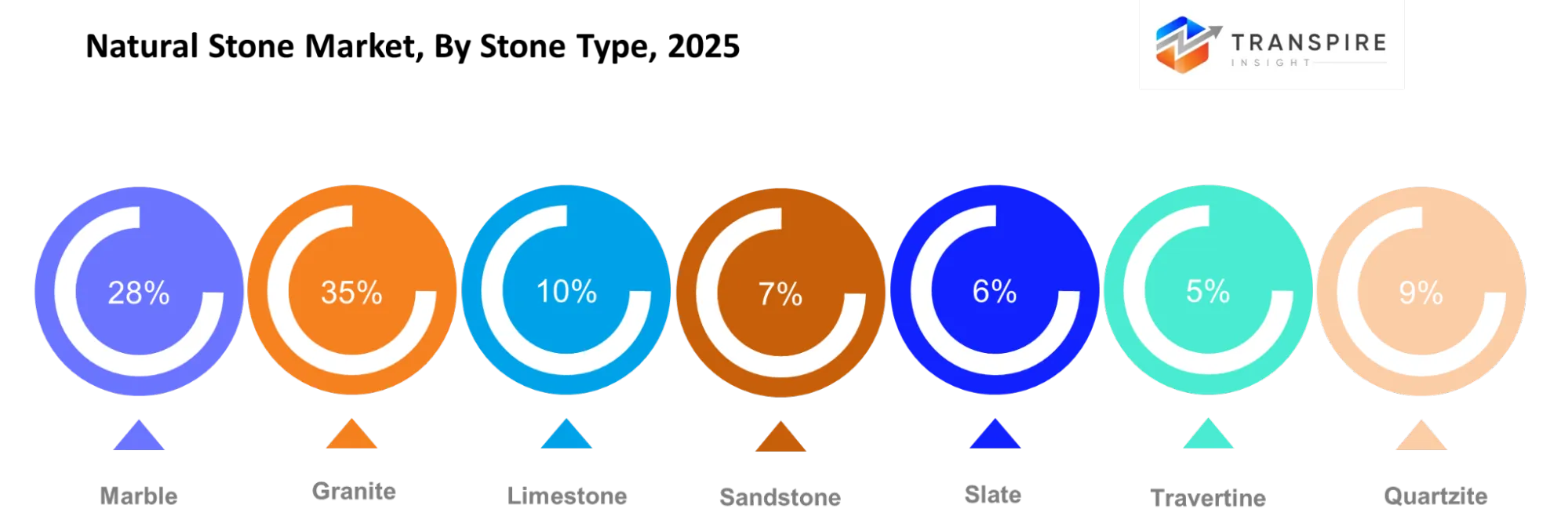
- Marble is 28.00%, and Levantina is a quarry control, technology, and logistics company that works to reinforce traceable, specification-led sales.
- Polycor's certified sustainability approach and focus on locally quarried stone is supported by limestone, which has a value of 10.00%.
- The use of digital fabrication allows more personalised façade and landscaping details, bringing the sandstone to 7.00%.
- As tactile and textured architectural finishes come to the fore, slate gains ground and makes up 6.00% of the market.
- The percentage of travertine is 5.00%; technical involvement of Mapei is taking a deeper step into stone fixing and finishing that is durable.
- Onyx comes in at 2.60% to help support the premium demand for statement interiors, through lighting, texture and bespoke fabrication.
- MSI's 2026 will feature six new honed finishes, which mark the trend of engineered surface technology that replicates the natural-stone depth and veining.
What are the Key Drivers, Restraints, and Opportunities in the Natural Stone Market?
Driver:
Premium renovation and design-led construction are shifting stone purchasing toward differentiated surfaces, custom dimensions, and complex finishes. Architects increasingly specify digitally designed interiors, façades and bespoke features, creating demand for precision fabrication. CNC cutting, robotic polishing and automated finishing enable processors to transform irregular blocks into higher-value products while reducing cutting errors and material waste. This improves yield, shortens fabrication cycles and supports project margins. As customisation becomes more accessible, fabricators can serve premium residential, hospitality and commercial projects with greater consistency and design flexibility.
Restraint:
Quarry development remains constrained by geology, permitting, land-use concerns, water management and the long lead time required to establish extraction capacity. These structural constraints persist because a new quarry cannot quickly replace a depleted or restricted source, making supply vulnerable to local approvals, transport bottlenecks and fluctuations in block quality. Processing plants also face energy, water and waste-management costs that can compress margins.
Opportunity:
Circular processing can open a new revenue layer by converting offcuts, powders and sludge into aggregates, engineered composites or other construction inputs. Marmomac 2026 specifically featured research on marble-processing sludge and residues, alongside technologies assessed for resource efficiency and environmental performance. Regions with established quarry clusters, such as Italy and India, can use digital fabrication, recovery systems, and traceability investments to sell higher-value stone while lowering waste intensity. This strengthens adoption where yield and compliance affect bid competitiveness across projects.
What Has the Impact of Artificial Intelligence Been on the Natural Stone Market?
Most of the impact of artificial intelligence on the natural stone industry today is being felt via inspection, planning and process optimisation- rather than de-skilling fabricators. Computer-vision systems can identify slabs and classify them for cracks, veins and surface defects and help with more accurate digital nesting before CNC cutting. AI-assisted nesting can match customer templates to usable areas of slabs, improving yields and minimising offcuts.
Predictive models that combine machine data with cutting loads, vibration and operating history can predict tool wear, maintenance needs and production disruption. In quarrying, AI and digital-twin applications can aid geological interpretation, machinery monitoring and safer production planning, helping boost throughput by providing decision-support to operators on block selection, cutting sequence, maintenance and quality release. Digital product records can also be used to help fabricators link material characteristics to architectural specifications. Overcoming barriers to adoption, which include implementation costs, variable production data, and accuracy issues with highly contrasting patterns, can lead smaller fabricators to deploy one or more targeted vision, nesting, or maintenance applications before implementing connected AI-based production systems.
In September 2026, Breton introduced the product launch of the Breton Kore, a compact 5-axis bridge saw engineered with an advanced, smart AI interface. This technology eliminates manual programming complexities and streamlines shop workflows by combining automated artificial intelligence with high-precision cutting parameters.
https://breton.it/products/machines-and-lines/breton-kore
Key Natural Stone Market Trends:
The market is shifting to create value through digitised value-added stone products using minimal resources. Appearance and durability are not the only factors in the purchasing process, as technology, traceability, and circular processing are starting to play an increasing role.
- CNC and robotic production have evolved from exclusive to common usage, enabling more precise manufacturing of complicated architectural orders.
- More of the measurements are now done digitally, which has reduced dimensional error and cut down on the amount of time spent preparing an installation.
- Nowadays, slab visualisation has gone online, and customers can see patterns and choose materials ahead of manufacture.
- Efforts are underway to change the business model of stone processors from waste disposal to recovery of offcuts, powders and sludge as secondary materials.
- Surface finishing is now moving towards design, with textured and tactile finishes now going beyond the traditional polished surface.
- Automated inspection is becoming a very important factor as fabricators are looking to detect cracks, defects and inaccurate finishes early.
- There is increasing use of monitoring and digital planning to be more data-driven, boost the efficiency of extraction, and keep work personnel safe.
- Sustainability credentials are becoming increasingly part of purchasing decisions, which is driving suppliers to report on their resource use, processing impacts and re-use.
- More data-driven in specification – architects making comparisons with technical properties at an earlier stage in the design process.
- Machinery is shifting its role in fabrication, and with that, the importance of digital skills increases. Smaller workshops are using modular digital tools, rather than automated systems at scale.
Natural Stone Market Segmentation
Stone Type:
Granite holds the dominant market position at 34.60%, supported by durability and extensive use in flooring and countertops, with future demand benefiting from high-traffic residential and commercial projects. Marble accounts for 28.00% and remains a premium material for interior decoration and monuments, although higher costs and maintenance can constrain adoption. Limestone 10.00% and sandstone 7.00% serve heritage restoration, façades and landscaping, while slate 6.00% supports roofing and textured applications. Travertine 5.00% retains demand in decorative surfaces, whereas quartzite, growing at 6.80% CAGR, benefits from premium countertop applications. Onyx 2.60% remains concentrated in luxury interiors and statement architectural designs, creating opportunities for specialised suppliers to capture higher-value architectural projects.
Product Type:
Slabs and countertops capture the highest value as digital templating and CNC cutting support customised kitchen, vanity and commercial surfaces. Tiles remain important for standardised flooring and wall applications, while blocks serve fabricators requiring raw material for specialised processing. Pavers benefit from landscaping and outdoor construction, whereas wall cladding is gaining importance in contemporary façades. Monuments retain demand in memorial construction, while architectural products provide higher-value opportunities through customised dimensions, complex geometries and design-specific fabrication for premium projects.
Application:
Flooring and countertops remain core outlets because they combine durability with strong aesthetic appeal across residential and commercial projects. Wall cladding is gaining importance as architects prioritise distinctive façades, thermal performance, and durable building envelopes. Roofing provides a specialized outlet where slate and other weather-resistant stones offer longevity. Landscaping uses pavers and textured stone for outdoor spaces, while monuments maintain specialized demand. Fireplaces and interior decoration increasingly use premium marble, granite and quartzite for visually distinctive architectural features.
End User:
Residential construction remains a major outlet, particularly for kitchens, bathrooms, flooring and renovation projects where homeowners prioritise durability and customised aesthetics. Commercial buildings increasingly specify natural stone in entrances, reception areas, lobbies, façades and high-traffic zones to create premium visual identities. Hospitality projects favour distinctive marble, granite and textured finishes to differentiate guest environments. Institutional buildings prioritise durability and maintenance performance, while industrial, infrastructure and government projects favour materials capable of delivering long service lives under demanding operating conditions.
Distribution Channel:
Direct sales and stone fabricators retain strong influence because projects often require technical consultation, material selection, and customised processing. Distributors and dealers extend regional availability while helping suppliers maintain inventory closer to construction markets. Contractors influence purchasing where installation requirements determine material selection and finishing specifications. Home-improvement stores support residential renovation by allowing customers to compare physical samples and finishes. Online retail is gradually strengthening product discovery, quotation and sample ordering, particularly for standardised tiles, accessories and smaller-format stone products.
Finish:
Polished surfaces remain widely selected for premium interiors because they enhance colour, veining and visual depth across marble and granite applications. Honed finishes provide a softer appearance with reduced reflectivity, while flamed and sandblasted treatments improve texture and outdoor functionality. Brushed and leathered finishes increasingly support contemporary design preferences by emphasising natural surface character. Tumbled finishes remain relevant for rustic and heritage-inspired projects, while natural finishes preserve raw material aesthetics. These alternatives allow suppliers to target specific requirements involving slip resistance, tactile appeal, weather exposure, and maintenance.
What are the Key Use Cases Driving the Natural Stone Market?
The core use case is premium interior and surface construction, where granite’s 34.60% share supports countertops, flooring and high-traffic surfaces requiring durability, while marble at 28.00% strengthens luxury interiors.
Expanding applications include façade cladding, landscaping, fireplaces and architectural products, as designers use limestone, sandstone, slate and travertine to combine visual identity with weather resistance and service life.
Emerging use cases are increasingly tied to digital fabrication and circular construction: CNC-shaped stone, customised wall systems, reclaimed pieces and products incorporating recovered stone residues can extend stone into complex architectural forms and lower material waste. This creates value for fabricators by combining precise cutting, distinctive finishes and commercial efficiency.
|
Report Metrics |
Details |
|
Market size value in 2025 |
USD 10.60 Billion |
|
Market size value in 2026 |
USD 11.20 Billion |
|
Revenue forecast in 2033 |
USD 16.90 Billion |
|
Growth rate |
CAGR of 6.05% from 2026 to 2033 |
|
Base year |
2025 |
|
Historical data |
2021 - 2024 |
|
Forecast period |
2026 - 2033 |
|
Report coverage |
Revenue forecast, competitive landscape, growth factors, and trends |
|
Regional scope |
United States; Canada; Mexico; United Kingdom; Germany; France; Italy; Spain; Denmark; Sweden; Norway; China; Japan; India; Australia; South Korea; Thailand; Brazil; Argentina; South Africa; Saudi Arabia; United Arab Emirates |
|
Key companies profiled |
Cosentino, Antolini, Levantina, Polycor, Dermitzakis, Temmer Marble, Mármoles de la Cruz, Pokarna, Fox Marble, Mapei, Daltile, MSI Surfaces, Island Stone, Arizona Tile, Artistic Tile |
|
Customization scope |
Free report customization (country, regional & segment scope). Available customized purchase options to meet your exact research needs. |
|
Report Segmentation |
Stone Type (Marble, Granite, Limestone, Sandstone, Slate, Travertine, Quartzite, Onyx); Product Type (Slabs, Tiles, Blocks, Countertops, Pavers, Wall Cladding, Monuments, Architectural Products); Application (Flooring, Countertops, Wall Cladding, Roofing, Landscaping, Monuments, Fireplaces, Interior Decoration); End User (Residential, Commercial, Hospitality, Institutional, Industrial, Infrastructure, Government); Distribution Channel (Direct Sales, Stone Fabricators, Distributors, Dealers, Home Improvement Stores, Online Retail, Contractors); Finish (Polished, Honed, Flamed, Brushed, Sandblasted, Tumbled, Leathered, Natural Finish) |
Which Regions are Driving the Natural Stone Market Growth?
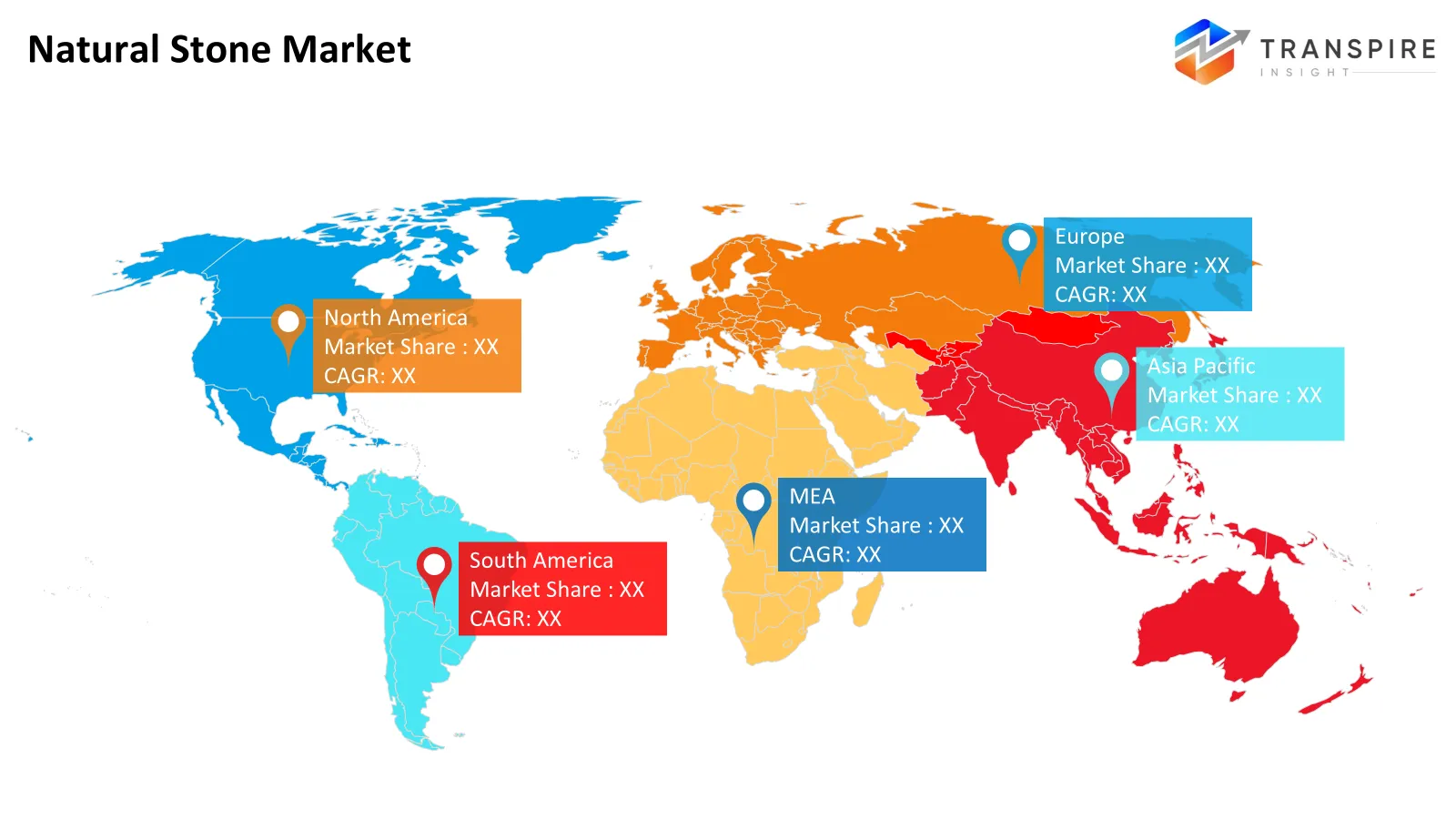
Asia Pacific, the top revenue generator globally at 38.90% of total natural stone sales, is expected to hold the top position aided by swift urbanization and government-supported infrastructure projects in India, China, Vietnam, and Indonesia. The construction industry in Asia Pacific benefits from the metro rail project, freight corridor, and airport expansion projects that depend on locally procured granite and sandstone. Additionally, higher expenditures by the middle-income group on home renovations promote the sales of granite flooring, marble premium projects, and limestone facade projects. This policy and quarry support go hand in hand with the growth of local demand to form a virtuous circle not seen in other regions.
In September 2026, Salsett Vinimay Private Limited acquired an 8.77% equity stake (2,250,000 shares) in Marble City India Limited through open-market purchases. This strategic move raised the investor group's total holding to 11.03% of the company's equity share capital.
Europe holds a market share of 28.00%, making it the second-largest player, with growth stability based on heritage rehabilitation, luxury residential, and luxury commercial projects in Germany, Italy, France, and Spain. While the Asia Pacific is expanding in volume, Europe will experience expansion in quality and standards, with EU regulation requiring sustainable extraction processes, while the EU Habitats Directive and the ISO 14001 standards have been instrumental in implementing new quarrying techniques, resulting in increased efficiency while still complying with the regulatory directive of environmental standards; this entails higher costs vis-à-vis developing markets.
In July 2026, Hitachi Construction Machinery launched the LANDCROS Innovation Studios Challenge Europe 2026 open-innovation programme. This initiative invites startups to introduce scalable, ready-to-test technological advancements that accelerate digitalization and optimize efficiency at European mining and quarrying sites.
https://www.agg-net.com/news/hitachi-bring-landcros-startup-challenge-to-europe
Middle East & Africa occupies 6.00% of the market share with a CAGR growth rate of 6.20%. It is projected to be the fastest-growing region as a result of recent major project announcements and luxury hospitality structures being built within Gulf Cooperation Council nations. Investments towards airports, resorts, and mixed-use commercial space infrastructure have elevated the demand for high-end natural stone for cladding, floors, and monuments.
Aligning extraction methods with sustainable standards will provide upcoming opportunities to gain entry to European and North American export markets. With capacity increasing, the region has the prospect of shifting its role to being a net exporter rather than an importer of dimension stone. North America accounts for a 22.00% share, and Latin America shares 5.10%.
In September 2026, Marble Design Factory Company announced that its Board of Directors recommended changing the corporate name to Marble Design. This action marks a new phase in the firm's modernisation strategy, aiming to strengthen its market presence and align with its ongoing corporate transformation journey on the Saudi Exchange.
https://maaal.com/en/news/details/marble-design-bod-recomme/
Who are the Key Players in the Natural Stone Market, and how do they compete?
The natural stone market features fragmented competition among quarry owners, fabricators, and surface-solution providers, with differentiation increasingly based on innovation, sustainability, and supply-chain control rather than price alone.
Cosentino is taking an innovation-led approach, with new product launches such as the CLOS collection and new applications for Dekton, while digital transformation is driving a sustained reduction in delivery times in Europe and North America. Levantina has adopted a vertical integration approach by co-investing in local quarries to improve factory efficiency by 18%, whilst also providing export capacity. Polycor is focused on sustainability and geographic expansion through the launch of new sustainable stone lines in 2024 and through the acquisition of Ebel Quarries to widen the company's access to Ontario. Other Suppliers (e.g., Antolini, Dermitzakis) Source High-end Marble Through Sourcing and Design Integration for the Luxury Hospitality/Residential End-use (Sourcing strategies) Target niche high-end markets through an exclusive range of colour collections and finish options (Channel & Product Segment differentiation) Target low-cost end-users in high-growth regions, with both domestic infrastructure and export opportunities (Geographic and Channel differentiation) Extend into adjacent surfacing categories via supplying complementing installation systems or premium collection (Product Category differentiation) Provide curated unique collection of natural stones for designers and architects.
Key Players are:
- Cosentino
- Antolini
- Levantina
- Polycor
- Dermitzakis
- Temmer Marble
- Mármoles de la Cruz
- Pokarna
- Fox Marble
- Mapei
- Daltile
- MSI Surfaces
- Island Stone
- Arizona Tile
- Artistic Tile
Recent Development News
- In March 2026, Construction Resources acquired Tampa-based Ramos Marble & Granite. The acquisition expanded its stone fabrication and installation capabilities in the Southeast while retaining the existing leadership team to support continued customer service and operational growth. https://www.datalogic.com/eng/media-center/press-releases/datalogic-to-unveil-ai-powered-solutions-for-intelligent-manufacturing-at-automate-2026-nd-8849.html
- In September 2026, India Stonemart inaugurated the Rajasthan Pavilion at Marmomac 2026 in Verona to showcase marble, granite, sandstone, and other natural stones to international buyers and industry stakeholders. The initiative is designed to strengthen market connections for Rajasthan’s stone sector and promote international participation in India Stonemart 2028. https://stonemart-india.in/rajasthan-pavilion-marmomac-2026-india-stonemart-2028
What Strategic Insights Define the Future of the Natural Stone Market?
The trend is moving to a hybrid value proposition: natural stone remains the premium provenance of authenticity, while digital fabrication, smart finishing, and material-efficiency technologies comprise commercial value. Hidden is the risk that heightened environmental standards, quarry permitting, and traceability demands will make many lower-quality supply chains tough to move into more premium work. A new opportunity is circular stone processing: reclaiming offcuts, powders, and sludge can minimize waste while establishing secondary material streams and increasing resource efficiency. For suppliers, it also means investing beyond the drill: automated cutting, digital inventory, material tracking, and environmental documentation. Innovations like Cosentino's new CLOS surface collection demonstrate how surface innovation is already integrating recycled content, robotic processing, and safer materials. Those that connect quarry management with material extraction, environmental reporting, and project specification will be among those best able to demand premium architectural value.
Key Segmentations are:
Stone Type
- Marble
- Granite
- Limestone
- Sandstone
- Slate
- Travertine
- Quartzite
- Onyx
Product Type
- Slabs
- Tiles
- Blocks
- Countertops
- Pavers
- Wall Cladding
- Monuments
- Architectural Products
Application
- Flooring
- Countertops
- Wall Cladding
- Roofing
- Landscaping
- Monuments
- Fireplaces
- Interior Decoration
End User
- Residential
- Commercial
- Hospitality
- Institutional
- Industrial
- Infrastructure
- Government
Distribution Channel
- Direct Sales
- Stone Fabricators
- Distributors
- Dealers
- Home Improvement Stores
- Online Retail
- Contractors
Finish
- Polished
- Honed
- Flamed
- Brushed
- Sandblasted
- Tumbled
- Leathered
- Natural Finish
By Regional Analysis
North America
- US
- Canada
- Mexico
Europe
- Germany
- UK
- France
- Italy
- Spain
- Russia
- Rest of Europe
Asia Pacific
- China
- Japan
- India
- South Korea
- Australia
- Rest of Asia Pacific
South America
- Brazil
- Argentina
- Rest of South America
Middle East & Africa
- UAE
- Saudi Arabia
- Qatar
- South Africa
- Rest of the Middle East & Africa
Frequently Asked Questions
Find quick answers to common questions.
The natural stone market size was valued at USD 10.60 billion in 2025 and is poised to reach USD 16.90 billion by 2033, expanding at a 6.05% CAGR.
Key segments for the natural stone market are Stone Type (Marble, Granite, Limestone, Sandstone, Slate, Travertine, Quartzite, Onyx); Product Type (Slabs, Tiles, Blocks, Countertops, Pavers, Wall Cladding, Monuments, Architectural Products); Application (Flooring, Countertops, Wall Cladding, Roofing, Landscaping, Monuments, Fireplaces, Interior Decoration); End User (Residential, Commercial, Hospitality, Institutional, Industrial, Infrastructure, Government); Distribution Channel (Direct Sales, Stone Fabricators, Distributors, Dealers, Home Improvement Stores, Online Retail, Contractors); Finish (Polished, Honed, Flamed, Brushed, Sandblasted, Tumbled, Leathered, Natural Finish).
Growth is primarily driven by premium renovation, design-led construction, demand for customized surfaces, digital fabrication, automated stone processing, and expanding architectural applications.
The natural stone market is led by major manufacturers, including Cosentino, Antolini, Levantina, Polycor, Dermitzakis, Temmer Marble, Mármoles de la Cruz, Pokarna, Fox Marble, Mapei, Daltile, MSI Surfaces, Island Stone, Arizona Tile, and Artistic Tile.
Asia Pacific, holding 38.90%, dominates through extensive quarrying and processing capacity, competitive manufacturing costs, infrastructure development, urbanisation, and strong domestic and export demand.
Opportunities include automated fabrication, premium customised surfaces, circular stone processing, material traceability, sustainable products, and rising architectural demand across the Middle East & Africa.
- Cosentino
- Antolini
- Levantina
- Polycor
- Dermitzakis
- Temmer Marble
- Mármoles de la Cruz
- Pokarna
- Fox Marble
- Mapei
- Daltile
- MSI Surfaces
- Island Stone
- Arizona Tile
- Artistic Tile
About the Authors

Pankaj Ghogare Patil
I am Pankaj Ghogare Patil, a Senior Research Analyst at Transpire Insight, specializing in the Pharmaceutical, Chemicals & Materials, Healthcare IT, and Biotechnology industry. My expertise lies in conducting comprehensive market research, analyzing industry trends, evaluating competitive landscapes, and translating complex data into actionable insights. At Transpire Insight, I closely follow emerging technologies, regulatory developments, and market innovations to create accurate, well-researched, and informative content that helps businesses and professionals make informed decisions. I am committed to producing credible, evidence-based articles that reflect industry best practices while making technical topics accessible and valuable for a broad audience.

Chakradhar Khansole
Chakradhar serves as the Research Director at Transpire Insight, bringing over 8 years of experience in technology, innovation, and strategic market intelligence. He specializes in transforming complex market data into actionable business insights that enable organizations to make informed, growth-oriented decisions. Recognized for his strategic vision and analytical expertise, Chakradhar leads high-impact research initiatives, delivering comprehensive market assessments, competitive intelligence, and forward-looking industry analysis.
Recently Published Reports
-
May 2026
Healthcare Polymer Packaging Market
Healthcare Polymer Packaging Market Size, Share & Analysis Report By Packaging Type (Syringes, IV Bottles and Pouches, Clamshells, Blisters, Bottles & Jars, Containers, Tubes, IV Parental Packaging, Others), By Type (Regulated, Non-regulated), By Polymer Type (LDPE (Low-Density Polyethylene), HDPE (High-Density Polyethylene), Homo-polymer (Homo), Random Copolymer (Random), Block Copolymer (Block), PET, Polystyrene, Polyvinyl Chloride, Polyamide/EVOH, Others), and Geography (North America, Europe, Asia-Pacific, Middle East and Africa, South and Central America), 2021 - 2031
-
Apr 2026
Hydrophilic Tape (Waterstop) Market
Hydrophilic Tape (Waterstop) Market Size, Share & Analysis Report By Type (Bentonite-Based Hydrophilic Tape, Rubber-Based Hydrophilic Tape), By Application (Residential Buildings, Commercial Buildings, Infrastructure Projects), and Geography (North America, Europe, Asia-Pacific, Middle East and Africa, South and Central America), 2021 - 2031
-
Apr 2026
Metalens Market
Metalens Market Size, Share & Analysis Report By Type (Visible Light Metalens, and Infrared Metalens), By Application (Consumer Electronics, Automotive Electronics, Industrial, Medical, and Others), and Geography (North America, Europe, Asia-Pacific, Middle East and Africa, South and Central America), 2021 - 2031
-
Apr 2026
PBT Resin Market
PBT Resin Market Size, Share & Analysis Report By Type (Reinforced PBT Resin, Unreinforced PBT Resin), By Processing Method (Injection Molding, Extrusion, Blow Molding, Others), By End-User (Automotive, Electrical & Electronics, Consumer Appliances, Industrial Machinery, Medical Devices, Packaging, Others), and Geography (North America, Europe, Asia-Pacific, Middle East and Africa, South and Central America), 2021 - 2031