

MOSFET Power Transistors Market Summary:
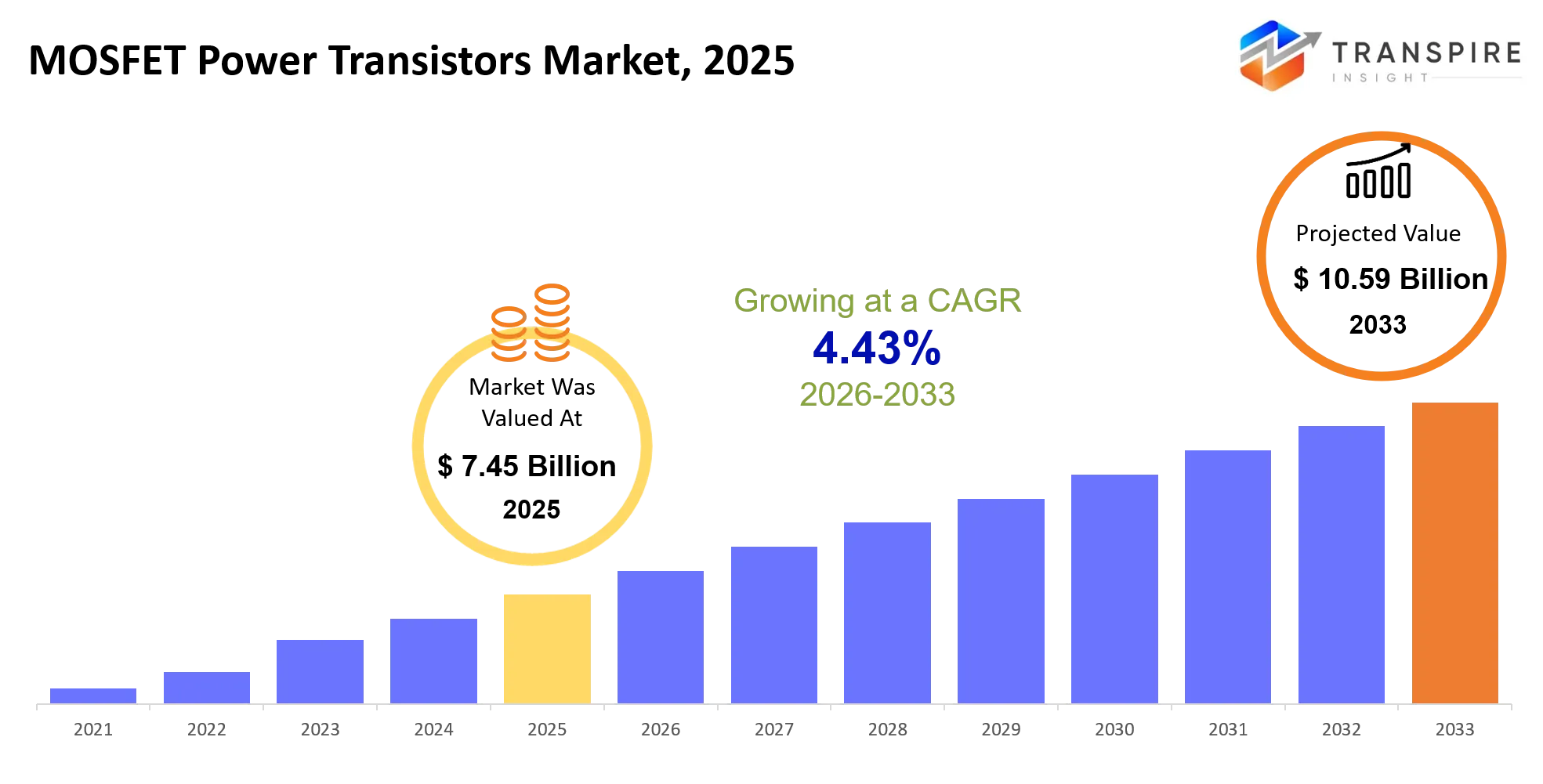
As per Transpire Insight Analysis, the MOSFET Power Transistors Market size is estimated at USD 7.45 billion in 2025 and is anticipated to reach USD 10.59 billion by 2033, growing at a CAGR of 11.82% from 2026 to 2033.
The MOSFET power transistor market around the world is useful for controlling power in various sectors such as automobiles, mobile devices, machinery, telephone services, and energy systems. Over the years, the market has moved toward better semiconductor technologies because companies want better heat control and less power loss. A big change has been the growing use of silicon carbide MOSFETs with silicon-based devices, especially where higher efficiency and faster switching are needed. At the same time, the growth of electric cars, clean energy systems, fast charging stations and power equipment for data centres has brought new needs for better power management parts. Automotive electrification has been a reason for this change, pushing companies to make power devices that can deal with tough voltage and heat situations. As companies look for energy efficiency, smaller designs and better power conversion, MOSFET makers are focusing more on better materials, better device designs and solutions made for specific uses. These changes are helping industries, both old and new, to use MOSFET power transistors.
MOSFET Power Transistors Market Size & Forecast:
- Market Size 2025: USD 7.45 Billion
- Expected Market Value (2033): USD 10.59 Billion
- Forecast CAGR (2026–2033): 4.43%
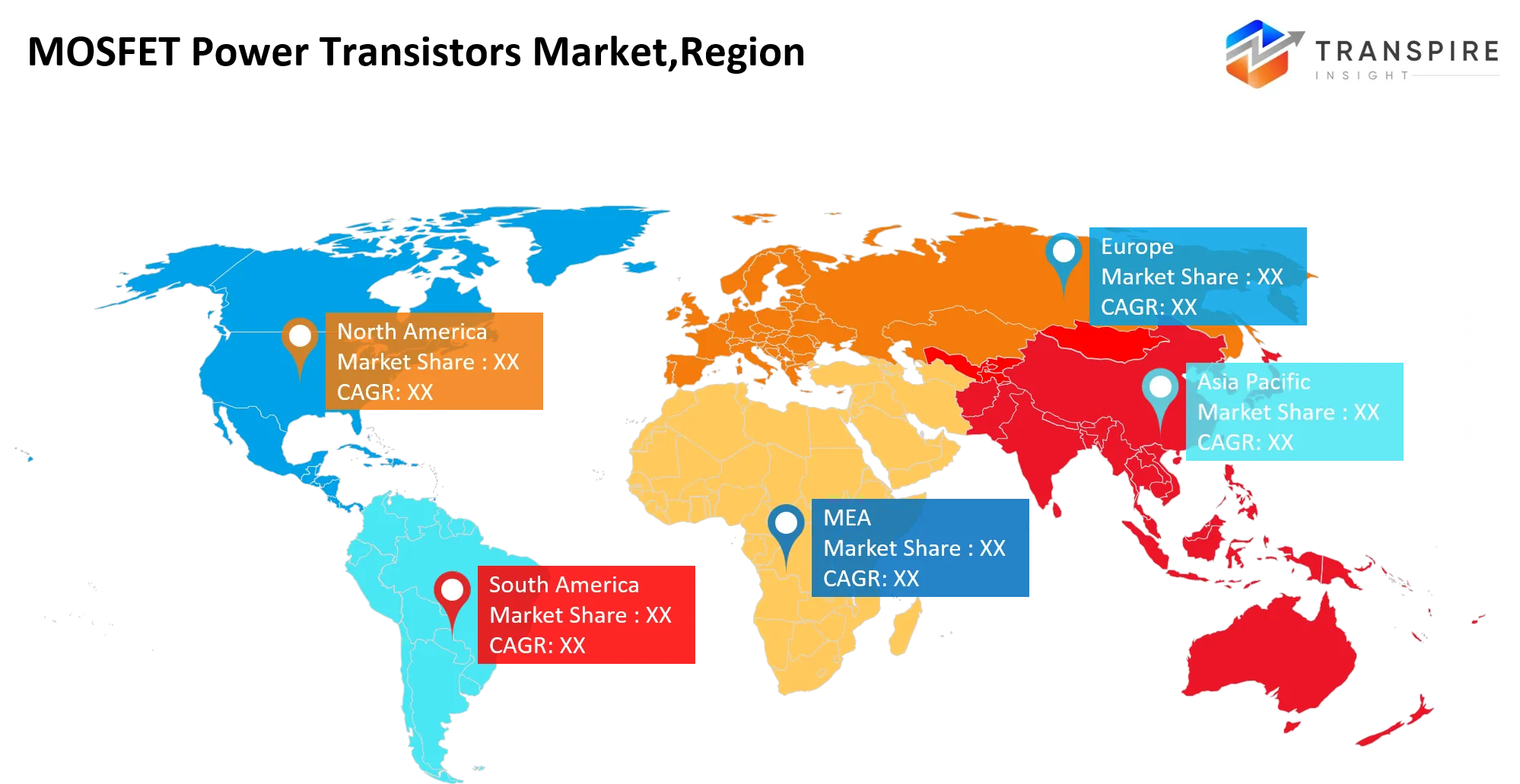
- Leading Region in 2025: Asia Pacific
- Fastest Growing Region: North America
- Key Company Profiles: Infineon Technologies, STMicroelectronics, Toshiba, Mitsubishi Electric, Renesas, onsemi, Vishay, ROHM, Nexperia, Panasonic, Fuji Electric, Wolfspeed, Alpha & Omega Semiconductor, Diodes Incorporated, Microchip Technology
Key Market Insights:
The industry is moving from traditional silicon-based components to specialised power electronics, and at the same time, there is a rising need for automotive and power-efficient systems.
- Silicon MOSFETs constitute 68%, as the market is maintained by continued usage of proven silicon technology by manufacturers.
- SiC MOSFETs have a growth rate of 19.1% CAGR as interest in efficient power devices increases for complex applications.
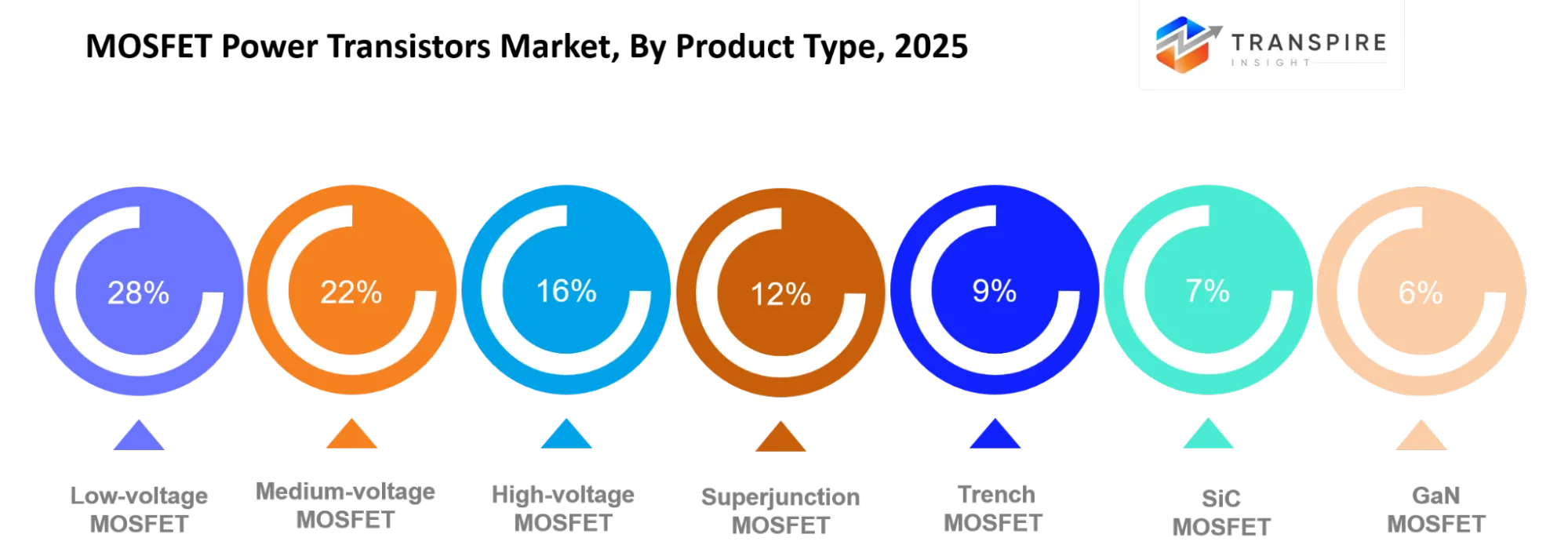
- Low-voltage MOSFETs make up 28%, due to their usage in consumer electronics, power supplies, and electronic systems.
- Medium-voltage MOSFETs constitute 22%, which is helped by the applications of these devices in industrial equipment and automotive electronics.
- High-voltage MOSFETs constitute 16%, as manufacturers seek components able to handle higher electrical loads in power conversion applications.
- Superjunction MOSFETs constitute 12%, with manufacturers focusing on designing low-conduction loss power efficient semiconductors.
What are the Key Drivers, Restraints, and Opportunities in the MOSFET Power Transistors Market?
Drivers
Growth is driven by the move towards energy-efficient power electronics and the use of electric vehicles, charging technology, renewable energy components, and data centres. In these applications, high-performance MOSFETs with energy-efficient switching, along with thermal management, are needed. The trend towards using Silicon Carbide MOSFETs is also fueling the move towards developing advanced MOSFETs.
Restraints
Increased cost and complexity of manufacturing the more advanced materials and device technologies constrain the market. This situation is caused by the necessity of special production technology, materials, and testing in order to obtain consistent performance. Due to the increased cost sensitivity, this can impede the changeover from traditional silicon-based devices to more advanced ones.
Opportunities
An opportunity for growth is the use of SiC MOSFETs in electric vehicles, fast charging stations, renewable energy systems, industrial power conversion systems, and many other power-efficient systems. As equipment manufacturers seek to minimise energy loss, there may be more opportunities for new MOSFET technologies to become accepted in more challenging power management systems.
What Has the Impact of Artificial Intelligence Been on the MOSFET Power Transistors Market?
The use of Artificial intelligence is having an impact on the MOSFET power transistors market through improving the design and manufacture of semiconductor chips, managing the manufacturing process, and monitoring the equipment used in the production line. AI technology allows analysing large volumes of data and finding process variations, defect detection, and quality-control decisions. Predictive analytics can be used in manufacturing facilities to spot any abnormal activity of the equipment that will prevent the occurrence of production issues due to malfunctioning equipment. In addition, AI technologies can be applied for the optimisation of power-electronic systems through analysis of operating conditions and allowing the assessment of the performance of a device at various loadings and temperatures. It may allow developing MOSFETs with improved performance and application-specific properties. The technologies will be especially helpful when working with advanced devices like SiC MOSFETs, where precise production and uniform performance of the components are essential. However, the use of AI requires substantial investments in data infrastructure, software, people, and integration into existing manufacturing processes. Inaccuracies in data and model accuracy can also influence decision-making based on AI.
Instance
In May 2025, Infineon Technologies reported that the company’s OptiMOS 6 power MOSFETs were used in an AI server platform for enhancing power conversion efficiency. The above example clearly demonstrates the rising requirement for efficient MOSFETs owing to the increasing need for such devices in the AI computing industry.
https://www.infineon.com/technology-news/2025/infpss202505-099
Key Market Trends:
The trend in the MOSFET power transistors industry is toward efficiency in the design of devices due to shifts in power needs in the automotive, industrial, and electronics industries. Technology advancements have been mainly geared towards improving switching efficiency, reducing power losses, and accommodating new power management systems.
- The transition towards more advanced technologies in power semiconductors is becoming more widespread to achieve higher efficiency and better performance in challenging applications.
- The growing trend towards using silicon carbide technology will affect the development of power devices, especially those where thermal management and power conversion play an important role.
- Electrification of the automotive industry will change the demands for devices since electric cars and charging systems demand more efficient power control devices.
- Power efficiency will become even more crucial for design since the manufacturers will be interested in ways to increase efficiency and minimise power losses.
- The demand for compact power devices will increase since electronic equipment is getting smaller but requires handling more power.
MOSFET Power Transistors Market Segmentation
By Types
Low Voltage MOSFET dominates the market with 28% market share owing to its extensive application in consumer electronics and power management. Medium Voltage MOSFET constitutes 22% market share, and High Voltage MOSFET accounts for 16%. These devices find application in higher power-handling cases. Super Junction MOSFET makes up 12% market share, and Trench MOSFET constitutes 9%. SiC MOSFETs represent 7% market share, whereas GaN MOSFETs hold 4% market share. Other types account for 2% market share.
By Material
Silicon is still leading with 68% market share of Silicon MOSFETs. It benefits from its well-developed manufacturing process, availability, and low cost. Silicon carbide and gallium nitride are becoming more popular due to demand for better efficiency and thermal characteristics in challenging environments. There are other materials that meet specific needs of particular applications. The transition to innovative materials will open new horizons for future generations of power semiconductors.
By Power Rating
The market includes low-power devices which are used in portable electronics and consumer-level power management; medium-power MOSFETs for various industrial and electronic devices. and high-power devices for complex and challenging applications where better electrical load capacity is required. There are also ultra-high-power semiconductors for specific applications when efficiency, reliability and thermal management are important.
By Application
the automotive industry becomes a major field of use because electrification calls for efficient power control components. Consumer electronics keep on needing small and reliable MOSFETs for power management. They are used in the industrial sector as well. Moreover, the telecommunication sector, power supplies, renewable energy equipment, and data centers become emerging fields of use. These sectors motivate manufacturers to make devices for varying needs in terms of efficiency, switching and heat dissipation.
By Package
TO-220 and TO-247 become popular package types that are suitable for applications that demand practical power handling and thermal management. The D2PAK and QFN packages allow for smaller designs, and the SMD type of package becomes highly relevant when there is a need for compactness. Power modules become suitable for high-performance systems that require integrated power components.
By Voltage
MOSFET devices are used in applications having an extremely wide operating range, which starts from less than 100V to more than 1700V applications. 100-300V, 300-600V, 600-900V, 900-1200V, and 1200-1700V devices are used to meet increasingly stringent power demands. High-voltage applications find their significance in the field of industrial equipment, energy systems, and advanced power conversion. This wide operating voltage range makes it possible for vendors to develop solutions for varying electrical topologies.
By End User
automotive and industrial applications continue to be significant end users of MOSFET power transistors owing to electrification, automation, and power management needs. Volume opportunities persist in the consumer electronics segment owing to power conversion needs in consumer products. Opportunities also persist in energy and power applications on account of renewable energy and power infrastructure requirements. Telecommunications and computing segments need components for networking and data processing.
What are the Key Use Cases Driving the MOSFET Power Transistors Market?
Power MOSFET transistors are used for power management and switching systems, with low-voltage MOSFETs applicable in consumer electronic products and other everyday electronic products because of their efficiency in controlling the electrical current in such systems. The emerging applications of power MOSFET technology include automotive systems, industrial systems, telecommunication devices, renewable energy systems, and data centres. Increased demand for electric vehicles and electric vehicle charging stations is increasing the demand for efficient power-control components, and industrial and energy systems have increased demands for devices that can work under demanding electrical loads. Emerging application areas are being developed for power technologies based on silicon carbide (SiC) and gallium nitride (GaN). Power technologies that utilise these two materials are especially applicable in situations that require high efficiency, fast switching, and good thermal performance. Such technologies may facilitate advanced electric mobility, efficient power conversion and small electronic designs.
|
Report Metrics |
Details |
|
Market size value in 2025 |
USD 7.45 Billion |
|
Market size value in 2026 |
USD 7.82 Billion |
|
Revenue forecast in 2033 |
USD 10.59 Billion |
|
Growth rate |
CAGR of 4.43% from 2026 to 2033 |
|
Base year |
2025 |
|
Historical data |
2021 - 2024 |
|
Forecast period |
2026 - 2033 |
|
Report coverage |
Revenue forecast, competitive landscape, growth factors, and trends |
|
Regional scope |
United States; Canada; Mexico; United Kingdom; Germany; France; Italy; Spain; Denmark; Sweden; Norway; China; Japan; India; Australia; South Korea; Thailand; Brazil; Argentina; South Africa; Saudi Arabia; United Arab Emirates |
|
Key company profiled |
Infineon Technologies, STMicroelectronics, Toshiba, Mitsubishi Electric, Renesas, onsemi, Vishay, ROHM, Nexperia, Panasonic, Fuji Electric, Wolfspeed, Alpha & Omega Semiconductor, Diodes Incorporated, Microchip Technology |
|
Customization scope |
Free report customization (country, regional & segment scope). Avail customized purchase options to meet your exact research needs. |
|
Report Segmentation |
By Type (Low-voltage MOSFET, Medium-voltage MOSFET, High-voltage MOSFET, Superjunction MOSFET, Trench MOSFET, SiC MOSFET, GaN MOSFET, Others); By Material (Silicon, Silicon Carbide, Gallium Nitride, Others); By Power Rating (Low Power, Medium Power, High Power, Ultra-high Power, Others); By Application (Automotive, Consumer Electronics, Industrial, Telecom, Power Supply, Renewable Energy, Data Centers, Others); By Package (TO-220, TO-247, D2PAK, QFN, SMD, Power Module, Bare Die, Others); By Voltage (Below 100V, 100–300V, 300–600V, 600–900V, 900–1200V, 1200–1700V, Above 1700V, Others); By End User (Automotive, Industrial, Consumer Electronics, Energy & Power, Telecommunications, Computing, Aerospace & Defense, Others) |
Which Regions are Driving the MOSFET Power Transistors Market Growth?
North America
The North American region represents 18%, which has become the most dynamic one and demonstrates a CAGR growth of 10.7%. The driver of this growth consists in the growing demand for advanced computer technology, electric mobility, energy systems, and power electronics. New developments in the field of advanced MOSFET technologies bring more opportunities to the suppliers.
In July 2025,onsemi has invested in Stony Brook University to set up a research centre in Wide Bandgap Semiconductors in New York. The objective is to drive forward research related to silicon carbide and other wide bandgap semiconducting materials with applications for power semiconductors used for electrification, Artificial Intelligence infrastructure, among others.
Europe
Europe accounts for 16% of the market. It has sustained its leadership position through automotive and industrial power-electronic ecosystems. There is an increasing focus in Europe on efficient power technologies for electrified vehicles and industrial purposes. Some recent developments in Europe include the partnership between Nexperia and Semikron Danfoss in SiC power modules for automotive traction inverters.
In June 2026, Nexperia and Semikron Danfoss have agreed to work together to develop silicon carbide-based power modules for traction inverters in automobiles. The alliance uses the silicon carbide technology from Nexperia along with the power module expertise from Semikron Danfoss for future electric vehicles.
Asia Pacific
The Asia Pacific region is the leading region in market share, with 62% attributed to its large base of electronics manufacturing and growth in automotive and semiconductor industries. It boasts a robust ecosystem which includes device manufacturing, electronics manufacturing, electric mobility, and power infrastructure.
In September 2025, Infineon Technologies launched OptiMOS Automotive MOSFET devices targeting the needs of electric vehicle applications in its Power Semiconductor Portfolio. The development is for applications requiring power conversion in electrified vehicles.
https://www.infineon.com/technology-news/2025/INFATV202509-139
Who are the Key Players in the MOSFET Power Transistors Market and how do they Compete
The MOSFET power transistors market competition consists of large semiconductor companies like Infineon Technologies, onsemi, STMicroelectronics, Wolfspeed, Mitsubishi Electric, Vishay Intertechnology, Toshiba, Nexperia, and Fuji Electric. Competition revolves around efficiency, switching speed, thermal performance, production capability, and developing products for certain end-user applications. Information presented in industry sources by Infineon also lists Infineon Technologies, onsemi, STMicroelectronics, Mitsubishi Electric, and Fuji Electric as significant vendors in the overall power discretes and modules market. Infineon Technologies is pursuing growth through the application-driven development of MOSFETs with its portfolio of OptiMOS transistors used in automotive, industrial, and consumer sectors. This company's strategy is based on efficiency, power density, and application-specific design. Wolfspeed relies on silicon carbide technology and has recently released advanced SiC MOSFETs used in high-voltage, automotive, industrial, and AI-data centre applications. onsemi and STMicroelectronics rely on their power semiconductors for automotive, industrial, and energy segments, while other companies, like Mitsubishi Electric, Vishay, Toshiba, Nexperia, and Fuji Electric, pursue their market presence through various approaches.
MOSFET Power Transistors Market companies
- Infineon Technologies
- STMicroelectronics
- Toshiba
- Mitsubishi Electri
- Renesas
- Onsemi
- Vishay
- ROHM
- Nexperia
- Panasonic
- Fuji Electri
- Wolfspeed
- Alpha & Omega Semiconductor
- Diodes Incorporated
- Microchip Technology
Recent Development News
In June 2026, the OptiMOS 8 100V Power MOSFET technology of Infineon Technologies came to the market. These MOSFETs were aimed at motor drives, battery protection, and power backup systems. The company underlined that they provided lower on-resistance, higher power density, and better thermal management when compared to the previous-generation technologies of the company.
https://www.infineon.com/technology-news/2026/infpss202606-101
In December 2025, the EliteSiC MOSFETs by onsemi with the T2PAK Top-Cool packaging were released. This packaging technology was created for high-power applications, such as electric vehicles, solar power plants, and energy storage devices.
What Strategic Insights Define the Future of the MOSFET Power Transistors Market?
The market for power transistors MOSFETs is evolving towards efficient and voltage-based technologies, with significant potential for SiC and GaN in the field of electric mobility, renewable energy, industries and AI infrastructures for data centres. Current trends in the industry indicate that the main focus of manufacturers is on improving power density, thermal properties and innovative packaging as electrical loads are growing. An underlying risk is supply chain pressure in terms of important semiconductor materials and components that might influence the cost of production and the manufacturing process itself. An emerging opportunity is the use of innovative MOSFET technologies in the field of high-voltage infrastructure for data centres due to the need for efficient power conversion in AI infrastructure. Strategically speaking, manufacturers need to concentrate on developing SiC and GaN technologies, application-specific products, innovative packaging and supply chain diversification, in addition to competitive silicon MOSFET portfolios. This will allow suppliers to meet evolving needs in automotive, industrial, energy and computing applications
By Type
- Low-voltage MOSFET
- Medium-voltage MOSFET
- High-voltage MOSFET
- Superjunction MOSFET
- Trench MOSFET
- SiC MOSFET
- GaN MOSFET
- Others
By Material
- Silicon
- Silicon Carbide
- Gallium Nitride
- Others
By Power Rating
- Low Power
- Medium Power
- High Power
- Ultra-high Power
- Others
By Application
- Automotive
- Consumer Electronics
- Industrial
- Telecom
- Power Supply
- Renewable Energy
- Data Centers
- Others
By Package
- TO-220
- TO-247
- D2PAK
- QFN
- SMD
- Power Module
- Bare Die
- Others
By Voltage
- Below 100V
- 100–300V
- 300–600V
- 600–900V
- 900–1200V
- 1200–1700V
- Above 1700V
- Others
By End User
- Automotive
- Industrial
- Consumer Electronics
- Energy & Power
- Telecommunications
- Computing
- Aerospace & Defense
- Others
Frequently Asked Questions
Find quick answers to common questions.
The MOSFET power transistors market size was valued at USD 7.45 Billion in 2025 and is poised to reach USD 10.59 Billion by 2033, expanding at a 4.43% CAGR.
Key segments for the MOSFET power transistors market are By Type (Low-voltage MOSFET, Medium-voltage MOSFET, High-voltage MOSFET, Superjunction MOSFET, Trench MOSFET, SiC MOSFET, GaN MOSFET, Others); By Material (Silicon, Silicon Carbide, Gallium Nitride, Others); By Power Rating (Low Power, Medium Power, High Power, Ultra-high Power, Others); By Application (Automotive, Consumer Electronics, Industrial, Telecom, Power Supply, Renewable Energy, Data Centers, Others); By Package (TO-220, TO-247, D2PAK, QFN, SMD, Power Module, Bare Die, Others); By Voltage (Below 100V, 100–300V, 300–600V, 600–900V, 900–1200V, 1200–1700V, Above 1700V, Others); By End User (Automotive, Industrial, Consumer Electronics, Energy & Power, Telecommunications, Computing, Aerospace & Defense, Others)
Growth is primarily driven by increasing use of electric vehicles, higher demand for energy-efficient electronic equipment, implementation of renewable energy sources, automation in industries, and efficient power management in automotive, consumer electronics, and industrial sectors.
The market is led by major manufacturers including Infineon Technologies, STMicroelectronics, Toshiba, Mitsubishi Electric, Renesas, onsemi, Vishay, ROHM, Nexperia, Panasonic, Fuji Electric, Wolfspeed, Alpha & Omega Semiconductor, Diodes Incorporated, Microchip Technology
The Asia Pacific region leads the market for MOSFET power transistors with a market share of 62%, due to the availability of strong semiconductor manufacturing, increasing demand for consumer electronics, automotive electrification, renewable energy systems, and fast industrial automation. The existing electronics supply chain, manufacturing capacity, and investments in power semiconductors help the Asia Pacific region maintain its market position.
The opportunities available in the MOSFET power transistors market include increased demand for electric vehicles, renewable energy generation, fast charging technologies, energy-efficient consumer electronics, and industrial automation systems. Companies may also gain from creating next-generation silicon carbide and gallium nitride power transistors, increasing their capacity to manufacture semiconductors, and offering high-efficiency solutions for next-generation power management applications.
- Infineon Technologies
- STMicroelectronics
- Toshiba
- Mitsubishi Electri
- Renesas
- Onsemi
- Vishay
- ROHM
- Nexperia
- Panasonic
- Fuji Electri
- Wolfspeed
- Alpha & Omega Semiconductor
- Diodes Incorporated
- Microchip Technology
About the Authors

Avinash Kumar
I’m Avinash Kumar, a Senior Research Analyst at Transpire Insight, with expertise in the Electronics and Semiconductor and Energy & Power industry. My work focuses on analyzing emerging technologies, market trends, industry developments, and innovation across these sectors. I specialize in transforming complex technical and market insights into clear, research-backed content that helps professionals, businesses, and decision-makers stay informed. Through continuous industry research and data-driven analysis, I strive to deliver accurate, reliable, and practical perspectives on the latest advancements shaping the semiconductor and energy landscape.

Chakradhar Khansole
Chakradhar serves as the Research Director at Transpire Insight, bringing over 8 years of experience in technology, innovation, and strategic market intelligence. He specializes in transforming complex market data into actionable business insights that enable organizations to make informed, growth-oriented decisions. Recognized for his strategic vision and analytical expertise, Chakradhar leads high-impact research initiatives, delivering comprehensive market assessments, competitive intelligence, and forward-looking industry analysis.
Recently Published Reports
-
Apr 2026
Fiber Optic Faceplates Market
Fiber Optic Faceplates Market Size, Share & Analysis Report By Type (< 300 mm2, 300-350 mm2, and > 350 mm2, By Application (Night Vision, Holographic Imaging, Medical, and Others), and Geography (North America, Europe, Asia-Pacific, Middle East and Africa, South and Central America), 2021 - 2031
-
Apr 2026
High Temperature Superconductors Market
High Temperature Superconductors Market Size, Share & Analysis Report By Type (1G HTS, and 2G HTS), By Application (Power Cable, Fault Current Limiter, and Transformer), and Geography (North America, Europe, Asia-Pacific, Middle East and Africa, South and Central America), 2021 - 2031
-
Apr 2026
Industrial Plugs and Socket Market
Industrial Plugs and Socket Market Size, Share & Analysis Report By Type (Industrial Plugs, Industrial Sockets), By Current (Up to 32 A, 32 to 125 A, Above 125 A), By Protection (Dustproof and Splash Proof, Waterproof, Explosion Proof), By End User (Heavy Industries, Oil and Gas, Chemicals and Pharmaceuticals, Power Generation, Others), and Geography (North America, Europe, Asia-Pacific, Middle East and Africa, South and Central America), 2021 - 2031
-
Apr 2026
InGaAs Avalanche Photodiodes Market
InGaAs Avalanche Photodiodes Market Size, Share & Analysis Report By Type (1100 - 1700 nm, and 1000 - 1600 nm), By Application (Missile Warning System, Muzzle Flash Detection, Wafer Defect Inspection, Laser Rangefinders, and Others), and Geography (North America, Europe, Asia-Pacific, Middle East and Africa, South and Central America), 2021 - 2031