
Middle East and Africa Tire Recycling Market Size & Forecast:
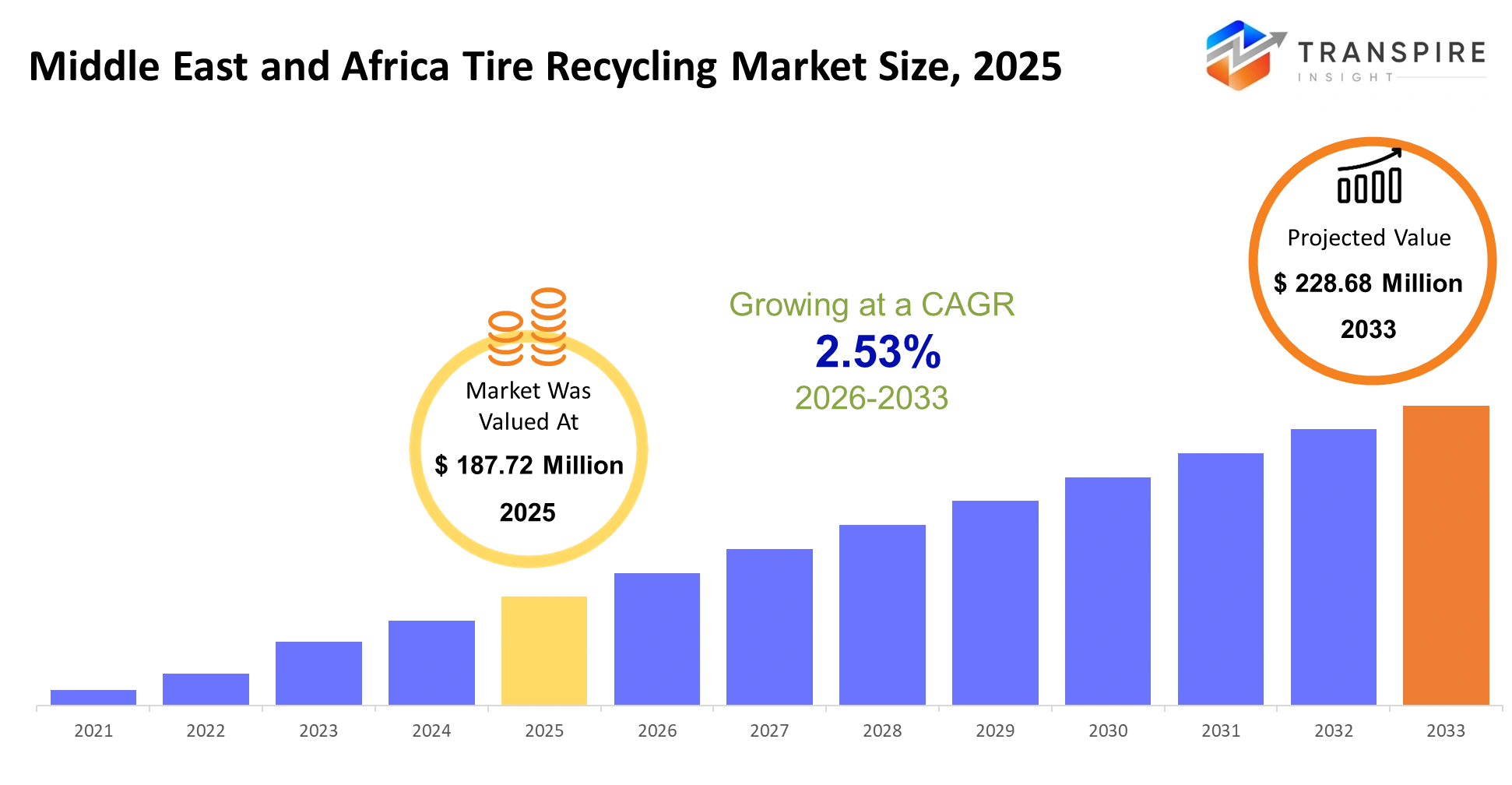
- Middle East and Africa Tire Recycling Market Size 2025: USD 187.72 Million
- Middle East and Africa Tire Recycling Market Size 2033: USD 228.68 Million
- Middle East and Africa Tire Recycling Market CAGR: 2.53%
- Middle East and Africa Tire Recycling Market Segments: By Process (Mechanical, Pyrolysis, Devulcanization, Chemical), By Application (Construction, Automotive, Fuel, Industrial), By End-User (Industrial Users, Recyclers, Governments, Construction Firms)
To learn more about this report,  Download Free Sample Report
Middle East and Africa Tire Recycling Market Summary:
The Middle East and Africa Tire Recycling Market size is estimated at USD 187.72 Million in 2025 and is anticipated to reach USD 228.68 billion by 2033, growing at a CAGR of 2.53% from 2026 to 2033. The Middle East and Africa tire recycling market in environmental services will progress toward better waste management and sustainable material recycling through structured collection systems. Governments will tighten disposal rules, pushing informal handling toward regulated channels. Consumers will expect cleaner cities and responsible disposal, encouraging collection networks. The development of pyrolysis and crumb rubber processing technologies will enhance product quality and increase market value. The regional industry will implement digital tire tracking systems, while construction and energy sector partnerships will create new opportunities for tire reuse, which will develop a more efficient and profitable business system.
What Has the Impact of Artificial Intelligence Been on the Middle East and Africa Tire Recycling Market?
The ongoing transformation of operational intelligence across various sectors by artificial intelligence shows its growing effect on tire recycling operations throughout the Middle East and Africa which impacts both strategic development and daily business operations. The Middle East and Africa tire recycling market has advanced its market research capabilities through AI technology, which provides instant data assessment together with detailed information about material movements and market pricing trends and regional consumer needs.
The Middle East and Africa tire recycling market uses artificial intelligence to boost operational productivity through its advanced automation systems. With the help of AI sorting technology, material sorting will be done with high precision, resulting in reduced pollution levels and high-quality output of recycled rubber along with other material products. These systems will enhance the operations within the supply chain management through the identification of appropriate paths for the organization, thereby reducing costs of transportation and improving delivery time in areas with poorly coordinated networks.
AI will drive innovation through its operational efficiency to create competitive advantages for businesses in the Middle East and Africa tire recycling industry. Companies will use intelligent systems to create their own recycled material grades which they will use in construction and energy recovery and manufacturing processes. Digital adoption increases business capability to meet changing customer demands and new government regulations while they build a competitive advantage in an economy that prefers transparent and sustainable and affordable business operations.
Key Market Trends & Insights:
- The Saudi Arabian tire recycling market holds a 28 to 32 percent share which will increase its market share in 2025 according to the implementation of waste management regulations.
- The United Arab Emirates experiences rapid growth because sustainability-related infrastructure projects will increase its development rates above 7 percent compound annual growth rate.
- South Africa maintains a substantial market presence because its recycling systems are already established and demand for crumb rubber products continues to increase.
- Crumb rubber dominates with nearly 40% market share in 2025, which construction and road surfacing applications use extensively.
- The industrial sector uses tire-derived fuel (TDF) as its second biggest segment because industrial facilities need energy recovery solutions.
- The pyrolysis oil market segment will experience its fastest expansion period because more companies will begin using alternative fuels until 2030.
- The construction sector uses recycled rubber from asphalt and infrastructure projects because recycled rubber accounts for more than 35 percent of their needs.
- Industrial facilities require affordable fuel alternatives which leads to energy recovery becoming the most rapidly expanding application.
- Government-backed infrastructure projects provide support to the construction sector which holds a market share of approximately 38%.
Middle East and Africa Tire Recycling Market Segmentation
By Process
The mechanical processing system will shred and grind scrap tires to create rubber granules and steel scrap, which will enable ongoing material recovery operations. The method will continue to be used because it requires less operational effort while meeting regular production requirements. Pyrolysis will attract attention because it transforms waste tires into valuable oil and gas and carbon black which comes from non-recyclable waste. The rising demand for tighter emissions controls will lead to the development of pyrolysis systems which comply with higher emission control standards.
Devulcanization will focus on breaking sulfur bonds which exist in rubber materials to enable their recycling into new tire manufacturing and industrial product development. The chemical processing system will enable advanced material recovery operations through its implementation of solvent-based and catalytic material recovery methods which will only be adopted if they prove to be cost effective. The output quality and regulatory requirements of each process will determine how operational decisions are made throughout the tire recycling industry in Middle Eastern and African countries. The ongoing development of processing methods will increase material recovery throughout the recycling process.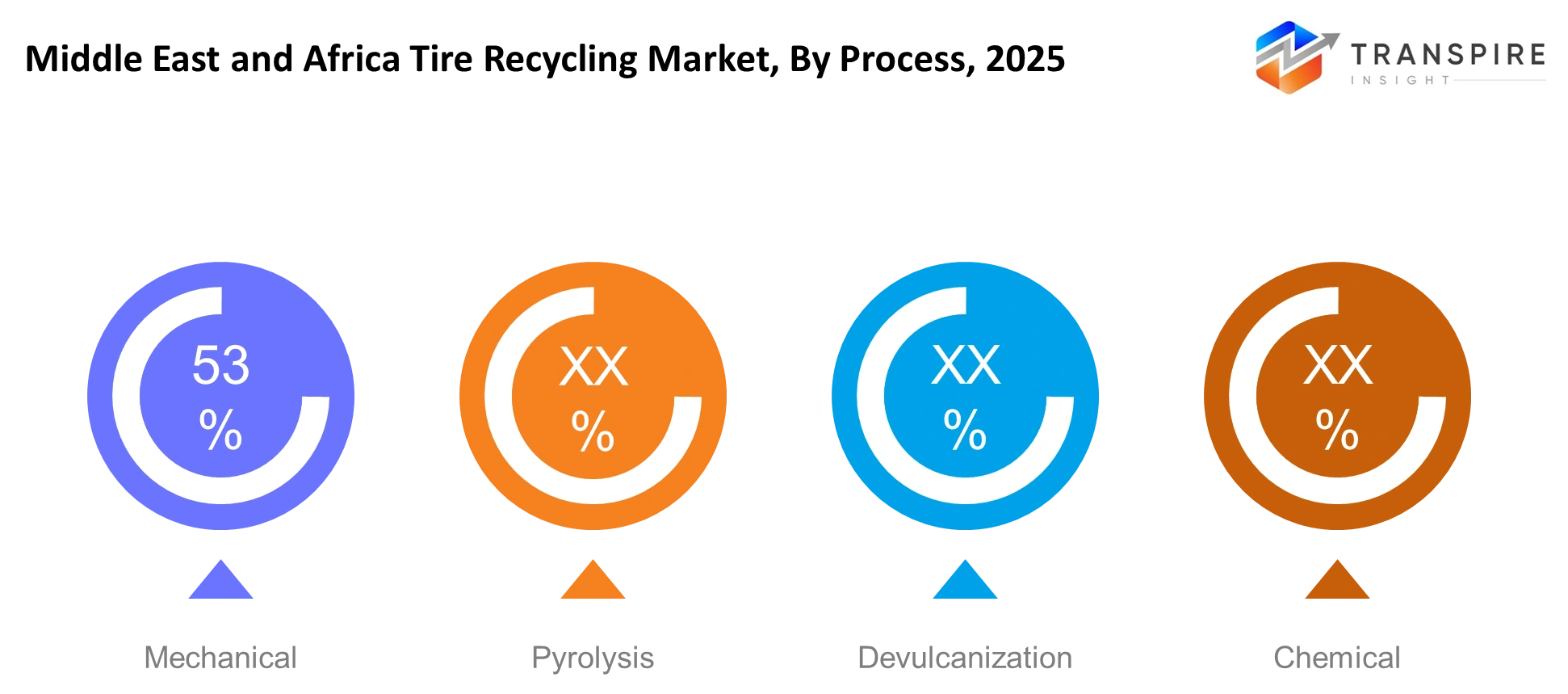
To learn more about this report, Download Free Sample Report
By Application
Construction applications will use recycled rubber in asphalt and flooring and insulation materials because it delivers both durability and cost efficiency. Crumb rubber usage will increase in road development because infrastructure projects will create higher demand for its application. The automotive industry will reuse processed rubber materials from automotive applications to create mats seals and secondary components, which will help achieve material circularity. Industrial heating and energy recovery operations will use tire-derived fuel as their primary fuel source.
Industrial use will expand into products such as conveyor belts, molded goods, and protective surfaces. The middle east and africa tire recycling market will experience changing material needs and sustainability requirements through its various applications. Infrastructure development and energy consumption patterns will drive construction and fuel consumption expansion. Recyclers will gain new revenue opportunities through their expanded industrial usage of materials.
By End-User
Industrial users will depend on recycled materials to produce their goods and generate their energy needs which will create continuous demand for processed materials. Recyclers will function as essential operators because they will control all aspects of recycled tire product collection and processing and distribution. Governments will create regulations that establish recycling obligations while they help develop organized waste management systems. Public policies will establish standards for proper waste disposal while they create systems for recycling that follow established procedures.
Construction firms will adopt recycled rubber materials for roads and building projects, driven by cost and performance benefits. The partnership between recyclers and construction companies will create better material distribution and efficiency in material usage. The middle east and africa tire recycling market will experience processing and investment changes because of end-user behavior patterns. The expanding regulatory frameworks will continue to influence how all user groups participate in activities.
What are the Main Challenges for the Middle East and Africa Tire Recycling Market Growth?
Market performance for tire recycling in the Middle East and Africa region encounters ongoing challenges because of existing technical and operational limitations. The operation of waste tire processing will face ongoing challenges because of uncertainties in feedstock materials and contamination issues. The implementation of pyrolysis and devulcanization technologies requires advanced control mechanisms which will restrict their use in small-scale operations. The operational efficiency of production processes will be disrupted by supply chain deficiencies which affect tire collection practices and logistics operations.
The Middle East and Africa tire recycling market will face profitability challenges because of existing barriers in manufacturing and market entry. The operational costs of advanced recycling facilities will rise because both high capital requirements and strict environmental regulations demand substantial financial investment. The progress of technology verification and certification processes will obstruct the rapid introduction of new products to the market. The market will experience limitations because recycled product prices fluctuate between recycled outputs and virgin materials which decreases their investment and manufacturing appeal.
The existing adoption challenges will create major obstacles because of insufficient infrastructure and inadequate technical personnel in multiple regions. The absence of organized collection systems and contemporary recycling facilities will hinder many regions from achieving effective operations and extensive recycling programs. The combination of funding gaps and low user awareness will create challenges that prevent recycled products from gaining market traction. The middle east and africa tire recycling market needs to overcome several growth obstacles which will restrict its ability to reach full development and maintain sustainable operations.
The market will develop competitive dynamics because of alternative waste management solutions and economical waste disposal methods. Structured systems will face pricing challenges because traditional landfilling and informal recycling continue to compete with their operations. The middle east and africa tire recycling market will face future uncertainty because environmental regulations and technological advancements will require businesses to make ongoing adjustments.
Regional Insights
The Middle East and Africa tire recycling market will demonstrate different performance levels across its various regions because of the strength of existing policies, the development of industrial sectors, and the effectiveness of waste collection systems. TIn Saudi Arabia, strict environmental policies and processing plants for improving recycling initiatives will be implemented using systems. In the UAE, emphasis will be placed on developing technological advancements and environmentally sustainable infrastructure projects.
South Africa will sustain its recycling activities through established programs and its structured value chains which facilitate material recovery. Other regions will experience development delays because they lack essential infrastructure and have ineffective law enforcement. Different countries will show growth patterns which depend on three factors: regulatory understanding, public knowledge, and financial resources dedicated to contemporary recycling technologies.
Urban areas will produce increased tire waste which will drive the establishment of local recycling facilities and the enhancement of transportation networks. Processing units will experience supply inconsistencies because rural areas will struggle with collection processes. The recycling system will achieve sustainable growth through regional partnerships and shared policy frameworks which will enhance operational efficiencies throughout the complete recycling process.
Recent Development News
In March 2026, Liberty Tire Recycling has earned a Bronze Medal in sustainability, recognition awarded to the Top 35% of companies assessed by EcoVadishttps://www.tyreandrubberrecycling.com
In April 2026, Liberty Tire Recycling stands as recycling platform, offering comprehensive solutions for tire collection, processing, and recycling. The acquisition of Liberty expands I Squared’s global portfolio of environmental infrastructure assets and underscores its commitment to fostering sustainable enterprises that deliver economic as well as environmental value.https://www.tyreandrubberrecycling.com
|
Report Metrics |
Details |
|
Market size value in 2025 |
USD 187.72 Million |
|
Market size value in 2026 |
USD 192.04 Million |
|
Revenue forecast in 2033 |
USD 228.68 Million |
|
Growth rate |
CAGR of 2.53% from 2026 to 2033 |
|
Base year |
2025 |
|
Historical data |
2021 - 2024 |
|
Forecast period |
2026 - 2033 |
|
Report coverage |
Revenue forecast, competitive landscape, growth factors, and trends |
|
Regional scope |
Middle East and Africa (Saudi Arabia, United Arab Emirates, South Africa, Rest of Middle East and Africa) |
|
Key company profiled |
Genan, Liberty Tire Recycling, Lakin Tire, Michelin, Bridgestone, Continental, Goodyear, Bolder Industries, Tyre Recycling Solutions, ECO Green Equipment, Eldan Recycling, Scandinavian Enviro Systems, Green Distillation, Lehigh Technologies, Granuband |
|
Customization scope |
Free report customization (country, regional & segment scope). Avail customized purchase options to meet your exact research needs. |
|
Report Segmentation |
By Process (Mechanical, Pyrolysis, Devulcanization, Chemical), By Application (Construction, Automotive, Fuel, Industrial), By End-User (Industrial Users, Recyclers, Governments, Construction Firms) |
How Can New Companies Establish a Strong Foothold in the Middle East and Africa Tire Recycling Market?
The Middle East and Africa tire recycling market offers new market participants an opportunity to establish a strong market presence by entering underserved market segments which currently experience increased demand but suffer from insufficient supply. Organizations can establish their value propositions by establishing specific output targets which include producing high-grade crumb rubber needed for road construction and generating pyrolysis oil required for industrial fuel.
The Middle East and Africa tire recycling market will depend on technology differentiation as the main factor which helps companies establish market presence. Startups that implement AI-powered sorting systems together with automated shredding equipment and advanced cleaner pyrolysis technology will achieve operational efficiency gains and consistent production results. The innovation methods will directly resolve important operational challenges which include contamination issues, variation in product output quality, and excessive operating expenses.
The establishment of strategic partnerships will improve market entry for new companies because these partnerships will create connections between these companies and construction firms and energy producers and municipal bodies. The collaboration will enable constant delivery of production materials through legally binding contracts which will decrease risks during the initial project stages.
The process of entering new markets requires companies to establish their environmental sustainability commitment which should match their smart city development projects. The new market entrants will be able to differentiate themselves from other competitors through their use of digital tracking systems and transparent reporting methods and their operation of environmentally sustainable business practices. The data-driven strategy which enables market expansion will help create a competitive advantage because the market demands both accountability and operational efficiency.
Key Middle East and Africa Tire Recycling Market Company Insights
The competition within the tire recycling market of the Middle East and Africa will increase because local companies and international organizations will both boost their recycling facilities and introduce new technologies. Through advanced recycling systems and cost control strategies companies will work to achieve better output quality. The ability to maintain supply availability and follow regulations and fulfill industrial requirements will determine competitive position in the market.
The main strategy for companies will be to expand their operations through new partnerships and the development of local facilities in different regions. Organizations will achieve better operational results and enhanced visibility when they invest in pyrolysis systems, automation technologies and digital tracking solutions. The construction sector, fuel industry, and manufacturing field will drive market differentiation as participants create specialized products for specific customer needs.
A company can achieve long-term success through innovation, maintaining consistent supply chains and following environmental rules. Companies that achieve a successful balance between cost efficiency and quality production will capture a larger share of the market. The industry will experience increased competitive pressure because new businesses enter the market with adaptable solutions which create an organized operational system that prioritizes performance.
Company List
- Genan
- Liberty Tire Recycling
- Lakin Tire
- Michelin
- Bridgestone
- Continental
- Goodyear
- Bolder Industries
- Tyre Recycling Solutions
- ECO Green Equipment
- Eldan Recycling
- Scandinavian Enviro Systems
- Green Distillation
- Lehigh Technologies
- Granuband
What are the Key Use-Cases Driving the Growth of the Middle East and Africa Tire Recycling Market?
The Middle East and Africa tire recycling market is experiencing growth because recycled rubber materials find effective applications in infrastructure projects and construction activities which use recycled rubber for asphalt and road building. The use of rubber-modified bitumen will become more common among governments and contractors because it enhances road longevity while decreasing upkeep expenses. The direct application of this solution will drive market expansion through its ability to create ongoing demand for crumb rubber used in extensive public works projects.
The Middle East and Africa tire recycling market will gain advantages from the automotive and manufacturing industries because they will reuse processed rubber to produce items like mats and seals and industrial goods. Manufacturers will seek cost-effective and sustainable raw materials which will lead to increased use of recycled materials. The industry will follow this path to achieve its goals which aim to decrease usage of newly produced materials while sustaining product efficiency.
The middle east and africa tire recycling market will experience growth because energy recovery serves as a primary application of tire recycling technology. Tire-derived fuel will be used in cement plants and industrial boilers, offering a lower-cost alternative to conventional fuels. The application will help organizations achieve their waste reduction and energy efficiency objectives, which apply to industrial regions with significant operational production.
New urban development applications together with smart city projects will create additional development possibilities. Used rubber will be utilized to make playground flooring, insulating products, and sound-absorbing products. The emerging applications will offer opportunities for sustainable growth, as they link recycling achievements with the objectives of sustainable urban development and environmental conservation.
Middle East and Africa Tire Recycling Market Report Segmentation
By Process
- Mechanical
- Pyrolysis
- Devulcanization
- Chemical
By Application
- Construction
- Automotive
- Fuel
- Industrial
By End-User
- Industrial Users
- Recyclers
- Governments
- Construction Firms
Frequently Asked Questions
Find quick answers to common questions.
The Approximate Middle East and Africa Tire Recycling Market size for the Market will be USD 228.68 Million in 2033.
Key Segments for the Middle East and Africa Tire Recycling Market are By Process (Mechanical, Pyrolysis, Devulcanization, Chemical), By Application (Construction, Automotive, Fuel, Industrial), By End-User (Industrial Users, Recyclers, Governments, Construction Firms).
Major Middle East and Africa Tire Recycling Market Players are Genan, Liberty Tire Recycling, Lakin Tire, Michelin, Bridgestone, Continental, Goodyear, Bolder Industries, Tyre Recycling Solutions, ECO Green Equipment, Eldan Recycling, Scandinavian Enviro Systems, Green Distillation, Lehigh Technologies, Granuband.
The Current Middle East and Africa Tire Recycling Market size is USD 187.72 Million in 2025.
The Middle East and Africa Tire Recycling Market CAGR is 2.53%.
- Genan
- Liberty Tire Recycling
- Lakin Tire
- Michelin
- Bridgestone
- Continental
- Goodyear
- Bolder Industries
- Tyre Recycling Solutions
- ECO Green Equipment
- Eldan Recycling
- Scandinavian Enviro Systems
- Green Distillation
- Lehigh Technologies
- Granuband
Recently Published Reports
-
Dec 2024
Handling and Lifting Equipment Market
Handling and Lifting Equipment Market Size, Share & Analysis Report By Product (Cranes and Hoists, Forklifts, Conveyor Systems, Aerial Work Platforms, Others), By Application (E-Commerce, Automotive and Railway, Food and Beverages, Aviation, Others), and Geography (North America, Europe, Asia-Pacific, Middle East and Africa, South and Central America), 2021 - 2031
-
Feb 2025
HVAC Equipment Market
HVAC Equipment Market Size, Share & Analysis Report By Heating Equipment Type (Boilers and Furnaces, Heat Pumps, and Unitary Heaters), By Ventilation Equipment (Air Handling Units, Humidifiers and Dehumidifiers, Air Filters, and Fan Coiling Units), By Air Conditioning Equipment (Unitary Air Conditioners, Room Air Conditioners, Packaged Terminal Air Conditioners, and Chillers), By End User (Commercial, Residential, Industrial, and others), and Geography (North America, Europe, Asia-Pacific, Middle East and Africa, South and Central America), 2021 – 2031
-
Feb 2025
Refrigeration Valves Market
Refrigeration Valves Market Size, Share & Analysis Report By Type (Solenoid Valves, Expansion Valves, Check Valves, Service Valves, Others), By Application (Commercial Refrigeration, Industrial Refrigeration, Transport Refrigeration, Residential Refrigeration, Air Conditioning Systems), By End User (Food and Beverage Industry, Pharmaceutical Industry, HVAC Industry, Chemical Industry, Others), and Geography (North America, Europe, Asia-Pacific, Middle East and Africa, South and Central America), 2021 – 2031
-
Dec 2025
E-Commerce Packaging Materials Market
E-Commerce Packaging Materials Market By Material Type (Corrugated Boxes, Paper & Paperboard, Foam & Cushioning Materials, Plastic Packaging, Flexible Packaging, Protective Packaging, Others), By Product(Primary Packaging, Secondary Packaging, Tertiary Packaging), By Packaging Function (Protective Packaging, Branding & Presentation Packaging, Transit & Logistic Packaging, Sustainable Packaging, Tamper Evidence Packaging), By End-User (Retail & Consumer Goods, Electronic Appliances, Food & Beverages, Healthcare & Pharmaceutical, Fashion & Apparel, Home & Furnishing, Others); By Industry Analysis, Size, Share, Growth, Trends, and Forecasts 2021-2033