

Middle East and Africa Swarm Robotics Market Size & Forecast:
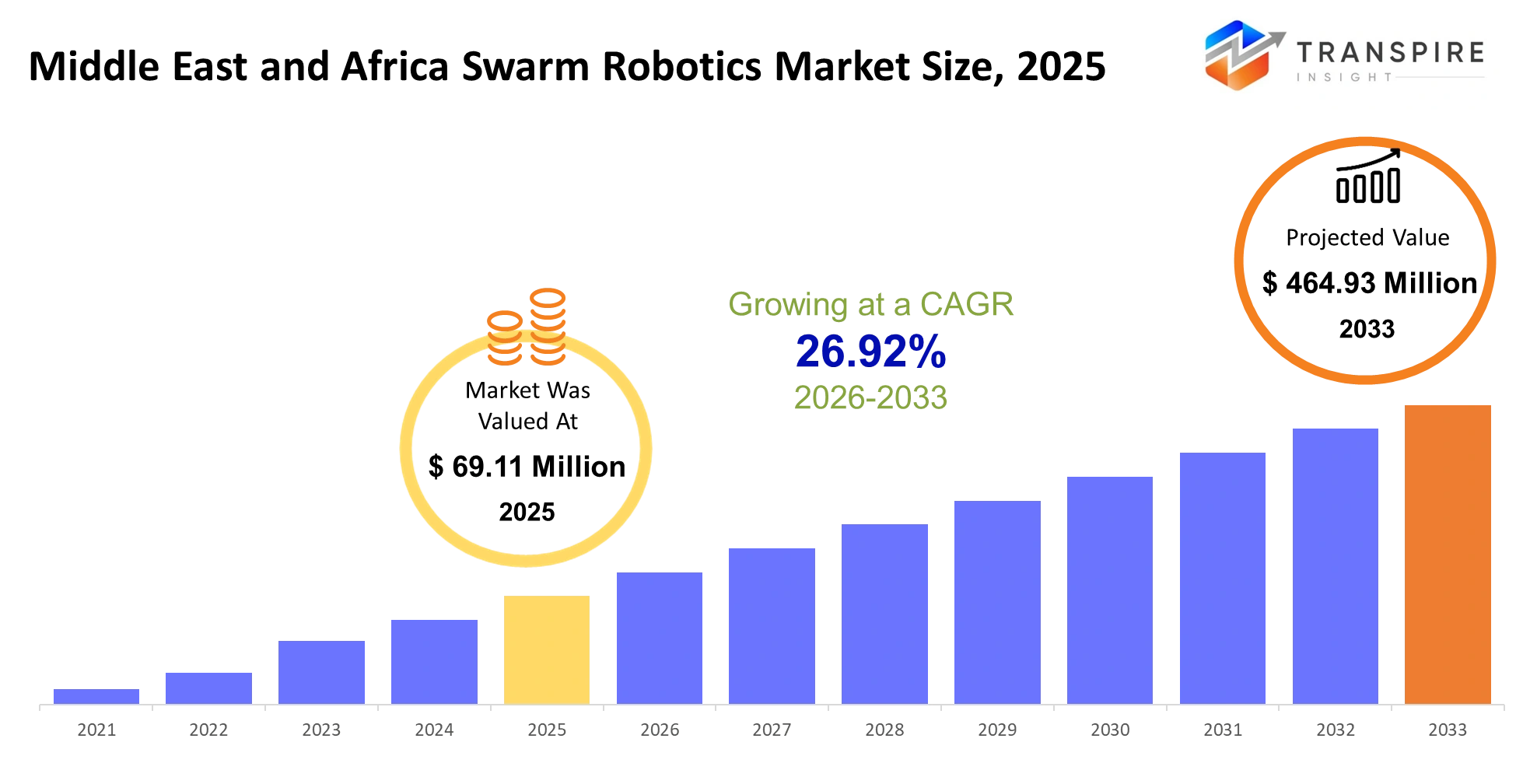
- Middle East and Africa Swarm Robotics Market Size 2025: USD 69.11 Million
- Middle East and Africa Swarm Robotics Market Size 2033: USD 464.93 Million
- Middle East and Africa Swarm Robotics Market CAGR: 26.92%
- Middle East and Africa Swarm Robotics Market Segments: By Component (Hardware, Software), By Robot Type (Aerial, Ground), By Control Type (Centralized, Decentralized), By Communication (Wireless, Mesh), By Application (Defense, Agriculture, Logistics), By End-User (Military, Industrial Companies).
To learn more about this report,  Download Free Sample Report
Middle East and Africa Swarm Robotics Market Summary:
The Middle East and Africa Swarm Robotics Market size is estimated at USD 69.11 Million in 2025 and is anticipated to reach USD 464.93 Million by 2033, growing at a CAGR of 26.92% from 2026 to 2033. The World Bank forecasts the Middle East and Africa region which includes Saudi Arabia, the United Arab Emirates, South Africa, and the remaining Middle East and Africa territories will experience a shift towards decentralized machine intelligence solutions which meet specific local requirements. The government and private sector will work together to create unified drone systems which will be used for infrastructure surveillance, border protection, and energy facility assessment. Business needs will drive demand for robotic swarms which combine adaptability and affordable operation costs to work successfully in extreme desert and isolated locations. The development of edge computing and AI-based coordination systems will determine deployment methods while the changing regulatory conditions will establish guidelines for safe multi-robot operations which will affect how businesses use autonomous collective systems in their everyday processes.
What Has the Impact of Artificial Intelligence Been on the Middle East and Africa Swarm Robotics Market?
The Middle East and Africa Swarm Robotics Market experiences rapid changes through artificial intelligence which alters data analysis methods and decision-making processes and robotics system implementation. AI in Middle East and Africa Swarm Robotics Market environments enables real-time coordination among multiple robots which allows energy and logistics and security industries to achieve higher operational accuracy. Advanced machine learning models now drive market research and data analysis activities which enable stakeholders to discover behavioral patterns and operational gaps and upcoming market developments. The Middle East and Africa Swarm Robotics Market systems will use artificial intelligence to enhance predictive analytics capabilities which help companies predict demand changes and manage resources with better precision.
The Middle East and Africa Swarm Robotics Market operates with better production efficiency because AI technology has been integrated into its operational processes. The autonomous swarm systems use intelligent algorithms to conduct inspection and maintenance activities while reducing the need for human involvement. AI-driven swarm robotics allows supply chain networks to become more responsive through its ability to optimize routes, monitor inventory and manage expenses. The developments currently underway improve efficiency while helping companies develop flexible robotic systems that can grow with their business needs.
The Swarm Robotics Market in Middle Eastern and African regions achieves competitive advantages through artificial intelligence-based innovation and customized solutions. Organizations use artificial intelligence to develop Swarm Robotics Market solutions that address specific regional challenges in Middle East and Africa which include extreme weather conditions and scattered transportation systems. The transition to intelligent, data-driven systems will improve market presence, foster technological uniqueness, and facilitate sustained growth across the entire region.
Key Market Trends & Insights:
- Saudi Arabia leads the market share with more than 32% market share owing to increasing developments in terms of smart cities and defense in Middle East and Africa swarm robotics market until 2025.
- The UAE emerges as one of the fastest-growing regions in the market with a growth rate over 20%, driven by infrastructure development through AI.
- South Africa is seen developing demand with increasing demand for mining automation, robotics and industrial robotics until 2028.
- Drone-based swarm robotics accounts for the largest market share with more than 45%, being used for surveillance, mapping and industrial inspection.
- Ground based robotic systems constitute the second largest market share, being used for logistics and warehouse optimization.
- Hybrid swarm robots constitute the fastest-growing segments, being used across multiple environments until 2026-2030.
- Defense and Security applications are leading application segments constituting 38% of the market share owing to border surveillance and monitoring.
- Agricultural application and environmental monitoring applications emerge as the fastest-growing application segments due to climate adaptation.
- Defense and government departments account for the highest market share with around 40% of the market share in 2025.
- Commercial organizations including logistics and energy are growing at a rapid pace owing to automation and predictive analytics.
Middle East and Africa Swarm Robotics Market Segmentation
By Component
Hardware will provide the tangible foundation for swarm robot systems, comprising sensor technologies, drone capabilities, actuators, and embedded processors that will work collectively. A preference will be given to miniaturized and energy-saving equipment capable of functioning effectively under extreme conditions such as desert terrains and marine environments. Software will serve as the control element that would facilitate the communication process, make decisions, and synchronize activities for multiple robots. Machine learning-based software will aid robots in working more effectively by coordinating with each other.
The development of software solutions will become a critical issue for industries, as software will be essential for implementing various operations. Cloud and edge computing integration will enable timely data transfer and analysis. The hardware-software integration will allow developing balanced solutions that will optimize swarm performance for industries.

To learn more about this report, Download Free Sample Report
By Robot Type
Both aerial and terrestrial robotics will be extensively employed for surveillance purposes, mapping, and inspection in places that are large, distant, and inaccessible for humans. Both technologies will prove to be flexible and fast enough to meet the needs of defense and environmental monitoring activities. On the ground, robots will perform various logistics tasks, automate warehouse operations, and assist with inspection processes.
Robotics adoption will grow because industries will want to solve issues related both to land and aerial operations. While aerial robotic technologies will be used to rapidly collect information, robots will assist in executing tasks on the ground. This will make work much easier and will help save time.
By Control Type
There will be one command center for the complete robotic operation. Hence, the task of coordinating the processes will be easier with a centralized control system. The centralized control system will prove to be extremely useful for environments that require synchronized operation of tasks. The centralized control systems will face some delay while doing large-scale operations.
The importance of the decentralized control system will be heightened with the growing need for agility in industrial sectors. There will be fewer dependencies on central control units for the decentralized control system. It will be much more flexible and robust towards any failures. Real-time decisions will add to its effectiveness.
By Communication
Wireless communication will provide a basic link for exchanging information between robots. This will allow the creation of communication processes that require sufficient signals and bandwidth to transfer information. However, challenges may emerge when robots operate in complex environments due to obstruction of the signal. Mesh network communication will address the problem by creating a network in which every robot is a node.
The use of nodes will create a robust network and ensure continuous communication even when one node fails. This type of network communication will be perfect for large-scale operations in remote areas. The data will flow using different channels hence making it reliable. Communication technology will develop to support fast, secure processes.
By Application
Swarm robotics will be driven by the need for more advanced surveillance and border patrol technologies by the defense industry. The advantage with swarm robots is that they will be able to work together and do tasks such as surveillance in a highly efficient way and hence accomplish more in less time. The agricultural industry will be able to embrace swarm robotics technology so as to make itself more efficient.
Robots assist farmers by evaluating crop conditions and delivering essential resources which include water and fertilizer. Swarm robotics will enable logistics companies to improve their warehouse operations and logistics management.
By End-User
The military organization will still be among the principal buyers owing to the significant advantages of swarm robotics in terms of surveillance, reconnaissance, and operations planning. The systems will offer better situational awareness and operations management capabilities. There is also going to be the industrial application of swarm robotics, which will result from efforts towards automation and labor independence.
The trend will gain traction as businesses seek ways to enhance efficiency without increasing costs. On the other hand, military organizations will continue using sophisticated technologies, including communication. The trends in both industries will shape the evolution of the technology in question.
What are the Main Challenges for the Middle East and Africa Swarm Robotics Market Growth?
Technical as well as operational challenges faced by the Middle East and Africa swarm robotics market may hinder large scale adoption of solutions. Challenges related to stability of system are one major issue where coordination of multiple robots in real time requires high precision of computing as well as low latency of communication. Limitations of performance in unfavourable conditions such as high temperatures and dusty environments, will pose a challenge to the reliability of the product.
Barriers related to manufacturing as well as commercialization of the products will also be seen by the market. Manufacturing process will become complicated as both software and hardware have to be integrated into one product, which will increase the time as well as the cost of the product. Safety standards for autonomous systems have not yet been defined; there is no guarantee of compliance by manufacturers.
The adoption issues will pose threats to the growth of the middle east and Africa swarm robotics market, especially in developing countries. Poor infrastructure such as inadequate communication facilities will act as a threat to efficient utilization of the swarm robots. Lack of professionals knowledgeable in robotics and artificial intelligence will also pose a challenge. Budget and funding limitations will act as a challenge to the adoption of automated technology by some organizations.
Another limitation to the market growth will be competition from other automated technologies that are more affordable than swarm robotics. This will affect pricing decisions. Besides this, changing regulatory framework and frequent technological changes will pose challenges in the middle east and Africa swarm robotics market.
Regional Insights
The Saudi Arabian region is expected to make the greatest impact in terms of adopting this technology. This is due to substantial investment made towards making the region smarter through investments in robotics and automation systems and upgrading military technologies. There will be increasing requirements for robust systems that can work effectively in arid conditions as well as in industrial sites.
On the other hand, UAE is expected to demonstrate rapid growth due to the adoption of innovative AI policies and developments in smart cities. South Africa is set to make slow but stable progress due to its need for automation in the mining industry. All the remaining regions will follow suit gradually.
Recent Development News
In March 2026, Red Cat Holdings announced acquisition. Red Cat Holdings completed the acquisition of Apium Swarm Robotics to integrate advanced multi-drone swarming autonomy into its defense UAV systems, strengthening capabilities applicable to global and MENA defense markets.
Source: https://thedefensepost.com
In March 2026, Red Cat Holdings announced acquisition. The company finalized its purchase of Apium Swarm Robotics to incorporate decentralized swarm-control software into its drone portfolio, enabling coordinated autonomous operations across multiple unmanned systems.
Source: https://www.alphapilot.tech
|
Report Metrics |
Details |
|
Market size value in 2025 |
USD 69.11 Million |
|
Market size value in 2026 |
USD 87.63 Million |
|
Revenue forecast in 2033 |
USD 464.93 Million |
|
Growth rate |
CAGR of 26.92% from 2026 to 2033 |
|
Base year |
2025 |
|
Historical data |
2021 - 2024 |
|
Forecast period |
2026 - 2033 |
|
Report coverage |
Revenue forecast, competitive landscape, growth factors, and trends |
|
Regional scope |
Middle East and Africa (Saudi Arabia, United Arab Emirates, South Africa, Rest of Middle East and Africa) |
|
Key company profiled |
SwarmFarm Robotics, KUKA, ABB, FANUC, iRobot, Boston Dynamics, DJI, Parrot, Lockheed Martin, Northrop Grumman, Thales, Elbit Systems, Siemens, NVIDIA, Amazon Robotics. |
|
Customization scope |
Free report customization (country, regional & segment scope). Avail customized purchase options to meet your exact research needs. |
|
Report Segmentation |
By Component (Hardware, Software), By Robot Type (Aerial, Ground), By Control Type (Centralized, Decentralized), By Communication (Wireless, Mesh), By Application (Defense, Agriculture, Logistics), By End-User (Military, Industrial Companies). |
How Can New Companies Establish a Strong Foothold in the Middle East and Africa Swarm Robotics Market?
Emerging firms will benefit from positioning themselves in the middle east and africa swarm robotics market by focusing on specific niches where there is increasing demand but still very little competition. This will help emerging firms tackle certain problems and become part of the solution. The middle east and africa swarm robotics market requires innovative products that can deal with harsh weather conditions, coordination at long distances, and real-time decisions making. Firms which tailor their product offerings based on regional requirements will see fast adoption and entry into the market.
Emerging firms should consider innovation as one of the strategies for differentiating themselves in the middle east and africa swarm robotics market. Innovation will involve combining aspects such as artificial intelligence, machine learning, and edge computing technologies to increase coordination in swarms while minimizing delays. Modularity and scalability can help firms develop solutions that are industry-specific while saving on cost associated with redesigning their products to fit into other markets. Examples of such emerging firms include SwarmFarm Robotics and Exyn Technologies.
Strategic alliances will guarantee that the company will have better market positioning owing to the availability of infrastructural, financial, and local knowledge advantages. With the cooperation between the government authorities, intelligent cities, and industries, the company will manage to get rapid acceptance and gain credibility. Moreover, such businesses that will put efforts into educating their employees and delivering services locally will overcome adoption barriers.
Key Middle East and Africa Swarm Robotics Market Company Insights
The basis of competition will continue to be built upon the efforts of companies that emphasize sophisticated AI implementation, synchronization, and scalability within their swarms. Companies already active in this market will engage in upgrading their existing products as well as geographical expansion. They will form strategic alliances with the military and industries to enhance implementation and increase technology adoption rates.
Upcoming companies will use innovation and specialization in their solutions at a lower price point to differentiate themselves from established firms. They will leverage their innovation in areas such as edge computing and communication technologies. These companies will seek partnerships and government programs to help gain traction in the market.
Company List
- SwarmFarm Robotics
- KUKA
- ABB
- FANUC
- iRobot
- Boston Dynamics
- DJI
- Parrot
- Lockheed Martin
- Northrop Grumman
- Thales
- Elbit Systems
- Siemens
- NVIDIA
- Amazon Robotics
What are the Key Use-Cases Driving the Growth of the Middle East and Africa Swarm Robotics Market?
The market for swarm robotics in the Middle East and Africa is gaining momentum due to applications in the field of defense and security, which require coordination and timely surveillance. The application of drones using swarm technology can be used for border surveillance, threat detection, and mission planning in vast and sensitive areas. This will lead to enhanced situational awareness and faster responses, thereby making them vital for the national security strategy and resulting in increased adoption in the coming years.
In industrial applications, the market for swarm robotics in the Middle East and Africa is growing owing to its use in the oil and gas industry, mining operations, and infrastructure monitoring. In such an environment, swarm robots can help in conducting inspections and identifying faults in equipment.
The agriculture sector is another application area that is expected to grow in the Middle East and Africa swarm robotics market due to automation of the farm processes through utilization of swarm robotics. These robots will monitor the plants and provide efficient allocation of resources such as irrigation so as to address problems such as water shortage and changing climatic conditions.
Among other areas which will boost the market growth are logistics and smart cities whereby the deliveries will be facilitated and traffic will be managed within the city. On the other hand, warehouse management will be enhanced by automation.
Middle East and Africa Swarm Robotics Market Report Segmentation
By Component
- Hardware
- Software
By Robot Type
- Aerial
- Ground
By Control Type
- Centralized
- Decentralized
By Communication
- Wireless
- Mesh
By Application
- Defense
- Agriculture
- Logistics
By End-User
- Military
- Industrial Companies
Frequently Asked Questions
Find quick answers to common questions.
The approximate Middle East and Africa Swarm Robotics Market size for the market will be USD 464.93 Million in 2033.
Key segments for the Middle East and Africa Swarm Robotics Market are By Component (Hardware, Software), By Robot Type (Aerial, Ground), By Control Type (Centralized, Decentralized), By Communication (Wireless, Mesh), By Application (Defense, Agriculture, Logistics), By End-User (Military, Industrial Companies).
Major Middle East and Africa Swarm Robotics Market players are SwarmFarm Robotics, KUKA, ABB, FANUC, iRobot, Boston Dynamics, DJI, Parrot, Lockheed Martin, Northrop Grumman, Thales, Elbit Systems, Siemens, NVIDIA, Amazon Robotics.
The Middle East and Africa Swarm Robotics Market size is USD 69.11 Million in 2025.
The Middle East and Africa Swarm Robotics Market CAGR is 26.92%.
- SwarmFarm Robotics
- KUKA
- ABB
- FANUC
- iRobot
- Boston Dynamics
- DJI
- Parrot
- Lockheed Martin
- Northrop Grumman
- Thales
- Elbit Systems
- Siemens
- NVIDIA
- Amazon Robotics
Recently Published Reports
-
Dec 2024
3D Optical Profiler Market
3D Optical Profiler Market Size, Share & Analysis Report By Type (Desktop 3D Optical Profiler, and Portable 3D Optical Profiler), By Technology (Confocal Technology, and White Light Interference), By End-Use Industry (Manufacturing, Research Institutions, Automotive, Aerospace and Defense, Medical Devices, and Other), and Geography (North America, Europe, Asia-Pacific, Middle East and Africa, South and Central America), 2021 - 2031
-
Feb 2025
Depth Sensor Market
Depth Sensor Market Size, Share & Analysis Report By Type (Infrared Depth Sensors, Time-of-Flight (ToF) Sensors, Stereo Vision Sensors, Structured Light Sensors, Ultrasonic Depth Sensors), By Application (Automotive, Robotics, Gaming, Consumer Electronics, Industrial Automation, Healthcare, Security & Surveillance, Others), By End Users (Automotive Manufacturers, Consumer Electronics Companies, Healthcare Providers, Industrial Companies, Security Agencies, Gaming Companies, Robotics Companies, Others), and Geography (North America, Europe, Asia-Pacific, Middle East and Africa, South and Central America), 2021 – 2031
-
Feb 2025
Digital Manufacturing Market
Digital Manufacturing Market Size, Share & Analysis Report By Component (Hardware, Software, and Services), By Technology (Robotics, 3D Printing, Internet of Things (IoT), and Others), By Application (Automotive and Transportation, Aerospace and Defense, Consumer Electronics, Industrial Machinery, and Others), By Process Type (Computer-Based Designing, Computer-Based Simulation, Computer 3D Visualization, Analytics, and Others), and Geography (North America, Europe, Asia-Pacific, Middle East and Africa, South and Central America), 2021 – 2031
-
Feb 2025
Digital Visa Services Market
Digital Visa Services Market Size, Share & Analysis Report By Type (Individual Travelers, Group Travelers), By Application (Tourism, Business Travel, Others), and Geography (North America, Europe, Asia-Pacific, Middle East and Africa, South and Central America), 2021 – 2031