Middle East and Africa Stem Cell Banking Market Size & Forecast:
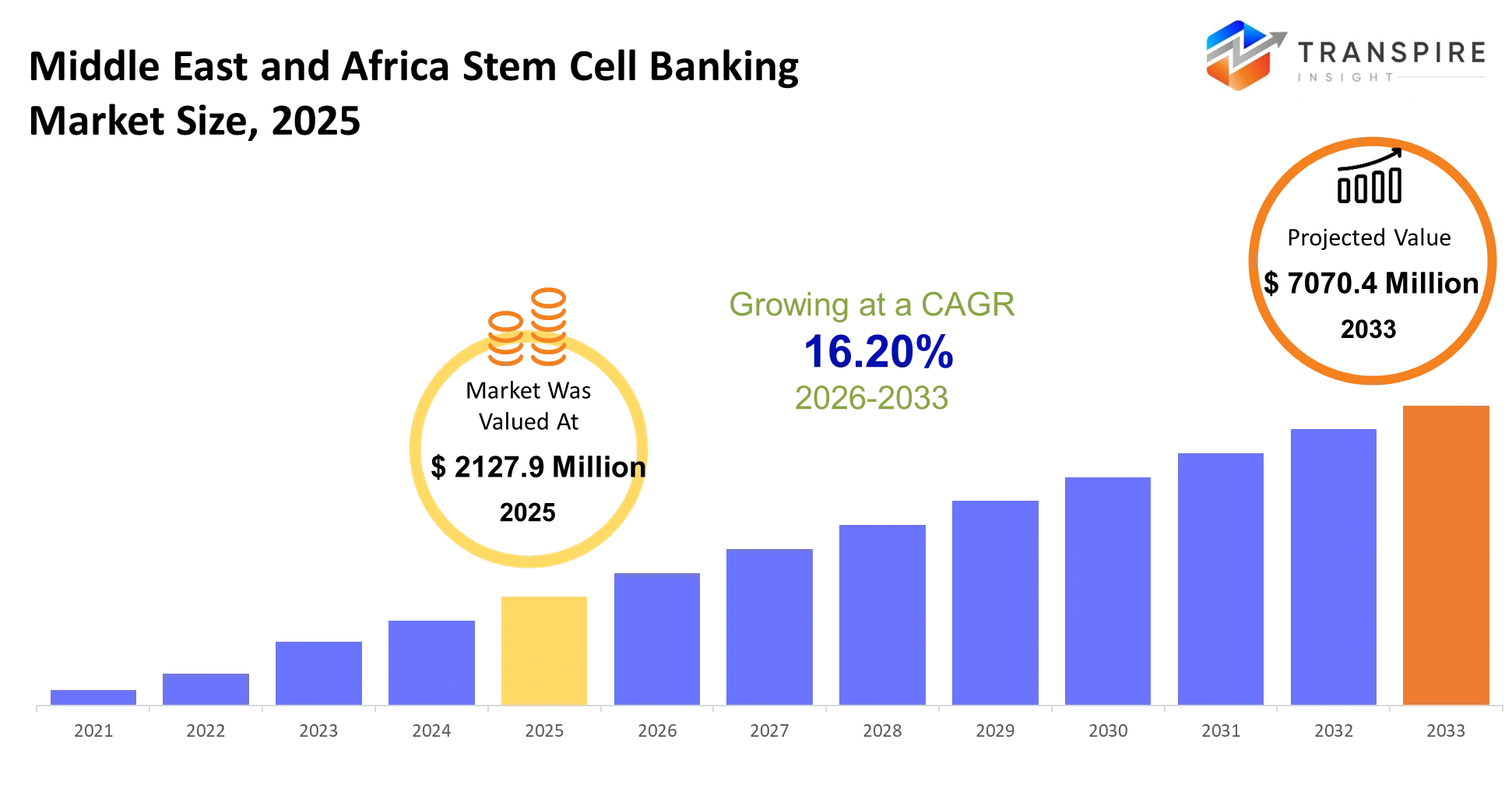
- Middle East and Africa Stem Cell Banking Market Size 2025: USD 2127.9 Million
- Middle East and Africa Stem Cell Banking Market Size 2033: USD 7070.4 Million
- Middle East and Africa Stem Cell Banking Market CAGR: 16.20%
- Middle East and Africa Stem Cell Banking Market Segments: By Type (Cord Blood, Cord Tissue, Adult Stem Cells), By Service (Collection, Processing, Storage), By Application (Therapeutics, Research, Regenerative Medicine), By End-User (Hospitals, Parents, Research Institutes, Biobanks)
To learn more about this report,  Download Free Sample Report
Middle East and Africa Stem Cell Banking Market Summary:
The Middle East and Africa Stem Cell Banking Market size is estimated at USD 2127.9 Million in 2025 and is anticipated to reach USD 7070.4 Million by 2033, growing at a CAGR of 16.20% from 2026 to 2033. The cord blood banking sector in the Middle East and Africa region, which encompasses Saudi Arabia, United Arab Emirates, and South Africa, along with the other parts of the Middle East and Africa, functions within the biotech and health care industry that thrives due to the increase in people opting for preventive health measures. Families will recognize the benefits of saving their babies' umbilical cord blood for the purpose of health security over a lifetime, as a result of the public relations campaign initiated and supported by doctors. The authorities in large nations will implement stricter regulations as they encourage the private sector's investment, ensuring a fine balance between development and regulation.
Key Market Trends & Insights:
People in the region will change their buying patterns because families want to establish permanent medical coverage instead of waiting for health emergencies. The urban populations of Saudi Arabia and the United Arab Emirates will show strong interest in spending money on newborn stem cell preservation because their disposable incomes have increased and they have learned about international healthcare methods. The African regions will implement new technologies at a slow pace because public awareness programs and maternity hospital collaborations will progressively change how people perceive the process.
Automation technologies will create new operational standards for organizations through their ability to automate sample processing tasks and their enhanced cryogenic storage systems which deliver better operational performance. Laboratories will use digital tracking systems that enable parents to see their stored samples after they donate them, which will create trust between parents and the laboratory. The collaboration between Europe and Asia biotech companies will develop advanced preservation methods which will enhance the survival rates of biological materials. The new developments will establish premium service providers as the top companies in the market that prioritize delivering high-quality products.
The development of regulatory frameworks will occur through increased governmental oversight which controls data collection, data storage, and data usage procedures. Saudi Arabia and South Africa will demand tighter regulations for obtaining licenses, whereas the UAE will most probably favor foreign investment by streamlining the approval process. The population will become more concerned about the moral implications of stem cell research, resulting in the development of stringent consent procedures. The process of establishing new facilities and services will receive its operational rhythm from the existing regulations and their supporting mechanisms.
The market structure will develop through private banks, which will expand their service offerings to include both cord blood and tissue storage and upcoming treatment methods. The establishment of maternity care centers will take place through partnerships between hospitals and specialized banks, who will deliver coordinated healthcare services. The introduction of installment payment systems will enable middle-income families to access services through new pricing structures. The changes will create new market dynamics, which will lead to new methods that service providers use to acquire and retain customers.
Middle East and Africa Stem Cell Banking Market Segmentation
By Type
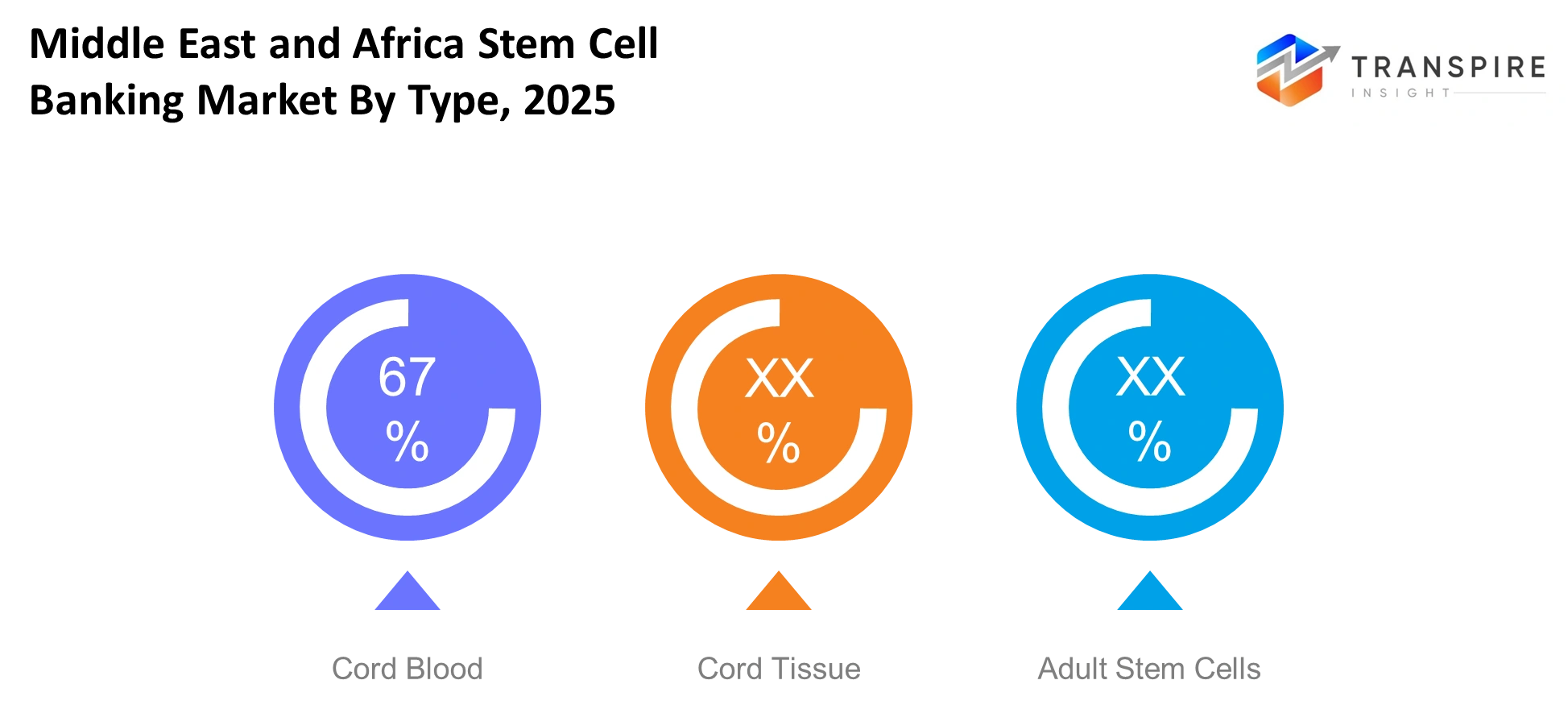
Cord Blood- The collection of cord blood at birth through non-invasive methods will establish this method as the primary source because it contains high levels of hematopoietic stem cells. Families will increasingly value its potential for treating blood-related disorders and immune conditions. The region will see growing demand through awareness programs which maternity hospitals implement while private banks will enhance their collection methods and preservation techniques to establish trust with parents.
Cord Tissue- The medical field will start paying attention to cord tissue because its mesenchymal stem cells will enable new treatments which extend beyond existing medical practices. Service providers will promote dual storage packages that combine cord blood and tissue, presenting a broader therapeutic horizon. As clinical research continues to advance, healthcare professionals in the Middle East and African regions will start to promote tissue preservation as an essential investment for their medical facilities.
Adult Stem Cells- Adult stem cells will become more important for both specialized medical treatments and scientific research activities. The procedures to collect bone marrow or peripheral blood will become more complicated which will restrict consumer access to these collection methods that provide neonatal sources. South Africa and urban medical centers will use these cells for specific medical treatments and research activities which advanced healthcare facilities will enable.
To learn more about this report, Download Free Sample Report
By Service
Collection- The delivery room collection process will experience increased efficiency through standardized protocols which hospitals will implement for their collection operations. The medical personnel who received training will execute the process to achieve safety and speed and meet the requirements of changing laws. The companies will spend money on developing dedicated equipment and transportation systems which will help them keep their samples intact during their delivery process. Expectant parents will choose pre-arranged collection plans more often because public awareness about this service increases which makes it an essential first step for their entire value chain.
Processing- The laboratory procedures will isolate and prepare stem cells which remain usable for future storage through their advanced laboratory techniques. The facilities will implement automated systems which will help them reduce human error while achieving consistent results. The quality assurance process will establish more stringent requirements for organizations operating in countries which are implementing stronger regulatory controls. The process will determine how usable the stored samples become thus prompting providers to use their laboratory standards as a marketing point to gain new customers.
Storage- The storage system will utilize cryogenic technology which preserves stem cells for multiple decades while maintaining their operational capabilities. Providers will create secure storage areas which include monitoring systems and backup facilities to protect against potential sample loss. The digital platforms will provide storage information and updates to clients which will enhance transparency of the process. The combination of flexible payment methods and extended storage plans will enable more people to use storage services which will result in increased usage among various income levels.
By Application
Therapeutics- The primary reason for stem cell banking will remain its therapeutic applications which find use in treating blood disorders and immune system deficiencies and some genetic disorders. Medical practitioners will increasingly highlight proven treatment pathways to reassure families about practical benefits. The public will develop greater trust in these applications because clinical outcomes show improvement which enables urban healthcare systems to use stored cells for medical purposes through their advanced treatment facilities.
Research- Research applications will expand as universities and biotech institutions seek reliable biological samples for studies. Stem-cell banks plan to work closely with academic centers and are committed to projects that study the mechanism of diseases for potential therapeutic strategies. The stored research samples in developing research regions will become essential scientific resources. This segment will not only drive innovation but also enhance the credibility of banking services within the broader medical community.
Regenerative Medicine- Regenerative medicine will represent a forward-looking application that focuses on repairing or replacing damaged tissues and organs through its advanced medical applications. Although still developing this field will attract attention because of its ability to transform existing systems. Healthcare providers will begin educating families about future possibilities which will position stem cell preservation as a step toward accessing upcoming treatments. The global clinical trials will create increasing regional interest which will establish permanent changes for medical care delivery.
By End-User
Hospitals- The role of hospitals establishes them as the main point for both patient education and sample collection activities. The hospital system will provide complete delivery services through its partnerships with stem cell banks which operate during delivery events. Expectant parents will receive medical guidance from professionals who will describe benefits and operational processes to them. Saudi Arabian and United Arab Emirates hospitals will start using international standard operating systems because their medical facilities possess adequate equipment to meet this requirement.
Parents- Parents will remain the most influential end-users who will drive demand for newborn stem cell preservation through their decision-making process. The dual force of rising awareness and parents' need to protect their children's health future will drive their purchasing activities. The service will become easier for middle-income families to access because of flexible pricing options which include installment payment plans. Parents will determine the worth of long-term biological storage through their emotional responses and medical guidance which they receive from professionals.
Research Institutes- Research institutes will use stored stem cells for their scientific studies and their experimental treatment research. Researchers will gain access to high-quality samples which will enable them to study disease treatment pathways and biological processes more thoroughly. The bank collaborations will provide researchers with consistent access to preserved materials which will support their work in nations that fund biomedical research. This relationship will create stronger connections between commercial storage facilities and academic research development throughout the regional area.
Biobanks- Biobanks function as dedicated facilities which handle the organized collection and storage of biological specimens. The organization will comply with multiple regulatory requirements which include safety measures and traceability systems and ethical standards for its operations. The growing demand for biobank services will force biobanks to increase their capacity to meet customer requirements.
Regional Insights
Healthcare modernization programs in Saudi Arabia will create a demand boost because they focus on preventive care. The private hospitals located in major cities will establish stem cell preservation programs which they will promote through government awareness initiatives. Parents will start to see these services as essential components of responsible parenting. The regulatory authorities will develop better licensing and ethical standards which will enhance credibility while driving innovation. The established balance will create a systematic framework which enables both local and global organizations to expand their business operations.
The United Arab Emirates will position itself as a regional hub for advanced medical services which include stem cell banking. The combination of high-income expatriates and strong private healthcare networks will create demand for stem cell banking services. Expecting parents will discover the service because clinics will offer it as part of their premium maternity packages. The authorities will establish transparent compliance requirements which attract foreign investment while enabling international companies to introduce advanced technologies that enhance service standards throughout the nation.
The medical research ecosystem of South Africa will sustain its progress through its existing research infrastructure. The hospitals and research institutions will work together with storage providers to develop solutions for both clinical needs and scientific research. Public understanding of the situation will develop at a slow pace because educational programs and improved healthcare access will create increased awareness. Yet people will not be able to afford products which will limit their ability to buy products so businesses need to develop different price options which will make their products available to more customers.
The Middle East and Africa regions will show different levels of technology adoption because each area has unique healthcare systems and economic environments. The new market will start to attract interest as private clinics begin to offer medical services in urban areas. The international companies will work together with local businesses to provide training which will create better access to knowledge. The way families understand long-term biological preservation methods will change because they will be exposed to international healthcare developments and specific awareness programs.
Recent Development News
In January 2026, there have been improvements by the Saudi Arabian government with respect to the regulation of stem cell banks as well as licensing new centers within its key cities. The health department is making efforts to standardize storage procedures in line with global clinical guidelines. The new regulation will drive private healthcare organizations to expand their maternity service offerings. Hospitals and specialized laboratories are now working together to enhance processing precision and build patient trust.
In October 2025, the UAE has witnessed investments being made in cryopreservation and automation technologies. The private hospitals are upgrading their services so that they can attract not only the locals but also the foreign tourists interested in having premium storage facilities. The country’s supportive regulatory environment is encouraging international partnerships, allowing global firms to introduce refined laboratory techniques. The region's stem cell storage solutions have become more attractive because of these advancements, which have strengthened the body's position as a main stem cell storage center.
|
Report Metrics |
Details |
|
Market size value in 2025 |
USD 2127.9 Million |
|
Market size value in 2026 |
USD 2472.1 Million |
|
Revenue forecast in 2033 |
USD 7070.4 Million |
|
Growth rate |
CAGR of 16.20% from 2026 to 2033 |
|
Base year |
2025 |
|
Historical data |
2021 – 2024 |
|
Forecast period |
2026 – 2033 |
|
Report coverage |
Revenue forecast, competitive landscape, growth factors, and trends |
|
Country scope |
Middle East and Africa (Saudi Arabia, United Arab Emirates, South Africa, Rest of Middle East and Africa) |
|
Key company profiled |
ViaCord, Cord Blood Registry, Cryo-Cell, StemCyte, Smart Cells, Vita 34, Cells4Life, Americord, Cryo-Save, Lifebank, Future Health, Biocell, Stemade, Reliance Life Sciences, Cordlife |
|
Customization scope |
Free report customization (country, regional & segment scope). Avail customized purchase options to meet your exact research needs. |
|
Report Segmentation |
By Type (Cord Blood, Cord Tissue, Adult Stem Cells), By Service (Collection, Processing, Storage), By Application (Therapeutics, Research, Regenerative Medicine), By End-User (Hospitals, Parents, Research Institutes, Biobanks) |
Key Middle East and Africa Stem Cell Banking Market Company Insights
The stem cell banking market in the Middle East and Africa which includes Saudi Arabia, the United Arab Emirates, South Africa and remaining parts of the region will develop through competition between local laboratories and international biotechnology companies. CryoViva, NovaCord and Revvity will extend their market reach together with CellSave Arabia and Smart Cells, which provide advanced storage options and family banking services. The main players will establish their credibility through partnerships with hospitals and research institutions while their international collaborations will bring advanced processing technologies that enable them to offer better preservation solutions.
Company List
- ViaCord
- Cord Blood Registry
- Cryo-Cell
- StemCyte
- Smart Cells
- Vita 34
- Cells4Life
- Americord
- Cryo-Save
- Lifebank
- Future Health
- Biocell
- Stemade
- Reliance Life Sciences
- Cordlife
Middle East and Africa Stem Cell Banking Market Report Segmentation
By Type
- Cord Blood
- Cord Tissue
- Adult Stem Cells
By Service
- Collection
- Processing
- Storage
By Application
- Therapeutics
- Research
- Regenerative Medicine
By End-User
- Hospitals
- Parents
- Research Institutes
- Biobanks
Frequently Asked Questions
Find quick answers to common questions.
The approximate Middle East and Africa Stem Cell Banking Market size for the market will be USD 7070.4 Million in 2033.
Key segments for the Middle East and Africa Stem Cell Banking Market By Type (Cord Blood, Cord Tissue, Adult Stem Cells), By Service (Collection, Processing, Storage), By Application (Therapeutics, Research, Regenerative Medicine), By End-User (Hospitals, Parents, Research Institutes, Biobanks).
Major players in the Middle East and Africa Stem Cell Banking Market are ViaCord, Cord Blood Registry, Cryo-Cell, StemCyte, Smart Cells, Vita 34, Cells4Life, Americord, Cryo-Save, Lifebank, Future Health, Biocell, Stemade, Reliance Life Sciences, Cordlife.
The Middle East and Africa Stem Cell Banking Market size is USD 2127.9 Million in 2025.
The Middle East and Africa Stem Cell Banking Market CAGR is 16.20%.
- ViaCord
- Cord Blood Registry
- Cryo-Cell
- StemCyte
- Smart Cells
- Vita 34
- Cells4Life
- Americord
- Cryo-Save
- Lifebank
- Future Health
- Biocell
- Stemade
- Reliance Life Sciences
- Cordlife
Recently Published Reports
-
Apr 2026
AI in Diabetic Retinopathy Market
AI in Diabetic Retinopathy Market Size, Share & Analysis Report By Type (Screening AI Systems, Diagnostic AI Systems, and Predictive AI Models), By Application Segment (Hospitals, Ophthalmology Clinics, Diagnostic Centers, and Research and Development), and Geography (North America, Europe, Asia-Pacific, Middle East and Africa, South and Central America), 2021 - 2031
-
Apr 2026
Psychometric Tests Market
Psychometric Tests Market Size, Share & Analysis Report By Type (Personality Tests, Ability/Aptitude Tests, Skill/Knowledge Tests, and Others), By Application (Talent Acquisition and Talent Management), and Geography (North America, Europe, Asia-Pacific, Middle East and Africa, South and Central America), 2021 – 2031
-
Apr 2026
Rare Biological Sample Collection Market
Rare Biological Sample Collection Market Size, Share & Analysis Report By Type (Isolation Kits & Reagent, Blood Collection Tubes, and Others), By Application (Oncology, Transcriptomics, Pharmacogenomics, and Others), and Geography (North America, Europe, Asia-Pacific, Middle East and Africa, South and Central America), 2021 – 2031
-
May 2026
Patient Lift Pendant Market
Patient Lift Pendant Market By Product Type (Wired Pendants, Wireless, Programmable), By Operation Type(Manual, Electric), By End-Users (Healthcare Professionals, Patients), By Application (Hospitals, Homecare, Rehabilitation Centers, Others), By Industry Analysis, Size, Share, Growth, Trends, and Forecasts 2021-2033
Our Clients
.jpg)