

Middle East and Africa Stationery Products Market Size & Forecast:
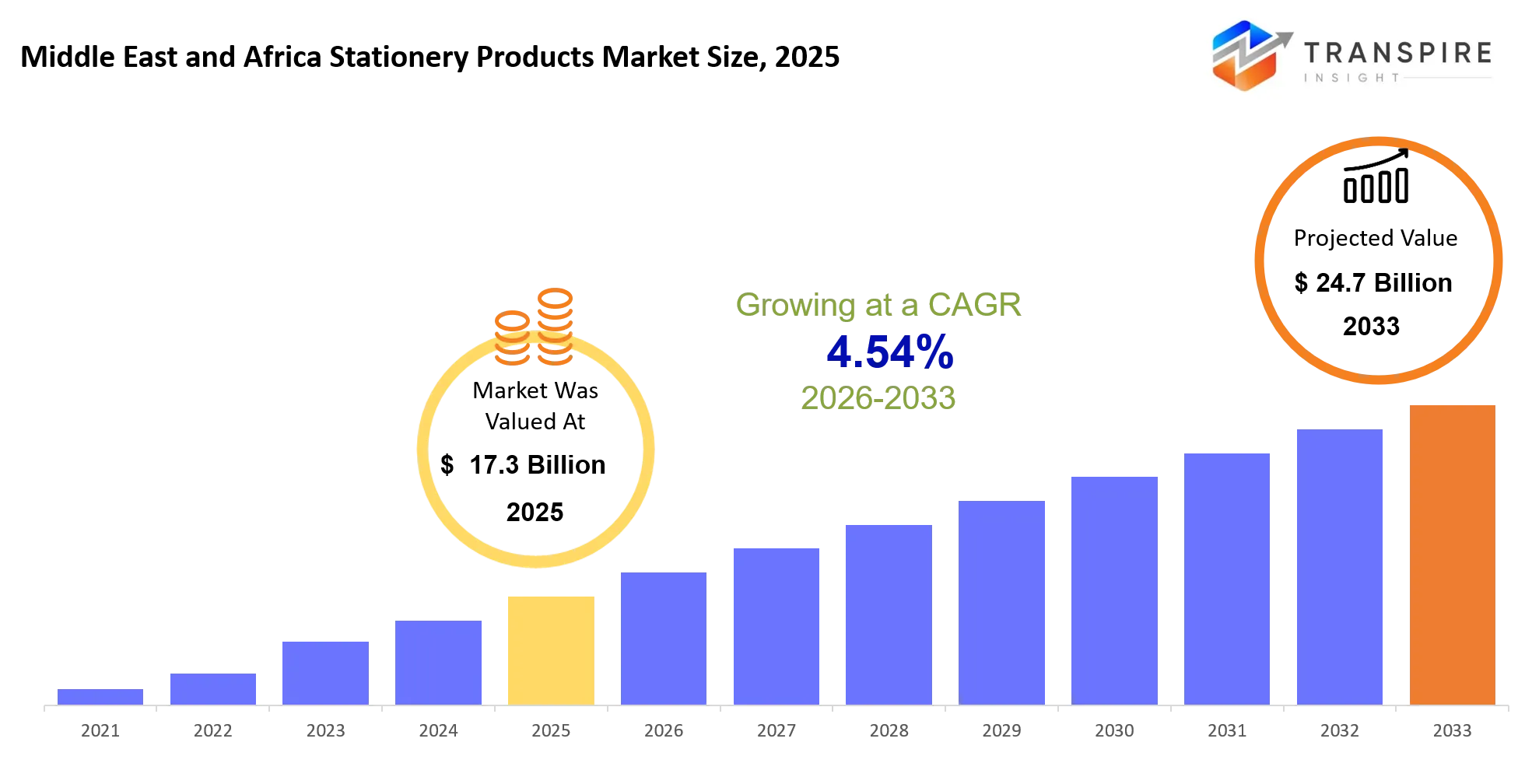
- Middle East and Africa Stationery Products Market Size 2025: USD 17.3 Billion
- Middle East and Africa Stationery Products Market Size 2033: USD 24.7 Billion
- Middle East and Africa Stationery Products Market CAGR: 4.54%
- Middle East and Africa Stationery Products Market Segments: By Product Type (Paper Products, Writing Instruments, Office Supplies, Art Supplies, Filing Products, Others); By Distribution Channel (Online Stores, Supermarkets, Specialty Stores, Stationery Shops, Others); By End User (Educational Institutions, Offices, Households, Others); By Material (Paper-based, Plastic-based, Eco-friendly, Others)
To learn more about this report,  Download Free Sample Report
Middle East and Africa Stationery Products Market Summary
The Middle East and Africa Stationery Products Market was valued at USD 17.3 Billion in 2025. It is forecast to reach USD 24.7 Billion by 2033. That is a CAGR of 4.54% over the period.
The Middle East and Africa Stationery Products Market, in a way it helps keep everything moving, for schools, offices, government institutions, and those retail education networks that need a constant stream of writing materials, paper goods, and office supplies, so administrative tasks and learning routines stay running. Basically it supports documentation-heavy workflows across public administration and private firms where digital adoption is still kind of uneven.
Over the last 3–5 years, the market has been changing in a more organized direction, with retail stores and branded product consumption taking over from fragmented informal distribution in a lot of urban areas. And at the same time, the growth of e-commerce platforms has remixed procurement habits, so bulk institutional buyers can source supplies more efficiently. One major nudge behind all this was the COVID-19 pandemic, it disrupted traditional supply chains and it practically pushed schools and offices toward more structured purchasing, plus dependable vendor networks, for steadier delivery. Today, growth is mostly fueled by institutional expansion, expanding literacy programs, and broader corporate sector formalization, which in practice raise steady volume demand. It also improves revenue visibility for manufacturers and distributors, even when the sourcing process looks more competitive than before.
Key Market Insights
- In the MEA stationery market, it looks like institutional demand is getting stronger, and the education side may come close to 38% share in 2025 across key economies.
- In the UAE, regional demand is leading, about 26% market share, largely because of a solid retail setup and more corporate office expansion, you know, the kind that keeps buying on repeat.
- South Africa still feels like the fastest riser, with roughly 5.2% forecast growth, mostly pulled by school infrastructure spending between 2025–2033.
- For product types, writing instruments sit at around 41% share, mainly because of high volume academic routines and administrative usage patterns.
- After that, paper-based products remain the second major segment, supported by exam formats, documentation needs and paperwork cycles.
- Meanwhile art and craft supplies are showing the quickest growth as well across urban schooling systems.
- On the end user side, education keeps about 55% share, since the academic calendar demand cycles never really stop.
- Corporate offices are also increasing procurement standardization, which then boosts branded product penetration.
- Brands such as Faber-Castell and BIC keep adding strength to their market position through pricing and distribution scale, and that helps a lot. Lastly, digital retail expansion by players like Newell Brands improves accessibility across semi-urban regions.
What are the Key Drivers, Restraints, and Opportunities in the Middle East and Africa Stationery Products Market?
The main driver behind the Middle East and Africa Stationery Products Market is basically the ongoing growth of formal education systems and administrative infrastructure, especially across developing economies, like you can see in many places. Governments in Saudi Arabia, Kenya, and Nigeria, have put more money into school enrollment programs and also the digitization of public offices, but it still leans heavily on physical paperwork. Because of that, there is a steady “starting point” demand for notebooks, writing instruments, and filing supplies. You can notice the effect in longer procurement cycles from institutions, and that helps manufacturers keep their volumes steadier, plus it supports longer distribution agreements
One big restraint is the kind of fragmented supply chain setup across several African markets, where informal retail is still the dominant route for procurement. This fragmentation pushes logistics costs upward and reduces pricing efficiency, especially for international brands that are trying to scale faster. Structurally, it is not something you fix in a short period because it is tied to uneven retail modernization and uneven infrastructure development. So overall, branded products take longer to penetrate, and global suppliers get less predictable margin outcomes
There is also a notable opportunity in the rise of organized retail and digital procurement platforms in the Gulf and parts of East Africa. For instance, in the UAE there are institutional e-procurement systems that let buyers do bulk stationery sourcing with clearer pricing and supplier traceability. This shift creates room for standardized product assortments and long-run contracts, which helps manufacturers smooth revenue streams while expanding their footprint across the region
What Has the Impact of Artificial Intelligence Been on the Middle East and Africa Stationery Products Market?
Artificial intelligence is slowly but surely reshaping supply chain planning and inventory optimization across the Middle East and Africa stationery ecosystem, especially for bigger distributors and retail chains. In practice, companies are turning to AI-enabled demand forecasting systems, so they can sync the production of notebooks, paper, and writing instruments with those seasonal school rhythms. That kind of alignment helps cut back overproduction, and it also boosts stock rotation efficiency, most noticeably in places where school enrollment patterns can shift quite a lot.
Then there are machine learning models that are getting used in warehouse automation and order fulfillment. With predictive algorithms in the background, distributors are able to plan delivery routes a bit smarter, and reduce logistics delays across fragmented geographies. On the corporate side, procurement systems are benefiting too, since AI-based analytics tools are strengthening vendor selection and cost benchmarking, which in turn supports faster purchasing decisions for large institutions.
Operationally, these tools improve inventory accuracy, and they can lower holding costs in more organized retail settings. They also tend to shorten replenishment cycles when the academic demand peaks. Still, adoption feels uneven. Outside major urban centers it remains pretty limited, mainly because integration costs are high, and because smaller markets often lack digitized supply chain data. A number of distributors, even today, lean on manual forecasting— and that limits how far AI-driven optimization can really scale. So, even if the long-term transformation potential is strong, the efficiency improvements from automation don’t spread evenly across the whole region.
Key Market Trends
- Since 2023, institutional procurement started leaning a bit more toward centralized digital platforms, so there’s less reliance on all those local, stationery wholesalers that used to be scattered everywhere.
- In 2025, UAE retail chains seemed to boost their branded stationery shelf space by almost 18%, which helped premium product visibility feel stronger.
- Over in South Africa, education reforms nudged standardized notebook procurement upward across public schools, and that made bulk demand more consistent.
- Writing instrument manufacturers also tightened product durability standards, basically to keep up with higher usage rates you see in big classroom environments.
- Meanwhile, e-commerce stationery sales climbed in Kenya and Nigeria, and it looks tied to mobile-first retail adoption style trends.
- Staedtler expanded distribution partnerships across Gulf retail chains, which should widen their regional reach further.
- Pilot also came in with low cost, refillable pen systems, aimed at price sensitive education segments, more or less.
- Eco-friendly recycled paper use rose in corporate offices too, driven by procurement policy shifts since 2024 .
- Regional distributors improved logistics automation, so delivery delays dropped across multi-country supply networks, not by a small amount either.
- And in multinational corporate hubs across Dubai and Riyadh, premium office supply demand went up noticeably because workforce expansion picked up pace.
Middle East and Africa Stationery Products Market Segmentation
By Product Type
The product type segment in the Middle East and Africa stationery market kind of mirrors the broad range of materials people end up using in education, corporate settings, and homes. Paper Products keep a major share, because schools and offices keep depending on notebooks, printing sheets, and exam-related documents for everyday paperwork routines . Writing Instruments also stay just as crucial, with heavy day to day usage across classrooms and administrative workflows, where pens pencils and markers are the go to essentials.
Office Supplies help keep workplace operations in a more organized flow, letting teams handle arrangement documentation and messages across different business spaces. Art Supplies are also picking up momentum as creative learning programs expand, along with extracurricular education inside schools . Filing Products are used pretty widely in corporate and government sectors, to sort records faster and to maintain compliance requirements. Then there are Others, covering smaller niche stationery items made for specialized academic or professional needs that don’t quite fit the main categories.
To learn more about this report, Download Free Sample Report
By Distribution Channel
The distribution channel segment shows how stationery products kind of find their way to end users across the Middle East and Africa. Online stores are growing fast, mostly because digital access is getting better, prices stay competitive, and it’s simply convenient to place bulk orders for institutions as well as households. Supermarkets also matter quite a lot, they provide easy access to basic stationery items with all the daily shopping stuff.
Meanwhile specialty stores still matter for premium and branded stationery products, especially in city areas where corporate demand is higher. Stationery shops continue to dominate in semi urban and rural regions, where traditional retail networks are still holding strong and are widely trusted. Other routes include institutional procurement channels and direct sales models, used by schools, offices and government buyers.
By End User
The end user segment shows a strong dependence on stationery products across education, business, and household segments, which is sort of noticeable in daily routines. Educational Institutions make up the biggest portion since schools and universities need constant supplies, like notebooks, pens, and other learning materials, through out academic cycles. This demand stays quite stable, because academic calendars are structured and enrollment rates keep growing.
Offices also contribute a lot, even if it feels less visible, since administrative operations rely on writing tools, filing systems, and documentary materials for everyday workflows. Households create a steady consumption base too, propelled by student requirements, plus personal use for note taking and organizing tasks at home. Others cover training centers, government departments, and informal learning environments, where stationery products are still sort of essential.
By Material
The material segment kinda shows how preferences are changing in product composition and sustainability across the stationery industry, you know. Paper based products stay on top because they’re still needed for education and for documentation tasks all over the region. Plastic based stationery is still commonly chosen too, especially for sturdy office items like folders, pens, and those storage accessories that last longer.
Eco friendly materials are slowly starting to get more attention, since institutions and corporate buyers are moving toward sustainability focused procurement rules, and they’re also picking recycled paper products more often. This movement is backed by rising environmental awareness, plus a sort of gradual alignment of policies in urban markets. Other options also show up, like hybrid materials made for durability and cost efficiency, and even for specialized industrial or academic uses.
What are the Key Use Cases Driving the Middle East and Africa Stationery Products Market?
In the Middle East and Africa Stationery Products Market the main use case is basically academic consumption, where schools,and universities lean on notebooks, pens and exam materials so learning keeps moving forward in a sort of continuous loop. Even though people talk about digital tools a lot, the pull stays pretty steady because physical records are still central to how education is actually delivered across the region.
Then there are secondary use cases, mostly around corporate office administration and government documentation workflows. Here, filing systems,printed forms and writing instruments help keep regulatory compliance on track and also support internal reporting, you know the kind that has to be documented clearly. These parts are growing too, because in many countries public sector digitization doesn’t fully replace paper, it more or less runs in parallel with it, at least for now.
On top of that, emerging use cases show up in creative education programs and vocational training institutes. In those settings, art materials and specialized stationery products are getting more attention, and they make sense for practical skill building. This trend should rise as skill based education programs expand into more urban learning centers and more training providers start offering hands-on modules.
|
Report Metrics |
Details |
|
Market size value in 2025 |
USD 17.3 Billion |
|
Market size value in 2026 |
USD 18.1 Billion |
|
Revenue forecast in 2033 |
USD 24.7 Billion |
|
Growth rate |
CAGR of 4.54% from 2026 to 2033 |
|
Base year |
2025 |
|
Historical data |
2021 - 2024 |
|
Forecast period |
2026 - 2033 |
|
Report coverage |
Revenue forecast, competitive landscape, growth factors, and trends |
|
Regional scope |
Middle East and Africa (Saudi Arabia, United Arab Emirates, South Africa, Rest of Middle East and Africa) |
|
Key company profiled |
Faber-Castell, Staedtler, BIC, Pilot, Pentel, Kokuyo, Hamelin, ACCO Brands, Newell Brands, Maped, DOMS, Luxor, Cello, Classmate, 3M |
|
Customization scope |
Free report customization (country, regional & segment scope). Avail customized purchase options to meet your exact research needs. |
|
Report Segmentation |
By Product Type (Paper Products, Writing Instruments, Office Supplies, Art Supplies, Filing Products, Others); By Distribution Channel (Online Stores, Supermarkets, Specialty Stores, Stationery Shops, Others); By End User (Educational Institutions, Offices, Households, Others); By Material (Paper-based, Plastic-based, Eco-friendly, Others) |
Which Regions are Driving the Middle East and Africa Stationery Products Market Growth?
The Gulf Cooperation Council (GCC) region is, in many ways, leading the Middle East and Africa Stationery Products Market, because it has a solid institutional base and a higher concentration of corporate offices, so, the whole demand chain feels more organized. In practical terms, countries like the UAE and Saudi Arabia usually keep procurement systems that, sort of naturally, lean toward branded stationery items and big, volume based contracts. At the same time, strong retail channels and more modern distribution hubs help keep the products reliably on hand across most city areas. On top of that, government spending on education keeps institutional orders moving, year after year, without too much drama.
North and Southern Africa looks stable overall but it is still structurally different from the GCC. In that area, the demand pulse is more tied to public education frameworks and government purchasing cycles rather than corporate growth. Retail is more fragmented there, and yes that can make things feel uneven, but the demand stays steady because the population base is large and enrollment levels remain relatively consistent. Also, in countries like South Africa, economic conditions support predictable stationery consumption across both public bodies and private organizations, which helps vendors plan better.
Sub-Saharan Africa is the fastest grower region, and the reason is pretty clear. School enrollment efforts are rising, while education infrastructure gets more focus. Also, improvements in logistics pathways, plus mobile commerce adoption, have shifted how procurement works in a noticeable way. Governments are spending more on learning materials, often as part of long-term literacy programs that don’t end quickly. That means there are real entry chances for manufacturers who want long range expansion between 2026 and 2033, because demand is not just present now, it’s being built for later.
Who are the Key Players in the Middle East and Africa Stationery Products Market and How Do They Compete?
The Middle East and Africa stationery market looks moderately fragmented, so you get this mix where global brands compete next to regional manufacturers, plus a layer of low cost local suppliers. The whole fight, at least in most cases, seems to come down to pricing efficiency, how wide the distribution reach is, and product durability, not so much on some fancy advanced product differentiation. Institutional buyers usually want reliable supply plus cost stability, and that kind of preference tends to lock in the standing of established multinational brands.
In practice, Faber-Castell keeps pushing premium writing instruments and educational kits, riding on long standing brand confidence and also on retail partnerships across urban areas. BIC plays it differently, leaning on cost leadership and high volume production, and it goes after the price sensitive school segments across Africa and the Middle East. Kokuyo, for its part, builds momentum with ergonomic office solutions, plus institutional arrangements with corporate buyers, that sort of thing.
At the same time, DOMS and Luxor are expanding quite aggressively in African markets via distributor partnerships, and by using competitive pricing. They seem to focus on scaling regional supply chains while also making products easier to find in semi urban and rural markets. The real competitive edge is becoming more about distribution efficiency, participation in school tenders, and the ability to keep stable pricing even when logistics get volatile.
Company List
- Faber-Castell
- Staedtler
- BIC
- Pilot
- Pentel
- Kokuyo
- Hamelin
- ACCO Brands
- Newell Brands
- Maped
- DOMS
- Luxor
- Cello
- Classmate
- 3M
Recent Development News
In March 2025, Pepkor completed its acquisition of Retailability brands including Boardmans. The deal expanded its lifestyle and school-related retail portfolio, strengthening downstream distribution channels for stationery-adjacent consumer goods across Southern Africa and improving access to mass-market school supply networks.https://www.reuters.com
In June 2025, Bisleri International entered into a strategic partnership with Apparel Group. The collaboration enabled expansion of manufacturing, marketing, and distribution operations across the Middle East and Africa, strengthening regional retail logistics networks that indirectly support FMCG and stationery distribution ecosystems through shared retail infrastructure.https://economictimes.indiatimes.com
What Strategic Insights Define the Future of the Middle East and Africa Stationery Products Market?
The Middle East and Africa Stationery Products Market is, kind of, structurally moving toward organized procurement ecosystems that are backed by education expansion and retail modernization. Over the next 5–7 years, demand will be shaped by institutional purchasing systems that put more weight on supply reliability and cost transparency rather than the more fragmented retail buying patterns, you know.
There’s also a risk that’s not so obvious at first. It’s this gradual substitution from digital learning tools, mostly in urban private education systems, that could end up lowering per student stationery consumption in the premium segments. At the same time, currency volatility across several African economies may keep pressuring import dependent supply chains and logistics.
One more interesting opportunity is the expansion of standardized school supply programs in Sub Saharan Africa, where government backed literacy initiatives are pushing baseline stationery consumption higher. Companies that invest in localized distribution networks and tender based procurement capabilities may end up with a longer term advantage. A practical recommendation would be to strengthen regional partnerships with education distributors to lock in recurring institutional contracts, instead of depending only on retail channels.
Middle East and Africa Stationery Products Market Report Segmentation
By Product Type
- Paper Products
- Writing Instruments
- Office Supplies
- Art Supplies
- Filing Products
- Others
By Distribution Channel
- Online Stores
- Supermarkets
- Specialty Stores
- Stationery Shops
- Others
By End User
- Educational Institutions
- Offices
- Households
- Others
By Material
- Paper-based
- Plastic-based
- Eco-friendly
- Others
Frequently Asked Questions
Find quick answers to common questions.
The Expected Middle East and Africa Stationery Products Market size for the Market will be USD 24.7 Billion in 2033.
Key Segments for the Middle East and Africa Stationery Products Market are By Product Type (Paper Products, Writing Instruments, Office Supplies, Art Supplies, Filing Products, Others); By Distribution Channel (Online Stores, Supermarkets, Specialty Stores, Stationery Shops, Others); By End User (Educational Institutions, Offices, Households, Others); By Material (Paper-based, Plastic-based, Eco-friendly, Others).
Major Middle East and Africa Stationery Products Market Players are Faber-Castell, Staedtler, BIC, Pilot, Pentel, Kokuyo, Hamelin, ACCO Brands, Newell Brands, Maped, DOMS, Luxor, Cello, Classmate, 3M.
The Current Middle East and Africa Stationery Products Market size is USD 17.3 Billion in 2025.
The Middle East and Africa Stationery Products Market CAGR is 4.54% from 2026 to 2033.
- Faber-Castell
- Staedtler
- BIC
- Pilot
- Pentel
- Kokuyo
- Hamelin
- ACCO Brands
- Newell Brands
- Maped
- DOMS
- Luxor
- Cello
- Classmate
- 3M
About the Authors

Chetan Dhatrak
I’m Chetan Dhatrak, a Senior Research Analyst at Transpire Insight, specializing in the Consumer Goods, Foods and Beverages industry. I focus on analyzing market trends, consumer behavior, competitive landscapes, and industry developments to deliver accurate, data-driven insights. My research at Transpire Insight is built on credible sources and in-depth analysis, helping businesses and readers better understand market dynamics, emerging opportunities, and evolving consumer preferences. I’m committed to creating reliable, well-researched content that supports informed decision-making and reflects the latest developments in the consumer goods and food & beverage sectors.

Chakradhar Khansole
Chakradhar serves as the Research Director at Transpire Insight, bringing over 8 years of experience in technology, innovation, and strategic market intelligence. He specializes in transforming complex market data into actionable business insights that enable organizations to make informed, growth-oriented decisions. Recognized for his strategic vision and analytical expertise, Chakradhar leads high-impact research initiatives, delivering comprehensive market assessments, competitive intelligence, and forward-looking industry analysis.
Recently Published Reports
-
Apr 2026
Bottled Water Market
Bottled Water Market Size, Share & Analysis Report By Product Type (Still Bottled Water, Carbonated Bottled Water, Functional Bottled Water, and Others), By Packaging (PET, Cans, and Others), By Sales Channel (Supermarkets/Hypermarkets, Convenience Stores/Drug Stores, Grocery Stores/Club Stores, Foodservice, and Others) and Geography (North America, Europe, Asia-Pacific, Middle East and Africa, South and Central America), 2021 - 2032
-
Apr 2026
Color Cosmetic Packaging Market
Color Cosmetic Packaging Market Size, Share & Analysis Report By Application (Mascara Packaging, Liquid Packaging, and Liquid Face), By Type (Tubes & Bottles, Pens & Markers, Compacts & Containers, and Droppers & Pumps), and Geography (North America, Europe, Asia-Pacific, Middle East and Africa, South and Central America), 2021 - 2031
-
Apr 2026
External Microphone For Camera Market
External Microphone For Camera Market Size, Share & Analysis Report By Type (Shotgun Microphone, Lavalier Microphone, and Others), By Application (Digital Camera, Professional Video Camera, and Others), and Geography (North America, Europe, Asia-Pacific, Middle East and Africa, South and Central America), 2021 - 2031
-
Apr 2026
Foot Orthotic Insoles Market
Foot Orthotic Insoles Market Size, Share & Analysis Report By Type (Pre-fabricated, and Custom-made), By Material (Thermoplastic, Composite Carbon Fiber, and Others), By Distribution Channel (Drug Stores, Hospitals & Clinics, and Others), and Geography (North America, Europe, Asia-Pacific, Middle East and Africa, South and Central America), 2021 - 2031