Middle East and Africa Rocket and Missile Market Size & Forecast:
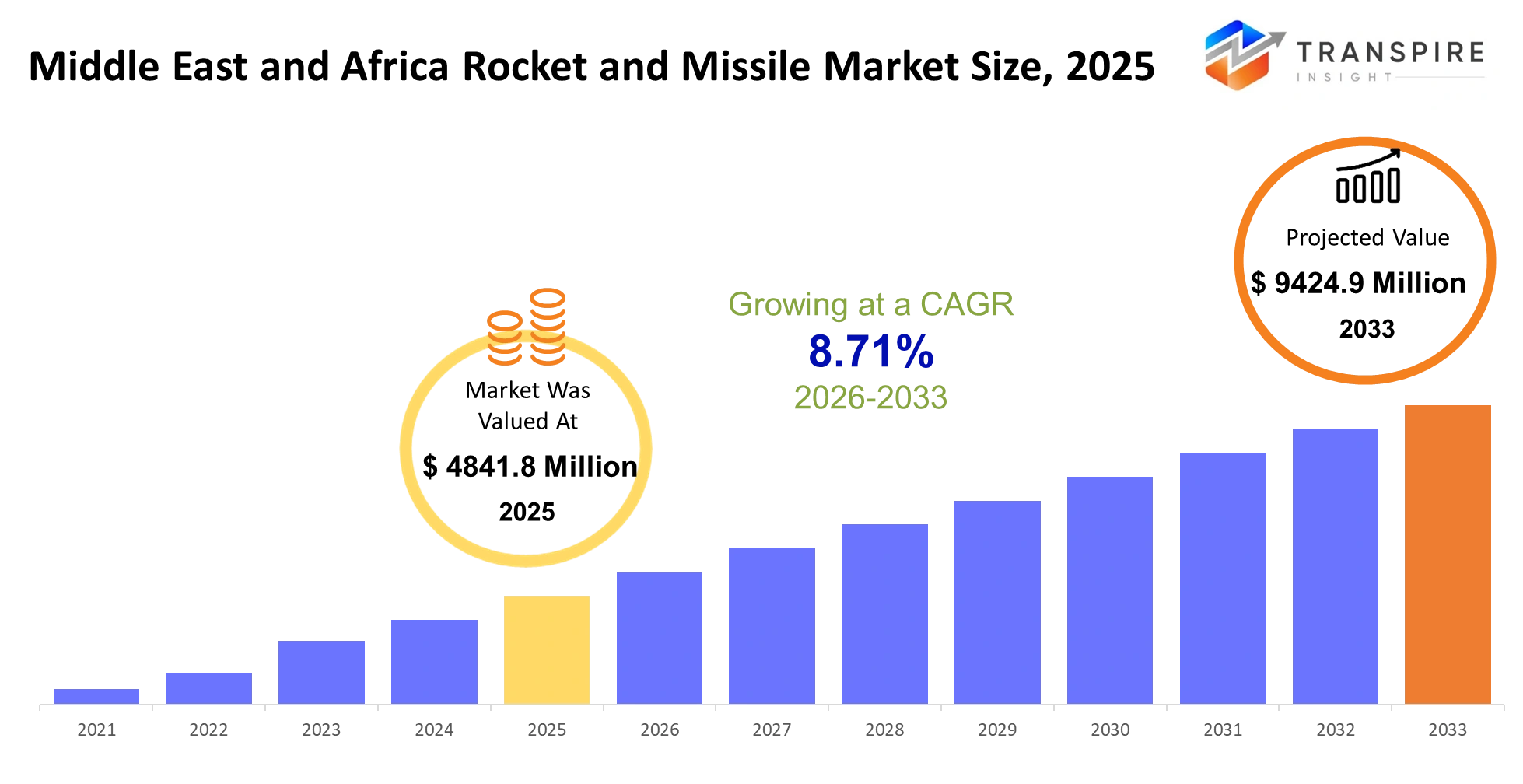
- Middle East and Africa Rocket and Missile Market Size 2025: USD 4841.8 Million
- Middle East and Africa Rocket and Missile Market Size 2033: USD 9424.9 Million
- Middle East and Africa Rocket and Missile Market CAGR: 8.71%
- Middle East and Africa Rocket and Missile Market Segments: By Type (Ballistic, Cruise, Tactical), By Range (Short, Medium, Long), By Platform (Land, Air, Sea), By Guidance (GPS, Radar, IR), By Propulsion (Solid, Liquid), By End-User (Defense Forces, Government Agencies, Military Contractors).
To learn more about this report,  Download Free Sample Report
Middle East and Africa Rocket and Missile Market Summary:
The Middle East and Africa Rocket and Missile Market size is estimated at USD 4841.8 Million in 2025 and is anticipated to reach USD 9424.9 Million by 2033, growing at a CAGR of 8.71% from 2026 to 2033. The defense industry rocket and missile market for the Middle East and Africa region which includes Saudi Arabia and United Arab Emirates and South Africa and other Middle Eastern and African countries will experience changes because of new security requirements and new acquisition methods. The increasing geopolitical tensions and border security requirements will force governments to choose between systems which offer precise targeting and system interoperability and quick deployment capabilities. Customers will start demanding platforms which offer modular designs and extended operational range and which can operate with digital military command systems. The government will implement stricter rules about domestic manufacturing which will create advantages for companies that establish production facilities through local business partnerships. The competition landscape will change because of improvements in guidance systems and hypersonic technology and countermeasure development whereas export controls and regional partnerships will determine supply chain operations and contract management.
What Has the Impact of Artificial Intelligence Been on the Middle East and Africa Rocket and Missile Market?
The rocket and missile industry in Middle Eastern and African nations will experience transformation through artificial intelligence which creates operational insights from complicated data sets. The Middle Eastern and African rocket and missile market analysis will use artificial intelligence to achieve quicker results through its ability to interpret defense spending patterns and procurement cycles and geopolitical signals. The advanced machine learning models will improve market research results which allow stakeholders to forecast demand changes while they identify new market trends with better accuracy and strategic clarity.
The Middle Eastern and African missile market operations will use artificial intelligence to enhance their production and engineering processes through intelligent automation solutions. Predictive analytics will reduce system downtime and achieve better maintenance scheduling and enhanced system dependability. Missile manufacturers will use AI-powered simulations to improve their missile design and testing and performance validation processes. The new system will decrease operational expenses while it increases production efficiency because it enables manufacturing systems to adapt to changing defense needs.
The Middle East and Africa rocket and missile market will gain advantages through AI technology which optimizes supply chains and establishes competitive advantages. Intelligent systems will forecast procurement needs, manage inventory risks, and strengthen supplier coordination. The Middle East and Africa rocket and missile market will use AI technologies to create new defense solutions through adaptive technology and customized defense systems. Companies and governments will gain the ability to adapt operationally while maintaining their technological edge through this transition.
Key Market Trends & Insights:
- In 2025, Saudi Arabia is forecasted to capture about 35% market share of the middle east and africa rocket and missile market due to high defense expenditure.
- The United Arab Emirates is projected to become the fastest-growing regional market, backed by strategies for growth and native development of defense products until 2030.
- South Africa commands a major market share in Africa on account of its well-developed defense base and capacity for exporting missile systems.
- The surface-to-surface missile system accounts for more than 40% share in 2025, owing to increasing importance of long-range capability missiles.
- Air-to-air missile systems constitute the second biggest market segment, owing to modernization efforts among fighter planes.
- The hypersonic and smart missile category accounts for the fastest-growing segment from 2026–2032, backed by R&D investment.
- Application to defense and military sectors leads the market, comprising in excess of 85% share, due to robust procurement plans.
- The missile defense systems segment accounts for the fastest-growing demand owing to geopolitical tensions and need for interceptions.
- The government and defense sector constitutes the biggest market player, with more than 90% market share.
Middle East and Africa Rocket and Missile Market Segmentation
By Type
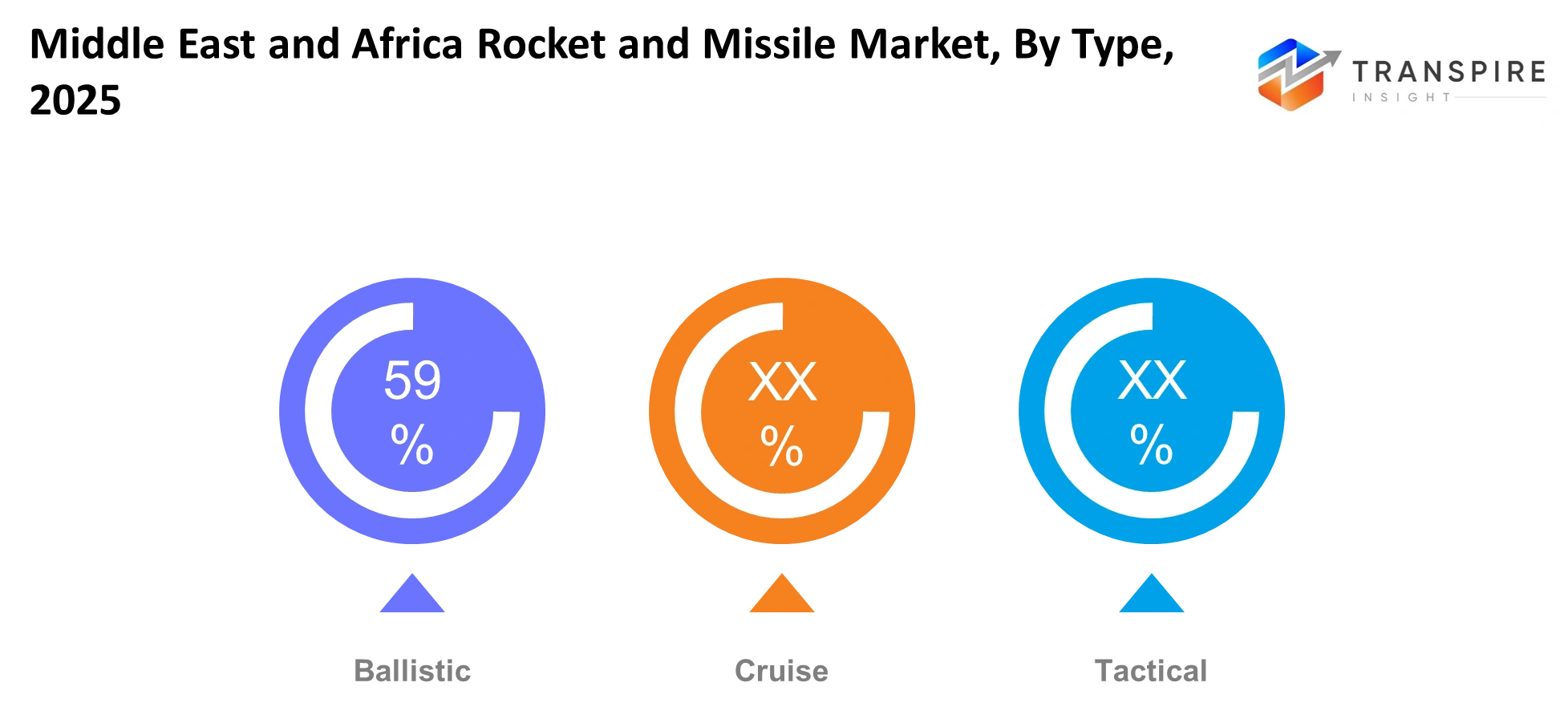
Ballistic systems will use high-arc flight paths for their long-distance missions which require maximum speed and impact power. Cruise systems will operate at lower altitudes while their guided navigation system enables them to achieve accurate targets in difficult operational settings. Tactical systems will execute short-range missions with fast deployment capabilities which enable them to meet battlefield requirements through operational flexibility.
Defense planners will shift their system preferences towards equipment which delivers both accurate results and flexible movement capacities. The precision strike capabilities of cruise and tactical systems will establish them as essential operational assets because they provide multiple operational uses. Deterrence capabilities of ballistic systems will maintain their significance for defense purposes while modernization initiatives will enhance performance and targeting precision across all system categories.
To learn more about this report, Download Free Sample Report
By Range
The deployment of short-range systems will enable military forces to respond quickly during emergency situations while meeting their requirements for protection in border areas and tactical operations. The medium-range systems will provide operational capabilities that enable security forces to conduct patrols and execute coordinated operations. The long-range systems will establish strategic deterrence capabilities through their ability to safeguard extensive regions and attack targets beyond their immediate vicinity.
The procurement strategies of organizations will develop a preference for medium and long-range capabilities as security requirements undergo transformation. The funding for projects will rise to develop systems that achieve superior precision across greater distances. The military will continue to use short-range systems for defending against immediate threats while all weapon systems will benefit from technological enhancements in guidance systems and propulsion technology.
By Platform
The deployment of land-based platforms will achieve stable operation because their high mobility and strong infrastructure support make them popular for use. The use of air-based platforms will enable quicker response times while extending operational range through support from fighter aircraft and aerial systems. Sea-based platforms will enhance maritime security and will support strategic positioning through naval fleets.
The choice of platform will be determined by both mission needs and the specific geographic environment. The deployment of air and sea platforms will become important because these platforms provide flexible operational capabilities and enable quick mission execution. Defense strategies will continue to rely on land systems as their primary component while platform integration will improve operational coordination between military branches.
By Guidance
GPS-based guidance provides accurate satellite navigation which enables precise targeting for remote identification of targets. Radar systems enable target tracking during different weather conditions and they support both interception and defense operations. Infrared guidance systems use heat signature detection to enable effective targeting in environments with low visibility.
Technological advancements will improve accuracy while making systems more resistant to signal disruption. The future of GPS systems will include improved signal protection, while radar and infrared technologies will achieve better target identification. The military will increasingly use combined guidance systems because these systems provide dependable performance and flexible operational capacity during various combat situations.
By Propulsion
Solid propulsion systems will enable fast launch operations while needing reduced maintenance, which makes them ideal for quick deployment. Liquid propulsion systems will enable precise thrust management, which enables extended missions through their ability to vary operational capabilities.
The future of propulsion system development will concentrate on creating safer and more efficient operational systems. Solid propulsion will maintain its leading position because of its handling simplicity, while liquid propulsion systems will serve specific operational needs. Research efforts will focus on developing methods to improve fuel efficiency while decreasing risks linked to operational processes.
By End-User
Defense forces will maintain their primary role as users who focus on operational readiness and national security needs. Government agencies will handle procurement and regulation tasks while developing strategic plans that comply with national security policies. Military contractors will provide support by creating systems, producing materials, and establishing technology links.
The groups will work together more often to boost their operational efficiency and their capacity to create new products. The introduction of new technologies and production techniques will depend on contractors' vital contributions to the project. Defense forces and security agencies will create ongoing demand which will result in future technological progress and defense solutions against new security threats.
What are the Main Challenges for the Middle East and Africa Rocket and Missile Market Growth?
The Middle East and Africa rocket and missile market will experience ongoing progress delays because of persistent technical and operational problems. Middle East and Africa rocket and missile market operations face three main challenges which include system integration difficulties and reliability issues and performance regularity problems. The supply chain will experience delays because advanced components, such as guidance systems and propulsion materials, will face distribution interruptions. Defense manufacturers will encounter difficulties meeting rising defense requirements because of two problems which include their current production capacity limitations and two their existing deployment challenges.
The Middle East and Africa rocket and missile market will face two major hindrances which include manufacturing restrictions and commercialization limitations. The project timelines will experience delays because of high production costs and strict regulatory approvals and long development cycles.
The Middle East and Africa rocket and missile market will experience negative effects because of adoption challenges which will especially affect emerging economies that lack proper infrastructure and trained personnel. The modern system deployment process will encounter delays because various regions need funding and lack advanced testing facilities.
The Middle East and Africa rocket and missile market will experience two main forces which include market competition and upcoming threats which will establish their path forward. The demand for pricing pressure will rise because countries require budget-friendly solutions whereas technological progress requires ongoing system enhancements. The Middle East and Africa rocket and missile market will face additional challenges through evolving regulations and geopolitical instability which will complicate their long-term operational plans.
Regional Insights
Middle East and Africa Rocket and Missile Market: Regional Insights: Saudi Arabia will lead regional demand because of its ongoing defense spending and dedication to advanced missile system development. The government will build domestic capabilities through its strategic procurement programs while international defense companies will provide access to essential technologies. The United Arab Emirates will follow with strong investments in localized production and smart defense technologies.
South Africa will maintain a stable position supported by established defense manufacturing and export activities. Other parts of the region will gradually increase their participation through modernization efforts and security-driven investments. Regional cooperation together with policy alignment will determine procurement patterns while different countries will develop their long-term strategies according to emerging threats.
Recent Development News
In April 2026, Terra Drone announced expansion of its interceptor drone technology into Gulf defense markets. The company highlighted rising demand from Saudi Arabia and the UAE for low-cost alternatives to missile interceptors amid ongoing regional conflicts.
Source: https://www.reuters.com/
In March 2026, the U.S. State Department approved a $16 billion defense package including missile systems and radar technologies for the UAE, Kuwait, and Jordan. The deal will strengthen regional air and missile defense capabilities amid escalating security threats.
Source: https://idsa.in/
|
Report Metrics |
Details |
|
Market size value in 2025 |
USD 4841.8 Million |
|
Market size value in 2026 |
USD 5253.4 Million |
|
Revenue forecast in 2033 |
USD 9424.9 Million |
|
Growth rate |
CAGR of 8.71% from 2026 to 2033 |
|
Base year |
2025 |
|
Historical data |
2021 - 2024 |
|
Forecast period |
2026 - 2033 |
|
Report coverage |
Revenue forecast, competitive landscape, growth factors, and trends |
|
Regional scope |
Middle East and Africa (Saudi Arabia, United Arab Emirates, South Africa, Rest of Middle East and Africa) |
|
Key company profiled |
Lockheed Martin, Raytheon, Boeing, Northrop Grumman, MBDA, Thales, Rafael, Saab, Elbit Systems, Kongsberg, Denel, Roketsan, Bharat Dynamics, DRDO, Mitsubishi Heavy Industries. |
|
Customization scope |
Free report customization (country, regional & segment scope). Avail customized purchase options to meet your exact research needs. |
|
Report Segmentation |
By Type (Ballistic, Cruise, Tactical), By Range (Short, Medium, Long), By Platform (Land, Air, Sea), By Guidance (GPS, Radar, IR), By Propulsion (Solid, Liquid), By End-User (Defense Forces, Government Agencies, Military Contractors). |
How Can New Companies Establish a Strong Foothold in the Middle East and Africa Rocket and Missile Market?
New entrants who want to establish themselves in the middle east and africa rocket and missile market should use a focused strategic approach instead of attempting to compete in all market segments. Niche targeting will help smaller companies address specific defense needs such as surveillance-linked missile guidance or cost-efficient tactical systems. New players who align their business activities with growing market segments and current security needs in their area will achieve better results according to developing industry patterns.
The middle east and africa rocket and missile market requires companies to innovate their products because this will help them achieve market success. Companies that invest in artificial intelligence along with smart automation and advanced propulsion technologies will create competitive advantages over existing market players. Anduril Industries and similar startups have proven that autonomous systems together with AI-based defense technologies can enhance operational performance. The emerging companies will use similar innovation methods to create unique products which meet current military requirements.
The success of the rocket and missile market in the Middle East and Africa will depend on partnerships and collaborations between different organizations. New companies will benefit from joint ventures with regional defense firms and government-backed programs to gain market access and regulatory support. EDGE Group has developed international partnerships with multiple global companies which demonstrates how strategic alliances help businesses to enter new markets while expanding their operational activities.
The Middle East and Africa rocket and missile market will see companies strengthen their competitive advantage through solutions that tackle their industry-specific challenges. Defense buyers will trust companies that address supply chain inefficiencies while lowering production costs and improving system reliability. Emerging companies will create sustainable value through practical solutions and technology differentiation which will help them establish long-term trust in a highly competitive market.
Key Middle East and Africa Rocket and Missile Market Company Insights
The Middle East and Africa Rocket and Missile Market shows competitive analysis which reveals that defense companies will sustain their market positions through their development of new technologies and their acquisition of extended government contracts. Global players will focus on precision systems, integrated defense solutions, and continuous upgrades to maintain relevance. Regional companies will enhance their abilities through domestic production and technological collaborations with other companies.
Companies will establish more strategic partnerships to enter new markets, as their partners possess valuable industry knowledge. The organization will dedicate funding to research and development activities to enhance system precision and enhance propulsion performance and improve guidance system reliability. The organization will establish its competitive edge through innovations that reduce costs and enable them to adapt to evolving defense demands in various regions.
Company List
- Lockheed Martin
- Raytheon
- Boeing
- Northrop Grumman
- MBDA
- Thales
- Rafael
- Saab
- Elbit Systems
- Kongsberg
- Denel
- Roketsan
- Bharat Dynamics
- DRDO
- Mitsubishi Heavy Industries
What are the Key Use-Cases Driving the Growth of the Middle East and Africa Rocket and Missile Market?
The Middle East and Africa rocket and missile market will experience its main growth from defense modernization programs which serve as the primary use-case for their adoption. The government plans to allocate funds for precision-guided systems, air defense networks and long-range strike capabilities, which will enhance national security. The upcoming deployments will enhance both response time and targeting accuracy, which will help market growth while matching the evolving regional threat landscapes and procurement requirements.
The rocket and missile market in the Middle East and Africa will expand through border security and surveillance operations. The system will use missile technology which combines radar with AI-based tracking to monitor sensitive areas and quickly eliminate threats. Advanced interception systems will improve defense readiness and operational effectiveness in areas which experience cross-border conflicts.
The Middle East and Africa rocket and missile market will experience growth through naval and maritime security applications. The defense systems which protect coastal areas together with the ship-based missile systems will create security for both trade routes and offshore assets. The defense market will require flexible missile solutions which operate in various maritime settings because of increased efforts to protect energy infrastructure and shipping routes.
The Middle East and Africa rocket and missile market will develop through new use cases which joint military operations and integrated defense systems will introduce. The use of interoperable systems which link land, air, and sea platforms will enhance mission success through improved operational coordination. The defense forces will achieve effective security responses through continuous development of smart technologies and automation which enables them to scale their operations for emerging security threats.
Middle East and Africa Rocket and Missile Market Report Segmentation
By Type
- Ballistic
- Cruise
- Tactical
By Range
- Short
- Medium
- Long
By Platform
- Land
- Air
- Sea
By Guidance
- GPS
- Radar
- IR
By Propulsion
- Solid
- Liquid
By End-User
- Defense Forces
- Government Agencies
- Military Contractors
Frequently Asked Questions
Find quick answers to common questions.
The approximate Middle East and Africa Rocket and Missile Market size for the market will be USD 9424.9 Million in 2033.
Key segments for the Middle East and Africa Rocket and Missile Market are By Type (Ballistic, Cruise, Tactical), By Range (Short, Medium, Long), By Platform (Land, Air, Sea), By Guidance (GPS, Radar, IR), By Propulsion (Solid, Liquid), By End-User (Defense Forces, Government Agencies, Military Contractors).
Major Middle East and Africa Rocket and Missile Market players are Lockheed Martin, Raytheon, Boeing, Northrop Grumman, MBDA, Thales, Rafael, Saab, Elbit Systems, Kongsberg, Denel, Roketsan, Bharat Dynamics, DRDO, Mitsubishi Heavy Industries.
The Middle East and Africa Rocket and Missile Market size is USD 4841.8 Million in 2025.
The Middle East and Africa Rocket and Missile Market CAGR is 8.71%.
- Lockheed Martin
- Raytheon
- Boeing
- Northrop Grumman
- MBDA
- Thales
- Rafael
- Saab
- Elbit Systems
- Kongsberg
- Denel
- Roketsan
- Bharat Dynamics
- DRDO
- Mitsubishi Heavy Industries
Recently Published Reports
-
Dec 2024
Aerospace Fluoropolymers Market
Aerospace Fluoropolymers Market Size, Share & Analysis Report By Type (PTFE, FEP, PFA, ETFE, and Others), By Application (Electrical Insulation, Seals & Gaskets, Coatings, and Others), By End User (Commercial Aviation, Military Aviation, General Aviation, and Others), and Geography (North America, Europe, Asia-Pacific, Middle East and Africa, South and Central America), 2021 - 2031
-
Jan 2025
Airborne SATCOM System Market
Airborne SATCOM System Market Size, Share & Analysis Report By Type (SATCOM Terminals, Transceivers, Airborne Radio, Modems and Routers, SATCOM Radomes, and Other), By Application (Government and Defense and Commercial), and Geography (North America, Europe, Asia-Pacific, Middle East and Africa, South and Central America), 2021 – 2031
-
Jan 2025
Ship Leasing Market
Ship Leasing Market Size, Share & Analysis Report By Vessel Type (Container Ships, Bulk Carriers, Tankers, and Specialized Vessels), By Lease Duration (Short-Term Lease (Less than 1 year), Medium-Term Lease (1-5 years), and Long-Term Lease (More than 5 years)), By Lease Type (Bareboat Charter, Time Charter, Financial Lease, and Others), By End-User Industry (Oil and Gas, Manufacturing and Industrial, Automotive, Agriculture and Food, Retail and Consumer Goods, and Others), and Geography (North America, Europe, Asia-Pacific, Middle East and Africa, South and Central America), 2021 – 2031
-
Dec 2025
Thread Rolling Dies Market
Thread Rolling Dies Market Size, Share & Analysis Report By Type (Flat Thread Rolling Dies, Circular (Cylindrical) Dies, Tangential Thread Rolling Dies, Planetary Thread Rolling Dies, and Other Types), By Material Type (High-Speed Steel (HSS), Carbide, Tool Steel, Alloy Steel, and Other Specialized Alloys), By Distribution Channel (Direct Sales, Distributors and Dealers, and Online Platforms), By Application (Automotive Industry, Aerospace and Defense, Construction and Infrastructure, Industrial Machinery, Electronics and Electrical Components, Medical Devices, and Fastener Production), and Geography (North America, Europe, Asia-Pacific, Middle East and Africa, South and Central America), 2021 – 2031
Our Clients