

Middle East and Africa Robotic Vision Market Size & Forecast:
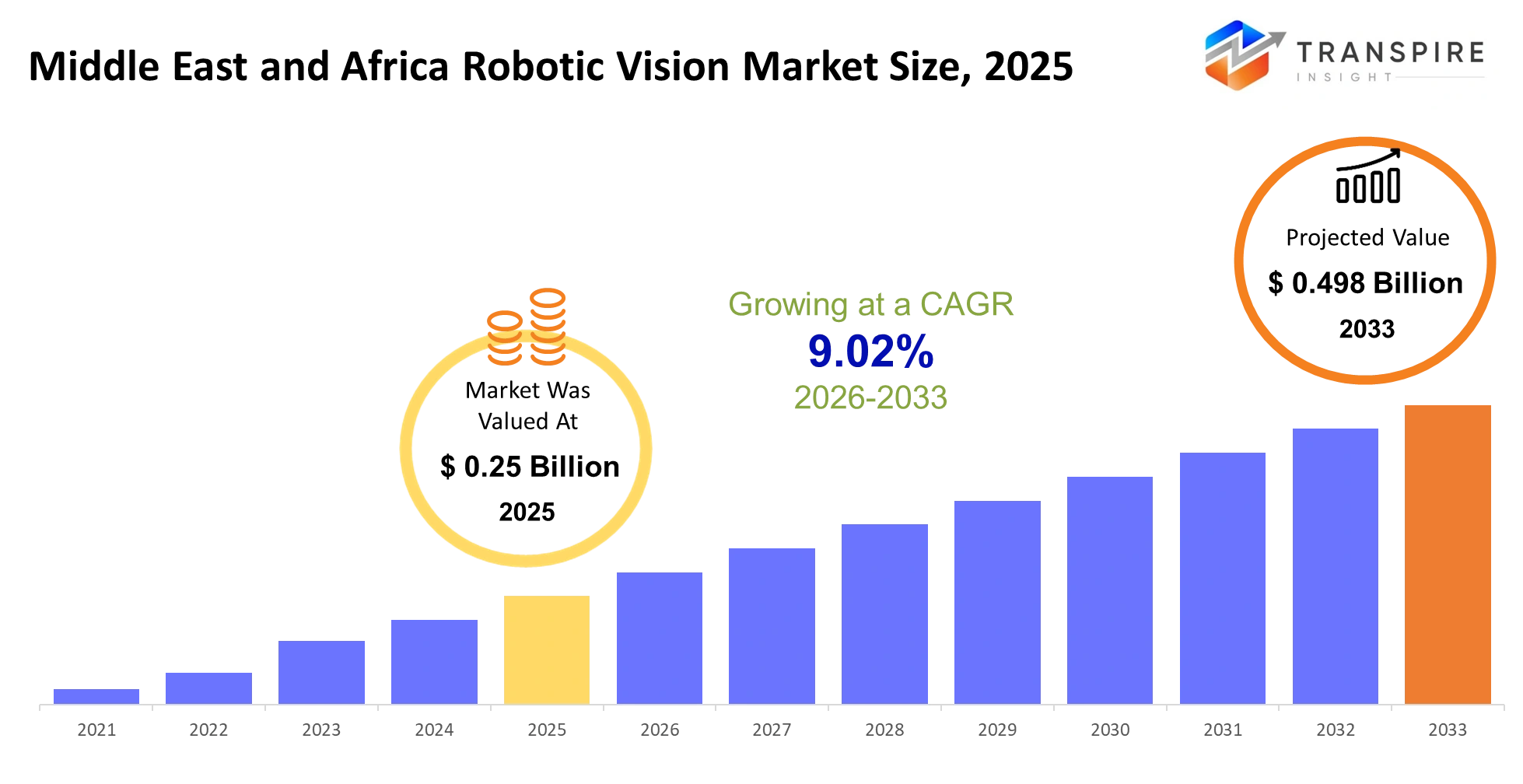
- Middle East and Africa Robotic Vision Market Size 2025: USD 0.25 Billion
- Middle East and Africa Robotic Vision Market Size 2033: USD 0.498 Billion
- Middle East and Africa Robotic Vision Market CAGR: 9.02%
- Middle East and Africa Robotic Vision Market Segments: By Component (Hardware, Software, Services), By Technology (2D, 3D, AI Vision, Machine Vision), By End-User (Manufacturing, Automotive, Electronics, Logistics).
To learn more about this report,  Download Free Sample Report
Middle East and Africa Robotic Vision Market Summary:
The Middle East and Africa Robotic Vision Market size is estimated at USD 0.25 Billion in 2025 and is anticipated to reach USD 228.68 billion by 2033, growing at a CAGR of 9.02% from 2026 to 2033.The industrial automation and intelligent systems sector in Middle Eastern and African countries will see its robotic vision market develop through manufacturer adoption of precision operations and flexible manufacturing systems.
The food processing industry, logistics sector, and electronics assembly sector will see increasing demand for inspection methods that deliver error-free results, provide faster output, and require less human monitoring. Machine vision sensor technology, edge computing advancements and AI-based image interpretation improvements will determine system deployment methods which will enable increased operational efficiency through better system responsiveness and capacity growth. The need to meet product quality requirements and safety standards, and tracking capabilities will drive companies to adopt robotic vision technology because it has become essential for their operations.
What Has the Impact of Artificial Intelligence Been on the Middle East and Africa Robotic Vision Market?
The implementation of artificial intelligence is revolutionizing the Middle East and Africa robotic vision market sector through the inclusion of intelligent capabilities within the manufacturing sectors. The integration of AI within the Middle East and Africa robotic vision market operations helps the firm to analyze visual datasets in order to conduct comprehensive market research and analysis. Through machine learning algorithms, firms can analyze production datasets and system performance metrics for improved decision making. The incorporation of AI technologies within robotic vision platforms is in tandem with emerging trends in automation technologies that require precision and adaptability.
AI in Middle East and Africa robotic vision market is promoting the development of predictive analytics and demand forecasting solutions within the industry. Predictive analytics is used in predicting the demand for machinery within the manufacturing industry and for optimal planning of production activities. Additionally, the implementation of smart automation within robotic vision platforms helps in ensuring that manufacturing firms achieve increased production efficiency and high-quality outputs.
The scope also broadens its application into supply chain optimization through the use of AI-powered vision technology that provides monitoring of stock levels, tracking of logistics, and pinpointing inefficiencies on-the-go. In the case of the Middle East and Africa robotic vision market, such applications are leading to a reduction of overheads and timely delivery of goods. Simultaneously, artificial intelligence is contributing to innovation, providing customized solutions for tackling problems peculiar to industries. Such customization not only gives competitive edge but also stimulates ongoing development of technology.
With the progression of artificial intelligence, the Middle East and Africa robotic vision market is likely to enjoy the advantages of smart machines that learn, grow, and adjust to industry needs. The integration of machine learning, predictive analytics, and automation is bringing about an improvement in performance as well as a change in attitude towards efficiency and scalability.
Key Market Trends & Insights:
- Gulf Cooperation Council (GCC) represents the biggest regional market that captures nearly 40% of the Middle East and Africa robotic vision market share in 2025 owing to investment made towards industrial automation.
- South Africa and North Africa represent two of the fastest growing regions in terms of market share growth rates at over 11% CAGR during 2025 to 2030.
- 2D vision system is the most dominant product type that captures approximately 45% market share in 2025 owing to cost effectiveness and wide-spread industrial adoption.
- The 3D robotic vision system holds the second-largest product type market share and finds increasing applications in areas of precision inspection and robotic systems.
- Vision software with AI capability represents the fastest-growing segment that will experience above 12% CAGR over the forecast period till 2030.
- Defect detection and quality inspection account for over 35% market share as industries seek accuracy and compliance in their processes.
- Logistics and warehouse automation is the fastest-growing application of robotic vision technology owing to increasing e-commerce demand for real time tracking.
- Manufacturing remains the dominant industry vertical representing close to 50% market share.
Middle East and Africa Robotic Vision Market Segmentation
By Component
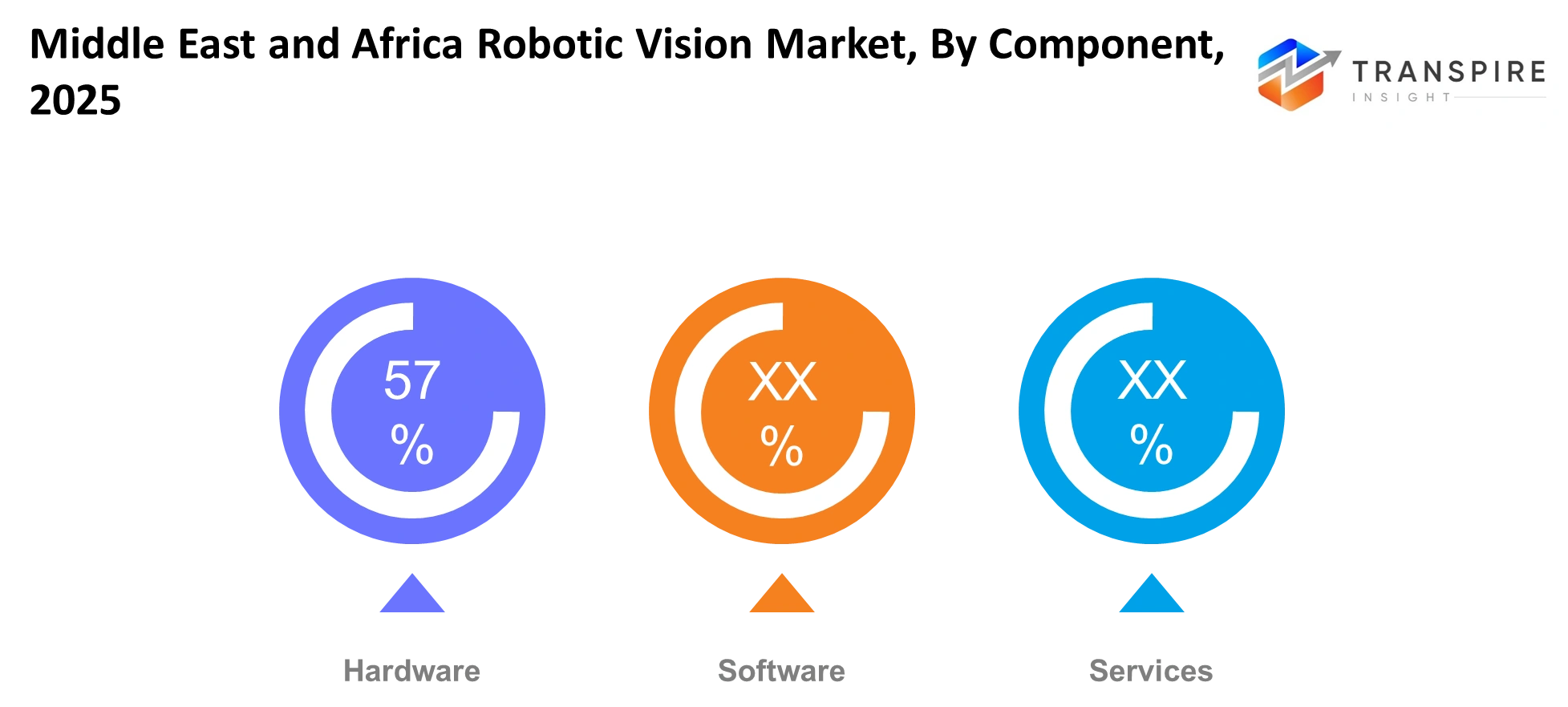
Hardware would comprise cameras, sensors, processors, and vision controllers used to capture and process visual information in automated environments. They would be indispensable in the context of accurate and fast results within such operations in addition to system stability. Higher resolution images and robust equipment for usage in rough working environments would become more in demand.
The software layer would be responsible for image processing, pattern recognition, and data interpretation by means of utilizing machine learning and artificial intelligence technologies. This would allow for automatic analysis of visual input data and immediate decision making by the system without human involvement. Services would encompass system installation, maintenance, and personalization. The Middle East and Africa robotic vision market should rely on synergy between hardware capacity, software intelligence, and services offered in order to ensure uninterrupted operation.
To learn more about this report, Download Free Sample Report
By Technology
The two-dimensional vision technology will remain popular due to its cost-efficiency and compatibility with basic sorting and inspection tasks. This technology will perform such functions as scanning barcodes, inspecting surfaces, and aligning simple objects accurately. The 3D vision system will be adopted when there is a need for depth perception and handling complex objects in robotics and precise manufacturing. These systems will offer more spatial awareness and measurement capabilities.
Both AI vision and machine vision will revolutionize the way systems operate due to the capability of learning and making predictions. AI vision technology will operate using unstructured data and continuously learn from its experiences. In turn, machine vision will continue to follow rules that were programmed in its system. This technology combination will help industries in the Middle East and Africa regions in balancing their needs for efficiency and cost.
By End-User
The manufacturing industry will drive implementation because of increasing needs for automation, quality control, and efficiency of the production process. The application of vision in robots will help in detecting defects, verifying assembly, and optimizing the process. In automotive manufacturing processes, there will be a need to apply the robotics vision in tasks such as assembly, quality check of welding, and positioning of components.
For the electronics industry, the robotics vision will assist in micro-inspection and assembly of the components since precision is very vital in this industry. Logistics will experience high growth because of the increasing demand for sorting and packaging of products using automated technology. The robotics vision will assist in improving performance in warehouse logistics activities and reducing dependence on manual efforts. The Middle East and Africa robotic vision market will experience growth in all these end user industries.
What are the Main Challenges for the Middle East and Africa Robotic Vision Market Growth?
However, technical and operational issues persist in the development of the market for Middle East and Africa robotic vision systems. In cases where the stability and effectiveness of the system vary significantly, progress will be hampered. Integrating vision systems into legacy equipment is often complex, creating gaps that may require additional implementation time.
Another critical aspect is the difficulty associated with the production and marketing of such robots. One of the reasons why it has been difficult to incorporate these robots is because of the high cost associated with the use of robots. Moreover, the exactness needed during the production of various parts including the sensors and processors will increase the cost of production.
The adoption issues persisting for a number of reasons. There is a lack of infrastructure as well as experts who have enough skills to handle sophisticated systems. Moreover, the financial constraints are a major hurdle to widespread adoption as there is no proper technical environment to implement these systems. Hence, the Middle East and Africa robotic vision market will continue to be affected by a range of factors affecting its growth, including lack of awareness, training and funding capabilities.
Moreover, the competition from various other automation methods and cheap alternatives poses a number of challenges as well. Companies need to ensure their pricing policies do not affect the bottom line while maintaining performance levels. The fast-paced change in technology also poses risks for businesses as there are constant system upgrades required.
Regional Insights
Demand for robotics vision is bound to be driven by the increased need for automation in manufacturing, logistics and inspection process. Industrial companies have started adopting automated systems due to their need for precision, less error margin and fast performance.Advancements in artificial intelligence and machine learning will provide organizations with improved decision-making capabilities and advanced adaptive systems.
Companies will implement vision-based systems to improve control of operational quality and enhance efficient performance. Integrating robots into the existing production environment can be quite difficult; however, advances in software and hardware will make deployment easier. Robotic vision market in the Middle East and Africa region will grow owing to the need for cost-efficiency, precision and productivity improvements.
The gulf countries are likely to lead in terms of adoption rate as they have been investing heavily in industrial automation and smart manufacturing technology. Countries such as United Arab Emirates and Saudi Arabia are likely to invest in sophisticated technologies to enhance their productivity levels.
Gradual progress is anticipated in Africa, with South Africa and North Africa being the leading players. Improved infrastructure and awareness will aid the uptake in logistics and manufacturing industries. The lack of technical know-how and financial constraints will limit the spread but will provide excellent prospects for the future.
Recent Development News
In April 2026, ABB Robotics launched and showcased next-generation automation solutions featuring advanced 3D vision-enabled systems at MACH 2026. The company demonstrated its FlexLoader FP800 robotic cell, highlighting improved bin-picking and intelligent material handling using integrated vision technology.
Source: https://www.automation.com/
In March 2026, Cognex Corporation released a new industry research report highlighting increased adoption of AI-driven machine vision systems across manufacturing sectors. The report found that over 57% of manufacturers are already using AI-based vision technologies to improve accuracy and efficiency.
Source: https://www.prnewswire.com
|
Report Metrics |
Details |
|
Market size value in 2025 |
USD 0.25 Billion |
|
Market size value in 2026 |
USD 0.272 Billion |
|
Revenue forecast in 2033 |
USD 0.498 Billion |
|
Growth rate |
CAGR of 9.02% from 2026 to 2033 |
|
Base year |
2025 |
|
Historical data |
2021 - 2024 |
|
Forecast period |
2026 - 2033 |
|
Report coverage |
Revenue forecast, competitive landscape, growth factors, and trends |
|
Regional scope |
Middle East and Africa (Saudi Arabia, United Arab Emirates, South Africa, Rest of Middle East and Africa) |
|
Key company profiled |
Cognex, Keyence, Basler, Omron, Teledyne DALSA, National Instruments, Sony, Intel, ABB, FANUC, Siemens, SICK, IDS Imaging, Allied Vision, Baumer. |
|
Customization scope |
Free report customization (country, regional & segment scope). Avail customized purchase options to meet your exact research needs. |
|
Report Segmentation |
By Component (Hardware, Software, Services), By Technology (2D, 3D, AI Vision, Machine Vision), By End-User (Manufacturing, Automotive, Electronics, Logistics). |
How Can New Companies Establish a Strong Foothold in the Middle East and Africa Robotic Vision Market?
Companies planning to join the Middle East and Africa robotic vision market should capitalize on the existence of niche areas where demand has not yet been addressed. Rather than going head-to-head in the market, players can target segments such as healthcare imaging, quality inspection in the food sector, and automation in warehouses. There is a pain point in all of these segments where there is need for improved accuracy and reduction of manual efforts in operations. Matching up solutions with the prevailing trends in the industry will be beneficial.
For emerging companies, innovation will form the backbone of gaining a competitive advantage in the market. This means that players can make use of technologies such as AI analytics, edge computing, and low cost vision sensors to differentiate their product portfolio in a competitive landscape. Innovation will also involve developing technology specifically for harsh conditions such as dusty and low-light environments. Some of the innovative emerging firms in the market include Keenon Robotics and Covision Media.
The use of strategic partnerships will facilitate entry into this market through partnerships between new firms and the existing distributors, system integrators, and industrial customers. The partnership with the manufacturing centers and the smart cities will enable new companies to deploy their technology solutions in the shortest time possible and have them validated. Entry barriers to this market through the provision of infrastructure and expertise will be addressed in the Middle East and Africa robotic vision market through such collaborations.
Solving the regional challenges in cost-effective ways while remaining efficient will enable long-term success in the industry. The companies that are able to combine their competitiveness through affordable products and efficient performance will be the most successful in the emerging market. The new entrants will be able to establish themselves within the emerging competition in the industry.
Key Middle East and Africa Robotic Vision Market Company Insights
The industry will experience new entrants who will enter through specialized applications which include quality inspection and automated warehouses and health care imaging. The organization will focus on developing technical solutions which address operational gaps that result from errors and operational inefficiencies. Small and medium-sized businesses will be attracted to budget-friendly and scalable products which enable them to implement automation without requiring substantial capital expenditures.
The field of technology will maintain its significance through ongoing technological advancements especially in artificial intelligence-based vision systems and edge computing. The development of equipment which can function effectively in conditions of low light and dusty environments will improve overall system performance. The robotic vision market in the Middle East and Africa will prioritize products that deliver efficient performance while remaining within budget constraints.
The market will experience higher rivalry because global and regional companies will establish partnerships and develop products for specific markets. ABB, Siemens, and Cognex will direct their efforts toward establishing more effective AI systems through their current and future technological developments. The business will achieve better sales results through system integrator partnerships which will enhance their sales and implementation capabilities.
New market entrants will create their unique identity through their ability to provide affordable solutions which can be customized and delivered within short timeframes. Research and development funding will enable technology and support service enhancements which will build greater customer trust. The companies that combine innovative solutions with practical applications will gain a competitive advantage in the Robotic Vision Market for the Middle East and Africa region.
Company List
- Cognex
- Keyence
- Basler
- Omron
- Teledyne DALSA
- National Instruments
- Sony
- Intel
- ABB
- FANUC
- Siemens
- SICK
- IDS Imaging
- Allied Vision
- Baumer
What are the Key Use-Cases Driving the Growth of the Middle East and Africa Robotic Vision Market?
The use case of industrial inspection and quality control is yet another area contributing significantly to the adoption of robotic vision technology in the Middle East and Africa robotic vision market. Industrial manufacturers have been incorporating robotic vision-based solutions to inspect product flaws and minimize production mistakes. This particular use case holds significant importance for the electronics and automotive industry because of the need for precision. As such, the market is experiencing positive impacts from increased demand for consistency and minimized errors.
In addition to that, warehouse automation and optimization is contributing positively to the adoption of robotic vision systems in the region. Robotic vision-enabled machines are being used for automated sorting and inventory management, thereby increasing efficiency and precision. The rise in e-commerce activities has compelled manufacturers to adopt such systems to cope with increased demands.
Robotic vision has emerged as one of the major industries that contribute to the adoption rate. In the field of healthcare, robotic vision can be used in medical imaging, laboratory analysis, and surgical procedures. In the food processing industry, robotic vision can be applied in contamination detection and package verification processes. These use cases have helped extend the scope of the Middle East and Africa robotic vision market into mission-critical industries.
In the future, the key factor that will drive the scalability of robotic vision technology will be the adoption of artificial intelligence and smart robotics across different industries. Companies are looking at incorporating adaptive vision technology that learns over time through the analysis of big data.
Middle East and Africa Robotic Vision Market Report Segmentation
By Component
- Hardware
- Software
- Services
By Technology
- 2D
- 3D
- AI Vision
- Machine Vision
By End-User
- Manufacturing
- Automotive
- Electronics
- Logistics
Frequently Asked Questions
Find quick answers to common questions.
The approximate Middle East and Africa Robotic Vision Market size for the market will be USD 0.498 Billion in 2033.
Key segments for the Middle East and Africa Robotic Vision Market are By Component (Hardware, Software, Services), By Technology (2D, 3D, AI Vision, Machine Vision), By End-User (Manufacturing, Automotive, Electronics, Logistics).
Major Middle East and Africa Robotic Vision Market players are Cognex, Keyence, Basler, Omron, Teledyne DALSA, National Instruments, Sony, Intel, ABB, FANUC, Siemens, SICK, IDS Imaging, Allied Vision, Baumer.
The Middle East and Africa Robotic Vision Market size is USD 0.25 Billion in 2025.
The Middle East and Africa Robotic Vision Market CAGR is 9.02%.
- Cognex
- Keyence
- Basler
- Omron
- Teledyne DALSA
- National Instruments
- Sony
- Intel
- ABB
- FANUC
- Siemens
- SICK
- IDS Imaging
- Allied Vision
- Baumer
Recently Published Reports
-
Dec 2024
Fiber Optic Faceplates Market
Fiber Optic Faceplates Market Size, Share & Analysis Report By Type (< 300 mm2, 300-350 mm2, and > 350 mm2, By Application (Night Vision, Holographic Imaging, Medical, and Others), and Geography (North America, Europe, Asia-Pacific, Middle East and Africa, South and Central America), 2021 - 2031
-
Jan 2025
High Temperature Superconductors Market
High Temperature Superconductors Market Size, Share & Analysis Report By Type (1G HTS, and 2G HTS), By Application (Power Cable, Fault Current Limiter, and Transformer), and Geography (North America, Europe, Asia-Pacific, Middle East and Africa, South and Central America), 2021 - 2031
-
Jan 2025
Industrial Plugs and Socket Market
Industrial Plugs and Socket Market Size, Share & Analysis Report By Type (Industrial Plugs, Industrial Sockets), By Current (Up to 32 A, 32 to 125 A, Above 125 A), By Protection (Dustproof and Splash Proof, Waterproof, Explosion Proof), By End User (Heavy Industries, Oil and Gas, Chemicals and Pharmaceuticals, Power Generation, Others), and Geography (North America, Europe, Asia-Pacific, Middle East and Africa, South and Central America), 2021 - 2031
-
Jan 2025
InGaAs Avalanche Photodiodes Market
InGaAs Avalanche Photodiodes Market Size, Share & Analysis Report By Type (1100 - 1700 nm, and 1000 - 1600 nm), By Application (Missile Warning System, Muzzle Flash Detection, Wafer Defect Inspection, Laser Rangefinders, and Others), and Geography (North America, Europe, Asia-Pacific, Middle East and Africa, South and Central America), 2021 - 2031